Energy Efficient Distributed Worst Case Robust Power Allocation in Massive MIMO
This letter proposes an energy efficient distributed worst case robust power allocation in massive multiple input multiple output (MIMO) system. We assume a bounded channel state information (CSI) error and all channels lie in some bounded uncertaint…
Authors: Saeed Sadeghi Vilni
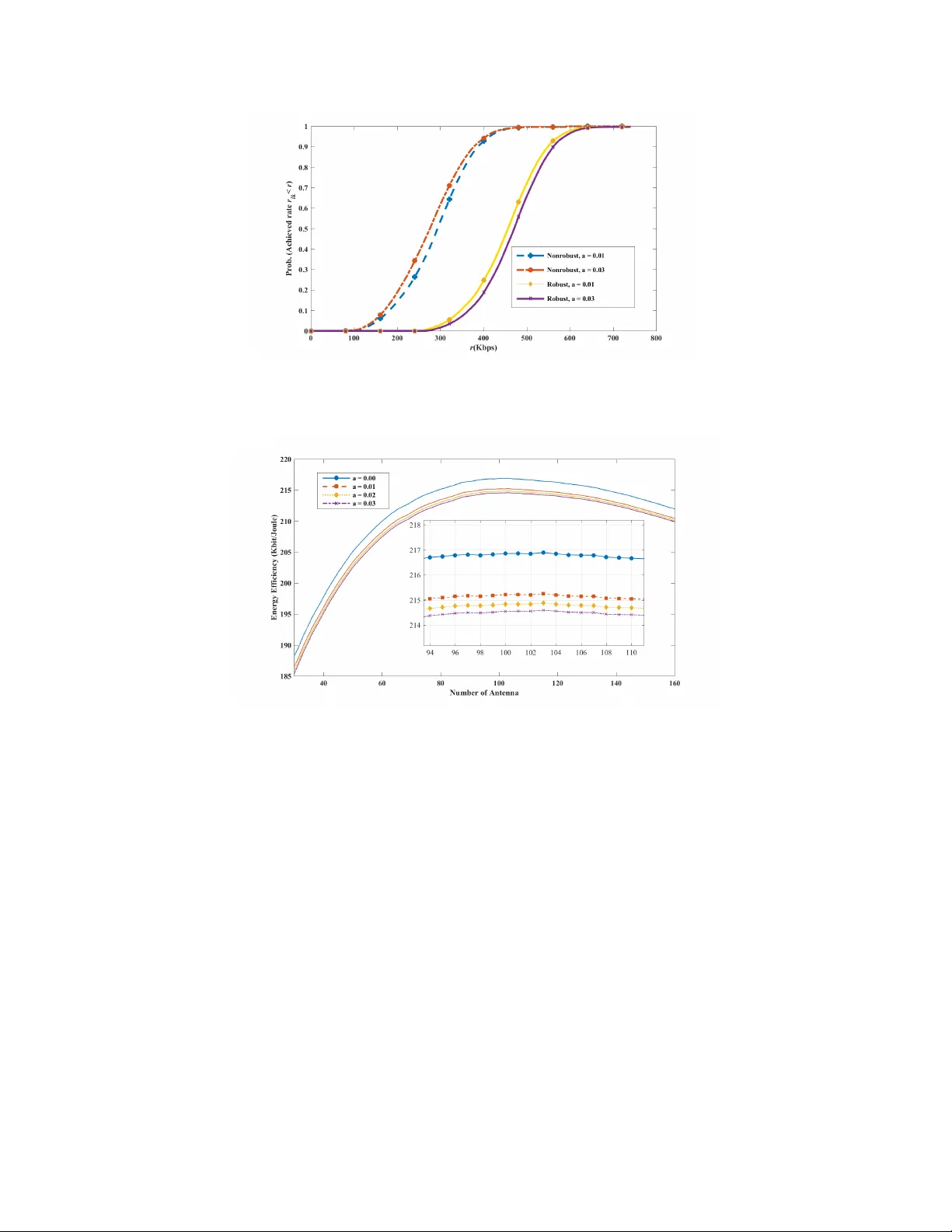
1 Ener gy Ef ficient Distrib uted W orst Case Rob ust Po wer Allocation in Massi v e MIMO Saeed Sadeghi V ilni Abstract This letter proposes an energy efficient distrib uted worst case robust po wer allocation in massiv e multiple input multiple output (MIMO) system. W e assume a bounded channel state information (CSI) error and all channel lie in some bounded uncertainty region. The problem is formulated as max-min one with infinite constraint. At first, we solve inner problem with triangle and Cauch y-Schwarz inequality , then by fractional programming and successive con ve x approximation (SCA) technique problem trans- fers to a con vex optimization. Finally closed form transmit power is obtained with distribution way . Simulation results demonstrate proposed algorithm conv ergence and validate robust power allocation. Also appropriate number of transmit antenna to ha ve maximum ener gy efficiency in simulation result is shown. Index T erms Energy efficiency , massive MIMO, robust, worst case, SCA. I . I N T RO D U C T I O N Massi ve MIMO is one of main technology that candidate for next generation. Massiv e MIMO enhance spectral and energy efficienc y regards to accessing CSI for efficient beamforming and appropriate number of transmit antenna to get high energy efficiency . Energy efficienc y defined as spectral efficienc y to power consumption ratio [1]. By increasing the number of transmit antenna spectral efficienc y is increased while circuit po wer consumption is also increased. So if circuit po wer consumption don’t considered in total po wer consumption, optimal number of transmit antenna is infinity [2]. T o estimate channel, users in any cell send pilot to o wn base station (BS) then BS estimate users channel. In practice, the number of orthogonal pilot sequences are limited so users use pilots that are non-orthogonal related to users in the S. Sadeghi was with the Department of Electrical and Computer Engineering, T arbiat Modares,T ehran, Iran (e-mail: saeed.sadeghi@modares.ac.ir). 2 other cells. Thus precision of channel estimated, due to inter cell interference for users which utilizing non-orthogonal pilots, is decreased. This issue is named pilot contamination [3]. In [4]-[8] energy efficient po wer allocation in a massiv e MIMO system for different scenarios are studied, where authors in [4]-[6] consider pilot contamination but do not robust design. T otal power consumption in [7]-[8] is not determined properly . Circuit power consumption do not considered in [7] and assuming constant in [8] where circuit power consumption is a function of number of transmit antenna. W orst case robust approach in resource allocation has been considered in [9], [10], [11] in different contexts. Author in [9] proposed a robust transceiv er design for the K-pair quasi-static MIMO interference channel with fairness considerations. they did their design as an optimization problem to maximize the worst-case SINR among all users. In [10], in vestigated the robust energy ef ficiency maximization in underlay cognitive radio networks with bounded errors in all channels, and adopted the worst-case optimization approach to ensure primary users QoS requirement. Author in [11], studied robust resource allocation schemes for MIMO-wireless po wer communication networks, where multiple users harvest energy from a dedicated power station in order to be able to transmit their information signals to an information receiving station. In this letter energy efficienc y maximization problem with circuit power consumption and pilot con- tamination considered which transmit power is designed robustly . W e formulate optimization problem to maximize the minimum energy ef ficiency related to channel estimation error bound and under constraint on po wer transmit and meet QoS. After finding minimum of energy ef ficiency respect to uncertainty region of estimation error we find optimal transmit power to maximize energy efficiency , and finally , an algorithm to find optimal transmit power is proposed. T o find optimal number of transmit antenna, maximum energy efficienc y regards to optimization problem for dif ferent transmit antenna is plotted. Simulation result validate effecti veness and con vergence of algorithm. Notation: The superscript H stand for conjugate transpose. I K is the K × K identity matrix and 0 L is the L × 1 all zero vector . k . k represents Euclidean norm and ( x ) + = max (0 , x ) . n ∼ C N (0 , C ) means probability density function of zero mean complex Gaussian vector with covariance matrix C . Fig. 1. TDD protocol for massive MIMO in a coherent interval 3 I I . S Y S T E M M O D E L W e consider the downlink of a multi-cell network with L cells, where any cells utilize from massive MIMO. BS ha ve M antenna with a linear configuration, and any BS serves K single antenna users where randomly located in each cell. All BSs and users use from a time frequenc y resource and operate in time di vision duplex (TDD) mode as shown in figure 1. A. Channel Model In the part of uplink pilot in coherent interv al, any user sends τ pilot symbols with the power q and then each BSs estimate the channels of its users. The pilot sequence of cell l represented by a K × τ matrix S l . Pilot sequence of a cell users are orthogonal then S l S H l = I K . Due to pilot reuse multiple of S i for different cell is not always zero. The received signal at BS i is represented by an M × τ matrix Y i as Y i = √ q H i S + Z i (1) Where S = [ S 1 ; ... ; S L ] ∈ C ( K × L ) × τ and H i ∈ C M × ( K × L ) is the channel matrix between all the users and i th BS, whose k th column of H i is h ilk represent the gains of the channels from user k in cell l to BS i and h ilk = √ β ilk g ilk ; where β ilk is large scale fading in volve path loss and shadowing and g ilk is small scale f ading with C N (0 , 1) distrib ution. Z i is an additi ve noise matrix with independent identically distributed and complex Gaussian random variable with zero mean and unit variance entries. By using a linear filter, estimated channel is ˆ H i = 1 √ q Y i S H and h ilk = √ β ilk ˆ g ilk where distribution of ˆ g ilk is C N (0 M , ( P L l =1 β ilk + 1) I M ) . It is obvious that estimated channel is not adopt to real channel h ilk which lead to estimation error is denoted by ∆ , therefore real channel can be written as follo ws h ilk = ˆ h ilk + ∆ (2) W e assume that the actual channel h ilk lies on the neighborhood of estimated channel ˆ h ilk that is known to the transmitter . W e consider that h ilk is in the uncertainty region R with radius √ a that define as the follo wing ellipsoid R = { ∆ : k ∆ k 2 < a } (3) B. P ower Consumption The network power consumption is include transmit po wer , circuit power of transmitters and users. Circuit Po wer consumption in BS has two parts, first part is constant po wer consumption P f ix , this part in volv es site cooling, control signaling, backhaul, local oscillator , channel estimation and processors [2]. 4 Second part in volv es required power for any antenna to run which shown with P pa . Also we consider transcei ver required po wer of of each user P pu . Thus the circuit power consumption of each cell P c l expressed as P c l = P f ix + M P pa + K P pu (4) C. Ener gy Efficiency By the estimated channel and use of maximum ratio transmitter beamformer, beamforming v ector for m th user in the j th cell that be expressed as w j m = ˆ h H j j m k ˆ h j j m k (5) the received signal at m th user in the cell j giv en by y j m = √ p j m w j m h j j m s j m + L X l =1 , 6 = j K X k =1 , 6 = m √ p lk w lk h lj m s lk + n j m (6) where p lk and s lk represent transmit po wer and data symbol for user k in the cell l respectiv ely the n j m is noise at the m th user in the j th cell and assume noise power is N 0 . Received signal to interference plus noise ratio (SINR) of user m in cell j is obtained by γ j m = p j m k w j m h j j m k 2 P L l =1 P K k =1 , 6 = m p lk k w lk h lj m k 2 + N 0 (7) then we can express the data rate for this user as r j m = B log 2 (1 + Γ γ j m ) (8) where B is channel bandwidth and Γ = − 2 3 ln(5 e ) is SINR gap between Shannon channel capacity and practical situation, where e is target bit error rate [12]. Thus energy ef ficiency of the whole network expressed as η = P L l =1 P K k =1 r lk P L l =1 P K k =1 p lk + P L l =1 P c l (9) D. Optimization Pr oblem Based on worst case optimization, the energy efficiency maximization problem expressed as max P min ∆ η s.t. C 1 : P K k =1 p lk ≤ P max C 2 : r lk ≥ R min C 3 : k ∆ k 2 ≤ a (10) 5 The goal of optimization problem is to find transmit po wer P = [ P 1 , ..., P L ] where P l = [ p l 1 , ..., p lK ] , which optimize the worst energy efficienc y for errors are in the uncertainty region. The optimization constraints are C 1 that shows maximum transmit power for each cell, C 2 sho ws minimum data rate requirements for any user and C 3 sho ws uncertainty region. I I I . S O L U T I O N T o solve the max-min problem, first inner minimization problem then the outer maximization are solved respecti vely . A. W orst Case SINR SINR is a fractional function of ∆ , thus to find minimum of SINR over uncertainty region we find minimum of the numerator and maximum of the denominator in uncertainty region. First we consider triangle inequality as follo ws k w j m ( ˆ h j j m + ∆) k 2 ≥ k w j m ˆ h j j m k 2 − k w j m ∆ k 2 k w j m ( ˆ h j j m + ∆) k 2 ≤ k w j m ˆ h j j m k 2 + k w j m ∆ k 2 (11) respect to Cauchy-Schwarz inequality a lo wer bound of the SINR can be computed as follows γ lb j m = p j m ( k w j m ˆ h j j m k 2 − k w j m k 2 k ∆ k 2 ) + P L l =1 P K k =1 , 6 = m p lk ( k w lk ˆ h lj m k 2 + k ∆ k 2 k w lk k 2 ) + + N 0 (12) and with k ∆ k 2 ≤ a we ha ve k w j m k 2 k ∆ k 2 ≤ a k w j m k 2 (13) According to inequalitys giv en in (12) and (13) worst case SINR of user m in cell j , γ ∗ j m is computed as γ ∗ j m = p j m ( k w j m ˆ h j j m k 2 − a k w j m k 2 ) + P L l =1 P K k =1 , 6 = m p lk ( k w lk ˆ h lj m k 2 + a k w lk k 2 ) + + N 0 (14) No w with worst case SINR we obtain worst case data rate r ∗ j m as follows r ∗ j m = B log 2 (1 + Γ γ ∗ j m ) (15) Then worst case energy efficiency ov er uncertainty region obtained as η ∗ = P L l =1 P K k =1 r ∗ lk P L l =1 P K k =1 p lk + P L l =1 P c l = T ( P ) E ( P ) (16) which lead to Finally optimization problem giv en bellow max P η ∗ s.t. C 1 : P K k =1 p lk ≤ P max C 2 : r ∗ lk ≥ R min (17) 6 B. Pr oblem Reformulation Optimization problem is a fractional problem, thus we use fractional programming method to solve it. W e assume the answer of (17) is as power transmit P ∗ and maximum energy efficienc y η op . Now we introduce following theorem based on Dinkelbach algorithm [13]: Theor em 1: The maximum energy efficienc y η op is achiev ed in (16) if and only if max P T ( P ) − η op E ( P ) = T ( P ∗ ) − η op E ( P ∗ ) = 0 for T ( P ) ≥ 0 and E ( P ) > 0 . Thus problem (17) changed to following optimization problem max P T ( P ) − η ∗ E ( P ) s.t. C 1 : P K k =1 p lk ≤ P max C 2 : r ∗ lk ≥ R min (18) No w to solve problem (17) we should solv e iterativ ely problem (18). For this a primary v alue of energy ef ficiency is considered to solve problem (18) then T ( P ) − η ∗ E ( P ) is computed, if it goes near to zero, η ∗ is the optimal energy efficiency , else η ∗ is computed respect to transmit power which obtained from solving (18), and do this iterativ ely until T ( P ) − η ∗ E ( P ) goes very close to zero. Our objective function is non con vex. For transforming this problem to conv ex optimization one, successi ve con vex approximation method is used [14]. In this method follo wing lo wer bound is assumed log(1 + Γ γ ) ≥ α log(Γ γ ) + β (19) and considering P as ˆ P = log P . By utilizing SCA, optimization problem (18) transfers to a conv ex optimization problem. So final optimization problem expressed as max ˆ P T ( ˆ P ) − η ∗ E ( ˆ P ) s.t. C 1 : P K k =1 e ˆ p lk ≤ P max C 2 : r ∗ lk ≥ R min (20) For solving problem (18) problem (20) is solved iteratively that use lo wer bound of r ∗ lk = α lk log(Γ γ ∗ lk ) + β lk then update α lk and β lk in any iteration until power transmit con verges. W ith assuming ˆ P 0 as optimal transmit power value in latest iteration, optimal SINR γ 0 lk is computed then update α lk and β lk as follows α lk = γ 0 lk 1+Γ γ 0 lk β lk = log(1 + Γ γ 0 lk ) − Γ γ 0 lk 1+Γ γ 0 lk log(Γ γ 0 lk ) (21) When power transmit con ver ge replace ˆ P 0 as optimal power transmit power . 7 C. Optimal P ower Allocation The Lagrangian function of (20) is obtained as L ( ˆ P , λ lk , µ l ) = P L l =1 P K k =1 r ∗ lk ( ˆ p lk ) − η ∗ ( P L l =1 P K k =1 e ˆ p lk + P L l =1 P c l ) + P L l =1 P K k =1 λ lk ( r ∗ lk ( ˆ p lk ) − R min ) − P L l =1 µ l ( P K k =1 e ˆ p lk − P max ) (22) Where λ lk and µ l are Lagrange multipliers corresponding to the two constraints. Based on the Karush- Kuhn-T ucker (KKT) conditions optimal transmit power for user m in cell j the following condition must be satisfied[15] ∂ L ( ˆ P , λ lk , µ l ) ∂ ˆ p j m = 0 (23) Then the optimal transmit power for user m in cell j is obtained as follo ws p j m = ( ( λ j m + 1) B α j m ln 2 B ln 2 P L l =1 P K k =1 ,k 6 = m α lk ( λ lk + 1) z lk I lk − ( η ∗ + µ j ) ) + (24) Where z lk = k w j m ˆ h j l k k 2 + a k w j m k 2 (25) I lk = P L n =1 ,n 6 = l P K u =1 ,u 6 = k e ˆ p nu ( k w nu ˆ h nlk k 2 + k w nu k 2 ) + k n lk k 2 (26) I lk is estimation of Interference plus noise on user k in cell l that users compute and feed back to its BS and BSs share this value together . from Lagrange function and use subgradient method the Lagrangian multipliers can be updated according to λ lk ( t + 1) = ( λ lk ( t ) − ζ 0 ( r ∗ lk − R min )) + (27) µ l ( t + 1) = ( µ l ( t ) − β 0 ( P max − K X k =1 p lk )) + (28) where ζ 0 and β 0 are step size and t is iteration index. finally , the algorithm of Energy Efficient Distributed W orst Case Robust Po wer Allocation presented in the Algorithm 1. I V . S U M - R A T E M A X I M I Z AT I O N Maximum sum-rate under condition of problem (17) can be computed by setting the denominator of the energy efficiency equal to 1. The optimal transmit power for user m in cell j , which maximize the network sum-rate, is obtained as follo ws p sr j m = ( ( λ j m + 1) B α j m ln 2 B ln 2 P L l =1 P K k =1 ,k 6 = m α lk ( λ lk + 1) z lk I lk − ( µ j ) ) + (29) 8 All the parameters are obtained as obtained for optimal transmit power for energy efficient power allocation. The algorithm of po wer allocation to maximize the sum-rate is done as power allocation in energy efficient power allocation in algorithm 1 with considering one iteration of Dinck elbach algorithm, because our problem is gone to a non-fractional problem. Algorithm 1 Energy Efficient Distributed W orst Case Robust Po wer Allocation 1: Initialize con ver gence tolerance and initialize arbitrary η ( t 1 ) = 0 , con = 0 and t 1 = 1 2: repeat 3: initialize with a feasible ˆ P ( t 2 ) , Set α lk ( t 2 ) = 1 , 4: β lk ( t 2 ) = 0 and t 2 = 1 5: repeat 6: initialize arbitrary λ lk , µ l , α 0 and β 0 7: repeat 8: Compute I lk by user with (26) and feed back to its BS 9: BS l compute summation of its users I lk and share with another BS s 10: Update λ lk and µ l according to (27) and (27) 11: Compute the optimal po wer transmit ˆ P ( t 2 + 1 ) according to (24) 12: until Conv ergence of λ lk and µ l 13: Compute γ ∗ lk ( ˆ P ( t 2 + 1 )) and update α lk ( t 2 + 1) and β lk ( t 2 + 1) 14: until conv ergence of ˆ P 15: Compute η ∗ with optimal ˆ P ( t 2 + 1 ) 16: if T ( ˆ P ( t 2 + 1 )) − η E ( ˆ P ( t 2 + 1 )) ≤ then 17: Set con = 1 18: Return η ∗ as optimal energy efficienc y 19: else 20: Set con = 0 21: t 1 = t 1 + 1 22: Return η ∗ as initial η ( t 1 ) in iteration 23: until con = 1 V . S I M U L A T I O N R E S U LT In this section we e valuate the proposed rob ust po wer allocation via simulation. First we show con ver - gence of Algorithm 1 , then compare robust and non-robust design and finally represent cost of robustness. 9 W e consider a multi-cell cellular network with L = 3 cells and a BS in its center . The BSs locate at the coordinate of (0 , 0) , (0 , 1000) and (0 , 2000) . W e consider large scale fading as β ilk = φ ( d 0 d ilk ) 4 where log( φ ) has a normal distrib ution with 0dB mean and 8dB variance, d ilk represent distance from user k in cell l to BS i . The radius of each cell is 500 meter . In each cell there are K = 5 single antenna users that uniformly distrib uted in each cell and minimum distance of each user to its BS is d 0 = 50 . W e consider noise po wer N 0 = -174dBm/Hz, bandwidth B = 180 KHz, q = 10 w , R min = 250 Kbps, P max = 1w , P f ix = 20 w , P pa = 0 . 1 w , e = 10 − 3 and P pu = 0 . 01 w . Fig. 2. Conver gence of Algorithm 1 for different uncertainty region with 100 antennas A. Con ver gence In fig.2 ener gy efficienc y under Algorithm 1 ov er iterations respect to M = 100 and three uncertainty region a = 0 , 0 . 01 , 0 . 02 is shown. The energy efficienc y con ver ge to a fixed v alue after three iterations. Also uncertainty region does not af fect on conv ergence iteration number . B. Robustness P erformance In fig.3 cumulativ e distribution function (CDF) of users data rate for robust and non-robust design while R min = 14 K bps is shown. It obvious that in rob ust design size of uncertainty region hav e con versely relationship with probability of error, and vice versa for non-robust design. C. Cost of Rob ustness In fig.4 ener gy efficienc y under Algorithm 1 ov er number of transmitter antenna is ev aluated. It can be sho wn that by increasing radius of uncertainty region energy efficienc y decreases. this decrease is cost 10 Fig. 3. Performance of robust design with R min = 215 K bps Fig. 4. Energy efficienc y over number of antenna for four different uncertainty region a = 0 . 00 , 0 . 01 , 0 . 02 , 0 . 03 of robustness. Also energy ef ficiency’ s curve first increases for dominance spectral efficienc y increasing to circuit po wer consumption increasing where after M = 102 circuit po wer consumption increasing dominance spectral efficienc y increasing, so appropriate number of transmit antenna obtaned equal to 102. V I . C O N C L U S I O N In this paper, we in vestigate energy efficient robust power allocation in a cellular network with massiv e MIMO BS. Based worst case approach we modeled channel then formulate our max-min ener gy efficienc y problem. Max-min problem is solved in two step, first minimizing objecti ve function on uncertainty re gion then maximizing on transmit po wer in a distrib uted way . Finally , a distributed rob ust po wer allocation to 11 maximize energy efficiency proposed. Simulation result verify conv ergence of presented algorithm and worst case rob ust design performance. Also, simulation show , by increasing uncertainty region, energy ef ficiency is decreased and any number of transmit antenna is not appropriate R E F E R E N C E S [1] S. Buzz, I. Chih-Lin, T . E. Klein, HV . Poor , C. Y ang and A. Zappone, “ A Surve y of Energy-Efficient T echniques for 5G Networks and Challenges Ahead, ” IEEE Journal on Selected Areas in Communications , vol. 34, no. 4, pp. 697-709, Apl. 2016. [2] L. Zhao, K. Li, K. Zheng and M. O. Ahmad, “ An analysis of the tradeoff between the energy and spectrum efficiencies in an uplink massive MIMO-OFDM system, ” IEEE T ransactions on Circuits and Systems II: Express Briefs , vol. 62, no. 3, pp. 291295, Mar . 2015. [3] L. Lu, G. Y . Li and A. L. Swindlehurst, “ An Overview of Massive MIMO: Benefits and Challenges, ” IEEE Journal of Selected T opics in Signal Processing , vol. 8, no. 5, pp. 742-758, Apl. 2014. [4] E. Bjrnson, L. Sanguinetti, J. Hoydis, M. Debbah, “Optimal Design of Energy-Efficient Multi-User MIMO Systems: Is Massiv e MIMO the Answer? , ” IEEE T ransactions on wireless Communication , vol. 14, no. 6, pp. 3059-3075, June 2015 . [5] H. Q. Ngo, E. G. Larsson, and T . L. Marzetta, “Ener gy and spectral ef ficiency of very large multiuser MIMO systems, ” IEEE T rans. Commun. , vol. 61, pp. 14361449, Apr . 2013. [6] T . M. Nguyen and L. B. Le, “Joint pilot assignment and resource allocation in multicell massive MIMO network: Throughput and energy efficiency maximization, ” In 2015 IEEE W ir eless Communications and Networking Conference (WCNC) , 2015, pp. 393398. [7] L. Zhao, H. Zhao, F . Hu, K. Zheng, and J. Zhang, “Energy efficient power allocation algorithm for downlink massive MIMO with MR T precoding, ” In V ehicular T echnology Conference (VTC F all), 2013 IEEE 78th , 2013, pp. 15. [8] K. Guo, Y . Guo, and G. Ascheid, “Energy-Efficient Uplink Power Allocation in Multi-Cell MU-Massiv e-MIMO Systems, ” Pr oceedings of 21th Eur opean W ir eless Conference , 2015. [9] E. Chiu, V . K. N. Lau, H. Huang, T . W u, and S. Liu, “Robust transceiver design for K-pairs quasi-static MIMO interference channels via semi-definite relaxation, ” IEEE T rans. W irel. Commun. , vol. 9, no. 12, pp. 37623769, Dec. 2010. [10] L. W ang, M. Sheng, Y . Zhang, X. W ang and C. Xu, “Robust energy efficiency maximization in cognitive radio networks: The worst-case optimization approach, ” IEEE T ransactions on Communications , vol.63, no. 1, pp. 51-56, Jan. 2015 [11] E. Boshkovska, D. W . K. Ng, N. Zlatanov , A. Koelpin and R. Schober, “Robust Resource Allocation for MIMO W ireless Powered Communication Netw orks Based on a Non-linear EH Model, ” IEEE T ransactions on Communications , v ol. 65, no. 5, pp. 1984-1999, Feb . 2017. [12] A. Goldsmith, W ir eless Communications , Cambridge, U.K.: Cambridge Univ . Press, 2005. [13] W . Dinkelbach, “On nonlinear fractional programming, ” Bulletin of the Australian Mathematical Society , vol. 13, pp. 492498, Mar . 1967. [14] J. Papandriopoulos and J. S. Evans, “SCALE: A low-comple xity distributed protocol for spectrum balancing in multiuser DSL networks, ” IEEE T rans. Inf. Theory , vol. 55, no. 8, pp. 37113724, Aug. 2009. [15] S. Boyd and L. V andenberghe, Con vex Optimization. Cambridge, U.K.: Cambridge Univ . Press, 2004.
Original Paper
Loading high-quality paper...
Comments & Academic Discussion
Loading comments...
Leave a Comment