Compressive Sensing Imaging of 3-D Object by a Holographic Algorithm
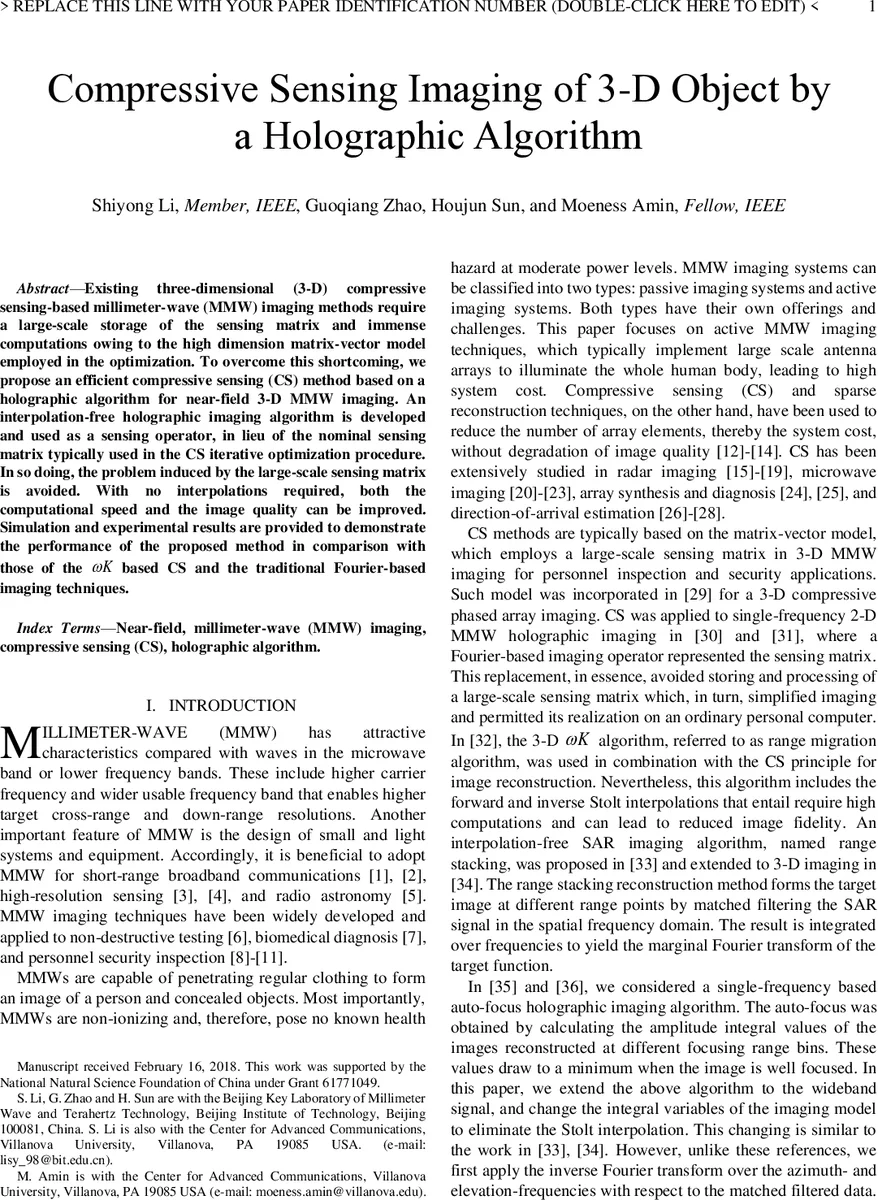
Existing three-dimensional (3-D) compressive sensing-based millimeter-wave (MMW) imaging methods require a large-scale storage of the sensing matrix and immense computations owing to the high dimension matrix-vector model employed in the optimization. To overcome this shortcoming, we propose an efficient compressive sensing (CS) method based on a holographic algorithm for near-field 3-D MMW imaging. An interpolation-free holographic imaging algorithm is developed and used as a sensing operator, in lieu of the nominal sensing matrix typically used in the CS iterative optimization procedure. In so doing, the problem induced by the large-scale sensing matrix is avoided. With no interpolations required, both the computational speed and the image quality can be improved. Simulation and experimental results are provided to demonstrate the performance of the proposed method in comparison with those of the Omega-K based CS and the traditional Fourier-based imaging techniques.
💡 Research Summary
The paper addresses a critical bottleneck in three‑dimensional (3‑D) millimeter‑wave (MMW) imaging that relies on compressive sensing (CS): the need to store and manipulate an enormous sensing matrix. Traditional CS‑based 3‑D MMW imaging methods typically adopt the Ω‑K (range‑migration) algorithm as the forward model, which requires Stolt interpolation to map non‑uniformly sampled spatial‑frequency data onto a uniform grid before a 3‑D inverse FFT can be performed. This interpolation step not only adds substantial computational load but also introduces interpolation errors that degrade image fidelity.
To overcome these limitations, the authors propose an interpolation‑free holographic imaging algorithm and use it directly as the sensing operator (Φ) in the CS reconstruction. Starting from the FMCW transmitted signal and the round‑trip delay of a point target, they express the received intermediate‑frequency signal as a superposition of spherical waves. By decomposing the spherical wave into plane‑wave components and carefully changing the integration variable from z·dk to dk, they derive a formulation where the inner double integral is exactly a 2‑D inverse Fourier transform (IFT) over the spatial frequencies (kx, ky). The outer integral over the fast‑time frequency (or wavenumber k) can be evaluated in parallel for all range bins, and the results are coherently summed to obtain a focused 3‑D image. Crucially, no Stolt interpolation is required; the algorithm consists of (1) a 2‑D FFT of the matched‑filtered data, (2) multiplication by a correction factor J(k) that accounts for the change of variables, and (3) integration over k.
The forward operator Φ and its adjoint Φ† are explicitly defined, allowing the CS measurement model y = Φx to be implemented as a pair of fast operators rather than a massive matrix. Complexity analysis shows that the proposed Holo3D method requires roughly O(R·A·E) floating‑point operations (FLOPs) for an image of size R (range) × A (azimuth) × E (elevation), whereas the Ω‑K approach needs O(R·A·E·I) FLOPs, where I (≈8) is the interpolation kernel length. For typical human‑body imaging dimensions (≈2 m × 1 m × 0.5 m) and a resolution of 5 mm × 5 mm × 3 cm, Holo3D achieves a computational efficiency gain of about 5–10×.
In the CS framework, the authors assume sparsity in the canonical domain (or total‑variation sparsity for piecewise‑constant objects) and formulate an ℓ1‑norm minimization problem. To reduce the number of antenna elements, they employ a uniform‑random spatial undersampling scheme rather than a fully random one, and they analyze the mutual coherence of the sensing operator, which directly relates to the peak sidelobe level of the point‑spread function (PSF). The uniform‑random scheme yields lower mutual coherence and thus better reconstruction performance.
Extensive simulations and experimental measurements on a near‑field MMW testbed demonstrate that the holographic‑based CS method outperforms both Ω‑K‑based CS and conventional Fourier‑based imaging. The PSF of the proposed operator exhibits lower sidelobes, leading to higher contrast and fewer artifacts in the reconstructed 3‑D images of concealed objects on a human body. Moreover, the elimination of interpolation accelerates the iterative CS optimization, resulting in faster convergence.
In summary, by replacing the large, explicit sensing matrix with an interpolation‑free holographic operator, the authors achieve substantial reductions in memory usage and computational cost while simultaneously improving image quality. This approach offers a practical pathway for real‑time, cost‑effective 3‑D MMW imaging systems, particularly in security screening and biomedical diagnostics where near‑field operation and high resolution are essential.
Comments & Academic Discussion
Loading comments...
Leave a Comment