Turbo EP-based Equalization: a Filter-Type Implementation
This manuscript has been submitted to Transactions on Communications on September 7, 2017; revised on January 10, 2018 and March 27, 2018; and accepted on April 25, 2018 We propose a novel filter-type equalizer to improve the solution of the linear…
Authors: Irene Santos, Juan Jose Murillo-Fuentes, Eva Arias-de-Reyna
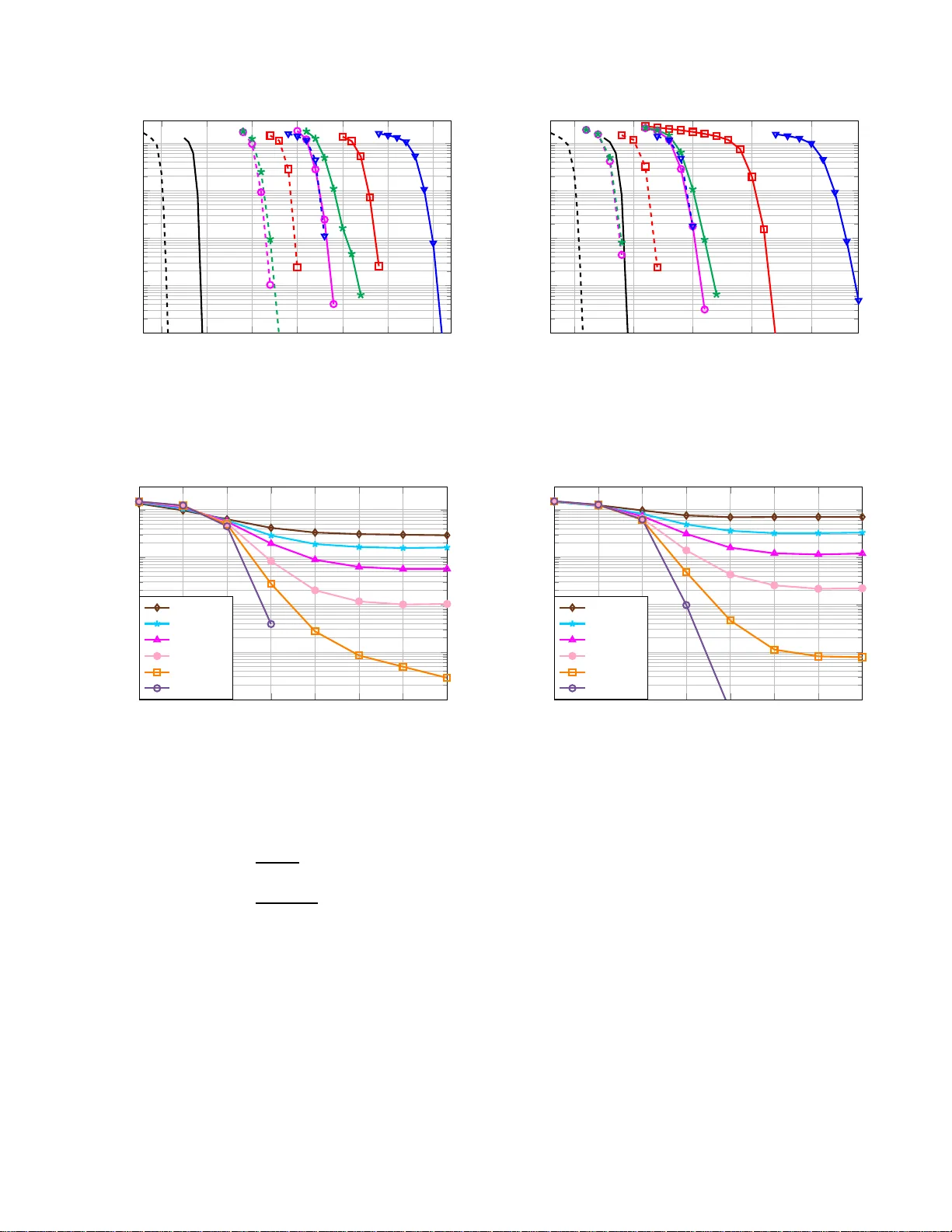
1 T urbo EP-based Equalizati on: a Filter -T ype Implementat ion Irene Santos, Jua n Jos ´ e Murill o -Fuentes, Eva Arias-de-Reyna, a nd Pablo M. Olmos Abstract —W e propose a no vel filter -type equalizer to im- prov e the solut ion of the linear min imum-mean s quared-error (LMMSE) tu rbo eq ualizer , with computational complexity con- strained to be q uadratic in the filter l ength. When high-order modulations and/or large memory channels ar e used the optimal BCJR equalizer is u n a vailable, due to its computational complex- ity . In thi s scenario, th e filter-type LM MSE turbo equ alization exhibits a good performa nce compared to other approximations. In this paper , we show that this solution can be significantl y impro ved by using expectation propag ation ( E P) i n the estimation of the a p osteriori probabilities. First, it yield s a more accurate estimation of the extrinsic distribut i on to be sent to the channel decoder . Second, compared to other solutions based on EP the computational complexity of the pro posed solution is constrained to b e quadratic in the length of the finite impulse r esponse (FIR). In addition, we review pre vious EP -based t u rbo equ alization implementations. Instead of considering d efault uniform priors we exploit t h e outp u ts of the decoder . Some simulation results are inclu ded to show t hat th is new EP-based filter remarkably outperfor ms the turb o approac h of previous versions of th e EP algorithm and also improv es the LMM SE soluti on, with and without turbo equ alization. Index T erms —Expectation p ropaga t i on (EP), linear MM SE, low-complexity , turbo equalization, ISI, fil t er-type equalizer . I . I N T R O D U C T I O N M ANY digital commu nication systems n e ed to tra nsmit over channels that are affected by inter-symbol interfer- ence (ISI). The eq ualizer produces a probabilistic estimation of the tran smitted data gi ven the vector of observations [1 ] . Sig- nificant improvements are foun d when th e previous estimation is g iv en to a proba b ilistic channel deco der [2]. Equalization can be don e in the fre quency domain to avoid complexity problem s associated with th e in verse of covariance matr ices [3]. In addition , feed ing the equ a lize r back again with the output of the decod er , iteratively , yields a tu rbo-eq ualization scheme that sig n ificantly reduces th e overall error rate [ 4 ]–[6] . The BC JR algorithm [7] perf orms optima l turbo equ al- ization un der the max im um a p o steriori (MAP) criter io n. It I. Santos, J. J . Murillo-Fue ntes and E. Arias-de-Re yna are with the Dept. T eor ´ ıa de la Se ˜ nal y Comunicaci ones, Escuela T . Superior de Ingenier ´ ıa, Uni versidad de Se villa, Camino de los Descubrimiento s/n, 41092 Sevi lla, Spain. E-mail: { irenesantos,murill o,earias } @us.es P . M. Olmos is with the Dept. T eor ´ ıa de la Se ˜ nal y Comunicaci ones, Uni versidad Carl os III de Madrid, A vda. de la Uni versidad 30, 2891 1, Legan ´ es (Madrid), Spain. He is also with the Instituto de In vestigac i ´ on Sanitaria Gregor io Mara ˜ n ´ on (IiSGM). E-mail: olmos@tsc.uc3m.es . This manuscript has been submitted to IE E E Transacti ons on Commu- nicat ions on September 7, 2017; revise d on January 10, 2018 and March 27, 2018; accepted on April 25, 2018. This work was partially funded by Spanish gove rnment (Ministeri o de Econom´ ıa y Competiti vidad TEC2016- 78434-C3- { 2 -3 } -R and Juan de la Cierv a Grant No. IJCI-2014 -19150) and by the European Union (FEDER). provides a posterior i probability (APP) estimation s g i ven some a priori informatio n about th e tr ansmitted d ata. Howe ver, its complexity gr ows exponentially with the length of th e channel and th e co nstellation size, becoming intractable for few taps and/or multile vel con stellations. I n this situation, ap proximate d BCJR solutio ns, such as [8]–[11 ], can b e used. T h ey are based on a searc h over a simplified trellis with only M e states, yielding a co mplexity which is line ar in this num b er of states. However , the perfor m ance of these appro aches is quite depend ent on the chan nel r ealization and the ord e r of the constellation used. In add ition, these appro ximated BCJR solutions degrade rapidly if the num ber of surviv or paths does not grow accor ding to the total n umber of states. For these reasons, filter-based eq ualizers ar e preferr e d [12]. A quite exten d ed filter ty pe eq ualizer in the literature is based on the well-known linear min imum-mean sq uared-er ror (LMMSE) algorithm [5] , [13], [14]. This LMMSE filter is an app ealing alternative wher e the BCJR is compu tationally unfeasible due to its robust perf ormance with linear com plex- ity in th e f rame length, N , and quad ratic dep endence with the win dow leng th , W . From a Bayesian p oint o f view , th e LMMSE algorithm obtains a G a ussian extrinsic distribution by replacin g the discrete prior distribution o f the transmitted symbols with a Gaussian prior . A more accur ate estimation for the extrinsic distribution can be obtained by replacing the prio r distributions with appr ox- imations o f the probab ility distribution. This can be do n e by means of the expectation p ropaga tion (EP) algorithm. The EP approa c h projec ts th e approximate d posterior distribution into the family of Gaussians by matching its mom ents iterativ e ly with the ones o f th e true posterio r . This algo rithm ha s b een already succ e ssfully app lied to multip le - input multiple-o utput (MIMO) systems [15] and low-density par ity-check (L DPC) channel decodin g [16 ], [ 17], among oth ers. I t has been also applied to turb o equa liza tio n in a me ssage passing app r oach as a way to inco rporate into the BP algorith m th e discrete in- formation coming fr om the cha n nel d ecoder [18 ], [ 1 9]. These message passing method s redu ce to the LMMSE estimation if no turbo equalizatio n is employed . A different approach is propo sed in [20] , [21] under th e nam e of block EP (BEP) where, rather than ap plying EP after th e chan nel decoder, it is used within the equalizer to b etter appro ximate th e posterior, outperf orming previous solution s. The computatio nal comp lexity of previous EP-based equ al- izers is large for long fram e lengths or mem ories of the ch a n- nel. Due to its block im p lementation, th e complexity of the BEP is quadr atic in th e frame length, becoming intractable for large frames [21]. T o ov e rcome this drawback, a smoothin g E P 2 (SEP) impleme n tation is pr oposed in [22], but its complexity is cubic with the memo ry of the ch annel. Fur thermore , d ue to their iterative pro cedure, their comp utational load is roug hly S tim es the on e o f the LMMSE co unterpar ts, where S is the num ber of itera tions used in th e EP alg orithm, typically around 1 0 [15 ], [20], [2 1]. Besides, in both, BEP an d SEP , unifor m discrete p riors are a ssumed for the constellation of the modulations wh e n computin g the EP appr o ximations, even within the turbo equalization iterations, while the use of informa tio n from the decod er rem ains unexplored. The results developed in this paper focus on improving these previous EP-based equalizer s [21 ], [22] bo th in co m putational complexity and perfo rmance. First, we improve the prior infor- mation used in the equalizer o n ce the turbo procedu re starts, forcing th e true discr e te prior to be non -unifor m in contrast to the unifo rm prio rs used by previous EP-based approach es. As a result, we achieve a perfor mance imp rovement. Second, th e computatio nal complexity of the EP algor ith m is redu ced to rough ly a third p a r t of th a t in [21 ], by op timizing the ch oice of EP parameters. Third, and most importan t, a n ew filter -typ e EP solution is design e d. This solutio n is co nstrained to have linear com p lexity in the fram e length an d quad r atic in the filter length, i.e., it is endowed with the same complexity or d er tha n the LMMSE filter . The novel EP-b ased filter proposed outperforms th e LMMSE algo rithm with a robust beh avior to cha n ges in th e constellation size and the channel realization, a s the BEP and SEP a pproach es do [21 ], [22] . In the e xperimen ts included, we show that th e EP filter so lu tion greatly improves the LMMSE solution with a n d without turb o equalization, specifically we have 2 dB g ains for a BPSK, 5 d B for the 8-PSK and 6-1 3 dB for 16 and 64-QAM, respectively . In comp arison with previous EP appr o aches, the EP filter ma tch es th eir perfor m ance with BPSK co nstellations, and outp erforms them with gain s of 2 dBs for 8-PSK and 4-5 dBs fo r 1 6 and 64 -QAM. W e study the extrinsic infor mation transfer (EXIT ) charts [5], [23] of our pr oposal for a BPSK, wher e the EP-based filter achieves the same perfor m ance as the BEP. The scop e of th is paper encom passes time do m ain equal- ization. Frequ e ncy dom ain equ alization has received a lot of attention as it usually ach ieves a c omplexity red uction for the block-wise processing [3], [1 4 ], [2 4 ], [2 5 ]. For this r e ason, deriv atio n of a frequen cy domain counterpa r t for the propo sed EP based tur bo-equ alizer r e mains as a future resear ch line . Another promising research route is th e application to MIMO with chann e ls with memo ry [3 ], [2 6], [27]. The pa p er is organized as follows. W e first describ e in Section II the mo del of the comm unication system a t han d. Section III is devoted to develop a new implemen tation of the EP-based equalizer con sidering non-un iform prio rs and studies the optimal values fo r th e parameter s. In Section IV, we revie w the f ormulation f o r th e LMMSE filter in turb o equa lization and describe the novel EP filter-type solution pro posed. In Section VI, we includ e several sim u lations to comp are b oth EP and LMMSE approa c hes. W e end with conc lusions. Throu g h the paper, we denote th e i -th en try o f a vector u as u i , its comp lex con jugate as u ˚ and its Hermitian transpose as u H . W e define δ p u i q as the delta f u nction that takes v alue one if u i “ 0 a nd zero in o ther case. W e use C N p u : µ , Σ q to den o te a norm a l d istribution of a rando m pr o per c omplex vector u with m ean vector µ an d cov ar iance matrix Σ . I I . S Y S T E M M O D E L The mo del of the c o mmunicatio n system is d e picted in Fig. 1, inclu ding turbo equalization at the re ceiv er . Ther e are three main blocks: transmitter, channel and turbo receiver . A. T ransmitter The information bit sequence, a “ r a 1 , ..., a K s J where a i P t 0 , 1 u , is enc o ded into the co ded bit vector b “ r b 1 , ..., b V s J with a code r ate equal to R “ K { V . After permuting the bits with an inter le aver , the codew o rd c “ r c 1 , ..., c V s J is par titioned in to N blo cks o f leng th Q “ log 2 p M q , c “ r c 1 , ..., c N s J where c k “ r c k, 1 , ..., c k,Q s , and mod ulated with a complex M -ary con stellation A of size | A | “ M . T hese modulated symbols, u “ r u 1 , ..., u N s J , where each component u k “ R p u k q ` j I p u k q P A , are transmitted over the ch annel. Hereafter, transmitted symb ol energy and en ergy per bit a re denoted as E s and E b , respectively . B. Chan nel The chann el is c ompletely specified b y the CIR, i.e., h “ r h 1 , ..., h L s J , where L is the numbe r of taps, an d is corrup ted with A WGN whose noise variance, σ 2 w , is known. Each k -th entry of the co mplex received signal y “ r y 1 , ..., y N ` L ´ 1 s J is giv en b y y k “ L ÿ j “ 1 h j u k ´ j ` 1 ` w k “ h J u k : k ´ L ` 1 ` w k , (1) where w k „ C N ` w k : 0 , σ 2 w ˘ and u k “ 0 for k ă 1 and k ą N . C. T urbo r eceiver When no information is av ailab le from the chan nel d e c oder, the p osterior pro b ability of the tran smitted symbo l vector u giv en th e whole vector o f ob servations y yields p p u | y q 9 p p y | u q p p u q (2) where, assumin g equip robable symbols, the prio r would be giv en b y p p u q “ 1 M N ź k “ 1 ÿ u P A δ p u k ´ u q . (3) This prior ma tches with the d efinition g i ven in [21] but, as explained below , it is just valid before the turbo procedu re. In a turb o ar chitecture the equ alizer an d decod er itera ti vely exchange info r mation for the same set of received sym b ols [5], [14 ]. Traditionally , this exchange of infor mation is don e in term s of extrinsic p robabilities in order to improve co n ver- gence and avoid instabilities. The extrinsic inform ation at the output of the equalizer (see Fig . 1) , p E p u k | y q , is co mputed so as to meet the turbo pr inciple [13 ]. These prob a b ilities, p E p u k | y q , are approxim a ted when the optimal solution is intractable. W e will denote the approx imation by q E p u k q . 3 Channel Coder ś Modulat or H(z) Equalizer Demap ϕ p¨q ś ´ 1 Channel Decoder ś Map a i b t c t u k w k y k p E p u k | y q L E p c t q L E p b t q p a i L D p b t q L D p c t q p D p u k q T ransmitter Channel T urbo receiver Fig. 1: System model. The extrinsic d istributions are dema pped, L E p c k,j q “ log ř u k P A | c k,j “ 0 p E p u k | y q ř u k P A | c k,j “ 1 p E p u k | y q , (4) deinterleaved and given to the decoder as extrinsic log - likelihood r atios, L E p b t q . The ch annel decod er comp utes an estimation of th e in formatio n bits, p a , along with th e extrinsic LLRs on the coded bits, compu ted as L D p b t | L E p b qq “ log p p b t “ 0 | L E p b qq p p b t “ 1 | L E p b qq ´ L E p b t q . (5) These extrinsic LLRs are interleav e d, ma p ped again and gi ven to the eq ualizer as u pdated prio r s, p D p u | L E p b qq , which are computed as p D p u k | L E p b qq “ ÿ u P A δ p u k ´ u q Q ź j “ 1 p D p c k,j “ ϕ j p u q| L E p b qq , (6) with ϕ j p u q denoting the j -th bit associated to th e d emappin g of symb ol u . This pro cess is rep eated iteratively f or a g i ven maximum numb er o f iterations, T , or until con vergenc e . Note that in Fig. 1 we hav e in cluded the compu tation of the extrinsic inform ation within the equalizatio n and channel decodin g blocks. Note also that, once the tu rbo p rocedur e starts, the p rior in (2 ) is con d itioned on the input at the channel decoder and the symbo ls ar e not e q uiprob able anymore. I n this situation, the posterior distribution comp uted by the equalizer is giv e n by p p u | y q 9 p p y | u q N ź k “ 1 p D p u k | L E p b qq , (7) The tru e posterior d istribution in (2 ) and (7 ) has complexity propo rtional to M L . When this complexity becomes intractable, we will approx imate it, denoting it a s q p u q . In th e following, we om it the dep e ndence on the input at the deco der, L E p b q , to keep th e notation un cluttered in the re st of th e paper . It is also unclutter e d in Fig. 1. I I I . N O N - U N I F O R M B E P T U R B O E Q U A L I Z E R EP [28] –[32] is a techniq ue in Bayesian machin e learnin g that ap proxim ates a (non -exponen tial) distrib u tion with an ex- ponen tial distribution who se mo ments m atch th e true ones. In this paper, we fo cus on com puting a Gau ssian a pproxim ation for the posterior in (7), which is clearly non Gaussian due to the pro duct of discre te priors in (6). As introdu ced in [21 ], this is do ne by iteratively u pdating an app roximatio n within the Gaussian exponen tial family by replacing the non Gaussian prior terms in (2) by a produ ct of Gaussians 1 , i.e., q r ℓ s p u q 9 p p y | u q N ź k “ 1 ˜ p r ℓ s D p u k q “ C N ` y : Hu , σ 2 w I ˘ N ź k “ 1 C N ´ u k : m r ℓ s k , η r ℓ s k ¯ (8) The marginalization of th e r esulting ap proxim ated Gaussian posterior distribution for the k -th transmitted symbo l and ℓ -th EP iteration yields q r ℓ s p u k q „ C N ´ u k : µ r ℓ s k , s 2 r ℓ s k ¯ (9) where µ r ℓ s k “ m r ℓ s k ` (10) ` η r ℓ s k h k H ´ σ 2 w I ` H diag p η r ℓ s q H H ¯ ´ 1 p y ´ Hm r ℓ s q , s 2 r ℓ s k “ η r ℓ s k ´ η 2 r ℓ s k h k H ´ σ 2 w I ` H diag p η r ℓ s q H H ¯ ´ 1 h k , (11) H is the N ` L ´ 1 ˆ N chan nel ma tr ix gi ven by H “ » — — — — — — — — — — – h 1 0 . . . 0 . . . . . . . . . . . . h L . . . 0 0 . . . h 1 . . . . . . . . . . . . 0 . . . 0 h L fi ffi ffi ffi ffi ffi ffi ffi ffi ffi ffi fl (12) and h k is the k - th colu mn of H (see Appen dix A for the demonstra tio n). At this point it is inter esting to re mark that (9)- (11) are completely equiv alent to equations (15)-(17 ) in [21]. Here we developed the values of the mean and variance fo r each symb ol while in [2 1] they were comp uted in blo ck form. The current description is simpler because we only include the elem ents of the covariance matrix that are used durin g the execution of the a lg orithm, excluding the non-d iagonal elements. 1 Note that in [21] we used an alternati ve e xpression for (8) (an exponen tial distrib ution with paramet ers γ k “ m k { η k and Λ k “ 1 { η k ). 4 The m ean and v ariance param e ters in (8 ) are initialized with the statistics from the chann el deco der as m r 1 s k “ ÿ u P A u ¨ p D p u k “ u q , (13) η r 1 s k “ ÿ u P A p u ´ m r 1 s k q ˚ p u ´ m r 1 s k q ¨ p D p u k “ u q . (14) Then, they are u pdated in parallel an d iter ati vely b y matc h ing the momen ts of the following distributions q r ℓ s E p u k q p D p u k q moment matching Ð Ñ q r ℓ s E p u k q C N ´ u k : m r ℓ ` 1 s k , η r ℓ ` 1 s k ¯ (15) where q r ℓ s E p u k q is an extrinsic marginal d istribution comp uted as 2 q r ℓ s E p u k q “ q r ℓ s p u k q{ ˜ p r ℓ s D p u k q “ C N ´ u k : z r ℓ s k , v 2 r ℓ s k ¯ (16) where z r ℓ s k “ µ r ℓ s k η r ℓ s k ´ m r ℓ s k s 2 r ℓ s k η r ℓ s k ´ s 2 r ℓ s k , (17) v 2 r ℓ s k “ s 2 r ℓ s k η r ℓ s k η r ℓ s k ´ s 2 r ℓ s k . (18) Note that this eq ualizer differs from the on e in [ 21] because we u sed different d efinitions fo r the true prior, p D p u k q . In the current manuscrip t, we con sidered non- uniform and discrete priors, giv en by ( 6), du ring the m oment match in g proced u re in th e equalizer, wh ile in [21] unifor m pr io rs as in ( 3) were considered b y default even after the turbo pro cedure. T o increase th e accuracy of the algo rithm, a damp ing pro cedure follows the momen t matching in (15). W e have de fin ed an algorithm , describe d in Alg orithm 1, called Moment Matching and Damping that runs these two procedu res. A. The n uBEP algorithm Algorithm 2 c ontains a detailed descrip tion o f the whole EP proced u re, wher e S is the nu m ber of EP iter ations while T is the number of tur bo iteratio ns. No te that the difference with th e approa c h in [ 21] lies in the d efinition of the prior distribution used d uring the mo m ent matching procedu r e. In [21] , we use an unifo rm d istribution (deno ted with th e indicator function ) , forcing the same a priori pro bability for the symbols, regard - less of the informatio n fed back f r om the decod e r , dur in g the moment match in g employed in the eq ualizer even after the turbo pr o cedure starts. In th is pap er , we refin e the d efinition of the prior used in the moment matching of EP algorithm as in (6), consider ing non-un iform prior s once th e turbo pro cedure starts. For th is reason , we na m ed this alg orithm no n-unifo rm BEP (nuBEP) turbo equalizer . 2 Note that in this paper we used q r ℓ s E p u k q to denot e the extrinsic mar ginal distrib ution, while in [21] we denoted as q r ℓ sz k p u k q and called it cavit y margin al function. Algorithm 1 Moment Matching and Damping Given inputs : µ r ℓ s p k , σ 2 r ℓ s p k , z r ℓ s k , v 2 r ℓ s k , m r ℓ s k , η r ℓ s k 1) Run momen t matching: Set the mean and variance of the unnor malized Gaussian distribution q r ℓ s E p u k q ¨ C N ´ u k : m r ℓ ` 1 s k,new , η r ℓ ` 1 s k,new ¯ (19) equal to µ r ℓ s p k and σ 2 r ℓ s p k , to get the solution η r ℓ ` 1 s k,new “ σ 2 r ℓ s p k v 2 r ℓ s k v 2 r ℓ s k ´ σ 2 r ℓ s p k , (20) m r ℓ ` 1 s k,new “ η r ℓ ` 1 s k,new ˜ µ r ℓ s p k σ 2 r ℓ s p k ´ z r ℓ s k v 2 r ℓ s k ¸ . (21) 2) Run dampin g: Update the values as η r ℓ ` 1 s k “ ˜ β 1 η r ℓ ` 1 s k,new ` p 1 ´ β q 1 η r ℓ s k ¸ ´ 1 , (22) m r ℓ ` 1 s k “ η r ℓ ` 1 s k ˜ β m r ℓ ` 1 s k,new η r ℓ ` 1 s k,new ` p 1 ´ β q m r ℓ s k η r ℓ s k ¸ . (23) if η r ℓ ` 1 s k ă 0 then η r ℓ ` 1 s k “ η r ℓ s k , m r ℓ ` 1 s k “ m r ℓ s k . (24) end if Output : η r ℓ ` 1 s k , m r ℓ ` 1 s k B. On the election of EP pa rameters The moment match ing con d ition explained in (15 ) d eter- mines th e optimal o peration po in t fou nd by th e EP approx ima- tion. By re peating this pro cedure, we allow to find a stationary solution fo r the o peration p oint. In o rder to a void instabilities and control th e a ccuracy an d speed of conv ergence, som e E P parameters are intr o duced. These p arameters are the n umber of EP iteration s ( S ), a minimu m allowed variance ( ǫ ) and a damping factor ( β ) . Based on recent stud ies, these EP parameters ca n be further optimized [33]–[3 5]. Following the guidelines in those papers and after extensive experimentation, in th e gener al case we fo und o ut th at instabilities can b e controlled b y setting 3 ǫ “ 1 e ´ 8 . Regarding the accur acy of the algo rithm, it is convenient to start with a c o nservati ve value of the damp in g pa r ameter β in Algo r ithm 2 . T he value β “ 0 . 1 forces our algorith m to m ove slowly towards the EP solution. On ce the turbo procedur e starts, we let th e dampin g parameter grow in ord er to speed up the achiev e m ent of the EP solution, reducing the v alu e o f S from 10 in [2 1] to 3. A sim p le rule for determination of β th at fulfills th is requ ir ements an d leads to good perfor mance is an exponen tial gr owth with a saturatio n value of 0 . 7 , i.e., β “ min p exp t { 1 . 5 { 10 q , 0 . 7 q , where t P r 0 , T s is th e nu m ber of the c u rrent turb o iteratio n. W ith this criterion the n umber of EP iter a tio ns after the turbo proced u re starts is red uced to S “ 3 , hen ce redu cing the computatio nal complexity b y more than a third. 3 Parame ters have bee n chosen to optimiz e turbo equaliza tion [35]. 5 Algorithm 2 nuBEP T urbo Equalizer Initialization : Set p D p u k q “ 1 M ř u P A δ p u k ´ u q fo r k “ 1 , . . . , N for t “ 1 , ..., T do 1) Compute the mean m r 1 s k and variance η r 1 s k giv en by (13) and (14), respectively . for ℓ “ 1 , ..., S do for k “ 1 , ..., N do 2) Compute the k -th extrinsic distribution as in (16), i.e., q r ℓ s E p u k q “ C N ´ u k : z r ℓ s k , v 2 r ℓ s k ¯ (25) where z r ℓ s k and v 2 r ℓ s k are given by (1 7) and (18), respectively . 3) Obtain the d istribution p p r ℓ s p u k q 9 q r ℓ s E p u k q p D p u k q an d estimate its mean µ r ℓ s p k and v ar iance σ 2 r ℓ s p k . Set a minimum allowed variance a s σ 2 r ℓ s p k “ max p ǫ, σ 2 r ℓ s p k q . 4) Run the mom ent matchin g a nd dam p ing proce- dures by executing Algorithm 1. end for end for 5) W ith the values m r S ` 1 s k , η r S ` 1 s k obtained after the EP algorithm , calculate the extrinsic d istribution q E p u k q . 6) Demap the extrinsic distribution and compu te th e extrinsic LLR, L E p c k,j q , by means of (4). 7) Run the channel deco d er to outp ut p D p u k q end for Output : Deliv er L E p c k,j q to the cha n nel d e coder for k “ 1 , . . . , N and j “ 1 , . . . , Q I V . F I LT E R - T Y P E T U R B O E Q UA L I Z A T I O N A. LMMSE filter In this sub section we review the formulation of the LMMSE-based filter [5], [13 ] , [ 14], modified to allow for unnor malized tr ansmitted energy and a different compu ta tio n of th e extrinsic distribution. The LMMSE-based filter [ 5 ], [13], [14] estimates one symbo l p er k -th iteration, u k , given a W - size window of observations, y k “ r y k ´ W 2 , ..., y k ` W 1 s J , where W “ W 1 ` W 2 ` 1 . This pro c edure differs from [36] , where each transmitted symb ol is estimated given the wh o le vector of observations, y . Th e LMMSE equ a lizer appr oximates the prior for each symbol, p D p u k q , as a Gaussian p D p u k q « ˜ p D p u k q “ C N p u k : m k , η k q , (26) where the mean, m k , and variance, v k , are a priori statistics for each transmitted sym bol, given by (13) and (14), respectively . For the first iteration of the turbo equalization no a priori informa tio n is av ailable and a suitable initialization is m k “ 0 , η k “ E s , which bo ils down to m k “ 0 , η k “ 1 when normalizin g the energy [ 5 ], [13], [14 ] . Gi ven the curr ent prior a nd the c h annel imp ulse r e sp onse (CIR), th e LMM SE filter compute s a Gaussian appro x imation of the po sterior probab ility of each symbol. When a tur b o sch eme is used, the equalizer and decod er exchange extrinsic in formation [6]. Throu g h the turbo equalization iterations, the a priori statistics in ( 26) are updated with the inform ation fed back from the channel decoder . Rather than co mputing the p osterior distribution as in ( 7), the LMMSE filter [5] considers the a posterior i pro babilities with respect to the estimated tran smitted sy mbol, p u k . For this reason , an d to keep the same no tation than in [5], we will denote the app roximated po sterior as q p u k | p u k q . W ith this posterior d istribution in m ind, the extrinsic pr o bability at the output of the LMMSE filter can be comp u ted as q E p u k | p u k q “ q p u k | p u k q ˜ p D p u k q . (27) This distribution is Gaussian and can be derived f rom th e extrinsic distribution of the estimated symbo l c o mputed in [5] , as shown in Appen dix B, yie ld ing q E p u k | p u k q “ C N ` u k : z k , v 2 k ˘ (28) where z k “ c k H p y k ´ H W m k ` m k h W q c k H h W , (29) v 2 k “ c k H h W E s p 1 ´ h W H c k q p c k H h W q 2 , (30) and, in turn, c k “ ´ Σ k ` p E s ´ η k q h W h W H ¯ ´ 1 E s h W , (31) H W “ » — — — — – h L . . . h 1 0 . . . . . . . . . . . . 0 h L . . . h 1 fi ffi ffi ffi ffi fl (32) is the W ˆ p W ` L ´ 1 q ch annel matrix, h W is the ( W 2 ` L )-th column of H W and m k “ r m k ´ L ´ W 2 ` 1 , ..., m k ` W 1 s J , (33) V k “ diag p η k ´ L ´ W 2 ` 1 , ..., η k ` W 1 q , (3 4) Σ k “ σ 2 w I ` H W V k H W H . (35) The computational co mplexity is dom inated b y (31), which has to be recompu ted every k -th iteratio n. Hence, the complexity is O p NW 2 q . This complexity can be fu r ther red uced by relying on some approx imations pro p osed in [5 ] , [14]. B. EP filter (EP- F) A novel EP filter-type is d ev elo ped in this sub section to improve the accuracy and perf ormance of the LMMSE-b a sed filter explained above. As expla in ed in Subsection IV -A, if the LMMSE filter is run, the prior o f each symbol is approx imated by a Gaussian with the statistics g iven b y the decoder, i.e., with m e an and variance gi ven by (13 ) and (14), respectively . By using the EP alg orithm we a pproxim ate the posterio r distribution with a Gaussian family . Since the posterior distribution in cludes the true discrete prio r s, we take into account the discrete nature of symbols. At every iteration of the EP algo r ithm, ℓ , we ap proximate the pro duct of prior s of ind ividual symbols in (7) as a pro duct 6 Algorithm 3 EP-F Initialization : Set p D p u k q “ 1 M ř u P A δ p u k ´ u q fo r k “ 1 , . . . , N for t “ 1 , ..., T do 1) Compute the mean m r 1 s k and variance η r 1 s k giv en by (13) and (14), respectively . for ℓ “ 1 , ..., S do for k “ 1 , ..., N do 2) Compute the k -th extrinsic distribution as in (28), i.e., q r ℓ s E p u k | p u k q “ C N ´ u k : z r ℓ s k , v 2 r ℓ s k ¯ (37) where z r ℓ s k and v 2 r ℓ s k are given by (2 9) and (30), respectively . 3) Ob tain the distribution p p r ℓ s p u k q 9 q r ℓ s E p u k | p u k q p D p u k q and estimate its mean µ r ℓ s p k and v ar iance σ 2 r ℓ s p k . Set a minimum allowed variance a s σ 2 r ℓ s p k “ max p ǫ, σ 2 r ℓ s p k q . 4) Run the mom ent matchin g a nd dam p ing proce- dures by executing Algorithm 1. end for end for 5) W ith the values m r S ` 1 s k , η r S ` 1 s k obtained after the EP algorithm , calculate the extrinsic distribution q E p u k | p u k q in (28). 6) Demap the extrinsic distribution and compu te th e extrinsic LLR, L E p c k,j q , by means of (4). 7) Run the channel deco d er to outp ut p D p u k q end for Output : Deliv er L E p c k,j q to the cha n nel d e coder for k “ 1 , . . . , N and j “ 1 , . . . , Q of N Gau ssians, ˜ p r ℓ s D p u k q “ C N ´ u k : m r ℓ s k , η r ℓ s k ¯ , wh o se pa- rameters (mean s and variances) are adjusted to find a better approx imation, q r ℓ s p u q 9 p p y | u q ś N k “ 1 ˜ p r ℓ s D p u k q , to th e true posterior . Similarly to (27 )-(28 ), for each k -th symbol, we first compute the curre n t extrinsic distrib ution, q r ℓ s E p u k | p u k q “ q r ℓ s p u k | p u k q ˜ p r ℓ s D p u k q . (36) Now , a more a c curate poster io r distribution can be obtaine d b y finding a new Gaussian app roximatio n , ˜ p r ℓ ` 1 s D p u k q , to match the moments of q r ℓ s E p u k | p u k q ˜ p r ℓ ` 1 s D p u k q and q r ℓ s E p u k | p u k q p D p u k q , as in (15). W ith these new values fo r the mean, m r ℓ ` 1 s k , and variance, η r ℓ ` 1 s k , we can rec o mpute a new e xtrinsic distribution q r ℓ ` 1 s E p u k | p u k q , which is mor e accurate than th e one in (28). The final extrinsic distribution deliv ered to the decod er is the on e obtaine d after the last iteratio n of the EP algor ithm, following (36 ). W e denote this new algor ithm as E P- filter (EP-F). Algo- rithm 3 is a detailed descrip tio n of its implemen tation. No te that the main d ifference between Algorithm 2 and Algorithm 3 lies in the computatio n o f the extrinsic distribution, i.e., equations (25) and (37 ). The computationa l comp lexity is also dominated by (31 ), which has to be computed for each symbol and each ℓ -th iteration. Hence, the com plexity is S times th e LMMSE complexity , i.e. O p S NW 2 q , where S is th e number of iterations of the EP-F . At this point, it is in teresting to remar k that the approx imations pro posed in [5], [14] to further reduce the complexity cann ot b e ap p lied when th e EP is used. The reason is th at the se app roximation s remove (at some points) the prior v ariance com puted by the deco der , setting it to on e. V . R E L AT I O N T O P R E V I O U S A P P RO AC H E S A. Upd ate of th e p riors W e improve th e prio r inform ation used in the equalizer on c e the tu rbo proc edure starts, forcing the true discrete prior to be non-u niform in co n trast to the u n iform p riors u sed by previous EP-based approach e s. In p revious prop osals [20]–[ 22], the p robabilities from the channel deco d er , p D p u k q , were used to initialize, at the beginning of ev ery iter ation o f the turb o-equa liza tio n, the produ ct of Gaussians that in the EP appro ximation replaces the produ ct of prior s, ˜ p r 1 s D p u k q . But wh en the mom ent matchin g was p erforme d in the EP algorith m , i.e., q r ℓ s E p u k q I u k P A moment matching Ð Ñ q r ℓ s E p u k q ˜ p r ℓ ` 1 s D p u k q , (38) the true priors used were unifor mly distributed following I u k P A “ 1 M ÿ u P A δ p u k ´ u q . (39) In the current propo sal, we keep the initialization of the Gaussians in every step of the tu rbo-eq u alization, ˜ p r 1 s D p u k q , but also p r opose to replace the u niform p riors in ( 3 9) by non - uniform on es in the mom ent matchin g step , as explain ed in (15), i.e., q r ℓ s E p u k q p D p u k q moment matching Ð Ñ q r ℓ s E p u k q ˜ p r ℓ ` 1 s D p u k q , (40) where p D p u k q “ ÿ u P A δ p u k ´ u q Q ź j “ 1 p D p c k,j “ ϕ j p u qq , (41) Note th at the different d efinition of p riors - (39) in previous propo sals, (4 1) in this manu script- is th e difference between the c u rrently pro posed nuBEP algorith m and the BEP in [ 21], with remarkable improvements. B. P arameter Optimization The com putational complexity o f the EP algor ithm is re- duced to rou ghly a third p art of that in [21], b y optim izin g the choice of EP parameter s. In particular, we pr opose some new values for ǫ and β , that control numerical instab ilities in the EP upd ates, an d S , th e numb er of iterations o f the EP equalizer . T h e param e ters pr oposed in this paper reduce the number o f iterations in tur b o equa liza tion to S “ 3 , rather than the S “ 1 0 iterations that wer e used in [21]. 7 C. F ilter -type solution The n ew filter - ty pe EP solution prop o sed is con strained to have linear complexity in th e fra m e length an d q uadratic in the filter length , i.e., it is endowed with the same co m plexity order than the LMMSE filter . This com p lexity is no t qu adratic with the block len gth as the one of the BEP [21] no r cubic with the window leng th as complexity of the SEP [ 2 2]. D. Equ alization solved with E P Regarding the EP-based equalizers p roposed b y o ther au- thors, the ap proach in [18] , [1 9] should be m entioned. These propo sals d eal just with how to pass in formation between the channel decode r and the LMMSE equalizer . Our pro p osal first focuses o n the EP ba sed eq ualization, per formed indep e n- dently of the tur b o iteration s. Ther efore the app roaches ar e quite different. Issues such as how to use the prio rs in th e moment m atching within the EP e q ualizer or the damping do not ar ise in these p r oposals where the imp rovement is related only to the handlin g of pro babilities b etween blocks. V I . S I M U L AT I O N R E S U L T S In this section, we comp are the perfo rmance of both the block LM MSE and EP-F equalizer s f or different scenario s. W e also include th e perform ance o f the BEP [2 1] an d the A WGN bou nd as ref erences. Note that the MMSE filter [5] has not b een inclu ded in the simulations sin c e th e b lock LMMSE exhib its equal or better per forman c e than any fil- tering ap proaches based on the LMMSE algorithm . W e did not in clude th e SEP algorithm since it exh ibits the same perfor mance a s th e b lock imp le m entation, as shown in [22]. W e also in clude the n uBEP ap proach to illustra te the q uite improved behavior when using n on-un iform priors at each EP iteration, even reducin g f r om 10 to 3 th e number of iteration s of the EP appro ach. The EP p a rameters have been selected as explained in Subsection III -B, both for the nuBEP and EP- F method s. For a full perfor mance com parison with BCJR approx imations, such as M-BCJR [8], M* - BCJR [1 0], RS- BCJR [9] , NZ and NZ-OS [1 1], p lease see [ 21]. In T able I we inclu de a d etailed comp arison of the complexity of all the simulated algor ith ms. Above we inclu d e the com p utational complexity of pr evious algorithms in [2 1] (BEP) and [22] (SEP), the b lock and filter implemen tation of the LM M SE a n d BCJR app roaches. Below we p rovide the co mplexity fo r the new app roaches in th is p aper, i.e., the propo sed nuBEP a nd EP-F . Parameter W is typically ar ound two times the length of the chann el, L . Here, we simulate the scenarios in [13], [14], using the same channe l respo nses and modulation s. Other modulatio ns are also consid ered. The a bsolute value of LLRs giv en to the de c oder is limited to 5 in ord er to av oid very confident pr obabilities. W e use a ( 3,6)-r egular LDPC of rate 1/2, an d b elief prop agation as d ecoder with a maxim um of 100 iteratio ns. The window length in the filtered appr o ach is set to W “ W 1 ` W 2 ` 1 , wher e W 1 “ 2 L and W 2 “ L ` 1 as suggested in [14]. In the following, we fir st include a section to an alyze the perfor mance of our approac h in a low co mplexity scen ario with BPSK m odulation, similarly to [1 4]. The optimal BCJR T ABLE I: Complexity comparison between algorithms. Algorithm Complexit y p er turb o iteration BCJR NM L BEP 10 LN 2 blo c k-LMMSE LN 2 SEP 10 NW 3 LMMSE filter NW 2 nuBEP 3 LN 2 EP-F 3 NW 2 algorithm can be run in this scenario with a low enough computatio nal complexity and is used as bo und. Next, we include a section to analyze th e behavior o f th e algorithm s in a large com plexity scenario, where we u se high -order modulatio ns such as 8-PSK, 16-QAM and 64-QAM. A. BPS K scena rio In Fig. 2 we include the BER, averaged over 10 4 ran- dom fr ames, for the LMMSE, BEP [21], n u BEP , EP-F an d BCJR equ alizers with a BPSK mod ulation and two differ- ent ch annel respo nses and lengths of en coded words: h “ r 0 . 227 0 . 46 0 . 68 8 0 . 46 0 . 227 s J and V “ 4096 bits in Fig. 2 (a)-(c) and h “ r 0 . 407 0 . 815 0 . 407 s J and V “ 1024 bits in Fig. 2 (d)-(f ). The chann e l responses were selected following the simulations in [13] , [14 ] . Th e p erforma n ces o f block- algorithm s, BEP and nuBEP , are very similar to the equivalent forward filtering approach. When the nuBEP algo rithm is ap- plied, 2 and 1.5 dBs gains are obtained compa red to LMM SE approa c h in th e turb o scenario, f or the two simulated scenarios, respectively . Th e EP-F exhibits a perfor mance similar to that of the nuBEP . In Fig. 3 we in clude the E XIT charts of the BEP [21] , nuBEP , EP-F , LMMSE and BCJR fo r the chan nel r esponse h “ r 0 . 22 7 0 . 46 0 . 688 0 . 46 0 . 2 27 s J as in [5] , [13] , BPSK modulatio n with E b { N 0 “ 9 (solid) and 7 dB (dashed). The EXIT chart of th e LDPC encoder of 2048 { 4 096 and R “ 1 { 2 used is also dep icted (solid). The hor izontal and vertical axis d epict the mutual info r mation at th e input, I i , and the outpu t, I o , re sp ectiv ely . W e use arrows to show the ev olutio n o f the m utual infor mation along th e turbo itera tions for E b { N o “ 9 d B. V ertical (horizo ntal) ar rows indicate the improvement in the mutual infor m ation each time the equalize r (chann e l decoder ) is ex e c uted. When no a priori informatio n is giv en to the deco der , i.e., I i “ 0 , both BEP a n d EP-F provide a higher value for the mutu al infor m ation at the o utput, I o , th a n the L MMSE appr oach, i.e., th ey star t from a more accurate estimation even before the turbo equalization . This g reatly improves th e per f ormance as it enlarges the gap between the equalizer and the cha n nel d ecoder EXIT c u rves. It can be seen that the LMMSE approac h will fail when E b { N o “ 7 dB, because both curves in tersect. Note that the wide EXIT tun nel fro m the e qualizer to the LDPC decod er is sugge sting tha t th e code is n ot optimu m in terms of capacity [3 7]. An optim a l code in this sense would 8 0 5 10 15 10 ´ 5 10 ´ 4 10 ´ 3 10 ´ 2 10 ´ 1 E b { N 0 (dB) BER Channel h “ r 0 . 227 0 . 46 0 . 688 0 . 46 0 . 227 s J (a) Without turbo feedback 0 5 10 15 10 ´ 5 10 ´ 4 10 ´ 3 10 ´ 2 10 ´ 1 E b { N 0 (dB) BER (b) After t wo turbo lo ops 0 5 10 15 10 ´ 5 10 ´ 4 10 ´ 3 10 ´ 2 10 ´ 1 E b { N 0 (dB) BER (c) After fiv e turb o lo ops 2 4 6 8 10 ´ 5 10 ´ 4 10 ´ 3 10 ´ 2 10 ´ 1 E b { N 0 (dB) BER Channel h “ r 0 . 407 0 . 815 0 . 407 s J (d) Without turbo feedback 2 4 6 8 10 ´ 5 10 ´ 4 10 ´ 3 10 ´ 2 10 ´ 1 E b { N 0 (dB) BER (e) After t wo turbo lo ops 2 4 6 8 10 ´ 5 10 ´ 4 10 ´ 3 10 ´ 2 10 ´ 1 E b { N 0 (dB) BER (f ) After fiv e turb o lo ops Fig. 2: B E R along E b { N 0 for BEP [21] ( ˝ ), nuBEP ( ˝ ), EP-F ( ˚ ), block-LMMSE ( Ź ) and BCJR ( ˛ ) turbo equalizers, BP SK, code words of V “ 409 6 bits (a)-(c) and V “ 1024 bits (d)-(f) and two different channel responses. Black lines represent t he A WGN bound. exhibit an EXIT char t near below the on e of the eq ualizer and above the curve of th e 1 { 2 r ate LDPC code used. The design of this code for the chan nel equalization response is out of the scope of this paper and remains as a futur e line of resear ch. B. Larg e complexity scena rio In Fig. 4 we simulate the same scenario o f Fig. 2, but using an 8-PSK modulation rather than a BPSK. It can be obser ved that af te r incre a sing the order of the modulation , the EP-F approa c h p resented in this work perf o rms identically as its block coun terpart, gr e a tly improving the perf ormance of the LMMSE algo rithm b efore and af ter the turb o procedu re. An improvement o f the BER of th e EP-F with respect to the one of the BEP appro ach in [21], after turb o equalization, can also be observed. In Fig. 5 we d epict the BER p erform a nce after five turb o loops fo r channels h “ r 0 . 22 7 0 . 46 0 . 688 0 . 4 6 0 . 22 7 s J in (a) and h “ r 0 . 4 07 0 . 81 5 0 . 40 7 s J in (b) with different modulatio ns. W e use so lid lines to represen t a 64-QAM con- stellation and dashed lines fo r a 16-QAM. W e sen t codewords of length V “ 40 96 in both scenarios. It ca n be observed that the p erform ance of the EP-F matches with the one of its block implem entation p roposed in this paper (n uBEP) when a 1 6-QAM is used . Howe ver, th e E P- F ap proach sligh tly degrades with a 64 -QAM, where the blo ck n uBEP gets the most accurate p erforman ce. Note that the behavior of th e EP-F could be imp roved by in c reasing the length of th e filter , 9 0 0 . 2 0 . 4 0 . 6 0 . 8 1 0 0 . 2 0 . 4 0 . 6 0 . 8 1 I i I o BEP [21] nuBEP EP-F LMMSE BCJR LDPC Deco der Fig. 3 : EXIT charts for the decoder , the BEP [21], nuBEP , EP-F , LMMSE and BCJR equalizers with 7 (dashed) and 9 (solid) dB of E b { N 0 , BPSK modulation and codew ords of V “ 4096 . yielding the perfo rmance of its block implementatio n. W e have a remarka ble improvement of 3 - 5 dB with respect to the BEP in [21] and of 7 - 13 dB compare d to the LMMSE algor ithm. For the sake of comp leteness, w e include Fig. 6 to show how the BER change s along the turbo iteration s and differ- ent block lengths at E b { N 0 “ 13 dB for an 8-PSK and h “ r 0 . 227 0 . 46 0 . 688 0 . 46 0 . 227 s J . The nuBEP algo rithm is r epresented in (a) a n d th e filter appr o ach EP-F in (b ). I t can be ob served that BER is higher fo r shorter codes and it improves when the cod e length is increased , as expected. Also, the BER d oes not significantly improve after th e fifth tur bo iteration. In the view o f these results we stopped r unning our turbo equalizers after five turbo iter ations in the experiments presented above. V I I . C O N C L U S I O N In a previous work, we presented a novel equalizer based on expectation prop agation (EP) [21]. This solution p resents quite an improved perf ormance compar ed to pr evious ap p roaches in the literatur e, bo th for h ard, soft and tur bo d etection. The solution was presented as a b lock-wise solution and it was therefor e d enoted as blo ck-EP (BEP). Th e major advantage of the BEP lies in th e fact that its computatio nal co m plexity does not grow exponen tially with the constellation size and channel memory , as opp osed to most eq ualizers, which are unfeasible for moderate v alues of these param eters. Howe ver, it exhibits a quadratic increase with th e size o f the tra n smitted word , V . T o avoid this problem , filter-type equ alizers are usually preferr ed [1 2]. For this re a so n, we p roposed a smoo thing EP (SEP) equalize r in [22 ]. Ho wever , the SEP has a comp utational complexity cubic in th e ch annel length, L . Both BEP and SEP equalizer s make use of a mod erate feedback in the sense that an in itial unifor m discrete prior is assumed at the beginning of each execution of the EP alg o rithm, e ven af ter the turbo proced ure has started. In this paper, we first prop ose a design to include the no n-unif orm discrete natu re of the priors from th e dec o der in the E P algo r ithm, which amoun ts to a stronger f eedback, qu ite outp erformin g the previous BEP and SEP app roaches. Seco nd, we d ev elo p a reduced- complexity approa c h b y pr oposing better values o f the EP pa r ameters. The resultin g algorith m has been d e noted as nuBEP , an d it significantly o utperfo rms the BEP red ucing th e com putational complexity to less than the third part. Finally , we adapt the EP block equalizer to the filter-type form , emu latin g the Wiener MMSE filter-type [14 ]. Theref ore, we mimic the structure of the filter-type MMSE equalizer . The EP is used to be tter approx imate the posteriors of a windowed version of th e inputs, sh if ted for every new o utput estimate. As a result, we p r esent a novel solutio n d ealing with W in puts at a tim e and with quad ratic comp u tational complexity in W . This novel solution, th e EP-F , despite the re d uction in the comp u tational complexity , exhibits a per forman c e in terms of BER q u ite close to that o f its block cou nterpart, the nuBEP . Furthermo r e, it remar kably improves the per formanc e of the LMMSE turb o- equalizer, with same comp lexity or der in term s of L and V . In the included experiments, for channels u su ally u sed as benchm a rks in the literature, gain s in the rang e 5 - 13 dB are reported for 8 -PSK, 16 -QAM and 64 -QAM modulatio n s. One of the main ben efits of this new p roposal is to redu c e the computatio nal complexity , reducing it to be of qua dratic order with the filter length. Oth er a p proach es, suc h a s those solutions working on the freq uency do main [3], could be in vestigated to achieve this goal. In this paper we face the equalizatio n in single-in p ut single- o utput c h annels, the application to MIMO cha n nels with m emory [2 7] remains unexplored . A P P E N D I X A P R O O F O F (10 ) A N D (11 ) In [21], the posterior distribution used for BEP is q r ℓ s p u q „ C N ´ u : µ r ℓ s , Σ r ℓ s ¯ (42) where µ r ℓ s “ Σ r ℓ s p σ ´ 2 w H H y ` d iag p η r ℓ s q ´ 1 m r ℓ s q , (43) Σ r ℓ s “ ´ σ ´ 2 w H H H ` diag p η r ℓ s q ´ 1 ¯ ´ 1 . (44) By a direct application of th e W oodbury identity , equatio n (44) can be rewritten as Σ r ℓ s “ diag p η r ℓ s q ´ diag p η r ℓ s q H H C ´ 1 H diag p η r ℓ s q (45) where C “ H diag p η r ℓ s q H H ` σ 2 w I . (46) The k -th diagonal element o f (45) yields (1 1). Regarding (43), it can be divided into two terms µ r ℓ s “ Σ r ℓ s σ ´ 2 w H H y lo oooo omo oooo on T 1 ` Σ r ℓ s diag p η r ℓ s q ´ 1 m r ℓ s lo oooooooooo omo oooooooooo on T 2 . (47) W e ap p ly the following identity [31] , p A ´ 1 ` B H D ´ 1 B q ´ 1 B H D ´ 1 “ AB H p BAB H ` D q ´ 1 (48) to the first term, T 1 , in (47), yielding T 1 “ diag p η r ℓ s q H H C ´ 1 y . ( 49) 10 5 10 15 20 10 ´ 5 10 ´ 4 10 ´ 3 10 ´ 2 10 ´ 1 E b { N 0 (dB) BER Channel h “ r 0 . 227 0 . 46 0 . 688 0 . 46 0 . 227 s J (a) Without turbo feedback 5 10 15 20 10 ´ 5 10 ´ 4 10 ´ 3 10 ´ 2 10 ´ 1 E b { N 0 (dB) BER (b) After t wo turbo lo ops 5 10 15 20 10 ´ 5 10 ´ 4 10 ´ 3 10 ´ 2 10 ´ 1 E b { N 0 (dB) BER (c) After fiv e turb o lo ops 5 10 15 10 ´ 5 10 ´ 4 10 ´ 3 10 ´ 2 10 ´ 1 E b { N 0 (dB) BER Channel h “ r 0 . 407 0 . 815 0 . 407 s J (d) Without turbo feedback 5 10 15 10 ´ 5 10 ´ 4 10 ´ 3 10 ´ 2 10 ´ 1 E b { N 0 (dB) BER (e) After t wo turbo lo ops 5 10 15 10 ´ 5 10 ´ 4 10 ´ 3 10 ´ 2 10 ´ 1 E b { N 0 (dB) BER (f ) After fiv e turb o lo ops Fig. 4 : BER along E b { N 0 for BEP [21] ( ˝ ), nuBEP ( ˝ ), EP-F ( ‹ ) and bloc k-LMMSE ( Ź ) turbo equalizers, 8-PSK, code words of V “ 4096 (a)-(c) and V “ 1024 (d)-(f) and two different channel responses. Black lines represent the A WGN bound. Now , we repla c e (45 ) into the seco nd term, T 2 , in (47), obtaining T 2 “ m r ℓ s ´ d iag p η r ℓ s q H H C ´ 1 Hm r ℓ s . (50) By replacing (49) and (50) into (47), we finally get µ r ℓ s “ m r ℓ s ` d iag p η r ℓ s q H H C ´ 1 p y ´ Hm r ℓ s q , (51) whose k -th element is given by (10). A P P E N D I X B P R O O F O F (29 ) A N D (30 ) In [5], the extrin sic distribution of the e stimated symbol is computed as q E p p u k | u k q „ C N ` p u k : u k c k H h W , σ 2 k ˘ (52) where p u k “ c k H p y k ´ H W m k ` m k h W q , (53) σ 2 k “ c k H h W E s p 1 ´ h W H c k q , (54) c k is g iven by (3 1) an d h W is the ( W 2 ` L )-th column of H W defined in (32 ). Note th at we generalized the expressions in [5] to consider a symbol e nergy of E s . If we set E s “ 1 , we obtain exactly th e form ulation in [5 ]. Instead o f the extrinsic distribution o f the estimated symbo l, we u se in our for m ulation the extrinsic distribution o f the true symbol, which can be computed from (52) as q E p u k | p u k q „ C N ` u k : z k , v 2 k ˘ (55) 11 5 10 15 20 25 30 35 10 ´ 5 10 ´ 4 10 ´ 3 10 ´ 2 10 ´ 1 E b { N 0 (dB) BER (a) Channel h “ r 0 . 227 0 . 46 0 . 688 0 . 46 0 . 227 s J 5 10 15 20 25 10 ´ 5 10 ´ 4 10 ´ 3 10 ´ 2 10 ´ 1 E b { N 0 (dB) BER (b) Channel h “ r 0 . 407 0 . 815 0 . 407 s J Fig. 5: B E R along E b { N 0 for BEP [21] ( ˝ ), nuBEP ( ˝ ), EP-F ( ˚ ) and block-LMMSE ( Ź ) turbo equalizers after fiv e turbo loops, 64-QAM (solid lines) and 16-QAM ( dashed lines), code words of V “ 4096 and two dif ferent channel responses. Black lines represent the A WGN bound. 0 1 2 3 4 5 6 7 10 ´ 5 10 ´ 4 10 ´ 3 10 ´ 2 10 ´ 1 turb o iteration # BER (a) nuBEP V “ 256 V “ 512 V “ 1024 V “ 2048 V “ 4096 V “ 8192 0 1 2 3 4 5 6 7 10 ´ 5 10 ´ 4 10 ´ 3 10 ´ 2 10 ´ 1 turb o iteration # BER (b) EP-F V “ 256 V “ 512 V “ 1024 V “ 2048 V “ 4096 V “ 8192 Fig. 6 : BER of nuBEP (a) and E P-F (b) turbo equalizers at E b { N 0 “ 13 dB for sev eral t urbo iterations and lengths of encoded words. 8-PSK modulation and the channel response h “ r 0 . 227 0 . 4 6 0 . 688 0 . 46 0 . 227 s J were used. where z k “ p u k c k H h W , (56) v 2 k “ σ 2 k p c k H h W q 2 , (57) yielding the formu lation in (29) and (30 ). R E F E R E N C E S [1] S. Haykin, Communicati on Systems , 5th ed. W iley Publishing, 2009. [2] L. Salamanc a, J. J. Murillo-Fuente s, and F . P ´ erez-Cr uz, “Bayesia n equali zatio n for LDPC channel decoding, ” IEEE T rans. on Signal Pr ocessing , vol. 60, no. 5, pp. 2672–2676, May 2012. [3] J. Karjala inen, N. V eselino vic, K. Kansanen, and T . Mat s umoto, “It era- ti ve frequenc y domain joi nt-over -antenna detec tion in multiuser mimo, ” IEEE T ransact ions on W irel ess Communications , vol. 6, no. 10, pp. 3620–3631, October 2007. [4] C. Douillard, M. Jezequel, C. Berrou, P . Didier , and A. Picart , “Itera ti ve correct ion of intersymbol interfer ence: turbo-equa lization, ” Europ ean T rans. on T eleco mmunicati ons , vo l. 6, no. 5, pp. 507–512, Sep 1995. [5] M. T ¨ uchler , R. Koette r , and A. Singer , “T urbo equaliza tion: princi ples and new results, ” IEEE T rans. on Communications , vol. 50, no. 5, pp. 754–767, May 2002. [6] R. Ko etter , A. Singer , and M. T ¨ uchler , “Turb o equal izati on, ” IEEE Signal Pr ocessing Magazine , vol. 21, no. 1, pp. 67–80, Jan 2004. [7] L. Bahl, J. Coc ke, F . Jel inek, an d J. Ravi v , “Optimal decoding of linear codes for minimizing symbol error rate (corresp.), ” IEEE T rans. on Informatio n Theory , vol . 20, no. 2, pp. 284–2 87, 1974. [8] V . Franz and J. Anderson, “Concaten ated decoding with a reduced- search BCJR algo rithm, ” IEEE J ournal on Selec ted Are as in Communi - cations , vol. 16, no. 2, pp. 186–195, Feb 1998. [9] G. Colav olpe, G. Ferrari, and R. Raheli, “Reduc ed-state BCJR-type al- gorithms, ” IEEE Jo urnal on Sel ected Areas in Communicat ions , vol. 19, no. 5, pp. 848–859, May 2001 . [10] M. Sikora and D. Costell o, “ A new SISO algorit hm with applicati on to turbo equaliz ation, ” in Proc . IE EE International Symposium on Informatio n Theory (ISIT) , Sep 2005, pp. 2031–2035. [11] D. Fertonani , A . Barbieri, and G. Colav olpe, “Reduced-co mplexi ty BCJR algorithm for turbo equal ization, ” IEEE T rans. on Communica- tions , vol . 55, no. 12, pp. 2279 –2287, Dec 2007. [12] C. Berrou , Codes and turbo code s , ser . Collecti on IRIS. Springer Paris, 2010. [13] M. T ¨ uchl er, A. Singer , and R. Koett er , “Minimum mean squared error equali zation using a priori information, ” IEEE T rans. on Signal 12 Pr ocessing , vol. 50, no. 3, pp. 673–683, Mar 2002. [14] M. T ¨ uchler and A. Singer , “T urbo equaliz ation: An overvie w , ” IEE E T rans. on Informat ion Theory , vol. 57, no. 2, pp. 920–952, Feb 2011. [15] J. C ´ espedes, P . M. Olmos, M. S ´ anchez-Fern ´ andez, and F . P ´ erez-Cruz, “Improv ed performance of LDPC-coded MIMO systems with EP-based soft-deci s ions, ” in P r oc. IEEE International Symposium on Information Theory (ISIT) , Jun 2014, pp. 1997–2 001. [16] P . M. Olmos, J. J. Murillo-Fue ntes, and F . P ´ erez-Cruz, “Tree-st ructure expe ctation propagati on for LDPC decoding over the BEC, ” IE EE Tr ans. on Informatio n Theory , vol. 59, no. 6, pp. 3354–3 377, 2013. [17] L. Salamanca, P . M. Olmos, F . P ´ erez-Cruz, and J. J. Murillo -Fuentes, “Tr ee-struct ured expec tation propa gation for LDPC deco ding over BMS channe ls, ” IEEE T rans. on Communicatio ns , vol. 61, no. 10, pp. 4086– 4095, Oct 2013. [18] J. Hu, H. Loelige r , J. Dauwels, and F . Kschischan g, “ A general computat ion rule for lossy summ aries/ messages with examples from equali zatio n, ” in Proc . 44th Allert on Conf . Communic ation, Cont r ol, and Computing , Sep 2006, pp. 27–29. [19] P . Sun, C. Zhang, Z. W ang, C. Manchon, and B. Fleury , “Iterat i ve recei ver design for ISI channels using combined belie f- and expe ctation- propagat ion, ” IEE E Signal P r ocessing Let ters , vol. 22, no. 10, pp. 1733– 1737, Oct 2015. [20] I. Santos, J. J. Murillo-Fuentes, and P . M. O lmos, “Block expect ation propagat ion equali zation for ISI channels, ” in Pr oc. 23r d Eur opean Signal Pr ocessing Confer ence (EUSIPCO) , Sep 2015, pp. 379–38 3. [21] I. Santos, J . J. Murillo-Fuent es, R. Boloix-T ortosa, E. Arias-de-Re yna, and P . M. Olmos, “Expectat ion propagati on as turbo equaliz er in ISI channe ls, ” IE EE T rans. on Communi cations , vol. 65, no. 1, pp. 360– 370, Jan 2017. [22] I. Santos, J. J. Murillo-Fuentes, E. Arias-de-Re yna, and P . M. Olmos, “Probabi listic equaliz ation with a sm oothing expecta tion propagation approac h, ” IEEE Tr ans. on W ireless Communications , vol. 16, no. 5, pp. 2950–296 2, May 2017. [23] K. Kansanen and T . Matsumoto, “ An analyti cal method for m mse mimo turbo equalizer exit cha rt computation , ” IEE E T ransactions on W ir eless Communicat ions , vol. 6, no. 1, pp. 59–6 3, Jan 2007. [24] D. Falconer , S. L. Ariyavi sitakul , A. Benyamin-See yar , and B. Eidson, “Frequen cy domain equaliza tion for single-carrie r broadband wireless systems, ” IEEE Communications Magazine , vol. 40, no. 4, pp. 58–66, Apr 2002. [25] M. T ¨ uchler and J. Hagenaue r, “T urbo equalizat ion using frequenc y domain equalizers, ” in Pro c. of the Allerton Confer ence . on Commu- nicati on, Contr ol, and Computing , Oct. 2000, pp. 1234–124 3. [26] N. V eselinov ic, T . Matsumoto, and M. Juntti, Iterativ e PDF Estimati on- Based Multiuser Diversit y Detection and Channel Estimation with Unknown Interfere nce . Hinda wi Publishing Corporati on: EURASIP Journal on Adv ances in Signal Processing, 2005. [Online]. A vail able: https:/ /doi.org /10.1155/ASP .2005.872 [27] L. Xiao, Y . Xiao, Y . Z hao, P . Y ang, M. D. Renzo, S. Li, and W . Xiang, “Ti m e-domain turbo equaliz ation for single-ca rrier general ized spatial modulati on, ” IEEE T ransactions on W ireless Communicatio ns , vol . 16, no. 9, pp. 5702–571 6, Sept 2017. [28] T . P . Minka, “ A family of algori thms for approximate Bayesian infe r- ence, ” Ph.D. dissert ation, Massachusett s Institute of T echnology , 2001. [29] T . Minka, “Expectati on propagation for approximat e Bayesian infer- ence, ” in Proc. 17th Confer ence on Uncertain ty in Artifici al Inte lligence (U AI) , 2001, pp. 362–369. [30] M. Seeger , “Expectation propagat ion for exponen tial familie s, ” Univ . Calif ., Berkele y , CA, USA, T ech. Rep. , 2005 . [31] C. M. Bishop, P attern Reco gnition and Machine Learning (Informati on Scienc e and Statistics) . Secauc us, NJ, USA: Springer-V erlag, New Y ork, 2006. [32] K. T akeuc hi, “Rigorous dynamic s of e xpecta tion-prop agation-based sig- nal reco very from unitari ly in variant measurements, ” in IEEE Interna- tional Symposium on Informat ion Theory (ISIT) , June 2017, pp. 501– 505. [33] M. Opper and O. W inther , “Expecta tion consistent appro ximate infer - ence, ” J ournal of Mach ine Learning Researc h , vol. 6, pp. 2177–22 04, Dec 2005. [34] J. C ´ espedes, “ Approximate infere nce in massiv e mimo scenarios with moment matching techn iques, ” Ph.D. dissertation, Uni versidad Carlos III de Madrid, Jan 2017. [35] J. C ´ espedes, P . M. Olmos, M. S ´ anchez-Fern ´ andez, and F . P ´ erez-Cruz, “Probabi listic MIMO symbol detectio n with expecta tion consistenc y approximat e inference, ” IEEE T rans. on V ehicular T echn ology , Sep 2017. Accept ed. [36] J. W u and Y . Zheng, “Low complexity soft-input soft- output block dec i- sion fee dback equalizati on, ” in Pr oc. IEEE Global T elecommuni cations Confer ence (GLOB ECOM) , Nov 2007, pp. 3379–3383. [37] Q. Xie, Z. Y ang, J . Song, and L. Hanzo, “EXIT-chart-matchi ng-aided near -capac ity coded modulation design and a BICM-ID design example for both gaussia n and rayleigh channels, ” IEEE T ransaction s on V ehic- ular T echno logy , vol. 62, no. 3, pp. 121 6–1227, March 2013.
Original Paper
Loading high-quality paper...
Comments & Academic Discussion
Loading comments...
Leave a Comment