A Markovian Analysis of IEEE 802.11 Broadcast Transmission Networks with Buffering
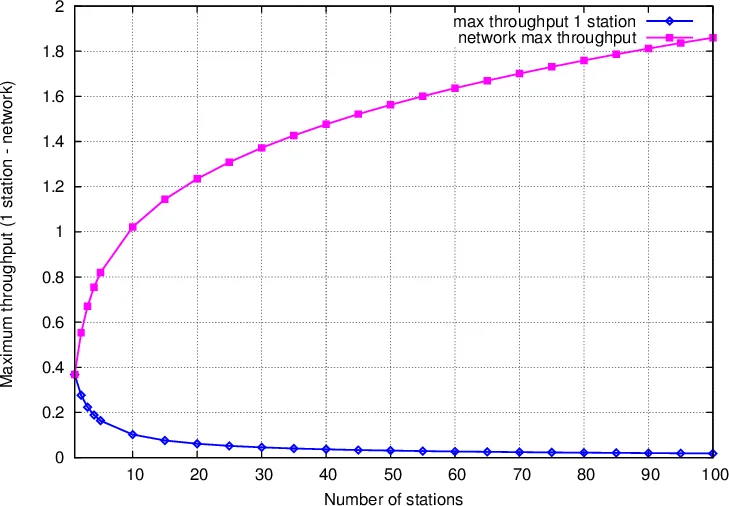
The purpose of this paper is to analyze the so-called back-off technique of the IEEE 802.11 protocol in broadcast mode with waiting queues. In contrast to existing models, packets arriving when a station (or node) is in back-off state are not discarded, but are stored in a buffer of infinite capacity. As in previous studies, the key point of our analysis hinges on the assumption that the time on the channel is viewed as a random succession of transmission slots (whose duration corresponds to the length of a packet) and mini-slots during which the back-o? of the station is decremented. These events occur independently, with given probabilities. The state of a node is represented by a two-dimensional Markov chain in discrete-time, formed by the back-off counter and the number of packets at the station. Two models are proposed both of which are shown to cope reasonably well with the physical principles of the protocol. The stabillity (ergodicity) conditions are obtained and interpreted in terms of maximum throughput. Several approximations related to these models are also discussed.
💡 Research Summary
The paper presents a rigorous stochastic analysis of the IEEE 802.11 broadcast mode when each station is equipped with an infinite‑capacity buffer. Unlike earlier works that discard packets arriving during a back‑off period, the authors retain them, thereby capturing the interaction between the back‑off mechanism and queueing dynamics. Time is discretized into two types of slots: a full transmission slot of length T (the time needed to send a packet) and a mini‑slot of length σ (used for carrier sensing). At each decision epoch a slot is a transmission slot with probability r and a mini‑slot with probability 1 − r; these events are assumed independent.
A station’s state is described by the pair (K,N), where K∈{0,…,W} is the current back‑off counter and N≥0 is the number of packets waiting in the buffer. Packet arrivals follow a Poisson process of rate λ. The evolution of (K,N) is a two‑dimensional discrete‑time Markov chain. The authors write the forward equations (3.3)–(3.4) that explicitly account for (i) arrivals during a transmission slot, (ii) arrivals during a mini‑slot, (iii) the decrement of the back‑off counter when the channel is idle, and (iv) the selection of a new back‑off value after a successful transmission. The “greedy” mode is defined by the rule that a transmission occurs immediately when K reaches zero, guaranteeing that the ensuing slot is a full transmission slot.
To obtain steady‑state probabilities p(k,n), the authors introduce generating functions F_k(x)=∑{n≥0}p(k,n)x^n. Transforming the balance equations yields a linear system (3.8)–(3.9) for the F_k’s. Solving this system recursively gives closed‑form expressions (3.11)–(3.14) in terms of two auxiliary functions a(x), b(x) and a correction term C(x). The normalization condition ∑{k,n}p(k,n)=1 leads to an explicit formula for the idle‑state probability p(0,0) (equation 3.15), where the constants
A =
Comments & Academic Discussion
Loading comments...
Leave a Comment