"Relativistic" particle dynamics without relativity
It is shown that the correct expressions for momentum and kinetic energy of a particle moving at high speed were already implicit in physics going back to Maxwell. The demonstration begins with a thought experiment of Einstein by which he derived the inertial equivalence of energy, independently of the relativity postulates. A simple modification of the same experiment does the rest.
💡 Research Summary
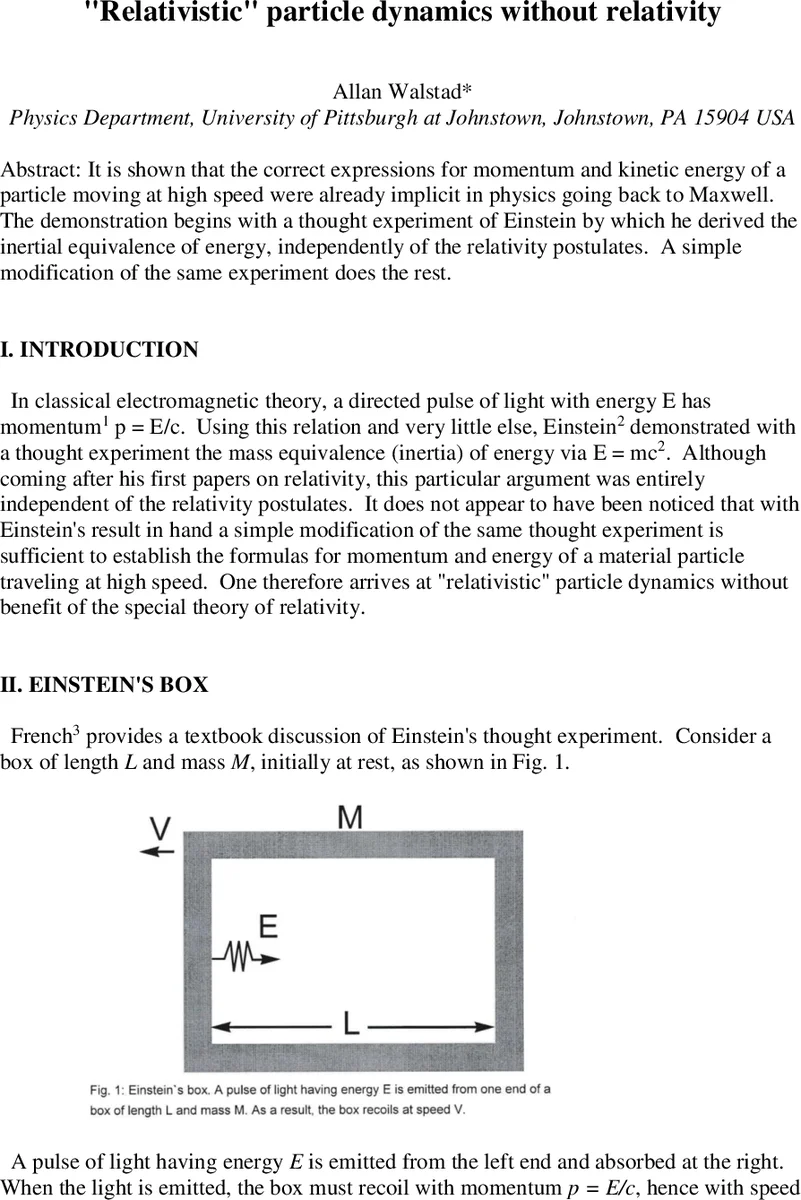
The paper presents a derivation of the relativistic expressions for momentum and kinetic energy that does not rely on the postulates of special relativity. The author starts from the well‑known “Einstein box” thought experiment, in which a box of mass M and length L emits a light pulse of energy E from its left end and absorbs it at the right. Because a light pulse carries momentum p = E/c, the box recoils with speed V = E/(M c). During the light‑travel time t = L/c the box shifts by δs = V t, apparently moving the system’s centre of mass. The paradox disappears if one assigns the light an effective mass δm = E/c², so that the loss of mass on the left balances the gain on the right and the centre of mass remains fixed. This argument uses only the inertial equivalence of energy (E = mc²) and Newtonian momentum conservation; no relativity principle is invoked.
The author then modifies the experiment by replacing the light pulse with a material particle of rest mass m, speed v, momentum p, and kinetic energy K (unknown at this stage). When the particle is emitted, the box’s mass is reduced by the total transferred mass m + K/c², while the particle carries the same amount to the opposite end. The recoil speed of the box is V = p/(M − m − K/c²). The particle traverses the distance L − δs while the box moves a distance δs = V t, where t = L/(v + V). Imposing the condition that the centre of mass of the isolated system does not move yields the relation
p = (m + K/c²) v.
This equation links the unknown kinetic energy K to the momentum p.
Next, the work‑energy theorem is applied. The work done on the particle is dK = F dz, with F = dp/dt, so dK = v dp. Substituting the previous relation for p and integrating gives
K = m(γ − 1)c², p = γ m v,
where γ = (1 − v²/c²)⁻¹ᐟ² is the Lorentz factor. Thus the familiar relativistic formulas for kinetic energy and momentum emerge solely from the mass‑energy equivalence and centre‑of‑mass conservation, without invoking the constancy of the speed of light or the relativity principle.
The paper reviews earlier attempts (French, Davidon) that arrived at the same formulas by assuming E = mc² and then “plugging” it into the Newtonian momentum expression p = mv. Those approaches required an extra, unjustified assumption, whereas the present derivation rests on a concrete physical thought experiment.
Finally, the author addresses a classic criticism of Einstein’s original box argument: the box cannot be perfectly rigid, so recoil cannot be transmitted instantaneously. By stripping the box down to two masses at its ends (each M/2) and allowing them to move independently, the same centre‑of‑mass shift appears if the light carries no mass. Introducing the mass δm = E/c² for the light restores centre‑of‑mass invariance, confirming Einstein’s conclusion even in the non‑rigid model. This analysis shows that the original paradox and its resolution are robust against the rigidity objection.
In sum, the paper demonstrates that the “relativistic” dynamics of a high‑speed particle can be derived from purely classical considerations—energy‑mass equivalence and conservation of centre of mass—without any of the special‑relativity postulates. This provides a pedagogically valuable route to the relativistic formulas and highlights how fundamental classical principles underlie modern physics.
Comments & Academic Discussion
Loading comments...
Leave a Comment