Dynamics over Signed Networks
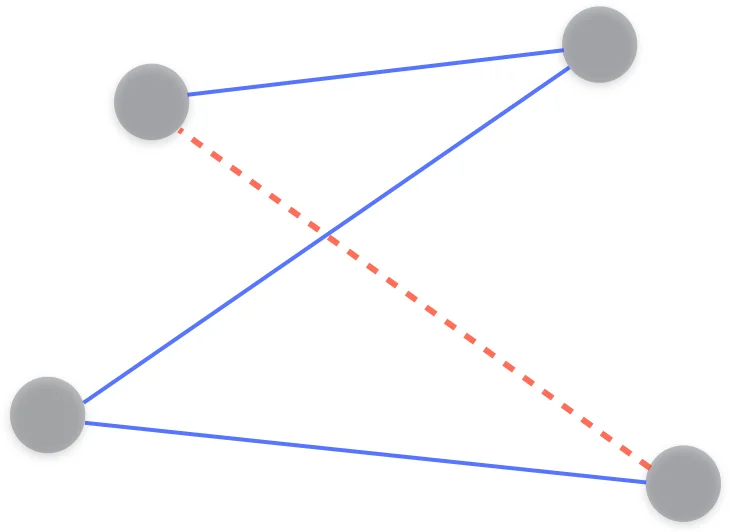
A signed network is a network with each link associated with a positive or negative sign. Models for nodes interacting over such signed networks, where two different types of interactions take place along the positive and negative links, respectively, arise from various biological, social, political, and economic systems. As modifications to the conventional DeGroot dynamics for positive links, two basic types of negative interactions along negative links, namely the opposing rule and the repelling rule, have been proposed and studied in the literature. This paper reviews a few fundamental convergence results for such dynamics over deterministic or random signed networks under a unified algebraic-graphical method. We show that a systematic tool of studying node state evolution over signed networks can be obtained utilizing generalized Perron-Frobenius theory, graph theory, and elementary algebraic recursions.
💡 Research Summary
The paper investigates the evolution of node states on signed networks, where each edge carries either a positive or a negative sign. Positive edges follow the classic DeGroot averaging rule, while negative edges are modeled by two distinct interaction mechanisms: the “opposing” rule, which pulls a node toward the opposite of its neighbor’s state, and the “repelling” rule, which pushes nodes away from each other. The authors develop a unified algebraic‑graphical framework that combines generalized Perron‑Frobenius theory, graph theory, and elementary algebraic recursions to analyze convergence properties for both deterministic and random interaction patterns.
The authors first formalize the signed graph G = (V, E) by separating it into a positive subgraph G⁺ and a negative subgraph G⁻. Degree matrices D⁺, D⁻ and adjacency matrices A⁺, A⁻ are defined, with A⁻ having entries –1 to reflect the sign inversion on negative links. Two Laplacians are introduced: the “opposing Laplacian” Lᵒ = L⁺ + Lᵒ⁻ and the “repelling Laplacian” Lʳ = L⁺ + Lʳ⁻. Their associated quadratic forms capture, respectively, the energy‑decreasing effect of both positive and negative links (for Lᵒ) and the energy‑increasing effect of negative links (for Lʳ).
Discrete‑time dynamics are written as linear updates. For the opposing rule the system evolves as
x(t + 1) = W_G x(t) = (I − αL⁺ − βLᵒ⁻) x(t),
and for the repelling rule as
x(t + 1) = M_G x(t) = (I − αL⁺ − βLʳ⁻) x(t).
Here α and β are non‑negative parameters governing the strength of positive and negative interactions, respectively. The matrices W_G and M_G become stochastic‑like when α + β is sufficiently small (e.g., α + β < 1/Δ_max, where Δ_max is the maximum node degree). Gershgorin’s circle theorem is used to bound the spectra of these matrices within the unit circle, guaranteeing non‑expansiveness under appropriate step‑size conditions.
A central contribution is the link between structural balance of the signed graph and the asymptotic behavior of the dynamics. Structural balance (Harary’s theorem) means the node set can be partitioned into two (or more for weak balance) subsets such that edges within a subset are positive and edges across subsets are negative. The authors prove:
-
Theorem 1 (Opposing rule) – If G is strongly balanced with partition V = V₁ ∪ V₂, then all nodes in V₁ converge to a common value equal to the average of the initial states weighted by the partition, while nodes in V₂ converge to the negative of that value (bipartite consensus). If G is not balanced, every node’s state converges to zero. The proof uses a gauge transformation (flipping the sign of states in one partition) that reduces the dynamics to a standard DeGroot consensus, for which classical convergence results apply.
-
Theorem 2 (Repelling rule) – Assuming the positive subgraph G⁺ is connected, if α is small enough (α < 1/Δ⁺_max) and β is also sufficiently small, the system converges to the zero vector regardless of the sign structure. However, if β exceeds a critical threshold, the spectral radius of M_G can exceed one, leading to divergence or the emergence of two opposite clusters, depending on the initial condition and the exact graph topology.
The paper then extends these deterministic results to random interaction models where, at each time step, a random subset of edges is selected (e.g., independent edge activation, gossip protocols). By taking expectations, the mean dynamics follow the same linear form with a weighted Laplacian that is the expectation of the random Laplacian. Using Markov chain convergence theorems and concentration arguments, the authors show that, with probability one, the same convergence or clustering outcomes hold provided the activation probabilities are positive for all edges and the step‑size constraints on α and β are satisfied.
Methodologically, the work unifies several previously disparate proof techniques—Lyapunov functions, graph lifting, observability analysis—under a single algebraic‑graphical approach. The generalized Perron‑Frobenius theory supplies the necessary spectral bounds for non‑negative matrices derived from absolute values of W_G and M_G, while the graph‑theoretic notions of balance dictate the structure of the invariant subspaces.
The authors discuss practical implications for systems where antagonistic relationships coexist with cooperative ones, such as political opinion formation, neural inhibition networks, and trust/distrust social platforms. They suggest that the presented framework can be adapted to more complex settings, including nonlinear saturation, time delays, asynchronous updates, and multilayer signed networks.
In summary, the paper provides a comprehensive, mathematically rigorous treatment of consensus‑type dynamics on signed graphs, clarifying how the interplay between positive and negative links, the choice of interaction rule, and the underlying structural balance determines whether the network reaches agreement, bipartite agreement, or collapses to a neutral state. The unified algebraic‑graphical method offers a powerful tool for future research on complex networks with mixed cooperative and antagonistic interactions.
Comments & Academic Discussion
Loading comments...
Leave a Comment