Learn to Fly: A Distributed Mechanism for Joint 3D Placement and Users Association in UAVs-assisted Networks
In this paper, we study the joint 3D placement of unmanned aerial vehicles (UAVs) and UAVs-users association under bandwidth limitation and quality of service constraint. In particular, in order to allow to UAVs to dynamically improve their 3D locati…
Authors: Hajar El Hammouti, Mustapha Benjillali, Basem Shihada
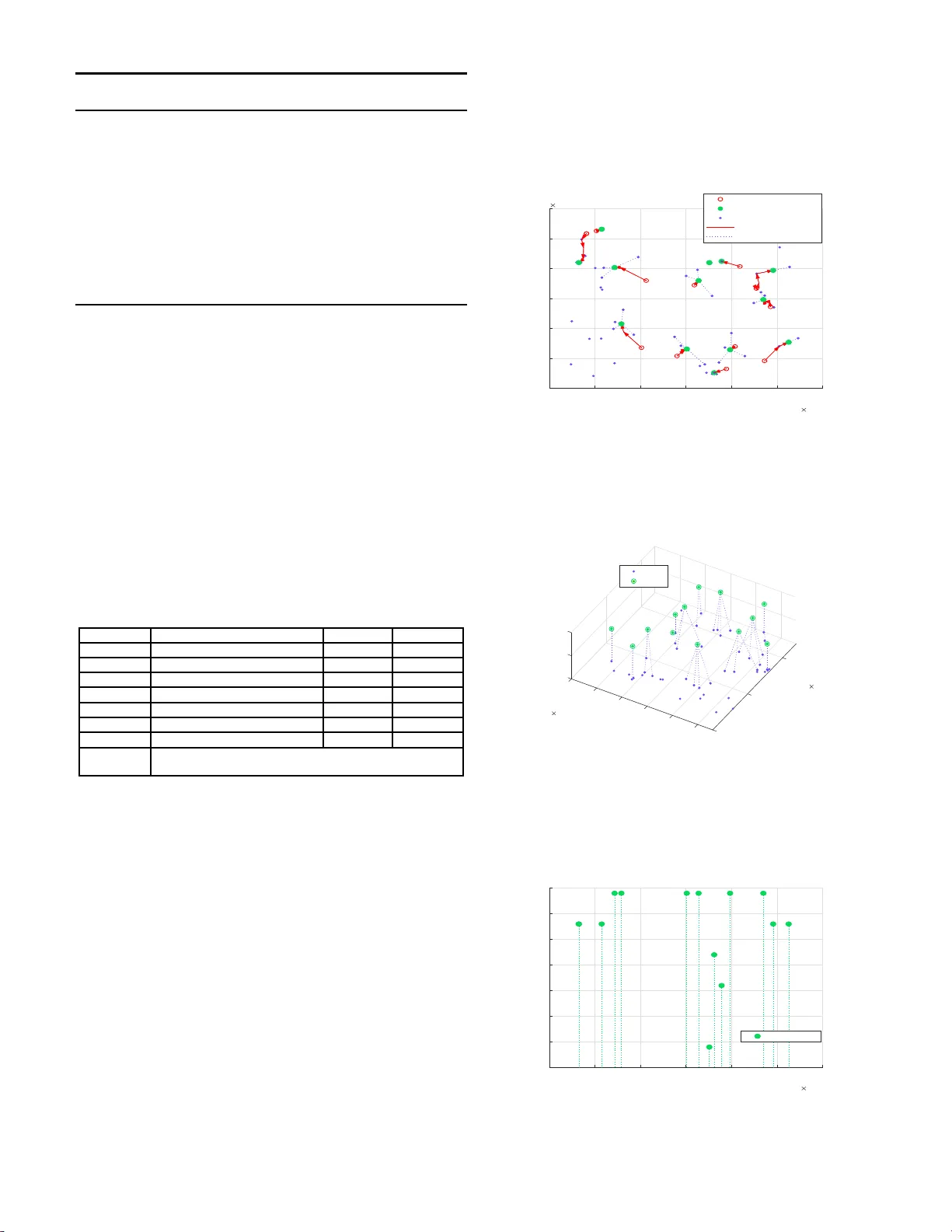
Learn to Fly: A Distrib uted Mechanism for Joint 3D Placement and Users As sociation in U A Vs-assisted Networks Hajar El Hammouti ∗ , Mustapha Benjillali † , Basem Shihada ∗ , and Mohamed-Slim Alouini ∗ ∗ King Abdullah University of Science and T echnolog y (KA UST), Thuwal, KSA. {hajar .hamm outi,basem. sh ihada,slim.alouini}@kaust.edu.sa † STRS Lab, National Institute of Posts and T elecommunica tions (INPT), Rabat, Morocco . benjillali@ieee.org Abstract —In this paper , we study th e joint 3D placement of unmanned aerial vehicles (U A Vs) and U A Vs-users association under bandwidth limitation a nd quality of serv ice constraint. In particular , in order to allow to U A Vs to dynamically impro ve their 3D locations in a distributed fashion wh ile maximizing the network’ s sum-rate, we br eak the underlying optimization into 3 subproblems where we separately solve the 2D U A Vs positioni ng, the altitude optimization, and the U A Vs-users association. First, giv en fixed 3D positions of U A Vs, we propose a fully distributed matching based association th at alleviates th e bottlen ecks of bandwidth allocation and guarantees the required qu ality of service. Next, to address the 2D p ositions of U A Vs, we adopt a modified v ersion of K-means algorithm, with a distributed im- plementation, wher e U A Vs dynamically c hange their 2D positions in order to reach the barycenter of the cluster that i s composed of the ser ved ground users. In order to optimize the U A Vs altitudes, we stud y a n aturally defined game-theoretic versio n of the problem and sh ow that u nder fixed U A Vs 2D coor dinates, a predefined association scheme, and limited - i nterferences, the U A Vs altitudes game i s a n on-cooperativ e potential game where the players (U A Vs) can maximize the limited-i n terference sum- rate by only optimizin g a local utility function . Th erefor e, we adopt the best response dynamics to reach a Nash eq uilibrium of the game wh i ch is also a local optimum of the social welfar e function. Our simulation results show that, using the proposed approach, the network’ s su m rate of the studied scenario i s impro ved by 200% as compared with the trivial case where th e classical version of K-means is adopted and users are assigned, at each i teration, to the closest U A V . I . I N T R O D U C T I O N As cities g row and b ecome more d ev eloped, they rely on more technolo gy to offer a wide rang e of sop h isticated services and improve citizens quality of life. On e of these key technolog ies, tha t is playing and will co n tinue to play a v ital role in today’ s and futur e smart cities, is the unman n ed aerial vehicles ( U A Vs) technolo gy , also known as dr ones . In the near future, thousand s of d rones are expected to navigate au- tonomo usly o ver cities to d eli ver a plethor a of services such as traffic reporting, package delivery and public surveillance [ 1 ]. The main virtue of such technology is the high mo b ility o f drones, their rapid dep loyment, and th e extremely wide range of services they can p rovide. Howe ver , dep loying U A Vs will pose a number of challenges. Clearly , wh en a drone is used to acco mplish some given tasks, it is e ssential to design its trajectory , minim ize its energy , and m aximize the pro fit of its mission. Fu rthermor e, in order to co ntrol the dron e remotely and to co m municate with groun d users, it is important to study the nature of the air -to-gro und channel [ 2 ], ma n age interferen ces [ 3 ] a nd ac h iev e the quality of service that satisfi es the communica tion requ irements [ 4 ]. In this pa p er , we study the joint optimizatio n of 3 D posi- tioning of UA Vs and th e users-UA Vs association . Although a num ber o f recen t work s hav e p rovided v arious app r oaches to approxim ately solve such an optimiza tio n pro blem, the majority of these works typically set up centralized alg o- rithms to reach the best n etwork p erforma n ce. W e believe that the dyn amic nature of the surrou nding environment and the growing size of to d ay’ s networks m ake it extremely d ifficult to implem ent centralized schemes to achie ve o p timal/near- optimal solutions. Th erefore, th e main th rust of this pape r is to design a distributed algorithm that can be implemented on U A Vs in o r der to achieve reliable and efficient solutions by only using local inform ation. A. Rela ted W ork A large body of recent work is av ailable in the litera ture that add resses resource allocatio n for UA V networks. In [ 5 ], authors study small-cells-U A Vs association under b a ckhaul capacity , band width constraint, and maximum numbe r of links limitation. They pre sent a distributed g reedy a pproach of lo w complexity , to improve the users sum rate. Although not pre - cised in [ 5 ], their gr eedy ap proach is only a 1 2 -appro ximation algorithm and, thus, cannot always guarantee a good sum rate perfor mance. In [ 6 ], the authors inves tigate the mean p acket transmission delay min imization for u p link c ommunica tions in a multi-layer UA Vs relay network. A gradient descent approa c h based on Bisection method is propo sed to find the optimal power and spectrum allo cation in a two-lay er U A Vs network. Unlike the p revious work s where the 3D placement of U A Vs is no t considered, authors in [ 7 ] propose an algorithm to a d just the U A V path in order to maximize a lower b ound of the users su m rate over th e uplink ch annel. T h eir o ptimization problem is solved using a line search for b o th time- and space- division multiple acce ss. A single UA V placeme n t is also in vestigated in [ 8 ] wher e the author s objecti ve is to maximize the n umber o f covered users while minimizing the transmit power of dron es. The U A V horizon tal and vertical location s are optimized separately witho ut any lo ss of glo bal optim a lity . The optimal altitude is fou nd b y solving a conve x decou - pled optimization p roblem, while the optimal 2D location is achieved by findin g a solution to the smallest en closing circle problem. Au thors in [ 9 ] study the pro blem of UA Vs placement in o rder to minim ize the deploymen t delay . T he authors propose an alg orithm o f lo w complexity to maxim iz e the coverage of a target area using heteroge n eous U A Vs of different cov erage radii and flying speeds. The afor ementioned works eith e r consider a sing le U A V setup or multiple UA Vs in interferen ce-free en vironm ent. In gener a l, optimizin g the U A V placement, in isolatio n , is equ i valent to find in g the optimal 3D loc a tion tha t provides a good pro bability of lin e-of-sigh t, but at the same tim e, d oes n ot result in an importan t p ath loss. In the presen ce of interfer ences, an additional constraint should be considered as UA Vs locations are tightly related to interferen ces a n d any inapp ropriate positionin g of the UA V may sev er ely a ffect the network perform a nce. Authors in [ 10 ] present a heuristic particle swarm opti- mization alg orithm to find th e 3D placement of UA Vs in order to maximize, under inter ferences, the u sers sum rate. In their prob lem formulation , the au th ors consider the presence of a macro base station with a large bac k haul b a ndwidth to serve delay-sensitive users. Under this assumption, th e optimal prop ortion of resource s allocated to U A Vs backhau l is determine d thro ugh a decomposition process that yields in a conve x optimization p roblem. Altho ugh th e pr oposed algorithm provides apprec iab le perfor mance, it sug gests a cen- tralized implem entation wh ich can inv o lve a large num ber of signaling messages a nd require a hig h computa tio nal effort. A distributed alg orithm to improve the coverage region o f d rones is espe c ially con sidered in [ 11 ]. Th e auth o rs assume th at th e positions of Internet of Thin gs (I oT) devices ar e permanently changin g an d provide a feedback based distrib uted algo rithm to max imize the coverage r egion of d rones while keeping them associated in clusters. The pro posed algo rithm still requires a centralized info rmation pertaining the coordin a tes of th e clusters center s in ord e r to reach a good network co nfiguration . B. Con tribution In this paper, we are interested in an urban type en v i- ronmen t where aerial base stations are d eployed to suppo rt damaged /overloaded gr ound base stations. Our o bjectiv e is to efficiently place the UA Vs in the 3D plan and associate th e users with the U A Vs in or der to reach an optim a l v alue of the overall sum rate o f the n etwork. Being non -conve x and NP- hard, the stu d ied prob lem can not be solved using c la ssical con - vex o ptimization meth ods. Therefo re, we break the underlying optimization into 3 subprob lems where we separ ately solve the 2D UA Vs p ositioning, the altitude optimization, and the U A Vs-users association. The p roposed solu tions ar e combined into a global distributed alg orithm that iter a tively r eaches an approx imate so lution in only a f ew iteratio ns. T o su mmarize, our contributions can be described as follo ws. 1) I n order to address the UA Vs-users assignment, we pro- pose an efficient match in g associatio n scheme th at is fu lly distributed, th at alleviates the bo ttlenecks of band width allocation and guarantees th e required qua lity of service. 2) W e update the U A Vs 2D coor d inates usin g a m odified K-means appro ach tha t locally maximizes the sum ra te of the gro und users. W e sho w th r ough simulatio n results that the pr oposed u p dating ru le presen ts a better sum rate p erforman ce when comp ared with th e classical K- means algor ithm primar ily used to min imize the su m of distances. 3) I n o rder to optimize th e U A Vs altitudes, we study a naturally defined game-theor etic version of the pr oblem and show that u nder fixed U A Vs 2D coord in ates, a predefined association schem e, and limited inte r ferences, the U A Vs altitudes game is a non-co operative potential game w h ere the play ers ( U A Vs) can ma ximize the ov erall sum rate by only o ptimizing a local utility function . T o this e n d, we prop ose a distributed appr o ach based on a local neighbor h ood structure to achieve an ef ficient altitude solution. 4) Ou r simulation r esults show that appreciab le perform ance can be reached as co mpared with classical K-means an d closest U A V association . C. Structure The rest of the paper is organ ized as fo llows. The next sec- tion d escribes the studied system model. Section III presents the general optimization pro blem. In Section IV , the proposed approa c h is described. Simulation results are described in Section V . Finally , co ncluding rem arks and possible extension s of this work are provided. D. Notatio n s Let M and m ij denote the m atrix and its ( i, j ) -th entry respectively . T he set d enoted by S × C r epresents th e Car te - sian prod uct o f S and C . E g is the expectation regarding random v ariable g . V ectors ar e de noted using b oldface letter s x w h ereas scalars are deno ted by x . |C | denotes the cardinality of the set C . Throu ghout the pap er , the w ords U A Vs and aerial base stations ( ABSs ) are used interchang eably . I I . S Y S T E M M O D E L A. Ba se Stations Deployment Consider an ar ea A where the ground base stations (GBSs) form a h omogen eous Poisson po int pro cess (HPPP), Φ G , o f intensity λ G . Assume that a nu mber of GBSs is not ope r ational or un der-functioning du e to a congestion (e.g . durin g a temp o- rary mass ev ent) or a m alfunction (e.g . a po st-disaster scena rio) of the infrastructu re. Th e overload ed/damaged base station s are modeled by an indepen dent thinnin g of Φ G with a proba- bility p . In or d er to sup port the terr e strial network, a numb e r of aerial base stations (ABSs) is deployed follo wing a 3D HPPP , Φ A , with the same intensity as the overload e d/damaged base stations. Acco rding to Slivnyak’ s theorem [ 12 ], this intensity is equ al to pλ G . Let B G and B A be rea liza tio ns of Φ G and Φ A respectively . W e deno te by ( x A , y A , h ) the 3D positions matrix of all ABSs, with ( x A , y A ) the 2D location s of ABSs and h their altitudes vector . Let U be the set of ground users that need to be served by th e ABSs. A lth ough n ot all the GBSs are overload e d/damaged , we assume, th rough o ut the paper , that ground u sers are allowed to associate with ABSs only in order to av oid any addition al load to th e terrestrial network. B. Air-to-Gr oun d Cha nnel Model In ord er to ca p ture the d istor tion of th e signal du e to obstruction s, we consider the widely adop ted air-to-groun d channel mod el where the commu nication link s are either line-of-sig h t (LoS) or non-line- of-sight (NLoS) with some probab ility that dep ends on both the UA V’ s altitude and the elev ation angle between the user and the ABS. Given a UA V j with an altitude h j and a user i with a distance r ij from the projected p o sition of the U A V o n the 2 D plane, the p robability of LoS is given by [ 2 ] p LoS ij = 1 1 + α exp( 180 π arctan h j r ij − α ) , (1) where α an d β are en v ir onment depend ent parame te r s. Ac- cording ly , th e path loss betwe e n UA V j and u ser i , in d ecibel, can be written L dB ij = 20log 4 π f c q r 2 ij + h 2 j c ! + p LoS ij ζ LoS + (1 − p LoS ij ) ζ NLoS , (2) where th e first term formulate s the free space p ath loss that depend s o n the carrier frequency f c and the speed of the light c . Parameters ζ LoS and ζ NLoS represent the additio nal losses due to LoS and NLoS links respectively . C. A verage spectr al efficiency W e con sider downlink co m munication and assume that each groun d/aerial base station j transmits with power P j . Henc e , when a frame is tran smitted by an ABS j , it is received at user i with the power P j g ij L ij , whe r e g ij accounts for th e multipath fading tha t is c o nsidered to follow an exponen tial distribution with mean µ . The quality of the wireless lin k is measured in terms of SINR, γ ij , defined as follows γ ij = P j g ij L ij σ 2 + P k 6 = j,k ∈B A ∪B G P k g ik L ik , (3) where σ 2 represents th e power of an ad d iti ve Gaussian no ise. According ly , th e a vera ge spectral efficiency rece ived at a user i f rom an ABS j , η ij , can be d e fined using Sha nnon capac ity bound as the following η ij = E g log 2 (1 + γ ij )] . (4) Assume e a ch g round u ser i has a rate r e quest of R i . Then, in order to satisfy the user’ s request, U A V j needs to adjust the allocated b andwidth b ij accordin g to the quality of th e link such that R i = b ij η ij . (5) I I I . P R O B L E M F O R M U L AT I O N Let A = ( a ij ) b e the u sers-ABSs association matrix. Ou r objective is to maximize the aggregate rates requ ested by all the groun d users by optimizing , jo intly , the u sers-ABSs association (i.e. A = ( a ij ) ) and the 3D placem ent of ABSs (i.e. ( x A , y A , h )) in a w ay that the bandwidth limitation for all ABSs is always r e sp ected and th e constraint on th e quality of service is n ot violated. Ou r constrained o ptimization problem is formulated as follows. maximize A , ( x A , y A , h ) X j ∈B A X i ∈U a ij R i (6a) sub ject to X i a ij b ij ≤ B j , ∀ j ∈ B A , (6b) a ij η ij ≤ 1 η min , ∀ ( i, j ) ∈ U × B A , (6c) x min ≤ x A j ≤ x max ∀ j ∈ B A , (6d) y min ≤ y A j ≤ y max ∀ j ∈ B A , (6e) h j ∈ H ∀ j ∈ B A , (6f) X j a ij ≤ 1 , ∀ i ∈ U , (6g) a ij ∈ { 0 , 1 } , ∀ ( i, j ) ∈ U × B A (6h) Constraint ( 6b ) ensures that the limitation on the ba n dwidth resource of each UA V is respe c te d (each U A V j h as a band- width limit B j ). Constraint ( 6c ) guaran tees that the av erage spectral ef ficiency is no less than a predefined threshold η min . Constraint ( 6d ) and ( 6 e ) show that it is n ecessary that the ABS 2 D co ordinates b elong to the target area. M oreover , constraint ( 6f ) ensures that the UA Vs altitudes will belong to the allowed flying altitude values d escribed in the set o f discrete altitudes H . Constraints ( 6g ) and ( 6 h ) restrict the groun d user to be associated , at most, with one ABS. In p ractice, p roblem ( 6 ) is no t ea sy to solve as it in volves a n o n-conve x ob jec ti ve function , non-conve x constraints (( 6c ) and ( 6h )) and a no n -linear constraint (in ( 6 c )). Clear ly , the underly ing o p timization p roblem is a mix ed inte ger n on-linear problem (MIN L P) that is NP-h ard. Finding an o ptimal solution to suc h a problem ma y inv olve searc h ing over continu ous 3D coordin ates for all ABSs and for every possible users-ABSs association. In the following, we propose a d istributed approach b ased on a loc a l neigh b orhoo d structure to achieve an efficient global solution to the unde r lying optimiza tio n p roblem. I V . P RO P O S E D A P P RO AC H As stated befor e, the problem under analysis is m athemati- cally challenging and finding a g lobal optimal solution cannot be achiev e d using classical con vex optimization methods. Our objective is to comp ute an app roximate solution, that is not necessarily o ptimal, but that can b e r e ached in only a few number of iteration s. Our idea is to break up the studied problem into sub problems that ar e locally solvable using combined low-complexity algorithm s. A. Efficient U A Vs-users Matching T o deal with the target optimization , we first assume fixed 3D locations of UA Vs and propose a suitable distributed mechanism for U A Vs-users association. The proposed mech- anism is ach ie ved using Gale-Sh a pley matchin g [ 13 ] where the prefer ences of th e U A Vs, on one hand, and the u ser s on the other hand, are b oth based on the q uality of service (i.e. the a verag e spectr al ef ficiency). At each step of the algorithm, each user i prefer s the U A V j that maximizes its η ij , an d similarly , each UA V j , on its turn , pref ers to serve th e u ser i that requires the lowest b ij = R i η ij to maximize th e number of its served users. A description of the proposed algorithm is giv en in Algorithm 1 . Algorithm 1 Users-ABSs Matchin g 1: Initializat ion 2: For each user i , sort η ij = R i b ij in a decr easing order such that η ij > η min , and establish a list L i 3: For each ABS j , sort b ij = R i η ij in an increasing o rder, and establish a list L j 4: a ij = 0 fo r each user i and ABS j 5: repeat 6: for i ∈ U do 7: i reque sts to conn ect to j = argmax k ∈L i { η ik } 8: if i = a rgmin s ∈ L j { b sj } & P c ∈ U , c 6 = i a cj b cj + b ij ≤ B j then 9: a ij = 1 10: else P c ∈U , c 6 = i a cj b cj + b ij > B j 11: if There exists a user s s.t. b ij < b sj & a sj = 1 & P c ∈U , c 6 = i,s a cj b cj − b sj + b ij < B j then 12: a ij = 1 , a sj = 0 13: else 14: L i = L i \{ i } & L j = L j \{ j } 15: until Bandwidth limit is reache d o r each u ser has been either connected , o r rejected by all its preferred ABSs. First, each user selects the ABSs that sati sfy co n straint ( 6c ), and sorts them in a decreasing order by com paring their spectral efficiencies. At this step, ea c h user has its own list of preferr ed ABSs (line 2 ). Sim ilar ly , each ABS establishes its list of prefer r ed users by comparing the requested bandwidths (line 3 ). Each user send s a request to conne ct to its most preferr ed ABSs (line 7 ). Each ABS accepts its most pr e ferred users one b y one until its bandwidth limit is reached and rejects the r emaining users (lines 8 and 9 ) . Each rejected u ser attempts to connect to its second most preferred ABS, if no more bandwidth is le f t on this ABS, the ABS can discon nect a less desire d user a n d replace it by the new one (lin e s 11 and 1 2 )) . Other wise, the user and ABS are mutually removed from their r espectiv e pref e rence lists (line 14 ). The a lg orithm stops whe n all ABSs h a ve reached their band w id th limit or each user has been either connected, or rejected b y all its preferr ed ABSs (line 15 ). B. 2D Placem e nt At this stage of th e paper, we will o nly deal with the 2 D placement of U A Vs. I n particular, we assume tha t the users- ABSs association scheme is the one describe d in Subsec- tion IV -A and th at the altitud es for all ABSs are fix e d at some random values. The UA Vs altitud e s are addressed separately in Subsection IV -C . Ou r ob jectiv e is to move the UA Vs towards their served groun d u sers in the 2D plan, in sequential steps, so that the quality of the link for each gro up is improved, and ev entually , m ore bandwidth is left to serve additional u sers. T o this end, we pro pose a modified version of K -me a ns algorithm [ 14 ] (with K = |B A | ) that operates in a distributed and asynchro nous (sequen tial) fashion . Th is modified version positions the U A Vs as the bar ycentre of the served UA Vs instead of the bar ycentre o f the closest users as it is the case for the classical K -mean s algorithm . The proce d ure of the U A Vs 2 D placem e n t via the mo d ified version of K -means is presented in Algorithm 2 . Algorithm 2 2D Placemen t Optimization 1: Initializat ion 2: For each ABS j , ( x A j (0) , y A j (0)) are c h osen randomly within the target ar ea A 3: For each ABS j , C j = ∅ 4: repeat 5: f o r j in B A do 6: if j is active then 7: for i in U do 8: Update η ij 9: Update A accord ing to Alg o rithm 1 10: if a ij = 1 then 11: C j = C j ∪ { i } 12: x A j ( t + 1) ← P i ∈C j x i |C j | 13: y A j ( t + 1) ← P i ∈C j y i |C j | 14: until U A Vs cannot improve their 2D locations or nu mber of iterations has reached a predefin ed th reshold. Giv e n K initial positions of ABSs ( x A (0) , y A (0)) (line 2 ), the algor ithm groups the u sers with th eir serving ABSs deter- mined u sing the association scheme described in Algorithm 1 (line 9 ). According ly , each UA V’ s 2D position is upda ted as a barycentre of its cluster (lines 12 an d 13 ). The algorithm is implemented on bo ard of each ABS in an asynchron o us way where each ABS u pdates its state depending on its own clock (line 6 ). Each U A V h as two states: a c tive and dorm ant. In the activ e state, the ABS updates its 2D co ordinates while in a dorman t state, the U A V sleeps in order to sa ve its energy and reduce exchanged signaling messages. When the position of a U A V is u pdated, th e feed backs of the users are upd ated as well: the U A V serving each user may change . This pr ocess is then repeated until no ne of the UA Vs 2D locations are up dated or the number o f iterations reaches a pred efined th reshold (line 14 ) 1 . C. A ltitu de Optimization In th is subsection, w e optimize the U A Vs altitude given fixed 2D coo rdinates of UA Vs an d a predefined association scheme, specifically , the one described in Subsection IV -A . 1) Defi nitions: Thro ughou t this sectio n, we ad opt th e fol- lowing d efinitions. • Neighborhood : two base stations (regardless the fact of b eing gr o und or aer ial base stations) are c onsidered neighbo rs if there exists at least one u ser tha t is covered by bo th b a se stations when they ar e at their max imum coverage. In mathematical words, the neig h borho od of a base station j ca n be defined as f ollows. N j ( τ ) = { k ∈ B A ∪ B G , ∃ i ∈ U s.t. max h j P j L ij > τ and max h k P k L ik > τ } , (7) where τ is the r eceiv ed signal thr eshold. Note that such a th r eshold is defined on the received power a veraged over sm a ll-scale (multipath) fading. For ease of notation, we will remove the ’ d ependen cy’ on τ in the rest of the paper, and note N j instead of N j ( τ ) . • Local sum rate function : is the function that comp utes the sum rate over a local neighbo rhood set. Thus, instead of considering the social welfare of all base stations with all interference s, on ly rates from neighb o ring base sta- tions with lim ited interference s (coming fro m neighbo r s) are considered . Accord in gly , for each ABS j , the local sum rate is giv en by U j ( h ) = X l ∈N j X i ∈U a il b il E log 2 1 + P l g il L il σ 2 + P k ∈N j , k 6 = l P k g ik L ik . (8) Note th a t when τ = 0 the local su m rate f unction coincides with the social welfare provid ed by th e global objective function in equation ( 6a ). • Nash equilibrium (NE): A strategy p rofile h is a Nash equilibriu m o f a gam e G if for each player j , ∀ h j 6 = h ∗ j [ 15 ] U j ( h ∗ j , h ∗ − j ) ≥ U j ( h j , h ∗ − j ) , (9) where h − j refers to the altitude s vector of UA Vs other than j . At a Nash equilibrium n o p layer has the incentiv e to unilaterally change its strategy . • Potential game : In gam e th eory , an inte r esting class of games called potential games has a specific prop erty: the NE is a local o ptimum of the social welfare f unction also called a poten tial function . Let X be a set of strategy profiles of a gam e G . G is a po tential game if there exists a p otential fu n ction F : X − → R such that fo r each player j , ∀ ( h j , h − j ) and ( h ′ j , h − j ) ∈ X [ 16 ] F ( h j , h − j ) − F ( h ′ j , h − j ) = U j ( h j , h − j ) − U j ( h ′ j , h − j ) . ( 1 0) 1 The c on verge nce of suc h a pro cess to a s table equilibrium is left a s part of fu ture work 2) A ltitu des adju stment : Let F ( h ) be the sum rate of all users where only interferences from neighbor in g base stations are considered. This function is given by F ( h ) = X j ∈B A X i ∈U a ij b ij E log 2 1 + P l g ij L ij σ 2 + P k ∈N j , k 6 = j P k g ik L ik . (11) In ord er to account for th e neighbo rhood an d altitudes in the av erage spectral ef ficiency , we set the following notation η N j ij ( h j , h − j ) = E log 2 1 + P l g ij L ij σ 2 + P k ∈N j , k 6 = j P k g ik L ik , (12) where L ij is the p ath loss when UA V j is at altitude h j . Hence, when a U A V j changes its altitude g iven fixed altitudes of its oppon ents, th e difference in the limited-interf e rence sum- rate can be written F ( h j , h − j ) − F ( h ′ j , h − j ) = X l ∈B A \N j X i ∈U a il b il η N l il ( h j , h − j )+ X l ∈N j X i ∈U a il b il η N l il ( h j , h − j ) − X l ∈B A \N j X i ∈U a il b il η N l il ( h ′ j , h − j ) − X l ∈N j X i ∈U a il b il η N l il ( h ′ j , h − j ) . (13) Notice that the term P l ∈B A \N j P i ∈U a il b il η N l il ( h j , h − j ) is indep e n - dent of ( h j , h − j ) as it does not in volve U A V j neighb orhoo d. Therefo re, F ( h j , h − j ) − F ( h ′ j , h − j ) = X l ∈N j X i ∈U a il b il η N l il ( h j , h − j ) − X l ∈N j X i ∈U a il b il η N l il ( h ′ j , h − j ) = U j ( h j , h − j ) − U j ( h ′ j , h − j ) . (14) The following Proposition arises f rom the previous analy- sis. Proposition 1. Let G b e the game wher e the U A Vs ar e considered as players and the altitud e s ar e their p laying strate gies. The game G is a potential g ame wher e the function F defin ed b y equation ( 11 ) is the potential function. The following result is an immediate conseq uence of Propo- sition 1 [ 16 ]. Corollary 1. I n a po te n tial game, a global optimu m of the potential function is a Nash equ ilibrium. Mo r eover , any Nash equilibrium is a local optimum. According ly , in order to re a c h a local optimum of the limited-interf erence sum rate F , we can only target a NE. T o this end, we ad opt Algo rithm 3 , ba sed o n best-r esponse dynamics, to help U A Vs to adaptively learn h ow to play a NE over iteration s [ 17 ]. Assume fixed 2 D locations o f U A Vs (lin e 2 ), each U A V maximizes its utility U j over a set of discrete altitude’ s values H given fixed altitud es of othe r ABSs (line 6 ). Subsequen t Algorithm 3 Best-Response Dyn amics for Altitudes Adjust- ment 1: Initializat ion 2: Let ( x A , y A ) b e the 2D locations vecto r obtain ed using Algorithm 2 3: For each U A V j , deter m ine its ne ighborh ood 4: repeat 5: for j ∈ U do 6: h ∗ j = a rgmax h ∈H U j ( h, h j ) 7: Update η ik for all neighb ors of k ∈ N j 8: Update A using Algorithm 1 9: until A NE is reached. changes are therefore fed b ack to the n eighbor s resulting in updates of the associatio n m atrix using Algorithm 1 . Th is process is repeated until con vergen c e to a NE 2 (line 9 ). Such process results in a local optim um of F g iv e n fixed 2D positions o f th e UA Vs a n d the p redefined association scheme . V . S I M U L A T I O N R E S U LT S A. Simu lation Setup In order to stud y the per f ormance o f the pro posed app r oach, we consider 1km × 1km ar ea where a number of GBSs with intensity λ G = 0 . 22 ∗ 1 0 − 4 are ran domly scattered. Assume f c = 2 GHz, P j = 10 dB m for all base stations. In order to co mpute the a verage spectr al efficiency , we use Mo nte Carlo simulation s with 500 0 runs. The simulation settings are summarized in T ABLE. I . Parame ter V alue Parame ter V alue R i Random from [90 , 100] Mbp s α 9 . 61 β 0 . 16 c 3 . 10 8 m /s ζ LoS 1 dB ζ NLoS 20 dB η min -20 dB τ -69 dBm µ 1 p 0.35 λ G 0 . 22 ∗ 10 − 4 GBS per m 2 |U | 46 H { 40 , 100 , 160 , 220 , 280 , 340 } m σ 2 -100 dBm U A Vs { 756 , 696 , 567 , 737 , 968 , 631 , 814 , bandwidt h 573 , 930 , 796 , 742 , 767 , 712 } MHz T ABLE I: Simulation Settings. B. Resu lts Fig. 1 plots the p ositions of U A Vs in the 2D plan . As depicted in the figure, ABSs dynamica lly change their 2D positions. Starting from their initial p o ints ( dots in r e d), the U A Vs move towards the served users in a few steps bef ore reaching th eir final destination (do ts in green) co nsidered as the b arycenter o f the ir served users. Clearly , d u e to the band- width limitation and the quality of service constrain t, some users are left witho ut co nnectivity . In the studied scena rio, 30 users fr om a total o f 46 un iformly d istributed user s are finally connected to the U A Vs. It is importan t to note that the K-means algorithm conver g ence de pends on the initial values of th e network config u ration: different in itialization 2 Con verg ence of best response dynamics to a NE has been proved in many works, e.g. [ 17 ]. vectors would lead to d ifferent fin a l results. So m e initialization proced u res can howev er be used to improve the con vergence results of K-means [ 14 ]. 10 5 10 6 P S f r a g r e p l a c e m e n t s UA V Start Point UA V Final Point User UA V Movement User-U A V Association x ( m ) y ( m ) 4 . 466 4 . 468 4 . 47 4 . 472 4 . 474 4 . 476 4 . 478 5 . 4118 5 . 412 5 . 4122 5 . 4124 5 . 4126 5 . 4128 5 . 413 Fig. 1: Movement of UA Vs in 2D plan. 12 10 5 10 6 9 13 11 8 3 7 1 6 5 4 2 10 P S f r a g r e p l a c e m e n t s x ( m ) y ( m ) h ( m ) 4 . 465 4 . 4 6 8 4 . 47 4 . 477 4 . 4 7 4 4 . 4 7 6 4 . 4 7 8 5 . 4 1 1 8 5 . 412 5 . 4122 5 . 4124 5 . 4126 5 . 4128 5 . 413 3 5 0 400 200 0 User UA V Fig. 2: Final 3D placement and UA Vs-users association. 10 5 1 2 3 4 5 6 7 8 9 10 11 12 13 1 2 3 4 5 6 7 8 9 10 11 12 13 P S f r a g r e p l a c e m e n t s Final Height x ( m ) h ( m ) 350 300 250 200 150 100 50 0 4 . 466 4 . 468 4 . 47 4 . 472 4 . 474 4 . 476 4 . 478 Fig. 3: Final heights of UA Vs. P S f r a g r e p l a c e m e n t s Proposed Appr o ach .................... Closest Association Sum-rate (Mb ps) Number of Iterations 3000 2500 2000 1500 1000 500 0 0 20 40 60 80 100 120 Fig. 4: Sum rate conv ergence. Fig. 2 shows the final 3 D U A Vs placemen t an d users association. As expected, the U A Vs stand at the center of the served u sers cluster s. Here, it is worth mentionin g that the served users ar e obtained using Algorithm 1 . Notice that when an ABS has o nly one user to serve, it simply stan ds above the served user in order to improve the L o S probability and enha nce the quality o f the link . This is for example the case of ABS 3. The final heights of ABSs are better shown in Fig. 3 where these altitudes are plotted v s UA Vs x-co ordinates. It can be seen fro m the figure that U A Vs ad just their heigh ts in order to redu ce interferences. F or example, one can remark from Fig. 2 that ABSs 6, 9 and 13 are neighbo rs. On the other han d, Fig. 3 shows that e a ch ABS has c on verged to a different heig ht value which would redu c e interferen ces and, thus, improve the per formanc e over this neighb orhoo d . Fig. 4 plots the c on vergence of the prop o sed approach vs the num ber of iterations. Th e figure shows how the sum- rate ev o lves over iterations u nder our pro posed scheme that adopts a UA Vs-u sers m atching association (as de scribed by Algorithm 1 ) and un der th e trivial c ase where users are connected , at each iteration , to the closest ABS. Clearly , the propo sed approach significantly improves the overall sum- rate. For the studied scenario , the sum -rate is imp roved by 200% comp ared with the nearest U A V associatio n. It is worth mentionin g that even high p erforma nce MIN L P solvers may not guarantee the con vergence to the glob al optimu m and may only halt at a local optimum. It is also important to note that for each 2D co nfiguration of the network and fixed association matrix, |H| |B A | = 6 13 possible altitudes vectors a re to test in order to find the best solution for that con figuration. V I . C O N C L U S I O N In th is pa p er , we have studied the joint 3D placement a n d U A Vs-users association in UA Vs-assisted networks. W e have propo sed a 3 steps appr oach that iteratively reach es an efficient solution to the studied optimizatio n problem in only a few number of iterations. I n par ticular , th e in itial prob lem was broken into 3 subproblem s: U A Vs-users association s, 2D po si- tioning of UA Vs, and altitudes op timization. E a c h sub problem has been so lved locally using a low-complexity a lg orithm. Ou r simulation results have shown appreciable p erforma nce of the propo sed a p proach as co mpared with the trivial case where users are associated, over iter a tions, to the closest UA V . I n ongoin g works, we will introdu ce mor e u ncertainty to the system mo d el and pro pose a ro bust app roach that takes in to account the dynam ic na tu re o f the network en viro nment. R E F E R E N C E S [1] N .H. Motlagh, T . T aleb, and O. Arouk, “Lo w-altit ude unmann ed aerial vehi cles-base d internet of things service s: Comprehen si ve surve y and future perspe ctiv es, ” IEEE Interne t of Things J ournal , vol. PP , no. 99, pp. 1–27, 2016. [2] A. Al-Hourani, S. Kandeepan, and A. Jamalipour , “Modeling air-to- ground pa th loss f or lo w altitude plat forms in urban en vironments, ” in IEEE Global Communica tions Confer ence (GLOBECOM) , Austin, USA, Dec. 2014, pp. 2898–2904. [3] V . V . C. Ravi and H. Dhil lon, “Do wnlink co verag e probabili ty in a finite network of unmanned aeri al vehic le (U A V) base stati ons, ” in IEEE International W orkshop on Signal Proc essing Advance s in W ir eless Communicat ions (SP A WC) , E dinb urgh, United Kingdom, Jul . 2016, pp. 1–5. [4] M. Mozaf fari, W . Saad, M. Bennis, and M. Debbah, “Drone small cells in the clou ds: Design, deploymen t and performance analysi s, ” in IEE E Global Communication s Conf er ence (GLOBECOM) , San Francesco , USA, De c. 2015, pp. 1–6. [5] S. Shah, T . Khatta b, M. S. Zeeshan, and M. Hasna, “ A distrib uted ap- proach for netwo rked flying platform associat ion with small cells in 5G+ netw orks, ” in IEEE Global Communica tions Confer ence (GLOBECOM) , 2017, p p. 1–7. [6] J. Li and Y . Han, “Optimal resource alloca tion for packe t delay minimizat ion in multi-layer U A V networks, ” IEEE Communications Letter s , vol. 21, no. 3, pp. 580–583, 2017 . [7] F . Jiang and A. L. Swindlehurst, “Opt imizati on of U A V heading for the ground-t o-air uplink, ” IEEE J ournal on Selecte d Area s in Communicat ions , v ol. 30, no. 5, pp. 993–1005, 2012 . [8] M. Alzenad, A. E l-K eyi, F . Lagum, and H. Y anikomeroglu , “3-D place ment of an unmanne d aerial vehicl e base statio n (UA V -BS) for ener gy-ef ficient maximal cov erage, ” IEEE W ir eless Communicatio ns Letter s , vol. 6, no. 4, pp. 434–437, 2017. [9] X. Zhang and L. D uan, “Fast deplo yment of U A V networks for optimal wireless coverag e, ” IEEE T ran sactions o n Mob ile Co mputing , 201 8. [10] E. Kalanta ri, I. Bor-Y alini z, A. Y ongacoglu, and H. Y anikomerog lu, “User association and bandwid th allocat ion for terrestria l and aerial base stations with backhaul considera tions, ” in International Symposium on P ersonal, Indoor , and Mobile Radio Communicat ions (PIMRC) , Montreal , QC, Canad a, 2017, pp. 1–6. [11] M. J. Farooq and Q. Zhu, “ A multi-layer feedba ck system approac h to resilie nt connecti vity of remotely deplo yed mobil e Internet of Things, ” IEEE T ransac tions on Cognit ive Communication s and Networking , 2018. [12] B F . Baccelli and B. B łaszczy szyn, “Stochastic geometry and wi reless netw orks: V olume I Theory , ” NoW P ublishe rsBre da , 2009 . [13] C. T eo, J. Sethuraman, and W . T an, “Gale-Shaple y stable marriage problem rev isited: strateg ic issues and applic ations, ” Manag ement Scienc e , vol. 47, n o. 9, pp. 12 52–1267, 2001 . [14] L. Bottou and Y . Bengio, “Con vergenc e properties of the K-means algorit hms, ” in Advance s in Neur al Informat ion Pr ocessing Syste ms , 1995, p p. 585–592. [15] E. Maskin, “Nash equilibr ium and wel fare optima lity , ” The Revie w of Economic Studies , vol. 66, no. 1, pp. 23–38, 1999. [16] D. Monderer and L. Shapley , “Pote ntial ga mes, ” Games and E conomic Behavior , vol. 14, no. 1, pp. 124–143, 1996. [17] B. Swenson, R. Murray , and S. Kar, “On best-respon se dynamics in potenti al games, ” SIAM J ournal on C ontr ol and Opti m ization , v ol. 56, no. 4, pp. 2734–2767, 2018.
Original Paper
Loading high-quality paper...
Comments & Academic Discussion
Loading comments...
Leave a Comment