LED Selection and MAP Detection for Generalized LED Index Modulation
In this paper, we propose light-emitting diode (LED) selection that can be applied not only to the conventional Multiple-Input Multiple-Output (MIMO) case, but also to a larger MIMO configuration of generalized LED index modulation (GLIM) system with…
Authors: Manh Le Tran, Sunghwan Kim, Thomas Ketseoglou
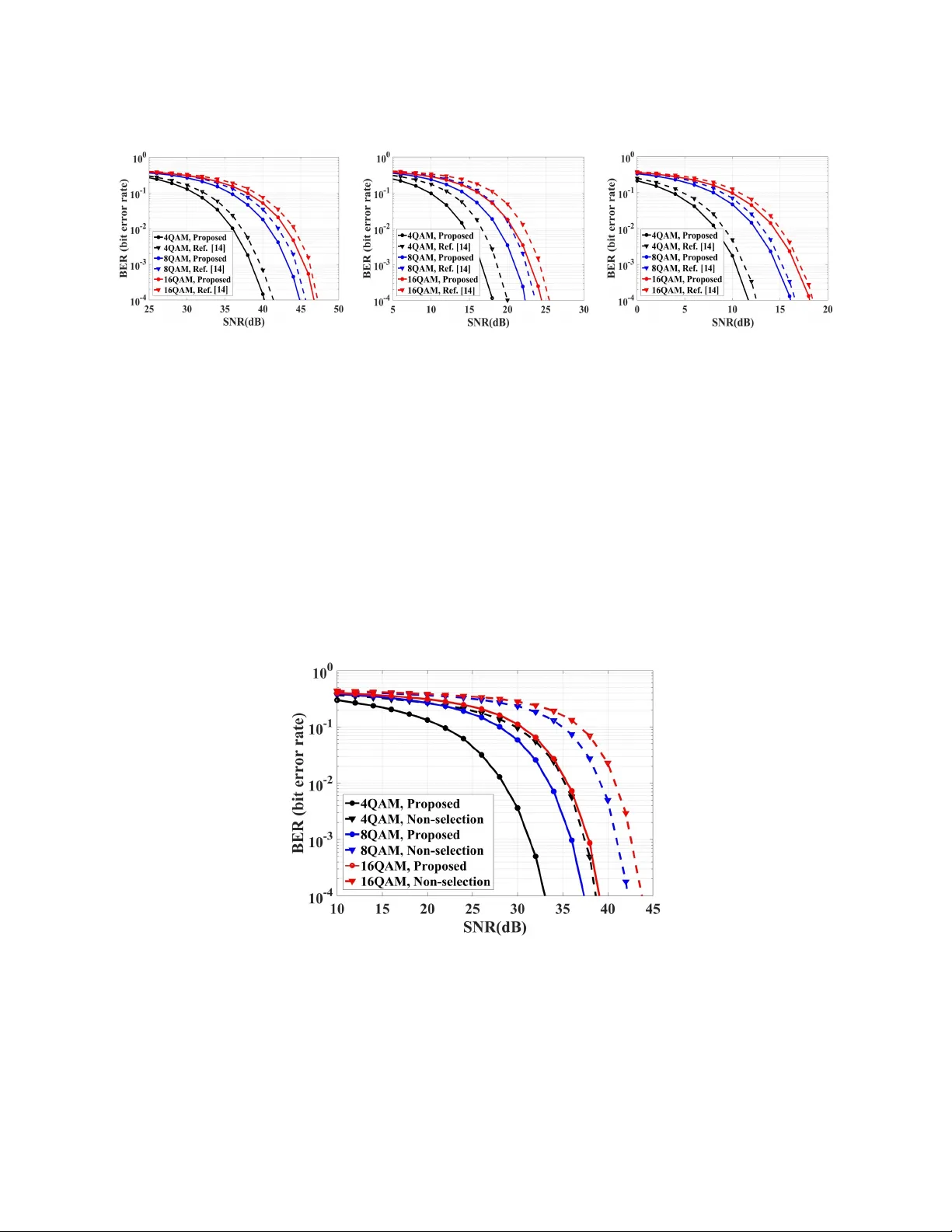
1 LED Selection and MAP Detection for Generalized LED Inde x Modulation Manh Le T ran, Sunghw an Kim, Thomas K etseoglou, Senior Member , IEEE and Ender A yanoglu, F ellow , IEEE Abstract In this paper , we propose light-emitting diode (LED) selection that can be applied not only to the con ventional Multiple-Input Multiple-Output (MIMO) case, but also to a larger MIMO configuration of generalized LED index modulation (GLIM) system with optical orthogonal frequenc y di vision multiplexing (OFDM) in visible light communication (VLC). Moreov er , we deriv e a simplified implementation of the maximum a posteriori (MAP) detector when the number of LEDs is an ev en number lar ger than four . Simulation results show that the performance of MAP and LED selection is better than other detection algorithms for larger e ven numbers of LEDs and con ventional GLIM for 4 × 4 transmission, respecti vely . Index T erms V isible light communication, MIMO-OFDM, Index modulation, LED selection. I . I N T R O D U C T I O N V ISIBLE light communication (VLC) which utilizes optical wireless communication technology via high-power and high-speed modulated light-emitting diodes (LEDs) as the transmitters and photo detectors (PDs) as the recei vers has the adv antages of a high transmission rate, ener gy preservation, and secure data communication [1]. As an emer ging technology , there Le T ran Manh, Sunghwan Kim are with the School of EE, Uni versity of Ulsan, 93, Daehak-ro, Nam-gu, Ulsan, 44610, K orea (e-mail: tranmanh@mail.ulsan.ac.kr; sungkim@ulsan.ac.kr) T . K etseoglou is with the Electrical and Computer Engineering Department, California State Polytechnic Uni versity , Pomona, CA 91768 USA (e-mail: tketseoglou@cpp.edu) E. A yanoglu is with the Center for Pervasi ve Communications and Computing, Department of Electrical Engineering and Computer Science, Uni versity of California at Irvine, Irvine, CA 92697 USA (e-mail:ayanoglu@uci.edu) 2 hav e been man y studies on multiple-input multiple-output VLC (MIMO-VLC) systems, including both theoretical analysis and experimental demonstrations [2], [3]. MIMO-based VLC schemes significantly suf fer from performance degradation because indoor optical wireless channels hav e a strong correlation [3]. There are ef forts to decorrelate the channels include altering the angle of PDs [4], [5], [6], using imaging lens and a detector array [2], or po wer allocation between transmitters [3]. Lately , orthogonal frequenc y division multiple xing (OFDM) with its high spectral ef ficiency and robustness to channel impairments has been frequently used in optical wireless communica- tions [7] such as DC-biased optical OFDM (DCO-OFDM) [8] and asymmetrically clipped optical OFDM (A CO-OFDM) [9]. These schemes also ha ve trade-of fs between v arious parameters that are related to system performance such as power ef ficiency , data rate, number of the OFDM sub-carriers. Furthermore, optical spatial modulation (OSM) in VLC exploits the spatial domain as a solution to reduce interferences between transmitters [10]. Non-DC-biased OFDM (NDC-OFDM) in [11] was proposed to transmit positiv e and negati ve signals separately without DC bias while non-Hermitian symmetry OFDM (NHS-OFDM) in [12] required DC bias to transmit real and image parts of signals by two LEDs. Recently , the GLIM and extended GLIM techniques for 4 × 4 MIMO-based OFDM systems were proposed in [13], [14] to ov ercome the need for Hermitian symmetry or DC bias, which are generally demanded for OFDM-based VLC systems. Performance of the 4 × 4 case was presented in [14]. Ho wev er , a generalization of the results in [14] to a larger number of LEDs was not discussed and application of the GLIM in [14] to larger number of LEDs system showed worse performance. In this letter , we e xpand GLIM to e v en numbers of LEDs larger than four , and deriv e a much simpler MAP-based demodulation algorithm at the recei ver . W e also propose LED selection to decorrelate MIMO channels for performance enhancement. The LED selection technique can be applied to the 4 × 4 GLIM case with v arious channels for channel decorrelation, and show better decorrelation performance when the number of LEDs is larger than four . Simulation results show that when the number of LEDs increases, the proposed system achie ves much better performances than the original GLIM system. 3 I I . P R O P O S E D G L I M S Y S T E M W e introduce the system model of the proposed GLIM scheme based on the original GLIM system [14], which focuses on MIMO transmission n T × n R where n T , n R are number of LEDs and PDs, respectiv ely . The general explanation of LED selection for large numbers of LEDs will be discussed in the next subsection. Fig. 1. Proposed transmitter model A. System Model The proposed system model has multiple LEDs and PDs. Let n T and n R be the number of LEDs and PDs, respecti vely , where n T is assumed to be an e ven number for GLIM. Let the vector z be the transmitted signal from the n T LEDs at time k , written as z = [ z 1 · · · z n T ] T . The time-domain OFDM signals x l in x T , l = 1 , · · · , N are separated into their real and imaginary parts as x l = x l,R + j x l,I and con v erted into a time domain signal vector as t = [ x 1 ,R , x 1 ,I , x 2 ,R , x 2 ,I , ..., x N ,R , x N ,I ] . Then, the ‘P/S’ box chooses n T / 2 elements in t in consecuti ve order as t k , t k +1 , ..., t k + n T / 2 − 1 . The index k is in the set { 1 , n T / 2 + 1 , n T + 1 , ... } . Let sgn(a) be sgn(a) = 1 , if a ≥ 0 − 1 , if a < 0 . The real signal t k + l after ‘+/-’ box can be transmitted as t + l = sgn ( t k + l − 1 ) + 1 2 t k + l − 1 , t − l = sgn ( t k + l − 1 ) − 1 2 t k + l − 1 . The signals t + l and t − l with l = 1 , 2 , · · · , n T / 2 can be mapped to z . Let the LED set L be { 1 , 2 , · · · , n T } . Then n T / 2 signals can be transmitted through n T / 2 sets of s 1 , · · · , s n T / 2 , which are subsets of L . Moreover , the sets s 1 , · · · , s n T / 2 are mutually exclusiv e and collectiv ely exhausti v e. 4 Each of the vectors s 1 , · · · , s n T / 2 will represent the signals { t + l , t − l } , l = 1 , 2 , · · · , n T / 2 . For example, if s 1 = { 1 , 3 } , s 2 = { 2 , 4 } , s 3 = { 5 , 7 } and s 4 = { 6 , 8 } , then z 1 = t + 1 , z 2 = t − 1 , z 3 = t + 2 , z 4 = t − 2 , z 5 = t + 3 , z 6 = t − 3 , z 7 = t + 4 and z 8 = t − 4 . The signal z is transmitted ov er the n T × n R optical MIMO channel as y = Hz + n , where y = [ y 1 , · · · , y n R ] , is the receiv ed signal. The signal z contains the electrical signals obtained from PDs, and the real-valued additiv e white Gaussian noise n whose elements are distributed as N (0 , σ 2 w ) . B. LED Selection in GLIM The LED selection technique is used to improv e the performance of the GLIM system with the MAP detector which is af fected by the correlation between LEDs. In particular , a candidate C i is a map of the signals to LEDs. In the 4 × 4 case [14], C i = { s 1 , s 2 } with s 1 = { 1 , 2 } and s 2 = { 3 , 4 } . Another candidate for 4 × 4 LED selection is s 1 = { 1 , 3 } and s 2 = { 2 , 4 } shown in Fig. 2. Let H i be an n R × n T channel matrix corresponding to C i . Then acti ve channel matrix H i j with size n R × n T / 2 is a sub-matrix of H i for j = 1 , ... 2 n T / 2 , which depends on activ e LEDs to transmit the signal. When transmitted through a number of LEDs, the performance of the system heavily depends on the SNR and correlation of the channel, as this determines the condition of the MIMO channel. For con v enience, the first signal t + 1 is allocated to the first LED. Then, the first element satisfies s 1 (1) = 1 . Moreov er , because of the symmetric position of the LEDs, the number of selections can be reduced. The correlation of the channel as the selection of one LED affects the (a) C 1 with (b) C 2 with s 1 = { 1 , 2 } , s 2 = { 3 , 4 } s 1 = { 1 , 3 } , s 2 = { 2 , 4 } Fig. 2. LED selection in 4 × 4 transmission recei ving performance of GLIM according to two factors: a) The correlation between a couple of 5 acti ve-inacti ve LEDs channel couples h a , h b measured by the cosine between them [15] defined as cos ( h a , h b ) = h H a h b k h a k k h b k , (1) where k . k denotes the l 2 - norm and b) the condition number between acti ve channel columns c ( H i j ) [16], defined as c ( H i j ) = λ max λ min , (2) where λ max , λ min are the maximum and minimum singular v alues of the channel matrix, respecti vely . An algorithm to jointly optimize tw o terms will first remo ve candidates mostly impacted by an incorrect acti v e decision, then select the candidate that can gi v e the best channel capacity . These steps are described in Algorithm 1. Algorithm 1 Algorithm for n T × n R LED selection Input: Channel matrix H Output: Optimal channel H opt 1: generate set Θ = { θ 1 , θ 2 ... } which includes all LED pairs θ 1 = { 1 , 2 } , θ 2 = { 1 , 3 } , θ 3 = { 1 , 4 } , ... 2: calculate t i = cos ( θ i ) with θ i ∈ Θ 3: set ω = max( t i ) 4: if t i = ω then Θ = Θ − { θ i } 5: from Θ generate U = { C 1 , C 2 ... } of all candidate C i 6: f or C i ∈ U do 7: generate active set V i = n H i 1 , ... H i 2 n T / 2 o 8: set µ i = max H i j ∈ V i c ( H i j ) 9: end for 10: set C selection = arg min C i ∈ U ( µ i ) 11: r eturn H opt corresponding to C selection C. MAP Detection Among the three detection algorithms, e.g., zero-forcing (ZF), minimum mean-square error (MMSE) and MAP , MAP is considered here, since its performance provides the best performance improv ement [14]. Meanwhile, the MAP detection in [14] is focused on the 4 × 4 case and requires 6 a complex mathematical representation with a higher dimensional system such as 8, 16, or more LEDs. T o employ MAP for more complex systems, we deriv e a much simpler representation of the solution that can be used in any GLIM system. For generality , take a VLC system with an n T × n R channel matrix H = h 1 h 2 ... h n T , where l = 1 , ..., n T is the l -th column of H , the recei ved signal is y = Hz + n = X n T / 2 l =1 h s l (1) t + l + h s l (2) t − l + n = X n T / 2 l =1 h Φ l ¯ t l + n , (3) where ¯ t l = | t l | and h Φ l is either h s l (1) or h s l (2) , l = 1 , ...n T / 2 . For a giv en set Φ = n h Φ 1 , ... h Φ n T / 2 o , by taking into account the clipped Gaussian distribution of the transmitted signal as the prior information [14], the conditional MAP estimation of ˆ t can be obtained in a fashion similar to [14], as ˆ t = arg min ¯ t Φ M M AP ( h Φ 1 , ... h Φ n T / 2 , ¯ t 1 , ... ¯ t n T / 2 , ) = arg min ¯ t Φ ( y − ¯ H Φ ¯ t Φ 2 + 2 σ 2 w k ¯ t Φ k 2 ) , (4) where ¯ t Φ = h ¯ t Φ 1 ... ¯ t Φ n T / 2 i T , ¯ H Φ = h h Φ 1 ... h Φ n T / 2 i is one of 2 n T / 2 matrix candidates of size n R × n T / 2 and corresponding to the set Φ . Dif ferentiating second part of (4) with respect to ¯ t Φ and equating it to zero, the solution for ¯ t Φ is ¯ t Φ = A Φ y , (5) where A Φ = ¯ H T Φ ¯ H Φ + 2 σ 2 w I − 1 ¯ H T Φ . Let vector [ a ] + denote that each element in [ a ] + calculated as max (0 , a i ) where a i is the i -th element in a . Then, due to positiv e value condition of light intensity , we need to tak e ˜ t Φ = [ ¯ t Φ ] + . After calculation of the MAP est imates for all cases of Φ and considering all possible acti ve LED scenarios, the conditional MAP estimator of the GLIM-OFDM scheme decides on the most likely acti ve LEDs by calculating the MAP estimation metric given for all scenarios. The unconditional estimates of ˜ t l , l = 1 , ...n T / 2 is ( ˆ t , Φ) = arg min ˜ t Φ M M A P ( h Φ 1 , ... h Φ n T / 2 , ˜ t 1 , ... ˜ t n T / 2 ) , (6) where ˆ t l = ˜ t ˆ Φ l . By precalculating the values of A Φ for all cases of the set Φ beforehand and storing them at the receiv er , the demodulation procedure is presented in Algorithm 2. 7 Algorithm 2 MAP estimation for n T × n R GLIM Input: Channel matrix H Output: Estimated signal ˆ t Initialization : 1: Generate all matrices H Φ = h h Φ 1 ... h Φ n T / 2 i of size n R × n T / 2 corresponding to the set Φ by selecting n T / 2 columns of channel matrix H Calculate matrices A Φ for all cases of Φ LOOP Pr ocess 2: f or H Φ do 3: Calculate ˜ t Φ = [ A Φ y ] + for Φ from equation (5) 4: Calculate ˆ t , H activ e from equation (6) 5: end for 6: r eturn ˆ t I I I . N U M E R I C A L R E S U LT S W e consider an 8 × 8 GLIM system arranged in a square shape as in Fig. 3, where one side of the square of the LEDs is 4 meters and the corresponding side for PDs is 1 meter . The (a) LED position (b) PD position Fig. 3. Position for 8 × 8 GLIM scenario transmitter uses OFDM with symbols from the 4QAM, 8QAM, or 16QAM mappings, and the recei ver uses the MAP , ZF [14], or MMSE [16]. 8 Fig. 4. Performance comparison of the 8 × 8 GLIM with MAP , ZF and MMSE demodulators Fig. 4 shows that the bit error rate (BER) performance of the ZF and MMSE detectors which are the same for high SNR. Meanwhile, the MAP detector still giv es the best performance compared with the others, as in the 4 × 4 case [14]. Fig. 5. Performance comparison of the 8 × 8 GLIM with other modulation schemes In Fig. 5 we compare the performance of GLIM with three reference systems for 8 × 8 MIMO-OFDM VLC transmission. T o ensure fairness, reference schemes transmit same number of bits/s/Hz. ’P-NDC-OFDM’, ’V -BLAST -A CO-OFDM’, and ’OSM-DCO-OFDM’ in Fig. 5 stand for four parallel NDC-OFDM systems [11], eight parallel v ertical Bell Laboratories Layered Space-T ime A CO-OFDM systems [9], and combination of DCO-OFDM [8] with OSM [10], respecti vely . BERs of GLIM with MAP are still better than 8 × 8 reference systems, which is 9 similar to the 4 × 4 case in [14]. (a) Physical channel A (b) Physical channel B (c) Physical channel C Fig. 6. LED selection for the 4 × 4 GLIM system T o examine the ef fecti veness of LED selection, results of reference GLIM [14] and the proposed GLIM for 4 × 4 transmission are sho wn in Fig. 6 where physical channel A, physical channel B, and physical channel C are same with the ones in [14]. From Algorithm 1, LED selection is determined as s 1 = { 1 , 3 } and s 2 = { 2 , 4 } . Over the three channels, BER performances of the proposed system are better than the ones in [14]. T o demonstrate LED selection can be implemented with larger number of LED systems, Fig. 7. LED selection for the 8 × 8 GLIM system performances of GLIM with and without selection for 8 × 8 transmission are shown in Fig. 7. No LED selection means s 1 = { 1 , 2 } , s 2 = { 3 , 4 } , s 3 = { 5 , 6 } and s 4 = { 7 , 8 } . From Algorithm 1, the LED selection is s 1 = { 1 , 3 } , s 2 = { 2 , 4 } , s 3 = { 5 , 7 } and s 4 = { 6 , 8 } . Performances of the proposed GLIM are about 5dB better than ones without LED selection for three QAM REFERENCES 10 modulations. I V . C O N C L U S I O N Simplified MAP and LED selection are proposed to enhance the transmission when the number of LEDs is ev en and larger than four . These schemes are not just extensions of 4 × 4 transmission, but they are also more efficient techniques for high order transmission. Simulation results sho w that the proposed MAP and LED selection lead to significant performance improvements in VLC systems. R E F E R E N C E S [1] T . K omine and M. Nakagawa, “Fundamental analysis for visible-light communication system using LED lights, ” IEEE T r ans. Consum. Electr on. , vol. 50, no. 1, pp. 100–107, Feb . 2004. [2] L. Zeng, D. O’Brien, H. Minh, G. Faulkner, K. Lee, D. Jung, Y . Oh, and E. W on, “High data rate multiple input multiple output (MIMO) optical wireless communications using white led lighting, ” IEEE J . Sel. Areas Commun. , v ol. 27, no. 9, pp. 1654–1662, Dec. 2009. [3] T . Fath and H. Haas, “Performance comparison of MIMO techniques for optical wireless communications in indoor en vironments, ” IEEE T rans. Commun. , v ol. 61, no. 2, pp. 733–742, Feb . 2013. [4] P . Fahamuel, J. Thompson, and H. Haas, “Improved indoor VLC MIMO channel capacity using mobile receiv er with angular di versity detectors, ” in Pr oc. IEEE Globecom 2014 , Austin, TX, Dec. 2014, pp. 2060–2065. [5] A. Nuwanpriya, S. W . Ho, and C. S. Chen, “Indoor MIMO visible light communications: Nov el angle diversity receiv ers for mobile users, ” IEEE J . Sel. Ar eas Commun. , v ol. 33, no. 9, pp. 1780–1792, Sep. 2015. [6] C. He, T . Q. W ang, and J. Armstrong, “Performance of optical receiv ers using photodetectors with different fields of view in a MIMO A CO-OFDM system, ” J . Lightwave T echnol. , vol. 33, no. 23, pp. 4957–4967, Dec. 2015. [7] J. Armstrong, “OFDM for optical communications, ” J. Lightwave T echnol. , v ol. 27, no. 3, pp. 189–204, Feb . 2009. [8] J. T an, Z. W ang, Q. W ang, and L. Dai, “Near-optimal low-comple xity sequence detection for clipped DCO-OFDM, ” IEEE Photonics T echnol. Lett. , v ol. 28, no. 3, pp. 233–236, Feb. 2016. [9] J. Armstrong and A. J. Lo wery, “Power efficient optical OFDM, ” Electr on. Lett. , v ol. 42, no. 6, pp. 370–372, Mar . 2006. [10] R. Mesleh, H. Elgala, and H. Haas, “Optical spatial modulation, ” IEEE/OSA J. Opt. Commun. Networking , v ol. 3, no. 3, p. 234, Mar . 2011. [11] Y . Li, D. Tsonev, and H. Haas, “Non-DC-biased OFDM with optical spatial modulation, ” in Proc. 2013 IEEE 24th Annual Int. Symp. on P er ., Indoor , and Mobile Radio Commun. (PIMRC) , London, UK, Sep. 2013, pp. 486–490. [12] C. Chen, W . D. Zhong, and D. W u, “Non-hermitian symmetry orthogonal frequency division multiplexing for multiple- input multiple-output visible light communications, ” IEEE/OSA J. Opt. Commun. Networking , vol. 9, no. 1, pp. 36–44, Jan. 2017. [13] E. Basar, E. P anayirci, M. Uysal, and H. Haas, “Generalized LED inde x modulation optical OFDM for MIMO visible light communications systems, ” in Pr oc. 2016 IEEE Int. Conf. on Commun. (ICC) , Kuala Lumpur, Malaysia, May 2016, pp. 1–5. 11 [14] A. Y esilkaya, E. Basar, F . Miramirkhani, E. Panayirci, M. Uysal, and H. Haas, “Optical MIMO-OFDM with generalized LED index modulation, ” IEEE T rans. Commun. , vol. 65, no. 8, pp. 3429–3441, Aug. 2017. [15] S. Jiang, “Angles between euclidean subspaces, ” Geom Dedicata , vol. 63, no. 2, pp. 113–121, Nov . 1996. [16] D. Tse and P . V iswanath, Fundamentals of wireless communication . Cambridge: Cambridge Uni versity Press, 2005.
Original Paper
Loading high-quality paper...
Comments & Academic Discussion
Loading comments...
Leave a Comment