CEVO: Comprehensive EVent Ontology Enhancing Cognitive Annotation
While the general analysis of named entities has received substantial research attention on unstructured as well as structured data, the analysis of relations among named entities has received limited focus. In fact, a review of the literature revealed a deficiency in research on the abstract conceptualization required to organize relations. We believe that such an abstract conceptualization can benefit various communities and applications such as natural language processing, information extraction, machine learning, and ontology engineering. In this paper, we present Comprehensive EVent Ontology (CEVO), built on Levin’s conceptual hierarchy of English verbs that categorizes verbs with shared meaning, and syntactic behavior. We present the fundamental concepts and requirements for this ontology. Furthermore, we present three use cases employing the CEVO ontology on annotation tasks: (i) annotating relations in plain text, (ii) annotating ontological properties, and (iii) linking textual relations to ontological properties. These use-cases demonstrate the benefits of using CEVO for annotation: (i) annotating English verbs from an abstract conceptualization, (ii) playing the role of an upper ontology for organizing ontological properties, and (iii) facilitating the annotation of text relations using any underlying vocabulary. This resource is available at https://shekarpour.github.io/cevo.io/ using https://w3id.org/cevo namespace.
💡 Research Summary
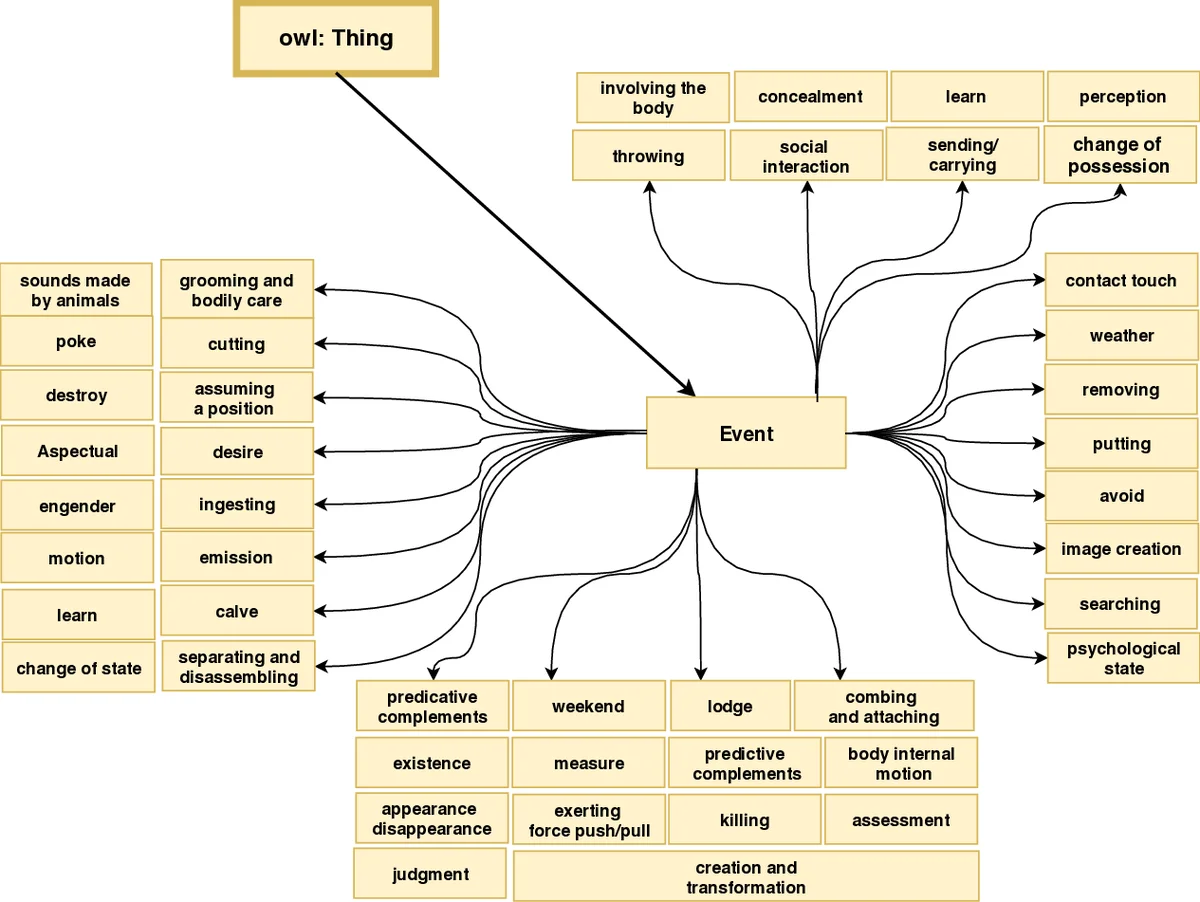
The paper addresses a notable gap in current information extraction research: while named‑entity recognition and linking have been extensively studied, the systematic conceptualization and annotation of relations (or events) among entities remain under‑explored. To fill this void, the authors introduce the Comprehensive Event Ontology (CEVO), a high‑level, cognitively motivated ontology built upon Beth Levin’s well‑known hierarchical classification of English verbs. Levin’s taxonomy groups verbs into classes that share both semantic coherence (a common underlying meaning) and syntactic behavior (similar argument structures). CEVO translates this hierarchy into an OWL ontology comprising roughly 230 event classes that collectively cover over 3,000 English verbs.
The design of CEVO is guided by five concrete requirements: (1) Relation tagging on textual data – the ability to recognize, normalize, and label each mention of a relation in raw text; (2) Relation linking – mapping textual relations to formal ontological properties via an upper‑level ontology; (3) Integration and alignment of properties – providing a common abstraction that eases alignment across heterogeneous domain ontologies; (4) Reusability – offering a domain‑agnostic conceptual layer that minimizes the effort needed to interpret or repurpose the ontology; and (5) Simplicity – keeping the model lightweight to encourage adoption.
CEVO’s core class is cevo:Event, a generic superclass for all specific event types. Each specific event class (e.g., cevo:Communication, cevo:CreationAndTransformation, cevo:ChangeOfState) inherits from this root and is linked to the corresponding Levin verb class. Because Levin’s classification is a graph rather than a strict tree—allowing a verb to belong to multiple classes—CEVO can represent contextual nuances: the verb “cook” may be annotated as both a creation/transformation event and a change‑of‑state event, depending on surrounding context.
Three illustrative use cases demonstrate CEVO’s utility:
-
Annotating relations in plain text – By parsing a sentence, extracting its main verb, and consulting the Levin‑derived mapping, the system assigns an abstract event label (e.g., “communication” for “say”, “announce”, “mention”). This abstracts away surface lexical variation while preserving the underlying relational semantics.
-
Annotating ontological properties – Existing vocabularies such as DBpedia, Schema.org, or domain‑specific ontologies often define properties like
dbo:spouse,schema:author, etc. CEVO provides a higher‑level alignment by mapping these properties to its event classes, enabling cross‑ontology reasoning (e.g., bothdbo:spouseandschema:authorcan be seen as instances of a broader “association” event). -
Linking textual relations to ontological properties – When a textual relation is identified (e.g., “Jack visits Sara”), CEVO serves as a bridge: the verb “visit” maps to the
cevo:Meetclass, which in turn is linked to the appropriate property in a target ontology (e.g.,dbo:placeOfResidenceor a customex:hasMeeting). This facilitates interoperability between NLP pipelines and knowledge‑graph population tools.
The authors also position CEVO within the broader ecosystem of linguistic interoperability standards such as OLiA (Ontologies of Linguistic Annotation), NIF (NLP Interchange Format), and QANARY. CEVO’s abstract event layer can be combined with these standards to enable end‑to‑end pipelines where raw text is processed, events are abstractly annotated, and the resulting annotations are consumed by downstream reasoning or question‑answering components.
Empirical validation is performed on a set of Twitter news headlines. The headlines are manually labeled with high‑level event types (communication, meet, murder) and then automatically annotated using CEVO. The CEVO‑based approach yields higher precision and better semantic consistency than baseline keyword‑matching methods, illustrating its capacity to handle synonymy, polysemy, and implicit relations.
In conclusion, CEVO offers a novel, cognitively grounded upper ontology that unifies the treatment of relational information across unstructured text and structured knowledge bases. By leveraging Levin’s verb taxonomy, it provides a rich yet manageable set of event classes that can be used for relation tagging, property alignment, and cross‑ontology integration. Future work outlined includes extending the model to other languages, automating context‑sensitive class selection, and scaling the approach to large‑scale linked open data repositories. The authors make the ontology publicly available at https://shekarpour.github.io/cevo.io/ under the namespace https://w3id.org/cevo.
Comments & Academic Discussion
Loading comments...
Leave a Comment