A Game-Theoretic Analysis of Shard-Based Permissionless Blockchains
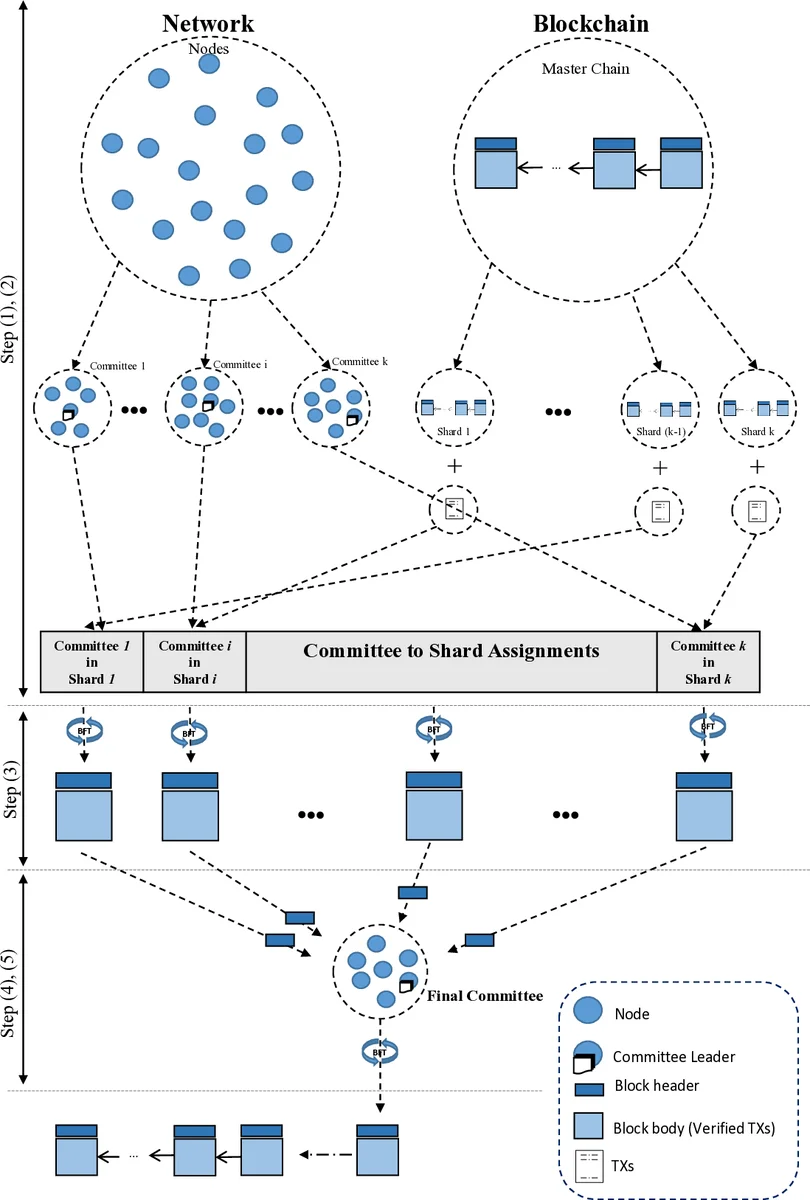
Low transaction throughput and poor scalability are significant issues in public blockchain consensus protocols such as Bitcoins. Recent research efforts in this direction have proposed shard-based consensus protocols where the key idea is to split the transactions among multiple committees (or shards), which then process these shards or set of transactions in parallel. Such a parallel processing of disjoint sets of transactions or shards by multiple committees significantly improves the overall scalability and transaction throughout of the system. However, one significant research gap is a lack of understanding of the strategic behavior of rational processors within committees in such shard-based consensus protocols. Such an understanding is critical for designing appropriate incentives that will foster cooperation within committees and prevent free-riding. In this paper, we address this research gap by analyzing the behavior of processors using a game-theoretic model, where each processor aims at maximizing its reward at a minimum cost of participating in the protocol. We first analyze the Nash equilibria in an N-player static game model of the sharding protocol. We show that depending on the reward sharing approach employed, processors can potentially increase their payoff by unilaterally behaving in a defective fashion, thus resulting in a social dilemma. In order to overcome this social dilemma, we propose a novel incentive-compatible reward sharing mechanism to promote cooperation among processors. Our numerical results show that achieving a majority of cooperating processors (required to ensure a healthy state of the blockchain network) is easier to achieve with the proposed incentive-compatible reward sharing mechanism than with other reward sharing mechanisms.
💡 Research Summary
This paper addresses a critical gap in the design of sharded permissionless blockchains: the strategic behavior of rational processors within shards and the resulting incentive problems. The authors first formalize a generic sharding protocol (inspired by Elastico and Omniledger) in which each epoch consists of an organization phase (PoW‑based identity creation and committee formation) and a committee‑participation phase (intra‑shard PBFT consensus, final aggregation, and randomness generation). Processors incur computational and communication costs in both phases, but participation in the consensus tasks is optional, opening the door to free‑riding.
The interaction among N processors is modeled as a static non‑cooperative game. Each processor chooses between “cooperate” (perform the shard validation and signing) and “defect” (skip the work while still receiving any reward). Three reward‑sharing schemes are examined.
-
Uniform sharing distributes the total block reward equally among all processors, regardless of contribution. The resulting payoff matrix is identical to a classic public‑goods game: the unique Nash equilibrium is universal defection, because any unilateral cooperation reduces the defector’s payoff.
-
Fair sharing allocates the reward only to processors who actually sign the shard (i.e., those who belong to the majority of the committee). This introduces a contribution‑dependent payoff, weakening the free‑rider incentive. The authors derive sufficient conditions on the ratio of expected reward to participation cost under which a cooperative Nash equilibrium can exist. However, these conditions are restrictive and may not hold in realistic settings.
-
Incentive‑compatible sharing augments fair sharing with a “shard coordinator” that monitors the current consensus status of each shard and promises rewards only when cooperation is expected to be profitable. By dynamically adjusting the payoff matrix, the coordinator steers the game toward a region where cooperation dominates defection.
Analytical results are complemented by extensive simulations varying the number of processors, number of shards, and cost parameters. The incentive‑compatible scheme consistently yields a higher proportion of cooperating processors than both uniform and fair sharing, even when participation costs are relatively high.
The paper’s contributions are threefold: (i) it provides the first game‑theoretic characterization of strategic behavior in sharded blockchains; (ii) it demonstrates that naïve equal reward distribution leads to a social dilemma and that fair reward alone is insufficient; (iii) it proposes a practical coordinator‑based incentive mechanism that can be integrated into existing sharding protocols to promote honest participation. The work opens avenues for future research on dynamic multi‑round games, adaptive shard reconfiguration, and robustness against malicious attacks.
Comments & Academic Discussion
Loading comments...
Leave a Comment