Phase transitions in social networks inspired by the Schelling model
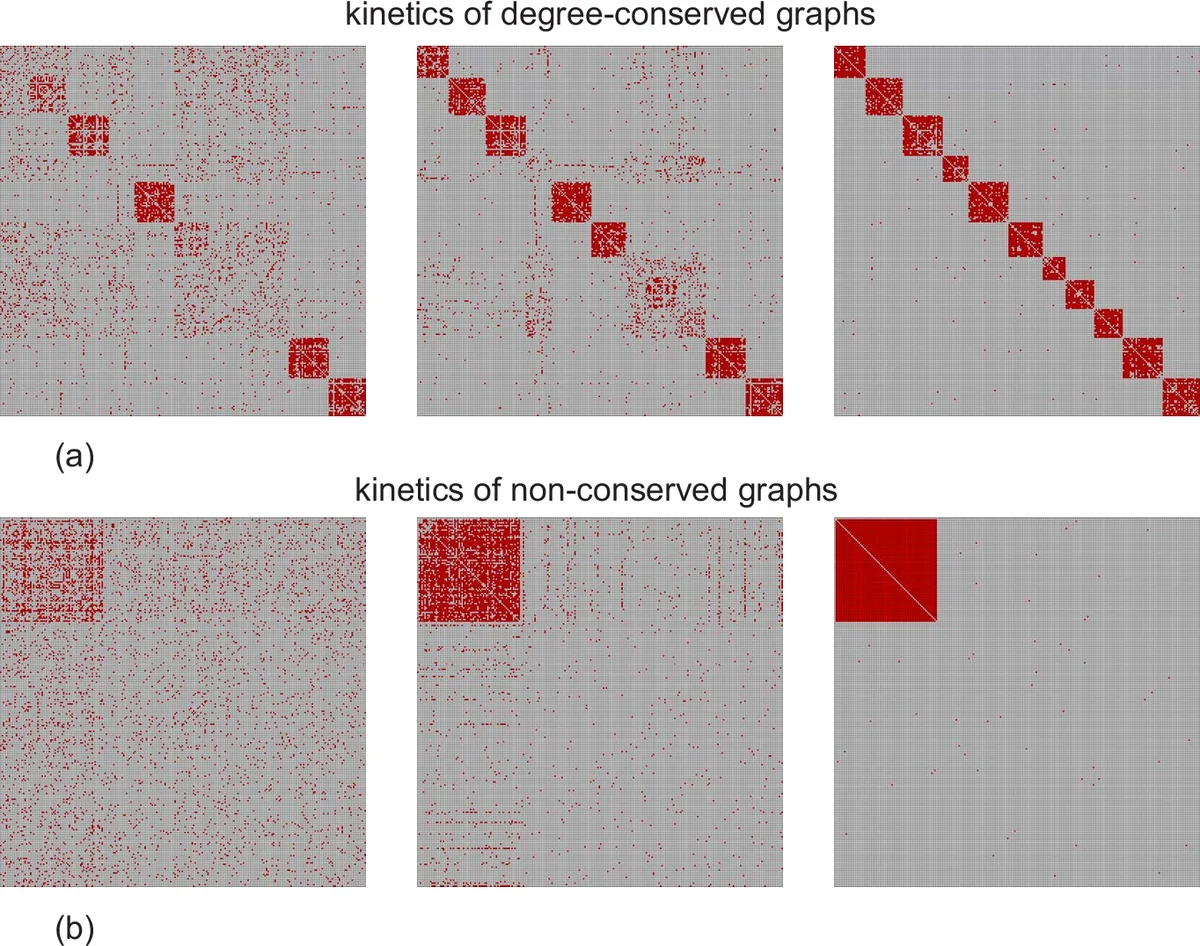
We propose two models of social segregation inspired by the Schelling model. Agents in our models are nodes of evolving social networks. The total number of social connections of each node remains constant in time, though may vary from one node to the other. The first model describes a “polychromatic” society, in which colors designate different social categories of agents. The parameter $\mu$ favors/disfavors connected “monochromatic triads”, i.e. connected groups of three individuals \emph{within the same social category}, while the parameter $\nu$ controls the preference of interactions between two individuals \emph{from different social categories}. The polychromatic model has several distinct regimes in $(\mu,\nu)$-parameter space. In $\nu$-dominated region, the phase diagram is characterized by the plateau in the number of the inter-color connections, where the network is bipartite, while in $\mu$-dominated region, the network looks as two weakly connected unicolor clusters. At $\mu>\mu_{crit}$ and $\nu >\nu_{crit}$ two phases are separated by a critical line, while at small values of $\mu$ and $\nu$, a gradual crossover between the two phases occurs. The second “colorless” model describes a society in which the advantage/disadvantage of forming small fully connected communities (short cycles or cliques in a graph) is controlled by a parameter $\gamma$. We analyze the topological structure of a social network in this model and demonstrate that above a critical threshold, $\gamma^+>0$, the entire network splits into a set of weakly connected clusters, while below another threshold, $\gamma^-<0$, the network acquires a bipartite graph structure. Our results propose mechanisms of formation of self-organized communities in international communication between countries, as well as in crime clans and prehistoric societies.
💡 Research Summary
The paper introduces two novel network‑based segregation models that extend the classic Schelling framework to graphs with conserved vertex degree. The authors first define “constrained Erdős–Rényi networks” (CERNs), i.e., random graphs drawn from the Erdős–Rényi ensemble in which each node’s degree is fixed at the moment of initialization and never changes during the dynamics. This constraint mimics the realistic situation that individuals can maintain only a limited number of social ties.
Model I – Polychromatic network.
Each vertex carries a categorical label (color), interpreted as a social group (e.g., ethnicity, nation, religion). Two energetic parameters are introduced:
- µ (µ_G = µ_R) – the chemical potential associated with the formation of monochromatic triads (three mutually connected nodes of the same color). Positive µ rewards such triads; negative µ penalizes them.
- ν – the chemical potential associated with each cross‑color edge (an edge linking nodes of different colors). Positive ν encourages inter‑group connections, while negative ν discourages them.
The system’s Hamiltonian is H = –µ·N_triads – ν·N_cross, where N_triads counts all monochromatic connected triples (both open 2‑stars and closed triangles) and N_cross counts all inter‑group links. The dynamics proceeds by repeatedly selecting two random edges (i–j and k–m) and rewiring them to (i–m) and (j–k) while preserving the degree of every vertex. After each rewiring a Metropolis acceptance step is applied: moves that increase the number of favored structures are always accepted; moves that decrease them are accepted with probability exp(–ΔE). This stochastic “switching” algorithm samples the equilibrium ensemble of CERNs under the given (µ, ν).
Simulation results on 256‑node graphs (128 per color) reveal a clear phase diagram in the (µ, ν) plane:
- µ‑dominated region (µ ≫ ν): The network self‑organizes into two weakly linked, almost monochromatic clusters. Cross‑color edges become scarce (ρ_GR → 0).
- ν‑dominated region (ν ≫ µ): The network becomes essentially bipartite: almost every edge connects opposite colors, producing a “cross‑community” structure (ρ_GR → 1).
- Critical line (µ > µ_crit, ν > ν_crit): A first‑order transition separates the two regimes. Near the line, the fraction of cross‑color edges ρ_GR drops abruptly, and the second smallest Laplacian eigenvalue λ₂ (the algebraic connectivity) shows a matching jump, confirming a genuine topological split.
- Low‑parameter regime (small µ, ν): The transition is smooth (crossover) rather than abrupt; ρ_GR varies continuously.
The authors also compute the third moment of the spectral density of the adjacency matrix, which serves as a quantitative measure of bipartiteness. Positive values of this moment coincide with the ν‑dominated bipartite phase, providing an independent spectral signature of the transition.
Model II – Colorless network.
Here the color attribute is removed, and a single parameter γ controls the propensity to form triangles (3‑cycles). Positive γ rewards closed triads, leading to fragmentation into many densely connected cliques; negative γ penalizes triangles, driving the network toward a bipartite or tree‑like structure. Again, the same degree‑preserving rewiring dynamics is used, with Metropolis acceptance based on Δ(γ·N_triangles). Simulations reveal two thresholds γ⁺ > 0 and γ⁻ < 0. For γ > γ⁺ the graph breaks into weakly linked clusters with high clustering coefficient; for γ < γ⁻ the graph becomes almost bipartite, with a vanishing clustering coefficient and a spectral signature similar to the ν‑dominated phase of Model I.
Interpretation and applications.
The authors argue that the abrupt emergence of a bipartite structure (high ν or negative γ) can be interpreted as the formation of “leadership” or “mediator” nodes that bridge otherwise segregated groups. Conversely, strong positive µ or γ leads to tight intra‑group cohesion and the emergence of autonomous communities (e.g., crime clans, ethnic enclaves, or prehistoric tribal clusters). The models thus provide a mechanistic explanation for how simple local preferences, combined with a global constraint on the number of relationships, can generate macroscopic social patterns such as international communication blocs, organized crime networks, or the self‑organization of early human societies.
Methodological contributions.
- Introduction of CERNs as a realistic ensemble for degree‑constrained social networks.
- Use of degree‑preserving edge swaps combined with Metropolis sampling to explore the equilibrium distribution of graphs under arbitrary triadic potentials.
- Application of spectral graph theory (Laplacian eigenvalues, third moment of adjacency spectrum) to detect and quantify phase transitions.
- Identification of both first‑order transitions (critical line) and continuous crossovers, depending on the magnitude of the control parameters.
Future directions.
The paper suggests extending the framework to scale‑free degree distributions, incorporating heterogeneous µ values per color, allowing dynamic degree adaptation, and exploring multi‑color (>2) scenarios. Such extensions could bring the models even closer to real‑world social media platforms, where degree heterogeneity and multiple identity dimensions coexist.
In summary, the work bridges statistical physics, network science, and sociology by showing that simple triadic preferences, when embedded in a degree‑conserved graph, can produce rich phase behavior—ranging from tightly knit homogeneous clusters to globally bipartite structures—offering fresh insight into the emergence of self‑organized communities across diverse social contexts.
Comments & Academic Discussion
Loading comments...
Leave a Comment