Building a Collaborative Culture: A Grounded Theory of Well Succeeded DevOps Adoption in Practice
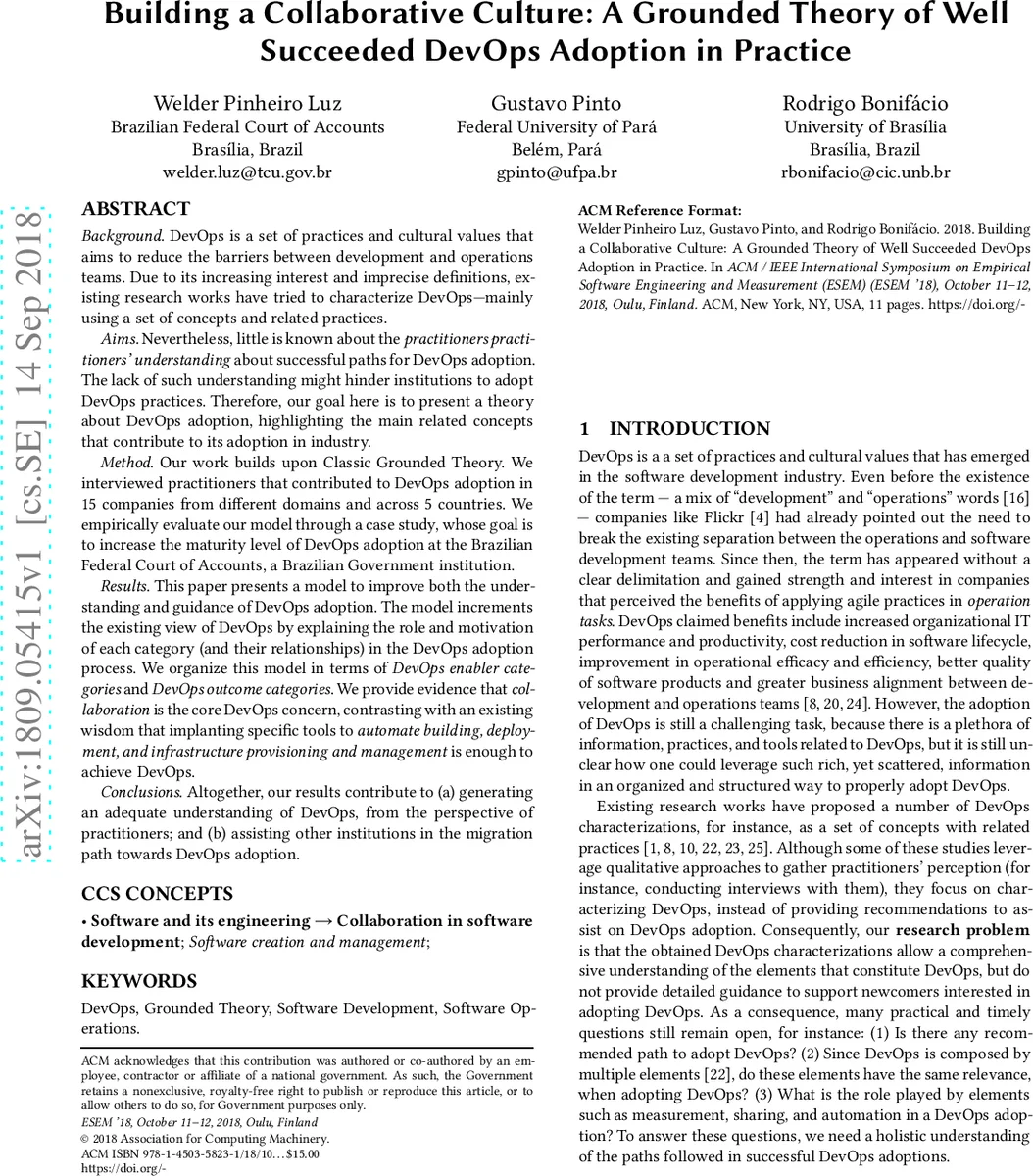
Background. DevOps is a set of practices and cultural values that aims to reduce the barriers between development and operations teams. Due to its increasing interest and imprecise definitions, existing research works have tried to characterize DevOps—mainly using a set of concepts and related practices. Aims. Nevertheless, little is known about thepractitioners practitioners’ understanding about successful paths for DevOps adoption. The lack of such understanding might hinder institutions to adopt DevOps practices. Therefore, our goal here is to present a theory about DevOps adoption, highlighting the main related concepts that contribute to its adoption in industry. Method. Our work builds upon Classic Grounded Theory. We interviewed practitioners that contributed to DevOps adoption in 15 companies from different domains and across 5 countries. We empirically evaluate our model through a case study, whose goal is to increase the maturity level of DevOps adoption at the Brazilian Federal Court of Accounts, a Brazilian Government institution.Results. This paper presents a model to improve both the understanding and guidance of DevOps adoption. The model increments the existing view of DevOps by explaining the role and motivation of each category (and their relationships) in the DevOps adoption process. We organize this model in terms of DevOps enabler categories and DevOps outcome categories. We provide evidence that collaboration is the core DevOps concern, contrasting with an existing wisdom that implanting specific tools to automate building, deployment, and infrastructure provisioning and management is enough to achieve DevOps. Conclusions. Altogether, our results contribute to (a) generating an adequate understanding of DevOps, from the perspective of practitioners; and (b) assisting other institutions in the migration path towards DevOps adoption.
💡 Research Summary
**
The paper presents a grounded‑theory study of successful DevOps adoption, focusing on the practitioners’ perspective rather than on abstract definitions or tool‑centric prescriptions. The authors interviewed 15 DevOps practitioners from fifteen companies across five countries (Brazil, Ireland, Portugal, Spain, United States) representing a variety of domains (IT services, health, telecommunications, marketing, food) and company sizes (from <100 to >5,000 employees). Using classic Grounded Theory (Glaser & Strauss), the research proceeded through three iterative stages: open coding, selective coding, and theoretical coding.
During open coding, the researchers initially considered “automation” as a possible core category but found it insufficient to explain many observed phenomena such as shared responsibility, product thinking, and problem‑solving across team boundaries. Re‑examining the data, they identified “collaborative culture” as the recurring, explanatory construct that linked most incidents and concepts. Consequently, collaborative culture became the core category.
Selective coding then narrowed the focus to variables directly related to collaborative culture. The authors identified two groups of categories: enablers (factors that facilitate the emergence of a collaborative culture) and outcomes (benefits that result from a mature collaborative culture). The enablers include:
- Automation – CI/CD pipelines, automated testing, deployment scripts.
- Infrastructure as Code (IaC) – version‑controlled infrastructure definitions, common language for configuration.
- Sharing & Transparency – shared pipelines, common repositories, visible configurations, regular knowledge exchange.
- Measurement – collection of metrics, feedback loops, continuous improvement cycles.
The outcomes encompass the classic DevOps promises: speed (shorter lead times, faster releases), quality (fewer defects, higher reliability), cost reduction (more efficient resource usage), and business alignment (closer coupling between development output and business goals). The authors illustrate each category with direct quotations from interview transcripts, showing how, for example, IaC improves transparency and thereby fosters collaboration, or how shared pipelines reduce “silo” thinking.
In the theoretical coding phase, the authors integrated these categories into a cohesive model: collaborative culture sits at the center, sustained by the identified enablers, and yields the listed outcomes. The model is positioned as a “process theory” that explains how DevOps adoption succeeds, rather than a “variance theory” that predicts success based on a set of independent variables.
To validate the model, the authors applied it in a real‑world case study at the Brazilian Federal Court of Accounts (TCU), a large government institution that had previously focused on tooling without achieving the expected cultural shift. By re‑orienting the initiative around the collaborative culture model—emphasizing shared responsibilities, transparent configuration, and using tools as support rather than goals—the TCU observed measurable improvements: reduced conflicts between development and operations, faster deployment cycles, higher stakeholder satisfaction, and broader dissemination of DevOps practices across the organization.
The paper’s contributions are threefold:
- Empirical Theory – A grounded theory of DevOps adoption derived directly from practitioner experiences, filling a gap in the literature where most prior work offered only taxonomies or prescriptive checklists.
- Emphasis on Culture – Demonstrates that a collaborative culture, not merely automation or tooling, is the decisive factor for successful DevOps transformation.
- Practical Validation – Shows that the model works in a non‑tech, public‑sector context, suggesting broader applicability beyond the typical start‑up or software‑product companies.
Limitations include the modest sample size (15 interviews) and the lack of quantitative performance metrics to complement the qualitative findings. Future work could involve large‑scale surveys, longitudinal studies, and controlled experiments to test the model’s predictive power and to refine the relative weight of each enabler.
Overall, the study reframes DevOps adoption as a cultural engineering problem, providing both scholars and practitioners with a nuanced, evidence‑based roadmap that prioritizes people and collaboration over tools alone.
Comments & Academic Discussion
Loading comments...
Leave a Comment