Tunable Fluidic Lenses with High Dioptric Power for Impaired Vision
We report experimental and theoretical results on the production of macroscopic fluidic lenses with high dioptric power, tunable focal distance and aperture shape, for applications in adaptive eyewear for the sub-normal vision segment. The lense is 17 mm wide and is made of an elastic PDMS polymer, which can adaptively restore accommodation distance within several centimeters according to the fluidic volume mechanically pumped in. Moreover, the lens can provide for magnification in the range of +25 Diopter to +100 Diopter with optical aberrations on the order of the wave-length, and overall lens weight of less than 2 $g$. We argue that these features make the proposed lenses appropriate for the impaired vision segment.
💡 Research Summary
The paper presents the design, theoretical modeling, fabrication, and experimental validation of a macroscopic fluidic lens capable of delivering very high dioptric power (from +25 D to +100 D) with a continuously tunable focal length. The authors target the “sub‑normal vision” market, which includes patients with severe myopia, hyperopia, presbyopia, or combined refractive errors that cannot be adequately corrected by conventional static lenses without becoming excessively thick, heavy, and optically compromised.
The lens consists of two thin elastic membranes made of polydimethylsiloxane (PDMS) that are sealed together by an aluminum frame. One membrane is relatively thick (≈1200 µm) and remains essentially flat under pressure, while the other is thin (≈200 µm) and deforms when fluid is injected between the layers. By varying the injected fluid volume (the authors used steps of 1 ml), the curvature of the thin membrane changes, thereby adjusting the focal distance from about 1 cm to 5 cm. This range corresponds to an optical power sweep of +25 D to +100 D, a dynamic range far beyond that reported for earlier fluidic lens prototypes (which typically max out near ±6 D).
To predict the membrane deformation, the authors adopt the nonlinear plate theory originally derived by Beger for thin isotropic elastic plates. The governing equation ∇⁴w − α²∇²w = q/D (where w is the out‑of‑plane displacement, q the uniform load, D the bending rigidity, and α a constant set by boundary conditions) is combined with the in‑plane strain compatibility condition. By assuming that the equal‑deflection contours are ellipses (ψ = 1 − x²/a² − y²/b²) the problem reduces to an ordinary differential equation in ψ, whose solution involves modified Bessel functions I₀ and I₁. The final expression (Eq. 10) links the displacement profile w(ψ) to the fluid volume, membrane geometry (semi‑axes a, b, thickness h), and material properties. The model predicts the focal distance as a function of fluid volume, and the authors show excellent agreement between theory and experiment for both circular and elliptical apertures.
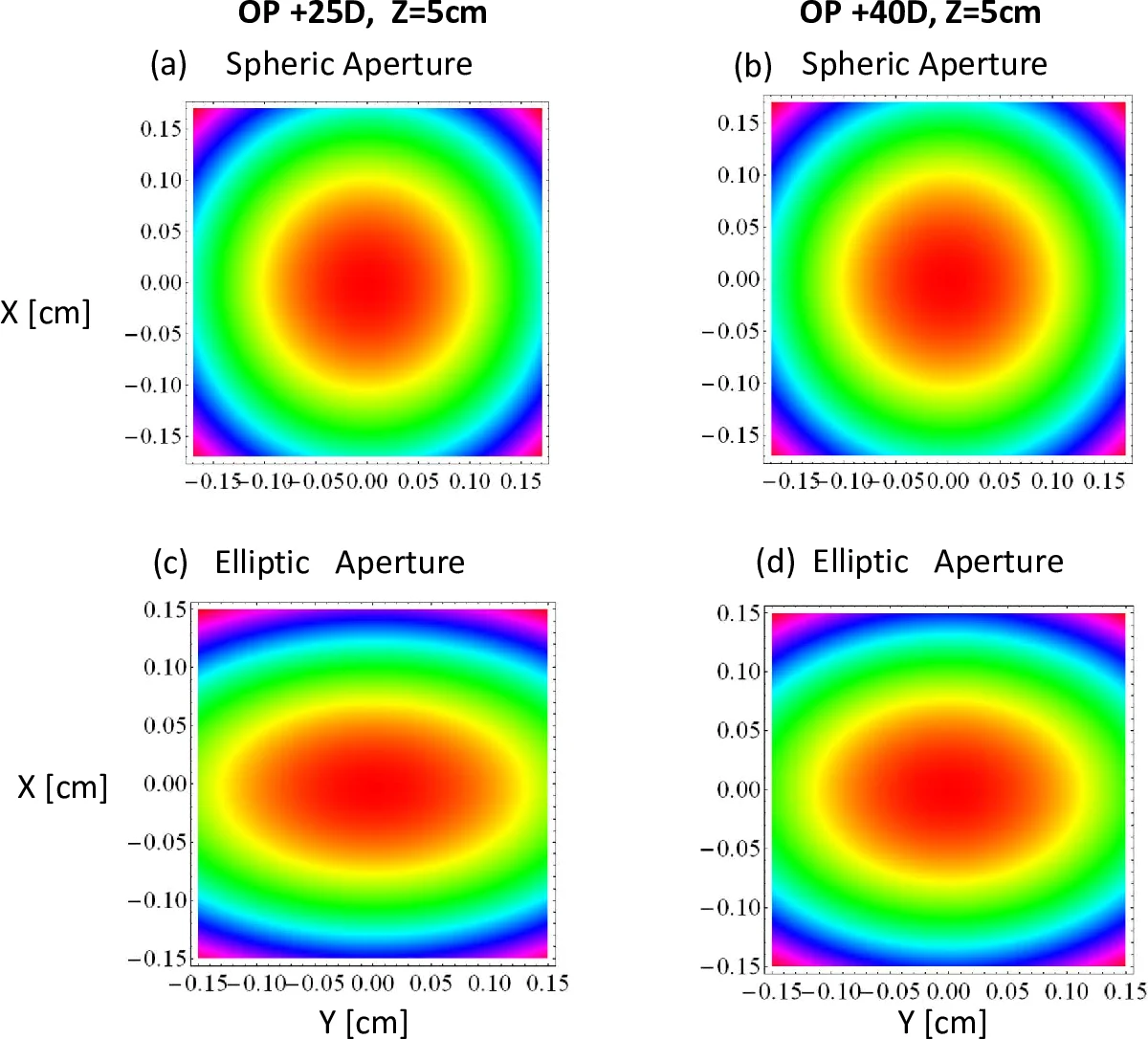
Two aperture shapes are investigated. A circular aperture (radius = 17 mm) yields a symmetric lens with negligible higher‑order aberrations; measured Zernike coefficients up to the 8th order are on the order of a few nanometers, i.e., well below the wavelength of visible light. An elliptical aperture (major axis = 17 mm, minor axis = 15 mm) intentionally introduces controlled astigmatism and other asymmetric aberrations. The authors demonstrate that by selecting the aperture shape, the lens can be tuned not only for focal power but also for specific corrective aberrations, offering a potential route to compensate for individual patients’ non‑spherical refractive errors.
Aberration analysis proceeds by tracing rays through the deformed membrane using Snell’s law, computing the phase distribution on a reference plane, and subtracting the phase of an ideal thin lens with the same mean focal length. The residual phase is expanded in Zernike polynomials, providing a quantitative metric for each aberration term. For the circular lens, all terms (defocus, astigmatism, coma, spherical, field curvature, etc.) are below 0.01 µm. For the elliptical lens, astigmatism terms reach −3 µm to −5 µm, while other terms remain small, confirming that the shape can be used as a design knob for customized correction.
The practical advantages of this design are several. First, the lens is purely mechanically actuated, avoiding the high voltages, liquid evaporation, and stability issues that plague electro‑wetting lenses. Second, the use of PDMS yields a lightweight device (<2 g) and a low‑cost manufacturing process: a master mold can replicate the membrane geometry with sub‑micron precision, enabling scalable production. Third, the fluid used (glycerol or distilled water) is refractive‑index‑matched to PDMS (n ≈ 1.47), minimizing Fresnel losses at the polymer‑fluid interface.
Limitations include the need for a reliable fluid‑pumping or valve system to achieve fine volume control in a wearable form factor, and potential long‑term sealing challenges at the PDMS‑frame interface. The authors suggest that electronic micro‑pumps or electro‑active valves could be integrated to provide user‑controlled focus adjustment, and that further durability testing is required for real‑world eyewear applications.
In conclusion, the work demonstrates a novel fluidic lens platform that simultaneously achieves (1) exceptionally high dioptric power (+25 D to +100 D), (2) a wide, continuously tunable focal range (1–5 cm), (3) wave‑length‑scale aberrations for the circular aperture, (4) customizable aberration profiles via aperture shaping, and (5) a lightweight, low‑cost construction suitable for mass production. These attributes make the technology promising for adaptive eyeglasses for presbyopia, high‑prescription corrective eyewear, compact high‑power camera lenses, and machine‑vision systems requiring large focal adjustments without bulky optics. Future work will focus on integrating compact fluidic actuation, long‑term reliability studies, and clinical trials to assess visual performance in patients with severe refractive errors.
Comments & Academic Discussion
Loading comments...
Leave a Comment