Molecular Signal Modeling of a Partially Counting Absorbing Spherical Receiver
To communicate at the nanoscale, researchers have proposed molecular communication as an energy-efficient solution. The drawback to this solution is that the histogram of the molecules' hitting times, which constitute the molecular signal at the rece…
Authors: Bayram Cevdet Akdeniz, Nafi Ahmet Turgut, H. Birkan Yilmaz
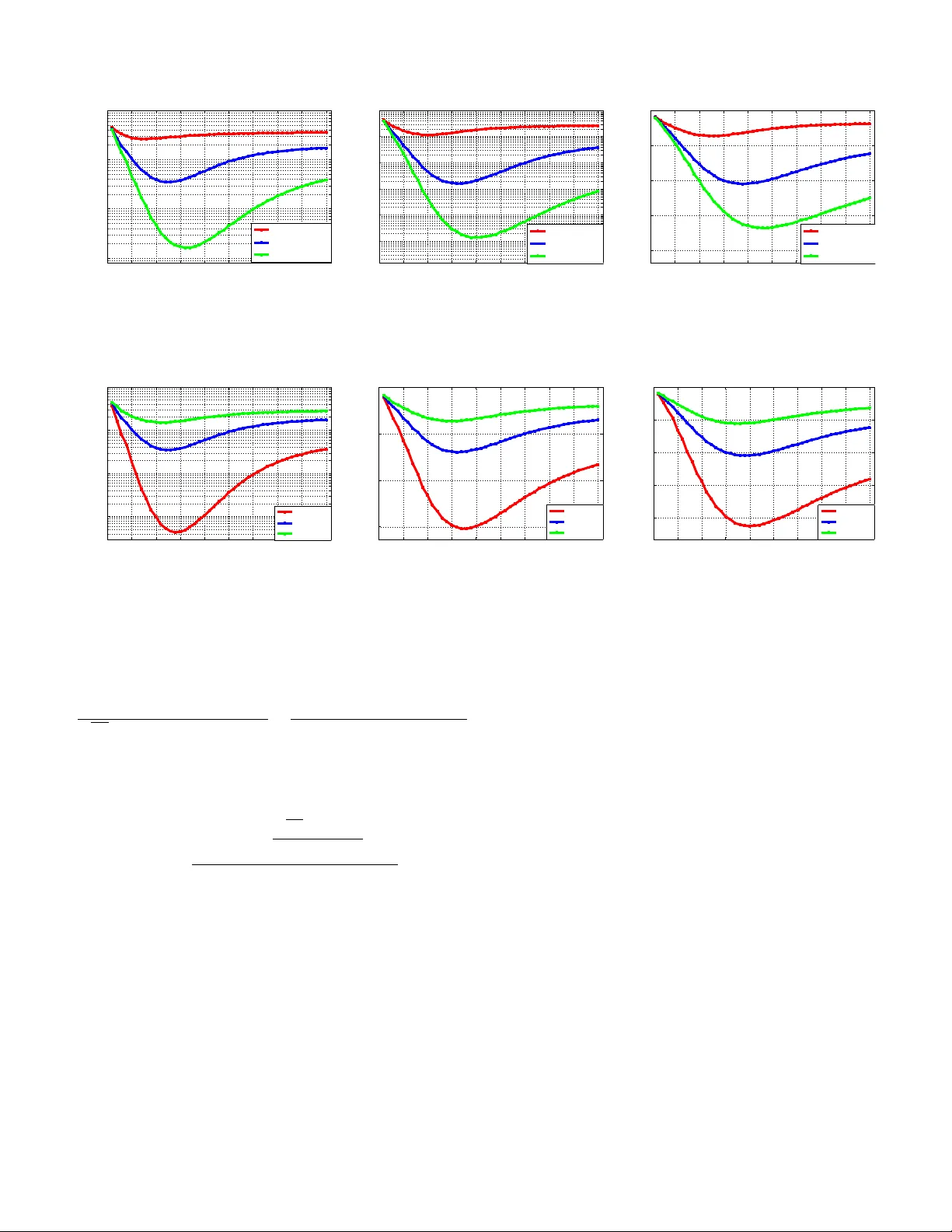
SUBMITTED TO IEEE TRANSA CTIONS ON COMMUNICA TIONS 1 Molecular Signal Modeling of a P artially Counting Absorbing Spherical Recei ver Bayram Ce vdet Akdeniz, Student Member , IEEE , Nafi Ahmet T urgut, Student Member , IEEE , H. Birkan Y ilmaz, Member , IEEE , Chan-Byoung Chae, Senior Member , IEEE , T una T ugcu, Member , IEEE , and Ali Emre Pusane, Member , IEEE Abstract —T o communicate at the nanoscale, researchers ha ve proposed molecular communication as an energy-efficient solu- tion. The drawback to this solution is that the histogram of the molecules’ hitting times, which constitute the molecular signal at the receiv er , has a heavy tail. Reducing the effects of this heavy tail, inter-symbol interference (ISI), has been the focus of most prior research. In this paper , a novel way of decreasing the ISI by defining a counting region on the spherical receiver’ s surface facing towards the transmitter node is proposed. The beneficial effect comes from the fact that the molecules received from the back lobe of the recei ver are more likely to be coming through longer paths that contribute to ISI. In order to justify this idea, the joint distribution of the arri val molecules with respect to angle and time is derived. Using this distribution, the channel model function is appr oximated f or the proposed system, i.e., the partially counting absorbing spherical receiver . After validating the channel model function, the characteristics of the molecular signal are in vestigated and impro ved performance is presented. Moreo ver , the optimal counting region in terms of bit error rate is found analytically . Index T erms —Molecular communication, partially counting recei ver . I . I N T R O D U C T I O N T HR OUGH billions of years of producing communication at small scales (i.e., distances of up to a few micro/nano meters), nature has provided, tested, and improv ed molecular communication (MC). Humans, on the other hand, strug- gle at this scale to utilize electromagnetic wav es thanks to the constraints imposed by the ratio of the antenna size to the wav elength of the electromagnetic signal [1], [2]. As an alternativ e to electromagnetic signal, molecular signals hav e been proposed for nanonetw orks in order to eliminate antenna constraint. There are other adv antages to molecular communication– molecular signals are typically more bio- compatible and can reach an intended receiv er within challeng- ing en vironments ev en on the macro-scale such as pipelines, B.C. Akdeniz, and A. E. Pusane are with the Department of Electrical and Electronics Engineering, Bogazici Univ ersity , Istanbul, 34342, T urke y (e-mail: bayram.akdeniz@boun.edu.tr and ali.pusane@boun.edu.tr). N.A. Tur gut was with the Department of Electrical and Electronics Engi- neering, Bogazici Uni versity . He is no w with the Electronics Engineering in K oc Univ esity (e-mail: ntur gut17@ku.edu.tr). T . Tugcu is with NETLAB, Department of Computer Engineering, Bogazici Univ ersity , Istanb ul, 34342, T urke y (e-mail: tugcu@boun.edu.tr). H. B. Y ilmaz was with the Y onsei Institute of Conv ergence T echnology , School of Integrated T echnology , Y onsei Uni versity , Korea. He is no w with the Department of T elematics Engineering, Universitat Politecnica de Catalunya, Barcelona, Spain (e-mail: birkan.yilmaz@upc.edu). C.-B. Chae is with the Y onsei Institute of Con ver gence T echnol- ogy , School of Inte grated T echnology , Y onsei University , Korea (e-mail: cbchae@yonsei.ac.kr). tunnels, and saline water en vironments [3]. Therefore, re- searchers direct their attentions to molecular communication to achieve communication in nanonetworks. Most of the existing research on MC has focused on channel modeling, interference mitigation, and modulation issues [4]–[7]. T o address the challenges in a methodological and inclusi ve manner , IEEE has established the standardization group IEEE P1906.1 for MC [8]. One of the main challenges in MC is to dev elop valid channel models capable of representing a time-dependent receiv ed signal. For the recei ver and the reception process in dif fusion-based MC models, there are mainly two types of models– the passive and absorbing recei vers. The former assumes the molecules are unaffected by the recei ver while the latter assumes the molecules are absorbed whenever they hit the receiv er . In the passi ve recei ver case, the molecules can pass through the receiver node surface multiple times without interaction [6], [9], [10]. Therefore, the molecules are allowed to contribute to the recei ved signal multiple times when the recei ver is passi ve. For the absorbing receiv er case, the molecules contrib ute to the recei ved signal only once and the molecules that hit the receiver are remo ved from the environment [11]–[14]. This process is modeled by the first-passage process and to model the receiv ed signal, we focus on the time-dependent first hitting histogram [15]. In [11] and [12], the recei ved molecular signal is modeled in a one-dimensional (1-D) en vironment with an absorbing receiv er and the system performance is analyzed by utilizing the receiv ed signal model at the physical layer . In [13], a receiv ed signal model is introduced for a point transmitter and a spherical absorbing recei ver in a 3-D en vironment. Since then, researchers ha ve focused on modeling the recei ved signal for an absorbing recei ver while relaxing some of the assumptions. Instead of using a fully absorbing receiv er , the authors have incorporated the receptor effect instead of using a fully absorbing receiv er [16]. Similarly , researchers have utilized machine learning techniques to model the receiv ed signal for a spherical reflecting transmitter with single absorb- ing receiver [17] or multiple point transmitters with multiple absorbing receiv ers [18], [19]. In [20], the communication be- tween a spherical receiv er and a spherical transmitter in which the surface is covered with e venly-spaced point transmitters has been modeled and the channel impulse response has been presented. In addition to channel modeling, another major and common challenge in MC systems is the inter -symbol interference (ISI), 2 SUBMITTED TO IEEE TRANSACTIONS ON COMMUNICA TIONS which is caused due to the late reception of some messenger molecules in the channel. Consequently , many recent w orks hav e focused on ov ercoming this issue by proposing either modulation or equalization methods. In [21] and [22], the authors ha ve used, simultaneously , different types of molecules as two orthogonal channels. T rying to cope with ISI molecules, the authors in [23] ha ve released an additional type of messen- ger molecule. T o reduce the ISI effect, the receiver observes and e valuates the difference in the number of molecules of both types. Although these works show promising results for reducing ISI, they require the usage of different types of molecules, hence different types of receptors at the receiver causing increased complexity of the system. There are also other solutions that use one type of mes- senger molecule. For instance in [24], ISI is used as a constructiv e component by adjusting the number of released molecules so that the residual molecules lead to a beneficial effect on decoding of the follo wing symbols. In [25], con- ventional equalization methods like minimum mean square error (MMSE), decision feedback equalizers, and maximum likelihood sequence estimation methods are proposed for MC channels. While these methods hav e incremental effects on the channel, the y require a significant amount of additional computational complexity . In this paper, we model the recei ved molecular signal for a partially counting absorbing receiver . That is, the receiver absorbs all hitting molecules but those counted are only the ones hitting at a specific site. Modeling the time-dependent receiv ed signal for such a system is an open issue and has the potential to enhance the communication system performance without any significant additional cost. Most of the receiv ed molecules are absorbed from the surface area facing tow ards the transmitter side. As the path to the back side of the recei ver is longer , the receptors on that side are more likely to receiv e the interference molecules. Therefore, limiting the counting area to the front side with a limited surface area enhances the signal quality . The main contributions of this paper are listed as follows: • The deriv ation of the joint distribution of the received molecules with respect to time and angle • The modelling the receiv ed signal • The inv estigating of the signal properties, and • The finding of the optimal region for counting for a partially counting and absorbing spherical receiv er in a diffusion-based MC system. I I . S Y S T E M M O D E L The recei ved signal in a dif fusion-based MC system is affected by three main processes: emission, propagation, and reception. Analytical deriv ations for the channel model depend on the emitter, the receiv er , the environment, and the propa- gation dynamics. Therefore, we give the details of the system before deriving the channel model. A. T opology Model W e consider a diffusion-based MC system with one point transmitter and one spherical receiver in a 3-D en vironment Tx 𝒓 𝟎 Co un ting Not C ount i ng 𝜽 𝒓 𝒓 R x Fig. 1. System model of a diffusion-based MC with a point transmitter and a partially counting absorbing spherical recei ver . (Fig. 1). Nov el feature of the receiv er (Rx) is the ability to count the molecules absorbed only through a specific region. This feature complicates the modeling procedure of the recei ved signal. In Fig. 1, the circular cap facing towards the transmitter node (Tx) counts the absorbed molecules while the rest of the surface area absorbs b ut does not count the molecules. As sho wn in Fig. 1, the molecules propagate by the diffusion process when they are emitted from the Tx point. The distance between the emission point and the center of the receiv er is denoted by r 0 and the radius of the absorbing receiv er is denoted by r r . The circular cap that counts is determined by the θ angle, which we name as the counting re gion . It is assumed that Tx and Rx nodes are fully synchronized in the time domain, and the interactions between dif fusing molecules are ignored. No en vironmental or counting circuit noise is considered; only the diffusion noise is considered to isolate the signaling gain due to partial counting receiver . Furthermore, it is assumed that a mechanism in Rx node determines the direction of Tx and aligns its counting r e gion facing towards Tx. B. Diffusion Model The emitted molecules propagate subject to Brownian Mo- tion, which is described by the W iener process [11]. The W iener process W ( t ) is characterized as follo ws: • W (0) = 0 , • W ( t ) is almost surely continuous, • W ( t ) has independent increments, • W ( t 2 ) − W ( t 1 ) ∼ N (0 , c ( t 2 − t 1 )) for 0 ≤ t 1 ≤ t 2 is the Gaussian distribution with mean µ and variance σ 2 and c is a constant. Simulating the Brownian Motion includes consecutiv e steps in an n -dimensional space that obe ys Wiener process dynamics. For an accurate simulation, time is divided into sufficiently small time intervals ( ∆ t ), and at each time interval the molecules take random steps in all dimensions. In an n -dimensional space, a random step is gi ven as ∆ ζ = (∆ ζ 1 , ..., ∆ ζ n ) , ∆ ζ i ∼ N (0 , 2 D ∆ t ) ∀ i ∈ { 1 , .., n } , (1) where ∆ ζ , ∆ ζ i , and D correspond to the random displacement vector , the displacement at the i th dimension, and the dif fusion coefficient, respecti vely . AKDENIZ et al. : MOLECULAR SIGNAL MODELING OF A P AR TIALL Y COUNTING ABSORBING SPHERICAL RECEIVER 3 Modu lat o r Channel Dem o dulat o r C SK Se le ct o r C SK Th res holdin g Fig. 2. Concentration-based modulator and demodulator . C. Modulation & Demodulation In this paper , concentration shift keying (CSK) based mod- ulation technique is used. General form of CSK is introduced in [5], [26]. In CSK based modulation techniques, the informa- tion is modulated on the amount of the transmitted molecules at the start of each symbol duration ( t s ). General structure of CSK based modulations is depicted in Fig. 2. F or the k th symbol s [ k ] , the modulator maps the symbol to the amount of molecules to emit (i.e., i th symbol is mapped to N Tx i ) at the start of the k th symbol duration. Depending on the modulation order ( m ), the number of possible symbols is determined and equals to 2 m . In this paper , we use binary CSK where m = 1 , i.e., it has two symbols s 0 and s 1 which represent bit-0 and bit-1, respecti vely . After CSK selector maps the symbol to the amount, the molecules are emitted to the channel and they propagate by diffusion. During the symbol duration, the arriving molecules are absorbed and counted according to the counting logic. At the end of the k th symbol duration, the final v alue is thresholded for obtaining the detected symbol ˆ s [ k ] for the k th symbol. I I I . C H A N N E L M O D E L F O R P A RT I A L C O U N T I N G R E C E I V E R The joint cumulati ve angle and time distrib ution of released molecules by a point transmitter at the spherical receiv er deserves an analytical deriv ation. This distribution function is utilized to determine the partial channel taps analytically . In the literature, marginal cumulative distribution with re- spect to time is deriv ed for a fully absorbing spherical receiver and introduced to the MC domain from a communication perspectiv e [13] as F hit ( t, r 0 , r r ) = r r r 0 erfc r 0 − r r √ 4 D t ! , (2) where erfc ( · ) is the complementary error function. Furthermore, the marginal angular distribution of the molecules is giv en in [15] (6.3.3a) for a 3-D medium when the time goes to infinity as p ( θ ) = 2 π r 2 r sin θ ( θ ) , (3) 𝜽 𝒓 𝒓 𝒓 𝟎 Tx 𝒓 𝟎 ∗ R x 𝑨 Fig. 3. An infinitesimally small sphere over the circular region on the surface of the sphere. The circular region is determined by the angle θ . where ( θ ) = 1 − r 2 r r 2 0 ! 4 π r r r 0 1 − 2 r r r 0 cos θ + r 2 r r 2 0 ! 3 / 2 . (4) In particular, p ( θ ) in (3) gi ves the distribution of the molecules absorbed by the sphere with respect to angle θ which is defined in Fig. 3. This function is plotted for different parameters in Fig. 4. As can be seen from this figure, the probability of absorption has a peak between θ = 0 ◦ and θ = 90 ◦ . Furthermore, it is zero for θ = 0 ◦ and θ = 180 ◦ . These are not surprising since θ = 0 ◦ and θ = 180 ◦ represent only a point on the surface. Therefore, the probability of absorption in these regions is zero although θ = 0 ◦ is the closest point to the transmitter . If we increase θ , we expect to have more receiv ed molecules since the circular region gets bigger . Ho wev er , after some point, the rate of increase is not enough compared to the decrease in the hitting rate that can also be observed in Fig. 4. Since the communication process occurs in a limited time, we need to obtain the joint distrib ution of absorbed molecules with respect to time and angle to apply partially counting receiv er system in MC. T o the best of our kno wledge, the joint distribution with respect to time and angle has not been deri ved yet. By utilizing (2) and (3), we find an approximate analytical closed-form expression for the joint cumulative distribution with respect to time and angle. The main concept of our approach is to cover the desired region on the surface of the spherical recei ver with infinitesimally small spheres and to ev aluate the absorption probability of these spheres. W e also add compensation functions in multiplication form and solve them by utilizing (2) and (3), i.e., the known marginal cases in the literature. When we consider an infinitesimally small sphere with radius dr placed at the surface making an angle of θ with the center of the sphere as shown in Fig.3, the distance of this arbitrarily placed sphere to the point transmitter can be calculated using Cosine rule as r ∗ 0 = q r 2 0 + r 2 r − 2 r 0 r r cos θ. (5) 4 SUBMITTED TO IEEE TRANSACTIONS ON COMMUNICA TIONS 3 - (°) 0 30 60 90 120 150 180 p( 3 ) 0 0.1 0.2 0.3 0.4 r 0 = 10 7 m r 0 = 12 7 m r 0 = 14 7 m Max pt. for r 0 = 10 7 m Max pt. for r 0 = 12 7 m Max pt. for r 0 = 14 7 m Fig. 4. Theta versus p ( θ ) curves for dif ferent r 0 values ( r r = 5 µ m ). Maximum v alues are attained at 28 . 6 ◦ , 34 . 3 ◦ , and 40 . 1 ◦ . Considering Fig. 3, if only the small sphere at point A is av ailable in the en vironment, the probability of absorption of molecules until time t could be obtained using (2) as F A hit ( t ) = F hit ( t, r ∗ 0 , dr ) = dr r ∗ 0 erfc r ∗ 0 − dr √ 4 D t ! . (6) Since r ∗ 0 dr , we hav e r ∗ 0 − dr ≈ r ∗ 0 and, therefore, (6) can be rewritten as F A hit ( t ) ≈ dr r ∗ 0 erfc r ∗ 0 √ 4 D t ! . (7) When the big sphere also acts as another absorber , some part of the small sphere lies behind the surface of the big sphere; hence this part does not act as a receiv er . Let A 0 be the region of the activ e receptors of the small sphere placed at point A of the big sphere whose receptors are also activ e. When the big sphere acts as a receiver , the small sphere at point A can only absorb a molecule unless it has not been absorbed by the big sphere earlier . Therefore, we add (1 − F hit ( t ) + F A hit ( t )) as a factor to F A hit ( t ) in order to model this e vent. Furthermore, an angle factor T ( θ ) and a time factor φ ( t ) are also added to F A hit ( t ) as the adjusting factors, which will be derived using marginal cases. Since the orientation of the active regions of the small spheres are dif ferent for dif ferent θ , these adjusting factors are necessary . Combining all of these arguments, the probability of absorption of a molecule until time t with the activ e regions of the small sphere at point A , F A 0 hit ( t ) , can be approximated as F A 0 hit ( t ) = [1 − F hit ( t, r 0 , r r ) + F A hit ( t )] F A hit ( t ) T ( θ ) φ ( t ) ≈ [1 − F hit ( t, r 0 , r r )] dr r ∗ 0 erfc r ∗ 0 √ 4 D t T ( θ ) φ ( t ) , (8) since F A hit ( t ) F hit ( t, r 0 , r r ) . After approximating F A 0 hit ( t ) , for a small sphere placed at point A that makes θ angle as sho wn in Fig.3, the next step is to find the total number of small spheres that have similar θ angle. These small spheres are lined up on a circle with radius r r sin( θ ) , as shown in Fig. 5. Since the radius of these spheres are infinitesimal, the total number of spheres on this circle can 𝒓 𝒓 𝜽 Fig. 5. Small spheres that make θ angle with the center of the big sphere. be calculated by dividing the circumference of the circle to the diameter of the small sphere as N θ = 2 π r r sin( θ ) 2 dr . Using this N θ , the probability of absorption of a molecule until time t by any small sphere that makes same θ angle as the sphere at point A can be obtained by p ( θ , t ) = N θ F A 0 hit ( t ) = π r r sin( θ )[1 − F hit ( t, r 0 , r r )] erfc r ∗ 0 √ 4 Dt r ∗ 0 T ( θ ) φ ( t ) . (9) When t goes to infinity , (9) can be equalized to (3), where lim t →∞ p ( θ , t ) can be obtained as lim t →∞ p ( θ , t ) = π r r sin θ (1 − r r r 0 ) 1 r ∗ 0 T ( θ ) lim t →∞ φ ( t ) . (10) Hence, equalizing (3) and (10) giv es us T ( θ ) as T ( θ ) = 2 r r r ∗ 0 ( θ ) 1 − r r r 0 lim t →∞ φ ( t ) . (11) Although (11) contains lim t →∞ φ ( t ) , in the follo wing steps this term is canceled out and p ( θ , t ) does not in volve any limit term. The next step is deriving the other compensation function, φ ( t ) . Note that p ( θ , t ) giv es the distribution of molecules with respect to angle θ until time t . Therefore, taking the integral of p ( θ , t ) with respect to θ from θ = 0 to an arbitrary angle α , giv es the cumulative distribution of molecules at the receiv er with respect to time and angle as F ( α, t ) = Z α 0 p ( θ , t ) dθ. (12) In (12), one can easily observe that, when α = π , all of the surface of the recei ver is absorbing. Therefore, F ( π , t ) is equal to the marginal cumulativ e function giv en in (2) as F ( π , t ) = F hit ( t, r 0 , r r ) . By using this equality , we can obtain φ ( t ) as φ ( t ) = F hit ( t, r 0 , r r ) π r r [1 − F hit ( t, r 0 , r r )] S π , (13) AKDENIZ et al. : MOLECULAR SIGNAL MODELING OF A P AR TIALL Y COUNTING ABSORBING SPHERICAL RECEIVER 5 Fig. 6. p ( θ , t ) heat map for r r =5 µm , r 0 =10 µm , and D = 80 µm 2 /s . where S π = Z π 0 sin θ r ∗ 0 erfc r ∗ 0 √ 4 D t T ( θ ) dθ . (14) Note that the denominator of φ ( t ) contains T ( θ ) . Since lim t →∞ φ ( t ) term in this integral can be taken outside of the inte- gral, we conclude that φ ( t ) inv olves lim t →∞ φ ( t ) in the numerator while T ( θ ) in volv es this term in the denominator . Therefore, multiplying these two compensation functions together cancels lim t →∞ φ ( t ) terms in p ( θ , t ) . After finding φ ( t ) , we can write p ( θ , t ) as p ( θ , t ) = sin θ erfc r ∗ 0 √ 4 Dt F hit ( t, r 0 , r r ) (1 − 2 r r r 0 cos θ + r 2 r r 2 0 ) 3 2 R π 0 sin θ 0 erfc r ∗ 0 √ 4 Dt (1 − 2 r r r 0 cos θ 0 + r 2 r r 2 0 ) 3 2 dθ 0 . (15) Fig. 6 is the heat map of p ( θ , t ) that gives the angular distri- bution of a molecule until time t . Considering this figure, some interesting inferences can be obtained. Firstly , the molecules will accumulate less at the higher angles compared to the lower angles. This is e xpected since as the angle increases, the distance also increases, which leads to the diminishing of the probability of absorption. Secondly and more interestingly , at very small angles around zero that can also be considered as the line of sight angles, the probability of absorption is even lower compared to other angles. This is a consequence of the fact that the number of small spheres is very limited for these angles (when θ = 0 ◦ , there is only one small sphere); hence, the probability of absorption at these angles is quite low . Note that p ( θ , t ) is used for calculating F ( α, t ) as in (16) where E i ( . ) is an exponential integral function. Once F ( α, t ) is obtained, the channel tap for the n th symbol duration, p n , can be obtained (for a given counting region that is defined by α ) as p n ( α ) = F ( α, nt s ) − F ( α , ( n − 1) t s ) . (18) I V . C H A N N E L M O D E L V A L I DA T I O N A N D M O L E C U L A R S I G N A L P R O P E RT I E S A. Received Signal V alidation Once the analytical distribution of the receiv ed molecules for partially counting system are obtained, the next step is to compare it with the simulation results obtained by using (1). As can be seen in Fig. 7, validation is done for various param- eters with different α v alues, and simulation and theoretical results are coherent. B. P eak T ime The communication literature considers the peak time, t peak , to be a crucial property for characterizing the channel, and defines it as the time that the receiv ed signal makes a peak at the receiver . In [13], it is concluded that, for the fully absorbing receiver , t peak is proportional with the square of d = r 0 − r r , which is the shortest distance from the transmitter to the receiver’ s surface. This is a major drawback in molecular communication via diffusion (MCvD) channels since as d increases, the data rate exponentially decreases to capture the signal until its peak, while in electro-magnetic communication this decrement is linear . W e ev aluate t peak by taking the deriv ativ e of F ( α, t ) with respect to time, which is the hitting rate of the molecules for a giv en α , and examine its maximum v alue. As can be seen in Fig. 8, t peak is still directly proportional with d 2 , which is the same with the fully absorbing receiver case. C. Optimum α for the Given Channel P arameters The optimum reception angle, α ∗ , of the receiv er in terms of bit error rate (BER) is determined by finding the position of the global minimum of BER formula of the CSK modulation with respect to α . On the other hand, closed-form of the BER formula in CSK is not a tractable function if the number of the channel taps is high. Therefore, we use an alternati ve objectiv e function whose ar gument of the global maximum is almost the same as the argument of the global minimum of BER as proposed in [27]. This function is named as the signal to interference difference ( S I D ), and gi ves the dif ference between the first tap and the sum of the other taps: SID = p 1 ( α ) − ∞ X n =2 p k ( α ) . (19) As shown in Fig. 9, the argument of the global maximum of this function is very close to the argument of the global min- imum of BER. Using S I D , the corresponding optimization problem is written as α ∗ = arg max 0 ≤ α ≤ π " p 1 ( α ) − ∞ X k =2 p k ( α ) # . (20) Since P ∞ k =2 p k ( α ) = F ( α, ∞ ) − p 1 ( α ) , the optimization problem can be rewritten as α ∗ = arg max 0 ≤ α ≤ π [2 F ( α, t s ) − F ( α , ∞ )] . (21) 6 SUBMITTED TO IEEE TRANSACTIONS ON COMMUNICA TIONS F ( α, t ) = erfc ( r 0 − r r ) √ 4 Dt D t erfc √ r 2 0 − 2 r 0 r r + r 2 r √ 4 Dt + 1 √ 2 π √ D t p r 2 0 − 2 r 0 r r + r 2 r E i − ( r 2 0 − 2 r 0 r r + r 2 r ) 4 Dt U ( t ) D t q r 2 0 − 2 r 0 r r + r 2 r r 2 0 − erfc ( r 0 − r r ) √ 4 Dt D t erfc √ r 2 0 − 2 r 0 r r cos( α )+ r 2 r √ 4 Dt + 1 √ 2 π √ D t p r 2 0 − 2 r 0 r r cos( α ) + r 2 r E i − ( r 2 0 − 2 r 0 r r cos( α )+ r 2 r ) 4 Dt U ( t ) D t q r 2 0 − 2 r 0 r r cos( α )+ r 2 r r 2 0 (16) U ( t ) = Z π 0 erfc( p r 2 0 + r 2 r − 2 r 0 r r cos θ √ 4 D t ) sin θ 1 − 2 r r r 0 cos θ + r 2 r r 2 0 ! 3 / 2 dθ = r 0 2 D t erfc r 0 − r r √ 4 Dt + √ D t ( r 0 − r r ) E i − ( r 0 − r r ) 2 4 Dt D r r t ( r 0 − r r ) − r 0 2 D t erfc r 0 + r r √ 4 Dt + √ D t ( r 0 + r r ) E i − ( r 0 + r r ) 2 4 Dt D r r t ( r 0 + r r ) (17) 0 0.2 0.4 0.6 0.8 1 1.2 1.4 1.6 1.8 2 0 0.05 0.1 0.15 0.2 0.25 time(s) F( α ,t ) theory, α = π /3 simulation, α = π /3 theory, α = π /4 simulation, α = π /4 theory, α = π /6 simulation, α = π /6 (a) r r = 5 µm , r 0 =10 µm and D = 80 µm 2 /s 0 0.2 0.4 0.6 0.8 1 1.2 1.4 1.6 1.8 2 0 0.05 0.1 0.15 0.2 0.25 0.3 time(s) F( α ,t ) theory, α = π /3 simulation, α = π /3 theory, α = π /4 simulation, α = π /4 theory, α = π /6 simulation, α = π /6 (b) r r = 5 µm , r 0 = 9 µm and D = 80 µm 2 /s 0 0.2 0.4 0.6 0.8 1 1.2 1.4 1.6 1.8 2 0 0.05 0.1 0.15 0.2 0.25 0.3 time(s) F( α ,t ) theory, α = π /3 simulation, α = π /3 theory, α = π /4 simulation, α = π /4 theory, α = π /6 simulation, α = π /6 (c) r r =5 µm , r 0 = 10 µm and D = 160 µm 2 /s 0 0.2 0.4 0.6 0.8 1 1.2 1.4 1.6 1.8 2 0 0.05 0.1 0.15 0.2 0.25 time(s) F( α ,t ) theory, α = π /3 simulation, α = π /3 theory, α = π /4 simulation, α = π /4 theory, α = π /6 simulation, α = π /6 (d) r r =10 µm , r 0 =20 µm and D = 80 µm 2 /s Fig. 7. Comparison of the analytical cumulative function obtained in Eq. (16) with simulation results for α = π/ 3 , π / 4 and π/ 6 from top to bottom The solution of the optimization problem in (21) can be solved by taking the deriv ati ve of the objecti ve function with respect to α and equating it to zero with reasonable simplifications. The corresponding solution can be obtained as α ∗ = cos − 1 r 2 0 + r 2 r − √ π a ( Y + M ) Y ! 2 2 r 0 r r , (22) where a = D t s , Y = − 2 r r F hit ( t s ,r 0 ,r r ) U ( t s ) , and M = r 2 0 / 2 . The details of the deriv ation of α ∗ is presented in Appendix. V . P E R F O R M A N C E A N A LY S I S In this section the performance analysis of the proposed system is examined for different parameters. W e mainly ev aluate the performance of the system in terms of BER. These ev aluations are done using channel taps, both obtained analytically by using (18) and Monte Carlo simulations by releasing 10 5 molecules from the transmitter and recording their arriv al times and angles at the receiv er . The channel taps AKDENIZ et al. : MOLECULAR SIGNAL MODELING OF A P AR TIALL Y COUNTING ABSORBING SPHERICAL RECEIVER 7 d - ( 7 m) 2 3 4 5 6 7 8 9 10 t peak 0 0.05 0.1 0.15 0.2 , = 20° , = 40° , = 60° , = 80° Fig. 8. t peak v sd curves for r r = 5 µm , r 0 = 10 µm , D = 80 µm 2 /s . 0 20 40 60 80 100 10 −3 10 −2 10 −1 α (degree) value of the objective function BER SID max. SID (anal.), α =31.78 max. SID (sim.), α =32 min. BER, α =32 Fig. 9. BER vs α curves and corresponding SID curves for r r = 5 µm , r 0 = 10 µm , D = 80 µm 2 /s , t s = 150 ms with minimum point of BER function obtained via computer simulations and maximum of the SID function obtained with both simulation and analytical solution of (22). are obtained using these records. W e firstly ev aluate the performance of the proposed system with respect to d and the diffusion coef ficient ( D ). As can be observed from Fig. 10, the optimum α in terms of BER increases as D increases. This is expected since, as the molecules mov e faster , they can readily reach the further part of the receiv er; hence, α should be increased in order not to miss the molecules coming during the current symbol slot. Similar results can be observed from Fig. 11 where optimum α increases as the distance between the transmitter and the recei ver decreases. Especially in the current time slot, the molecules can move towards the further parts of the spherical recei ver as the distance decreases or D increases. Therefore, the relative gain of the first tap compared to other taps increases by increasing α when the distance is shorter or D is higher . Furthermore, one can deduced from Fig. 10 and 11, as t s is increased the optimum α will also increases. This is also expected since optimum α will be 180 ◦ when t s approaches to infinity . In Fig. 12, we present the BER curves of three systems; α = π (con ventional receiv er), α = π / 2 (half sphere), and α = α ∗ as well as their corresponding channel taps for both simulation and analytical results. Considering this figure, it can be concluded that the performance of the system will be significantly impro ved if α is chosen properly . Although the signal tap is also decreased with this method, due to the decrease in ISI, this reduction is compensated. Furthermore, it can also be seen that analytical solutions using (16) and simulations are coherent. V I . C O N C L U S I O N In this paper , it has been confirmed that a partially counting absorbing receiv er demonstrates a significant improv ement ov er the con ventional fully absorbing one. Due to the nature of dif fusion, it can be expected that the molecules received in the back lobe of the recei ver will most possibly take longer time to reach that point than the molecules received in the front lobe. Therefore, the molecules absorbed in the back lobe most likely belong to the pre vious transmitted symbols. Thus, they contrib ute to ISI. W e, therefore, have proposed a counting region on the spherical receiver surface that faces to wards the transmitter node. In order to justify this idea, we hav e deriv ed the joint cumulativ e angle and the time distrib ution of the absorbed molecules at the receiver surface that had yet to be deri ved in the literature. Using this function and simulations, we have observed that the molecules are likely to be accumulated with a certain range of angles, which satisfies our claim. W e, then, have examined the recei ved signal model for v arious parameters. The optimum counting region to obtain the lowest BER was also derived. W e have presented here evidence of the impro ved performance of the proposed system. As future work, our plans are to weight counting regions by an optimization approach so as to improve the performance of the system ev en better than how it did here. W e intend to adopt this work to nanonetworks that in volv e one hub and many transmitters that aim to send their messages to this hub, the counting re gion of which should be assigned to the transmitters using the concepts proposed in this work. A P P E N D I X The objectiv e function S I D = [2 F ( α , t s ) − F ( α , ∞ )] can be written e xplicitly using (16) and discarding the α independent terms as S I D = Y a erfc √ x √ 4 a + 1 √ 2 π √ a √ xE i − ( x ) 4 a a √ x + M √ x (23) = S I D 1 + M √ x , (24) where x = r 2 0 − 2 r 0 r r cos( α ) + r 2 r , a = D t s , Y = − 2 r r F hit ( t s ,r 0 ,r r ) U ( t s ) , and M = r 2 0 / 2 . Before taking the deriv ativ e of S I D with respect to α , it needs to be simplified. S I D 1 can be expanded to the series around x = 0 , and, since x is on the order 10 − 12 , higher order terms can be neglected. Therefore, S I D 1 can be written as S I D 1 ≈ Y √ x − Y log x 2 √ π a . Using this approximation, S I D can be written as S I D ≈ Y √ x − Y log x 2 √ π a + M √ x . (25) 8 SUBMITTED TO IEEE TRANSACTIONS ON COMMUNICA TIONS 0 10 20 30 40 50 60 70 80 90 10 −3 10 −2 10 −1 10 0 α (degree) BER D=40 µ m 2 /s D=80 µ m 2 /s D=120 µ m 2 /s (a) t s =100ms 0 10 20 30 40 50 60 70 80 90 10 −5 10 −4 10 −3 10 −2 10 −1 10 0 α (degree) BER D=40 µ m 2 /s D=80 µ m 2 /s D=120 µ m 2 /s (b) t s =150ms 0 10 20 30 40 50 60 70 80 90 10 −8 10 −6 10 −4 10 −2 10 0 α (degree) BER D=40 µ m 2 /s D=80 µ m 2 /s D=120 µ m 2 /s (c) t s =200ms Fig. 10. BER vs α curv es for r r =5 µm , for r 0 =10 µm with different dif fusion coef ficient ( D ) values . 0 10 20 30 40 50 60 70 80 90 10 −3 10 −2 10 −1 10 0 α (degree) BER d=4 µ m d=5 µ m d=6 µ m (a) t s =100ms 0 10 20 30 40 50 60 70 80 90 10 −6 10 −4 10 −2 10 0 α (degree) BER d=4 µ m d=5 µ m d=6 µ m (b) t s =150ms 0 10 20 30 40 50 60 70 80 90 10 −8 10 −6 10 −4 10 −2 10 0 α (degree) BER d=4 µ m d=5 µ m d=6 µ m (c) t s =200ms Fig. 11. BER vs α curv es for r r =5 µm , D = 80 µm 2 /s with different d = r 0 - r r values T aking the deriv ati ve of S I D with respect to α and equating it to 0, we can arriv e at Y √ π a ( r 2 0 − 2 r 0 r r cos( α ) + r 2 r ) − M + Y ( r 2 0 − 2 r 0 r r cos( α ) + r 2 r ) 1 . 5 = 0 . (26) Hence, α ∗ can be obtained by solving (26) as α ∗ = cos − 1 r 2 0 + r 2 r − √ π a ( Y + M ) Y ! 2 2 r 0 r r . (27) AC K N OW L E D G E M E N T The work of and H.B. Y ilmaz, C.-B. Chae, T . T ugcu, and A.E. Pusane was supported in part by the joint project titled MEDUSA between TUBIT AK of T urkey and NRF of South K orea. The work of T . T ugcu was also partially supported by the State Planning Or ganization (DPT) of T urkey under the project T AM (2007K120610). R E F E R E N C E S [1] I. F . Akyildiz, F . Brunetti, and C. Blazquez, “Nanonetworks: A new communication paradigm, ” Elsevier Comput. Netw . , vol. 52, no. 12, pp. 2260–2279, Aug. 2008. [2] N. Farsad, H. B. Y ilmaz, A. Eckford, C.-B. Chae, and W . Guo, “ A com- prehensiv e survey of recent adv ancements in molecular communication, ” IEEE Commun. Surveys T uts. , vol. 18, no. 3, pp. 1887–1919, 2016. [3] W . Guo, C. Mias, N. Farsad, and J.-L. W u, “Molecular versus elec- tromagnetic wav e propag ation loss in macro-scale environments, ” IEEE T rans. Molecular , Bio. and Multi-Scale Commun. , vol. 1, no. 1, pp. 18– 25, 2015. [4] G. Genc, Y . E. Kara, H. B. Y ilmaz, and T . Tugcu, “ISI-aware modeling and achiev able rate analysis of the diffusion channel, ” IEEE Commun. Lett. , v ol. 20, no. 9, pp. 1729–1732, 2016. [5] M. S. Kuran, H. B. Y ilmaz, T . T ugcu, and I. F . Akyildiz, “Modulation techniques for communication via diffusion in nanonetworks, ” in Pr oc. IEEE Int. Conf. on Commun. (ICC) , Jun. 2011, pp. 1–5. [6] A. Noel, K. Cheung, and R. Schober , “Improving receiver performance of diffusi ve molecular communication with enzymes, ” IEEE T rans. NanoBiosci. , v ol. 13, no. 1, pp. 31–43, Mar . 2014. [7] W . Guo, T . Asyhari, N. Farsad, H. B. Yilmaz, A. Eckford, and C.-B. Chae, “Molecular communications: channel model and physical layer techniques, ” IEEE Wir eless Commun. Mag. , vol. 23, no. 4, pp. 120– 127, Aug. 2016. [8] IEEE Draft Recommended Practice for Nanoscale and Molecular Com- munication F ramework , IEEE P1906.1 Std., 2011. [9] M. Pierobon and I. F . Akyildiz, “ A physical end-to-end model for molec- ular communication in nanonetworks, ” IEEE J. Sel. Areas Commun. , vol. 28, no. 4, 2010. [10] D. Kilinc and O. B. Akan, “Receiver design for molecular communi- cation, ” IEEE J. Sel. Ar eas Commun. , vol. 31, no. 12, pp. 705–714, 2013. [11] K. V . Srinivas, A. W . Eckford, and R. S. Adve, “Molecular commu- nication in fluid media: The additive inv erse Gaussian noise channel, ” vol. 58, no. 7, pp. 4678–4692, Jul. 2012. [12] T . Nakano, Y . Okaie, and J.-Q. Liu, “Channel model and capacity analysis of molecular communication with Brownian motion, ” IEEE Commun. Lett. , vol. 16, no. 6, pp. 797–800, Jun. 2012. [13] H. B. Y ilmaz, A. C. Heren, T . T ugcu, and C.-B. Chae, “Three- dimensional channel characteristics for molecular communications with an absorbing receiver , ” vol. 18, no. 6, pp. 929–932, Jun. 2014. AKDENIZ et al. : MOLECULAR SIGNAL MODELING OF A P AR TIALL Y COUNTING ABSORBING SPHERICAL RECEIVER 9 100 200 300 400 500 600 700 800 900 1000 10 −8 10 −6 10 −4 10 −2 10 0 Number of molecules for bit−1 BER theory, optimum α simulation, optimum α theory, α = π /2 simulation, α = π /2 theory, α = π simulation, α = π (a) BER curves for t s =300ms and d =5 µm 100 200 300 400 500 600 700 800 900 1000 10 −4 10 −3 10 −2 10 −1 10 0 Number of molecules for bit−1 BER theory, optimum α simulation, optimum α theory, α = π /2 simulation, α = π /2 theory, α = π simulation, α = π (b) BER curves for t s =300ms and d =7 µm 100 200 300 400 500 600 700 800 900 1000 10 −4 10 −3 10 −2 10 −1 Number of molecules for bit−1 BER theory, optimum α simulation, optimum α theory, α = π /2 simulation, α = π /2 theory, α = π simulation, α = π (c) BER curves for t s =400ms and d =7 µm 0 0.2 0.4 0.6 0.8 1 1.2 1.4 1.6 0 0.05 0.1 0.15 0.2 0.25 time(s) channel taps theory, optimum α simulation, optimum α theory, α = π /2 simulation, α = π /2 theory, α = π simulation, α = π (d) channel taps for t s =300ms and d =5 µm 0 0.2 0.4 0.6 0.8 1 1.2 1.4 1.6 0 0.02 0.04 0.06 0.08 0.1 0.12 0.14 time(s) channel taps theory, optimum α simulation, optimum α theory, α = π /2 simulation, α = π /2 theory, α = π simulation, α = π (e) channel taps for t s =300ms and d =7 µm 0 0.2 0.4 0.6 0.8 1 1.2 1.4 1.6 1.8 2 0 0.02 0.04 0.06 0.08 0.1 0.12 0.14 0.16 time(s) channel taps theory, optimum α simulation, optimum α theory, α = π /2 simulation, α = π /2 theory, α = π simulation, α = π (f) channel taps for t s =400ms and d =7 µm Fig. 12. T op: BER vs number of molecules per bit-1 ( M ) curv es for r r =5 µm , D = 80 µm 2 /s with dif ferent d = r 0 - r r and t s values with receiver α =180 ◦ (con vetional CSK), α =90 ◦ and optimum α to obtain lo west BER. Bottom: corresponding channel taps of the communication systems [14] H. B. Y ilmaz, G.-Y . Suk, and C.-B. Chae, “Chemical propagation pattern in molecular communications, ” IEEE W ir eless Commun. Lett. , vol. 6, no. 2, pp. 226–229, April 2017. [15] S. Redner , A Guide to Fir st-passage Pr ocesses . Cambridge UK: Cambridge Uni versity Press, 2001. [16] A. Akkaya, H. B. Y ilmaz, C.-B. Chae, and T . Tugcu, “Effect of receptor density and size on signal reception in molecular communication via diffusion with an absorbing receiver , ” IEEE Commun. Lett. , vol. 19, no. 2, pp. 155–158, Feb . 2015. [17] H. B. Y ilmaz, C. Lee, Y . J. Cho, and C.-B. Chae, “ A machine learning approach to model the received signal in molecular communications, ” Pr oc. IEEE Int. Black Sea Conf. on Commun. and Netw . (BlackSeaCom) , June 2017. [18] C. Lee, H. B. Y ilmaz, C.-B. Chae, N. Farsad, and A. Goldsmith, “Machine learning based channel modeling for molecular MIMO com- munications, ” Pr oc. IEEE W orkshop on Signal Process. Adv . in Wir eless Commun. (SP A WC) , July 2017. [19] B. K oo, C. Lee, H. B. Y ilmaz, N. Farsad, A. Eckford, and C.-B. Chae, “Molecular MIMO: from theory to practice, ” IEEE J . Sel. Ar eas Commun. , v ol. 34, no. 3, pp. 600–614, March 2016. [20] A. Noel, D. Makrakis, and A. Hafid, “Channel impulse responses in diffusi ve molecular communication with spherical transmitters, ” arXiv pr eprint arXiv:1604.04684 , 2016. [21] M. H. Kabir , S. R. Islam, and K. S. Kwak, “D-MoSK modulation in molecular communications, ” IEEE T ransactions on Nanobioscience , vol. 14, no. 6, pp. 680–683, 2015. [22] H. Arjmandi, A. Gohari, M. N. Kenari, and F . Bateni, “Diffusion- based nanonetworking: A ne w modulation technique and performance analysis, ” IEEE Communications Letters , vol. 17, no. 4, pp. 645–648, 2013. [23] B. T epekule, A. E. Pusane, M. S ¸ . Kuran, and T . Tugcu, “ A nov el pre-equalization method for molecular communication via diffusion in nanonetworks, ” IEEE Communications Letters , vol. 19, no. 8, pp. 1311– 1314, 2015. [24] B. T epekule, A. E. Pusane, H. B. Y ilmaz, C.-B. Chae, and T . T ugcu, “ISI mitigation techniques in molecular communication, ” IEEE T ransactions on Molecular , Biological and Multi-Scale Communications , vol. 1, no. 2, pp. 202–216, 2015. [25] D. Kilinc and O. B. Akan, “Receiver design for molecular communi- cation, ” IEEE Journal on Selected Areas in Communications , vol. 31, no. 12, pp. 705–714, 2013. [26] N.-R. Kim and C.-B. Chae, “Novel modulation techniques using iso- mers as messenger molecules for nano communication networks via diffusion, ” IEEE J. Sel. Ar eas Commun. , vol. 31, no. 12, pp. 847–856, Dec. 2013. [27] B. C. Akdeniz, A. E. Pusane, and T . T ugcu, “Optimal reception delay in diffusion-based molecular communication, ” Accepted for Publication in IEEE Communications Letters , 2017.
Original Paper
Loading high-quality paper...
Comments & Academic Discussion
Loading comments...
Leave a Comment