Classifying Exoplanets with Gaussian Mixture Model
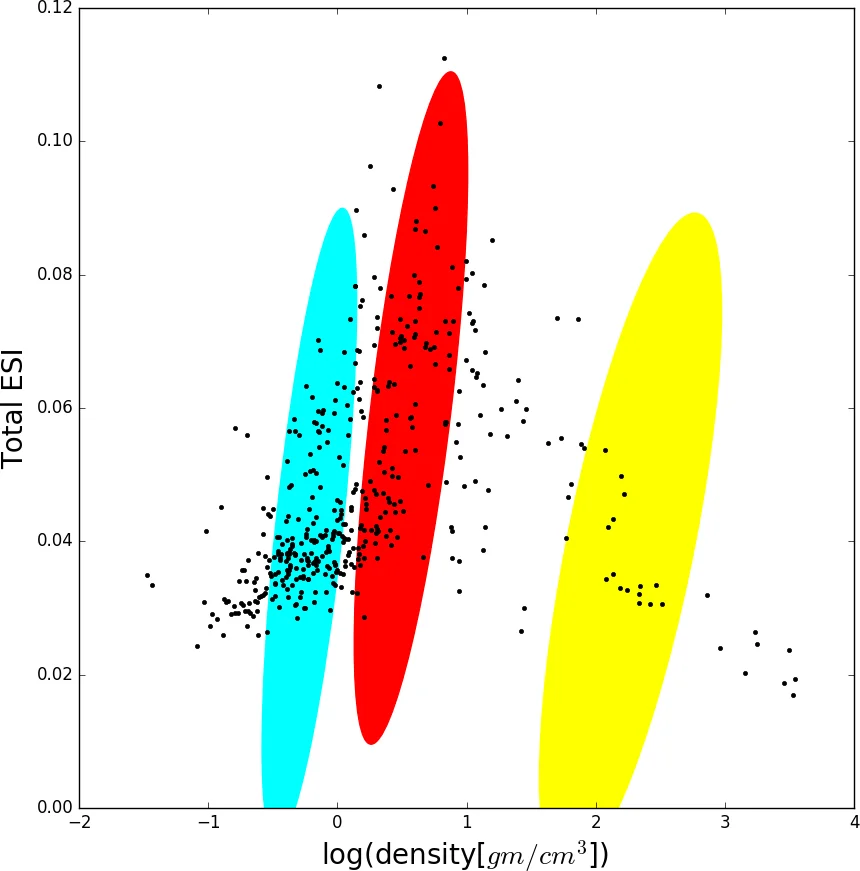
Recently, Odrzywolek and Rafelski (arXiv:1612.03556) have found three distinct categories of exoplanets, when they are classified based on density. We first carry out a similar classification of exoplanets according to their density using the Gaussian Mixture Model, followed by information theoretic criterion (AIC and BIC) to determine the optimum number of components. Such a one-dimensional classification favors two components using AIC and three using BIC, but the statistical significance from both the tests is not significant enough to decisively pick the best model between two and three components. We then extend this GMM-based classification to two dimensions by using both the density and the Earth similarity index (arXiv:1702.03678), which is a measure of how similar each planet is compared to the Earth. For this two-dimensional classification, both AIC and BIC provide decisive evidence in favor of three components.
💡 Research Summary
The paper investigates the statistical classification of confirmed exoplanets using Gaussian Mixture Models (GMM) and information‑theoretic criteria (Akaike Information Criterion, AIC; Bayesian Information Criterion, BIC). The authors first assemble a “gold‑sample” of 450 planets that appear in both the NASA Exoplanet Archive and the Extrasolar Planet Encyclopedia as of February 2017, ensuring that each object has measured mass, radius, surface temperature, orbital period, and thus a reliably computed density and Earth Similarity Index (ESI). Density is derived from the standard spherical assumption (ρ = M / (4/3 π R³)), while ESI combines six normalized planetary parameters (density, radius, temperature, surface gravity, escape velocity, orbital period) using a Bray‑Curtis‑like formulation, yielding values between 0 (completely dissimilar to Earth) and 1 (identical to Earth).
For the statistical analysis, the authors employ the Scikit‑learn implementation of GMM, fitting mixtures of log‑normal Gaussians to the data via the Expectation‑Maximization (EM) algorithm. They explore model dimensionalities k = 1 … 14, but focus on the comparison between k = 2 and k = 3, which are the most plausible numbers of planetary classes suggested by previous work (Odrzywolek & Rafelski 2016, “OR16”). After obtaining the maximum‑likelihood estimates for each k, they compute AIC = 2p − 2 ln L and BIC = p ln N − 2 ln L, where p is the number of free parameters (means, covariances, weights) and N = 450 is the sample size. The ΔAIC and ΔBIC values (differences relative to the best‑scoring model) are used to assess the strength of evidence: Δ < 2 indicates negligible evidence, 2–6 weak, 6–10 strong, and >10 decisive.
In the one‑dimensional (density‑only) case, the AIC minimum occurs for the three‑component model (ΔAIC = 0), while the two‑component model is only 5.6 units higher, well below the decisive threshold. Conversely, BIC prefers the two‑component model (ΔBIC = 0) with the three‑component model only 0.36 units higher. Because both ΔAIC and ΔBIC are far below 10, the authors conclude that the data do not provide decisive evidence for either k = 2 or k = 3; the choice remains ambiguous. The fitted means for k = 2 are ≈ 0.88 g cm⁻³ and 9.69 g cm⁻³ (322 and 128 planets, respectively), while for k = 3 they are ≈ 0.71, 2.03, 88.1 g cm⁻³ (225, 175, 50 planets). These values are broadly consistent with OR16’s peaks (0.71, 6.9, 29.1 g cm⁻³) but show a shift in the intermediate component, reflecting the different statistical framework.
When extending the analysis to two dimensions (log density + ESI), the authors repeat the GMM fitting and model‑selection procedure on the subset of planets with complete ESI data (still 450 objects). In this case both AIC and BIC decisively favor the three‑component model, with Δ values exceeding 10 for any alternative k. The three clusters can be interpreted as (1) low‑density, low‑ESI bodies corresponding to gas/ice giants, (2) intermediate‑density, moderate‑ESI planets resembling super‑Earths or rocky super‑Neptunes, and (3) high‑density, high‑ESI objects that may include brown dwarfs or unusually compact terrestrial planets. This result demonstrates that incorporating a habitability‑related metric (ESI) sharpens the statistical separation of planetary populations.
The discussion highlights several methodological points. First, GMM combined with AIC/BIC provides a principled way to balance fit quality against model complexity, avoiding over‑fitting that can arise from pure likelihood maximization. Second, the disagreement between AIC and BIC in the 1‑D case underscores the sensitivity of model selection to the penalty term, especially when the sample size is moderate. Third, the authors acknowledge limitations: the error bars on planetary parameters are not explicitly modeled (the “Extreme Deconvolution” variant of GMM is mentioned but not used), and the sample is dominated by transit detections, potentially biasing the density distribution. They suggest future work could incorporate hierarchical Bayesian GMMs, propagate measurement uncertainties, and add further planetary descriptors (e.g., atmospheric composition, stellar irradiation) to refine the classification.
In conclusion, the paper reproduces the earlier finding of distinct exoplanet density groups but shows that density alone does not yield a statistically decisive number of classes. By adding the Earth Similarity Index, the authors obtain robust evidence for three planetary clusters, suggesting that multidimensional statistical approaches are essential for a nuanced taxonomy of the ever‑growing exoplanet catalog.
Comments & Academic Discussion
Loading comments...
Leave a Comment