Emergence and Evolution of Hierarchical Structure in Complex Systems
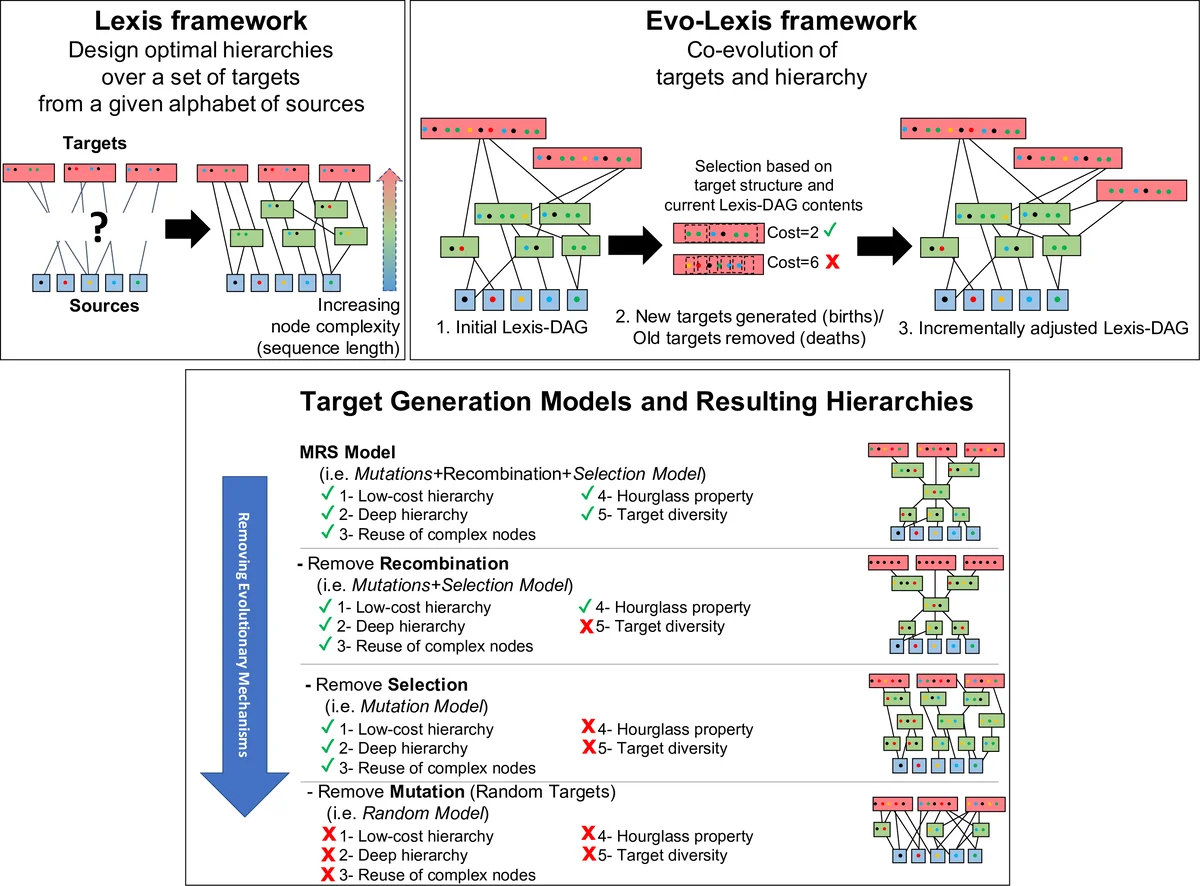
It is well known that many complex systems, both in technology and nature, exhibit hierarchical modularity: smaller modules, each of them providing a certain function, are used within larger modules that perform more complex functions. What is not well understood however is how this hierarchical structure (which is fundamentally a network property) emerges, and how it evolves over time. We propose a modeling framework, referred to as Evo-Lexis, that provides insight to some fundamental questions about evolving hierarchical systems. Evo-Lexis models the most elementary modules of the system as symbols (“sources”) and the modules at the highest level of the hierarchy as sequences of those symbols (“targets”). Evo-Lexis computes the optimized adjustment of a given hierarchy when the set of targets changes over time by additions and removals (a process referred to as “incremental design”). In this paper we use computation modeling to show that: - Low-cost and deep hierarchies emerge when the population of target sequences evolves through tinkering and mutation. - Strong selection on the cost of new candidate targets results in reuse of more complex (longer) nodes in an optimized hierarchy. - The bias towards reuse of complex nodes results in an “hourglass architecture” (i.e., few intermediate nodes that cover almost all source-target paths). - With such bias, the core nodes are conserved for relatively long time periods although still being vulnerable to major transitions and punctuated equilibria. - Finally, we analyze the differences in terms of cost and structure between incrementally designed hierarchies and the corresponding “clean-slate” hierarchies which result when the system is designed from scratch after a change.
💡 Research Summary
The paper investigates why hierarchical modularity—especially the “hourglass” architecture where a few intermediate modules dominate the flow from many inputs to many outputs—appears so frequently in both natural and engineered complex systems. To answer this, the authors introduce Evo‑Lexis, a dynamic extension of the previously proposed Lexis framework for constructing a minimum‑cost directed acyclic graph (DAG) that represents how elementary symbols (sources) are combined into higher‑level strings (targets).
In Lexis, each node stores a string; source nodes have zero indegree, target nodes have zero outdegree, and intermediate nodes represent substrings that are reused at least twice. The cost of a Lexis‑DAG is simply the number of edges (i.e., the total number of concatenation operations). Finding the exact minimum‑cost DAG is NP‑hard, so the authors rely on a greedy heuristic called G‑Lexis.
Evo‑Lexis adds a temporal dimension: the set of target strings changes over time through births (additions) and deaths (removals). When a change occurs, the framework performs incremental design, adjusting the existing DAG with the smallest possible increase in edge count, while also computing a clean‑slate design that re‑optimizes from scratch for comparison.
Four evolutionary mechanisms are modeled:
- Mutation – random insertions, deletions, or substitutions generate new targets.
- Recombination – parts of two existing targets are swapped to create a novel target.
- Selection – a candidate target is accepted only if its integration cost (additional edges needed) is below a threshold, mimicking fitness‑based survival.
- MRS (Mutations + Recombination + Selection) – the full combination, representing the most realistic evolutionary scenario.
The authors evaluate these mechanisms using several quantitative metrics: total edge cost, hierarchy depth (longest path length), reuse of complex (long) intermediate nodes, the “hourglass property” (fraction of paths that pass through a small set of core nodes), and target diversity (how similar the target strings are).
Key findings include:
- Emergence of low‑cost, deep hierarchies – As targets evolve through mutation and recombination, intermediate substrings become widely reused, reducing total edges while increasing DAG depth.
- Bias toward complex node reuse produces hourglass structures – Strong selection pressure favors the incorporation of longer substrings, leading to a small core (waist) that carries the majority of source‑to‑target paths. In many simulations, the core accounts for >70 % of all paths.
- Core node stability and punctuated change – Core nodes tend to persist across many evolutionary steps, providing structural stability. However, occasional recombination events can replace the core, causing abrupt “punctuated equilibria” where the set of highly reused modules shifts dramatically.
- Incremental vs. clean‑slate trade‑off – Incremental design leverages existing structure, achieving on average 5–10 % lower cost than a naïve re‑design for the same target set, but it can suffer spikes in cost when new targets are poorly aligned with the current DAG. Clean‑slate design yields the absolute minimum cost but requires rebuilding the entire hierarchy, which is computationally expensive.
- Impact of target diversity – High diversity (few shared substrings) reduces intermediate reuse, leading to broader, shallower DAGs with weaker hourglass signatures. Conversely, when targets share many substrings, hierarchies become deeper and the core shrinks.
These results support the hypothesis that a simple objective—minimizing inter‑module connection cost—can simultaneously generate hierarchical modularity, deep structures, and hourglass architectures. Moreover, the balance between mutation, recombination, and selection determines whether a system exhibits long‑term core stability or experiences rapid structural transitions.
The paper concludes by suggesting that Evo‑Lexis can be applied to real‑world domains such as micro‑service architectures, metabolic pathway analysis, and neural network design, where understanding the trade‑off between incremental evolution and full redesign is crucial. Future work is proposed to incorporate richer cost models (e.g., latency, energy) and to validate the framework against empirical data from biological and engineered systems.
Comments & Academic Discussion
Loading comments...
Leave a Comment