ELROI: A License Plate For Your Satellite
Space object identification is vital for operating spacecraft, space traffic control, and space situational awareness, but initial determination, maintenance, and recovery of identity are all difficult, expensive, and error-prone, especially for smal…
Authors: David M. Palmer, Rebecca M. Holmes
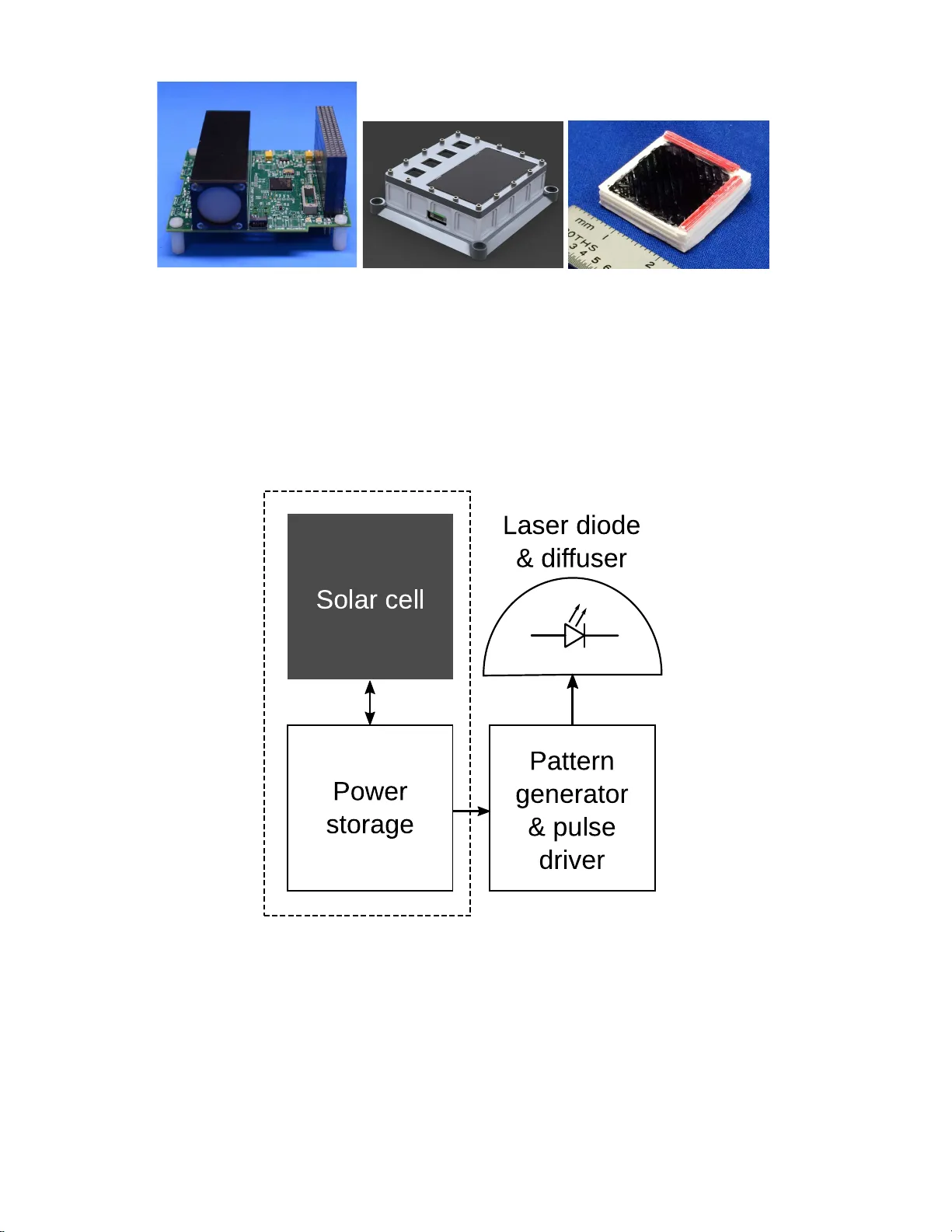
ELR OI: A License Plate F or Y our Satellite David M. P almer 1 and Rebecca M. Holmes 2 L os A lamos National La b or a tory, L os Al amos, NM, 8754 5 Space ob ject identifica tion is vital for op erating spacecraft, space traffic con trol, and space situational a w areness, but initial determination, main tenance, and reco v ery of iden tity ar e all difficult, exp ensiv e, and error-prone, es p ecially for small ob jects li k e Cub eSats. A ttac hing a b eacon or license plate with a uni que iden tification n um b er to a space ob ject b efore launc h w ould greatly simpli fy the task, but radio b eacons are p ow er-h ungry and can cause i n terference. This pap er describ es a new concept for a satellite license plate, the Extremely Lo w Resource Optical Identifier or ELR OI. ELR OI is a mi lliwatt -scale s e lf-p ow ered autonomous optical b eacon that can b e attac hed to an y space ob ject to transmi t a p ersi sten t iden tification signal to ground s tations. A system appropriate for a LEO Cub eSat or other sm all s pace ob ject can fit i n a pac k age with the area of a p o stage stamp and a few mill imeters thic k, and requires no p ow er, data, or control from the host ob ject. The concept has b een v alidated with ground tests , and the first fligh t test unit is sc heduled for l aunc h in 2018 . The unique identification n um b er of a LEO s atellite can b e determined unambiguously i n a si ngle orbital pass o v er a low-cost ground station. 1 ISR-2, MS B244, Los Al amos National Laboratory , palmer@lanl.g ov 2 ISR-1, MS D466, Los Al amos National Laboratory , rmholmes@lanl .gov 1 Nomenclature λ = wav elength ∆ λ = s p ectr a l bandwidth of filter τ = pulse duration T = pulse interv al P peak = p ea k emitted o ptical p ower P ave = average emitted optica l power ε DQE = detector quantum e fficiency , the ratio of detected to incident photons R dar k = detector dark r ate Ω = emiss ion solid ang le D = telesc o p e effectiv e ap erture diameter r = rang e fro m satellite to g round station dBm = decib els referenced to 1 mW dB γ = decib els referenced to 1 photon / s T erminology and Acron yms ELROI : Extremely Low Resource Optical Identifier $SW aP : Cost, Size, W eigh t, a nd P ow er HR T : Hor iz o nt al Range T est ID : Satellite Ident ification Number LEO : Low Earth Orbit RFI : Radio F requency Int erference STC : Space T raffic Control SOI : Space Ob ject Identification SSA : Space Situational A w areness 2 I. In troduction Space is cro wded—with tho us ands of ma nned spacecraft, active and retired pa yloads, r o ck et bo dies , explos io n fragments, and other orbiting space ob jects—and getting more so. Kno wing where satellites ar e is essential for preventi ng collisio ns, and useful fo r satellite owners and op erator s. The current publicly av aila ble Space-T rack catalog [1] lists ov er 16 ,000 ob jects a long with their orbital element s. How ev er, this list is restricted to those ob jects that hav e b een contin uously tra ck ed since launch to ma in tain “track custo dy ,” or those that hav e b een c onfident ly iden tified by other means. T rack custo dy can b e lost when there are interruptions in observ ations, w hen so lar activity c a uses sudden increases in atmo s pheric drag , when there ar e unexp ected maneuvers, or when tw o sa tellite orbits b ecome confusingly close. When an unident ified satellite then rea ppea rs in r adar and o ptical observ ations, it ca n’t b e put back in to the catalog unless multiple observ ations can q uant ify its orbit and tr a ck it back to a previously - lost satellite. Ev en when a satellite is tr a ck ed fr o m the moment it is relea sed from its launcher, it may not be fully identified. Individual ro ck et la unch es can r e le a se dozens to more than a hundred satellites (particularly Cub eSats) at a time [2, 3 ]. Shortly after launch, a satellite op erato r may know only that their satellite is one of the many “OBJ ECT XX” ent ries in the ca talog, making it difficult to contact and control the spacecr aft. Space Ob ject Identification (SOI) is ea sier if a s atellite car ries an identifying b eaco n that can be read from the g round. Ideally , this bea con would c onsume few resour ces and would last the ent ire o rbital lifetime of the sa tellite. Ther e is curre ntly no standa rd or widely a ccepted technology to pr ovide such a b ea con, but se veral o ptions a re under co nsideration, including conven tional radio bea cons com bined with GPS, radio tags activ ated b y a gro und signal, and passiv e reflectors [4]. Radio is the most developed option, but radio transmitters that ca n be rece ived at orbital distances tend to b e heavy and power-h ungry . F urthermore, if they op era te contin uously they can cause radio frequency interference (RFI), so they are turned off when a sa tellite is decommissio ned. Thus, ra dio bea cons do not enable SOI for p ost-missio n satellites, and they are also not suitable for passive debris o b jects such a s r o ck et b o os ters and in terstages. Conv en tional optical b ea cons (LEDs, for example) av oid the problem of RFI, but still require significant pow er to b e visible from the ground with traditional detection metho ds . 3 The Extremely Low Resour c e Optica l Identifier (ELROI) bea con is a new co ncept for a low- power optical “license pla te” that ca n b e attached to anything that go es in to s pace [5, 6] (Figures 1 & 2). The ELROI b ea con enco des a unique ID num ber in shor t, om nidirectional flashes o f laser lig ht, which can b e read from the ground with only a few photons p er s econd using single- photon detection and an inno v a tive background-r ejection technique. The remark ably low pow er level re q uired for photo n-counting o ptical communications has alr eady b een noted as a p ossibility for low p ow er commun ication, ev en at interstellar distances [7 ]. This strategy allows the b eaco n to b e low cos t, small, light weigh t, and low p ow er, so it fits the $SW aP (Cost, Size, W eight, and P ow er) budg e t, even a t the Cub eSat level. The power requirements are low enough that the bea con can b e self-p ow ered with a small sola r cell, which ma kes syste m integration simple, and allows the bea con to be flown on iner t debris o b jects without power, communications, data, or attitude control systems. The b eaco n do es not pr o duce RFI, and may b e ope r ated con tinuously throughout the on-orbit lifetime o f the satellite. The ELR OI signal consists of sho rt, brigh t pulses of mono chromatic light clo ck ed a t a fixed per io d. Eac h p erio d starts with e ither a flas h of light (enco ding a 1 bit), o r no fla sh (a 0), as shown in Figure 2. The ID rep ea ts several times a second. The p ea k p ow er of the light sour ce (a laser dio de) is in the 1 W range, but the av erage power is muc h low er. If the pulse duration and interv al are a s shown in Figure 2 and half the bits ar e ones, the duty cyc le of the laser dio de is 1:500 , and a pea k p ow er of 1 W g ives an av erag e power of just 2 m W. This means that p ower for the b eaco n can be provided by a few square centimeters o f sola r cell, ma king it indep endent of the host satellite. The ELROI signal is inten tionally op en and accessible to anyone with a gro und station that can b e built fro m Commercia l Off The Shelf comp onents. The identification num b er (ID) of each bea con will b e sto r ed in an op en registry , along with co nt act information for its op era tor and other information. This allows ELROI to b e ado pted as an international standard, read by ground stations a round the world to assist in the worldwide problem o f space traffic control (STC) a nd space situational awareness (SSA). The b eaco n ca n transmit additional data b eyond the ID, giv ing satellite o per ators a ba ckup channel for a nomaly res olution and other diag nostic purp oses. This, along with the b enefits to the spacecraft op era tor of being a ble to identify their own satellite, can 4 Fig. 1 Overview of the ELRO I system. The b eacon is attac hed to a satellite and con tinuously emits its optical signal—enco ding a unique ID num b er—o ver a wide solid angle. A ground telescop e collects a small p ortion of the emi tted photons, whic h are detected with a photon- coun ting sensor. A narrowband filter cent ered on the be acon wa velength rejects background light. The recorded data (circular i nset) consists of a list of photon detection times at a trac ked lo cation (green circle). Streaks represent backgr ound stars. The data analysis techn ique uses the timing ch aracteristics of the ELROI signal to eliminate more than 99% of backgrou nd photons, making it possibl e to read the ID in a single pass even i f the signal is only a few photons pe r second. Fig. 2 Representat ive c haracteristics of the ELROI signal. The sp ectral bandwidth of the signal is ab out 1 nm, and the e xample wa velength shown is 638 nm (other wav elengths may also b e suitable, as discussed in §II I). The width of the optical pulses is τ = 2 µ s, and the interv al b e t ween pulses is T = 0 . 5 m s. I f the instantaneous p eak pow er is 1 W a nd hal f the bits cont ain a pulse , the averag e pow er with this duty cycle is 2 m W, and a 128-bit ID rep eats every 64 ms. 5 drive ado ptio n of ELR OI even in the absence of in ternationa l no r ms or mandates. The first ELR OI prototype has b een delivered and integrated with a spa cecraft (Figur e 3a) scheduled for launch in 2018. A fully autono mo us mo dule (Figur e 3b) suitable for either attaching to a host satellite o r la unc hable as a 1/2U CubeSa t free-flyer, is curr ent ly b eing designed and will be pro duced in quantit y (6 for the initial pro duction run) to suppo rt multiple flight opp ortunities as they pr esent themselves. An optimized b eacon will even tually b e miniaturized to a pack age the size of a thick p os tage s tamp—a few squar e centimeters in a r ea and a few millimeters thic k—that can b e mas s pro duced in quantit y to supp ort the global launch rate (Figure 3 c). The ELROI concept has also b een v erified in gro und-to-ground tests. Using tw o test units op erating at 638 nm with av erage p ower less than 0.3 mW at a distance of 15 km, photo n detection rates in the range of 0.1–4 0 photo ns / s were measured, dep ending o n lens ap erture and atten uation. As discussed in detail in §IV A, these measurements a re consistent with the predicted detection rate, a nd the same mo del predicts a ra te of approximately 3.3 signal photons / s fro m a LEO range of 1 000 km (App endix B). The enco ded ID was success fully extracted from the ground-to- ground test data, with reliability dep ending o n the total nu mber of photons. Scaling the measur ed photon detection rate to simulate the LEO cas e shows that a pproximately 100-16 0 seconds o f o bserv a tion at the LEO rate is sufficient to reduce the misidentification rate to less than 1 in a billion, making it practica l to read the ID in a single sa tellite pass ov er the gro und s tation. ELR OI has be en developed at Lo s Alamos National Lab ora tory (LANL), g rowing out of our exp erience b oth with space systems and with single-photon imag ing . Initial testing will use a pre- existing g round station co nsisting of a commer cial telescop e (a Celestron 3 5 c m ap erture telesc o p e on a Soft ware Bisque Paramount ) and a LANL-develop e d single- photon imaging ca mera [8, 9]. How ev er, any additional g roups that wish to use their own systems to identify the ELROI bea cons are invited a nd encoura ged to do so. In this pa per , §I I describ es the ELROI concept, and briefly de scrib es the desig n and op er ations of the b e acon and the ground station. §II I discusses so me of the design details that allow a low power signal to b e transmitted, what tr a de-offs a nd o ptimiza tio ns a re av aila ble to ma ke this a practical system, and what e ls e can b e done with ELROI. Our pr ogress so far in developing this, 6 with b o th ground tests and current a nd future flight hardware, is discussed in §IV. The Conclusion, §V, summarizes the pap er and discusses how ELR OI can dev elop to b eco me a global standard. Appendix A shows how to computationally ex tract the ELROI ID fro m the g round station’s data and Appendix B works through an example link budget to demonstrate the feasibility of t his co ncept. II. Concept ELR OI uses a small optical beac o n that can b e attached to a ny ob ject that go es into space (Figure 1). This b eacon pro duces flashes of lig ht that enco de a n ID num ber, providing a “license plate” that uniquely identifies the satellite. The flashing light ca n b e detected a nd read by a small ground telescop e with a single-photon detector, allowing any one to identify the satellite. The sp ecific characteristics of the light flashes allow the ID to b e rea d even if only a few photons ar e detected per second, and in the presence of ba ckground. The optical s ignal is diffused to a larg e so lid angle (almost a full hemisphere) so tha t spacecra ft attitude control or p ointing is not requir ed. The receiver teles c o p e trac ks the satellite, using its known orbital elements. The light is spe c tr ally filtered to select only those photons at the b eaco n wa v elength. A single-pho ton detector records the arriv al time of each photon, and the list of times is then analyzed to reconstruct the ID b y determining which time bins contain 1’s and 0’s. This data analys is is describ ed in more detail in Appendix A. The combination o f the bea c o n signal characteristics and the gro und statio n desig n enable background rejection and signal extraction techniques that allow an extremely lo w-p ow er signal to b e recovered. Unlik e a ra dio antenna, an optica l telescop e’s ima g ing capability can reject all background sources more than a small fraction of a degree from the b eacon. The s pec tr al pur it y of the laser dio des allow narrow-bandwidth filters to r eject almost all o f the non-b eaco n light fro m the sky and the satellite itself. The use of sing le-photon detection and timing brings the signal into the digital domain, eliminating a nalog no ise a nd allowing signa l integration ov er the entire o bserv a tion time. The extremely low duty cycle a nd strict p erio dicity of the b eaco n allows a phase cut that rejects the background ligh t that do esn’t pr ecisely match the timing of the b eacon. Finally , the us e of a n err or-co rrecting co ding scheme for the ID makes it very unlikely that one ID will be mistaken 7 for another, even when the v alues of some bits are uncertain. A. System Design Overview More detailed design consider ations ar e discussed in §I II. The elec tr onics re q uired for the b eaco n a re quite s imple, as shown in the blo ck diagra m Figure 4. The p ow er system is mostly r emark a ble for its low capacity r equirements compar ed to co nven tio nal satellite sys tems. The pattern gener ator can be a very simple micro co nt roller , FPGA, or ASIC. The pulse driver circuitry dr ives a laser dio de, which provides highly mono chromatic light with g o o d efficiency . This lig h t is diffused to cover a wide solid ang le so that light rea ches any ground station in its field of view without any p ointing requirements place d on the ho st. The ground station, shown in Figure 5, uses a telescop e to concentrate the ligh t from the satellite and reject light fr om other parts o f the sky . This teles cop e must b e moun ted so that it can track sa tellites, based on supplied orbital elements. The collected ligh t is further filtered b y wa velength, using a narrow-band sp e ctral filter at the b eacon wa velength. This rejects the ma jority o f background light at o ther wav elengths (from the sky and from sunlight reflecting from the satellite). The filter e d light is then recor ded with a “photon-co unt ing detector.” This is a detector that, minimally , emits a pulse that trig gers a time-recording circuit every time it detects a pho to n. The detecto r may also have s ome p osition-s ensitivit y or imaging ca pability which, as we shall see in §II I B, affects the requirements on the telescop e and its tra cking system. T he data from the photon-counting detector—a list of photon times, including both be a con photo ns and ba ckground photons—is then a nalyzed to determine the ID of the b eaco n, as descr ib ed in Appe ndix A. B. Ope rations The ELROI b ea c o n requires a ta r geted observ ation to read a n ID. It is int ended a s an adjunct to pe r sistent satellite tracking op era tions by r adar and optical metho ds that maintain a nd update a self-consistent cata lo g. It will t ypically b e us e d for ob jects where the identit y is unknown o r questionable, such as immediately after launch when multiple sa tellites must b e matched to multiple ob ject detections. The ex istence of an ELROI b eacon on an ob ject r elaxes the demands on the 8 (a) NMTSat (b) ELROI-UP (c) ELROI 1.0 Fig. 3 ELROI hardware development stages. a. ELROI -PC104 unit to b e incorporated into a Cube Sat in the PC-104 form factor. b. CAD Drawing of ELRO I-UP unit that can op erate fully autonomously when attac hed to host ob ject, or as a free-flyer. c. Illustrative mo ck-up of a miniaturized ELRO I unit, suitable for any LEO Cube Sat or other small LEO space ob ject. Fig. 4 Comp onents requi red for the be acon. A smal l solar cell pro vides p ow er indep endent of the host satelli te, with the battery all o wing operation during orbital night . A pattern generator supplies the pulse sequence to a pulse driv er, which pow ers the laser dio de that emits the optical si gnal . The light is diffuse d into a wide solid angle so that the b eacon do es not need to b e p ointed di rectly at the ground station. 9 per sistent tra cking systems, b ecause the consequences of a lost track are diminished if the iden tity can b e r ecov ered. Due to sky background, the t ypical g r ound station can only oper ate at nigh t. Observ a tions will require clear skies, at least ov er a significant p ortion of the apparent path of the sa tellite, but atmospheric turbulence (seeing) is unlikely to have muc h of a n effect on receiver sensitivity . The narrow field o f view of the telescop e will require that the satellite’s orbit b e known in a dv ance. The required o rbit pr ediction a ccuracy is determined by the field of view of the photo n co un ting detector , and the presence or absence o f sunlight o n the satellite to allow clo sed-lo op tracking. F or larger satellites, obser v ations in eclipse will reduce the background and allow for faster identification, at the c o st of requiring accurate “blind” p ointing without s eeing the sa tellite itself in r e flec ted sunlight. Each ground station is exp ected to observe many differen t sate llites during their resp ective passes above the horizo n. The cost of an individual ground station (likely to b e in the in the range o f 0.1 –1 million dollars), and the skills required to op erate it, will b e beyond the pr a ctical capability of most individual Cub eSat op erator s. It would b e wasteful to develop a ground station and use it only for a single sa tellite (which might b e visible from a given ground sta tion for o nly a few minutes a day) and that restricted usag e would require tha t the satellite’s iden tity b e already known. Thus ELROI iden tification is pr obably b est implemented to by sp ecialized g round station op erators c o nt acting the op era tor o f ea ch satellite as it is ident ified, as either a commercial o r gov ernmental service. A full implementation of ELROI for global Space T raffic Control (STC) w ill require a worldwide net work of gr ound stations to provide pr ompt iden tifications for a v ar iet y of orbital g eometries, regar dles s of the weather and other co nditions at individua l ground s tations. Different lo cations, or different ground stations at a single lo cation, can hav e differen t design choices in terms of telescop e, mount and detecto r , to cov er the diversity of situations exp ected. 10 II I. Design and T rade-offs A. Beacon Design The optimal ELROI b e acon signal characteristics—wav elength, p eak p ow er, pulse width and separation, etc.—will dep end on trade-offs b etw een the reso urces that will b e devoted to each bea con ($SW aP), the reso urces for each g round system (prima rily cost), the characteristics of the sa tellite, and the required re lia bilit y of ident ification. Some of these ch ara cteristics mu st be standard for all ELR OI units, while others can v a ry from sa tellite to sa tellite. The strictest technical requirements for an ELROI s tandard are merely that the b ea con pro duce sufficient lig ht a t a n a greed-up on wa velength, so that a teles cop e with a narrow-band filter and a photon-counting detector can recor d the pho tons. V ariation in the details of the timing and co ding scheme ca n b e drawn from a small set of standards, which can evolve with time as mor e exp erience is gained and more ca pabilities ar e require d. (The co mputational p ow er requir ed to pro cess a list of photon time-ta gs is minimal, allowing the data to be tested a gainst each of the standards in use to find the correct o ne.) Semiconductor la ser dio des at the watt scale a re r eadily av ailable in rugge d pack ages for a v ar ie ty of techn olog ies, and are relatively resistant to radiation a t the levels exp ected in a LEO environmen t [10 – 1 2]. The planned flig h t tests (§IV B– IV D) include a v ariety of laser dio des and, along with additional en vironmental tests, will help determine final part selection. Because this application do es not require coherence, mult iple indep endent emitters ca n b e combined to pr ovide the desired optical p ow er. This a llows P peak to b e sc a led to ar bitrary levels by merely adding mo re emitters. Increasing P peak while keeping P ave constant (a b eaco n with shorter, brighter pulses) will reduce the num ber o f in-phas e ba ckground counts while keeping the source counts the same. Thus, for larger (brighter) satellites, higher P peak laser dio des may be optimal if the pack age size is determined by the s olar cell and battery (and hence P ave ). F or smaller satellites, reduction of the alre a dy low in-phase background g ives les s adv antage and may not b e worth the increas ed circuitry r equired for higher P peak . Differen t laser technologies will have different characteristics, including p ow er efficiency , av ail- 11 ability o f comp onents, robustness , radiation har dness, a nd wa velength v ariability . They will a lso hav e different wa velengths, which affects b oth the pro pagation characteristics and the av a ilability and efficiency of detectors. (The choice of λ = 638 nm and 450 nm laser dio des for the initial flight units is la r gely determined b y the wav elength-depend en t sensitivity o f the pre-existing LANL ground station and camera.) If the b eacon is a single unit mounted o n a fla t surface , this res tricts emission to a hemisphere ( Ω = 2 π sr ) whic h for a ra ndomly-oriented craft lea ds to a 50% pr obability of being o bs erv a ble from a g round s tation at any given time. This can be addre s sed in a num b er o f wa ys: the emitter may be mount ed on a corner of the satellite or a t the end of a solar pa nel to provide a wider view; mult iple emitters or mult iple b eacons ca n b e mo un ted a round the s pacecra ft; o r the r estricted emissio n can be accepted a s a factor that reduces but do es not e liminate the probability of a v alid ID. If, for example, the s atellite is exp ected to b e freely tumbling so that its emitter is visible to the gr ound station for half of a typical pass, then the asp ect and attitude v ariation of a satellite during a given pass may be enough to provide a v alid ID a cceptably often. Although Fig. 4 shows the c o mpo nent s o f an autonomous b eaco n, s o me of the functions can be in tegra ted with other spacecra ft s y stems. A s ystem that taps a small amoun t of p ow er fro m the existing spacecr aft bus and is controlled by surplus capa cit y of a pro c e ssor o r FPGA could b e incorp orated into a spacecraft during the desig n stage, requiring nothing mor e tha n the laser dio des, drivers, and diffusers to be a dded to the s pacecraft hardware. Howev er, an autonomous b e a con a s a separa te pack a ge ca n b e a dded to a spa c e c raft muc h later in the design cycle with a muc h lower engineering exp ense. The design of an er ror-co rrecting co ding scheme that selects the ID num bers is beyond the scop e of this pap er. One p ossibility is a Bo se-Chaudhuri-Ho cquenghem (BCH) co de, which for a 127-bit ID length would provide 4 million different IDs while b eing robust to up to 21 erroneous bits. Another po ssibility is a 32 -of-128 co de, which has less err or correctio n capability but (due to the low er num b er of ’1’ bits) requires less power to tr a nsmit. 12 B. Ground Station Desi gn Because clear, dark skies with a line of sig h t to the sa tellite are required for a g round station to read the ELROI b eacon, a globa l netw ork of g round stations will be req uired to supp o rt the need for timely identification. It is likely that there will b e diversit y in the types of detector s a nd other characteristics of these gro und systems. The ma jor design trade-offs ar e amo ng the capabilities and costs of the detector, the telesc op e, and its tracking sys tem. The sensitivit y of the ELROI ID measure men t r elies o n the use of a “photo n-counting detector” . That is, e a ch photon r egistered by the detector must pro duce a discr ete signal who se timing can be mea sured with resolution be tter tha n the pulse width τ . The detector will hav e a quantum efficiency , ε DQE , with which it register s the photons that hit it, and a detector dark coun t rate, R dar k , which is the r ate of false photo n detections. These detectors ca n b e single pixels, registering the time for a pho ton anywhere on a s e nsitiv e area, or p osition sensitive detectors that provide b oth the time and a lo catio n in the field of view for each photon. Popular single-pixel detectors include si ng le-photon a v ala nche dio des (SP ADs) and photomultiplier tubes (PMT s). Arrays o f SP ADs, p osition-se nsitiv e re a douts for PMT s, and other technologies s uch as micro channel plates (MCPs) can pr ovide p osition re s olution, fro m simple quadrant detectors up to full imag ing detector s with hu ndreds or thous a nds of pixels on a side. (More familiar imaging senso rs suc h as conv entional CCDs, electro n-mu ltiplying CCDs, and CMO S imagers do not hav e the combination of time re s olution and low read noise needed fo r rea ding an ELR OI b eaco n.) A s ingle-pixel detector requires that the lig ht from the satellite be concentrated on the detector, without to o mu ch a dditional background ligh t. This requires a teles c o p e and mount that can precisely fo llow the tra ck of a satellite across the s ky . If the satellite is illuminated by the Sun, a conv en tional camer a can detect the satellite and provide p o in ting co rrections to the telesco pe mount, while a dichroic mir r or directs photons at the b eaco n w av elength to a single-photon detector. If the satellite is not illuminated, the sa me conv ent ional camera can provide detections of stars as they pass throug h the field of view, and keep the mount p ointin g a t t he satellite’s pr e dicte d lo c a tion, based o n or bital elements provided b y previous obse r v ation s. Some s uitable gr ound stations already 13 exist with the addition of a small amount of extra ha r dware and s oft ware—for example, satellite laser ranging (SLR) stations hav e the equipment and ex per tise to track LEO satellites a nd obse r ve them with sing le- pixel detecto rs. These stations ar e widely-s paced ar ound the glo be and used for geo desy [13]. A p os ition-sensitive detector allows a less-a ccurate tracking system to keep the sa tellite in a larger field-of-v ie w, with the satellite pho to ns sepa r ated from the star and sky background in later pro cessing stag es. How ever, such detectors are substantially more complex and exp ensive than single-pixel detectors. The ground station that we will us e for the initial testing uses a photon counting camera developed at LANL [8], but equiv alent systems a re av aila ble commercially [14, 15]. A la rger ground station ap erture and a higher ε DQE increase b oth sour ce and ba ckground count rates. These cause a corresp o nding decre a se in the time require d to ID the bea con. The trade-offs discuss ed ab ov e may drive the system to different desig ns in different op era ting regimes; for example, LEO vs. GEO satellites. F or obser ving LEO satellites, which hav e apparent sp e eds of o rder one degr ee per second across the sky , the o ptim um may be a relatively small teles c o p e on a r apidly slewing mount , with an imag ing detector used to reduce the re quired pre c is ion of the high-sp eed motion. F or satellites at or near ge o synchronous orbit, a la r ger telescop e ca n b e mounted on a s low er mount and lo ck ed on to a slowly-mo ving targe t to feed a single-pixel detector . The la rger telescop e ap ertur e a nd the higher ε DQE av a ilable in single-pixe l detector s helps to comp ensate for the inv erse-squa re loss at the muc h longer ra nge to GEO. Changes in tec hnolog y will also change optimal design choices. La r ge imaging SP AD arrays are under a ctiv e development (driven by the desire for flash- LIDA R systems for self-driving ca r s [16, 17]) and may make high-p erformance pho ton co unt ing c a meras cheap. Sup erconducting nanowire singlephoton detectors (SNSPDs) a re beco ming commercially av ailable and may provide higher per formance than o ther single-pixel detector s a t an a cceptable cost [1 8 – 20]. C. Additional capabilities The ID signal co nsists of low-dut y-cycle p erio dic flashes co nfined to a n in-phase time slice of width τ in each pe rio d T . This p ermits a dditional signals to b e interleav ed as extra flashes out o f 14 phase with the ID bits. The additiona l signal must hav e low eno ugh sp ectral p ower at the p erio d of the ID signal to avoid int erference with the clo ck r ecov ery , but this can b e a ch ieved by a careful choice of co ding scheme. One p ossible use fo r this a uxiliary data channel is to provide “ black box” information for di- agnosing and r ecov ering from spa cecraft anomalies . The op eratio n o f a n autonomo us ELROI unit will b e una ffected b y most failure mo des of its host satellite, and so this can provide an indepen- den t low-bandwidth channel for small a mount s o f status informa tio n when o ther information is no t av a ilable. The ELR OI unit may hav e its own s ensors, such as MEMS ac c e le r ometers, gyr oscop es, and sho ck s e ns ors. Ev en with no a dditional hardware, v ar ia tions in the solar cell voltage ca n b e analyzed to detect sudden changes in satellite a ttitude or spin state. The cost in $SW a P for implementing this optional capa bilit y is rela tiv ely low, and includes an increase in complexity o f the pattern generato r, any in terfaces or internal sensors that ar e req uired for the status infor ma tion, and an increase in ov erall pow er prop ortional to the additional light generated to tr ansmit the additional bits. IV. Curren t results and future development A. Horizon tal range test T o v alidate link budget calculations a nd determine whether the ID can b e read in conditions similar to a LEO s ystem, the ELR OI concept was demonstrated with a horizo n tal ra nge test (HR T) ov er a pproximately 15 km. The bit error ratio (BER) and resulting co deword er ror ratio (CER, the probability o f inco rrectly identifying the ID) were measured under a rang e of o bserving a nd analys is conditions to simulate different observ ation durations and signal streng ths. The results of the HR T show that the link budget calculations are accurate when applied to the test conditions, and that the transmitted ID num ber can b e r e a d with data rates compara ble to a LEO sys tem. 1. Horizontal r ange test c onditions The HR T used a receiver stationed 15 km aw ay from tw o transmitter units (at altitudes o f ∼ 25 0 0 m for the tra nsmitters and ∼ 20 0 0 m for the receiver). Each tr ansmitter consisted of a laser dio de (638 nm), o ptical diffuser, and driver electronics. The laser s were driven in a 6 4-of-12 8 pattern ID 15 with a τ = 2 µ s pulse duration, a T = 500 µ s pulse interv al, which rep ea ts the ID every 64 ms (recall Figure 2). The t wo trans mitter units enco ded different IDs. The time-av erag ed effective isotro pic radiated p ow er (EIRP) in the direction of the r eceiver was measur e d to be 0.3 m W, cor resp onding to a p eak EIRP o f 150 m W a fter adjusting for the 1:5 00 duty fraction. Unit 2 was attenuated by a 13%-transmiss ion neutral density filter, while Unit 1 was left unfiltered. The receiver consisted of a LANL-developed photo n-counting camera [8, 9] with an f = 4 00 mm lens a nd adjustable ap erture (up to f/2.8 = 14 3 mm diameter ). The c a mera ha s a quantum efficiency of ab out 3 .9% at 638 nm and sub-nanos econd timing reso lution. The receiver was eq uipp ed with a 10-nm bandpass filter centered on the transmitter laser w av elength (638 nm) to reduce background. The obse r v ations w ere ma de on a moo nless night under v ariable c lo uds, beg inning ab out 90 minutes after sunset. Observ ations were interrupted by rain a nd fog at times, but the da ta discussed here was taken while c o nditions were clear with no obvious o bscuration. The optical path was within Los Alamos Count y , NM, USA (po pulation 1 8,000) and light p ollution was minimal. 2. Link budget verific ation Link budget calculations (see App endix B) pr edict that a P ave = 2 mW ELROI b eaco n on a sunlit Cub eSat from L EO at 100 0 -km ra nge from the F enton Hill Observ atory 14" telesco pe and LANL senso r w ould pr o duce 3.3 sig nal counts and 91 ba ckground co un ts p er s econd. Applied to the horizontal range test, the same ca lculation predicts that Unit 1 at f/8 will pro duce 4 .7 counts per second, and the attenu ated Unit 2 will pro duce the same co unt rate at f/2.8. As discussed in Appendix B, the v ariable transmissio n o f the atmosphere is no t accounted for in these estimates; how ev er, the HR T test rang e of 15 k m was chosen to pr ovide more tha n the equiv alent atmos pheric attenu ation o f a sea -level site observ ing a t the zenith. The measured v alues from the HR T a r e 8.3 counts/s fo r Unit 1 a t f/8 and 4 .5 counts/s for Unit 2 at f/ 2 .8. Mea surements cov ered a range of a p e r tures yielding co un t ra tes fro m ab out 0.1 co unt s/s (atten uated Unit 2 at f/22) to 40 counts/s (Unit 1 at f/2.8). The measured count rates for Unit 2 agree well with predictio ns , while count rates for Unit 1 are somewhat higher than predicted. This may b e due to the effect o f indirect light from the sides of Unit 1 illuminating the area around the 16 transmitter and then reaching the r eceiver. In contrast, Unit 2 was housed in a b ox with a window cov ered b y the neutral density filter. 3. Signal extr action and err or r ates T o deco de the ID, the photons from the lo ca tion of the transmitter are first selected from the camera FO V. In the analysis of the HR T this is done manually with a ra dius cut ar ound each transmitter lo cation. As discussed in App endix A, an al g orithm is used to detect the car r ier frequency of 2 kHz (see Figure 6), a nd out-o f-phase photons ar e rejected. The remaining photo n detections are then stack ed by the 128- bit pattern length to form a histogra m of counts in the cyclic time bins cor resp onding to each bit. A threshold level is set to distinguish betw een 0 a nd 1 v alues. Due to er rors from statistical fluctuations and background, this analys is will g ive some fraction of incorrect bit v alues (the bit error r atio, o r BER), so identif ying the correct ID requires searching the registry for the nu mber that ha s the fewest discr e pa ncies from the measured sequence. F or the HR T, an ID is consider ed cor rect if it contains 12 or fewer bit err ors–a n ID with 13 or more bit er rors is considered a Co deword Error. O ptimal co ding schemes can cor rect mor e than 12 erroneous bits out of 128 , and using a simple thresho ld cut decr eases statistical p ow er compared to more so phisticated methods , therefore this is a conserv ative criterion. Figure 7 shows the bit er ror ratio (BER) as a function of o bserv a tion time for the HR T con- ditions, and scaled by signa l count rate to the predicted L EO system. The co deword erro r ra tio (CER) is a function of the BER; a s a result of using err or-cor recting co des, a BER of 3.7 % g ives a CER o f just one in a tho usand while a BER o f 1% gives a CER b elow one in a billion. In the data of Figure 7, 55-9 5 seconds at the predicted LEO rate is required to achiev e CER = 1 0 − 3 , and 105-1 57 seconds reduces the CER to 10 − 9 . These obser v ation times are reasona ble for a single pass of a LEO s atellite; therefore, we exp ect to b e able to rea d the ELROI ID with high confidence in the predicted LEO system. The mea sured count rates in the HR T conditions also confirm that the link budget calculation metho ds a re accurate. The HR T therefore success fully demo nstrates the ELROI concept and lays the gr oundwork for the first on- orbit test, ELROI-PC104, describ ed in the next section. 17 B. ELRO I-PC104 ELR OI ha s b een develop ed in a PC-104 form factor for integration in to a Cube Sa t (Figure 3 a ). It has 4 laser dio de emitters pro jecting throug h tw o diffusers on o pp os ite s ides of the CubeSa t. One diffuser has tw o λ = 63 8 nm red laser dio des, at P peak = 1 W and 0 . 7 W , from t wo differen t manuf acturer s (Mitsubishi ML50 1P73 and Oclar o HL631 93MG, resp ectively). The other diffuser has an identical 1 W λ = 63 8 nm laser dio de a nd a λ = 45 0 nm 1 . 6 W blue las er dio de (Thor la bs L450P16 0 0MM). This unit relies on the spacecraft bus for p ow er, and can b e controlled by the spacecra ft computer ov er a n In ter-Integrated Circuit (I 2 C) interface. Each las e r emitter ca n be indep endent ly co n trolled with its own combination o f pulse width τ , pulse interv al T , and ID n umber (up to 128 bits). The relative phases o f the dio des can b e controlled so that they do not flas h sim ultaneously , even if they hav e the same T . In the abs e nce o f any commands from the space c r aft, the unit waits for 45 minutes after p ow er is a pplied, then a utomatically p ow ers up the three red laser dio des , ea ch with its own ID and phase. The 45 min ute delay b efore transmission is required for 1-3U CubeSats by the CubeSat standard [21]. Only the red dio des a re automatically activ a ted b eca use the blue las e r r equires a higher o p e r ating voltage a nd more power fr o m the spacecr aft bus. In this thre e - dio de, red-o nly mo de, the en tire ELROI unit draws only 56 mW . Many Cub eSats fail after launch b efor e providing their firs t telemetry [22]. Although the fail- ure rate is declining as the co mm unity ga ins g reater exp erience, the lack o f feedback can preven t anomalies from b eing diagno sed, ma king recov ery or lear ning fr o m the ex per ience v ery difficult. The autonomous start- up of ELROI-PC104 will improve this situation. If the ELROI s ignal is detected, it will demonstr a te that the spacec r aft p ow er systems are a ctive. As the spacecr aft pro cesso r b o ots up and s ta rts a c tiv ating systems, it can update the transmitted ID, allowing progr ess to b e moni- tored. An y failures detected by the pro cessor ca n als o b e transmitted by mo difying the ELROI ID. Other status information, such as the num ber of radio co mmands received from the ground, can b e transmitted in the same wa y . The unit shown in Fig 3a has b een int egra ted into the New Mexico Institute of T echnology’s 18 NMTSat, a 3 U CubeSa t with la unc h expec ted in 201 8 [2 3]. C. ELRO I-UP A unit that ca n be attached to any s a tellite, the ELROI Universal Pro totype (ELR OI-UP), is currently b eing designed and built (Figure 3 b). This mo del includes its own sola r cell and battery , and is ca pable of fully autonomous op eration. It can accept co mmands or power from the hos t spacecraft, but do es not r e q uire them. The unit can a lso b e mounted in a passive mechanical structure and launched as a free-flying Cub eSat in 1/3U, 1/2 U or lar ger fo r m factor. ELR OI-UP supp or ts up to four laser dio des. The first test flight units will b e po pulated with four λ = 63 8 nm red laser dio des, at P peak = 2 . 5 W (Mitsubishi ML562G84 ). Multiple co des and timings with different combinations of the emitters w ill b e pre-pr ogrammed to a llow testing at up to P peak = 1 0 W . The first pro duction r un will b e of 6 units at a marginal c o st o f $ 4,000 e a ch. The size is 9 . 8 × 9 . 2 × 3 . 1 = 2 80 cm 3 , the mass is 300 g a nd the p ow er (if externally supplied instead of provided b y the sola r cell) is 50 mW . This $SW AP qualifies it as a Low Resourc e Optical Identifier. W e a re willing to pr ovide these b eaco ns to appro priate launch opp ortunities. D. ELRO I-1.0 T est re s ults fro m ELROI-PC104 and ELR OI-UP will allow ELROI to b e standardized and adopted by the entire space communit y . Cub eSats are the clas s of space ob ject that hav e the most pressing need for an identification s ystem, a nd are also the mo st co nstrained by $SW a P . Thus we need to develop the lightest, smallest, cheapest ELROI b eacon that can b e mass- pro duced and attached to any Cub eSat with minimal integration co st. The size of b eaco n will b e dominated by its largest co mpo nen ts, which in this case will b e the power sys tem. A given system power mandates the solar cell area needed to supply it, and the battery volume required to ma in tain p ow er b oth throug h the or bital night , a nd through extended per io ds when a ra ndomly-oriented inert or non-attitude-controlled satellite migh t keep the s olar cell po in ted aw ay from the Sun. A satellite that ma in tains attitudes that prevent go o d sola r illumination ( e.g. , if the b eaco n is on a nadir-p ointing face o f the spacecr aft) may r equire additional, separ ated, 19 or re- oriented s o lar cells. F or the L EO Cub eSat b eacon used as an example in the link budget App endix B, P ave is 2 mW of o ptical p ow er. Assuming a 50% conv ersion efficiency fr o m electricity to light a nd a llo cating an additional 1 mW for other comp onents such a s the pulse pa tter n generator, this g ives a total system power of 5 mW . W e assume a photovoltaic cell that is 30% efficient, is ra ndomly oriented on the re le v ant timescales (50% o f the time it is p ointed awa y fro m the Sun, and the remaining time has a sla n t-adjusted a rea tha t av era g es to 50 %) a nd is in eclipse for 5 0% of its or bit. Thes e benchmark v alues combined with a 1 . 3 6 kW / m 2 solar co nstant give an average yield of 5 mW / cm 2 of photov oltaic cell area. LiF ePO4 cells sto r e ∼ 0 . 22 Wh / cm 3 of p ow er (e.g., [24]) so 0 . 5 5 cm 3 of this chemi stry could p ower the b eacon for an entire day on a full charge. Th us, if the size of the bea con is dominated by the p ow er system, this implies a size scale of ∼ 1 cm 3 . Although this minimal-size system would provide a dequate p ow er and sig nal under the typical conditions, increas ing the ov erall sig nal would allow the ID to b e r ead over a wider rang e o f condi- tions, s uch as shorter- duration passes at low er ho r izon ang les and lo nger distance s fro m the ground station. Under optimal conditions, an increased s ignal would allow the ground station to rece ive the ID co de more ra pidly , allowing it to serv ice more satellites per night. Allowing a larg er b eacon would also simplify the engineer ing challenges o f manuf acture. Exp erience ga ined from the early flights of ELR OI-PC104 a nd ELROI-UP will help to r efine the pra ctical trade-o ffs b etw een the c o st and b enefits of a larg er, more p ow erful bea con. Figure 3c shows a mo ck-up o f what such a b eacon could lo o k like in a 2 × 2 × 0 . 5 cm 3 size with 3 cm 3 of pho tov oltaic cell. A ttaching o ne o r mor e of these to every Cub eSat would b e tec hnically and eco nomically fea sible and, given the benefits that it provides to the spacecr a ft op erator, likely to b e widely adopted. V. Conclusion ELR OI is a simple, low-cost optical b ea con tha t allows a mo dest ground station to pr ovide un- ambiguous Spa ce Ob ject Ident ification. The b eaco n is cheap a nd small enough for use on Cub eSats, and gro und statio ns ca n b e built ar ound the world using co mmercially-av aila ble technology . It is 20 suitable for use on everything that go e s in to spa ce to simplify the imp ortant tas k of Spa ce T ra ffic Control. The ELROI concept has bee n verified in long - range ground tests that simulate the link budget and atmos pheric pa th-length of a LEO system. A bea con has b ee n integrated in to a spa cecraft for launch in the near future, and will b e observed with an existing gr ound station. Multiple copies of an autonomo us b eaco n that can b e attached to other spacecra ft with minimal integration are b eing built. There are no technical barriers to miniaturizing ELROI to the size of a thick po stage stamp for easy application to even small satellites. W e encourag e other gr oups to develop their own ground systems or use existing facilities to track the ELROI b eacons a fter launch. W e can a lso pr ovide proto type b eacons to spacecra ft developers for integration into their sa tellites. Based on the data from these initial flights, in ternational standards can b e developed to allow any g round statio n to ident ify an unknown satellite that ha s a b eacon. Pro ducing an o ptimal s et of req uir ement s on the b eacon and ground s tations will also requir e extensiv e physical mo deling and s imulation, vendor sur veys, technology forecasts, economic and po licy c o nsideration, a nd v alue judgemen ts to balance the comp eting interests that will eventu ally arise . The adv antages that ELR OI provides to spacec raft o per ators, combined with the low exp endi- ture required to incorp o r ate the b eacons in satellites, means that they can b ecome widely used even in the a bsence of international no rms or ma ndates. Appe ndix A. Data extraction and analy sis This is a simplified desc ription of the pro cess o f determining a n ELROI b eacon’s ID from observ ations. A more detailed dis c us sion of statistical ana lysis and co mputationa l optimization tech niques is b eyond the scop e of this pap e r. The telesco pe and detector acquire the data from the bea con a s a list of time-tagg ed photon detection even ts. T o go from that data to a ID is a mul ti-step pro cess: 1. Detect and recover c lo ck phase a nd p erio d. 21 2. Extra ct photon count v alues for each ID bit. 3. Determine the ID that be st fits the data, a nd a n estimate o f its reliability . If the precise clo ck p er io d of the b eac o n, T , is known, then the fra ctional phase of each photon in the r ange of [0 , 1 ) cycles, is φ i = frac ( t ′ i /T ) where t ′ i is the time at which photon i is detected, a djusted fo r light-tra vel time from the satellite’s lo cation, and frac ( x ) = x − ⌊ x ⌋ is the fractional part function. The tr ue clo ck phase may b e determined b y genera ting a histogr am of φ i and finding the maximu m at a v alue φ p eak , with a width τ /T . In practice, even if a nominal v alue o f T nom is standa r dized (so that it can b e predicted for an unidentified satellite), the true v alue of T will be in an uncertaint y range T nom (1 − e T ) < T < T nom (1 + e T ) where e T , the fractional error tolera nce in T , is due to tolerance s in the bea con’s clo ck. F or a cr ystal oscillator , e T ∼ 5 0 × 10 − 6 or 50 ppm is a common v alue. In addition, there may b e drift in T during the cour s e o f the observ ation, primarily due to temp erature v ariation. This v ariation in T can be handled by sea r ching ov er the exp ected range for the v alue that pro duces the b est p eak in the histogra m o f φ i . T o preven t lo ss of sensitivity , this s earch will require a granularity o f δ T < ∼ τ T / ∆ t wher e ∆ t is the total duration of the da ta analyzed. F or a 10 s observ a tion with τ = 1 µ s , T nom = 1 ms , a δ T = 1 × 10 − 10 s search over a ± 50 ppm range ( T nom ± 5 × 10 − 8 ) will require 1000 tria l histograms. This ca n be handled with go o d co mputational efficiency by tec hniques s uch as the F as t F olding Algorithm [25] (FF A), which allows a sp ecified frequency range to be searched with a sp ecified frequency spacing to lo o k for features that are narrow in phase s pace. The FF A can b e extended to allow e fficient sear ches ov er s low changes in freq uency during the obser v ation to co mpensa te for temper a ture dr ift. The FF A is fast enoug h that detecting and recov ering the clo ck phase w ill take an insignificant a mount of co mputer time compar ed to the dur a tion of the observ ation. When a trial histogr am shows a significa nt p eak, small adjustmen ts to T , drift in T , and the phase offset can often improv e the peak v alue if the b eacon photo ns were originally distributed 22 among adjacent phase bins. This ‘p eaking up’ is an acceptabl e wa y of refining the clo ck solution, with the under s tanding that the significance of the result re flects a lar g er nu mber of tr ia ls. Note that the ba sic version of the m uch more familiar F ast F ourier T rans form (FFT) is not computationally efficient for this search. This is b ecause the sp ectra l ener gy of the ELROI signal is spread out ov er many harmonics (from b elow a kHz to ab ove a MHz ), the FFT must be calculated ov er all frequencies fro m zer o to the highest frequency o f interest, the FFT’s frequency spa c ing is fixed and ina dequate, and the FFT cannot eas ily handle slowly-v arying frequencies. After the clo ck characteristics are determined a nd refined, the photo n detections can b e divided in to thos e who se detection times are r esp ectively in-phase and out-of-phase with the b eaco n’s emis- sion. The out-o f-phase photons a re used to determine the background rate, but can b e otherwise discarded. The in-pha se photons , which include b oth bea con and background photons are used in further analysis. Each in-phas e photon detection is given a bit index 0 ≤ j ′ < m which indicates which bit it cor resp onds to in the rep eating m -bit ID, with the pr ime ( ′ ) to indicate that the ’fir st’ bit of the ID a s found in the registry do es no t necessar ily co rresp ond to j ′ = 0 . C j ′ , the num b er of detected photons for bit index j ′ , is therefor e a measurement of whether the corresp onding bit of the ID is a one o r a zero. This will tend to b e bimo dally distributed, with the exp ectation v alue for bits that ar e zero, h 0 N i , b eing estimable fro m the background rate, a nd the exp ectation v a lue for bits that are one having an additional sig na l: h 1 N i = h 0 N i + h 1 S i . The simplest wa y to match the data to an ID is to ass ig n a threshold cut: b j ′ = 1 , if C j ′ ≥ C thresh 0 , otherwise with C thr esh chosen to split the b j ′ v alues in to the exp ected num ber of zer o s and ones. The set of b j ′ v alues is then matched to each individual IDs in the cata lo g o f all currently flying ELR OI units, with each o f the m bit p ositions b eing used as j ′ = 0 . The ID that matches the set o f b j ′ with the few est discrepancies is the mos t likely ID to corres po nd to the observed ELR OI bea con. If all other IDs hav e substantially more discr epancies, then that indicates with high confidence that the identification is corr ect. There are many p oss ible r e finemen ts to this a lgorithm. Improv ed clo ck recov ery alg o rithms that 23 take a dv antage o f the s parse nature of the data (the r elatively small n umber o f detected photons) can be developed. Photon detections c a n be weigh ted ba sed on the measured v ar iation in the background and exp ected sig nal level. The threshold cut ma y be replac e d by a pro babilistic analysis with a contin uo us ra ther than binar y 0 vs 1 determination. The co nfidence lev el of an iden tification can b e rigoro usly ca lculated based on the counting statistics of the photon detections. Thes e refinements significantly improv e the b eacon detecta bilit y and are straightforward to implement , but ar e b eyond the scop e o f this pap er. B. Link budget calculation for a sample design The link budget g ives the rate of signal photon detections ( photons / s ) exp ected under v arious conditions. This r ate dep ends o n the optical p ow er emitted by the b eacon, the distance from the bea con to the ground station receiver, the a rea of the collecting optics, the transmission of the atmosphere and optical co mpo nen ts, and the quantum efficiency of the pho to n-counting sensor . The v alues in the following example c a lculation are based o n the LANL gro und s ta tion at F enton Hill, but would b e applicable to mo st mid-sized teles c o p e s and many differen t types of single- pho ton detectors. An estimate o f background co un t rates in several scena rios is also given. The count r ate in pho tons / s at the receiver is R = P a vg × 1 / Ω × A/r 2 × T tot × ε DQE /E γ P a vg is the av erag e p ow er of the beaco n, which dep ends on the p eak p ow er P p eak and the duty cycle d . Ω is the s o lid angle of the b eaco n emission, and can be as large as 2 π . A is the collecting area of the r eceiver optics, and r is the distance from the b eacon to the receiver. T tot is the total optical tra nsmission, including the sp ectra l filter tra ns mission T f and the atmospher e tra ns mis s ion T atm . Atmospheric transmissio n can change rapidly a nd depends o n so many fac to rs (a tmospheric densit y , h umidit y , pollution, zenith ang le, wa velength, etc.) that a detailed mo del is b eyond the scop e of this work. Th us, as in §IV A, T atm is ignored for the purp os es of a link budget estimate, but it ca n b e expected to contribute 1-3 dB of additional loss dep ending on conditions. ε DQE is the q ua nt um efficiency of the pho to n-counting detector, which rang es from 1% (some PMT s) to 75% (some SP ADs), a nd has bee n measured to b e 3.9% for the LANL se ns or. E γ is the energy p er 24 photon at the b eacon wav elength. Typical v alues for the link budget par ameters are shown in T able 1 , and the calculation is work ed o ut in T able 2, giving a nominal rate o f 3 .3 photons / s fro m LEO. When the host satellite is in s unlight , reflected light will b e the do minant sour ce of background photons [30]. The amo unt of reflected sunlight dep ends o n a combination o f the satellite’s size and alb edo, and will generally be higher for lar ger satellites. This ba ckground also depe nds on the spacecraft attitude and the angle b etw ee n the Sun and the obs erver, s o for simplicit y the spacecraft is approximated by an equiv alent sphere at a 90 ° (“half mo on”) phase ang le. T he ba ckground r ate for a 10- cm sunlit CubeSa t is worked o ut in T able 3, giving a nominal rate of 0.36 ba ckground photons/seco nd after filtering . The predicted sig nal r ate of 3.3 photons / s and ba ckground rate of 0.3 6 photons / s gives a suffi- cient link budget to read the ID reliably in a sing le pass —as discussed in §IV A and shown in Figure 7, 55 to 9 5 s of observ ation at the predicted LEO ra te is r equired to reduce the CER (Co deword Error Ratio, the probability o f incorrectly ident ifying the co de) to one in a thousand, and 105 to 157 s reduces the CER to one in a billion. Ac k no wledgme nt s Initial work on this pro ject was supp orted by the US Department of Energy through the Los Alamos National Lab orator y (LANL) L a b o ratory Dire cted Research and Developmen t prog ram as part of the IMP ACT (Int egra ted Mo deling of Perturbations in Atmospheres for Conjunction T ra cking) pro ject. F urther work was suppo rted by the Richard P . F eynman Center for Innov a tion, LANL. ELR OI hardware a nd so ft ware was develop ed at LANL b y Louis Borges , Richard Dutc h, David Hemsing, Jo ellen Lansfor d a nd Charles W eav er, with thermal a nalysis by Alexandra Hick ey , [30] The con tribution f rom sky bac kground i s usually small, but depends on the local sky surface brigh tness and the field of view necessary for trac king. Assuming a field of view of 1 arcmin ute and the other parameters giv en in T able 1, the sky backgr ound coun t rate ranges from ab out 40 photons / s with no mo onligh t (sky sur- face brightness = 21.6 magnitude / arcsecond 2 ) to ab out 1000 photon / s at the full mo on (sky surface brightn ess = 18 magnitude / arcsecond 2 ), b ef ore the phase cut [28]. (Note that sky surface brightne ss v alues are measured in the V sp ectral band; scattering of light in the atmosphere is biased tow ard the blue end of the vi s ible sp ectrum, so coun t rates at 638 nm will b e low er.) After the phase cut, these rates would b e reduced to ab out 0.2 photons / s and 4 photons / s , respectiv ely . The bac kground coun t rate may increase dramatically if brigh t stars en ter the field of view, but these even ts are i solated in time and can be remov ed from the data. 25 Lee Holg uin, and Za chary Kennison. The Ho rizontal Range T est was assisted by Amanda Graff, David Gra ff, Mike Rabin, and David Thompson. W e thank the New Mexico T ech Cub eSat team, including Anders Jorgens e n, Sawy er Gill, Saman tha Y oung, a nd Aaron Zucherman, for providing the first opp ortunity to fly a n ELR OI unit. W e tha nk Rob erta Ew art o f the Space and Missiles Systems Center for her enco uragement and advo cacy . References [1] “ S pace-T rack.org,” [Online] https://w ww.space-trac k.org/, 2017. [2] F oust, J., “ I n dia sets record with launch of 104 satellites on a single ro ck et - SpaceNews.com,” [Online] http:// spacenews.com/india-sets-reco rd-with-launch-of-104-satel lites-on-a-single-rocke t/, 2017. [3] F oust, J., “ Soyuz launches 73 satellites,” [Online] http:// spacenews.com/so y uz-launches-73-sa tellites/, 2017. [4] Ew art, R. M., “ Enh anced Space Ob ject Id entifica tion: T aking th e Guesswo rk out of LEO Cub esats,” Aiaa Sp ac e 2016 , , No. September, 2016, pp . 1–10, doi:10.2 514/6.20 16- 5287. [5] Pa lmer, D., “ OPTICAL I DENTIFICA TION BEACON,” Pro visional patent application 62/ 218,232, September 14, 2015. [6] Pa lmer, D., “ OPTICAL IDEN TIFICA TIO N BEACON,” Paten t application 15/232,857 , August 10, 2016. [7] How ard, A., Horow itz, P ., Coldw ell, C., Klein, S ., S u ng, A., W olff, J., Caruso, J., Latham, D., P apalio- lios, C., Stefanik, R., and Za jac, J., “ Opt ical SETI at H arvar d-S mith sonian,” Bio astr onomy 99: A New Er a in the Se ar ch for Li fe , V ol. 213, 2000, pp. 1–8. [8] Priedhorsky , W. and Bloch, J. J., “ Op tical detection of rapidly mo ving ob jects in space,” Appli e d O ptics , V ol. 44, No. 3, 2005, p. 423, doi:10.1 364/A O.44.00042 3. [9] Thompson, D. C., “ Imaging One Photon at a Time,” T ech. rep., Los A lamos N ational Laboratory , LA-UR- 13-22617 , 2013. [10] Johnston, A ., “ Proton displacement damage in ligh t-emitting and laser dio des,” IEEE T r ansactions on Nucle ar Scienc e , V ol. 48, No. 5, 2001, p p. 1713–17 20, doi:10.1 109/23.9 60362. [11] Ph ifer, C. C., “ Effects of R adiation on Laser Dio des ( S AND2004-4725),” T ech. rep., Sand ia National 26 Laboratories, 2004. [12] O tt, M. N., “ NASA Pa rts and Pac kag ing Program: High Po wer Laser Diod e A rra y Qualification and Guidelines for Sp ace Flight Enviro nments,” T ech. rep., NAS A Godd ard Sp ace Fligh t Center, 2006. [13] Pearlman, M., Degnan, J., and Boswo rth, J., “ The I nternational Laser Ranging Service,” A dvanc es in Sp ac e R ese ar ch , V ol. 30, No. 2, 2002, pp. 135–143, doi:10.1 016/S0273- 1177(02)00277- 6. [14] “ Imaging Photon Coun ting Camera | PHOTONIS,” [Online] https://www .photonis.com/en/product/imaging- photon-counting-camera/ , 2017. [15] “ R oentDek Handels GmbH - Time and P osition sensitive MCP Dela y Line Detectors,” [On line] http:// www.roentdek.com/detectors/ . [16] H ec ht, J., “ Optics of Autonomous V ehicles,” SPIE Pr ofessional Magazine , pp. 10–13, doi:10.1 117/2.42 01701.05. [17] McManamon, P . F., Banks, P ., Bec k, J., F ried, D. G., Huntington, A . S., and W atson, E. A ., “ Com- parison of flash lidar d etector options,” Optic al Engine ering , V ol. 56, No. 3, 2017, p. 031223, doi:10.1 117/1.OE.56 .3.031223. [18] “ Qu antum Opus,” [Online] https:/ /www.quan tumopus.com/w eb/. [19] “ Photon Sp ot,” [Online] http://www. photonsp ot.com/detectors/. [20] “ ID 281 Sup ercondu cting Nanowire from ID Quantique,” [Online] http://www .idquantique.com/photon- counting/ photon-counting-modu les/id281 /. [21] “ Cub esat design sp ecification rev. 13,” The Cub eSat Pr o gr am, Cali fornia Polyte chnic State University . [22] S w artw out , M., “ The fi rst one hundred Cub eSats : A statistical lo ok,” Journal of Smal l Satel lites , V ol. 2, N o. 2, 2013, pp. 213–2 33. [23] Land a v azo, M., Coop er, B., Jorgensen, A., Bernson, C., Chesebrough, S., Dang, C., Guillette, D., Hall, T., Huyn h, A., Jac kson, R., Klepp er, J., MacGillivra y , J., Park, D., Ravindran, V., Stanton, W., Y elton, C., and Zagrai, A., “ N ew Mexico T ech Satellite Design and Progress,” A GU F al l Me eting Ab str acts . [24] “ A 123 Systems 18650 Cylindrical Cell,” Data sheet, 2017. [25] S taelin, D. H., “ F ast folding algorithm for detection of p erio dic pulse trains,” Pr o c e e di ngs of the IEEE , V ol. 57, No. 4, 1969, pp. 724–725, doi:10.1 109/PR OC.1969.70 51. [26] Cognion, R. L., “ Observ ations and Mod eling of GEO Satellites at Large Phase Angles,” A dvanc e d M aui Optic al and Sp ac e Surveil l anc e T e chnolo gies Confer enc e . [27] V allerie , E. M., Investigation of photometric data r e c eive d fr om an artificial e arth satel lite , Master’s 27 thesis, Air F orce Institute of T ec hnology , 1963. [28] S p oelstra, H., “http://www. darkskiesaw areness.org/nomogram. php,” [On line], 2009. [29] ASTM E490-00a(2000), Standar d Solar C onstant and Zer o Air Mass Solar Sp e ctr al Irr adianc e T ables , ASTM International, W est Conshohocken, P A , 2000, doi:10.1 520/E0490 . 28 Fig. 5 Comp onents required for the ground station. A trac king system drives a telescop e equipp ed with a photon-coun ting se nsor. If a single- or few-pixel detector is used, trac king requirements are more stringent than for an imagi ng se nsor, and a separate trac king camera may be required. A time -tagger records the tim e of each photon detection. (F or a single - photon camera, the lo cation of each detection is al so recorded.) The signal i s decode d by acquiring the carrier frequency , rejecting out-of-phase background photons, and assi gning a v alue to each bit based on the number of photons detected. The resulting bit v alues are compared to the entries in a registry to find the b est match to an existing ID. 29 0 . 3 1 3 1 0 O bs erv at ion D u r at ion (s ) 1 % 1 0 % 1 0 0 % C arr i er N on- det ec t i on R at io 0 . 3 1 3 1 0 S c al ed f or LE O (s ) 1 % 1 0 % 1 0 0 % T i m e t o D e t e c t C ar r i er Fig. 6 Time requi red to de tect the signal carrier p erio d and phase. The left panel cov ers a range of ap ertures (f/2.8 to f/22) for b oth transmitter units (solid: Uni t 1, dotted: Unit 2) in the HR T conditions, cov ering s ignal count rates of 0.1–40 coun ts/second. The right panel is the same data, scaled to 3.3 signal coun ts/s to si mulate the case of a LEO Cub eSat. The collapse of the scaled data to a common band gives us confidence in our li nk budget mo del and indicates that, after all the bac kground reje ction steps are imple mented, the total num b er of signal coun ts i s the domi nant parameter i n our abi lity to track the signal , at l east in the Cube Sat-equiv ale nt case. 30 3 1 0 3 0 1 0 0 O bs erv at ion D u r at ion (s ) 1 % 1 0 % 1 0 0 % B i t E r ror R at i o 3 1 0 3 0 1 0 0 S c al ed f or LE O (s ) 1 % 1 0 % 1 0 0 % C E R = 1 e - 0 9 C E R = 1 e - 0 6 C E R = 1 e - 0 3 B it E r r or R a t io Fig. 7 Time required to ac hieve a confident ID read. The bit e rror ratio (BER) is shown as a function of observ ation duration in the HR T conditions (left), and scal ed to simulate the LEO case (right). The BERs corresp onding to a range of co dewor d error ratios (CERs, horizon tal lines) are marked. As i n Figure 6, the agreeme n t among the scale d data meas urem ents indicates that the domi nan t requirem ent for accurately reading the ID co deword is the num be r of signal coun ts. 31 T able 1 Example link budget and background parame te rs for the ELROI b eacon. The e ff ective alb edo areas of sunlit host satellites assume the ob ject is a diff use w hi te reflecting sphere with an alb edo of 1, viewed at a 90-degree phase angle (“half mo on”); actual alb edo may b e low er. [26, 27]. Link budget parameter V alue Beacon wa vel ength λ 638 nm P eak p o wer emitted P p eak 1 W Pulse width τ 2 µ s Pulse interv al T 500 µ s F raction of 1 bits f 1 0.50 Solid angle of emission Ω 2 π Distance to receiv er r 1000 km Diameter of receiver telescope D 36 cm Filter transmission at λ T f 0.83 Filter b andwidth ∆ λ 10 nm Solar sp ectral flux at λ I λ 1.654 W/m 2 /nm Detector qu an tum efficiency ε DQE 0.039 10-cm Cub esat effective alb edo area α CS 0.0005 3 m 2 1-m satellite effective albedo area α 1m 0.053 m 2 32 T able 2 Example li nk budget calculation for the ELR OI b eacon. The exp ected coun t rate i s the pro duct of all the contributions given b e low. With the parameters given in T able 1, the exp ected signal count rate is 3.3 photons/second, or 5.2 dB γ (where the unit dB γ is refe renced to 1 photon/second). Link budget contr ibution F actor V alue dB Refe rence P eak p o wer P p eak 1000 m W 30 1 m W A vera ge p ow er (du ty cycle) d = τ /T × f 1 0.002 -27 — Solid angle of emission 1 / Ω 1 / 2 π -8 1 sr − 1 Distance to receiv er 1 /r 2 10 − 12 m − 2 -120 1 m − 2 Receiver ap erture A = π ( D / 2) 2 0.1 m 2 -10 1 m 2 Filter transmission T f 0.83 -0.8 — Detector qu an tum efficiency ε DQE 0.039 -14 — Energy p er photon 1 /E γ = ( hc/λ ) − 1 3 . 2 × 10 15 photons/mJ 1 55 1 ph oton/mJ Exp ected coun t rate 3.3 ph otons/second 5.2 1 photon/s (d B γ ) 33 T able 3 Ex a m ple bac kground rate calculation. F or a sunli t 10-cm Cube sat host wi th effective alb edo area α CS , the ex pe cted backgroun d count rate (sho wn b elow) is 0.36 photons/second. F or a sunlit 1-m satel lite with alb edo area α 1m , the exp ected backgro und count rate is 36 photons/second. Sol ar sp ectral flux at λ taken from ASTM standard [29]. Backgr ound contr ibution V alue dB Refe rence Solar sp ectral flux at λ I λ 1 . 654 × 10 3 m W/m 2 /nm 32.2 1 m W/m 2 /nm Filter bandwidth ∆ λ 10 nm 10 1 nm Cub eSat effective albedo area α CS 0.0005 3 m 2 -32.7 1 m 2 Distance to receiver 1 /r 2 10 − 12 m − 2 -120 1 m − 2 Receiver ap erture A = π ( D / 2) 2 0.1 m 2 -10 1 m 2 T ransmission T f 0.83 -0.8 — Detector quantum efficiency ε DQE 0.039 -14.1 — Energy p er photon 1 /E γ = ( hc/λ ) − 1 3 . 2 × 10 15 photons/mJ 155 1 photon/mJ Exp ected bac kground count rate 91 photons/second 19.6 1 photon/s (dB γ ) be fore phase cut Phase cut f φ τ /T 0.004 -24 — Exp ected bac kground count rate 0.36 photons/second -4.4 1 ph oton/s (dB γ ) after phase cut 34
Original Paper
Loading high-quality paper...
Comments & Academic Discussion
Loading comments...
Leave a Comment