Transforming Energy Networks via Peer to Peer Energy Trading: Potential of Game Theoretic Approaches
Peer-to-peer (P2P) energy trading has emerged as a next-generation energy management mechanism for the smart grid that enables each prosumer of the network to participate in energy trading with one another and the grid. This poses a significant chall…
Authors: Wayes Tushar, Chau Yuen, Hamed Mohsenian-Rad
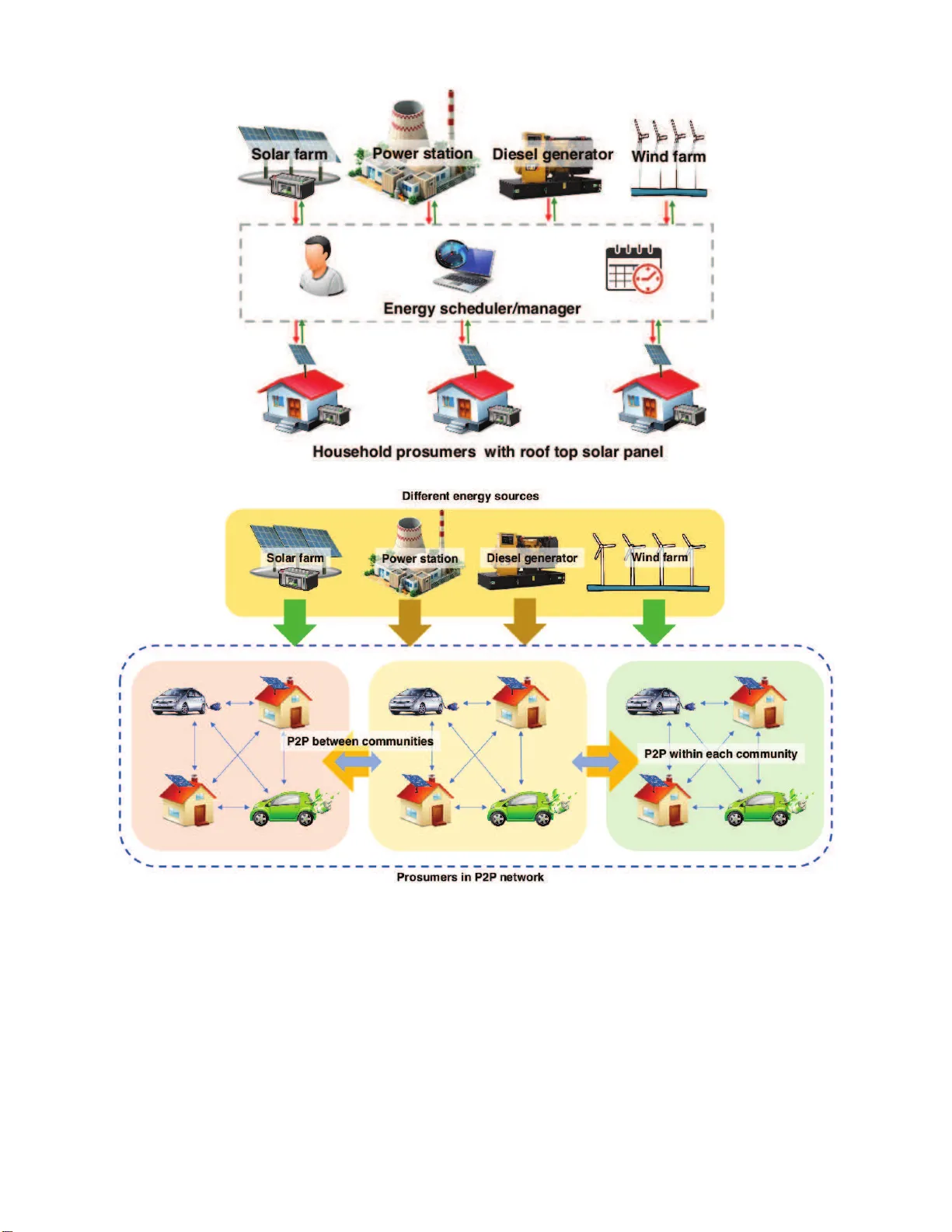
1 T ransforming Ener gy Networks via Peer to Peer Ener gy T rading: Potential of Game Theoretic Approaches W ayes T ushar , Senior Member , IEEE, Chau Y uen, Senior Member , IEEE, Hamed Mohsenian-Rad, S enior Member , IEEE, T apan Saha, Senio r Member , IEE E , H. V incent Poor , F ellow , IEEE and Kristin L. W ood Abstract Peer-to-peer (P2P) en ergy tradin g h as emerged as a next-g e n eration energy managem ent mech anism for the smart g rid that enables each prosu m er of the n etwork to participate in energy trading with o ne another and the grid. This poses a significant challenge in terms of modeling the decision-mak ing process o f each p articipant with conflicting interest and motiv atin g pro sumers to p a r ticipate in energy trad ing an d to co operate, if necessary , for achieving different en ergy managem ent g oals. T herefor e, such decision-mak ing process need s to be built on solid mathematical and signal processing too ls that can ensure an efficient operation of the smart grid. Th is paper provides an o verv iew of th e u se of game theo retic app roaches for P2P energy tr a d ing as a fea sible an d ef fective means of energy manag e m ent. As s u ch, we discuss various games and auction theo r etic appro aches by following a systematic classification to provide informatio n on the impo rtance of g a m e theo ry f or smart energy re sear ch. T hen, the pap e r focuses on the P2P e nergy trading describing its key featu r es and giving an intro duction to an existing P2P testbed . Further, the pape r zo oms in to the detail of so me specific gam e and auction the o retic mod els that have recently b een used in P2P energy trad ing and discusses some im portant find ing of the se schem es. Index T erms Peer-to-peer , energy trading, smar t grid , gam e theory , overview . I . B A C K G R O U N D A N D M OT I V AT I O N Due t o growi n g concerns for en v ironmental sus tainability and c limate cha nge, there h as be en a constant pursuit for an alternati ve ene r g y system, in which ene rgy production, transmission, distrib ution, a n d consumption would t ake place in an en v ironmentally sustainab le fashion. As a result, development of smart, sustainab le, an d gree n s olutions W . Tu shar and T . Saha are with the School of Information T echnology and Electrical Engineering of the University of Queensland, QL D , Australia. (Email : w .tushar@uq.edu.au; saha@itee.uq.edu.au). C. Y uen, and K. L. W ood are with the Singapore University of T echnology and Design (SUT D), 8 Somapah Road, S i ngapore 487372. (Email: { yuenchau, kristinwood } @sutd.edu.sg). H. Mohsenian-Rad is with the Department of Electrical Engineering of the University of California at Riv erside, CA, USA. (E mail: hamed@ee.ucr .edu). H. V . P oor is with the Department of Electrical E ngineering of Princeton Univ ersity , Pr i nceton, NJ, US A. (Email: poor@princeton.edu). 2 including widespread deployment of distrib uted energy resources (DERs) in residential houses [1], intr o d uction of electric vehicles (EV) on roads [2], and the establishme nt o f vari o us smart e nergy services such a s demand response manage ment [3] for e f fec ti vely managing ene r g y within the electricity g rid are being given preeminent importance rece ntly . C o nsequ e ntly , different signa l process ing tech niques have b e en us e d in the last decad e to bring these solutions to the f o refront of the consumers. Examples of such sign a l processing t e chniques include, b u t not limited to, mach ine learning, artificial intelligence [4], and game theory [5]. An import a nt objec ti ve of using these s ignal proce ssing technique s is promo ting the use of renewable energy sources within the ene r g y grid. For example, ma chine learning and artificial intelligence have be en extensively used to forec ast the power gene ration from solar pan els an d wind turbines [6]. Due to suc h innovati ve use of signa l process ing tools, a nd extensive rebates from local governments, a number of tec hniques are es tablished at this moment to uti lize the DERs as the main or subsidiary source of ene rgy across the globe. In particular , the global market for rooftop solar panels is booming. F or instance , whereas t h e global market for rooftop solar panels w as nearly US $30 bill ion in 2016 , it is expected to gro w by 11 p ercent over the next six years [7]. Meanwh ile, the shift towards s olar is being complemen ted by an increase in the adoption of residential energy storage sy stems, whose ability to deliv e r is predicted to grow from a round 95 megawatts (MW) in 2016 to mo re than 3 , 700 MW by 2 025 [7]. Hence, if properly utilized, the s e energy sources at the edge o f the g rid c o uld h elp manage dema nd more efficiently . Nonetheles s, this wi ll only happe n if t h e p eople own thes e gen erating assets are f ully inco rpo rated into the en e r gy market [7]. T o this e nd, feed-in-T ariff (FiT) sch eme is a suitable example that engages c ustomers to participate in the e nergy trading in the ma rket. In FiT , as shown in Fig. 1a, prosumers 1 with DERs su ch a s roof-top solar p a nel sell their excess solar energy only to the grid, and c an also buy energy from the grid in case of any energy deficiency . H owever , due to the significant dif ference between the buying and selling prices per unit of energy , the benefit to the prosume rs from participating such t ra d ing o f ener gy i s not significant. As a result, s ome of the FiT technique s are no w disco ntinued [8]. Under such circumstance s, the creation of new ener gy market that would a llow small-scale pa rticipants (or u ser) actively trade e n ergy with one another in rea l time, and thus facilitate a susta ina ble and reliable balance between ge neration and c onsumption of e n ergy within the community has become signific a ntly important [9]. As such, peer-to-peer ( P 2 P) energy t rad ing is being considered as a potential t o ol to promote the use of DERs within the e nergy grid [9]. T h e main o bjectiv e of P2P s h aring is to break the centralized infrastructure of the electricity grid by allowing the direct c o mmunication and s upply o f energy between various p rosumers with DERs within the en ergy sys tem, as shown in F ig. 1b. This enab les the interes ted co n sumers to buy renew a ble energy at a 1 Prosumers are the energy consumers who also produce electricity . 3 (a) Demonstration of traditional Fi T scheme. (b) Demonstration of how a P2P energy trading network may contribute to all eviate dependenc y on the main grid. Fig. 1: Th is figur e pr ovid e an overview of curren t trend of re n ew ab le energy trad in g in the smart grid a n d em erging P2P energy tradin g scheme. cheape r rate from a peer (or neighb o r) with excess re n ew a ble en ergy (e. g., from rooftop solar), and thus reduce its depend ency on the grid o r cen tral supplier [ 1 0 ]. Development of su c h P2P ener gy tr a d ing h as sign ificant potential to bene fit the p rosumers in terms of bo th e arning re venues a nd red ucing elec tricity cos t, as well as lo wering its depend ency on the grid. An examp le of recent development of such P 2P te c hnology i n real ener gy system can be found i n the Brook lyn Microgrid [9]. 4 Direct inv olvement o f eac h user in energy trading with one an other and with the g rid makes P2P system unique ly dif feren t f rom existing FiT . It p oses the cha llenge o f modeling the de cision-making process of ea c h participant for the greater b enefit o f the entire energy ne twork while taking h uman f a ctors such as rationality , moti vation, and en vironmental friendliness into ac c ount. Parti cularly , in settings where there are many use rs with conflicting interests participate, it would be quite ch a llenging either to capture such conflicting interests in des igning the decision-making process of each participant, or to motiv ate them to coop erate, if ne c essa ry , for achieving objectives such as cost reduction, rev e nue maximization, and maximizing the use of rene wable energy . Hence, the trading needs to be buil t on signal p roc essing tools that can take s uch div e rse set of constraints into cons ideration, and deliver an energy manag ement solution, w h ich ensu res an efficient a n d robust op eration of such heterogene ous and large-scale cyber- p hysical system. In this context, c o nsidering the interactive and conflicting na ture of en ergy trading, game theory is a very ef fec ti ve too l for modeling the decision-making proces s o f the participants of s uch P2P n etworks. Essentially , game theory h a s been extensively used for de sign and a nalysis of the ener gy sy s tem, as we wil l see in the next section. Howe ver , du e to the framew ork and aim of P2P e nergy trading, existing sche mes might not be s uitable to use in the s ame c ontext. The is bec ause: first, in P2P , the main objecti ve would be to encourage the participants to trade energy with one another and thu s co mprise a community of energy without (or , very minimal) direct influence of the grid. T h erefore, the pri c e s ignal from the central power station may not aff e ct the performance of the P2P trading as that influe n ced the schedu ling and trading of energy in existing sy s tems. Second , while the en ergy trading schemes in the smart g rid ha ve exploit e d v arious pricing sc hemes, inc luding real-t ime and time-of-use pricing, P2P will neces s itate the i n corporation of more innovati ve pricing sch emes. For examp le , being an indepe ndent decision maker , a prosu mer may intend to se ll its surplus ene r g y at diff e rent rates to dif feren t buyers within the network. Hence, dev e lop ment of new p ricing schemes would be n ecess ary . F ina lly , relaxing the presenc e of cen tralized managemen t from the trading sc h eme subsequ e ntly impos es a very high emph asis on the security of transactions of ene r g y trading between the pa rticipants of the P 2 P network. In this context, novel and inn ovati ve ap plications of game theoretic a pproache s will be ne cessa ry to d esign mechanisms for P2P ener g y trading . As such , this paper s eeks t o contribute tow a rds achie ving this goal by • Presenting a n overview of various game s and a uction theoretic approaches by following a systematic classifi- cation to p rovide information about the basic und erstanding and importance of game the ory , and its ext e nsive use in smart energy research . • Focusing on the basic of P2P ene r g y tr a ding t echnique for integrating renewable ene r g y s ources into the grid through describing key features of such trading network, as well a s well a s by providing the explan a tion of an existing tes tbed t hat has de ployed P2P trading for managing ener gy , an d • Finally , zoo ming into the details of some specific game and auction theoretic models that ha ve been used 5 T ABLE I: A brief sum mary of ad vantages and limitations of using game theor y fo r designin g energy ma n agemen t schemes. !"#$ % & Area Focus Brief discussion Energy management without P2P Challenges Designing management scheme based on the large am ount of data from smart meters, modeling users behavior, forecastin g users dem and, forecasting the generation from renewable energy sources, modeling the interaction between the grid and custom ers, incentive design for increasing users participation, improving grid’s stability in response to extensive renewabl e integration to the grid, accommodation and coordi nation of electric vehicles in the network. Advantage of game theor y Well established, m athematically tractab le an d pro ven optimi zation technique; can easily be integrated with other s ignal process ing and d ata-driven techniqu es such as mac hine learning; is com patible with IoT de v ices, ca n su itably ca pture i n teractive nature of management problem s an d inc lude users ’ rat ional behaviour in the modelling, and is applicable to model in any domains of energy network including electric vehicle, residential, indus trial, and commerc ial. Limitation of game theor y Practical deployment of gam e theoretic m odels is limited, and it is hard to im plement when it n eeds to directly involve human subject in the optimization process. Further, it is heavily dependent on the performance of the communication network, w h ich could potentially limit the performance of the process in case of a natural calam ity or network congesti on. Similar application in sect ors other than energy Financial modelling (allocation of investors ’ savings through financial market), behavioral science (rationality of hum an beh aviour), com puter sc ience ( testing boundari es of algorithms ), resource management (water confl icts in a ri ver bas in), agriculture ( strategies or irrigation followed b y stackeholders), com munication system ( challel allocation). Energy management in P2P Challenges Modeling users behavior, designing pricing schemes that help users to cooperate within t he P2P network, managing s ecurity and privac y of the u sers, establishing s trategy- proof transactions, maintaining trust between t he users without the existence of a centralized authori ty, reducing re liance on central grid either parti ally or com pletely, m anaging network congestion when the num ber of users becomes large; stabilizing the s ystem due to incre ase penetration of renewables; incorporate the central power station as a part of the P2P trading. Advantage of game theor y Can m odel users behavior and their interactive tr ading with one another, and easil y integrat e pricing and incentive design as a part of game framework development; c an potentially establ ish the trust bet ween the users within the network and m otivate them to cooperate via its cooperative gam e framework; can be incorporated with other signal processing techniques such as fuzzy logic and m achine learning. Limitation of game theor y Practical deployment of game theoretic models is lim ited, and it is hard to implement whe n it n eeds to directly involve human subject in the optimization process. However, there are recent developments of game theory (auction gam e) in pilot P2P projects s uch as in Brooklyn m icr ogrid. Similar application in sect ors other than energy Banks (online financia l transactions ), IoT (device discovery and de vice control) , he alth care (peer to peer help with patients with chro nic conditions), rea l estate (peer-to-p eer lending), financ e (debt financing). for P2P e nergy tr a ding, an d share some key results from those stud ies. This will provide the read er with an understand ing of how to use game theo ry in P2 P en ergy trading paradigm, an d what is the potential ben e fit of i t. This pape r can be used as a referen c e by bo th new and experienc ed researche rs in an important emerging field in the smart grid research. He re it is important t o note that signal process ing is part o f a much lar ger context within the s mart grid context, and i n this pap er , we only overvie w the a pplications o f v arious g a me and auction the oretic approach es for manag ing the trading between dif fe ren t e ntities within the ene rgy network. Thu s, this s tudy see k s to complement existing ga me-theoretic literature in g uiding e ngineers to effecti vely de sign a nd ma nage the substantial energy g enerated by DERs across the overall netw o rk without compromising the stability of t h e grid by enabling prosumers with co nflicting interes ts to a cti vely take part in energy trading with one another . For instanc e, in T able I, we p rovide a summary of the pros and cons of game theory in addressing various ch a llenges in energy system as well as its similar ap p lication in other sectors. T o this end , su bsequ e nt to a c omprehens i ve literature revie w on game and auction theoretic approac hes for smart grid ener g y management in Section II, w e explain the con cept o f P2P energy trading follo wed by a d iscussion on s o me key game a nd auction theoretic approac hes that hav e been used for P2P ene rgy trading in S e ction III. In Section IV, we share some resu lts from the ga me theoretic formulations an d solution approa ches explained in Section III, and co mpile the key insights from tho se res ults. Finally , Sec tion V summa rize s the en tire discus sion of 6 the pape r a nd makes s ome con cluding remark on po tential future rese a rch in P2P ene rgy trading that can potentially be addressed with game and auction t h eoretic approaches. I I . G A M E T H E O RY F O R S M A RT E N E R G Y M A N AG E M E N T W ithin the context of energy ma nagemen t in smart grid, the applications of ga me and auction theoretic ap proaches are plentiful. On the o ne ha nd, no n-cooperative game s have be en extensiv e ly use d to sc h edule ene r g y -related activit ies , and su bsequ e ntly , trade the su rplus energy with the buyers for making revenues. On the other hand, recently there ha s b een large scale integration of alternative ener g y s ources s uch a s e lectric vehicles (EVs) [11], solar p h otov o ltaic (PV) [12], and wind turbines [13] into the grid that exploit ga me theory for efficiency energy trading to provide regulation services [14] and efficient h ome energy ma nagemen t [15]. In this section, we disc uss the a pplication o f d if ferent g a me and auction theoretic approac hes across EV domain, DER and storage domain, and service d omain. T o do so, we first provide a brief overview of the basic ga me theoretic concept. Then we provide a discussion of the dif ferent game and auction t h eoretic approach es that have b een used to design various energy manageme nt schemes in t h e se three domains for pa st few years. Here, it is important to note that the literature on game the o ry in e nergy manageme nt is extensi ve. Nonetheles s, we keep our focus only on some of t h e k ey studies in each domain to co mp ly with the j o urnal’ s guideline on the total number of references. A. Basic Game The or etic Conce pt Game theo ry is a ma thematical and signal processing tool [ 1 6] t h at analyz es strategies of co mpetiti ve s ituations where the outcome of a participant’ s choice of action d epends on the ac tions o f othe r p articipants. It can be d i v ide d into t wo main branches including non-cooperativ e g ame theo ry and cooperative g ame theo ry . 1) Non-co o perative game: A non-co operativ e ga me an a lyzes the strategic dec ision-making proce ss of a number independ ent players that hav e partially or totally conflic ting interest over the outcome of a d e cision process, wh ich is influe nced by their actions. Suc h game s a llo w players to take nece ssary action, e.g. , optimal d e cision, without any coordination or co mmunication. Here, it is important to note that the term n on-coope rative do es not refer to the ca se that the players do not coo perate. Rather , it attributes to the fact that any coo peration that ma y arise in the non-coope rati ve game must be enforced wi th neither communic a tion nor coordination of strategic choices a mo ng the players [5]. In general, the n on-coope rati ve game can be di vided into two c ategories: 1) s tatic game, a n d 2 ) dynamic game. • Static game: In a static game, the players take their a c tions only on ce, either simultane ously or at different points in time. A static g ame can be defined in its strate gic form a s {N , ( S n ) n ∈N , ( U n ) n ∈N } , w h ere N is the s et of a ll participating playe rs in the game, and eac h player n ∈ N has a strategy set S n from which it 7 choose s an action s n ∈ S n to optimize its utility function U n . The utility that a player n att a ins is a f fected by choices of action S − n of t h e players in set N \ { n } . • Dynamic game: In contrast, players in a dynamic ga me act more tha n onc e and have some information regarding the ch o ice o f other p layers. In dynamic game s, time plays a central role in the decision-making p rocess of each p layer . Dynamic ga mes can also be defined as that of a static game. Non etheless, there is a need for some additional information including time a nd i n formation set that a re usually re fl ected in the utili ty functions . For bo th static and dy namic non-cooperativ e ga mes, the play e rs may take their decisions e ither in a deterministic manner (pure strategies) or in a probab ilistic man ner (mixed strate g ies). The mo s t popu la r so lution conc ept of the non-coope rative game {N , ( S n ) n ∈N , ( U n ) n ∈N } is the Nash equilibrium. A Nash equilibrium can be define d a s a vec tor of actions s ∗ if and only if U n ( s ∗ ) ≥ U n ( s n , s ∗ − n ) , ∀ n ∈ N , whe re s = [ s n , s n ] . T h us, the Nash equilibrium refers to a stable state of a non -co operativ e game, i n which no player n ∈ N c an improve its utility by un ilaterally altering its action s n from s ∗ n when the ac tions o f the other participating players N \ { n } are fixed at s ∗ − n . Whil e a Nash equilibrium always exists in a n on-coope rati ve game with mix ed strategies, the existence is not guaran te e d in a game with pure strategies. Further , a non-coop erati ve may also have multiple Nash equilibria, a nd in s u ch ca ses, it is import a nt to select a n efficient and des irable Nash eq uilibrium as the solution of the game . 2) Coop e rative game: In co operativ e game s , on the other ha nd, the focus is on how one can provide incentives to ind epende nt decision makers to act toge the r as one e ntity in order to improve their position in the g ame. I n essen ce, both Nash bargaining and the coa litional game can be con sidered und er the sa me umbrella o f the coope rati ve game. Nash bargaining is the study of terms and cond itions unde r which a numbe r o f play ers may a gree to form a coalition. Mean wh ile, coalitional ga mes d eal with t h e formation of c oalitions [5]. I n general, a co alition game can be expressed by the pa ir ( N c , ν ) , which in volves a se t of players N c who s eek to form coope rati ve groups. ν is the value function asso ciated with each c o alition S ⊆ N c and is express ed by a real number to quantify the v a lue of the respectiv e coalition. Th e mos t common form of a c oalitional game i s the cha ra c teristic form [17], where the value of coalition is determined base d on t h e me mbers of that co a lition, irrespective o f how the players in the coalition are structured. A c oalitional game can be clas s ified into three categories inc luding 1 ) cano n ical coalitional game, 2 ) coaliti o n formation game, and 3) c o alitional graph games. • Canonical coalitional ga me: A canonica l coalitional game can be expres s ed either as a ga me with transferable utility or as a game with non-transferrable utility . In this type o f game, the formation of the grand c o alition (the coa lition of a ll players in the game ) is never detrimental to the players, which p ertains to the mathema tical property of superadditi v ity . The main objecti ves o f a canonical co alitional game are to s tudy the p roperties and stability of the g rand c oalition, the gains resulting from the c oalition, and the distribution o f the se gains in 8 a fair manner to the players. The most renowned solution con cept for t h e coaliti o n al game is the c ore, which is directly related to the sta b ility of grand co alition. Ess entially the core is defined a s the set of revenues x where no co alition S ⊂ N c has any incentive to r e ject the grand coaliti o n for the propos ed revenue a llocation x . • Coalition formation game : In coalition formation game , network structure and cost for coope ration p lay a major role. In general, coalition formati o n g ame is not supe ra d diti ve. Although forming coalition brings gains to its members, the gains are limited b y a c ost asso ciated with coalition formation. As a conseq uence , the formation of a grand coalition is very rare i n this type of game, and therefore the objectiv e o f static coalition formation game is to study the n e twork c o alitional structure. In dynamic co alition game, howev e r , t he coalitional g ame is su bject to envi ron mental change s including chang e in the number of players and variation in the network topology . Hence , the main objecti ves are to analyze the formation of a coalitional structure, through players’ interaction, and then study t h e p roperties o f the structure and its adapta b ility to en vironmental variations. • Coalition graph game : Communication be tween play ers within a coalition plays a significa nt role in coalitional games. In f act, in some scena rios, the un d erlying co mmunication structures be tween playe rs can have a major impact on the utility and other c haracteristics of the c oalitional game [17]. The coalitional game tha t deals with such con nectivity of co mmunications between players is referred to a s the c oalitional graph game in [17]. In this type of game , the main objec ti ves are to deri ve low comp lexity distrib ute d algorithms for playe rs that wish to b uild a network graph (directed or undirected ) and to study the properties (such as stabili ty and efficiency) of the formed network graph. B. Energy Management in EV Domain Recently , EVs h ave attracted much att ention as a sus tainable transp o rt s y stem n ot only for their e n vironment- friendly fea tures but also due to the ir capacities to assis t the ene r g y grid via vehicle-to-grid (V2G) and grid-to-vehicle (G2V) techn ologies. EV , as an ind epende nt en tity , ca n participate in energy trading with other entities within the energy ne twork e ither by co ordinating its charging a nd disc h arging b ehavior in order to pro vide regulatory service to the grid [14], or by direct interaction with other traders within the ne twork to decide on trading price an d e n ergy via n egotiation [11]. In this c ontext, now we provide a bri e f o verview of some p opular game theoretic approache s that ha ve be en studied in the literature to model energy trading by EVs. As EV market i s growing rapidly around the world, both the gri d and EV o wne rs will ben e fit if the flexible demand o f EV c harging can be p roperly mana ged [18]. This ha s been done by d evising new schedu ling tech n iques for the cha rging and d ischarging of EV in [15], [18], and [19] base d on no n-cooperative Nas h game. For examp le, a day-a h ead EV charging scheduling is propos ed in [18] considering the impa ct of the electricity prices as we ll as 9 the pos sible a ctions of other EVs. The un ique N a sh equ ilibrium is determined through qua dratic programming, and the c ase s tudies a re demonstrated using data from the Danish Nati o nal Tra vel Surveys. Price competition between dif feren t EV c harging stations with renewable power g enerators is studied in [19], in which the autho rs sh ow that the interaction between the EV charging stations can be captured via a supe rmodular game, which has a u nique Nash e q uilibrium. Finally , a smart c harging a nd disc harging p rocess for multiple EVs is des ign ed in [15] to optimize the energy consumption profile of a building. In the non-c o operativ e e nergy char ging and discha r g ing scheduling game, the players are the EVs, and their s trategies are the ba ttery cha r g ing an d d is c harging sche dules, and the utility function of ea ch EV is defined as the negative total e nergy paymen t to the buil d ing . Each EV ind epende ntly selects its bes t s trategy to maximize the utility function, and all EV s update the building planner with their ene r g y charging and discharging sc h edules. It is shown tha t the EV owners will have ince n ti ves to p articipate in the prop osed g a me. In the literature, auction-ba sed game the oretic approac h es, also known a s a uction g ames [20], have be en use d for studying the prob lem of coordina tion that arises from char ging a population of EVs, bar ga ining o f pri c e at which energy is traded between an electricity mark et and dif ferent EVs [21], and for P2 P electricity trading among EVs using newly introduced blockcha in [22]. For instanc e, the a uthors in [20] us e a progressive second price auc tion mechanism to ensure that incentive compatibility holds for the auction game, and the efficient bid profile of the auction ga me is achie ved a s the Nash equilibrium. In [21], a non-cooperativ e game i s formulated between s torage units of EVs tha t are trading the ir stored ener gy . In the energy exch ange market between the storage u nits and the smart grid e lements, the price at wh ich energy is traded is determined via an au ction me chanism and is shown to admit at least one Nash equilibrium. An interes ting blockchain based auction mechanism is d eveloped in [22], in which the authors p rop ose a c onsortium blockc h ain me tho d to detail the operation of localized P2 P energy trading . The electricity pricing and the amount of traded en ergy among the E Vs are a dministered by an it e rati ve dou ble auction mechanism. Another branch o f game theory that has bee n exploited to de sign EV trading mechanism is the coalition game, which i s ess e ntially ch aracterized by a s et o f players and a v alue function tha t quantifies the wort h of a c oalition. Examples of application of coalition game in EV ene r g y trading can be found in [23] a nd [24]. In [23], the authors propose a Baye sian Coalition Negotiation Game as a means to perform energy managemen t f or E V s in the V2G en vironment. T he game is us ed along with Learning Automa ta, whe rein Le arning Automata is stationed on EVs that are as sumed as the players in the game. A Nas h Equilibrium is shown to be achieved in the ga me using con vergence t h eory . In [24], the authors argue that lev erag ing the cooperation among EVs ca n enable the grid to efficiently stimulate EV users to cha r g e in load valley a nd discha r g e in load peak . As a conse q uence , the e lectricity load is well balanced , and the EV u s ers also ach iev e a highe r p rofi t. As such , the authors formulate the EV cha r ging and discha rging cooperation in the frame work of a coalition game, and by doing so they show tha t the EV users 10 have be tter s atisfaction in the v e hicle battery status and economic pr o fit. Hierarchical games , in particular , the Stackelberg game, is proba bly the most popular g ame that has been extensiv e ly used for de s igning e nergy trading mechanisms for EVs. For instance, in [11], the authors study a static non-coop erati ve Stackelberg game to facilitate energy trading between a smart g rid an d EV g roups, wh ich is then extend ed to a time-v arying case that c an incorporate a nd handle slo wly varying en vironments. The en ergy trading between the aggregation of EVs and f ast ch arging station is modeled as a Stackelber g game in [25] to provide regulation reserves to the power system. In this s tudy , EVs , as the followers of the game, ca n obtain a tradeoff between the benefits from energy consu mption and rese rves provision, by d eciding their charging and reserve strategies. In [26 ], a similar game is des ign ed to capture the interaction betwee n EVs and the char ging system con troller , and is shown that the game ha s a u nique and optimal s o lution robust to poor communica tion channe ls. A two-stage Stackelber g game is studied in [27] to address the problem of char g ing station pricing an d EV cha r g ing s tation selec tion, in which the char ging s tations (leaders) ann o unce their charging prices in stage I and the EVs (followers) make their selection of charging stations in s tage II. It is shown that there always exists a unique c harging station s election equilibrium in stage II, and su c h equilibrium depen ds o n the charging stations’ service c apacities a nd the price dif ference between them. Simi lar e xa mples of the hie rarc h ical and other game s in the EV domain can be found i n [28]–[30] and [31]. C. Energy Management in DER and Storag e Domain The widesp read ado ption of DER in the power system can play a key role in creating a clea n an d reliable e nergy system with substan tial en vironmen tal a nd othe r b e nefits. Howe ver , due to the fact that the energy produ ction from these DERs is highly intermittent, their integration into the power system poses a significant challenge in maintaining the grid’ s s tability . H owever , with s uitable energy storage and energy mana gement technique s , s uch intermittency can be address e d, and thus the benefit of using DERs can be increased significan tly . As such, we discuss some of the game-theoretic techniques that have be e n use d in the lit e rature for e ffecti ve ener gy trading in the DER and storage d o main. The development of two-way communication enables interaction between su pply and demand side of the elec- tricity network, and thu s allows users to exploit Na s h ga mes to design en ergy manag ement schemes for DERs. In [32], for example, a ga me the oretic approach is analyzed to minimi z e the indi v idual ener g y c o st to c onsume rs through scheduling t h eir future e nergy consump tion profiles. In particular , an instantaneou s load billing s c heme is designed to effecti vely c on vince the consumers to shift their peak-time con sumption and to fairly char ge the consume rs for their energy pu rch ase from the grid. W ith a vie w to reducing the co st of ener gy trading with the grid, a da y-ahead optimization proce ss regulated by an ind epende nt cen tral unit is p roposed in [33]. The existence 11 of optimal strategies is proven, an d further , the authors presen t a distributed algorithm to be run on the users’ s mart meters, w h ich provides the optimal energy production an d s torage strategies, wh ile preserving the p ri vacy of the users and minimizing the required communication wit h the central un it. The auc tion game ha s b e en frequently used for trading b oth storage spac e a nd renew a ble e nergy from DERs. Example of such trading mechanis m can be found in [34] and [35]. [34] pres ents a rea l-time implementation o f a multiagent-bas e d game theory reverse auction model for microgrid market operations featuring con ventional and renew able DERs. The proposed methodology was realistically implemented in a s mart grid sys tem at the Florida International Univ e rsity . The in vestigation shows that the prop osed algorithm and the industrial hardware-based infrastructure are suitable to implement in the existing electric utility grid. Meanwhile, the authors in [35] u tilize an auc tion game to study the so lution of joint energy storage o wn ership sharing betwee n multiple sh ared facility controllers an d thos e dwelling in a residen tial community . It is s hown that the auction proce ss pos sess e s both incentiv e compa tibility and individual rationality properties, and is capa ble to enab le the residen tial un its to de cide on the fraction of their e nergy storage capac ity that they want to share with the shared facility controllers of the community t o ass is t them in storing e lectricity . Recently , c oalition games h ave also received attention for designing ene r g y trading mech a nism for us ers in residential areas that a re equipped with DERs a nd storage devices. For example, in [36], the au thors use a coa lition game to s tudy the c ooperation be tween s mall-scale DE R s and e nergy users to enable direct trading o f e n ergy without g oing throug h the retailers. The a symptotic Sh apley value is sho wn to be in the core of the coalitional game such that no gr oup of small-scale DERs and energy users has an incentiv e to aba n don the coalition, which implies the stable direct trading of energy f or the propose d pricing scheme. F urther , it is shown via numerical case studies that the scheme is suitable for prac tical i mp lementation. The authors in [37 ] focus on comprehensive economic power trans action of the multiple microg rids ne twork with the multi-agent system and d esign a three-stag e algorithm b a sed on coalitional game strategy cons isting of a requ e st excha nge stage, mer ge-an d -split stage, and cooperative trans action stage . Th e developed algorithm enab les microg rids to form c oalitions, where each microgrid can exchange power d irectly by paying a transmission fee. Similar to EV do main, hierarchica l games ha ve also been extensiv e ly u sed for tr a ding mechanisms in DER and storage domain 2 . T wo po p ular examples of such study inc lude [38] and [1]. [38] propos e s a distributed mech anism for e nergy trading amon g microgrids in a c o mpetiti ve market via a multileader- mu lti-foll ower Stackelber g ga me. The game is formulated between d if ferent utili ty companies and e nd-users to maximize the re venue of each u tility company and the payo f f of ea ch user , where the existenc e of a unique Sta c kelberg e q uilibrium is proven. The paper also studies t h e impact o f an attacker who c an manipula te the price information from the utility co mpanies and 2 Nonetheless, due to the constraint on the total number references, we are unable to provide an ov erview of all of them. 12 proposes a s cheme based on the conc ept of shared reserve power to improve the grid reliability and ensure its depend ability . A similar type of ga me is also designed in [1], in which the a uthors propos e a three -party en ergy trading me chanism within a smart grid community . In particular , a non-coo perativ e Stackelberg game betwee n the residential use rs and the shared facility controller is propose d to explore how bo th entities can ben efit, in terms of achieved utility and reduction of total cost respecti vely , from their ener g y trading with ea ch other and the grid. It is shown that the maximum benefi t to the SFC, in terms of reduction in total c ost, is obtained at the unique and strategy-proof Stackelberg eq uilibrium. Othe r games that hav e also bee n u sed in the DER a n d s torage domain for energy mana gement include dynamic games such as in [39]. D. Energy Management in Service Domain In this do main, we discus s ho w ga me theoretic approache s h ave b een exploited to provide services to the grid and consume rs via schedu ling of energy-related activities by the us e rs. Examples of su ch service include regulatory services such as voltage and frequency regulation, demand respons e re g ulation, services in terms of sharing of resources such as storage, and designing inc entiv e s for us ers. In this context, we can now expla in h ow Na sh g a me, auction game, coalition g a me and the hierarchical game has bee n u s ed to provide these services to the energy users in EV , and DER and storage domain. Nash ga me has been mostly use d for providing de mand resp onse service s to the grid. On the on e hand , s ometimes Nash game is exploited a lone by the users to dec ide on the s cheduling of their daily energy-related ac ti vities to participate in d emand respons e , e.g., in [18] and [3]. On the other h and, Nas h game has also be e n play ed a s a pa rt of a nother game, such as hierarchical game, to reac h the d e sired solution. For instance, in [11] an d [1], Nas h ga me has be en playe d by the follo we rs, as pa rt of the Stackelberg game, to reach an equilibrium s olution. Nash game has als o be e n exploited in [14], in which the authors develop a smart pricing p olicy and des ign a mechan ism to achieve optimal frequency regulation p erformance in a distrib uted fashion. The application of a uction games can be found in designing services like storage sha ring [35], demand re- sponse [21], and frequency regulation [40]. For example, in [40], the authors pres ent a b idding behavior mo deling and an auc tion a rchitecture con s isting of a ce ntral agg regator an d networked microgrid agents. The b idding beh avioral states of the microg rid agen ts are formalized for the belief upda tes a nd sho rt-term p olicy determination to maximize the individual profit. The n, a reverse a uction mode l is adapted to enab le c ompetiti ve n egotiations between the ce ntral aggregator and networked microgrid agents. The auction a nd aggregation p rocesse s were i mp lemented in a power system control area to contribute to frequency con trol. Further , auc tion game s such as in [35] have also b een exploited by incentivizing us ers t o participate in ene r g y managemen t. Coalition g ames, including bo th coa lition formation an d a c anonical c o alition, has a pplied for designing s ervices in the ener gy sector . For ins tance, demand r e spons e re g ulation in the EV domain has b e en implemented by using 13 T ABLE II: This table d emonstrates the imp ortance and extensiv e u se of gam e theo ry in smart energy dom ain. T ype Domain General focus of the study Non-cooperative game Cooperative game Smart energy network without P2P EV domain (Section II-B) Coordination and scheduling of charging and discharging of EVs for optimizing energy consumption profile of build ings, reducing q ueue size at charging stations, providing mobile storage facility , peak load reduction, efficie nt use of grid’s ene rgy , and incentive desig n. [1 1], [15], [18]--[22], [25] – [31] [23], [24] DER and storage domain (Section II-C) Scheduling household activities and managing energy dispatch from storage for reducing the volatility of renewable generation, improving the lifetime of storage. Further , designing pricing schemes to coordinate the users beh avior towards efficient use of grid’s e nergy . [1], [32], [33], [34], [35], [38] [36], [37] Service domain (Section II-D) T o man age energy in both EV and DERs and service domains to provide voltage and freque ncy regulation to the grid, and perform demand response. Further , both static and mobile storage sharing as well as sharing of gene rated renewable energy with the grid. [1], [3], [1 1], [14], [18], [ 21], [25], [29], [35], [40], [41] [23], [24], [36] Smart P2P energy network EV domain (Section III-B) The energy trading among multiple EVs within the P2P network to ensure the security of transactions and privacy protection. The objective is to maximize social welfare of the entire network, keep the trading with the grid at minimal, and penalize EVs who do not abide by the rules. [22], [44] - DER and storage domain (Section III-C) Design of suitable pricing and revenue distribution schemes such that peers are always interested to trade in P2P market via a steady coalition. Further , t o enable large scale participation of users, the trading mechanism incl ude efficiency and fairness. [46], [47], [48] [36] Service domain (Section III-D) Sharing of energy storage between different peers within the P2P network such that it maximizes the benefits t o all users. The pricing of auction is determined to ensure all participating entities are happy , and have no incentive to lea ve t he trading. [35], [46], [47] [36] a coalition formation game in [23]. In [36], the authors demonstrate how to incen ti vize e nergy users with s mall- scale ener g y po we r production u n it s uch as rooftop solar pa nels t o directly ene r g y trade with other users within a community ins tead of trading with the retailer . F u rther , the exploration of coalition g a me for regulation se rvice can be found in [24], in which the authors design a coalition formation game to sche d ule the charging and discha rging of EVs within a sma rt g rid network suc h tha t t h e g rid’ s stability is no t compromised. Hierarchical games have covered almost all aspe cts of s ervice domain. For example, demand respo n se regulation has been covered in [38], wh ereas the authors in [1] show how hierarchical g ame c an influenc e users with suitable incentiv e s to participate in ene r g y trading. In [29], a hierarc h ical game is propose d to provide frequency regulation under a V2G sc enario. In particular , a hierarchica l Markov game is designe d to coordina te the c harging proce ss of EVs. It is shown that the Mark ov game optimizes the regulation c apacity of the aggregator , and thus strengthe n its ability in bidding a more fa vorable frequency regulation price. Regulation se rvice with a hierarchical ga me is also implemented in [25]. F urther , application of Stackelberg ga me to decide on a price for sharing energy storage device can be found in [35] . Finally , anothe r examp le of the game -theo retic approa ch in this domain can be f o und in [ 4 1]. As can be se en from the above d iscussion , which is also summarized in T a b le II, the ap plication of game theory in the paradigm of e nergy trading and ma nagemen t is extensiv e . Howe ver , the discus sion on its application in the field of P2P energy trading is limited, which c ould be due to the rec ent emer gen ce and exploration of P 2P trading framew ork in the ene r g y domain. In this context, what follows is an introduc tion to the P2P ene r g y ne twork 14 follo we d by a discussion on s ome spe cific g ame theoretic tech niques that have bee n used for designing P2P e nergy trading. I I I . G A M E T H E O RY F O R E N E R G Y M A N AG E M E N T I N P 2 P N E T W O R K A. P2P Energy Network P2P is a network, in which the me mbers or peers of the ne twork share a part o f their own res o urces and information to facilitate certain applications. Ea c h pe er i s bo th a provider and r e ceiver of the resource an d can directly communica te with rest of the peers of the network without the intervention o f any intermediate node [42]. This e nables the ne twork to be resilient agains t the failure of one or more pe ers within the network, and con tinue to operate no rmally . Thus, new peers ca n be ad ded or old one can b e rep laced without altering the operationa l structure of t h e system. As s uch, P2P energy network, as shown in Fig. 1b, consists of a number of energy use rs including both consume rs and pr osumers. Prosumers are equipp e d with small-scale DER units such as rooftop solar panels and small wind turbines. T he production of e nergy takes place within ea ch h ouse or n earby to red u ce trans mission losses a nd utilize cogeneration, if pos sible. When a prosumer has surplus energy , it can either store this energy within its storag e device, if there is any , or distrib u te the energy amon g other peers within the network to avoid having wasted energy [42]. As such, e mpowers the us ers of the energy network to take control of the prod u ction and co nsumption of energy within the community without any c entral c o ntrol authority suc h as the grid [35] by potentially av oid employing complex algorithms and te c hnological equipment to negotiate pricing f o r buying and selling of ene r g y and storage [ 4 2]. A P2P ener gy network consists of t wo main components including the virtual en e r gy trading p la tform, an d the physical e n ergy network [9]. V irtual ene rgy trading platform p rovides the tech n ical infrastructure for the local electricity market. It ha s to be base d on a secured information system, e .g., blockcha in based architecture in Brooklyn microgrid, in which the transfer of all kinds of information takes place . It ne e ds to be implemented in a way such that eac h pe er has equal ac cess to avoid d iscrimination. For example , the generation, demand, an d consump tion d ata of a peer are transfe rred fr om its smart m eter to the virtual layer ov er a s ecured co mmunication network. Th en, buy a n d sell orders are created in t h e virtual layer bas ed o n this information from the smart me te r , which is then se nt to the a ppropriate ma rket mech anism to facilitate e nergy trading. Onc e the match ing of buy and sell orde rs are completed between dif feren t p eers, the pay me nt is c arried ou t, and sub seque ntly , the exchan ge of energy takes place over the physical layer . On the other hand, p hysical e nergy network is the d istrib ution grid, which is used for the physica l transfer of energy among the p eers. This ph ysical network could be the traditional distributed grid network provided and maintained by the ind epende nt system operator (ISO). Alternatively , it c an be an add itional se p arate phy sical 15 microgrid distrib u tion grid in c onjunction with the traditional grid, which provides the peers of the ne twork with the flexibility to be physica lly disconnec ted fr o m the main grid in ca se of an eme r g ency ev e n t [9]. Here it is important t o note tha t t h e fi n ancial trans a ctions that are c arried ou t be twe e n different pee rs in the virtual platform have no influe nce on the physical de li very of electricit y . Rathe r , the payment can be tho ught of a s the payment from the c onsume rs to their p roducing prosumers within the P 2P network for fee ding the renewable genera tion into the distrib ution grid [9]. 1) Ke y fea tures: According to [9] and [43], an energy network s hould have seven key features , as exp la ine d in the foll owing sections, for su ccess ful P2 P e nergy trading. Market participants: A c lear definition of market pa rticipants, as well as the purpose of the P2P en ergy trading, must be established , and the form o f e nergy that is trade d in the market should be clarified. P 2P energy trading neces s itates the existence of a s ufficient number of ma rket pa rticipants within the netw o rk, and a subgroup of the participants need to have the capacity to produce energy . The purpose of P2P energy trading, e.g., increasing the use of renewable ene r g y or reducing depen dency on the main grid, affects the design of pricing s cheme and market mechanism of the trading market. Further , the form of energy traded in the market sho u ld be de fined, i.e., whe ther the ener g y is traded in form of electricity , heat or combination of both. Grid c onnec tion: For balancing the ener g y generation and consumption within the P2P ener g y trading ne twork, it is imperati ve that the co nnection points towards the main grid are well define d. At these c o nnection points, it is possible to conn ect a smart meter to ev aluate the performance of the P2P energy network, e.g., how much energy co st t h e participants can s av e by n ot b uy ing fr o m the grid. If a physica l microgrid distribution network exists between the pa rticipants, it swiftly de c ouple itself from the main grid in c a se of an emergency . Howev e r , for such island-mode operation, participants should have e nough g eneration capacity to e nsure the appropriate lev e l of supply s e curity an d resiliency . Nonetheles s , if the P2P energy trading is only c onducted over the existing traditional distrib u tion network, such island-mode operation is not possible. Information s y stem: A high p erforming information system is the heart of any P2P energy trading ne twork. Such an information s ystem is necessary for: 1) conne cting all market p articipants for e n ergy trading, 2) providing the participants wi th a suitable mark e t platform, 3) t o ren d er the pa rticipants with acce ss to the market, a nd 4) to monitor the market operation. It is important that every market pa rticipan t has eq ual acces s to the market information without any d iscrepancy . An example of such an information system is the block chain base d smart c ontracts [22]. Market operation: Market o peration of P2P energy trading is facilitated by the information system. It co nsists of the market’ s allocation, paymen t rules, a n d a clearly defined bidding format. The ma in purpos e is to provide an ef fi cient energy trading experience by match ing the market pa rticipants’ se ll and buy orders in near real-time granularity . In ma rket operation, the cons traint of energy generation influences the thresholds of max imum and a 16 minimum allocation of e nergy . Dif ferent mark e t time horizon c an exist in the market ope ration, such as da y ahead and intraday , to cov e r various stag e s of the electricity market, a nd the mark et operation should be able to produce efficient allocation in every s tage. Pricing mechanism : Th e o b jectiv e of pricing mech anism is to e f fic iently ba lance energy sup p ly an d de ma nd, and is implemented as a pa rt of the market op eration. Ex amples of pricing mecha nisms include auctions with individual or uniform c learing price. Pricing mecha nism for P2P en ergy trading has a big diff e rence with that of the traditional energy market. W ith traditional e nergy , a lar ge part o f ene r g y p rice c onsists o f taxes a nd surchar ge s, whereas in a P2P trading market s uch tax a nd surcharges a re abs ent d ue to zero ma r g inal cost of renewable ene r g y . Nevertheless, pricing need s to reflect the state o f energy within the P2P en ergy netw o rk. For example, a higher surplus should lower the pri c e of P2P energy trading and vice versa. Automatic en ergy management s ystem: Th e purpose of automatic en ergy ma nagemen t system (AEMS) is to s ecure the supply o f ener gy for a market participant while implementing a specific bidding strategy . T o do so, AEMS has acce ss to the real-time demand and supply information of its ma rket participant, and based on these data, an AEMS forec asts the generation and c onsumption profile as well a s develops the bidding strategy . The AEMS of a rational use r would always buy ene r g y at the microgrid market when the price falls b elow its maximum price limit. Nonetheles s , individual agen ts ’ intelligent bidding s trategies s hall emp loy varying prices at different times a nd are expected to be on e o f t h e core components of acti ve P2P ene r g y ma rkets in the future. Re gulation: Finally , the regulation is the feature of a P2P energy trading that determines how suc h markets fit into the current energy p olicy . That is, gov ernme nt r u les decide which market design is allo we d, how taxes and fees are distributed, and in which way the mark e t is integrated into the tr a ditional energy market and ener gy supply sys tem. Hence, governments either c an su pport P2P ene r g y markets to acce lerate the efficient utilization of renew able energy r e sources and to dec rease en vironmenta l degene ration by regulatory chan g es, or discourage the implementation of such markets if these result in n egati ve impacts on the current traditi o nal ener g y s ystem. 2) Br o oklyn T rans Active P2 P pr o ject: Now we f o cus o n an existing p ilot project on P2 P ener gy trading , which is built in Brooklyn, New Y o rk. This discussion on a rea l P2P en ergy ne twork will pro v ide the reade r wi th a brief idea of how the P2P e nergy trading is b eing en vis ion ed to be c onducted in the future en e r gy mark et 3 . The cho ic e of Brooklyn microgrid for this discuss ion is moti vated by the extensivity of the project as well as the succ essful implementation of trading techniques as portrayed by their recent pilot demon s tration. Brooklyn microgrid project, which we will refer to as BMP for the rest o f the paper , c onsists of a microgrid market in Brooklyn, New Y o rk. The project is run by LO3 Energy , and the participants of the BMP are loca te d across three d istrib ution grid includ ing Borough Hall, the Park Slope , and the Bay Ridge. As s hown in Fig. 2, the BMP trading network con s ists of a 3 As of today , local P2P energy trading without any uti l ity in volv ement is yet to be cov ered by the regulation, which decides how such market fits into the current energy policy [9]. 17 Fig. 2: Th is figur e dem onstrates the topolog y of Brooklyn microgrid , an d is inspired from [ 9]. physical layer and a virtual laye r . In the ph ysical layer , the B MP uses the traditional grid to sup ply ph y sical e nergy flow . Ho wever , it also has a physical microgrid network among a limited numbe r of housing blocks 4 that ca n be decoup led from the main grid in ca se of emergency . The virtual lay er is completely sepa rated from the phys ical layer . The virtual lay e r is implemented on top of the existing phys ical grid infrastructure, and p rovides the technic a l infrastructure for the local elec tricity market, an d is ba sed on T endermint protocol bas ed priv ate bloc kchain called T rans Acti ve b lockchain architec ture [9]. Ea ch peer mu st have a blockch ain acc o unt to participate in the P2P ene r g y trading. A T rans Activ e meter is installed within the hous e of each pe e r that commun icate with his b loc kchain accoun t and transfers energy g e neration an d d emand data from the TransActi ve meter . The ene r g y trading at BMP is mostly done au toma tically by a n AEMS, and only requ ires several preferences from its market participants. In p articular , the participants use a mobile app (name BMG App), throug h which they can choose their preferences o n the sou rce of ene r g y an d p rice limits for the AEMS to cond u ct the energy trading. An example diagram of the mo bile application 5 is shown in F ig. 3. Althoug h the p a rticipants can ch ange their preferences at any time, it i s also pos sible for the pa rticipants to cho ose on e preference , an d s et that for a ll t h e time without any further int eraction wi th the mobile a pplication. Now , on ce the preferences are submitted through the mobile application by the participants, the ener gy trading between two participants (one consumer a nd one 4 Which in parti cular comprises 10-by-10 housing blocks at present. 5 LO3 energy has giv en permission t o use this screen shot of the mobile application in t his paper . 18 Willingness to pay determine what kind of e nergy someone needs to buy . Preferred daily maximum cost can be chang ed using this toggle. A participant can choose which source of energy he/she wants to buy . Fig. 3: Th is figur e dem onstrates the screen sh o t of the mo bile applicatio n used in the BMP . The screen shot o f th e application is taken from the Broo klyn micr ogrid we b site: https://www .bro o klyn.en ergy/video-gallery . prosumer) t a kes p la c e f o llo wing a step-by-step process explained below [9]: Step 1 : The buy and sell orders of a consumer an d a p rosumer are sub mitted to the market by the ir AEMSs respectively . Any buy o r sell order consists of a q u antity an d a price. Step 2: The market mechan ism is a closed order book with a time discrete double auction in 15 minutes time slot. In the double auction: 1 ) Consume rs constantly bid their maximum p rice limit for the ir preferred e nergy sources , 2) Prosume rs bid the minimum price limit that they reques t for selling their gene ration on the market, 3) The highest b idder is allocated first, and then lower bidders are a llocated followi n g a merit- o rde r dispatch, and finally 4) The l a st a llocated bid price represents the market c learing p rice for that particular time slot. Step 3: Consumers tha t cannot undercut the clearing price a re supplied by additional s o urces. Step 4: F ina ncial transac tions a re carried o ut between the alloca ted market participants of tha t particular time slot according to predefined payment rules. Step 5: Local trading is then realized in the virtual layer , and the transfer of funds is completed. Step 6: In the physic a l, upon comp le tion of the transaction of pay ment, the pros umers feed their ren ew a ble generation into the distrib ution grid 6 for the cons umers to consume . A more comp rehensive discuss ion on the Brooklyn microgrid ca n b e fou nd i n [9]. As we now h ave some idea of ho w a P2P energy netw o rk works in real life, we detail some specific game theoretic approac hes that h ave be en us e d for P2P e n ergy trading in EV , DER a nd storage, and se rvice d omains. 6 Prosumers may need to pay a subscription fee to the utility grid to use its network for P 2P trading of energy . 19 For each d omain, we t a ke a specific study as an example and the n explain in detail how the relevant game of that particular s tudy is used to design the P2P trading scheme. Note that such explan ation would help the read e r to visualize how they may us e such app roaches to des ign game s be tween diff e rent no des in a P2 P networks to att a in various energy management objecti ves. In particular , we detail an auction game for EV d omain, a coaliti o n game for DE R and storage domain, and a hybrid g a me (auction a nd Stackelbe r g game toge ther) for s ervice do ma in in the next se ction. Some interesting r e sults from these study wil l be shared in Section IV . B. P2P energy trading in EV domain Recently , P2P en ergy trading in EV d omain is gaining muc h attention, a nd the studies are be ing co n ducted based on both d if ferent g ame the oretic and optimization app roa ches, such as in [22], [44] an d [45] respectively . In this section, h owever , we keep our focus on the s tudy in [22], where an interes ting exploration of auction ga me for P2P energy trading can be found in the EV domain. In particular , this s tudy designs a P2P energy trading technique among EVs i n the sma rt grid v ia auction game, a nd ensure t h e security and pri vacy of the transactions by inco rporating a co n sortium block c hain within the trading mechanism. No te that to explore how a u ction ga me is used i n [22] for P2P energy trading in the EV domain, we wi ll only focu s on t h e u se of an auc tion game for P2P trading and ignore the de sign of co nsortium blockchain in the discu s sion. Interested reader can fin d the detail of the consortium blockch ain in [22]. As such , first we note that the main objective o f all E Vs w ithin the P 2 P energy network is to max imize the s ocial welfare, a n d the model for this localized P2P energy trading co nsists of three main components: • EVs: Th e EVs play diff e rent rol es in the propose d P2P electricit y trading at char g ing stations: charging EVs, discharging EVs, and idle EVs. Ea ch EV can ch o ose its o wn role ac cording to its current e nergy state and dri ving plan. • Local a ggregator: Loca l aggregators a re the ene rgy brokers that provide access points for electricity and wireless communication service s for EVs. Eac h c harging EV se nds a reques t for electricity deman d to the neares t local aggregator . Then, the energy broker does a statistics of loc al ele c tricity demand and announc es this demand to l ocal EVs. In response, EVs with surplus electricit y submit selling prices to the broker . The ener gy broker acts as an auc tioneer to c arry out a n iterati ve do uble a uction a mo ng EVs and matches electricity trading pairs of EVs. • Smart meter: Each char g ing pole is equ ipped wit h the smart meter that calculates and rec ords the amount of traded e lec tricity in real time. Th e rec ords in the smart meters a re u sed by the ch arging EVs to pay the discharging EVs . In each charging station, a local aggregator can commu nicate with any loca l EV to e s tablish a real-time elec tricity 20 trading market a nd f acilitate electricity tr a ding between any c harging EV and a ny discharging EV in the network. Each charging EV C V n i , which is conn ected to a local agg regator n has a particular e nergy demand c n ij from the discha r g ing EV D V n j connec ted to the same loca l aggregator . Meanwhile, d n j i is the amou nt of energy that a discharging EV DV n j supplies to C V n i in local ag gregator n . Now , due to the char ging a n d discharging o f c n ij and d n j i , the satisfaction a nd cost function of c harging and dischar ging EVs a re res p ectiv e ly giv e n by [22]: U i ( C n i ) = w i ln( η J X j =1 c n ij − c n, min i + 1) , (1) and L j ( D n j ) = l 1 I X i =1 ( d n j i ) 2 + l 2 I X i =1 d n j i . (2) In (1), η is average c h arging e f fi ciency from d ischarging EVs to C V n i , and w i is the cha r g ing willingness of C V n i . In ( 2 ), l 1 and l 2 are c ost f actors. Please note that the se s a tisfaction and cost function refer to the ben e fit and cost, in terms of real numbers, that e ach charging and discharging EV can obtain by participating in P2P e nergy trading with one another and may vary with the change s in the parameters such as energy price, cha r g ing willingnes s, a n d cost f actors according to (1) and (2). Nonetheles s , a s me n tioned earlier , the purpo se of this P2P trading is to maximize the social welfare. Th is is done by the loc al agg regator n by interacting with both ch arging and d ischarging E Vs to d ecide on the suitable c harging and discharging en e r g y vec tor C n and D n for trading. In doing so, as explaine d in [22], the local ag gregator n that is working as an energy broker not on ly to meet the dema nd of ch a r ging EVs but also max imize elec tricity allocation ef ficiency . As su ch, the overall objective function of the social welf are problem becomes the dif ferenc e of (1) an d (2) for the participating E V . Note that for the soc ial welfare maximization problem, it is nece s sary that the ener gy broker obtains true and complete i n formation of a ll EVs’ utility and c ost functions. Th e complete information of EVs includes c urrent ener gy state, ba ttery capacity and so on. Howe ver , this is pri vate information for EVs that EVs may n ot be willing to sh are with the energy broker . T o ad dress the issue , the d esigned mec hanism needs to extract h idden infor ma tion fr o m t he EVs. Auction mechanism: In this context, an auc tion game, which is a pa rt of the non-co operativ e game, is e f fi cient to elicit the hidden information in a real and co mpetiti ve ener g y market, and t h erefore used in [22] to facilit a te P2P energy trading among the EVs. A double a uction technique poss esses the indi vidually rational an d weakly budget balance d properties, which confirm tha t the participating EVs bid t ruthfully acc o rding to pri vacy information, and at the same time the energy broker would not lose money to con duct the auction, respec ti vely . In this context, the au c tion game in [22] i s adopted by follo wing an iterative step-by-step manner as mentioned b elow . In each iteration, 21 Step 1: Each parti c ipating c harging and discharging E V submit its bid price to the auctioneer . Step 2: Bas ed on the recei ved bid price vec tor o f buying ene r g y (vector of bid prices from all charging EVs) and bid price vector o f selling energy (vector of bid prices from all d ischarging EVs ), the auctioneer prod u ces optimal a llocation of de mand and supply en ergy vectors b y following a p re -de fined allocation policy , a nd broadcas ts them to the participating EVs. Step 3 : According to the receiv e d allocated en ergy vectors from the auctione er , e ach EV determines its optimal bid price, i.e., the optimal bid p rice for s elling by discharging EV an d optimal b id price for buying by charging EV . Step 4: Each EV submits i ts optimal bid price to t he auctioneer . Step 5 : Th e auctione er receives the vectors o f o p timal bid price from both types of EVs an d be nchmark a gainst pre-defined crit e ria to un derstand whether the optimal solution is obtaine d. Step 6: If optimal solution is obtaine d, the a uction game is comp leted, a n d no f u rther iteration is needed. Otherwise, the proce ss re-iterate from St e p 2 aga in. In t h e proposed auction proce ss, the auctioneer monitors localized P2P en ergy trading i n real time. When some unexpected inc idents ha ppen, for example, few EVs may lea ve sudde nly from the sched uled trade s, the auctioneer may restart the auction process again, and a ne w energy t rad ing process is executed. Howe ver , in such cases, the abruptly discon n ected EVs are h eld accou ntable and are made to pa y a penalty of disc onnection. As shown in [22], the conside red auction-ba sed ap proach c an o btain e f fic ient energy allocation solution with o ptimal s ocial welfare in the e nergy market, without requiring the participants to share complete p ri vate information about the ir s atisfaction and cost functions. C. P2P Ener g y T rading in DER and Storag e Domain T o study the application of game theoretic approach for P2P energy trading in the DER and storage doma in, we will focus on the study in [36 ]. In this study , the autho rs de sign a c oalition game to enable direct en e r g y trading from one peer to another peer within the energy netw ork. T o do so, the cus tomers within the network a re divided i nto two kinds . Th e fi rs t type of cus tomers a re s ma ll-scale e lectricity s uppliers, who h ave rene wable energy facilities (such as house s with rooftop solar pane ls), and can sell their excess e nergy t o the market for monetary profit. Another type of customers is e nd users who need to b uy energy to conduct ener g y-related acti vities. The amount of elec tricity su pply and e nergy demand vary ac ross time and may differ for e ach e ntity . Wh ile the customers can trade their res pective energy amoun t i n the traditional market with retailers, in [36], the autho rs show that energy trading i n the P2P market could be more beneficial for both t h e end users and small-sca le electricity suppliers. This is mainly due to the fact that there is a significant dif ference between the wholesale price p wp (selling price 22 per u nit of en ergy) and retail pri c e p rp (purchase price per unit of ener g y) in the tr a ditional electricity market, and p rp > p wp . Hence , the monetary benefi t that a customer ma y gain in terms of e ither obtaining revenue or to r e duce cost is very low . In P 2 P energy trading, on the o ther hand , the trading price p p2p is set between the wholesa le price and the retail price, i.e., p wp ≤ p p2p ≤ p rp . In [36], it is sho wn that suc h a choice o f pr ice is benefi cial to both the small-scale sellers and end-users. The coalition ga me formed between the small-scale electricity s uppliers and end-use rs is a ca nonical coalition game with trans ferable utility , and the authors d e termine the price p p2p for P2P energy trading based on asymptotic shapely value [17]. The canon ic a l coalition game is formally defined by the pair ( N c , ν ) , where N c is the union of the set N s of sma ll-scale electricity sup pliers and the se t N u of en d-users, and as d escribed in Se ction II-A2, ν is a real number t h at refers to the t o tal benefit that all participants of the g ame attain for formi n g the coalition. It is cons idered tha t the value function ν de p ends on the net su rplus and defic ie n t e nergy of t he coa lition. That is a ll participants of the co alition primarily trade their energy a mong the ms elves with a price p p2p . Th en, if there is any net s urplus f rom the coalition, it is sold in the retail market at a rate of p wp per u nit o f ener gy , a n d buy en ergy at a price p rp per unit if there is any net deficiency . Thu s, ν = ( p wp × n et surplus) - ( p wp × net deficie n cy). Now , to effecti vely p erform P2P energy trading , a coalition ne eds to sa tisfy three properties as explaine d below . • Superadditivity: Formation of grant coa lition nee d s to b e ben eficial for all pa rticipating customers of the coalition. In other words, it is alw a ys beneficial for the sma ll-scale electricity suppliers and the end-use rs to trade in P2 P en e r g y trading, rathe r tha n trade in the traditional market. Thu s , both p arties are interested to maximize t h e total rev en ue of the coalition. T o meet t h is prop erty , ho wever , the v a lue fun c tion ν needs to be superadd iti ve, which is the case in [36]. Superadd iti vity refers to the con d ition that the total benefi t that se t of small-scale electricity suppliers and end-users obtained by forming the grand coalition is at least equal to the total bene fit that they ac h iev e by trading separately . • Cor e: There s hould be a fair distrib ution of total revenue among e ach cus tomers forming the coalition. In P2P energy trading, this allocation o f revenue ca n be done by suitably adjusting the trading price p p2p such that no subgroup of cus tomers can obtain more revenue b y deviating from the P2 P trading. The feas ible allocation of such revenue amo ng participants is kn own as the c ore o f a co alition, and if the core of a coalition is n on-empty , no group of u sers has any incentiv e to leave tha t coaliti o n. It is sh own in [36], for the considered stud y , the re is a non -empty core for t h e coa lition when p rp > p wp . • Stability: When all custome rs receive their re s pective revenues, which is at the core, no one wants to leav e the coalition, which ma kes the c o alition stable. In other words, all customers within the network continue to participate in P2P energy trading among themse lves. Nev e rtheless, d eri vation of fair distrib u tion of rev enue is co mplex and could be computationally e xp ensive. There 23 are a number of mechanisms that can be used in literature to determine f air rev en ue distr ibution such as Shapley value, nucleo lus , and proportional fairness. In this work, p p2p is deriv ed ac cording to the Sh a pley value. Esse ntially , the conc ept of Shapley v alue is base d on three ax ioms: efficiency , s ymmetry , and balan c ed contrib u tion, and is a measure of the con trib ution made by each customer pa rticipating in P2P ener gy trading. By allocating r evenue to each customer acc o rding to its Shapley value, the rev enue of the P2P energy trading is fairly di vided . Th is is due to t he f a ct that what each cus tomer ob tains c orrespond s to its contrib ution to P2 P e nergy trading. Howe ver , as the number of customers w ithin co alition bec o mes very large, the numb er of computations increases prohibiti vely to d etermine the Shapley value o f each cus tomer . As suc h, in [36], the revenue distrib u tion is c o nducted using an a symptotic Shap ley value. For detail on the deri vation of asymptotic S hapley value, please see [36]. It is becau s e the derived as ymptotic Shapley value l ies within the core of the coalition g a me. As a consequen ce, according to the third prope rty mentioned above, the c o alition is stab le even for a very large n umber of customers. In othe r words, the propo sed P2P ener g y trading scheme is s uitable to adopt in an energy network cons isting of a very large number of customers. Based on the abov e dis c ussion, the adapted c anonical c oalition ga me to design P2 P ener gy trading in DER an d storage domain can be s ummarized in follo wing steps: Step 1: Choose o r design a sys tem model su itable to incorporate P2P energy trading. Step 2: De sign a value function tha t captures the ben efit of the coalition. Determine whe ther the value function posses ses the property of superadditivity . Step 3: In ves tiga te the existence o f t h e core in the coaliti o n g ame. Step 4: If the c ore is no n-empty , des ign a suitable r evenue distrib ution mechanism that lies a t the core. Th us, the coalition is stable. Step 5 : Ensure that the design o f revenue distribution techn ique can acco mmodate a large numb e r of cu stomers. This will co n firm the practicality o f a ctual i mp lementation of the model. Other game theoretic application for P2P trading in the DER and storag e domain can be found in [46], [47] and [48]. D. P2P Ener g y T rading in Service Doma in Finally , we disc uss the application of game theory in P2P ene r g y tr ading for se rvice domain by describing the game proposed in [35]. I n [35], the a u thors propose an interesting integration of a u ction g ame with Stackelberg game to provide demand respo nse service to the users of the ne twork by sharing of ene rgy storage device. In particular , the pape r studies the s olution of a joint ener gy storage sha ring be tween multiple res idential un its a nd shared facility co ntrollers (SFCs ) within a commu nity b y en a bling the reside ntial un its to decide on the fraction of 24 Fig. 4: Demo nstration o f the system model of ap plication of P2P energy trading in service d o main. their ES c apacity that they ma y sh are with the SFCs o f the c ommunity in orde r to assist them in storing electricity , e.g., for fulfilling the demand of various shared faciliti e s. T o do so, a modified auction game is de s igned that captures the interaction between the SFCs and the residential units to determine the allocation of storage spac es shared by the R Us . The au ction price, o n the o ther hand, is determined by a n oncoop erati ve Sta c kelberg game formulated between the residential un its and the auctioneer . T o design the scheme, as shown i n Fig. 4, a smart community is co n sidered that consists of a large number of residential un its, wh ich ca n be an individual home , or a large n umber of homes conne c ted v ia an aggregator , and a number o f SF C s that provide energy service s such as man aging lifts, corridor lights, water pumps, and hea t pumps of the co mmon facilities of the c ommunity . Each SFC a nd residen tial units h av e its own ene r g y production cap a city and storage devices. As the P2P is de s igned in [35], each SF C, which has lar ge r ene r g y generation capacity , may sometimes n e ed larger storage space to store extra gene ration, and it can share storage space s from the res idential users of the community who has relatively small gene ration and storag e c a pacity . Now , to facilitate this sha ring (or , leasing) of storage spac es between multiple SFCs an d residential un its, in the designed mod ified auction proc e ss consist of three rules inc luding a determination r ule , a payment rule, and an allocation rule. The ob je c ti ve o f the determination rule is to determine the s et o f SFCs and residential unit s that ca n eff e cti vely participate in the auction sche me to d etermine the pa y ment a nd s hared storage amou nt. This is executed in a step b y step fashion, and the number of pa rticipating S FC and res idential units is aff e cted by their res pective bidding prices, a numbe r of storage s paces that the SFCs want to share a nd the re s idential units ag re e to lea se respectively , and the V ick rey price. Once the numbe r of participating entities are determined , pay ment rule is e xec uted to determine the auction price. 25 In paymen t rule, the proposed technique i n [35] is mainly v a ried fr o m the V ick rey auc tion, and thus named a s the modified auction scheme. In V ickrey au ction, the auction price for sharing the storage spa ces would b e the second high est res ervation price, i.e., the V ickrey p rice. Howev e r , this se cond highes t price might not b e co nsidered benefic ial by all the residential units participating in the auc tion sch eme. Therefore, t h e auction price nee ds to be increas ed. On the other hand, if the a uction price is set to the maximum bidding price, the p rice could be detrimental from so me of the participating SFCs. Now , to make the auc tion sc h eme a ttracti ve and ben eficial to all the p articipating r e sidential units and, at the same ti me , to be cost e f fec ti ve for a ll the SFCs, a Stackelber g game between the auc tioneer , which decide s on the a uction price to maximize the average cost savings to the SFCs as well as satisfying their desirable needs of storage spaces , and the residen tial units. Residential units decide on the vector containing the storage space they would like t o put into the market for sharing such tha t their benefits are maximized. In the Stackelberg ga me , it is shown in t h at t h ere a lways exists a unique s olution to the ga me. Therefor e, a unique a u ction p rice ca n b e derived a ll the time, w h ich all r esidential units and SFCs agr ee upon to be the equilibrium price for ener gy storage shar ing between them. Also, at this a uction price, no participants hav e an i n centiv e to deviate from the auction proce ss. Once the auction price is estab lished, the allocation of storage spaces from the residential units to the SFCs is conduc ted base d on an alloca tion rule. According to this rule, if t h e total requirement of the SFCs is e ither grea ter than o r equal to the total supply from the r e sidential units, then all the offered storage sp a ces a re s h ared by the SFCs. Ho wever , if the sup ply is greater than the requiremen t, the participating reside ntial units need to tolerate the burden of oversupply , i.e., t h e monetary loss in cases whe n the supply of storag e becomes larger tha n the total requirement of storage s paces by the S FCs. In [35 ], two a llocation proce s ses are con sidered for the distri bution of this b urden: 1) propo rtional all o cation and 2) equal allocation. • Pr opor tional all ocation: In proportional allocation, the b urde n of ov e rsupply is shared among the residential units based on their respectiv e reserv ation prices du ring the au c tion proc ess. That is a residential un it, which asked for more res ervation price will endure more burden compared to an other residential u nit with l ower reservation price. • Equal allocation: In equ al alloca tion, howev er , the b u rde n is distributed equa lly among all participating residential units. The auction proce s s is completed with the completion of the alloca tion process . It i s important to note that onc e an auction process is executed, there is a lways a po ssibility tha t the owners of the storage s paces , i.e., residential units, might chea t on the amount of storage that they agreed to put into the market during the auction. Howe ver , suc h auction scheme s tha t possess the prope rty of incentive c ompatibility are secured from s uch cheating. Essentially , an auction process, in which no p articipant has any motiv ation to cheat 26 during auction refers to as ince nti ve compatible auction. I n s uch an incenti ve compatible a uction, the participants are satisfied w ith the alloca tion and pay ment tha t they received, a prope rty k nown as individu a l rationality , an d therefore they h ave no incentive to c heat. It is shown in [35] that the Stackelberg game based payment rule and proportional alloca tion rule prepare the proposed modifie d au c tion for the P2P trading as individually rationa l. Th e scheme is further extended to a time-varying c ase, wh ich also pos sess es all the properties of the s tatic cas e as well. Now , ba s ed on the above discuss ion, the overall exploration of modified auction scheme in the prop osed s torage sharing in the P2P trading network c an be summarized as follows: Step 1: The res idential units a nd S F Cs that can participate in the propose d auction a re identified by following the determination rule. Step 2: The auction p rice is determined based on a Stackelberg game bas ed pay ment rule. In the pay ment rule, it is shown that the deriv ed auction price is uniqu e, and all residential un its and SFCs a gree on that auction price for sharing energy storage spaces betwee n them. Step 3: The allocation of storage spac e b etween the SFCs are conducted based on the allocation rule. The burden of oversupply , howe ver , is distributed a mo ng the participating residential units using either an equ al allocation or a proportional all ocation scheme. Step 4: The proposed auc tion s cheme is sh own to be incenti ve compatible, and hence no p articipant ha s an y incentiv e to chea t during the a uction process . The p roperty also h olds when the auction sc heme is extende d to a time-varying cas e. From the discu ssion in Sec tion II and Sec tion III, the difference betwee n the game-theo retic applications in existing energy manag e ment studies and in P2 P energy network is o bvious. In existing en ergy manage ment, the focus of the studies is not p rimarily focusing on e nergy tr a ding betwe e n them, rather coo peration or competition with one anothe r t o achieve an objectiv e, which also in volves the main grid significantly . On the contrary , in P2P , the participants also w ork togethe r to achieve the d e sired objecti ve, b ut with minimal (or no) i n teraction with the grid. A summa ry of the s e distinctive properties in this domain is shown in T able II. I V . O U T C O M E S O F G A M E T H E O R E T I C A P P L I C A T I O N S I N P 2 P E N E R G Y N E T W O R K In Sec tion III, we hav e provided detail desc riptions of very specific game theoretic applications in P2P ene r g y trading by disc ussing three different studies in detain in EV , DER and storag e, and service domains respectively . In this s ection, our pu rpo se is t o study some interesting res ults from thos e studies, and sho w how the P2P s cheme outperforms some existing sch emes in t h ese d omains. T h ese re s ults, o n the one ha n d, demo nstrate the importance of P2P energy t rad ing scheme in achieving g reater benefit in cost reduction and utility maximization of ener g y entities within the n etwork. On the other hand , the s e results also s how the e f fec ti vene s s o f using game theory t h at enables the propose d sch e me in achieving those benefits. 27 1 551 -3203 (c) 201 6 IEEE. Personal use is permitted, but republication/redistribution requires IEEE permission. See http://www.i rg/publications_standards/publications/rights/index.html for more information. This article has been accepted for publication in a future issue of this journal, but has not been fully edited. Content may ch ange prior to final publication. Citation information: DOI 1 0.1 1 09/TII.201 7.2709784, IEEE Transactions on Industrial Informatics 10 15 20 25 30 18 19 20 21 22 23 24 25 Iteration Social wealfare (a) PETCON P2P energy trading 10 12 14 16 18 20 Algorithm comparison Average converged iterations Algorithm 1 in PETCON ( =0.01) The proposed algorithm in [6] 5: (a) Ev olution of social welf are with PETCON, (b) comparison between algorithms in terms of iterations. and the a v erage electricity transmission ef ficienc y is 0.9. re w ard for a dischar ging PHEV m i n randomly ranges from 1 to 2 dollars. The con v er gence threshold is W e tak e a parking lot with 35 char ging PHEVs and 45 char ging in L AG as an e xample. ) sho ws the con v er gence e v olution of social welf are achie v ed by our Algorithm 1 . Note that the social welf are rapidly con v er ges close to the optimal one (i.e., the dotted ) after 12 iterations. Fig. 5(b) sho ws iteration con v er gence comparison between Algorithm 1 used for PETCON and the ener gy trading algorithm in [6]. After 1000 e xperiments of electricity trading with dif ferent ener gy demands from PHEVs, a v erage con v er ged iterations of Algorithm 1 is 11.9, which is 36.7% less than that in [6]. From the figures, it is clear that ed Algorithm 1 is f aster than the algorithm in [6]. 6 sho ws performance comparison between our PET - CON and a h ybrid ener gy trading model in [7]. In the h ybrid ener gy trading model, ener gy b uyers can not only de electricity with local ener gy seller b ut also with the smart grid. Unlik e so, we focus on localized P2P electricity between char ging PHEVs (i.e., ener gy b uyers) and 0.12 0.16 0.2 0.24 0.28 0.12 0.13 0.14 0.15 0.16 0.17 0.18 Sell − out price of the smart grid for energy buyers (dollar/KWh) Average buying price of energy buyers (dollar/KWh) 0.12 0.16 0.2 0.24 0.28 15 16 17 18 19 20 21 0.12 0.16 0.2 0.24 0.28 15 16 17 18 19 20 21 Average transmitted electricity from energy sellers and smart grid (KWh) Buying price of energy buyers (EBs) in [7] Buying price of EBs in PETCON Transmitted electricity from energy sellers (ESs) in [7] Transmitted electricity from ESs in PETCON (a) 0.08 0.1 0.12 0.14 0.16 0.12 0.13 0.14 0.15 0.16 0.17 Buy back price of the smart grid for energy sellers (dollar/KWh) Average selling price of energy sellers (dollar/KWh) 0.08 0.1 0.12 0.14 0.16 10 11 12 13 14 15 0.08 0.1 0.12 0.14 0.16 10 11 12 13 14 15 Average amout of available electricity for energy buyers (KWh) Selling price of energy sllers (ESs) in [7] Selling price of ESs in PETCON ilable electricity for energy buyers (EBs) in [7] ilable electricity for EBs in PETCON 6: (a) A v erage b uying price and transmitted electricity , a v erage selling price and a v ailable electricity . char ging PHEVs (i.e., ener gy sellers) with 90% electricity nsmission ef ficienc y [21]. While there e xist high ener gy nsmission losses between the smart grid and ener gy b uyers and sellers resulting in lo w transmission ef ficienc y (only 70%) ) sho ws that when the sell-out price of the smart grid for ener gy b uyers is smaller than that of local char ging PHEVs, the ener gy b uyers obtain more benefits in because of lo wer a v erage b uying price. Ho we v er , because of high transmission losses, the a v erage amount of transmitted electricity from both ener gy sellers and the smart gird is higher n that of PETCON. If the sell-out price of the smart grid is too high, the ener gy b uyers will b uy electricity from local ener gy sellers instead of the smart grid in [7], then obtain the same benefits as our PETCON. Similar results can be found in Although the a v erage selling price of ener gy sellers reases with the increasing b uy-back price gi v en by the smart in [7], the a v erage a v ailable electricity for ener gy b uyers is decreasing because of higher ener gy losses during electricity nsmission. Therefore, compared with the trading model in ON has less ener gy loss and higher electricity ation ef ficienc y from the system’ s perspecti v e. Buying price of energy b uyers in P2P scheme. Buying price of energy b uyers in hybrid scheme. T ransmitted electricity from sellers in hybrid scheme T ransmitted electricity from sellers in P2P scheme. A verage buying price of energy buyers (dollars/kWh) A verage transmitted energy from energy sellers and smart grid (kWh) Sell out price of the smart grid for energy buyers (dollars/kWh) (a) A verage buying price and transmitted electricit y for the EVs. 1 551 -3203 (c) 201 6 IEEE. Personal use is permitted, but republication/redistribution requires IEEE permission. See http://www.i rg/publications_standards/publications/rights/index.html for more information. This article has been accepted for publication in a future issue of this journal, but has not been fully edited. Content may ch ange prior to final publication. Citation information: DOI 1 0.1 1 09/TII.201 7.2709784, IEEE Transactions on Industrial Informatics 10 15 20 25 30 18 19 20 21 22 23 24 25 Iteration Social wealfare (a) PETCON P2P energy trading 10 12 14 16 18 20 Algorithm comparison Average converged iterations Algorithm 1 in PETCON ( =0.01) The proposed algorithm in [6] 5: (a) Ev olution of social welf are with PETCON, (b) comparison between algorithms in terms of iterations. and the a v erage electricity transmission ef ficienc y is 0.9. re w ard for a dischar ging PHEV m i n randomly ranges from 1 to 2 dollars. The con v er gence threshold is W e tak e a parking lot with 35 char ging PHEVs and 45 char ging in L AG as an e xample. ) sho ws the con v er gence e v olution of social welf are achie v ed by our Algorithm 1 . Note that the social welf are rapidly con v er ges close to the optimal one (i.e., the dotted ) after 12 iterations. Fig. 5(b) sho ws iteration con v er gence comparison between Algorithm 1 used for PETCON and the ener gy trading algorithm in [6]. After 1000 e xperiments of electricity trading with dif ferent ener gy demands from PHEVs, a v erage con v er ged iterations of Algorithm 1 is 11.9, which is 36.7% less than that in [6]. From the figures, it is clear that ed Algorithm 1 is f aster than the algorithm in [6]. 6 sho ws performance comparison between our PET - CON and a h ybrid ener gy trading model in [7]. In the h ybrid ener gy trading model, ener gy b uyers can not only de electricity with local ener gy seller b ut also with the smart grid. Unlik e so, we focus on localized P2P electricity between char ging PHEVs (i.e., ener gy b uyers) and 0.12 0.16 0.2 0.24 0.28 0.12 0.13 0.14 0.15 0.16 0.17 0.18 Sell out price of the smart grid for energy buyers (dollar/KWh) Average buying price of energy buyers (dollar/KWh) 0.12 0.16 0.2 0.24 0.28 15 16 17 18 19 20 21 0.12 0.16 0.2 0.24 0.28 15 16 17 18 19 20 21 Average transmitted electricity from energy sellers and smart grid (KWh) Buying price of energy buyers (EBs) in [7] Buying price of EBs in PETCON Transmitted electricity from energy sellers (ESs) in [7] Transmitted electricity from ESs in PETCON (a) 0.08 0.1 0.12 0.14 0.16 0.12 0.13 0.14 0.15 0.16 0.17 Buy − back price of the smart grid for energy sellers (dollar/KWh) Average selling price of energy sellers (dollar/KWh) 0.08 0.1 0.12 0.14 0.16 10 11 12 13 14 15 0.08 0.1 0.12 0.14 0.16 10 11 12 13 14 15 Average amout of available electricity for energy buyers (KWh) Selling price of energy sllers (ESs) in [7] Selling price of ESs in PETCON Ava ilable electricity for energy buyers (EBs) in [7] Ava ilable electricity for EBs in PETCON 6: (a) A v erage b uying price and transmitted electricity , a v erage selling price and a v ailable electricity . char ging PHEVs (i.e., ener gy sellers) with 90% electricity nsmission ef ficienc y [21]. While there e xist high ener gy nsmission losses between the smart grid and ener gy b uyers and sellers resulting in lo w transmission ef ficienc y (only 70%) ) sho ws that when the sell-out price of the smart grid for ener gy b uyers is smaller than that of local char ging PHEVs, the ener gy b uyers obtain more benefits in because of lo wer a v erage b uying price. Ho we v er , because of high transmission losses, the a v erage amount of transmitted electricity from both ener gy sellers and the smart gird is higher n that of PETCON. If the sell-out price of the smart grid is too high, the ener gy b uyers will b uy electricity from local ener gy sellers instead of the smart grid in [7], then obtain the same benefits as our PETCON. Similar results can be found in Although the a v erage selling price of ener gy sellers reases with the increasing b uy-back price gi v en by the smart in [7], the a v erage a v ailable electricity for ener gy b uyers is decreasing because of higher ener gy losses during electricity nsmission. Therefore, compared with the trading model in ON has less ener gy loss and higher electricity ation ef ficienc y from the system’ s perspecti v e. Selling price of energy selle r s in P2P scheme. Selling price of energy se llers in hybrid scheme. Availab le electricity for buyers in hybrid scheme Availab le electricity for buyers in P2P scheme Buy back price of the smart grid for energy sellers ( dollars/kWh) A verage selling price of energy sellers (dollars/ kWh) A verage amount of available energy for energy buyers (kWh) (b) A verage selling price and transmitted electricity for the EVs. Fig. 5: Both figu res in this illustration are taken from [22], which provide insights o n how the be n efits of energy trad ing in P2P and h ybrid m odels ar e influen ced in terms of p ricing and en ergy u tilization. A. EV Domain T o demons trate how game theory ca n be used to design P2P e nergy trading in EV do main, we have d iscusse d an auction game based on [22] i n the pre v iou s sec tion. Now , we show how the discusse d game theo retic approach is benefic ial for both the buyers and sellers of ener gy wit h in the conside red P2P netw ork. T o do so, we demonstrate two results fr o m [22] in Fig. 5. No te that these performances are evaluated ba sed on a real da taset in a real urban area of T exas. The latitude of obs e rved a rea is from 30.25 6 to 30.2 7 6, and the lon gitude is from − 97 . 76 to − 97 . 725 . The observed area is app rox imately 2 . 22 × 3 . 88 km 2 including 5 8 parking lots. Therefore, the battery capacity of the EVs is set t o 24 KWh, an d the minimum and maximum of electricit y de mand for char ging EVs are assumed to b e [5, 10] KWh and [12, 18 ] KWh, respectively . T he ma x imum o f e lectricity su p ply for discharging EVs is considered to be [10, 20] KWh. Fig. 5 sho w s performance c omparison between the propos ed P2 P model in [22] and a hybrid energy trading model. By t he hybrid ene r gy trading model, the authors refer to the model in [ 4 9], in which en e r gy buyers ca n not only trade electricity with loc al energy seller but a lso with the s mart grid. In [22], u nlike the hyb rid model, the focus is on loc a lized P2P electricity trading betwee n char g ing EVs (i.e., energy b uy ers) and discharging EVs (i.e., e n ergy s ellers) with 90 % elec tricity transmission efficiency in con trast to the high energy transmission loss es between the smart grid and ene rgy buyers a n d sellers in hybrid model resulting in low tr a nsmission efficiency of 70% [22]. Now , in Fig. 5a, it is shown that when the s e ll-out p rice of the smart gri d for energy buyers i s smaller than tha t of local discha r g ing EVs, the ene r g y buyers obtain more benefits by following a h ybrid e n ergy trading model b ecaus e of the lower average buying price. Howe ver , bec ause of high transmission loss es, the average amount 28 of trans mitted electricity from bo th energy sellers and the smart grid is higher tha n that of the P2P scheme to meet the sa me requirement. If the sell-out p rice of the s mart grid is too high, the e n ergy buyers will buy electricity from local ener g y sellers instead of the smart grid in the hybrid mode l. Thus, they obtain the same benefits as the P2P scheme . Similar resu lts can als o be foun d in F ig. 5b. Although the average se lling price of energy sellers increa ses with the increasing buy-back p rice given by the smart grids, the average av a ilable elec tricity for en e r g y buyers is decreas ing becaus e of highe r e nergy losses du ring electricity transmiss ion . Th e refore, c ompared with the trading model in [49], the p roposed P2P model in [ 2 2 ] has less energy loss and higher elec tricity utilization ef ficiency from the system’ s perspec tive. Thus , b ased on the r e sults in Fig. 5, i t is r e asona ble to state that • For both cases i n Fig. 5a and 5b, P 2P energy trading is bene fi cial i n terms of increasing systems’ e nergy efficiency , which is mainly due to the lo wer t ran s mission loss compa red to the hybrid network. • In Fig. 5a, EVs would only be interested t o participate in P2P trading when the sell-out price of t h e smart grid is very high, which is d ue to the fact that buyers are always moti vated to buy from a source of en ergy that offers a lower price per unit of e n ergy [1]. There fore, to ef fecti vely establish suc h P2 P trading scheme in the EV do main, the average buying pr ice, which is 0 . 17 dollar/kWh on av e rage in the P2P n etwork n eeds t o be revised to a lo wer value to compete with the hy brid ma rket. None theless, the proposed P2P sc h eme is stil l able to a ttract EVs a t peak period time whe n the electricity p rice is, in general, very high. • Due to a lower se lling price on a verage, EVs ma y se ll within P2P network during times w h en the price of hybrid network is also lo w . However , as the selling p rice increas es in the hybrid network, more EVs would become interested to sell to the smart g rid ins tead of in the P2P network. Hence , similar to the ca s e in F ig. 5a, the se lling p rice in P2P n etwork s hould be chos en ca refully . One example of a s u itable pricing sche me for such P2P network could be mid-rate pr ic ing scheme [ 5 0]. B. DER and S torage Domain In this section, we demo n strate how the P2P e nergy trading s cheme can be b eneficia l in terms of earning revenue for both the buyers and sellers wi thin the network. In particular , we discuss some results from [36], in which the load profile of h ouseh o lds is constructed from the indi vidual loa d profiles of home appliances. Each applianc e ha s a dif ferent po wer consumption and a different probability to be acti vated in each hour of the day su ch that the load profile has d if ferent statistical charac te ristics (e.g., me a n and variance) for dif ferent hou rs. The autho rs use an appliance load profile, wh ich considers various app liances s uch a s stov e , dishwashe r , refrigerator , and l ighting. Then, they sc ale the load profile such that the average daily electricity usa g e o f h ouseho lds is similar to that of househ olds in North Carolina. 29 (a) E ffec t of number of small scale energy suppliers on t he monthly rev enue of various end-users and energy suppliers. (b) Effect of number of percentage of solar generation on the monthly rev enue of variou s end-users and energy suppliers. Fig. 6: Both figures in this illu stra tio n ar e taken f rom [36] as snapsho ts, which provide insights on how P2P energy trading may b ring be n efits to both end- users and small scale en ergy sup pliers in term s of monetar y revenue per mon th. As for the genera tion profile of small-scale energy s upplies, solar generation and wind generation data profiles are use d. For electricity ge nerated by solar gen e ration, the authors use the h ourly electricity gen e ration data which was meas ured at Elizabeth City S ta te Univ e rsity in North Carolina d uring Jun e 2012. The dataset was obtained from the C o operativ e Networks For Renewable Res ource Mea surements w e bsite o f the National Ren ew a ble Energy Laboratory (NREL). T he generation profile of the sola r generators is then scaled by assuming that the size o f the solar panels i s 6 . 45 m 2 . For electricity generated by wind turbines, the Eastern W ind Source s da ta set is use d , which is also available at the NREL. The gene ration profile of the wind turbines is scaled by assuming tha t the capac ity of the wind turbines is 5 kW . Now , we demon s trate two outcomes from [36] in Fig. 6. Fig. 6a sh ows the monthly re venue of individual e nd- users and small- s cale energy supp liers who participate i n P2 P energy trading. In this figure, it is assu med that all energy s uppliers have either solar ge nerators or wind turbines. As shown in Fig. 6a, the monthly revenue of energy suppliers and end-use rs participating in P2 P c an reac h u p to 80 and 62 dollar , r espec tively . However , a s shown in [36], the monthly elec tricity bill of a household without P2P reache s 110 dollars, and the refore e a ch en d u ser can save up to 60% o f its monthly electricity bill by participating in P2 P en ergy trading with o ne anothe r . Another phenome non that we obse rve in Fig. 6a is that the mon thly rev en ue of an energy supplier ev e ntually decrea ses with increasing nu mber of su p pliers. This is ma inly due t o the chara c teristics of the P2P market a s explaine d in [9]. That i s , a s the n u mber o f small- s cale e n ergy suppliers i n c reases in the ma rket, the amount of a vailable ene r g y for sale increase s ubseq uently , which leads to a drop in trading price. Therefore, the rev e n ue to the su ppliers decrea ses. Further , Fig. 6 a also shows how different kind o f gene ration may a f fec t the monthly rev e nue of the suppliers and end-users. Such scen ario re fers to the ca se in which the p articipants are able to c hoose the type of generation they would l ike to use for tr a ding. Example of suc h a c ase can be found in the Br o oklyn microgrid. No w , we obs erve 30 in Fig. 6a that when the n umber of s uppliers is lower than 24, both buyers and sellers p refe r solar ge n eration over wind generation due to high er mon thly revenue of solar gen eration. Similarly , both parties prefer wind ge neration when the number of energy s u ppliers is lar ger than 72. Ho wever , i f t he number of ener gy suppliers is between 24 and 72, e nd-users prefer s olar gene ration wh ereas energy su ppliers prefer wind generation. T h erefore, in this case, mixed usa ge of wind ge nerators and solar generators is advisable. Now , to ge t the ans wer to the q uestion what is the suitable mix o f solar an d wind gene rations tha t would p r ovide maximum benefit to the e nd-users and the small-scale energy sup pliers , Fig. 6 b de monstrates the mo nthly mon e tary profit of end -users and energy suppliers for diff e re n t perce n tages of solar gene rators used by energy suppliers. According to this figure, t here exists a n optimal percentage of so lar ge n erators which maximizes the total revenue of end -users and energy suppliers. For exa mp le, wh e n the numb e r of sup pliers is 30, the total rev e nue is ma ximized when 60% of all s uppliers are solar generators. It can als o be seen from Fig. 6b tha t the optimal percentage of solar generators approache s zero as the number of ener gy sup p liers increases, which is supported by the findings in Fig. 6a. Based on the o u tputs in the DE R a nd storage doma in, as discuss ed above, we c an summarize our insigh ts as follo ws : • Cooperation of participants within a P2 P energy network is always bene fi cial. Bec ause, it provides a platform to trade energy be tween themse lves without in volving the main grid, whose pricing s cheme is no t as a ttractive as the P2P sche me (as in the c ase of [36 ]). Nonetheless , this may also be affected by how the pricing sc heme is designed, as we dis c ussed in the EV do main. • When the number of ener gy supp liers in the market b ecomes very large, the re venu e to the ene r g y suppliers reduces , which subs equen tly increas es the re venu e of the end-users of the P2P ene rgy trading network. • Depending on the number of en e r g y suppliers within the market, the different percentage mixture of solar and wind gene rations would be optimal for the ene r g y suppliers to maximize their revenue fr om the energy trading. C. Servic e Domain Finally , in this section, we will illustrate and discuss some of the findings of a game theo retic approach in the service domain, based on the study in [35]. In this study , the autho rs consider a number of r e sidential units at dif feren t blocks in a co mmunity that is interested in allowing the SFCs of the c ommunity to jointly sha re their energy storage devices and thus provide demand respons e s e rvices in the P2P energy trading market. When there are a large number of res ide ntial units an d S F Cs in the system, the reservation and bidding prices will vary significantly from one to an other . Each residential unit is assume d to be a g rou p of [5 , 25] house holds, where each hous ehold 31 100 150 200 250 300 350 400 450 500 550 600 200 300 400 500 600 700 800 900 1000 1100 Required battery space by the SFCs (kWh) Average utility achieved by the RUs α = 0.001 (more willing to share) α = 0.01 (less willing to share) Supply < Demand Supply > Demand η 0.001 > 0 η 0.01 = 0 η 0.001 = 0 η 0.01 = 0 η 0.001 > 0 η 0.01 > 0 Required storage space by the SFCs A verage benefit achieved by the residential units Fig. 7: Illustra tion of how the av e r age bene fit achieved b y a residen tial un it may vary across various storage dem ands o f the SFCs with in the P2P energy network [35]. is eq uipped with a storage d evice of cap a city 25 kWh. The required electricity storage for eac h SFC is assumed to be within the ran g e of [100 , 500] kWh. N evertheless, the required storag e space for sharing could b e different if the users’ usag e pattern chan g es. Since t h e type of ene r g y storage (and their associated cost) used by dif feren t residential units c an vary significantly , the choices of reserv a tion prices to share their storage s pace with the SFCs can v ary considerably as well. Note that once all the p articipating reside n tial units p u t their free storage spac e tha t they would like to s hare into the auction mark e t, they are distrib u ted acco rding to the allocation rule described in Section II I-D . In this regard, Fig. 7 in vestiga te how the av e rage utility of each res idential unit is varied as the total storag e amount required by the SFCs change s. In this case, the co nsidered total ES requirement of the SFCs is assumed to be 100 , 150 , 200 , 250 , 300 , 350 , 400 , 450 , 500 , 550 a nd 600 . Now , as s hown in Fig. 7 , in general, the a verage utility of each residential initially increa ses with inc re a sing req uirements of the SFCs an d eventually be c omes sa turated to a stable value. This is due to the fact that as the required amount of storage s pace increa ses, the residen tial unit ca n share more of its reserved ene r g y s torage that it put into the market with the SFCs with the determined auction price. Hence, it’ s u tility increas e s. Howev e r , ea ch reside ntial unit ha s a particular fixed storage amount that it can put on the market to s hare. Consequen tly , on c e the shared storage a mount reaches its maximum, e ven with an increase in requ ireme n t of the SFCs the residen tial units ca nnot share more. The refore, its utility b ecomes stable without any further inc rement. Another interesting observation from Fig. 7 is that the d esigned P2P storage sharing s cheme fav ors the residential 32 T ABLE III : Demon stration of the improvement of average benefits o btained b y the re sid e ntial un its in a P2P sharing schem e in comparison with ED and FiT schemes [ 35]. Required storage sp ace by SFCs 200 250 300 350 400 450 Average ne t benefits to residential units for ED scheme 536.52 581.85 624.52 669.85 715.19 757.85 Average ne t benefits to residential units for FiT scheme 537.83 583.16 626.83 673.16 717.50 759.16 Average ne t benefits to residential units for P2P sch eme 629.82 789.82 944.26 960.09 960.09 960.09 % improvement compare d to ED scheme 17.4 35.74 51.19 43.32 34.24 26.68 % improvement compare d to FiT scheme 17.1 35.43 50.63 42.61 33.81 26.46 units with high e r reluctanc e parameter mo re whe n the storage requ irement of the SFCs is relativ e ly lo we r and vice versa. Here, the reluc tance pa rameter , which is de n oted with α in Fig. 7, re fers to the meas ure of the willingnes s o f sharing storage b y eac h reside n tial units. A lower value of α indic a tes higher willingness to share. Now , the variation of achieved bene fit with different reluctan ce parameter is dictated by the burden of the oversupply of storage spac e. If reluctance is lower , a reside ntial unit is interested to put a h igher a mount o f s torage into the market to sh a re. Howe ver , if the total amo u nt of e nergy s torag e req uired by the SFCs is lower , it w ou ld put a higher b urden o n the res pectiv e residen tial units. As a co nseque nce, t h e relative utili ty o f the auction is lower . Nevertheless, if the requirement of the SFCs is higher , t h e sharing b rings sign ificant bene fits to the residential units as can be seen from Fig. 7. On the othe r ha nd, with higher reluctance , reside n tial units tend to sh are lower storage amount, which then enables them to e n dure a lower burden in case o f lower demand s from the SFCs. T his conseq uently e nhanc e s their a chieved util ity . Nonethe less, if the requirement is higher from the SF Cs, their utility reduces subs e quently compared t o the residential un its wi th lower reluctance parameters. In T able III, the resulting average utilities that e ach residential un it can ach iev e from sh aring its storage sp a ce with the SFCs by adopting the P2P trading is shown and compared with existing equal distribut ion (ED), an d feed-in-T arif f (FiT) s chemes . In the table, first, we no te tha t as the amount of ener gy storage r e quired by the SFCs increases, the av e rage utility a c hieved per residential units also increase s for a ll the cases due to t h e sa me reason explained in Fig. 7 . Also, in all the studied cases, the P2 P storage sharing scheme shows a conside ra b le performanc e improv e ment compared to both ED and FiT sche mes. Particularly , an interesting trend of performance improvement can be observed if we compare t h e p e rformance of the proposed scheme with the ED and FiT performances f or e ach of the ener gy storage requ iremen ts. For instan ce, the performance of the P2P scheme is higher as the requirement for the storage increases from 2 00 to 350. Howev e r , the improvement is relati vely less significan t a s the storag e requirement switches from 400 to 450. This is mainly due to the fact tha t the a mount of storage shared by ea c h participating res idential unit is influenced by their reluctance parameters. That is, even if the demand of the SFCs 33 could be lar ger , the residen tial units ma y choos e n ot t o share more o f their storage spac es if their reluctance is limited. Now , the residential u nits in the cons idered study increase their s hares of en ergy storage as the requirement for the SFCs increases , which in turn produc e s higher revenue for them. Nonethe less, once the av a ilable storage space s from the residen tial un its reach the saturation, the inc rease in d emand, i.e., from 40 0 to 450 in this cas e, does not affect their s hares. As a conse q uence , their performance improvement i s not as noticea ble as in the previous four case s. Nonethe less, for all the cons idered cas es, the a uction proces s performs better than the ED scheme with an average performanc e improvement of 3 4.76%, which clearly shows the value of the propo s ed methodology . Th e performance improvement with respect to the FiT scheme, which is 34.34% o n average, is d ue to the diff e rence between t h e determined au ction price and t h e p rice per un it of e nergy for the FiT scheme. T o this end, based on the abov e res ults, the key insights can be summarized as follows: • From Fig. 7, if the total required ene rgy storag e o f the SFCs is smaller , reside ntial units with higher reluctance benefit more and vice versa. This illustrates the fact that ev e n res idential units w ith high unwillingness to share their storage spac e can be b enefic ial f o r SFCs of the system i f their required storage is small. • For a high er storage r e quirement, SFCs would attain more benefit from having reside n tial units with lo wer reluctances as they wi ll be interested in sharing mo re to ach ieve h igher average utilities. • Energy s torage sh a ring in the P2P trading market is more b e neficial for the residential un its comp ared to the sharing by following both ED a nd Fi T sche mes. V . C O N C L U S I O N In this pa per , we have provided a n overview of the potential of ga me theoretic approac hes for energy manage ment in the P2P network. T o do so, fi rs t, we ha ve highlighted the ext ensive use of game theoretic approa ches in the smart ene r gy domain and divided the discussion into three doma ins including EV domain, DER and storage domain and service domain. Then, we have exten d ed our focus o n so me recen t g a me the o retic energy mana gement models that have be en proposed and implemented in P2P energy network. He re, instead of providing an ov e rview , we have gi ven a detail discus sion of a sp ecific ga me theoretic ap proach in e ach of the domain of the P2P ne twork. The purpose h as b een t o introduce the audien ce how different game theoretic models can be designed to so lve energy trading problems in t h e P2 P energy network, a nd what are the k ey criteria or properties that need to be considered du ring the impleme n tation. Fina lly , we have shown some interesting results from the discuss ed game theoretic mo d els and summarized the interpretation of those o u tcomes for a better und e rstanding of p articipants’ behavior in P2P en ergy manage ment. The research of ener g y managemen t in the P 2 P ne twork is relati vely new , a nd c urrently , all developments of P2P ene r gy trading p latforms are i n pilot ph ase. Hence, a l ot are y e t to b e done before i ntegrating the P2P energy 34 trading into the curr ent energy sy stem. In this con text, some future rese arch directions, in which ga me theo ry may play a signific a nt role are p rovided as follo ws: • Consume r-centric model: The design of the P2P ene r g y trading sche me nee d s to b e c onsumer-centric. Tha t is, consumers n eed to hav e benefit from participating in P2P en ergy trading. Note that some recent ener gy trading models a nd p ilot projec ts have been discontinued as they were no t acc epted by the c onsume rs . Hence, to av oid the occurrence of the s a me with P2P ener gy trading, the users’ inte res ts and benefits must be taken into c onsideration. On e po tential way to do this is to explore coo perativ e games to s how that u sers can always benefit from cooperating o ne another . That is, a u ser may choose to be a part of the entire network ( i.e ., the grand c oalition in a c anonica l c oalition game ) o r dyn a mically chang e its position to a different small co alition (coalition f o rmation game) to come to an agreement with other p eers within the netw o rk for energy trading. • Demonstrated bene fi t to the g rid: In the most P2P en ergy trading pilots at pres ent, the physical transfer of energy takes place over the distrib ution network w h ich is se t up by the traditional grid [9] . Hence, expecting that P2P e nergy trading will completely exclude the grid from any energy-r e lated activities with the local consume rs could be impractical, wh ile the trading itself is c o nducted using the g rid’ s asset. One potential way to address this problem is to d emonstrate tha t P2 P ener gy trading is also benefic ial for the grid, and a grid may a ls o participate in P2P energy trading, if nece s sary . This will also potentially help the regulatory bo ard to understand the importanc e o f P2P en e r g y trading to both the grid and the local users, and thus p av e the way for being approved for be ing a part of the ene r gy sys te m. The Stackelberg game could be an ide al ca ndidate to model this trading, in which the grid can participate either a s a lea d er or a follower , de pending on the context of t h e model, an d interact wi th other users to decide on various ene r g y tr ading parameters across times. • High security and l o w computational comple x ity: Du e to the reduced i nv olvement of c entralized authority in P2P trading, the sec urity , and pri vacy of participants has be come a critical i s sue. In P2P network, a n end user (buyer) does n ot w an t to re veal his/her identity during a transaction with a s eller , whe reas the seller doe s not want the buyer to misuse the traded ener gy , e.g., for ille ga l purpos e s. The refore, there is a strong n eed for a e nergy trading distribution mech anism over P2P ne tworks that do not pose sec urity and pri vacy threats to the s ellers and e nd us e rs, respectively . The advancement of blockcha in technology , ho w ever , has solved this problem. A block chain is e ssentially a continuous ly growing list o f records , called b locks, wh ich are linked and secured using cryptography . The most existing pil o t projects on P2P energy trading in the USA, Eu rope, and Aus tralia are base d on blockc hain based information p latform. Hence, how to integrate blockchain with game theory is a potential future research direction of significant importanc e. However , blockcha in for p riv a cy protection i n peer-t o-pe e trading may require h igh c omputational power . Hence, the integration of blockchain with game theory needs to c onsider this charac teristic with care, and design trading mechan isms that are 35 efficient and possess less computational po wer to provide the desired service to the u sers. • Energy trading with incomp lete informa tion: Inc o mplete information can be defi ned as the lack of information of the real-time deman d of prosumers a nd P2P tr a ding p rice due to a p roblem in the network, e.g., packet loss in the communica tion network. S u ch incomplete information can potentially damage the pe rformance of the P2P energy trading techn ique. He nce, there is a need to d e sign ener g y management s olutions that can properly deal with such sc e narios. On e promising way t o de sign ener gy trading mechanism f o r P2P network with incomplete information ga me. One example of such game is the Ba y esian game whose solution is a Bayesian Nash Equ ilibrium. • Incorporation of phy sical laws i n the game model: An important aspect tha t governs the power flo ws on the network and co uples DERs and ag g regators on the physica l network is the is the Kirchh off l aws, which are not properly modeled in most of the papers. It is important to note that the prese nce of the phys ic a l laws may greatly c omplicate the en ergy trading analys is and also has signific ant impact on how the market sh ould be designed and o p erated. He n ce, how to incorporate the impac t of the Kirchhoff laws into the g a me theoretic model for p eer-t o -peer energy tr a ding nee ds considerable attention. One poten tial way could be to include a common constraint betwee n the players of the game , e .g., as usually considered in gen eralized Nas h g a me, that will be influe n ced by the Kirchhoff laws. No netheless , in de pth in vestigation is requ ired to dec ide on how to i ntroduce such a common coupling constraint. The potential application of game theoretic approa c hes in P2P energy trading and the ir s ubsequ ent implication on the participating users i s large. The purpose o f this paper h as been to pu t a small drop in that large vessel by showing the importance o f game theory f or such a netw o rk via de monstrating wh a t game theory is capable of and how it has be en used so f ar , and to pro vide the reader with some fruits f or t h oughts on ho w they might con trib ute in t his emer ging energy domain by using game theory . A C K N O W L E D G E M E N T This work is supported in part by the Adv anc e Queens la n d Research Fello wship A QRF11016 -17 RD2, which is jointly spon s ored by the State of Que ensland through the D e partment of Scienc e, Information T echnology an d Inno - vation, the University of Qu e ensland and Redb a ck T echno logies; in part by the p rojec t NRF20 15ENC-GBICRD001- 028 funded by Nationa l R e search Foundation (NRF) via the Green Buildings Innovation Cluster (GBIC), which is a dministered by Building and Construction Authority (BCA); in p art b y the SUT D-MIT International Design Centre (idc; idc.su td.edu.sg ); an d in part by the NSF grant 1253516. 36 R E F E R E N C E S [1] W . Tusha r, B. Chai, C . Y uen, D. B. Smith, K. L. W ood, Z. Y ang, and H. V . Poor , “Three-party energy management wit h distributed energy r esources in smart grid, ” IE EE T ransactions on Industrial E lectr onics , vol. 62, no. 4, pp. 2487–2498 , Apr . 2015. [2] L. Gan, U. T opcu, and S. H. Low , “Optimal decentralized protocol for electric vehicle charging, ” IEEE Tr ansactions on P ower Systems , vol. 28, no. 2, pp. 940–951, May 2013. [3] A. H. Mohsenian-Rad, V . W . S . W ong, J. Jatske vich, R. S chober , and A. Leon-Garcia, “ Autonomou s demand-side management based on game - t heoretic energ y consumption scheduling for th e future smart grid, ” IEEE Tr ansactions on Smart Grid , vol. 1, no. 3, pp. 320–33 1, Dec. 2010. [4] B. K. Bose, “ Artificial intelligence techniques in smart grid and renewab l e energy systems - S ome example applications, ” Procee dings of the IEEE , vol. 105, no. 11, pp. 2262–227 3, Nov . 2017. [5] W . Saad, Z. Han, H. V . Poor, and T . Bas ¸ ar, “Game-theoretic methods for the smart grid: An overvie w of microgrid systems, demand-side management, and smart grid communications, ” IEE E Signal P rocessing Magazine , vol. 29, no. 5, pp. 86–105, Sep. 2012. [6] C. V o yant, G. Notton, S. Kal ogirou, M.-L. Niv et, C. Paoli, F . Motte, and A. Fouilloy , “Machine learning methods for solar radiation forecasting: A revie w , ” Renewable Energy , vol. 105, pp. 569–582 , May 2017. [7] M. E. Peck and D. W agman, “Energy trading for fun and profit buy your neighbor’ s rooftop solar po wer or sell your own-it’ll all be on a blockchain, ” IEEE Spectrum , vol. 54, no. 10, pp. 56–61, Oct. 2017. [8] Strategic Futures, Energy Industry Poli cy, “Queensland solar bonus scheme policy guide, ” Department of Energy and W ater Supply , State of Queensland, QLD, Australia, Report, 2015. [9] E. Mengelkamp, J. G ¨ arttner , K. Rock, S. Kessler , L. Orsini, and C. W einhardt, “Designing microgrid energy markets - A case study: The B rooklyn microgrid, ” Applied Ener gy , pp. 1–11, June 2017, pre-print. [10] The Econo mi st , “The rise of sharing economy , ” Mar . 2013. [Online]. A va i lable: http://www .economist.com/ne ws/leaders/2157310 4- internet- ev erything- hire- rise- sharing- economy [11] W . Tush ar, W . Saad, H. V . P oor , and D. B. Smith, “Economics of electri c vehicle charging: A game theoretic approach, ” IE EE T ransactions on Smart Grid , vol. 3, no. 4, pp. 1767–177 8, Dec 2012. [12] W . Tush ar, C. Y uen, D. B. S mith, and H. V . Poor , “Pri ce discrimination for energy trading in smart grid: A game theoretic approach, ” IEEE T ransactions on Smart Grid , vol. 8, no. 4, pp. 1790–1801, July 2017. [13] M. Marzband, M. Jav adi, J. L. Dom ´ ınguez-Garc ´ ıa, and M. M. Moghaddam, “Non-cooperativ e game theory based energy management systems for energy distr i ct i n the retail market considering DER uncertainties, ” IET Generation, Tr ansmission and Distribution , vol. 10, no. 12, pp. 2999–3 009, Sep. 2016. [14] C. W u, H. Mohsenian-Rad, and J. Huang, “V ehicle-to-aggre gator interaction game, ” IEEE Tr ansactions on Smart Grid , vol. 3, no. 1, pp. 434–442, Mar . 2012. [15] H. K. Nguyen and J. B. Song, “Optimal charging and discharg i ng for multiple PHEVs with demand side management in vehicle-to- building , ” Journa l of Communications and Networks , vol. 14, no. 6, pp. 662–671, Dec. 2012. [16] G. Bacci, S. Lasaulce, W . S aad, and L. Sanguinetti, “Game theory for networks - A tutorial on game-theoretic tools for emerging signal processing applications, ” I E EE Signal Pr ocessing Maga zi ne , vol. 33, no. 1, pp. 94–119, Jan. 2016. [17] W . Saad, Z. H an, M. Debbah, A. Hjørun gnes, and T . Bas ¸ar, “Coalit ional game theory for commun i cati on networks, ” IEEE Signal Pr ocessing Maga zi ne , vol. 26, no. 5, pp. 77–97, Sep. 2009. [18] Z. Liu, Q. Wu , S. Huang, L. W ang, M. Shahidehpour , and Y . Xue, “Optimal day-ahead charging scheduling of electri c vehicles through an aggregati ve game model, ” IEE E T ransactions on Smart Grid , vol. PP , no. 99, pp. 1–1, 2017. 37 [19] W . Lee, L. Xian g, R. Schobe r, and V . W . S. W ong, “Electric veh i cl e charging stations with renewab l e power ge nerators: A ga me theoretical analysis, ” IEE E T ransactions on Smart Grid , vol. 6, no. 2, pp. 608–617, Mar . 2015. [20] S. Zou, Z . Ma, X. Liu, and I. Hiskens, “ An efficient game f or coordinating electric vehicle charging, ” IEEE T ransactions on Automatic Contr ol , vol. 62, no. 5, pp. 2374–2389 , May 2017. [21] Y . W ang, W . Saad, Z. Han, H. V . Poor, and T . Bas ¸ ar, “ A game-theoretic approach to energy trading in t he smart grid, ” IEEE T ransactions on Smart Grid , vol. 5, no. 3, pp. 1439–145 0, May 2014. [22] J. K ang, R. Y u, X. Huang, S. Maharjan, Y . Zhang, and E . Hossain, “Enabling localized peer-to-peer electricity trading among plug-in hybrid electric vehicles using consortium blockchains, ” IEE E T ransactions on Industrial Informatics , pp. 1–10, 2017, pre-print. [23] N. Kumar , S. Misra, N. Chilamkurti, J. H. Lee, and J. J. P . C. Rodrigues, “Bayesian coalition nego ti ation game as a utility for secure energy management in a vehicles-to-grid environ ment, ” IE EE T ransactions on Dependable and Secur e Computing , vol. 13, no. 1, pp. 133–14 5, Jan. 2016. [24] R. Y u, J. Ding, W . Zhong, Y . Liu, and S. Xie, “Phev charging and discharg i ng cooperation in v2g networks: A coalition game approach, ” IEEE Internet of T hings Journa l , vol. 1, no. 6, pp. 578–589, Dec. 2014. [25] T . Zhao, Y . Li, X. Pan, P . W ang, and J. Zhang, “Real-time optimal energy and reserve management of electric vehicle fast charg i ng station: Hierarchical game approach, ” IEEE T ransactions on Smart Grid , vol. PP , no. 99, pp. 1–1, 2017. [26] R. W ang, G. Xiao, and P . W ang, “Hybrid centralized-decentralized (HCD) charging control of electri c vehicles, ” IEE E T ransaction s on V ehicular T echnolo gy , vol. 66, no. 8, pp. 6728–6741, Aug. 2017. [27] W . Y uan, J. Huang, and Y . J. A. Z hang, “Comp etit iv e char ging station pricing for plug-in electric vehicles, ” IE EE T ransactions on Smart Grid , vol. 8, no. 2, pp. 627–639, Mar . 2017. [28] H. Y ang, X. Xie, and A. V . V asilakos, “Noncoope r ativ e and cooperati ve optimization of electric vehicle charging under demand uncertainty: A robust stackelber g game, ” IEEE T ransactions on V ehicular T echno l ogy , vol. 65, no. 3, pp. 1043–1058, Mar . 2016. [29] J. T an and L . W ang, “ A game-theoretic frame work for vehicle-to-grid frequenc y re gulation co nsidering sma rt cha rging mechanism, ” IEEE T ransactions on Smart Grid , vol. 8, no. 5, pp. 2358–2369, Sept. 2017. [30] A. M ondal and S. Misra, “Game-the oretic energy t r ading netwo rk topology control for electric vehicles in mobile sma rt grid, ” IET Networks , vol. 4, no. 4, pp. 220–228, 2015. [31] Z. Zhu, S. Lambotharan, W . H. Chin, and Z. Fan, “ A mean fi el d game theoretic approach to electric vehicles charging, ” IEEE Access , vol. 4, pp. 3501–351 0, 2016. [32] H. Chen, Y . Li , R. H. Y . Louie, and B. V ucetic, “ Autonomous demand side management based on energy consumption scheduling and instantaneous l oad bil l ing: An aggreg at ive game approach, ” IEEE T ransaction s on Smart Grid , vol. 5, no. 4, pp. 1744–1 754, July 2014. [33] I. Atzeni, L. G. Ord ` o ˜ nez, G. Scutari, D. P . Palomar , and J. R. Fonollosa, “Demand-side management via distributed energy generation and storage optimization, ” IEE E T ransactions on Smart Grid , vol. 4, no. 2, pp. 866–876, June 2013. [34] M. H. Cintuglu, H. Martin, and O. A. Mohammed, “Real-time implementation of multi agent-based game t heory rev erse auction model for microgrid market operation, ” IE E E T ransactions on Smart Grid , vol. 6, no. 2, pp. 1064–1072, Mar . 2015. [35] W . Tushar , B. Chai, C. Y uen, S. Huang, D. B. Smit h, H. V . Poor , and Z. Y ang, “Energy storage sharing in smart g r i d: A modified auction-based approach, ” IEEE T ransactions on Smart Grid , vol. 7, no. 3, pp. 1462–1475, May 2016. [36] W . Lee, L. Xiang, R. Schober , and V . W . S. W ong, “Direct electri city tr ading in smart grid: A coalitional game analysis, ” IEEE Jo urnal on Selected Ar eas in Communications , vol. 32, no. 7, pp. 1398–14 11, July 2014. [37] J. Ni and Q. Ai, “E conomic power transaction using coalitional game strategy i n micro-grids, ” IET Generation, T ransmission & Distribution , vol. 10, no. 1, pp. 10–18, Jan. 2016. [38] S. Maharjan, Q. Zhu, Y . Zhang, S. Gjessing, and T . Bas ¸ ar , “Dependable demand response management in the smart grid: A S tackelber g game approach, ” IEE E T ransactions on Smart Grid , vol. 4, no. 1, pp. 120–132, Mar . 2013. 38 [39] E. Mojica-Nav a, C. A. Macana, and N. Quijano, “Dynamic population games for optimal dispatch on hierarchical mi crogrid control, ” IEEE T ransactions on Systems, Man, and Cybernetics: Systems , vol. 44, no. 3, pp. 306–31 7, Mar . 2014. [40] M. H. Cintuglu and O. A. Mohammed, “Behavior modeling and auction architecture of network ed microgrids for frequency support, ” IEEE T ransactions on Industrial Informatics , vol. 13, no. 4, pp. 1772–1782, Aug. 2017. [41] Q. Zhu and T . Bas ¸ ar, “ A multi -resolution large population game framew ork for smart grid demand response management, ” in Pr oc. of the International Confer ence on NET work Games, Contro l and Optimization (N et GC ooP 2011) , Paris, France, Oct. 2011, pp. 1–8. [42] C. Giotitsas, A. Pazaitis, and V . Ko stakis, “A peer-to-peer approach to energy production, ” T echnolo gy in Society , vol. 42, pp. 28–38, Aug. 2015. [43] D. Ilic, P . G. D. Silva, S. Karnousk os, and M. Griesemer , “ An energy market for trading electricity in smart grid neighbourhoo ds, ” in IEEE International Confer ence on Digital Ecosystems and T echn ologies (DEST) , Campione d’Italia, Italy , July 2012, pp. 1–6. [44] W . Saad, Z. Han, H. V . Poor, and T . Bas ¸ar, “A nonc ooperativ e game for d ouble auction-ba sed energy trading between PHE Vs an d distribution grids, ” in P r oc. of the IE EE International Confer ence on Smart Grid Communications (SmartGridComm) , Brussels, Belgium, Oct. 2011, pp. 267–27 2. [45] R. Alva r o-Hermana, J. Fraile-Ardanuy , P . J. Zufiria, L . Knapen, and D. Janssens, “Peer to peer energy trading with electric vehicles, ” IEEE Intelligent T ransportation Systems Magazine , vol. 8, no. 3, pp. 33–44, Fall 2016. [46] P . Samadi, V . W . S. W ong, and R. S chober , “Load scheduling and power trading in systems with high penetration of renew able energy resources, ” IEEE Tr ansactions on Smart Grid , vol. 7, no. 4, pp. 1802–181 2, July 2016. [47] D. Kalat hil , C. W u, K. Poolla, and P . V araiya, “The sharing economy for t he electricity storage, ” IEEE T ransaction s on Smart Grid , vol. PP , no. 99, pp. 1–1, 2017. [48] C. Zhang, J. W u, M. Cheng, Y . Zhou, and C. Long, “ A bidding system for peer-to-peer energy trading in a gridconnected microgrid, ” Ener gy Pr ocedia , vol. 103, pp. 147–152, Dec. 2016. [49] Y . W u, X. T an, L. Qian, D. H. K. Tsang, W . Z. Song, and L. Y u, “Optimal pricing and energy scheduling for hybrid energy trading market in future smart grid, ” IEEE T ransaction s on Industrial Informatics , vol. 11, no. 6, pp. 1585–15 96, Dec. 2015. [50] C. Long, J. W u, C. Zhang, L. Thomas, M. Cheng, and N. Jenkins, “Peer-to-peer energy trading in a community microgrid, ” in Proc. IEEE PES General Meeting , Chicago, IL, July 2017, pp. 1–5.
Original Paper
Loading high-quality paper...
Comments & Academic Discussion
Loading comments...
Leave a Comment