RFID-BASED Prepaid Power Meter
An Electric power meter is an important component in electric energy service. In the past, many consumers have complained about reading inaccurate of the electric meter. This research presents the development of an electrical power meter equipped wit…
Authors: Rozita Teymourzadeh, Mahmud Iwan, Ahmad J. A. Abueida
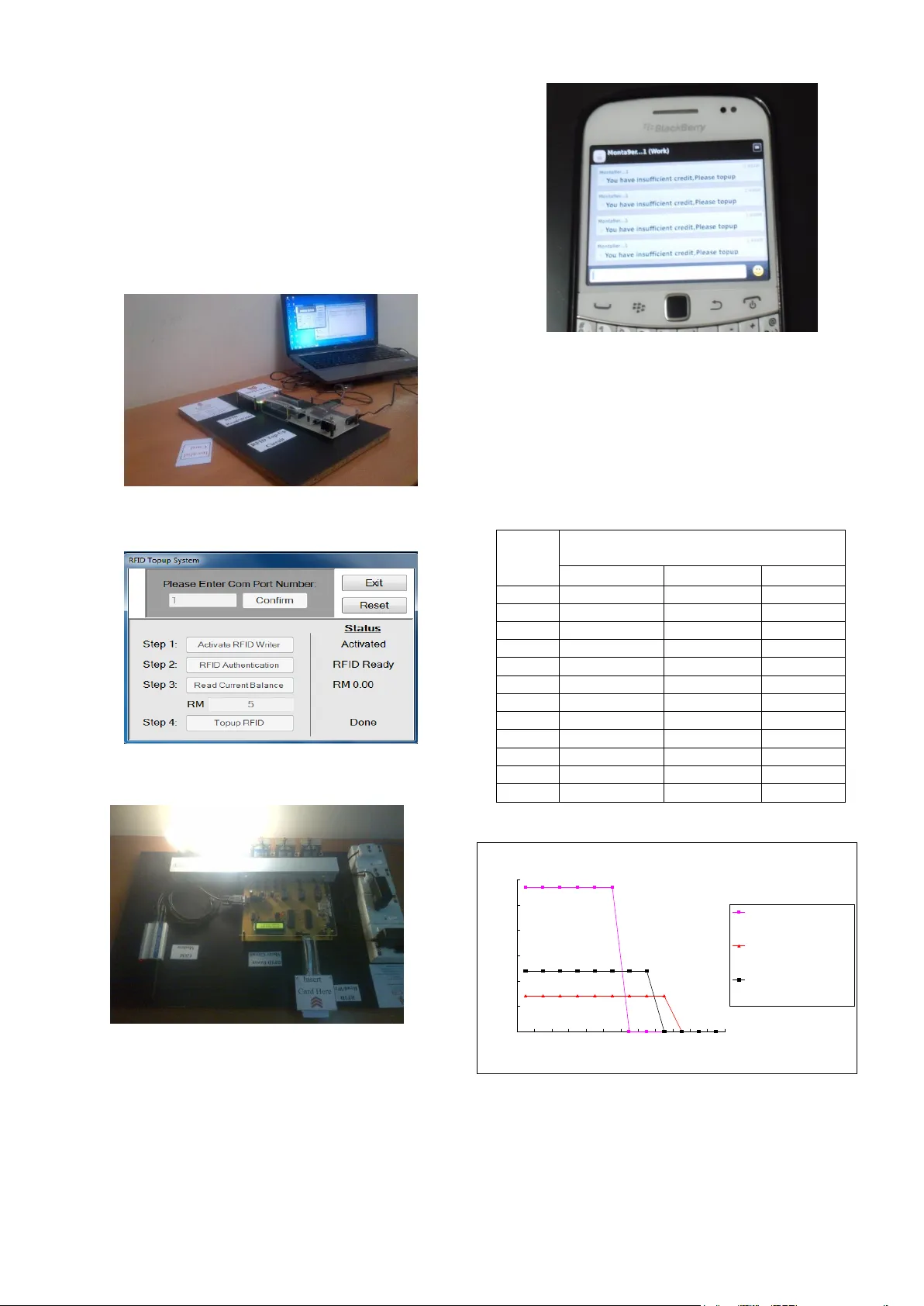
RFID-BASED Prepai d Power Mete r Rozita Teym ourzadeh Mahmud Iw an S Ahmed J. A. Abue ida Rozita Teymourzadeh, Ma hmud Iwan, Ahmad J. A. Abueida Faculty of Engieering, T echnology and Built Environme nt UCSI University, Chera s, Kuala Lu m pur, Malaysia Abstract — Electrical p ower m eter is an im portant component in electric energy service. In the past, many consumers ha ve complain ed about reading inaccurate of the ele ctric meter. This research pr esents the development of an ele ctrical power meter equipped w ith RFID reader. The RFID reader reads a valid RFID card and activates the pow er meter so that it can s upply electricity. When the credit is about low or before the electricity is auto cut off, an S MS message w ill be se nt to the user’s hand phone to alert. Keywords: RFID system, prepaid power meter , GSM message I. I NTRODUCTI ON Prepaid electric ity power meter may not be popular in Malaysia though it has been used in many countries. It is designed f or the e lectric cus tomers to have control over their electric bil ls. In addi tion, an individual can us e electricity on his own bill which is useful in some situation s like hotel, apartm ent or movin g house. This research attempts to develop a prototype o f a prepaid power meter employ ing RFID technology [1] . In the current RFID power meters , many have used “read ” types of RFID technology to activate the m eter and supply electricity to the consum ers [2 ,3 ] . One can only program the credit by a given code in the RFID card. The code cann ot be change d. Therefo re, to top up diffe rent credits in the RFID card, one should use different RFID cards instead of one. For example, if the user wants to top up RM 10, RM 20 and RM 30 o n the RFID pow er meter, he has t o use three cards with different credi ts hold. T his scenari o caus es users ha ving to buy m ore RFID c ards for different amount of credits used. There exis ts anothe r type of RFID card w here it can read and write the data. This type of RFID card requires a s pecial RFID reader to operate. T he RFID reader can be connected to computer using USB cable . When the RFID card placed on the reader, the data ca n be trans ferred to the computer or from the computer t o the RFI D card. For co nveni ent use of RFID electrical power meter, the read and writer type o f RFID device is chosen. This kin d of RFID device can help to reduce the num ber of RFID cards used for different credits top up. One card can be programmed to load for diff erent am ount of credit . II. D ESIGN OF T HE R FID -B ASED P REPAID P OWER M ETER The diagram of designing the e lectric al power meter using RFID rea d/write re ader is sh own in Figures 3 and 4. Figur e 3. Conne ction or to p up the c redit in the RFI D car d [4]. Figur e 4. Bas ic RFI D el ectric al pow er me ter circ uit de sign [ 2]. Figure 3 shows the co nne ction diagram to co m municate with RFID read/write device. T he implemen tation shown in Figure 3 is mainly for top up the cr edit into the RFID ca rd. Notice that in the top up process, no microcontrol ler is required. The communicatio n between the d evi ce and the computer is via a direct connection to MAX232 IC. T he MAX232 regulates the voltage level betw een the output of the RFID read/write device and the computer. The arrows shown in Figure 3 indicate the direction flow s of d ata. The commun ication between the device and the computer is in duplex o r bi-directi on. Figure 4 show s the basic RFID electri cal power mete r designed to read the RFID card and supplies electricity to the loads. The workin g principle of the RFID power m eter begins from the A C 240V power s ource. From the b lock diagram, the transform er steps down the AC 240V into AC 12V. The diode connected in bridge converts 12V AC sine w ave into full wave rectifie r waveform . W ith capacitor connected at the o ut put, the full wave rectifier waveform is co nverte d into DC. T he capacitor actually acts as filter w hich removes the ripple content in the DC. With voltage regulator connect across at the output of the capacitor, the DC voltage is regulated down into 5V. The 5V is then used by m icrocontrolle r, relay, MAX232 IC and L CD display . When the RFID reader is activated or read the correct RFID card, the data from the card is transferred to the microcont roller. The microcontro ller will compute the power, credit and trigger the relay so that the AC load is connected to the AC source. Both the power and credit are displayed in the LCD screen. As the credit is low , the buzzer will be activated and an SMS message will send o ut to the hand phone through GSM modem . The proposed RFID power meter works very much relyin g on the program em bedded int o the m icrocontroll er. The algorithm of C lang uage u sed t o detect the RF ID ca rd a nd activate the pow er meter is designed and show n in Figur e 5. Fig ure 5 . Sy stem algor ithm design for t he m icroco ntroll er w ork i n the RFI D powe r mete r. From the algorithm , there are two I/O ports configurat ions, one is for the LCD display and the o ther is for microcont roller. The I /O ports configur ation is very important to read and write the data. Once the microc ontroller knows the I/O ports and where the data flows, the next algorithm is read the RFID card from the RFID reader. The microcontrol ler com pute s the credit deduction , display s the p ow er and the cr edit, and makes decision or comparison to trigger the buzzer and the relay and GSM modem to send the SMS message. T he algorithm is then repeated from th e beginning w hen the p ower is cut off. By referring to Figure 4, there is a feedback path connect ed at the load . This feedback is used to determine the current in the AC circuit. In o ther words, the feedback is a ctually a current sensing cir cuit. For most o f the digital RFID power meters, a shunt resistanc e method is commonly used method to determin e the current . The shunt resistan ce will b e connected in series with the load and its value is small compared to the load resistan ce. When the current varies, the voltage across the shunt resistor also varies. T he variati on of voltage gives information of the current . Figure 6 shows the shunt resistance m ethod used as feedback system to detect the current and convert it into equivalent voltage . From the feedback system, there is a transfo rmer connected in shunt across the shunt resistor. The voltage drops across the shunt resis tor an d input t o the transf ormer is given by [5]: V = IR shunt (1) The capacitor connected at the output of the transformer is used to convert th e AC volt age into DC voltag e. This DC voltage is representing the current values and it has a un it of ampere per volt . The ampere m eter “A ” connect ed in th e circuit is use d f or ca lib ration and obs erves th e output V out in relation to the cu rrent. Figure 6. T he fee dbac k sys tem to deter mine the c urre nt. The calib ration can be done by using different AC loads. The calibration w ill form a reference table for the program mer to refer to. The co mpu tation of power in the microc ontroller can be wr itten by: P = 240*I (2) where I refers to the tabl e for diffe rent values of voltage. A value o f 240 is a sing le phas e AC source and P is an activ e power. P o we r c o n su mp t io n fo r ea c h li gh t b ul b 0 10 20 30 40 50 60 5 10 15 20 25 30 35 40 45 50 55 60 T im e i n se c o nd P o we r i n wa tt P o we r c o n su mp t io n te s ti ng o n th r ee d if fe r en t li gh t bu l b s L i g ht b ul b 1 P o we r c o n su mp t io n te s ti ng o n th r ee d if fe r en t li gh t bu l b s L i g ht b ul b 2 P o we r c o n su mp t io n te s ti ng o n th r ee d if fe r en t li gh t bu l b s L i g ht b ul b 3 III. R ESULTS Figures 7, 8, 9 and 10 show the experimen tal test on the RFID p repai d power meter. The circuits are constructed on the PCB and the testing was perf ormed. Figure 7 show s the RFID top up system , Figure 8 shows the GUI window designed to top up any values on the RFI D card, Figure 9 shows the RFID pow er meter and Figur e 10 show s the SMS receive d wh en credit is low. Figur e 7. The RFI D top up cir cuit Figur e 8. The top up GUI window . Figure 9. Te st the RFID Pow er Meter circuit o n the PCB. Figure 10. T he SMS message re ceived about low credit. Table 1 shows the r esults of testin g on the power cutoff time for the 60W, 25W and 15W light bulbs. Figure 11 show s the graphs plotted for Table I. TABLE I . EXPERI MENTAL TEST ON LIGHT BUL BS UNDER RFID POWER METER CONT ROL Time (s) Power consumption testing on three different light bulbs Light bulb 1 Light bulb 2 Light bulb 3 5 57 14 24 10 57 14 24 15 57 14 24 20 57 14 24 25 57 14 24 30 57 14 24 35 0 14 24 40 0 14 24 45 0 14 0 50 0 0 0 55 0 0 0 60 0 0 0 Fi gure 11. The oper ation of 6 0W lig ht b ulb co mpare d to 25 W, 15W lig ht bul b From the experimen tal test results, it is seen that w ithin 1 minute, the lig ht bulb of 60W is cutof f first. This is because the power consum ption is higher compared to 25W and 15W ligh t bulbs. The 60W light bulb takes 30 seconds to operate whereas the 2 5W light bulb takes 40 seconds to operate and 1 5W light bulb takes 45 seconds to opera te. This show s that th e higher t he power consum ed, the faster the meter will deduct the credit. In the experim ent, RM 5 Ringgit is program med for the testin g. Figure 12 show s the curr ent sensin g results f or differen t light bulbs in the expe rimental test. T he obse rvation output is the DC voltage where it is impo rtant for the m icrocont roller to look up th e current table and identify the e quivalent va lues. TA BLE II VOL TAG E REP RESENT ING THE CURREN T FO R DIFF ERENT LIG HT BUL BS Voltage representing the current 60W light b ulb 25W light b ulb 15W light b ulb 3.5 2.2 1.2 Figur e 12. The plo t for Table II . It can b e seen th at, the higher the l oad used , the m ore output voltage will be prod uce d. From the graph, the connecti on of 60W light bulb gives 3.5V where its curren t is 250mA . For the 25W light bulb, the voltage produced is 2.2V and its current value is 104. 2mA. The 15W light bulb giv es 1.2V at the o utput o f the current sensing circuit and its current value is 62.5mA . IV. C ON CLUSIONS From the experim ental test, it can be seen that the op eration of the RFID power meter based on the amount of credit top up is successf ul. This w ill enable the users to have cont rol over the usage of the ir elec tric energ y. As additional featur e, when the credit is about to finish, the RFID power meter will alert the users via his GSM h and phone. The electricity power supply will be cut automatically when th e credit is finishe d . R EFERENCES [1] Kamran A, Hanifa S, and Paul K. “ RFID Applications: An Introductory and Exploratory Study ”, IJCSI International Journal of Computer Science I ssues, Vol.7(1), No 3, Ja nuary 2010 [2] T.F.Lai and Surendran, “RFI D Electrical Pow er Meter” , Pro c. of the International Conference on Adva nces in Electronic Devices and Circuits, 2012. [3] H. Huang, “The R ead Only RFID Reader I mple mentation”, I EEE Transl. W ireless Transducers. UK , vol. 5, pp. 40 – 71, p. 30, Ju ne 2005. [4] T . G. Jong, “The Topup System Design for Smart Ca rd,” in RFID, vol. II, L . Ray and H. Smith, Eds. Ne w York: A cademic, 2009, pp. 71 – 82. [5] Thomas. F, Electrical Technolo gy, M cGraw-H ill Publisher, New York, 2007. volt age repr esenti ng the c urrent 0 0.5 1 1.5 2 2.5 3 3.5 4 60W li ght bul b 25W li ght bul b 15W li ght bul b load Vol tage
Original Paper
Loading high-quality paper...
Comments & Academic Discussion
Loading comments...
Leave a Comment