Prediction of the Optimal Threshold Value in DF Relay Selection Schemes Based on Artificial Neural Networks
In wireless communications, the cooperative communication (CC) technology promises performance gains compared to traditional Single-Input Single Output (SISO) techniques. Therefore, the CC technique is one of the nominees for 5G networks. In the Deco…
Authors: Ferdi Kara, Hakan Kaya, Okan Erkaymaz
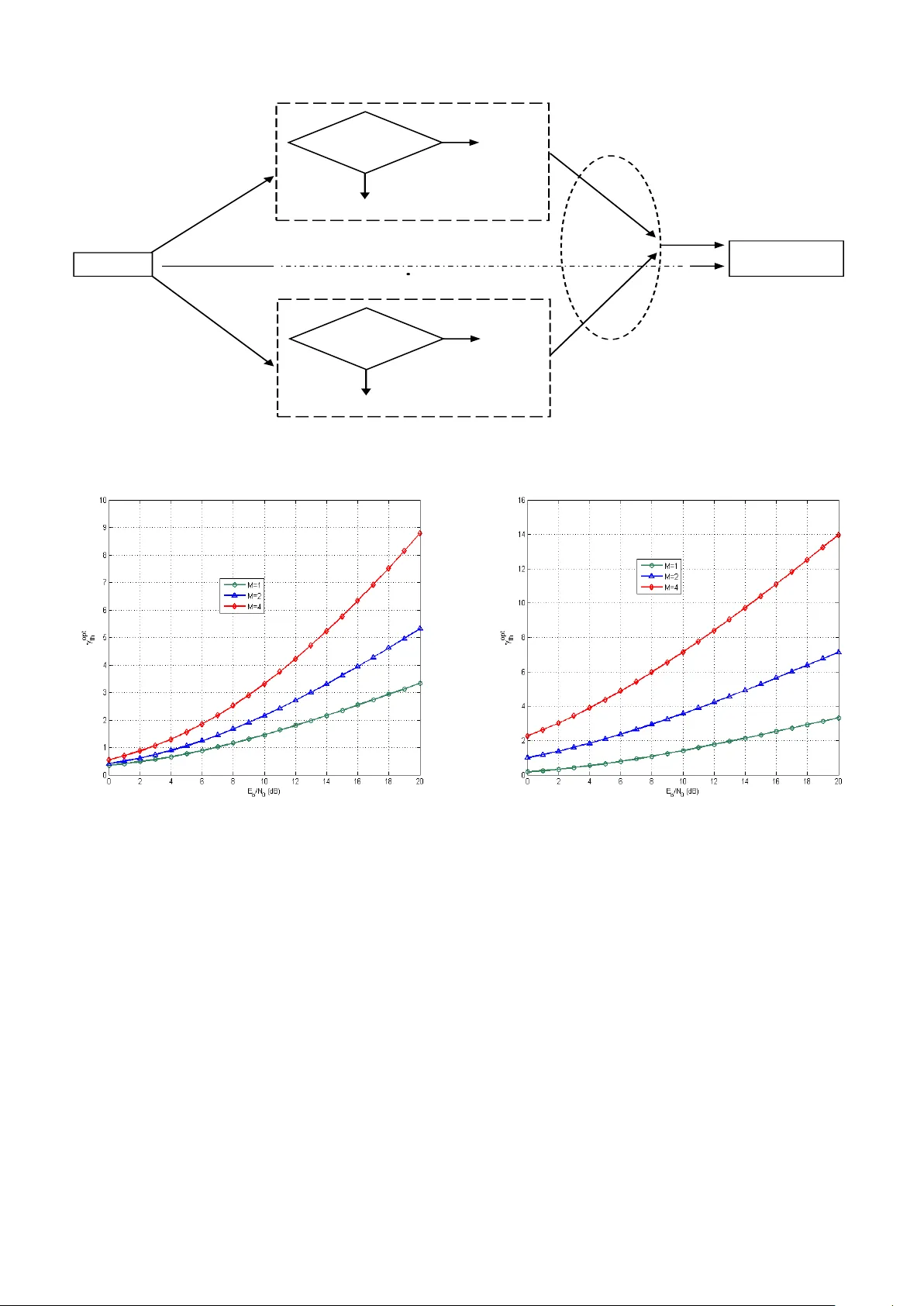
Prediction of the Optimal Threshold Value in DF Relay Selection Schemes Based on Artificial Neural Networks 1 Ferdi KARA, 1 Hakan KAY A, 2 Okan ERKAYMAZ, 1 Ertan ÖZTÜRK 1 Department of Electrical E lectronics Engineerin g , 2 Department of Co mputer Engineering Bulent Ecevit Univer sity, Zonguldak, Turkey {f.kara@beun.edu.tr , hakan.ka ya@beun.edu.tr, o kan.erkaymaz@beun.edu.tr, eozturk@beun.edu.tr} Abstract — In wireless communications, the cooperative communication (CC) tec hnology promises performance gai ns compared to tr aditional Single -Input Single Output (SI SO) techniques. Therefore, the C C technique is one of t he nominees for 5G networks. In the D ecode-and-Forw ard (DF) relaying scheme which is o ne of the CC techniques, determination of t he threshold value at the relay has a key role f or the system performance an d power usage. In this paper, we propose prediction of the o ptimal threshold values for the best relay selection scheme in c ooperative communications, based on Artificial Neural N etworks (ANNs) for the first time in literature . The average link qualities and number of relays have bee n used as in puts in the prediction of optimal threshold val ues using Artificial Neural Networks ( ANNs): M ulti-Layer Perceptron (MLP) and Radial Basis Function (RBF) networks. The MLP network has better perfor mance fro m the RB F network on the prediction of optimal threshold value w hen the sa me number of neurons is used at the hidden layer for both networks. Besides , the opti ma l t hreshold values ob tained using ANN s are verified by the optimal threshold values obtained numerically using the closed form ex pression derived for the system. The results s how that the optimal threshold values obtained by ANNs on t he best relay selectio n sche me provide a minimum B it-Error-Rate (BER) because of the reduction of the probability that error propagation m ay occur. Also , for the sam e BER p erformance goal, p rediction of optimal threshold values provides 2dB less power usage, w hich is great gain in ter ms of g reen communication. Keywords — relay selection, cooperative, ANNs, MLP, RBF, optimal threshold I. INTRODU CTION The p erforman ces of wireless communication techniques are mostly evaluat ed according to bit-error rate (BER) and outage probabil ity. T hese two cr ite ria’s depend on the wireles s channel properti es such as interf erence, fading, shadow ing and path-loss etc[1] . Researchers have been study ing on sev eral techniques in order to increase the perform ance. One of these techniques for impr ov ing the p erform ance is diversity in which the copies of data are transmitted o ver independent dimension s such as time, frequen cy and space (antennas). In spat ial diversity , the copies of data are transmitted/r eceive d by multiple ant ennas. Therefo re, the spatia l diversity is mostly called as Multi ple Input Multiple Output (MIMO) system [ 2] , which is key technology in 4 G standards i,e LTE and LTE- Advanced [3]. However, in mobile communications multiple antennas cannot be easily adapted due to physical limitation s. To overcome these limitations the relaying systems are proposed in literatu re. In the relaying systems, the other users - called relays- in the environment forward a processed version of the received data from source to the destination. The relayin g systems are s een the nominees for the 5G and beyond technologi es. This relaying system is called cooperati ve commun ication (CC) and the obtain diversity is called cooperativ e diversity or virtual spatial diversity [4]. In literatu re, d ifferen t relaying protoco ls such as amplify-an d- forward (AF) and decode-and-forw ard (DF) are used accordi ng to the employed processing at the relay. In AF protocol, the received data is amplifie d by a relay (to eq ualiz e the effect of the channel fade between the source and the relay) then the relay retransmits the a mplifie d version of data to a destinat ion [5]. On the other hand, in DF protocol, a relay first decodes the received data, then re-encodes and forwards to a destination. In the DF protocol, the relay decides wh ether it transmits or not according to the source-re lay link quality . If the source -re lay link quality is less than a threshold value on the relay, relay remains silent . Otherwise the relay transm its [6]. However, it is still possible that the relay may decode incorrectly even if a threshol d value is greater than the source-relay link quality and decode the data from the source and then forward this incorrect data t o the destinat ion erroneous ly. T his p henom enon is called error p ropagation pr oblem. The pr obability of this inc orrect detecti on at the relay depends on the thresh old va lue [7] . In a CC sys tem, the source could transmit the signal to the destinati on not only through the one relay but also throug h multi relay s (all availa ble relay s) to increas e diversity order gain .Inste ad of using all avai labl e relay s, only one relay, w hich is the best o ne among the multi r elay s to obtain best perform ance, can be selected. The selected relay has the highest link qualiti es in terms of the transmis sion path and called best relay. Hence this scheme is called relay selecti on [8] .T he use of only the best relay also p rovi des the fu ll diversity order with an efficien t use of the bandw idth. In the DF protocol and relay selecti on scheme, the threshol d value has great effect on the p erform ance o f cooperativ e comm unication. To minimize B ER, an opti mal threshol d valu es has to b e o btained. T his optim al thresh old value d epends on the number of relays and the link qualiti es This work has been suppor ted by The Scien tific and Techn ologi cal Rese arch Coun cil of Turkey (TU BITA K) with the name 2211A PhD Scho larsh ip Pr ogr am . between sour ce -rel ay, relay- destination and source-destina tion [7]. The computati on of optimal thresh old value changing rel ay numbers an d link qualities by analytical ly is h ardly possible . In this paper, for the prediction of optimal threshold values by usin g MLP and RBF networks, the num ber of r elay s and the average link qual ities of sour ce-relay -destination paths are used as inputs after n orm alization. The optim al threshold values o n the b est relay selection scheme are determ ined for diff erent scena rios by numerica lly min imizing the close d form BER equation similar to given in [6] . Different types of scenarios having different relay num ber s and different link qualities have been used to test the proposed techniques. T he outputs of ANNs are perfect match with the numerical results . This paper organized into six sections. In section II, we have briefly explained the b est relay selection in DF network models. Also the numerical results for optim al threshold valu es are given in this section. Section 3, has an overview of literatu re in determination of thresho ld values on DF networks. Section 4 deals w ith the description o f ANNs as proposed techniques. Application of ANNs for the prediction of optim al threshol d values in DF netw orks and results ar e given in Section 5. In section 6, so me r esults are discussed, and the paper is conclu ded. II. SYSTEM MODEL In the relay selection scheme, one relay is selected among multi-rel ays in order to utiliz e full cooperative diversity [8] . The relay selection is perf orm ed b y considering source-relay - destinati on cascaded link qualities of all available relays. Relay selection is done in two steps: First, the d ecoding set (C) of relays which are called reliable relays, is d eterm ined by considering so urc e-relay link qualities of all available relays. If the receive d SNR from source at the relay is less than a threshol d value, the relay cannot decode the source message correctly and it does not transm it. If the received SNR at the relay is greater than the threshol d, this relay is ad ded in to the decoding set. It is also as sumed that the r elay s belong to th e decoding set may detect the signals from source erroneous ly and forw ard incorrect data to the desti nati on, causing e rror propagati on that can reduce the performance o f the system [9] . Second, the relay selection is completed at the destina tion by taking the relay having the highest relay-destination link quality from the decoding set. After determ ining the best relay, the des tination informs all relays ab out w hich relay is selected to transm it as the best relay through a reverse broadcast channel then other unselecte d relays turn to be idle [10] . The destinati on combines the data received from so urce and best relay b y using Maximum Ratio Combinin g (MRC). The best relay sele ction s cheme is g iven Fig 1. For the best r elay selection scheme, the BER of system , which is given in the ( 1), is obtained by using the equations given in [5] and [11] under the conditi on that the d estinati on uses MRC and the modula tion is Binary Phase Shift Keying (BPSK). The BER of systems d epends on the threshold value ( ), the average link SNRs ( ) and the number o f relays (M). The definition of erfc (.) function used in (1) is . The optimal thresh old ( ) is the value which minimizin g the BER of the sy stem . (2) In our scen arios , it is assum ed that th e average s ource- relay, relay- destination and s ourc e-destination link SNRs are , , respectively . E(.) is the statistica l average (or expectati on) operator. h SD , h SR and h RD are the channel coefficients and they are modeled as Rayleigh flat fadi ng channels with variance of , and , respectively . In Fig . 2, the optimal threshol d value ( ) numerically obtaine d min imizing BER as a function of is show ed for diff erent number of relays (M) on the symmetric netw ork w hich has . In Fig. 3, the optimal threshol d value ( ) is showed on another netw ork in which and . It is mostly po ssible scenari o if the relay stands between source and destinati on. (1) Figure 2. The opt imal threshold value s ver sus on the symm etric networ k for M=4 Figure 3. The optimal threshol d values ve rsus on the netw ork and for M=4 III. R ELATED WO RKS The optim al th reshold va lue in DF schemes could have been obtained by analytically just for a single relay i,e M=1 over Rayleigh fading channels [7] and over Nakagam i- m fading channels [12] by using optimum decision rule similar to gi ven (2). Similarly in [13] , the authors proposed a method for the optimal thresh old value and optimal power allocation when single r elay is used . In [7] , the authors hav e obtain ed t he optimal values num erically by minim izing BER values as described Section II for the multiple r elay scenarios. H owever, this meth od could not be used at the relay because of t he computati onal b urden . In [1 4], the authors used the MATL AB Optim ization Toolbox for the determ ination of the thresh old values. IV. OVERVIEW OF ARTIFI C IAL NEURAL NETWORK S The Artif icial Neural Networks (ANNs) have been stud ied by researchers since 1970 s. A rtificial Ne ural Net works (ANNs) have become commo nly used tool to generate proper outputs for given inputs in the ab sence o f a formula bet ween inputs and o utputs. An ANN model is formed by i nput(s) with weight(s), activation f unction(s), biases an o utput(s) [15] .The weights and biases are changed b y the ti me an o utput is generated with a tolerated error for given inputs. T hanks to . . . Destination Source Relay Selection Yes No İdle Reliable Relay 1 Yes No İdle Reliable Relay M Direct Link Figure 1. Best Re lay Selection S cheme F i g u r e 1 F i g u r e 2 their computational speed , ability to handle co mplex functions and great efficie ncy e ven if full infor mation is absent for the problem, ANNs have beco me one of the m os t prefer red methods to solve non-linear engineering pro blems. ANNs are mainly used for classifica tion, function approximatio n, clustering and re gression [16]. ANNs have b een also used in wireless communications for the purpo se of cha nnel estimations, channel eq ualizations etc [1 7] [18] [19]. In the last years, researchers have started to use the ANNs for the network solutions as rela y selection methodolo gy[3]. ANNs have d iffe rent types which are called according to netw ork connections and the activation functions used. Multi- Layer Perceptron (MLP) and Radial Basis Function (RBF) netw orks are tw o of the m ost popu lar ANNs. A. Multi -Layer Perceptron (MLP ) Network Multi-Lay er Perceptron (MLP) netw ork w hich is proper for the linear and non-linea r applicati ons is the most used ANN netw ork. MLP network consists o f an input lay er, one o r more hidden layers and an output lay er. A MLP network w ith o ne hidden lay er is sh ow n Fig. 4. Figure 4. Multi-L ayer Perce ptron Network w ith one hid den laye r The computati ons are located on the neurons at the each layer and the inf ormation is transferred forw ard from nod e to node via w eighted c onnection s. The weig hts on the connection s and the biases values for each neuron are adjusted according to desired outputs via backpropa gation algorith ms [20]. There are several learning algorithms in the literature. In this work, one of the mostly used algorit hm Levenberg-Marqua rdt back propagati on is preferred . MLP is chosen in this work due to its simple structur e for prediction problem s a nd its efficiency in learning large data sets. T he output of MLP with one hidden layer is : . (3) In (3) is input(s ) and is the output . , , are hidden layer activati on funct ion, input-hidd en layer w eights and hidden l ayer bi ases, res pectively . Likew ise , , are output layer activation function, hidden-output lay er weights and output layer bi ases, res pectiv ely. In this work “ tangent sigm oid ” and “ pure linear ” functions are used as a hidden lay er activati on and out put lay er acti vation f unction. B. Ra dial Basis Fu nction (RBF) Netw or k Radial Basis Function (RBF) network also consists of three layers: input lay er, hidden lay er and output layer like MLPs. However, RBF netw orks are traine d f aster than ML Ps. T he RBF netw orks could be d efined as an applicati on of neu ral netw orks for function approxim ation on the m ulti dimension space. RBF netw orks use Gauss function as hidden layer activati on functi on. The output of a RBF netw ork is: (4) In (4) is the input and is output of network. are neurons center points and spread, respectiv ely. The output of the hidden layer is transferred to output after multiplie d by hidden-outpu t layer weigh ts ( ) and summ ed with o utput b iases ( ). In the RBF netw ork the input-hidden layer w eights are all 1 [ 20]. V. PREDICTI ON OF OPTI MAL THRESHOLD VALUES The BER values for the sel ection relaying scheme giv en in (1) are calculat ed for various thresh old values on the d ifferen t scenari os having changing num ber o f relays and link qualit ies as descri bed Part II. Then, the thresh old value w hich minim izes the BER is assumed the opt imal. T he data set explain ed above how to o btain is div ided into two par ts for training and testi ng. The training data has 12500 samples and the testing data has 3125 s amples. After normaliz ed, the train ing data is applie d to ANNs: MLP an d RBF netw ork s, in the same w ay. During the training of ML P, the network was tr ained many times for different num bers of hidden layer neurons , and the perform ance criteria – Mean Sq uare d Error (MSE) - was noted. The more neurons in the hidden layer, the less MSE is obtained on training. How ever, the changin g of MSE after 12 neuron s is very slow. In addition to that, considering the complexity to implem ent of ML P, the number of hidden layer neur ons is chosen 12. T he training MSEs of MLP according to different number of hidden neurons are g iven Table 1. TABLE I . T HE TRAIN MSE S OF MLP ACCORDING TO N UMBER OF H IDDEN L AYER N EURONS Number of Hidd en Layer Neurons MSEs 4 2.62 E- 04 6 8.49 E- 05 8 1.45 E- 05 10 1.16 E- 05 12 8.59 E- 06 14 2.53 E- 06 16 1.58 E- 06 18 1.11 E- 06 The RBF netw ork was trained w ith the same number of neurons to com pare with MLP network prope rly. The sprea d of the network on RBF has effect on training MSE. However, there is not a w ay to calculate the spread c oefficient . Therefore , the RBF network was retrained for different sprea d coefficien ts until the minim um MSE is obtained. The spread coeff icient is chosen 0. 8 for R BF netw ork. After training of two netw orks, they were tested with dataset not used for training. For the 10 different samples randomly selected from the test data, the outputs of ANNs are obtained. Three statistical p erform ance criteria’s – Mean Squared Error (MSE), Mean Absolute Error (MAE) and coefficient of determ ination (R 2 )- are calculated to compare the ANNs o utputs with the numerical optimal thresh old v alues. The resul ts are giv en Tab le 2. TABLE II . T HE COMPARISON OF NUMER ICAL RESULTS WITH ANN S OUTPUTS AND THE STAT ISTICAL PERFORMANCE CR ITERIA ' S OF ANN S FOR 10 SAMPLES RANDOMLY SELECTED . S. No Inputs Num. Values ANN Outpu ts M MLP RBF 1 1 5.5 10 2 9 0.1100 0.1094 0.989 2 10 3.25 10 8 8 0.3432 0.3371 0.3377 3 1 3.25 7.75 4 0 0.3171 0.3222 0.3056 4 3.25 5.5 7.75 6 0 0.0753 0.0786 0.0791 5 3.25 1 10 2 3 0.0750 0.0739 0.0652 6 10 10 10 6 13 0.4438 0.4446 0.4387 7 7.75 3.25 3.25 4 20 0.4291 0.4303 0.4190 8 3.25 5.5 3.25 8 10 0.2839 0.2805 0.2861 9 1 7.75 5.5 8 18 0.4107 0.4090 0.4540 10 7.75 3.25 7.75 8 16 0.6127 0.6125 0.6196 MSE 9.225 E- 06 2.4516 E- 04 MAE 0.0024 0.0109 R 2 0.9997 0.9914 On the two network scenarios described in Part II, the ANNs outputs are calculate d lik e given in ( 3) and (4). In Fig. 5, on the symmetric network - - the optimal values numerically obtained and the ANNs outputs are given according to values for M=4. In Fig. 6 , the same computati ons are given for M=6 o n the other network - and -. Figure 5. The nume rical optimal t hresholds and A NNs ’ outputs versus for M=4 on the sy mmetric netw ork in which Figure 6. The n umerical optimal thresholds and A NNs ’ outputs ver sus for M=6 on the netw ork in which and . VI. CONCLUSION W e have propo se d the use o f two different ANN models (MLP and RBF) for the first time to obtain the optimal threshol d values for the best relay selection schem e in cooperativ e communications systems. Different s cenarios having different link qualities and different number of relay s were used to test the vali dity o f the proposed models. Numerical results have show n that the optimal thresh old va lue increases as a function of relays nu mber and of SNR wh ich represents all link qualities. T he results have shown that two ANN networks can predict the optimal values. Howev er, the MLP network o utpe rform s the RB F network when using the same num ber of hid den lay er neu rons. By the prediction of the optimal threshold value at the relay adaptively , BER value of the DF scheme rem ain minim um all SNR values. Othe rwise, sm all thresh old values w ould have low BER perform ance at high values because of the propagati on erro r; high thr eshold values would have lo w BER pe rfo rmance at the l ow value. On the symm etric netw ork - - which has M=4 relay s, the BER perform ances of the system have obtained for different constant thresh old values and for the optim al threshold values according to changing values. TABLE III . THE COMPARISON OF THE BER VALUES FOR ACHIVED BY OPTIMAL THRESHOLD VALUES W ITH THE ACHIVED BY CON STANT THRESHOLD VALUES ON TH SYMETRIC NEWROKS WITH 4 RELAYS Threshold Values (dB) 0 4 8 10 12 16 20 1 7,32 E-02 1,54 E-02 4,74 E-03 3 E-03 1,93 E-03 7,92 E-04 3,19 E-04 3 0,130 2,8 E-02 2 E-03 5,55 E-04 2,29 E-04 7,96 E-05 3,19 E-05 5 0,144 4,96 E-02 4,67 E-03 9,26 E-04 1,61 E-04 1,12 E-05 3,63 E-06 10 0,147 7,31 E-02 1,58 E-02 4,41 E-03 9 E-04 1,99 E-05 2,96 E-07 (MLP ) 6,98 E-02 1,48 E-02 1,86 E-03 5,39 E-04 1,38 E-04 6,83 E-06 2,44 E-07 (RBF) 7,2 E-02 1,51 E-03 1,85 E-03 5,45 E-04 1,43 E-04 7,38 E-06 2,87 E-07 In summary , obtaining the thresh old value adaptively with the ANNs for average values and number of relays provides min imum BER v alues f or all values . T he results also shown that, compare d to constant threshol d values using optimal threshold values at the r elay gives us 2 dB less power o pportun ity for the sam e BER perform ances. T his is very promisin g result in terms o f green commun ication sy stem s. As a conclusion, this paper s hows th at by the time the threshol d value is obtained properly, the DF cooperat ion commun ication systems are very promising for 5G standards instead of the traditi onal MIMO techniques already exist in 4G standards REFERENCES [1] M. K. Simon and M.-S. Alouini, Digital Communication over Fading Channels . Hoboken, NJ, USA: John Wiley & Sons, Inc., 2004. [2] A. G oldsmith, Wire less Communications , First., vol . 1. Cambridge: Ca mbridge University Pr ess, 2005. [3] K. Sankhe, C. Pradhan, S. Kumar, and G. Ramamurthy , “Machine Learning Based Cooperative Relay S election in Virtual M I MO,” p. 6, Jun. 2015. [4] J. N. Chen, D.;Laneman, “Modul ation and d emodula tion for cooperative diversit y in wireless systems,” IEEE Trans. Wi rel. Commun. , vol. 5, no. 7, pp. 1785 – 17 94, Jul. 2006. [5] S. S. Ikki and M. H. Ahmed, “On the Performance of Amplify -and - Forward Cooperative Diversity with the,” Co mmun. Soc. , pp. 0 – 5, 2009. [6] F. Atay Ona t, Y. Fan, H. Yanikomerogl u, and H. V. Poor, “Thre shold -Based Relay Selection for Dete ct-an d-Forw ard Relaying in Cooperative Wireless Networks,” EURASIP J. Wirel. Commun. Netw. , vol. 2010, no. 1, pp. 1 – 10, 2 010. [7] F. A. Onat, A. Adinoy i, Y. Fan, H. Yanikomeroglu, J. S. Thompson, and I. D. Marsland, “Threshold selection for SNR -based selective digital relaying i n cooperative wireless networks,” IEEE Trans. Wirel. Commun. , v ol. 7, no. 11, p p. 4226 – 4237, 2008. [8] A. Bletsas, A . Khisti, D. P. Reed, and A . Lippman, “A s imple Cooperative diversity method based on network path selection,” IEEE J. S el. Areas Commun. , v ol. 24, no. 3, pp. 659 – 672, M ar. 2006. [9] P. Herhol d, E. Zimmermann, and G. Fettweis, “A simple cooperative extension to wirele ss relaying,” in International Zurich Seminar on Di gital Communic ations , 2004, pp. 36 – 39. [10] E. Öztürk and H. K aya, “Per formance analy sis of distributed turbo coded s cheme with two ordered best rel ays,” IET Commu n. , vol. 9, no. 5, pp. 638 – 648, Mar. 2015. [11] S. S. Ikki a nd M. H. A hmed, “On the Performance of Cooperative - Diversity Netwo rks with the Nth Best- Relay Selection Scheme ,” IEEE Trans. Comm un. , vol. 58, no. 1 1, pp. 3062 – 3069, Nov . 2010. [12] S. Ikki and M. H. Ahmed, “Performance of Decode -and-Forw ard Cooperative Diversity N etworks Over Nakagami -m Fading Channels,” in IEEE GLOBECOM 2007-2007 IEEE Global Telecommunic ations Conferen ce , 2007, pp. 4328 – 4333 . [13] W. P. Siriw ongpairat, T. H imsoon, W. S. W. Su, and K . J. R. L iu, “Optimum t hreshold -sele ction relay ing for decode-and-forward cooperation protocol ,” IEEE Wirel. C ommun. Netw. Conf . 2006. WCNC 2006. , vol . 2, no. c, pp. 1015 – 1020, 2006. [14] H. X. Nguyen an d H. H. Nguyen, “Selection combini ng for noncohere nt decode-and- forw ard relay networks,” EURASIP J. Wirel. Commun. Netw. , vol. 2011, no. 1, p. 106, 20 11. [15] S. Hay kin, “Neural networks: a comprehensive foundation,” Knowl. Eng. Rev. , vol. 13, no. 4, Fe b. 1999. [16] J. M. Zurada, “I ntroduction to Artificial Neural Systems,” West Publ. , p. 683, 19 92. [17] S. Theodor idis, “Schemes for equalisation of communica tion channels with nonlinear impairments,” IEE Proc. - C ommun. , vol. 142, no. 3, p. 1 65, 1995. [18] G. J. Gibson, S. Siu, S. Chen, C. F. N. Cowan, and P. M. Grant, “The ap plication of n onlinear architectures to adaptive channel equalisation,” in Conference Record - International Conference on Communications , 1 990, vol. 2, pp. 649 – 653. [19] K. Burse, R. N. Yadav, and S. C. Shrivastava, “Channel Equalization Using Neural Networks: A Review,” IEEE Trans. Syst. Man, Cybern. Part C (Applications Rev. , vol. 40, no. 3, pp. 352 – 357, May 2010. [20] L. I. Guan, “R.O. Duda, P.E. Hart, and D.G. Stork, P attern Classification, New York: John Wiley & Sons, 2001, pp. xx + 654, ISBN: 0 -471-05669- 3, ” J . Classif. , vol. 24, no. 2, pp. 305 – 307, Sep. 2007.
Original Paper
Loading high-quality paper...
Comments & Academic Discussion
Loading comments...
Leave a Comment