Distance-Two Colorings of Barnette Graphs
Barnette identified two interesting classes of cubic polyhedral graphs for which he conjectured the existence of a Hamiltonian cycle. Goodey proved the conjecture for the intersection of the two classes. We examine these classes from the point of view of distance-two colorings. A distance-two $r$-coloring of a graph $G$ is an assignment of $r$ colors to the vertices of $G$ so that any two vertices at distance at most two have different colors. Note that a cubic graph needs at least four colors. The distance-two four-coloring problem for cubic planar graphs is known to be NP-complete. We claim the problem remains NP-complete for tri-connected bipartite cubic planar graphs, which we call type-one Barnette graphs, since they are the first class identified by Barnette. By contrast, we claim the problem is polynomial for cubic plane graphs with face sizes $3, 4, 5,$ or $6$, which we call type-two Barnette graphs, because of their relation to Barnette’s second conjecture. We call Goodey graphs those type-two Barnette graphs all of whose faces have size $4$ or $6$. We fully describe all Goodey graphs that admit a distance-two four-coloring, and characterize the remaining type-two Barnette graphs that admit a distance-two four-coloring according to their face size. For quartic plane graphs, the analogue of type-two Barnette graphs are graphs with face sizes $3$ or $4$. For this class, the distance-two four-coloring problem is also polynomial; in fact, we can again fully describe all colorable instances – there are exactly two such graphs.
💡 Research Summary
The paper investigates distance‑two colorings of the two families of cubic polyhedral graphs introduced by Barnette, commonly referred to as Barnette graphs. A distance‑two r‑coloring assigns one of r colors to each vertex such that any two vertices at graph‑distance at most two receive distinct colors. Because a vertex of degree d together with its d neighbors must all have different colors, a cubic (3‑regular) graph requires at least four colors. It is already known that the distance‑two four‑coloring problem for cubic planar graphs is NP‑complete.
The authors first define “type‑one Barnette graphs” as tri‑connected bipartite cubic planar graphs (the first class Barnette identified) and “type‑two Barnette graphs” as cubic plane graphs whose faces have sizes only from the set {3, 4, 5, 6} (the second class). They also single out “Goodey graphs” – the subclass of type‑two graphs whose faces are only 4‑ or 6‑gons.
Complexity for type‑one graphs
The main hardness result (Theorem 3.1) shows that the distance‑two four‑coloring problem remains NP‑complete even when restricted to type‑one Barnette graphs. The reduction starts from the H‑coloring problem, where H is a small 4‑vertex graph containing a triangle. Since planar 3‑colorability is NP‑complete, H‑coloring is also NP‑complete. For each vertex of the input planar graph a “ring gadget” is constructed: a cycle of 2k squares (k is the degree of the original vertex) with alternating “links”. Each link provides a connection point for incident edges. An auxiliary vertex f_{vw} is added for every original edge vw, attached to a pair of links (one from each endpoint). The resulting graph G′ is planar, subcubic, and bipartite.
In any distance‑two four‑coloring of a ring, the four vertices of each square must all receive different colors, and the two a‑vertices of consecutive squares must share a color. Consequently each ring is characterized by a pair of colors (the colors appearing on the b‑ and d‑vertices). The reduction forces the characteristic pair of a ring to correspond exactly to the color assigned to the original vertex in an H‑coloring. Because adjacent original vertices receive intersecting pairs, the auxiliary vertices f_{vw} can be colored consistently, yielding a distance‑two four‑coloring of G′. Conversely, any distance‑two four‑coloring of G′ determines a characteristic pair for each ring, which gives an H‑coloring of the original graph. Hence the decision problems are equivalent, establishing NP‑completeness for type‑one Barnette graphs.
Polynomial‑time solvable cases for type‑two graphs
The paper then turns to type‑two Barnette graphs and shows that the distance‑two four‑coloring problem is tractable and, moreover, the set of colorable instances can be described completely.
Relation to edge‑colorings. Theorem 2.1 proves that any graph of maximum degree d that admits a distance‑two (d + 1)‑coloring (with d odd) also admits a proper d‑edge‑coloring. For cubic graphs this yields a derived 3‑edge‑coloring from any distance‑two four‑coloring.
Special 3‑edge‑colorings. For a cubic plane graph G, a “special” 3‑edge‑coloring is obtained from a 3‑face‑coloring (possible for any bipartite cubic plane graph) by assigning to each edge the color not used on its two incident faces. Theorem 2.3 characterizes when such a special edge‑coloring is the derived edge‑coloring of a distance‑two four‑coloring: precisely when every face has size a multiple of four. The proof shows that around a face the colors must alternate, which is possible only for 4k‑gons. Consequently, Corollary 2.4 states that any cubic plane graph all of whose faces have size divisible by four is distance‑two four‑colorable.
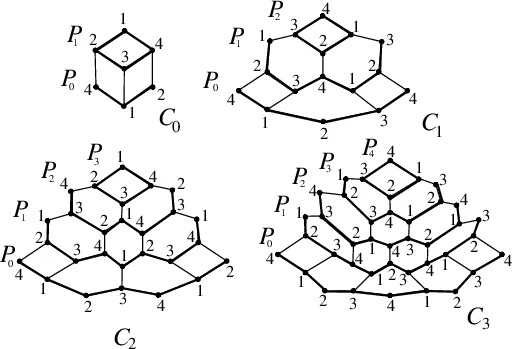
Goodey graphs. For the subclass where faces are only 4‑ or 6‑gons, the authors give a full description of which graphs admit a distance‑two four‑coloring. All‑4‑gonal graphs are trivially colorable by the previous corollary. For graphs containing 6‑gons, they prove that a distance‑two four‑coloring exists unless a 6‑gonal face is adjacent to a 4‑gonal face in a configuration that forces a color conflict; the paper enumerates precisely those forbidden configurations. Thus an infinite family of Goodey graphs is colorable, and the non‑colorable ones are completely characterized.
Faces of size 3 and 6. Theorem 2.5 deals with bipartite cubic plane graphs whose faces are 3‑colored (red, blue, green) with red faces of arbitrary even size and blue/green faces of size a multiple of four. By shrinking red faces and orienting the derived red edges, the vertices split into two classes, each of which can be 3‑colored (by Brooks’ theorem) to obtain a distance‑two six‑coloring. Although this result concerns six colors, it demonstrates the power of the face‑coloring approach.
Putting these pieces together, the authors conclude that a type‑two Barnette graph is distance‑two four‑colorable if and only if it belongs to one of the following categories:
- Every face size is a multiple of four (including the all‑4‑gonal case).
- All faces are 3‑ or 6‑gons (the 3‑/6‑gonal subclass).
- It is a Goodey graph that does not contain any of the explicitly forbidden adjacency patterns between 4‑ and 6‑gons.
For each of these families a constructive polynomial‑time algorithm is given (essentially by constructing the appropriate face‑coloring, deriving the special edge‑coloring, and then recovering the vertex coloring).
Quartic (4‑regular) planar graphs
The authors also examine the analogue for 4‑regular planar graphs whose faces have sizes only 3 or 4. They show that the distance‑two five‑coloring problem for this class is polynomial and, remarkably, that only two specific graphs satisfy the condition. The proof proceeds by a case analysis of possible face configurations and uses similar edge‑coloring arguments.
Concluding remarks
The paper delivers a clear dichotomy for Barnette graphs: the distance‑two four‑coloring problem is NP‑complete for the bipartite, tri‑connected cubic case (type‑one), but becomes polynomial and fully characterizable for the face‑size‑restricted cubic case (type‑two). The work highlights deep connections between distance‑two vertex colorings, edge colorings, and face colorings, and it provides explicit structural characterizations (especially for Goodey graphs) that may guide future algorithmic and combinatorial investigations in planar graph coloring.
Comments & Academic Discussion
Loading comments...
Leave a Comment