Power Imbalance Detection in Smart Grid via Grid Frequency Deviations: A Hidden Markov Model based Approach
We detect the deviation of the grid frequency from the nominal value (i.e., 50 Hz), which itself is an indicator of the power imbalance (i.e., mismatch between power generation and load demand). We first pass the noisy estimates of grid frequency through a hypothesis test which decides whether there is no deviation, positive deviation, or negative deviation from the nominal value. The hypothesis testing incurs miss-classification errors—false alarms (i.e., there is no deviation but we declare a positive/negative deviation), and missed detections (i.e., there is a positive/negative deviation but we declare no deviation). Therefore, to improve further upon the performance of the hypothesis test, we represent the grid frequency’s fluctuations over time as a discrete-time hidden Markov model (HMM). We note that the outcomes of the hypothesis test are actually the emitted symbols, which are related to the true states via emission probability matrix. We then estimate the hidden Markov sequence (the true values of the grid frequency) via maximum likelihood method by passing the observed/emitted symbols through the Viterbi decoder. Simulations results show that the mean accuracy of Viterbi algorithm is at least $5$% greater than that of hypothesis test.
💡 Research Summary
The paper proposes a novel framework for detecting power imbalance in a smart grid by exploiting deviations of the instantaneous grid frequency from its nominal value (50 Hz). The authors first model the noisy frequency measurements as Gaussian‑distributed observations and apply a three‑hypothesis maximum‑likelihood test to classify each measurement into one of three states: negative deviation (under‑generation), zero deviation (balanced), or positive deviation (over‑generation). The decision outcomes of this hypothesis test are treated as emitted symbols of a hidden Markov model (HMM), while the true underlying frequency‑deviation states constitute the hidden states of the HMM.
A transition probability matrix is defined to reflect the practical behavior of frequency control in power systems: once a deviation occurs, the system quickly returns to the balanced state due to primary, secondary, and tertiary control actions. The emission probability matrix is derived analytically from the false‑alarm and missed‑detection probabilities of the hypothesis test, which are expressed in closed form using the Q‑function.
Given a sequence of emitted symbols, the authors employ the Viterbi algorithm to compute the maximum‑likelihood estimate of the hidden state sequence. This dynamic‑programming approach efficiently evaluates the joint probability of the observed symbols and a candidate state path, which factorizes into products of emission probabilities and state transition probabilities.
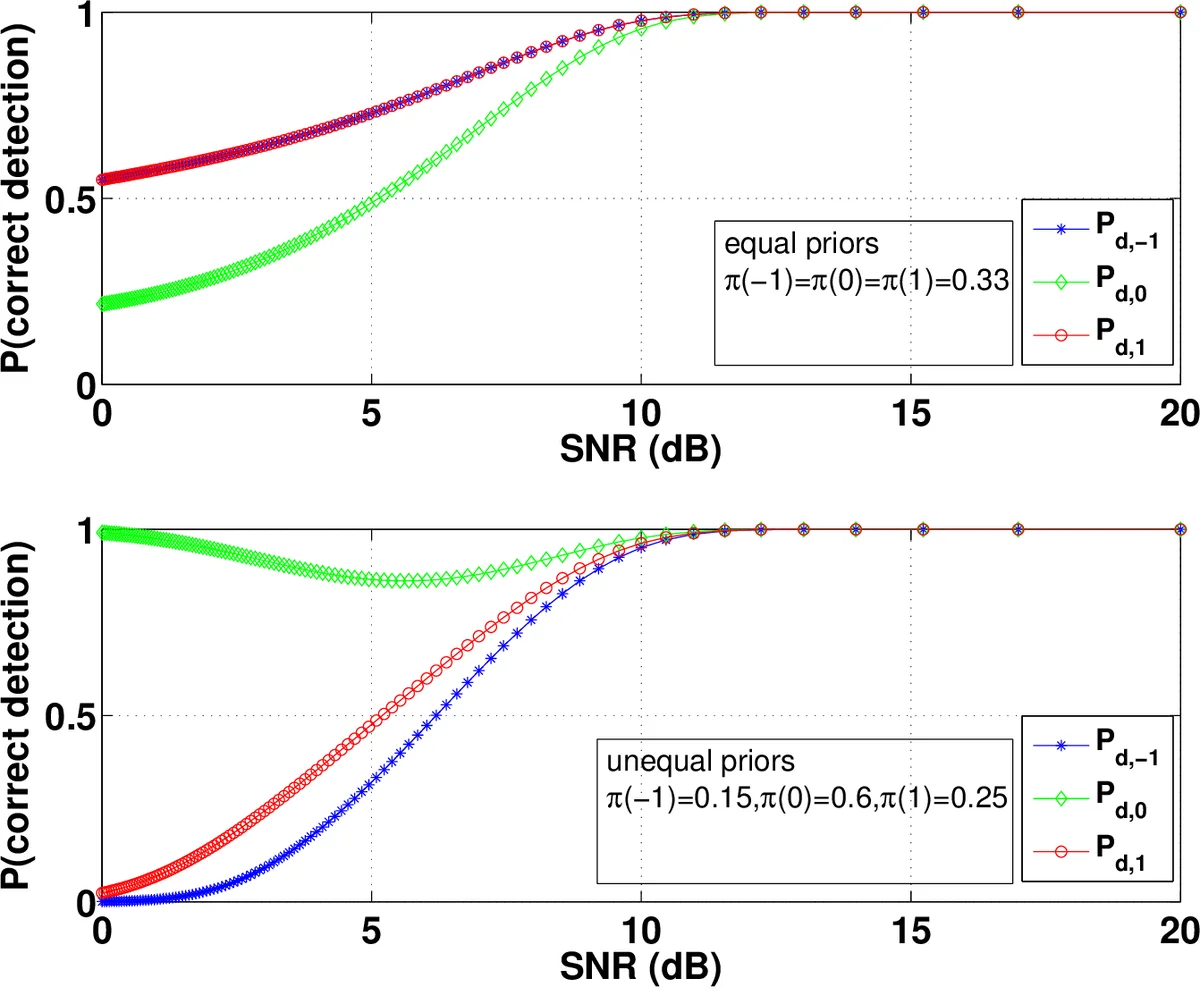
Simulation studies are conducted with realistic parameter choices (e.g., measurement noise σ = 0.2–0.8 Hz, prior state probabilities, and nominal frequency offsets). The results show that when the signal‑to‑noise ratio exceeds roughly 12 dB, the probability that the observed symbol matches the true state approaches unity, indicating that the HMM becomes effectively observable. Monte‑Carlo experiments over 100 000 trials compare the raw hypothesis‑test classification accuracy with the Viterbi‑decoded accuracy for sequence lengths of 100 samples. Across different noise levels, the Viterbi algorithm consistently outperforms the hypothesis test, achieving an average accuracy improvement of about 5–6 percentage points (e.g., from 64 % to 71 % for σ = 0.4 Hz, and from 71 % to 77 % for σ = 0.8 Hz). Gaussian fits to the accuracy histograms reveal that the Viterbi method not only has a higher mean accuracy but also a slightly lower variance, indicating more reliable performance.
Key insights include: (1) treating the hypothesis‑test output as an HMM observation enables the exploitation of temporal correlations to mitigate measurement noise; (2) the transition matrix can be tuned to reflect actual control dynamics, improving state‑tracking fidelity; (3) accurate estimation of model parameters (noise variance, prior probabilities, frequency offset bounds) is crucial for optimal performance; and (4) the proposed approach requires only modest computational overhead beyond existing PMU/FDR data pipelines, making it suitable for real‑time deployment in load‑side frequency control schemes.
The authors conclude that the hidden‑Markov‑model‑based Viterbi decoding provides a statistically principled and practically viable enhancement over simple hypothesis testing for power‑imbalance detection. Future work is suggested on adaptive parameter learning from field data, extension to multi‑area or 60 Hz systems, and integration with demand‑response control loops to close the feedback loop between detection and corrective action.
Comments & Academic Discussion
Loading comments...
Leave a Comment