Iterative Equalization with Decision Feedback based on Expectation Propagation
This paper investigates the design and analysis of minimum mean square error (MMSE) turbo decision feedback equalization (DFE), with expectation propagation (EP), for single carrier modulations. Classical non iterative DFE structures have substantial…
Authors: Serdar c{S}ahin, Antonio M. Cipriano, Charly Poulliat
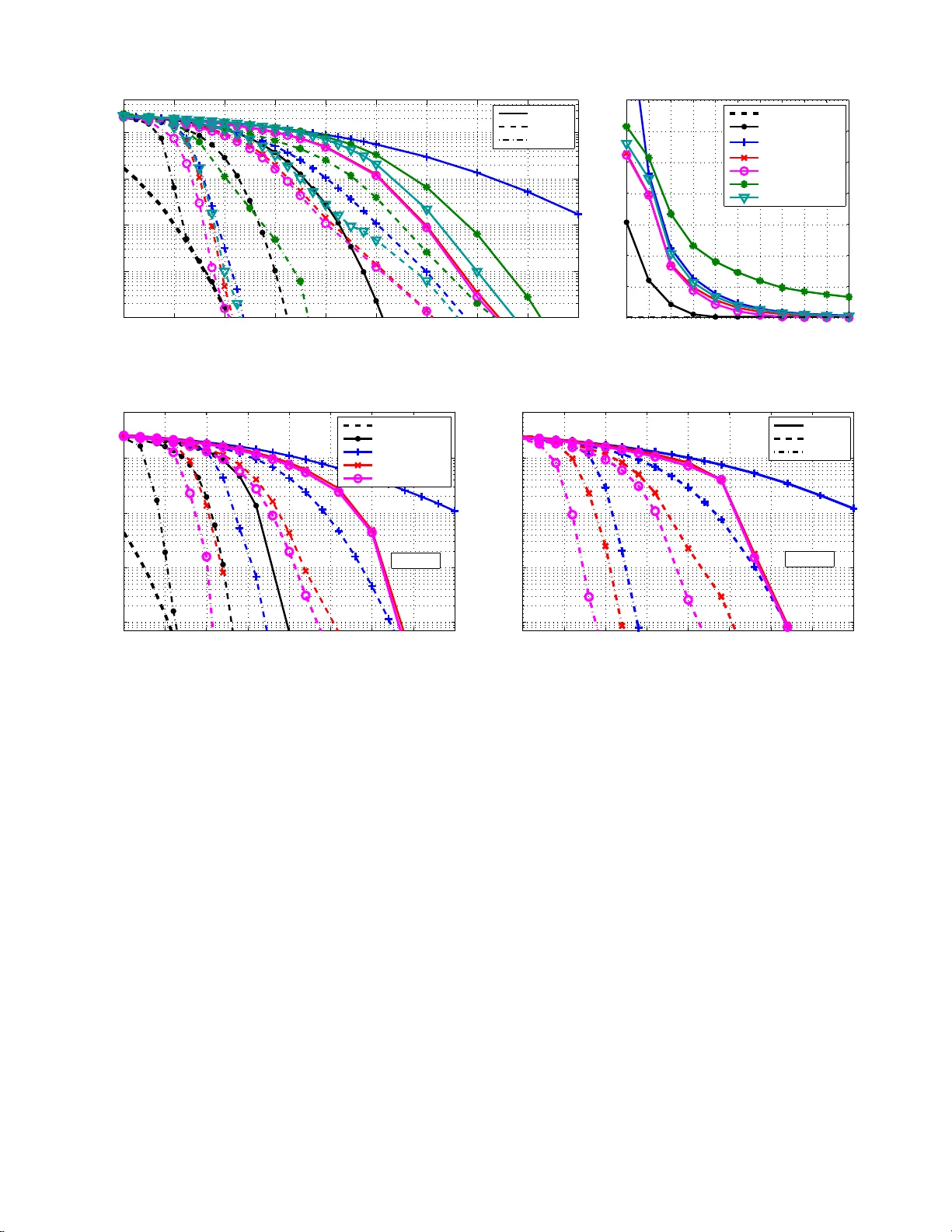
TO APPEAR ON IEEE J OURNAL ON TRANSACTIONS ON COMMUNICA TIONS - MA Y 2018 1 Iterat i ve Equalization with Dec ision Feedback based on Expectation Propagation Serdar S ¸ ahin, Antonio Maria Cipriano, Cha rly Poulliat and Marie-Laure Bouch e ret Abstract —This paper inv estigates the design and analysis of minimum mean square error (MMS E) turbo decision feedback equalization (DFE), with expectation p ropagation (EP), for single carrier modulations. Classical non iterative DF E structures hav e substantial advantag es at h igh data rates, ev en compare d to tu rbo linear equalizers - interference cancellers (LE-IC), hence making turbo DFE-IC schemes an attracti ve solution. In this paper , we derive an it erativ e DF E-IC, capitalizing on the use of soft feedback based on expectation p ropagation, along with the use of p rior i nform ation for improv ed fi ltering and interference can- cellation. T h is DFE-IC significantly outperforms exact turbo L E - IC, especially at high spectral effici en cy , and also exhibits various advantages and performance impro vements ove r existing variants of DFE-IC. The proposed scheme can also be self-iterated, as done in the recent trend on EP -based equ alizers, and it is shown to be an attractive alternativ e to linear self-iterated receive rs. For time-vary ing (TV) filter equalizers, an efficient matrix in version scheme is also proposed, considerably reducing the computational complexity relati ve to existing method s. Usin g fin ite-length and asymptotic analysis on a sever ely selective channel, the proposed DFE-IC is shown to achi ev e h igher rates than known alternatives, with better waterfall thresholds and faster conv erg ence, whi l e keeping a similar compu t ational complexity . I . I N T RO D U C T I O N C OMMUNICA TION systems operating on wide- band channels suffer from inter-symbol interfere nce (ISI), which can b e mitigated with an appr o priate transceiv er de- sign. In par ticular, for wireless systems where the throu ghput requirem ents increase at each n ew gen eration, more effecti ve receivers are n eeded in order to maintain r obust data links. W ith the discovery of turb o-cod es, iterati ve processing principles were extended to joint detection and decod ing tech- niques via soft-input soft-outp ut (SISO) receivers which use prior information provided by the channel decod er , to further reduce detection errors. Although early turbo equalization technique s, such as m aximum a posterior i ( M AP) detector using BCJR estima tio n [1]– [ 3], can op erate near the channel capacity with pr operly desig n ed coding sche m es, th e ir o p er- ational comp lexity significantly in creases for large chann el delay spre ad or with high modulation orders. Conseq uently , finite im p ulse r esponse ( FIR) filter-based turbo equalizer s with Manuscript recei v ed November 16, 2017; rev ised April 05, 2018 and accep ted on May 24, 2018. S. S ¸ ahin is with both T hales Communication s & Security and IRIT/INPT - ENSEEIHT (e-mail: serdar . sahin@tha lesgroup.com) A. M. Cipriano is with Thales, 4 A v . des Louvresses, 92230, Genne villi ers, France (e-mail: antonio.cipri ano@tha lesgroup.com) C. Poul liat and M. -L. B oucheret are with IRIT / INP T oulouse - ENSEEIHT , 2 Rue Charles Camichel, 31000, T oul ouse, Franc e (e-mail s: { charly .pouillat , marie-laure.bouc heret } @enseeiht.fr) lowered c omputatio nal comp lexity have been pr oposed. These structures can be categorized into th ree group s with regards to its filter updates d e pending on prior inf ormation . Other kinds of adaptive FIR recei vers ar e out o f this paper’ s scope. Time- in variant (TI) structu res update their filters only on ce at each packet reception, using the av ailable channel state. Iteration- variant (IV) equalizers are u pdated at each turb o iteration by additionally using the overall prior infor m ation. T ime-varying (TV) stru ctures u pdate their filters a t ea ch symbo l, using both symbol-wise prior info rmation and channel states, making them particularly suitable f o r doubly selectiv e chann els, where the impulse response varies over time. The first FIR turbo structure, p roposed b y Laot e t al. [4] , uses a tim e - in variant interfere nce canceller [5], and an app li- cation to IV filtering appear e d in [6], [7 ]. Further extension to TV eq ualization is provided in [8 ] and a fo rmal f ramework presented in [ 9] derive th ese rec e ivers fro m the MAP criterio n. An alternative approach f ormalized by T ¨ uchler et. al [10] consists in designin g a T V adaptive LE, by using statistics condition ed on prio r information , while solv in g the MMSE criterion. T his structure ha s b een ap plied to hig h-ord er mod u- lations, time-varying ch annels an d to IV , TI , f requen cy domain structures for lower co mplexity , and also to multi- u ser detec- tion for multiple input-mu ltiple outpu t systems [11]–[14]. Equiv alence of these appr oaches was shown in [15], m ak- ing the T V MMSE LE -IC the mo st widespread refer ence. Although tu r bo LE- IC br ings significan t imp rovements over classical filtering, it falls far beh in d classical DFE [16], [ 17] at hig h spectra l ef ficiency oper ating points. Oppositely , at lower rates, turbo LE-IC is near cap acity-achieving while DFE perfor ms poo rly 1 . This pape r addr e sses the design of iterative time-doma in TV DFE-IC equalizer s, i. e. FIR receivers wh e re pr ior in formatio n and a symbol- wise decision f eedback is respectively u sed on anti-causal and cau sal symb ols, to improve equalization. These receivers are of interest for application s wh ere doub ly -selective channels are in volved, such as HF comm unication s [18]. A. Rela ted W ork There exist several prior works on DFE- IC. Propo sals mainly differ with th e nature of decision feed back, an d with the filter up dating method . Besides, recent com p lex r e ceiv ers use DFEs as con stitue n t elements for concaten a ted eq ualizers. Hence, for clarity , we prop ose to classify related works in three sub-categories. 1 These facts are also shown in subsection V -C, in Fig. 7. c IEEE. Personal use of this materia l is permitted. Howe v er , permission to reprint/re publish this material for advert ising or promotional purposes or for creati ng new collecti ve wor ks for resale or redistrib ution to s ervers or lists, or to reuse any copyrighte d component of this work in other works must be obtaine d from the IEEE. Final version: https://ieee xplo re.ieee.org/document/8 371591/ 2 T O APPEAR ON IE E E JOURNAL ON TRANSACTIONS ON COMMUNICA TIONS - M A Y 2018 1) Ite rative Hard DFE-I C: Among hard feedb a ck stru c - tures, DFE-IC in [ 1 9] is a c lassical DFE that uses prior informa tio n f or IC o n anti-cau sal symbols. This stru cture is known for its err or propagation issues which makes its TV form even less efficient than TI LE, and its extrinsic infor- mation tran sfer (E XIT) analy sis yields contradic to ry results [19, Fig. 14] . In [ 20], the previous struc tu re is enh anced with a powerful soft demapper that uses the d istribution of residual ISI sequence s for symbo l detectio n . This mod ified structure outperf o rms turbo LE-IC, but this residual ISI dis- tribution is very difficult to deriv e even in the simple BPSK case. A mor e practical solution, prop osed in [21], consists in approx imating the residu al ISI at the DFE -IC ou tput to an additive white Gau ssian noise (A WGN), which simplifies the demapp e r . While th is solution ch allenges TV LE- IC on BPSK, its extension to multilev el m odulation s h as not been explored so far . T o the authors’ knowledge, this is the only DFE-IC outperf orming exact TV LE-IC in the referen ce scenario of Proakis-C channel with BPSK sy mbols. DFE-I Cs in [20], [21] were later used as con stituent elem ents fo r more advanced receivers such as bi-directio nal DFE, or structu r es obtained by parallel concatenation of FIRs [22]. 2) Ite rative Soft DFE-IC: Literatur e on turbo soft DFE - IC is more d iv erse; altho ugh fee dback is mo stly based o n the posterior distribution, th ere is no commo n stra tegy fo r eval- uating its variance [ 23]–[25]. Such iterati ve structure is fir st presented in [26], wher e various TI DFE with sof t feed back are ev aluated with a p erfect dec ision hy pothesis, within a sub - optimal receiver using h a r d decoding . In p articular, it is seen that soft feedback mitigates to some extent err o r prop agation, despite igno ring decision err ors in filter compu tation. An o ther notable structure is the IV sof t interferen ce canc e ller in [23]; using both prior and p osterior L L Rs f or filtering and for interferen ce ca n cellation with BPSK, this scheme significantly outperf orms IV LE-I C, b ut it requires stochastic methods for estimating the correlatio n prop erties of posterio r LLRs. Sev eral other I V sof t feedback structures exist [2 5], [27], with alterna ti ve h euristics for feedb ack q uality assessment. Structural co mparison of IV schemes u sing p osterior f eedback is given in [24], extend ing [2 3] and [27 ] to higher o rder modulatio ns, but requ iring new heuristics w ith LE-I C pre- equalization for filter c omputatio n. These ap proach es h av e drawbacks due to their limitations in usable co nstellations [ 23], [25], [2 7], or due to the sub-optima lity of heuristics used in filter computatio n [2 3], [24], [27]. Ind eed, I V stru ctures n eed static statistics of its soft feed b ack for computin g its filter s, which requires approxim a tions. T ime-varying soft posterio r feed back stru ctures do n ot h av e such issues; they can upda te their filters after each sym bol is detected, as it had been done for MIMO receivers in [2 9]. In equalization , the structure closest to [29] is a block-f e e dback turbo DFE in [ 28], which u p dates its filters every P symbols. A classification of the references a bove is given in T able I. 3) Re ceivers based o n Exp ectation Pr opagation: There is a recent renewal of interest in iter ativ e e qualization, broug ht by the use of an app roximate statistical infere nce meth od, namely expectation prop agation (EP) [30]. This tech nique ca n be used as a message passing algo rithm, wh ich extends the loo py belief propag ation (BP) b y using exchan ge o f expectation s. When EP is used with prob ability d ensity fun c tio ns (PDF) b e longing to the exponential family , it is possible to compu te an extrinsic message passed from the d emapper to the equalizer . This parad igm has alrea dy b een used in chan nel decodin g [31], and in receiver d esign with MIMO receivers [32], bloc k linear equ a lizers [33] and Kalm an smo others [34], [35]. In particular, a concom itan t work has rec e ntly extended these schemes to FIR with a self-iterated LE-IC [36]. In [ 37], EP was applied on multiv ariate wh ite Gaussian distributions to derive a low-complexity self-itera ted fr e quency do m ain eq ualizer . T he receivers above use EP in a parallel in terferen c e c ancellation scheduling throug h self-itera tio ns, i.e. the whole data block is detected, a n d then detection process is r epeated using EP feedback from the demapp er . These structu res are n o t d ecision feedback stru ctures as in [16], wh ich a r e n a tural successi ve interferen ce cancellers. Hence, in this p aper, we p ropose to derive a DFE- IC EP exploiting the successive interfe r ence cancellation schedu le of DFE-IC to operate on an EP-based soft feedb ack. Moreover, we comb ine this serial d etection framework with an outer loo p , as in p rior work on EP , to o btain a self- iterated DFE-IC EP . A low complexity matrix in version strategy f or TV FIR stru c- tures is also derived, significan tly reduc in g the computatio nal complexity difference between DFE - IC and LE-IC. B. Contributions and P aper Ou tline The main contributions of this paper are as follows: • A novel tim e - varying DFE-I C algorith m , using EP to update its filters, an d to cancel residual ISI, is propo sed. It outperf orms other co nstituent FIR receivers k nown to the authors, while provid ing an overall efficient complexity- perfor mance trade-off. • DFE-IC EP is extended to a self-iterated structure, and compare d to prior work on self-itera ted EP rece ivers. • W ell-known h ard [ 19], [21] or su b -optimal [2 4], [ 28] DFE-IC pro posals are extended to TV structures with soft posterior feedback , b y using MMSE Bayesian estimators. • Analytical and asympto tic a n alysis of DFE-IC is carried out on a h ighly selective de terministic chan nel. Perf o r- mance and comp utational complexity comparison be- tween LE- I C and d ifferent DFE-I C structur es is provided . • A new recursive m atrix in version strategy for TV equal- izers is exp osed. Compar ed to the iterative algo r ithm in [10], it brings betwee n 30% (fo r lo ng data blo cks) and 75% (for shorter blocks) com plexity redu ction fo r L E-IC. The rem a inder of this paper is o rganized as follows. The considered BICM co mmunica tio n scheme and the generic FIR receiver m o del are described in section II. Section III pr oposes a factor g raph model for the system an d applies the expectation propag ation fra m ew ork to der iv e the pr o posed eq ualizer in subsection II I-D. A novel matrix inv ersion strategy is detailed in section IV for red ucing TV equ alization complexity . Section V extends prior work on DFE-IC to the state-of-the- art an d compare s with the pr oposed DFE- IC EP . In sectio n VI, DFE- IC EP is self-iterated, and co mpared with several existing self- iterated EP receivers. S ¸ AH ˙ IN et al. - ITER A TIVE EQU ALIZA TION WITH DECISION FEE DBA CK BASED ON EXPECT A TION PROP AGA TION 3 T ABLE I C L A S S I FI C AT I O N O F C O N S T I T U E N T F I R T U R B O E Q UA L I Z E R S V S . T H E U S A G E O F P R I O R I N F O R M AT I O N . Linear Structure Decision Feedback Structures Update T ype TI IV TV Dec. T ype TI IV TV Referen ces [4], [19] [6], [7], [9], [10], [12], [14], [15] [8]–[11], [13], [19] Hard [20], [21 ] [20], [21] [19]–[21] Soft APP [26] [23], [24], [27], [28 ] Proposed Soft EP Proposed C. Nota tions Bold lowercase letters are used for vectors: let u be a N × 1 vector , then u n , n = 0 , . . . , N − 1 are its entries. Capital b old letters deno te matrices: for a g i ven N × M m atrix A , [ A ] n, : and [ A ] : ,m respectively denote its n th row and m th column, and a n,m = [ A ] n,m is the entry ( n, m ) . I N is the N × N iden tity matr ix , 0 N ,M and 1 N ,M are respectively all zeros an d all o nes N × M matrices. e n is the N × 1 ind icator who se on ly n on-zer o en try is e n = 1 . Operator Diag ( u ) d enotes the diag onal ma trix whose diag o nal is defined by u . R , C , and F k are respectively the real field, the complex field and a G a lois field o f order k . Let x and y be two ran d om variables, then µ x = E [ x ] is the expected value, σ 2 x = V ar [ x ] is the variance and σ x,y = Cov [ x, y ] is the covariance. The probab ility of x tak ing a value α is P [ x = α ] , and proba b ility d ensity fun ctions (PDF) are denoted as p ( · ) . If x and y are random vector s, then we defin e vectors µ µ µ x = E [ x ] and σ σ σ 2 x = V ar [ x ] , the covariance matrix Σ x , y = Cov [ x , y ] an d we note Σ x = Cov [ x , x ] . C N ( µ x , σ 2 x ) denotes th e circu larly- symmetric complex Gaussian distribution of mean µ x and variance σ 2 x , and B ( p ) denotes the Bernoulli d istribution with a success probab ility of 0 ≤ p ≤ 1 . I I . S Y S T E M M O D E L A. T r ansmission Over a Multipath Channel W e conside r a single carrier transmission using a bit- interleaved coded mod ulation (BICM) scheme. Let b ∈ F K b 2 be a binary infor mation packet of length K b bits. A channel encoder maps b into a co dew ord c ∈ F K c 2 , with a co de rate R c = K b /K c , which is th en inte r leav ed to g iv e a d ata blo ck d ∈ F K c 2 . A memory less mapping ϕ associates d to the symb ol block of length K , den oted x ∈ X K , where the constellation X ⊂ C has M elemen ts. The q -word associated to a symbo l is deno ted d k = [ d ] qk : q ( k +1) − 1 , and ϕ − 1 j ( x k ) and d k,j denote the value of the j th bit labellin g the k th symbol x k , i.e. d kq + j . W e assume the constellation has zero m ean, and has an av erage symbol power of σ 2 x , with equipr obable symbo ls. For th e sake of clarity , only the single user , single in p ut- single outpu t T -spaced (sym bol spa ced) equalization problem is co nsidered. Th e ch a nnel is mo delled at the base-ban d as an equivalent L -tap linear time-varying filter h [ k ] = [ h k,L − 1 , h k,L − 2 . . . h k, 0 ] , k b eing the time index, and where pulse shaping and transceiver filters are accou nted for . The signal going throug h the channel is then affected by therma l n o ise w k at the receiver side, an d assuming a perfect ch annel state info r mation, ideal time and frequ ency synchro n ization and the ab sence of inter-block interfer ence (IBI), the base-band received samp les ar e given by : y k = P L − 1 l =0 h k,l x k − l + w k , (1) where k = 0 , 1 , . . . , K + L − 2 , an d x k , k < 0 an d k > K are set to 0 . These assumptio n s ca n be satisfactorily app roached in pra ctice with the use o f a unique- word signalling scheme, among o ther op tions, to jointly enab le chan nel estimation and the IBI removal. The n oise is m o delled as w k ∼ C N (0 , σ 2 w ) , i.e. its real and imaginary parts are real ind ependen t zero mean Gau ssian rando m processes with σ 2 w / 2 variance each. The transmission can be rewritten as: y = Hx + w , (2) with y = [ y 0 , . . . , y K + L − 2 ] T , w = [ w 0 , . . . , w K + L − 2 ] T , x = [ x − L +1 , . . . , x K + L − 2 ] T and H is the ( K + L − 1) × ( K + 2 L − 2) m a trix wh o se k th row is [ 0 1 ,k − 1 , h [ k ] , 0 1 ,K + L − 1 − k ] , k = 1 , . . . , K + L − 1 . B. On MMSE FIR Equa lization FIR structure s can be modelled by windowed pro cesses; applying a sliding window [ − N p , N d ] on the observation vec- tor y , we define y k = [ y k − N p , . . . , y k + N d ] T . N p and N d are respectively the n umber of pre-c u rsor and po st-cursor samples, and we den o te N , N p + N d + 1 , and N ′ p , N p + L − 1 to simplify notation s. Then , using th e same window on w , an d [ − N ′ p , N d ] on x , the channel model becomes y k = H k x k + w k , (3) with H k = [ H ] k − N p : k + N d , k − N ′ p : k + N d , for k = 0 , . . . , K − 1 . Below , a generic structure of an unbiased MMSE FIR receiver is given for comparing different stru c tu res and their dynamics in the remainder of the paper . Prior estimates on x with means ¯ x fir k , [ ¯ x fir k − N ′ p , . . . , ¯ x fir k + N d ] and variances ¯ v fir k , [ ¯ v fir k − N ′ p , . . . , ¯ v fir k + N d ] are used for interfer e n ce cancel- lation. Then den oting its output estima te o n x k as x e k , and the variance of the residual interfer ence and noise as v e k , with x e k = f fir k H y k + g fir k v e k = 1 /ξ fir k − ¯ v fir k , f fir k , Σ fir k − 1 h k /ξ fir k , g fir k , ¯ x fir k − f fir k H H k ¯ x fir k , ξ fir k , h H k Σ fir k − 1 h k , (4) where Σ fir k , k w σ 2 w I N + H k ¯ V fir k H H k , ¯ V fir k , diag ( ¯ v fir k ) , h k , H k e k and k w = 1 / 2 , wh en sig nals with one r e al degree of freedom are used ( e.g. X is BPSK), and otherwise k w = 1 [17]. A proof of these relationships is in Ap pendix A. Note that ¯ x fir k and ¯ v fir k completely character ize such re- ceiv ers. When ¯ x fir k ′ and ¯ v fir k ′ are indepen d ent of x e k , v e k , ∀ k ′ , k , we ca ll this receiver a LE-I C, an d when ¯ x fir k ′ and ¯ v fir k ′ are depend ent on x e k , v e k , ∀ k ′ < k , we ref er to it as a DFE- IC. I I I . R E C E I V E R D E S I G N W I T H E X P E C TA T I O N P R O PAG A T I O N This section focu ses o n the design o f a FIR rece iver that approx imates the p osterior probab ility distribution o n x k using an EP-based message passing on th e system factor gr aph. 4 T O APPEAR ON IE E E JOURNAL ON TRANSACTIONS ON COMMUNICA TIONS - M A Y 2018 A. F a ctor Graph Model for FIR Receivers The o ptimal joint MAP r e c eiv er satisfies the MAP criterio n ˆ b = max b p ( b | y ) , where, assumin g i.i.d. informa tio n bits, the posterior PDF can be factorized as f ollows p ( b | y ) = p ( b , d , x | y ) ∝ p ( y | x ) | {z } channel p ( x | d ) | {z } mapping p ( d | b ) | {z } encoding . (5) This density can be further factorized by u sing: - the memo ryless mapping: p ( x | d ) = Q K − 1 k =0 p ( x k | d k ) , - the indepen d ence assumption in BICM encoding: p ( d | b ) = Q K − 1 k =0 Q q − 1 j =0 p ( d k,j ) , where p ( d k,j ) , p ( d k,j | b ) is a probab ility mass fun ction (PMF) w h ich is seen as a Berno ulli-distributed p r ior constraint provided b y the decoder, fro m the r eceiv er’ s po int of v iew . The “ch annel” factor in (5) creates constrain ts between th e whole blo ck of r eceived baseb a n d samples an d the transmitted symbols, howe ver to der iv e a r educed com plexity FIR receiver which estimates x k and d k , the win dowed model in (3) is needed. The FIR approxim a tion posterio r is p ¯ d k , x k | y k ∝ Q k + N d k ′ = k − N ′ p p ( y k | x k ) p ( x k ′ | d k ′ ) Q q − 1 j =0 p ( d k ′ ,j ) , (6) where ¯ d k = d k − N p − L +1: k + N d . Note that working with p ¯ d k , x k | y ≈ p ¯ d k , x k | y k is not the only option for estimating x k . Ind eed x k can b e estimated through inferenc e on x k ′ , w ith k ′ = k − N d , . . . , k + N ′ p , but by selecting x k , this option is ind irectly translated to the cho ice of window parameters, which is a common aspect of FIR equalizers. A message-passing based decoding algorithm it eratively estimates the variable nodes (VN) x k and d k,j by using constraints imp osed by factor nodes (FN). Factor nodes are non pro per PDFs for reso lv ing transmission steps. The dec o der FN models BICM encoding constraints with f DEC ( d k,j ) , p ( d k,j ) , (7) and the demapper FN incorpor ates m apping constraints with f DEM ( x k , d k ) , p ( x k | d k ) = Q q − 1 j =0 δ ( d k,j − ϕ − 1 j ( x k )) , (8) where δ is th e Dirac delta functio n. The multipath channel constraints are modelled within the equalization factor n ode f EQU ( x k ) , p ( y k | x k ) ∝ e − y H k y k /σ 2 w +2 R ( y H k H k x k ) /σ 2 w , (9) where the de penden ce on y k is o mitted, as obser vations are fixed during th e message-p a ssing pro cedure. Using the se notations, the posterior (6) g iv es the factor gra ph shown in Fig. 1. B. Exp ectation Pr o pagation Message P assing F ramework EP-based m essage passing algorithm is an extension of loopy belief propag ation, where VNs are assumed to lie in the exponen tial distribution family [ 38]. Co nsequently , the ex- changed messages are depicted b y tractable distributions, and they allow iterative co mputation of a fully-factor ized ap prox i- mation fo r cumber some po sterior PDFs such as p ( ¯ d k , x k | y k ) . y k − N p y k − N p +1 . . . y k . . . y k + N d − 2 y k + N d x k − N ′ p . . . x k . . . x k + N d . . . d k, 0 . . . d k,q − 1 . . . . . . f EQU ( x k ) f DEM ( x k , d k ) f DEC ( d k ) Fig. 1. Fac tor graph for the posterior PDF (6) on x k and d k . Updates at a FN F co nnected to variable nodes v ar e as fo llows. Message s exchanged betwe e n a VN v i , the i th compon ent of v , and factor nod e F a r e m v → F ( v i ) , Q G 6 = F m G → v ( v i ) , (10) m F → v ( v i ) , proj Q v i [ q F ( v i )] /m v → F ( v i ) , (11) where pro j Q v i is the Kullback -Leibler projection tow ards the probab ility distribution Q v i of VN v i . The posterio r q F ( v i ) is an approx imation of the marginal of the true posterior p ( v ) on v i , obtaine d by combin in g th e true factor o n FN F with messages from the neighbour ing VNs q F ( v i ) , R v \ i f F ( v ) Q v j m v → F ( v j ) dv \ i , (12) where v \ i are VNs without v i [38]. The projectio n opera tio n for expon e ntial families is equiv alent to moment ma tching , which simplifies the computation o f messages [30], [38]. In this paper symbol VNs are assumed to lie in the family of mu ltiv ariate circularly symmetric Gaussians with diagon al covariance matrices, making the ap proxim ate d istributions fully factorized to indep endent Gau ssians. Hence, a message on x k will be defined by a mean and a variance. The VNs d k,j are co nsidered to follow Bern oulli distributions (wh ich is included in the exponential family), and their messages ca n b e described by bit log-likelihood r atios (LLR). This forma lism is very generic and allows th e der ivation of many receiver structur e s. It has b een used to derive a MIMO detec to r in [ 32], and a Kalman smooth er in [34]. Howe ver EP receivers can also be d eriv ed withou t a message passing fo rmalism, as r ecently shown for the b lock [33] or FI R [36] equ a lizers. T o the auth ors’ knowledge, message-passing formalism was not previously u sed for FIR de sign, an d it is fa voured in th is paper because of the av ailable scheduling options it allows to clearly identify . C. Derivation of Exchanged Messages This section d etails the EP-based message pa ssing algo- rithm’ s applica tio n to the conside r ed factor g raph. First, ex- changed messages are defined, and th en their characterizing parameters ar e explicitly comp uted. See Fig . 2 for a conven- tional view of the receiver with these q uantities. The messages arriving on the VN x k are Gaussians with m EQU → x ( x k ) ∝ C N ( x e k , v e k ) , (13) m DEM → x ( x k ) ∝ C N x d k , v d k , (14) S ¸ AH ˙ IN et al. - ITER A TIVE EQU ALIZA TION WITH DECISION FEE DBA CK BASED ON EXPECT A TION PROP AGA TION 5 EQU Node DEM Node DEC Node y ( x e , v e ) L e ( d ) Π Π Π − 1 ˆ b ( x d , v d ) L a ( d ) Π Π Π SISO Equal- izer Soft Mapper / Demapper SISO Decoder Fig. 2. Factor nodes shown as an iterati v e BICM recei v er . whereas messages arriving on the VN d k,j are Bernoullis m DEC → d ( d k,j ) ∝ B ( p a d ) , m DEM → d ( d k,j ) ∝ B ( p e d ) . (15) During the message passing proced ure, the char acteristic pa- rameters of th ese distributions are upd ated f ollowing a selected schedule. For Bernoulli distributions, it is rath er prefe r able to work with bit LL Rs, rather than the su c cess probability p d : L ( d j ) , ln P [ d j = 0 ] P [ d j = 1 ] = ln 1 − p d p d . (16) W e use L a ( · ) , L e ( · ) an d L ( · ) opera to rs to d enote respec ti vely a prio ri, extrinsic and a poster iori LLRs. When applied to d k,j , this vocabulary rep r esents the receiver’ s perspec tive, i.e. L a ( d k,j ) , L e ( d k,j ) respec tively cha racterize m DEC → d ( d k,j ) and m DEM → d ( d k,j ) . Finally , conside r ing the factor grap h shown on Fig. 1, all variable nodes are on ly conn ected to a pair o f distinct facto r nodes. Conseq uently , using eq. (10), m v → F ( v i ) = m G → v ( v i ) , for all VN v i , and FN F , G , F 6 = G they are conne cted to. 1) Messages fr om DEC to DEM: I n this pap er , we assum e DEC is a SISO decoder providing prior inform ation L a ( d ) to DEM, whenever it receives extrinsic inform a tion L e ( d ) by DEM. The d emapper uses these pr io r LLRs, along with the DEM FN (8) to compute a prior PMF o n x k = α , ∀ α ∈ X with P k ( α ) ∝ Q q − 1 j =0 e − ϕ − 1 j ( α ) L a ( d k,j ) . (17) This is a c a tegorical PMF correspon d ing to the margina l of f DEM ( x k , d k ) m d → DEC ( d k ) on x k [32], used h ereafter to compute approx imate marginals q DEM ( x k ) and q DEM ( d k,j ) . 2) Messages fr om DEM to EQU: The d emapper com putes an approxim ate po ster io r on the VN x k using eq. (12) with q DEM ( x k ) = P d k f DEM ( x k , d k ) m x → DEM ( x k ) Q q − 1 j =0 m d → DEM ( d k,j ) . (18) This is a posterior categor ical PMF o n the e lements x k of X , which ca n be compu ted using eqs. (13) an d (1 7), which will be denoted as D k ( α ) ∝ exp − k w | α − x e k | 2 /v e k P k ( α ) , ∀ α ∈ X . (19) For computing messages towards EQU, the posterior PMF is projected into C N thro ugh mo ment matching. The mean and the variance of D k are µ d k , E D k [ x k ] = P α ∈X α D k ( α ) , γ d k , V ar D k [ x k ] = P α ∈X | α | 2 D k ( α ) − | µ d k | 2 . (20) When m x → DEM ( x k ) ∝ 1 , i.e. when th ere is no info rmation from the EQU n o de (equiv alent to x e k = 0 an d v e k = + ∞ ), D k = P k , and we denote the prior mean and v ariances as x p k , E P k [ x k ] , v p k , V ar P k [ x k ] . (21) Note that these values are used as soft f eedback in conv en- tional turbo equalization. Then in or d er to calculate m DEM → x ( x k ) as in ( 1 1), a Gaussian di vision [30] is implemente d x ∗ k = µ d k v e k − x e k γ d k v e k − γ d k , and , v ∗ k = v e k γ d k v e k − γ d k . (2 2 ) This is the major novelty in using EP: the computa tio n of an extrinsic f eedback f rom the dem a pper to the equalizer . Attempting th is with categorica l distributions, as in BP , would completely rem ove m x → DEM ( x k ) , and th e extrin sic “feed - back” to E QU would simply be the prior PMF P k [32], which would yield a recei ver equ ivalent to LE- IC [ 19]. EP message passing algorithm consists in minim iz in g g lobal div ergence th rough iterative minimization of simpler local div ergences. Thus, it might lock o n undesirable fixed po ints, and a damping heuristic, as recommend ed in [3 8, eq. (1 7)], is used to improve accuracy v d ( next ) k = h (1 − β ) /v ∗ k + β / ¯ v d ( prev ) k i − 1 , x d ( next ) k = v d ( next ) k " (1 − β ) x ∗ k v ∗ k + β x d ( prev ) k v d ( prev ) k # , (23) where 0 ≤ β ≤ 1 con figures the dampin g, a nd its effectiv eness has been verified in [36]. 3) Messages fr om EQU to DEM: T h e equ alizer co mputes an approxim ate posterior on the VN x k using eq. (12) with q EQU ( x k ) = R x \ k k f EQU ( x k ) Q k + N d k ′ = k − N ′ p m x → EQU ( x k ′ ) dx \ k k . (24) The integran d of th e equation ab ove is a multiv ariate Gau ssian distribution C N ( µ µ µ e , Γ e ) , hence, using eq. (9), its covariance and mean satisfy Γ e k = ( V d k − 1 + σ − 2 w H H k H k ) − 1 , µ µ µ e k = Γ e ( V d k − 1 x d k + σ − 2 w H H k y k ) , (25) where V d k = diag ( v d k ) , with v d k = [ v d k − N ′ p , . . . , v d k + N d ] , and x d k = [ x d k − N ′ p , . . . , x d k + N d ] . Using some matrix algeb r a, and W oodbury’ s identity o n Γ e , the mean µ e k and th e variance γ e k of the marginalized PDF q EQU ( x k ) are gi ven by γ e k = e H k Γ e k e k = v d k (1 − v d k h H k Σ d k − 1 h k ) , µ e k = e H k µ µ µ e k = x d k + v d k h H k Σ d k − 1 ( y k − H k x d k ) , (26) with Σ d k = k w σ 2 w I N + H k V d k H H k . Message to the dema pper is then extracted with the Gaussian d ensity division in eq . (11) v e k = γ e k v d k v d k − γ e k , an d , x e k = v d k µ e k − γ e k x d k v d k − γ e k . (27) Dev eloping these y ields a FIR expression as in (4) with ¯ x ep k , [ x d k − N ′ p , . . . , x d k + N d ] and ¯ v ep k , [ v d k − N ′ p , . . . , v d k + N d ] for IC. 6 T O APPEAR ON IE E E JOURNAL ON TRANSACTIONS ON COMMUNICA TIONS - M A Y 2018 Algorithm 1 Proposed Self-Iterated DFE- IC E P receiv er . Input y , H , σ 2 w 1: Initialize deco d er with L (0) a ( d k ) = 0 , ∀ k . 2: for τ = 0 to T do 3: ∀ k = 0 , . . . , K − 1 , use L ( τ ) a ( d ) to co mpute P ( τ ) k with (17), and set ( x d (0) k , v d (0) k ) ← ( x p k , v p k ) using (21). 4: for s = 0 to S τ do 5: f or k = 0 to K − 1 do 6: Equalize using (27) and get ( x e ( s ) k , v e ( s ) k ) . 7: Use (1 9)-(20) to u pdate D ( s +1) k , and gen erate EP feedback ( x d ( s +1) k , v d ( s +1) k ) with (22)-(23). 8: If v d ( s +1) k ≤ 0 , then ( x d ( s +1) k , v d ( s +1) k ) ← ( µ d k , γ d k ) and store k in the set I ( s ) err . 9: end for 10: ∀ k ∈ I ( s ) err , ( x d ( s +1) k , v d ( s +1) k ) ← ( x d ( s ) k , v d ( s ) k ) . 11: end f or 12: Compute L ( τ ) e ( d k ) using D ( τ , S τ ) k with (29), ∀ k , and provide them to the decoder, to obtain L ( τ +1) a ( d k ) , ∀ k . 13: end for 4) Messages fr om DEM to DEC: The demapper co mputes an approxim ate po ster io r on the VN d k,j using eq. (12) with q DEM ( d k ) = P x k ∈X f DEM ( x k , d k ) m x → DEM ( x k ) Q q − 1 j =0 m d → DEM ( d k,j ) . (28) As b it LLRs are used to represent m e ssages to DE C, this distribution is marginalized on d k, 0 , . . . , d k,q − 1 [32], an d the division in eq. (11) is directly carried out with LLRs L e ( d k,j ) = ln X α ∈X 0 j D k ( α ) − ln X α ∈X 1 j D k ( α ) − L a ( d k,j ) , (2 9) with X p j = { α ∈ X : ϕ − 1 j ( x ) = p } where p ∈ F 2 . D. Pr oposed Self-Iterated D FE-IC EP R eceiver A factor graph (sec. II I -A) and messages exchan ged over it ( sec. III-C) are n ecessary to der iv e a receiver algorithm, but may be insufficient when considerin g a grap h with cycles. Indeed , specifying a scheduling for the upd ate of VNs and FNs is also required . In this paper, a serial scheduling across variable no des x k is considered . In deta il, whe n E QU u pdates a VN x k , facto r node DEM is immed iately activated in o rder to p rovide its own extrinsic estimation of x k , jo in tly using prior inform ation from the d ecoder and th e eq u alizer’ s extrinsic o utput. This re su lts in a DFE-I C structur e, using a novel k ind of soft feed back, unlike any h ard or sof t APP feedb ack p reviously used in the literature [19]– [21], [23]–[ 27]. Moreover, when detection across the whole block is co mpleted, this serial schedu ling can be repeated by keeping th e previously updated DEM messages, yielding a self-iterated DFE- IC E P structure. T o clarify the dy namics of th e prop osed receiver , τ = 0 , . . . , T den o tes turb o iterations (T I), i. e . exchanges betwe e n the DEM and DEC factor nodes. E ach TI consists of s = 0 , . . . , S τ self-iterations (SI ) (may vary with τ ), i.e. exchanges between EQU and DEM factor node s, which seq uentially y k f k x e k v e k Soft Demapper L e ( d k ) ¯ x a k g a k g c k ¯ x c k x d k − 1 v d k − 1 Gaussian Div ision Soft Mapper L a ( d k ) σ 2 w H k y k + N d + − − x p k + N d v p k + N d + x p k {P k } µ d k − 1 γ d k − 1 Fig. 3. TV DFE-IC EP (dashed) / AP P (no dashed) structure . updates the whole bloc k x . In the following, EQU ↔ DE M messages derived previously are app ended a super scr ipt ( s ) , but τ is omitted for read ability . The propo sed sched uling, given in Algo rithm 1, gener ates an EP FIR receiver which uses the fo llowing means and variances for interfer e n ce can cellation ¯ x dfe-ep k ( s ) , [ x d ( s +1) k − N ′ p , . . . , x d ( s +1) k − 1 , x d ( s ) k , . . . , x d ( s ) k + N d ] T , ¯ v dfe-ep k ( s ) , [ v d ( s +1) k − N ′ p , . . . , v d ( s +1) k − 1 , v d ( s ) k , . . . , v d ( s ) k + N d ] T , (30) for k = 0 , . . . , K − 1 . This lay out shows that this structu re indeed follows a time-varying DFE-IC ev olution, with anti- causal symbols using demapp er’ s ou tput from the p revious self-iteration, and causal symbo ls using cu r rent EP f eedback from the d emapper . The extrinsic f e edback from the demap per is obtain e d by using jointly the prio r inform ation from the previous T I, an d the past e q ualizer ou tputs of the cu rrent and previous self iterations (see (19)-(23)). The Algorithm 1 also incorpo rates a mechanism to deal with EP- b ased feedback ’ s infamous negative variances [32], [3 3], with the set I ( s ) err which stores their in dexes. Th ese values are replac e d with APP-b ased variances in th e curren t SI, and then replaced again with their previous values f o r the n ext SI. Although equ ation (4) is usefu l for FI R an a lysis, c a usal and anti-causal f eedback of DFE-I C should be separated in practice. Using E c = [ I N ′ p , 0 N ′ p ,N d +1 ] , E a = [ 0 N d +1 ,N ′ p , I N d +1 ] , (31) we define H c k = H k E c T and H a k = H k E a T , to respectively operate on ¯ x c ( s ) k = E c ¯ x dfe-ep ( s ) k , and ¯ x a ( s ) k = E a ¯ x dfe-ep ( s ) k , as a generalized interference can cellation scheme. The SI DFE-IC EP of (30), is re written as: x e ( s ) k = ¯ x a ( s ) k + f ( s ) k H y k − g c ( s ) k H ¯ x c ( s ) k − g a ( s ) k H ¯ x a ( s ) k , v e ( s ) k = 1 /ξ dfe-ep ( s ) k − ¯ v a ( s ) k , (32) with f ( s ) k = Σ dfe-ep ( s ) k − 1 h k /ξ dfe-ep ( s ) k , g c ( s ) k = H c k H f k , and g a ( s ) k = H a k H f ( s ) k . When S τ = 0 , the propo sed r e c eiv er is a strict TV DFE-IC EP , with · d ( s +1) k = · d k and · d ( s ) k = · p k , this case is shown on Fig. 3 with the dashed module. In conc lu sion, we have a pplied message passing framework of EP fo r equ alization, using slidin g window o bservations. This results in a novel me ssage compu tation given by (22)-(23) and (27), unlike bloc k wise m essages in [32], [33]. M o reover , by usin g an hybrid serial/par a llel schedule, o ur structure S ¸ AH ˙ IN et al. - ITER A TIVE EQU ALIZA TION WITH DECISION FEE DBA CK BASED ON EXPECT A TION PROP AGA TION 7 Algorithm 2 Cholesky upd ate algorithm fo r LE- I C. Input L k − 1 , σ 2 w , ¯ v k + N d , H k − 1 , H k , ¯ V k − 1 Output L k 1: { Ad d a r ow and a column } 2: [ h 1 k , h 2 k ] ← [0 , e H k + N d H k ] 3: w ← H k − 1 ¯ V k − 1 h 1 k 4: l 12 ← L − 1 k − 1 w 5: l 22 ← q h 1 H k ¯ V k − 1 h 1 k + ¯ v k + N d | h 2 k | 2 − l 12 H l 12 + σ 2 w 6: { Bu ild augmented ma trix and r emove r ow & column } 7: × 0 1 ,N l 21 L 22 ← L k − 1 0 N , 1 l 12 H l 22 8: { Ra nk-1 update L k L H k = L 22 L 22 H + l 21 l 21 H } 9: for l = 1 to N do 10: r ← q [ L 22 ] 2 l,l + | [ l 21 ] l | 2 , c ← [ L 22 ] l,l r , s ← [ l 21 ] ∗ l r 11: [ L 22 ] l : N ,l ← c [ L 22 ] l : N ,l + s [ l 21 ] l : N 12: [ l 21 ] l : N ← c [ l 21 ] l : N − s ∗ [ L 22 ] l : N ,l 13: end for 14: L k ← L 22 operates as a self- iter ated DFE-IC, u nlike the self-iterated LE- IC schem e co n curren tly developed in [36]. I n th e fo llowing, a matrix inversion strategy is in troduc e d, that red uces the computatio nal comp lexity difference between DFE-IC and LE- IC. I V . M AT R I X I N V E R S I O N F O R T I M E - V A RY I N G S L I D I N G W I N D O W T U R B O E Q UA L I Z E R S A. Sh ortcomings of Ex isting Appr oaches T ime-varying FIR as in (4) have excessive computationa l costs d ue to symbol-wise filter u pdates, requirin g recursive matrix in version metho ds. T h is section overviews the prob lem of computing f k = Σ − 1 k h k , for k = 0 , . . . , K − 1 efficiently . In [10], T ¨ uch ler et al. prop o se fo r LE-I C, a recursive matrix in version algor ith m, based on co mmon submatrices between successiv e inverses. T he proced u re requires comp uting an initial in verse (Gauss-Jord an inversion) with a c o mplexity order 2 of 4 N 3 / 3 , but f urther re c ursions’ complexity is 2 N 2 . Practical imp le m entations avoid inv ersion by so lv ing th e system Σ k f k = h k for f k with triangular factorizations [3 9], using forward/backward substitutions. T his approach is even more advantageous in eq ualization where the system is sparse. In th is paper, we pro pose a novel recursive in version strategy for LE-I C and DFE-IC, based o n an initial Ch o lesky d ecom- position, and followed by sparse r a n k-1 u pdates/downdates o f the factor s fo r following inversions. Unlike [ 39], our alg orithm is ab le to d eal with channel matrices evolving in time, makin g it more e fficient f o r turbo TV FIR. For LE-I C the complexity order is of N 2 , hence roughly 50% less complex than [10]. B. Cholesky F ac tor Upda te for MMSE LE-I C W e con sider a LE-IC with p r iors variances ¯ v k , let L k − 1 be the lower triangula r Cholesky dec omposition o f th e covariance 2 ”Order” means asymptotic expa nsion as N → + ∞ , assuming N ∝ 3 L , i.e. sliding window operatin g on 4 L symbols. Algorithm 3 Cholesky update algorithm for DFE-IC. Input ˜ L k , ¯ v a k − 1 , ¯ v c k − 1 , [ H k ] : , − 1 Output L k 1: w ← q | ¯ v a k − 1 − ¯ v c k − 1 | [ H k ] : , − 1 2: for l = N p to N do 3: if ¯ v c k − 1 < ¯ v a k − 1 then 4: { Rank-1 do wndate L k L H k = ˜ L k ˜ L H k − ww H } 5: r ← q [ ˜ L k ] 2 l,l − | [ w ] l | 2 , c ← [ ˜ L k ] l,l r , s ← [ w ] ∗ l r 6: [ ˜ L k ] l : N ,l ← c [ ˜ L k ] l : N ,l − s [ w ] l : N 7: else if ¯ v c k − 1 > ¯ v a k − 1 then 8: { Rank-1 up date L k L H k = ˜ L k ˜ L H k + ww H } 9: r ← q [ ˜ L k ] 2 l,l + | [ w ] l | 2 , c ← [ ˜ L k ] l,l r , s ← [ w ] ∗ l r 10: [ ˜ L k ] l : N ,l ← c [ ˜ L k ] l : N ,l + s [ w ] l : N 11: end if 12: [ w ] l : N ← c [ w ] l : N − s ∗ [ ˜ L k ] l : N ,l 13: end for 14: L k ← ˜ L k matrix Σ k − 1 , i.e. L k − 1 L H k − 1 = Σ k − 1 . The r e sulting updated Cholesky d ecompo sition is a rank- 1 upd ate [ 40] of L 22 , defined within algorithm 2 . These steps, followed b y for ward/backward substitutio n s f k = L − H k L − 1 k h k , allow low co mplexity filter comp utation. C. Cholesky F actor Update for MMSE DFE-IC In the case of DFE -IC, the diago nal o f the covariance matrix ¯ V tdfe is compo sed of two in depend ently sliding parts: on e for causal sym b ols ¯ v c k , between symbols k − N ′ p and k − 1 , the oth er for a nti-causal ¯ v a k , b etween symbols k and k + N d . T he LE - IC upd ate p rocedu r e above h a n dles th e addition of ¯ v a k + N d and the rem oval of ¯ v c k − N ′ p − 1 , but the change in ( k − 1) th symbol remains to be updated. Algorithm 3 gives a such u pdate pr ocedur e for DFE-IC, by app lying either a rank- 1 update or do wndate on ˜ L k , the Cholesky factor who h as already been updated by algorithm 2, depending on th e sign of ¯ v c k − 1 − ¯ v a k − 1 . Such updates are carried out using G ivens p lane rotations [40]. D. Compu tational Comp lexity Ana lysis The comp utational complexity of the prop osed algorithm is ev aluated with the number of req u ired multiply and accu- mulate units, estimated b y th e number of rea l add itions a nd multiplications, amoun ting to half a floating point oper ation ( 0 . 5 FLOPs) each. FLOP count ratios between different FIR implem entations are plotted in Fig. 4, depending on the channel sprea d , with a b lock length K = 2 048 and a FIR wind ow giv en by N = 3 L + 2 , N d = 2 L . The blue dashed cu rves show the FLOP count ratio of a L E-IC using ou r strategy relative to using th e algorithm in [1 0], fo r different co n stellation or ders. Up to 50% sa ving is observed as ch annel spread increases. DFE-IC FLOP count is compar ed to L E-IC, b oth u sing th e propo sed inv ersion strategies, with red solid lines. T h is ratio is high for a low nu mber chann el taps, but decre a ses to 7% as L 8 T O APPEAR ON IE E E JOURNAL ON TRANSACTIONS ON COMMUNICA TIONS - M A Y 2018 5 10 15 20 25 −100 −75 −50 −25 0 25 50 75 100 125 150 Chan nel Spread L (Number of Paths) Chan ge in C omputati onal Complex it y (F LO Ps) (%) M=2 M=4 M=8 M=16 M=32 M=64 Prop. DF E-IC vs. Prop. LE -IC Prop. LE-IC vs. LE-IC in [10] MAP vs. Prop. LE-IC Fig. 4. Complexi ty comparison of LE-IC and DFE -IC with proposed matrix in v ersion algorithm. increases, m ore or less qu ickly depe n ding on the modu lation order M . Finally , MAP detector is seen to be a n in teresting alternative to FIR r eceivers for BPSK/QPSK signalling , in channels with very sh o rt channel spreads. V . C O M PA R I S O N W I T H T H E P R I O R W O R K O N T I M E - V A RY I N G D F E - I C S T R U C T U R E S In this section , th e DFE-IC based on EP feedb a ck, pr oposed in section III- D, in its can onical form without self -iterations ( S τ = 0 ) and witho ut dampin g is comp ared to alternative state-of-the- art TV DFE-IC structur es. First, to p rovide a fair perform ance co mparison with alter- natives , existing subo ptimal DFE - IC sch emes [19], [21], [24] are extend ed to time-varying structures using soft posterio r feedback . Next, analy tical an d asympto tic ana lysis, and Monte Carlo simulation s sho w the superio r ity o f DFE-IC based on EP relati ve to LE-IC, classical DFE and concu rrent DFE-IC structures. A. On th e TV DF E-IC based on Bayesian e stimators References on tim e-varying DFE-IC with sof t feedb ack a r e limited. Hence, here existing method s are gener alized and improved befor e co mparison , thanks to o ur framework, in order to provide a fair comparison. Un til EP , soft posterio r feedback was the only imp erfect feedback with a re a sonable complexity in the literature, app licable to any constellation. Nev ertheless, it is not possible to d erive a structur e using such feedback with in the co n ventional BP formalism, but her e its usage is justified with Bayesian inference. One can consider the equ alization prob lem within a Bayesian fram ew ork, wher e a p articular realization of a ran- dom data sym bol is estimated. For instance , the con ven- tional MMSE linear turbo receiver [ 10] is also the MAP estimator, if priors are for ced to lie in the family of Gaus- sian distributions [9]. Hence this equ alizer is the unb iased Bayesian estimator E L k [ x k | y k , H k ] , whe re th e joint pr ior distribution L k ( x k ) ∝ Q k + N d l = k − N ′ p , C N ( x p l , v p l ) is used. How- ev er , in Bayesian estimation theory , the mean square erro r can be fur ther reduce d , using a sequentia l MMSE estimator , which imp roves its po sterior with previously estimated d ata (Sect. 12 .6 in [41]). Follo wing this idea, we p ropose the im- proved estimator E A k [ x k | y k , H k ] , ba sed on the joint posterio r A k ( x k ) ∝ Q k + N d l = k C N ( x p l , v p l ) Q k − 1 l = k − N ′ p C N ( µ d l , γ d l ) , wher e µ d l and γ d l are given by (20). In the following, we deriv e a posterior feedback b ased DFE-IC using this estimator fo r IC, with model (4). 1) Ex act TV DFE-IC with A PP F eedback: Th is equalizer is a genera lization of in v ariant schemes in [2 3], [24] to TV structures. It is derived by u sing the jo int posterio r A k ( x k ) with the mode l ( 4), derived in the Appen dix A . The r esulting APP FIR structure, is fully defined b y ¯ x app k = [ µ d k − N ′ p , . . . , µ d k − 1 , v p k , . . . , x p k + N d ] T , ¯ v app k = [ γ d k − N ′ p , . . . , γ d k − 1 , v p k , . . . , v p k + N d ] T . (33) This stru cture will be ref e rred as DF E-IC A PP in the remainder of this paper, and illustrated in Fig. 3 without the dashed module. 2) TV DFE-IC with P erfect APP F eedb ack: Here we pro- pose to g eneralize [19], [26] to APP f e edback, with perfect decision hyp o thesis. This im poses decision covariances to 0, focusing the MMSE filter design to o nly mitigate an ti-causal symbol interfe r ence. Howe ver , its u se of ha r d feedback , i.e. arg max α D k ( α ) , was sh own to be seriously pro n e to err o r propag ation [19]. While [26] showed im p rovements with soft posterior feedb ack on non-tu rbo, in variant structure s, here , we extend this case to time- varying tur bo structures. This case named DFE- IC P APP , differs from the DFE - IC APP with the v ariance estimates: ¯ x papp k = ¯ x app k , ¯ v papp k = [ 0 T N ′ p , v p k , . . . , v p k + N d ] T . (34) 3) Hyb rid TV DFE-IC with APP F eedba ck: Th is stru cture is an extension of the TV stru cture from [21] to APP feed back. In [ 21], the D FE - IC with per fect h ard decision s fro m [1 9] is improved b y adding an estimate of the decision error to the eq ualizer output variance v e k . This quan tity is given by V ar D k [ g c k H ([ x − µ µ µ d ] k − N ′ p : k − 1 )] , u sing (1 9). Mor eover , this structure checks wheth er this variance causes sign ch anges in extrinsic LLRs, and sets amb iguou s LL Rs to zero. This receiver is extend ed to use APP soft feedba c k, instead of hard decisions, and d enoted DFE-IC HAPP . B. An alytic Comparison o f DFE-IC vs. LE-IC This p aragrap h semi- a n alytically assesses the beh aviour of a DFE-IC relative to a L E-IC to u nderlin e the inter est in join tly using decision feedback and prior informatio n for IC. In fact, LE-IC oper ating with p riors ( ¯ x k , ¯ v k ) p r ovides a lower bou nd for the achiev able infor mation rate of a DFE-IC structure using the same prio r informatio n fo r its anti-cau sal symbols ( ¯ x a k , ¯ v a k ) = ( ¯ x k , ¯ v k ) , alon gside d e cision feedback estimates ( ¯ x c k , ¯ v c k ) (see (32)). By exploitin g the structur a l S ¸ AH ˙ IN et al. - ITER A TIVE EQU ALIZA TION WITH DECISION FEE DBA CK BASED ON EXPECT A TION PROP AGA TION 9 0 0.2 0.4 0.6 0.8 1 0 0.5 1 1.5 2 2.5 3 3.5 Deci si on F eedbac k R eli abi li t y ¯ v c Ouput S NR rati o of DFE-IC / LE-IC: G (dB) ¯ v a = 1 ¯ v a = 0 . 5 ¯ v a = 0 . 2 σ − 2 w = 0 d B σ − 2 w = 5 d B σ − 2 w = − 5 dB Fig. 5. Post-equal izati on SNR ratio G depending on channel SNR σ − 2 w , prior reliab ility ¯ v a and “decision” reliabil ity ¯ v c . similarities betwee n DFE-IC and LE- IC, the causal feedb ack’ s impact is reflected on a ratio of post-equalization SNR 3 G = SNR dfe out SNR le out = σ 2 x E [ v e ( dfe ) k ] E [ v e ( le ) k ] σ 2 x = ξ dfe ξ le 1 − ¯ v ξ le 1 − ¯ v ξ dfe (35) where ¯ v = E [ ¯ v k ] and ξ XX = E [ ξ XX k ] , where XX is “le” or “dfe”. This gain is greater than u n ity iff ξ dfe ≥ ξ le , or equiv alently iff E [ ¯ V le k − ¯ V dfe k ] is po siti ve semi-defin ite. Henc e having ¯ v > ¯ v c , ¯ v c = E [ ¯ v c k ] for D FE - IC is requ ired for achieving improvements. Based on em pirical and experimen tal evidence not pr esented here, the conjecture P [ ¯ v c k > ¯ v k ] < 0 . 5 has been verified over a wide ran ge of input SNRs, and for random con stellations, fo r ¯ v c k = v d k (DFE-IC EP) an d for ¯ v c k = γ d k (DFE-IC APP). This ensures ¯ v > ¯ v c and thus, L E-IC output SNR is a lower b ound on DFE-IC EP/APP , as p ossible detection degradations are small. G is p lotted in Fig. 5, with N = 1 7 , N d = 10 and σ 2 x = 1 for the static Pro akis-C ch a nnel, h = [1 , 2 , 3 , 2 , 1] / √ 19 ; when decisions are m ore reliable than priors, G in c reases, o therwise DFE-IC b rings small improvements. Whe n ¯ v a → 1 , there is no pr ior inform a tio n, and d ecisions brin g a significant g ain. Oppositely , when ¯ v a → 0 , prior informatio n is already close to the ideal, and DFE-IC cannot improve further . This indicates boosted perform a nce at initial turbo -iterations. C. Asymp totic Analysis a nd P erformance Pr ediction T o assess the full poten tial of DFE-IC, asym ptotic an alysis is used to evaluate its ach iev able rates. Extrin sic infor mation transfer (EXI T) an alysis [42] of a SISO modu le is used as a tool fo r characte r izing its asym ptotic limits, b y track ing extrin- sic mutu al informatio n (MI) exchanges be tween the iterative compon ents. Essentially , a SISO receiver ca n be characterized by a simp le transf e r function I E = T R ( I A , H , σ 2 w ) , wh ere I A and I E are the MI b etween coded bits and respectively its 3 SNR XX out = σ 2 x / E [ v e ( XX ) k ] is the post-equa lizat ion SNR, where XX is “dfe” or “le”, (s ee (4) for v e k ). Superscript “le” refers to the use of ( ¯ x k , ¯ v k ) for IC, and “dfe” refers to the use of ( ¯ x a k , ¯ v a k ) and ( ¯ x a c , ¯ v a c ) for IC, as in (32). 0 0.1 0.2 0.3 0.4 0.5 0.6 0.7 0.8 0.9 1 0 0.1 0.2 0.3 0.4 0.5 0.6 0.7 0.8 0.9 1 I A, Rece iv er − I E, Decoder I A, D ecoder − I E, Receiv e r RSC [7 , 5] 8 Decoder MFB MAP LE-IC [10] DF E-IC APP DF E-IC EP DF E-IC P APP DF E-IC HAPP Fig. 6. EXIT curve s and av erage MI traject ories of FIR equalizers with BPSK in Proakis C channel at E b / N 0 = 7 dB. 0 2 4 6 8 10 12 14 16 18 20 0.1 0.2 0.3 0.4 0.5 0.6 0.7 0.8 0.9 1 E b / N 0 (dB) Ac hiev able I nformati on Rate (bits /s/Hz ) T urbo R ate U.B . Non-Iter ati v e Rate MAP LE-IC [10] DF E-IC APP DF E-IC EP Class ical DF E [16] Fig. 7. Achie v able spectral ef ficien cy on determinist ic Proakis C channel with BPSK. input prior LLRs and ou tput extrinsic LLRs, and σ 2 w and H show its dep e ndence on the chan nel an d the re ceiv ed SNR. In Fig. 6, transfer curves T R are p lotted in solid lines for considered receivers alon g with th e reverse transfe r T − 1 D of the BCJR decod e r of a recur si ve systema tic conv olutional (RSC) code. DFE-I C APP y ields a high er I R than L E -IC fo r all I A , u n surprising ly given the po sterior feedb a ck, an d there is little difference with DFE-IC EP , which has slig h tly lower rates at low prior infor mation. In par ticular, the improvement at I A = 0 lets us con jecture a lower waterfall thr eshold in BPSK, and the hig her slope of the T R curve at low I A hints an imp roved conv ergence speed ac ross turb o iterations. EXIT curves provide a fairly accura te waterfall th reshold estima tio n and can be u sed for code design [43]. Another use of EXIT analy sis is perfor mance p rediction, howe ver this in volves strong assumptions on prio r inp uts that often cann o t b e met for FIR turbo eq ualizers in pr actice. Hence, EXIT cu rves on ly provide an uppe r-bound on in for- mation rate for receivers other than MAP . In this respec t, it 10 TO APPEAR ON IEEE J OURNAL ON TRANSACTIONS ON COM M UNICA TIONS - MA Y 2018 2 4 6 8 10 12 14 16 18 20 10 −5 10 −4 10 −3 10 −2 10 −1 E b / N 0 (dB) Bi t E rror Rate (BER) 0 1 2 3 4 5 6 7 8 9 10 6 8 10 12 14 16 18 20 Num b er of Tur bo Iterati ons E b / N 0 (dB) requi red f or BLER=10 − 2 No Iter 1 Iter 10 Iter MFB MAP LE-IC [10] DF E-IC APP DF E-IC EP DF E-IC P APP DF E-IC HAPP Fig. 8. BER and con ver gence performance of the proposed DFE-IC in Proakis C channel with BPSK constell ation. 5 7.5 10 12.5 15 17.5 20 22.5 25 10 −4 10 −3 10 −2 10 −1 E b / N 0 (dB) Bi t E rror Rate (BER) 10 12.5 15 17.5 20 22.5 25 27.5 30 10 −4 10 −3 10 −2 10 −1 E b / N 0 (dB) Bi t E rror Rate (BER) MF MAP LE-IC DF E-IC APP DF E-IC EP No Iter 1 Iter 10 Iter 8-PSK 16-Q AM Fig. 9. BER performance of the proposed DFE-IC in Proakis-C with 8-PSK and 16-QAM constella tions. is then inter esting to comp are transfer curves, with actual MI trajectories (in dashed lines in Fig. 6). It had been no ted in [19], that trajec tories o f DFE-IC with hard, “perf ect” decision assumption do not fo llow EX I T curves; this issue remains with DFE-I C P APP , althou gh less se verely , indicating that the “perfe c t decisions” assumption causes a severe inform ation loss. Other FIRs’ trajectories overall follow receiv er and deco der cu rves and re a ch MFB, but after a few iteration s, they no longer make contac t with transfer cur ves, losing convergence spe e d. Th is is a co mmon disadvantage o f FIR eq ualizers, attributed to short cycles caused by neigh bourin g symb ol corr elations, as shown in Fig. 16 in [19]. Howe ver note that amon g DFE-IC r eceiver , EP fee d back yields trajector ies th a t rem a ins c lo sest to E XI T curves, mak ing it easier to predict. The achiev able spectral efficiency for a given re c e iv er can be measu red with th e help of th e area theorem fo r EXIT charts [ 4 4]. In Fig. 7, achiev able rates for BPSK con stellatio n are p lotted. Note that fo r MAP receivers, this rate is an accurate appro ximation of the channel sym metric informa tion rate (SIR) [4 5]. As n on-itera tive FIR do no t depe nd on prior inputs, th e ir achievable r a te s are also accu rately co mputed . For turbo FIR, upp er b ounds are ob tained by combinin g results of area theorem with the chan nel SIR. Tightness of this bound depend on the closeness o f tru e MI trajectories to EXIT charts in Fig. 6, so APP feedba c k’ s asym ptotic perf ormance is likely to be overestimated c o mpared to EP feedback. D. F inite-Length Comparison with Existing Schemes Monte Carlo integration remains the most reliab le a n alysis approa c h joint detectio n of BPSK symbols is considered with parameters in section V -B, and K u = 20 4 8 , cod ed with a terminated [7 , 5] 8 RSC code. Bit error rate (BER) of various receivers are plotted in Fig. 8. For th e reported iteratio ns, the DFE-IC APP outperf orms other APP feedb ack D FE structures, and th eir convergence speeds are compared on the rig ht side of the figur e, at a block er ror rate ( BLE R) o f 10 − 2 . EP-based feedback p rovides fur ther imp rovement o f the thr eshold b y 0 .5 dB relative to APP , and it is shown to r each MFB limit with in 7 iterations, earlier than DFE-IC APP . Assessing DFE-IC performa nce at lo w spectral ef ficiency condition s, as above, is of interest, to remedy the poor be- haviour of cla ssical DFE at those ope rating p oints (see Fig. 7). Indeed , turbo processing helps DFE structure s to outperf o rm LE at all ra tes. A high er spectral efficiency case is plotted on th e left side o f the Fig. 9, with 8 -PSK con stellation in S ¸ AH ˙ IN et al. - ITER A TIVE EQU ALIZA TION WITH DECISION FEE DBA CK BASED ON EXPECT A TION PROP AGA TION 11 5 10 15 20 25 30 35 10 2 10 3 10 4 10 5 10 6 E b / N 0 (dB) requi re d f or BLER=10 − 2 Complex it y (FLO Ps p er equali zed sy m bol) MAP LE-IC DF E-IC APP DF E-IC EP BPSK 8-PSK 16-Q AM Matched Fi l ter Bound Fig. 10. Performance complexi ty trade-of f in Proakis C. the same co nfiguratio n; DFE-IC APP is shown to improve LE-IC waterfall thresho ld by 2 dB, DFE-IC EP asym ptotically provides an additional 1 . 2 dB. On the rig ht side of the Fig. 9, 16-QAM is consider ed; showing that DFE-IC EP provides further perf ormanc e enhance m ents for o n e or more iteratio ns. Finally , the coded p erform ance of DFE-IC is b alanced with complexity conside r ations. In Fig. 10, the receiver co m puta- tional com plexity (FLO Ps per symb ol) requir e d to deco de with a BLER of 10 − 2 is plotted as a functio n of E b / N 0 . These values are c omputed , assum ing the u se of the p roposed matr ix in version algo rithm in section IV, and by accounting for the equalization , the demapping and the d e coding costs. A cu rve represents the evolution o f BLER a nd the co mputation al costs of a receiv er accr oss turbo iterations. DFE-IC provide s a better trade-o ff th an LE-I C; at any given complexity , it is mo re efficient, especia lly at initial iteration s, and the asympto tic E b / N 0 gap between LE-IC and DFE- IC increa ses with the modu lation order M . T he use of EP feedback is m ore advantageou s at higher iterations, for hig her order constellations, while APP is mor e efficient fo r n on- iterativ e recei vers. In conc lu sion, DFE-IC outperfo rms LE-I C in various as- pects: it c o n verges faster towards MFB, has a lower decodin g threshold than LE-IC, especially at h igher spectral efficiencies. Among DFE - IC with APP feed back, exact der iv ation DFE-IC APP is sup erior accor d ing to bo th finite- length and asymptotic analysis. Alth ough EXIT cha r ts show little difference b e tween DFE-IC EP and APP , in pr actical simulations EP fe e d back tends to outp erform APP . T h is is justified by the tig h tness of EP MI trajectories to EXIT curves; APP is overestimated. Although it DFE-IC EP appears to be able to reach channel SIR at low to me d ium spectral efficiencies, th ere is still a g ap to MAP perfor mance. In the f ollowing, the use of self- iterations will b e a ssessed to further improve perfo rmances. V I . C O M PA R I S O N W I T H T H E P R I O R W O R K O N S E L F - I T E R AT E D E P S T RU C T U R E S Some re cent EP-b ased receivers [32], [3 3], [35]– [37] have observed remarka b le perfor mance improvements in repeating the d etection p rocess in a par allel sche d ule thro ugh self- iterations. As the demap ping process is compu tationally less intensive than ch annel dec o ding, suc h stru ctures are of p rac- tical interest. In this section , the ben efits in using a self- iterated DFE-IC EP compared to structures in prior work is in vestigated. Indepe n dently of our work, an EP-based FIR structure is derived in the conco mitant work [36]. Unlike the message passing fo rmalism used in section III, structure in [3 6] is obtained by appr oximating a self-itera ted block r e ceiv er , de- riv ed by EP-based appro ximation of the posterior PDF (5) . The resulting FI R structure uses a parallel schedule, and correspo n ds to a LE-I C within each SI . Using our form alism, it is equiv alent to up dating, all VNs x k with messages from EQU sequ entially , and only then acti vating DEM to update posterior approx imations. Th is process is then iterated with DEM sending back a n extrinsic message to EQU, and finally DEM compu tes messages to wards DE C. In the f ollowing, the structure den o ted as “EP- F” in [36], is refered as a self-iter ated LE-IC (SI LE-IC), with f o llowing me a n and variances used for IC ¯ x le-ep k ( s ) = [ x d ( s ) k − N ′ p , . . . , x d ( s ) k + N d ] T , ¯ v le-ep k ( s ) = [ v d ( s ) k − N ′ p , . . . , v d ( s ) k + N d ] T . (36) If the com putation s o f messages on EQU is carried out only once ( S τ = 0 ), this r eceiver y ields the same result as th e conv entional turbo LE-I C [1 0]. A. Asympto tic Comparison First, we look into the achiev able rates of SI LE-IC and DFE-IC EP to identify op e rating points where self-iter ations have an advantage. W e consider 8- PSK sign alling on the Pro akis-C channel, an d use the area theo rem to obtain an upper b ound on asymptotic achiev able rates (i.e. τ → ∞ ), plotted on the le f t side of Fig. 11. Inf ormation rates of th e optim a l MAP d e tector, LE-IC and DFE-IC EP witho ut SI, and SI LE-IC and SI DFE-I C are co nsidered. For self-iterated receivers, a static da m ping with β = 0 . 6 is used. Nu merical re su lts show that SI is not required for LE-IC up to 0.7 5 b its/s/Hz (i.e. using a cod e rate less than 1/4 ) , as LE-I C is close to the SIR, whereas DFE- IC EP continues to follow MAP ra te s up to 1 bit/s/Hz (up to a code r a te of 1/3 ). On the other h and, when u sing 5 self- iterations, DFE-I C EP follows MAP r a te s within 0 . 5 dB up to 2.25 bits/s/Hz, while L E-IC fo llows up to 1.85 bits/s/Hz. I t is also interesting to note that DFE- IC EP with 2 SI outper forms LE-IC with 5 SI, at all rates, indicating at faster conver gence of DFE-IC EP tow ards asymptotic lim its. At th e r ight side of Fig. 11, non -turbo iterative achiev able rates of these receivers, an d those o f the classical DFE [16], are compare d . Th ese rates are accu rate, and not an u pper boun d, unlike asympto tic rates, and no te that MAP d etector is a mere 12 TO APPEAR ON IEEE J OURNAL ON TRANSACTIONS ON COM M UNICA TIONS - MA Y 2018 0 2.5 5 7.5 10 12.5 15 17.5 20 0.25 0.5 0.75 1 1.25 1.5 1.75 2 2.25 2.5 2.75 3 E b / N 0 (dB) Ac hiev able I nformati on Rate (bits /s/Hz) 5 7.5 10 12.5 15 17.5 20 22.5 25 27.5 30 0.25 0.5 0.75 1 1.25 1.5 1.75 2 2.25 2.5 2.75 3 E b / N 0 (dB) Ac hiev able I nformati on Rate (bits /s/Hz) 1 Self. I ter. 2 Self. I ter. 5 Self. I ter. MAP Detec tor LE-IC DF E-IC EP SI LE-IC SI DF E-IC EP Class ical - DF E Asy mptot i c: τ → + ∞ Non I terat iv e: τ = 0 Fig. 11. Achie va ble Rates of Self-itera ted L E-IC and DFE-IC in Proakis-C with 8-PSK constellati on. maximum likeliho od (ML) detec tor in this case. Althou g h self-iterations significantly improve LE-IC pe rforma n ce, at rates ab ove 2.7 5 bits/s/Hz, classical DFE still o utperfo rms these rece iv ers. DFE-IC E P o n the other hand o utperfo rms alternative FIRs at any giv en self iteration. Note th at the gap to capac ity still remains significan t for non tu rbo itera ti ve rates, and to some extent, for asymptotic rates. Hence with the objec ti ve of deriving capacity achieving practical receivers in mind , future work should exp lore the usage of the prop osed DFE-IC EP as a co n stituent elemen t for bidirection al DFE [20] or for con catenated FIR [ 22] re c e iv ers. B. F inite-Length Comparison In this section, numerical finite-length results complete the previous an alysis. In addition to r eceivers above, th e self- iterated block linear r eceiv er ( SI BLE-IC), deno ted n uBEP in [36], is consider ed. W ithout self-iteratio n s, this r eceiver is equiv alent to turbo b lock L E -IC [46], an d it ou tperfo r ms the self-iterated b lock r e ceiv er and Kalman smooth er in [ 33], [35]. SI BLE-IC provides a lower bo u nd to th e BER perfor m ance of SI LE-IC. A low density parity chec k (LDPC) coded 16-QAM trans- missions over the Proakis C chan nel, with rate 1/2 and 3/4 encodin g of K b = 204 8 bits (Fig. 12). Th e pr oposed SI DFE - IC EP u ses r espectively β = min(0 . 5 , 1 − e τ / 2 . 5 / 10) an d β = min(0 . 1 , 1 − e τ / 1 . 5 / 10) fo r dampin g , in th ese two cases, whereas the op timized dampin g repo rted in [36] is kept for SI BLE-IC an d SI LE-IC. Th e LDPC codes a re obtaine d by path edge growth metho d, a n d a BP decoder up to a 100 iter ations is used. The low rate case, with (3,6) regular LDPC, shows that wh ile all self-iterated r e ceiv ers reach the same asympto tic perfor mance as S τ increases, DFE-IC conv erges m uch faster at intermediar y iterations. On th e other hand, a t the high rate configur ation, with (3,12) r egular LDPC, DFE-IC is strictly superior to LE-I C, even withou t self-iterations. Asymp totically ev en the exact SI BLE-IC is 3. 8 dB beh ind the pr oposed SI DFE-IC. These nu merical perfor mance resu lts are comp leted with computatio nal co mplexity co nsideration s in Fig. 13, where decodin g threshold for BLER = 10 − 2 is ev aluated for τ = 0 , . . . , 5 , for each receiver . In the me dium rate (2 b its/s/Hz: 16 - QAM with rate 1 /2 co de) case the thr e e con - sidered recei vers co n verges to th e same asymp totic limit near 17 dB, but DFE-I C offers lower complexity at interm ediary iterations. At 3 bits/s/Hz config uration (16 -QAM with rate 3/4 code), with 5 TI and 3 SI, DFE-I C r equires 3 dB less energy , and 3 times less compu tational resources than BLE-IC. W ith τ = s = 0 , LE-IC is unable to decod e, BLE- I C decod es around 39 dB, and DFE-IC decodes w ith 13 dB less en ergy . These nume rical resu lts confirms co nclusions drawn by th e asymptotic analysis; the p ropo sed SI DFE-I C is of a significant interest fo r hig h da ta rate applications where linear stru ctures are less efficient. Using the efficient imp lementation meth od of section IV, DFE-I C ou tperfor m s prior work in term s of b oth complexity and per forman ce. V I I . C O N C L U S I O N This pap er in vestigates on the use of decision feed back with tur bo equalizatio n , for imp r oving the limitation s of lin ear equalizers for high data rate applications. T urbo DFE structures in th e literature consist in eithe r using har d feedback with symb ol-wise adaptive filters, o r soft posterior feed back with symbol-wise inv ariant filters. Th e former p erform po o rly at low spectral efficiency , and require complex mechanisms to im prove this issue, wher eas the latter are o utperfo rmed ev en by the conventional TV LE-IC. Both schemes ar e extended to time-variant sof t f e edback structur es in this paper, with d ifferent filter compu tation hyp otheses. W e show that an exact appr oach ju stified with sequential Bayesian MMSE estimators (DFE-IC APP) outpe r forms o ther APP feedback alternatives. Howe ver , due to th e use of posterio r estimate s, this structure does not fit within the turbo pr in ciple wh ic h requ ires th e exchange of extrinsic inform ation. Consequ ently , we focus our discourse o n the deriv ation of FIR DFE within the exp ectation propag ation fr amew ork, which allows the co mputation of a novel type of extrinsic feedba ck from the d e mapper to the equalizer . Build ing up on the emergin g tr e nd on self- iter ated S ¸ AH ˙ IN et al. - ITER A TIVE EQU ALIZA TION WITH DECISION FEE DBA CK BASED ON EXPECT A TION PROP AGA TION 13 13 14 15 16 17 18 19 20 21 22 23 10 −4 10 −3 10 −2 10 −1 E b / N 0 (dB) Bi t E rror Rate (BER) 16 18 20 22 24 26 28 30 32 34 36 10 −4 10 −3 10 −2 10 −1 E b / N 0 (dB) Bi t E rror Rate (BER) SI BLE-IC [36] SI LE-IC [36] SI DF E-IC EP 0 Self. I ter. 1 Self. I ter. 2 Self. I ter. Rate 1/2 Rate 3/4 Fig. 12. SI LE-IC and DFE-IC in Proakis C with LDPC coded 16-QAM, with 5 turbo iterations. 16 18 20 22 24 26 28 30 32 34 36 38 40 10 4 10 5 10 6 E b / N 0 (dB) requi re d f or BLER=10 − 2 Complex it y (FLO Ps p er equali zed sy m bol) 0 Self. I ter . 1 Self. I ter . 2 Self. I ter . SI BLE-IC SI LE-IC SI DF E-IC EP 16-Q AM 1/2 16-Q AM 3/4 Fig. 13. Performance complexity trade-of f for self-iter ations in LDPC coded Proakis C. EP-based equalizer s, the propo sed DFE-IC ca n be self-iter ated to further improve perfo rmances. Thanks to finite-leng th an d asymp totic analysis, DFE-IC EP , with SI or no t, is shown to set n ew upper limits in achievable perfor mance amon g FIR tu rbo receivers. At high data rates, ev en exact self-iterated b lock line ar r eceiv ers fall over 3 dB behind the propo sal. Finally , the gap of ach iev able rates b y turbo DFE-I C to the channel capacity remain s still significan t at very hig h spec tr al efficiencies. Bidirectional extension of T V DFE-EP sho uld be explored to try to close th is ga p . A P P E N D I X A. Derivatio n of MMSE F IR with IC In this appen dix, FIR equalizatio n with interfe rence cancel- lation is der iv ed b y minimizin g the Bayesian MM SE criterio n J = E A k [ | x k − x e k ′ | 2 ] , where x e k ′ = f ′ k T y k + g ′ k is the equalized linear e stimate, and A k is a joint multiv ariate Gaussian p r ior d istribution on x k defined with m eans ¯ x fir k and variances ¯ v fir k (see sec. II- B). E A k [ · ] and Cov A k [ · ] respectively denote the expectation and the covariance with resp ect to distribution A k . Solution to this is gi ven by E A k [ x k | y k , H k ] , i.e. th e sym bol mean with respect to p A k ( x k | y k , H k ) . Th is distribution is the margin a lization of the con jugate Gau ssian posterior p A k ( x k | y k , H k ) , i.e. of likelihood p ( y k | x k , H k ) and prior A k . Hence, x e k ′ is deduced by multiplying the MM SE estimator of x k [41] by e k : f ′ k = e H k Cov A k [ y k , x k ]( V a r A k [ y k ]) − 1 , (37) g ′ k = e H k E A k [ x k ] − f ′ k T E A k [ y k ] , (38) by developing expectations ab ove with prior statistics, it holds f ′ k = ¯ v fir k h H k ( Σ fir k ) − 1 , (39) g ′ k = ¯ x fir k − f ′ k T ¯ x fir k , (40) with Σ fir k = k w σ 2 w I N + H k V fir k H H k and V fir k = diag ( v fir k ) . This recei ver is b ia sed , as its MMSE estimators’ nature: E A k [ x e k ′ | x k = x ] = (1 − ¯ v fir k ξ fir k ) ¯ x fir k + ¯ v fir k ξ fir k x, with ξ fir k = h H k Σ fir k − 1 h k . Removin g additive an d multip lica tive biases with x e k = ( x e k ′ − (1 − ¯ v fir k ξ fir k ) ¯ x fir k ) / ( ¯ v fir k ξ fir k ) yield s the estimator giv en in ( 4), w h ich completes the proo f . R E F E R E N C E S [1] C. Douilla rd, M. J ´ ez ´ equel, C. Berrou et al. , “Iterati v e corre ction of intersymbol interferen ce: Turbo -equali zation, ” Eur . T r ans. T elecomm. , vol. 6, no. 5, pp. 507–511, Sep. 1995. [2] L. Bahl, J. Coc ke, F . Jelinek , and J. Ra vi v , “Optimal dec oding of linea r codes for minimizing symbol error rate, ” IEEE T rans. Inf. T heory , vol. 20, no. 2, pp. 284–287, Mar . 1974. [3] G. Bauch and V . Franz, “ A comparison of soft-in/soft-out algorithms for turbo detectio n, ” in P r oc. Int. Conf. on T elecomm , 1994, pp. 259–263. [4] A. Glavieux, C. Laot, and J. Labat, “T urbo equali zation ov er a frequenc y select i ve channel, ” in P r oc. 1st Symp. T urbo Codes , 1997, pp. 96–102. [5] A. Gersho and T . L . Lim, “ Ada pti ve cancel lation of inter symbol interfe r- ence for data transmission, ” The Bell System T echnic al Jo urnal , vol. 60, no. 9, pp. 1997–2021, Nov . 1981. [6] I. Fijalko w , A. Roumy , S. Ronger , D. Pirez, and P . V ila, “Improve d interfe rence cancel lation for turbo-e qualiz ation, ” in Pro c. IEEE Int. Conf . on A coust., Speech, and Signal Proce ss. , vol. 1, Jun. 2000, pp. 416–419. [7] A. Roumy , “ ´ Egalisati on et d ´ ecodage conjoint s: m ´ ethode s turbo, ” Ph.D. dissertat ion, Univ . de Cergy-Pont oise, Oct. 2000. [8] X. W ang and H. V . Poor, “Iterati v e (turbo) soft interference cancellat ion and decoding for coded CDMA, ” IEEE T ra ns. Commun. , vol. 47, no. 7, pp. 1046–1061, Jul. 1999. 14 TO APPEAR ON IEEE J OURNAL ON TRANSACTIONS ON COM M UNICA TIONS - MA Y 2018 [9] J. Boutros and G. Caire, “Iterat i ve multiuser joint decoding: unified frame work and asymptotic analysis, ” IE EE T r ans. Inf. Theory , vol. 48, no. 7, pp. 1772–1793, Jul. 2002. [10] M. T ¨ uchler , A. C. Singer , and R. Koette r , “Minimum mean squared error equali zation using a priori information, ” IEEE T rans. Signal Pr ocess. , vol. 50, no. 3, pp. 673–683, Mar . 2002. [11] A. Dejonghe and L . V andendorpe, “T urbo-e qualiza tion for multile vel modulati on: an efficie nt lo w-comple xity scheme, ” in Pr oc. IEEE Int. Conf . on Commun. , vol. 3, Apr . 2002, pp. 1863–1867. [12] M. T ¨ uchler and J. Hagenauer , “Linear time and frequenc y domain turbo equali zation , ” in Proc. IEEE 54rd V eh. T echnolo gy Conf . , vol. 4, Nov . 2001, pp. 2773–2777. [13] R. Otnes and M. T ¨ uchl er , “Iterati v e channel estimation for turbo equali zation of time-v aryi ng frequenc y-select i ve channel s, ” IEEE T rans. W i re less Commun. , vol. 3, no. 6, pp. 1918–1923, Nov . 2004. [14] R. V i soz et al. , “ A ne w class of itera ti ve equalizers for space-time BICM ov er MIMO block fading multipath A WGN channel, ” IEEE T rans. Commun. , vol. 53, no. 12, pp. 2076–2091, Dec. 2005. [15] R. Le Bida n, “T urbo-equa lizat ion for bandwidt h-ef ficient digital commu- nicat ions ove r frequen cy-sel ecti v e channels, ” Ph.D. dissertat ion, INSA de Rennes, Jan. 2003. [16] C. A. Belfiore et al. , “Decision feedback equaliza tion, ” Pr oc. of the IEEE , vol. 67, no. 8, pp. 1143–1156, Aug. 1979. [17] J. M. Ciof fi, EE379A - Chapter 3. Equalizati on . Stanford Uni versit y Course, 2008. [Online]. A v ail able: http:/ /web .stan ford.edu/group/ciof fi/doc/book/chap3.pdf [18] M. A. Elgenedy , E. Sourour , and M. Nafie, “Ite rati v e MMSE-DFE equali zer for the high data rates HF wa vefo rms in the HF channel, ” in Procee dings of the Asilomar’13 , Nov . 2013, pp. 1243–1247. [19] M. T ¨ uchler , R. Koet ter , and A. C. Singer , “T urbo equal izati on: principles and ne w results, ” IEEE T ra ns. Commun. , vol. 50, no. 5, pp. 754–767, May 2002. [20] S. Jeong and J. Moon, “Soft-in soft-out DFE and bi-direct ional D F E , ” IEEE T rans. Commun. , vol. 59, no. 10, pp. 2729–2741, Oct. 2011. [21] ——, “Turbo Equalization Based on Bi-Direct ional DFE, ” in IEEE Int. Conf . on Commun. , May 2010, pp. 1–6. [22] ——, “Sel f-itera ting soft equal izer , ” IE EE T rans. Commun. , vol. 61, no. 9, pp. 3697–3709, Sep. 2013. [23] R. R. Lopes and J. R. Barry , “The soft-feedback equaliz er for turbo equali zation of highly dispersi ve channels, ” IEE E T r ans. Commun. , vol. 54, no. 5, pp. 783–788, May 2006. [24] J. T ao, “On lo w-compl exit y soft-input soft-output decisio n-feedbac k equali zers, ” IEEE Comm. Lett. , vol. 20, no. 9, pp. 1737–1740, Sep. 2016. [25] V . D. Traj ko vi ´ c, P . B. Rapajic, and R. A. Kennedy , “Turb o DFE algorit hm with imperfec t decision feedback, ” IEE E Signal Pr ocess. Lett. , vol. 12, no. 12, pp. 820–823, Dec. 2005. [26] J. Balakrishn an, “Miti gation of error propagati on in decision feedback equali zation , ” Master’ s Thesis, Cornell Univ ., 1999. [27] H. Lou and C. Xiao, “Soft-deci sion feedback turbo equal izatio n for multile v el modulations, ” IEEE T r ans. Signal Proce ss. , vol. 59, no. 1, pp. 186–195, Jan. 2011. [28] J. T ao, J. W u et al. , “Enhanced MIMO L MMSE turbo equali zatio n: Algorith m, simulations, and undersea experi mental results, ” IEE E T r ans. Signal Proce ss. , vol. 59, no. 8, pp. 3813–3823, Aug. 2011. [29] J. W . Choi, A. C. Singer , J. W . Lee, and N. I. Cho, “ An improved soft feedbac k V -BLAST detect ion techni que for TURBO-MIMO systems, ” in Proc. IEEE ICASSP’08 , Mar . 2008, pp. 3181–3184. [30] T . P . Minka, “ A famil y of algo rithms for approxi mate bayesia n infer- ence, ” Ph.D. dissertati on, M. I.T ., Jan. 2001. [31] J. M. W al sh, “Distribut ed iterati v e decodi ng and estimatio n via expec - tatio n propagati on: performance and con v er gence, ” P h. D. dissert ation, Cornell Univ ersity , May 2006. [32] M. Senst and G. Ascheid, “Ho w the framew ork of exp ectati on prop- agati on yiel ds an iterat i ve IC-LMMSE MIMO recei ver , ” in GLOBE- COM’11 , Dec. 2011, pp. 1–6. [33] I. Santos, J. J. Murillo-Fue ntes et al. , “Expectation propagat ion as turbo equali zer in ISI channels, ” IEEE T rans. Commun. , vol . 65, no. 1, pp. 360–370, Jan. 2017. [34] P . Sun, C. Zhang, Z. W ang et al. , “Iterati ve rece i ver design for ISI channe ls using combined belief- and expecta tion-propa gation, ” IEEE Signal Proce ss. Lett. , vol. 22, no. 10, pp. 1733–1737, Oct. 2015. [35] I. Santos, J. J. Murillo-Fuent es et al. , “Probabil istic equalizat ion with a smoothing expectat ion propagatio n approach, ” IEEE T rans. W ir el ess Commun. , vol. 16, no. 5, pp. 2950–2962, May 2017. [36] I. Santos, J. J. Murill o-Fuente s, E. A. de Re yna, and P . M. Olmos, “T urbo EP-based equali zation : a filter -type implement ation, ” arXiv pre print:1711 .08188, to appear on IE EE T rans. Commun. , Jan. 2018. [37] S. S ¸ ahi n, A. M. Cipriano, C. Poulliat, and M.-L. Boucheret, “ A frame- work for itera ti ve frequenc y domain EP-based recei ve r design, ” arXiv pre print:1804 .01484, under revi ew for IEEE T r ans. Commun. , Apr . 2018. [38] T . Minka et al. , “Di ver gence measures and message passing, ” Microsoft Researc h, T ech. Rep., 2005. [39] C. Studer , S. Fat eh, and D. Seethaler , “ASIC imple mentatio n of s oft- input soft-output MIMO detecti on using MMSE paral lel interference cance llati on, ” IEEE Jou rnal of Solid-Stat e Cir cuits , vol. 46, no. 7, pp. 1754–1765, Jul. 2011. [40] G. H. Golub and C. F . V an Loan, Matrix computations . JHU Press, 1996, vol. 3. [41] S. M. Kay , F undamental s of Statistica l Signal Proc essing: Estimation Theory . Prentical Hall PTR, 1993. [42] S. T en Brink, “Designing itera ti ve decoding schemes with the extrinsi c informati on transfer chart, ” in A EU Int. J. E lectr on. Commun. , vol. 54, no. 6, Jan. 2000. [43] K. R. Naraya nan, X. W ang, and G. Y ue, “Es timating the PDF of the SIC-MMSE equalizer output and its applicat ions in designing LDPC codes with turbo equalizati on, ” IEEE T rans. W ir el ess Commun. , vol. 4, no. 1, pp. 278–287, Jan. 2005. [44] J. Hagenauer , “The EXIT chart - introduction to extrinsic information transfer in ite rati v e processing, ” in Pr oc. IEEE 12th Europe an Signal Pr ocess. Conf. , Sep. 2004, pp. 1541–1548. [45] D. M. Arnold, H. A. L oelige r , P . O. V ontobe l et al. , “Simulation -based computat ion of information rates for channe ls with memory , ” IEEE T r ans. Inf. Theory , vol. 52, no. 8, pp. 3498–3508, Aug. 2006. [46] M. T ¨ uchler et al. , “Tur bo Equalizatio n: An Overv ie w, ” IEEE T rans. Inf. Theory , vol. 57, no. 2, pp. 920–952, Feb . 2011.
Original Paper
Loading high-quality paper...
Comments & Academic Discussion
Loading comments...
Leave a Comment