On intelligent energy harvesting
We probe the potential for intelligent intervention to enhance the power output of energy harvesters. We investigate general principles and a case study: a bi-resonant piezo electric harvester. We consider intelligent interventions via pre-programmed…
Authors: Feiyang Liu, Yulong Zhang, Oscar Dahlsten
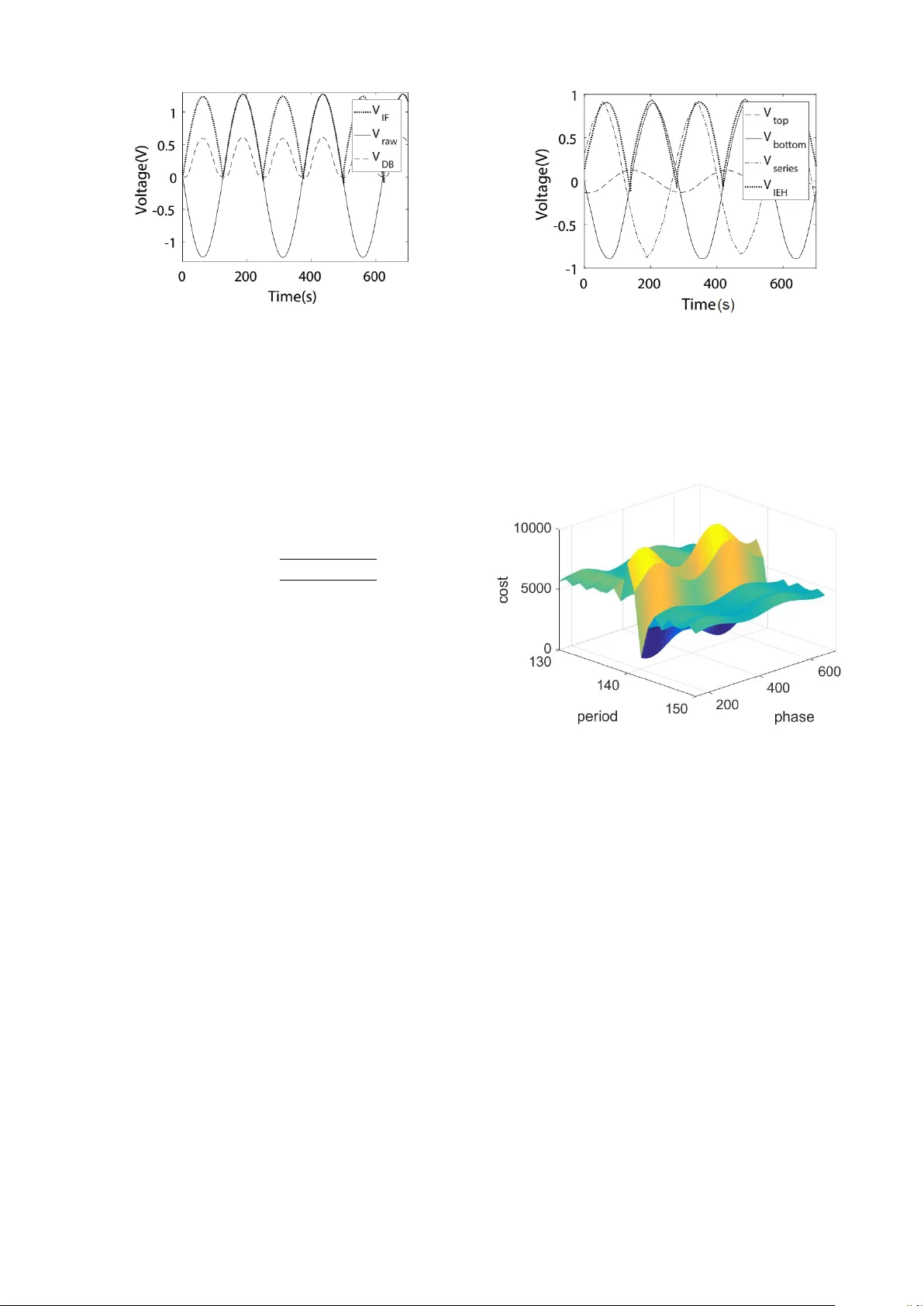
On in telligen t energy harv esting F eiy ang Liu, 1 Y ulong Zhang (co-first), 2 Oscar Dahlsten, 1, 3, 4, 5 , ∗ and F ei W ang (co-corr.) 2 , † 1 Physics, Southern University of Scienc e and T e chnolo gy (SUST e ch), Shenzhen, China 2 EEE, Southern University of Scienc e and T e chnolo gy (SUST e ch), Nanshan District, Shenzhen, China 3 Shenzhen Institute for Quantum Scienc e and Engine ering, SUST e ch, Nanshan District, Shenzhen, China 4 L ondon Institute for Mathematic al Scienc es, Mayfair, 35a South Stre et, L ondon, W1K 2XF, UK 5 Wolfson Col le ge, University of Oxfor d, Oxfor d OX2 6UD, UK (Dated: March 24, 2022) W e prob e the potential for in telligent interv en tion to enhance the p o w er output of energy har- v esters. W e inv estigate general principles and a case study: a bi-resonan t piezo electric harv ester. W e consider intelligen t in terven tions via pre-programmed reversible energy-conserving op erations. W e find that in imp ortan t parameter regimes these can outp erform dio de-based interv en tion, whic h in contrast has a fundamental minimum pow er dissipation bound. Intr o duction— Energy harvesting, exploiting ambi- en t energy for our purp oses, play a crucial role in hu- man tec hnological developmen t [1]. Curren tly , an im- p ortan t fo cal area is micro energy harvesters (with out- put p o w er 10-100 µ W). These conv ert, through v arious transduction metho ds, ambien t thermal and kinetic en- ergy from the environmen t to electrical energy . They pro vide an in-situ pow er source for remote electronic de- vices, typically for pow ering sensor no des of the Internet of Things. This a voids the problems associated with bat- teries and/or wiring [2 – 5]. A k ey challenge for micro harvesters is that am bient en- ergy sources are very often random. F or instance, the am- plitude and the frequency of a vibrational energy source can b e highly v ariable. This makes it difficult to rectify the generated voltage/curren t and store the energy in an efficien t manner [2, 3, 6]. In terven tions by an intelligen t agent aids energy har- v esting from v ariable sources in certain contexts, as ex- emplified by the in terven tions of a sailor, or a windv ane turning a generator into the wind. Such examples serve to remind us that the 2nd law of thermo dynamics, as used to prov e that a Maxwell’s demon cannot work [7], concerns maximum entrop y single heat baths, whereas often forces in nature are not maximally random. Highly sophisticated in telligent in terv en tions in en- ergy harv esting are now practicable, owing to adv ances in: (i) artificial intelligence softw are and hardware[8, 9], (ii) electronic interfacing circuitry [10 – 14], and (iii) ex- p erimen tal and theoretical understanding of the rela- tion b et w een information and energy , such as the fact that reversible computation has no fundamental energy cost [15–17]. T ak en together, this giv es significant hop e that intelligen t interv en tion may b e a p o werful to ol in mitigating the randomness faced by micro-harvesters. W e therefore here aim to identify in telligent in terven- tions that allo w micro harv esters to extract more rectified p o w er from v ariable sources than current state-of-the art metho ds. ∗ dahlsten@sustc.edu.cn † wangf@sustc.edu.cn A key paradigm we adapt is to use interv en tions that are rev ersible and energy conserving. Moreov er, for prac- tical and fundamen tal thermo dynamical reasons, these in terven tions are pre-programmed, c hosen by systematic mac hine learning metho ds applied to past data from the harv ester, as in Fig.1. W e consider general principles and for concreteness also a case study of a piezo-electric harv ester which conv erts motion to electricity [18]. In this case study we consider idealised, pre-programmed, bias-flips and phase-shifts on the electrical outputs. W e find these can indeed replace and outp erform the current state-of-the art: the dio de bridge. W e moreov er note FIG. 1. W e find that rectifying the voltage with intelligen tly c hosen pre-programmed energy conserving interv en tions can lead to impro ved p o wer output. Possible in terven tions include v oltage bias flip with ON/OFF-perio d τ , and voltage phase shift of time θ . The trainer tunes θ and τ to optimise the v oltage output. that the the dio de bridge has a thermo dynamically fun- damen tal low er b ound on p o wer dissipation, whereas the metho ds use here do not. W e pro ceed as follows. W e briefly describ e the har- v ester being used as a case study . W e describ e the in ter- v entions, and how they can b e intelligen tly chosen. W e then give the results, follow ed by a discussion and con- clusion. Harvester and its output— The harvester we use in this pap er as a case study is a dual resonan t structure energy harv ester [18], which can harv est energy from ran- dom fluctuation sources at low frequencies (typically less than 100Hz), consisten t with motion of ev eryda y ob jects suc h as h uman b eings. It consists of t wo piezoelectric de- vices, eac h outputting its own voltage time-series, with 2 the voltages finally combined to give one v oltage time- series. The device is sho wn in FIG. 2. FIG. 2. The bi-resonant harv ester, originally designed in [18]. Tw o piezo-cov ered cantilev ers with masses on their free ends are driv en by the same vibrational motion source on the righ t axis. W e consider ho w m uch bias flips and phase shifts on the outputs can enhance the p o w er output. The output can b e used to charge a capacitor, which is used to p o w er a sensor and wireless transmission of the sensor signal when required. The capacitor, and nor- mally the sensor and transmission comp onen ts, needs a DC ( V ≥ 0) source with a sufficiently high ro ot mean square v oltage V RMS . How ev er the ra w v oltage from the device is AC. The curren t state-of-the-art solution for con verting it to DC is the dio de bridge . Dio de bridge and its p ower c onsumption— A dio de bridge, as in Fig.3, will take any voltage p olarit y on the inputs to a p ositiv e p olarit y on the output, but at a loss in p o w er. The loss in p o w er is necessary given that FIG. 3. A diode bridge will tak e an y v oltage p olarit y on the inputs to a positive p olarit y on the output. eac h diode has a v oltage drop. F or practical device pow er dissipation calculations a pn-junction dio de’s current vs v oltage curve can b e appro ximated as V = V 0 + I R for the regime V > 0 [19]. The instan taneous p o wer dissipated b y a single dio de when V > 0 is then P = I V 0 + I 2 R . (The av erage and rms pow er dissipations follow immedi- ately .) The dio de bridge has t w o dio des in eac h path and th us t wice that dissipation. Note also that in the case of tw o sub-harv esters the dio de bridge can b e applied on eac h b efore combining the voltages in order to a void destructive interference, but again at a p o w er loss. 2nd law mandates dio de bridge p ower c onsumption— If it were possible to reduce the ab o v e p o w er dissipation to 0, a dio de bridge could b e used to violate the second law of thermo dynamics, b y turning thermal curren t fluctuations in to rectified curren t at no w ork cost. Kelvin’s version of the 2nd law states that no work can b e extracted from a single heat bath in a closed cycle. Thermal voltage fluctuations dep end on materials and it is b ey ond the scop e of this pap er to inv estigate their v alues for dio de bridges used here, but e.g. the thermal voltage V th = kT /e is approx 0.03V at ro om temp erature. (The argument can be mo dified to other fluctuation sizes). F or the device to be called a diode the current I ≈ 0 for negativ e voltages b ey ond the thermal fluctuation range of − V th (up to some breakdo wn v oltage which is outside of the range currently considered). Then for voltages in the p ositiv e thermal fluctuation range w e must also hav e I ≈ 0, or else the dio de would generate a current in a circuit em bedded in the heat bath, a circuit which could include a load driven by that curren t, violating the 2nd la w. Th us, according to the abov e argumen t, there is an inescapable v oltage drop of V th in a dio de, and asso ciated p o w er loss. W e now turn to the comp eting approach to turn the A C into DC and to remo v e destructiv e interfer- ence betw een v oltages. Two examples of intel ligent interventions: sign flip and phase shift— The sign flip, which can also b e called voltage inv ersion, can b e written as V → − V where V is the instantaneous v oltage. This can switch b et w een b eing on and off with p eriod τ . τ is a priori a free parameter and will later b e set according to optimising based on past data. The phase shift is simply a dela y of the v oltage time series b y some amoun t φ (so strictly sp eaking it is a dela y rather than a phase shift whic h should only b e betw een 0 and 2 π times some p eriod). It can b e written as V ( t ) → V ( t + φ ) ∀ t where t is time. Interventions ar e ortho gonal matric es— It is con venien t to use bra-ket vector notation here suc h that a v oltage time series V i ( t 0 ) , ...V i ( t f ) is a vector | V i i with the first entry V i ( t 0 ). (The time series is discrete as it is sampled exp erimen tally at a finite rate). The transp ose of the vector is denoted h V i | , such that the dot pro duct of t wo vectors | V i i , | V j i is written as h V i | | V j i = h V i | V j i . In this notation V RMS = r 1 d h V i | V i i , where d is the dimension of | V i i . Moreov er let | V 0 i i denote the transformed | V i i . In an idealised case the in telligent transformations pre- serv e V RMS suc h that h V i | V i i = h V 0 i | V 0 i i ∀ i. (1) Then, if we also assume the interv en tions can b e repre- sen ted as matrices, the interv entions corresp ond to or- thogonal matrices O , meaning O T O = I where I is the iden tity and T the transp ose. The idealised interv en- 3 tions w e consider are indeed orthogonal matrices: phase shifting can be represented as a cyclic p erm utation of elemen ts, a particular p ermutation matrix, and voltage in version as a diagonal matrix with diagonal entries all 1 or -1. More generally the interv entions S are naturally represen ted as matrices, since they should resp ect prob- abilistic mixtures of different voltages: S ( P i p i | V i i ) = P i p i S ( | V i i ) [20]. This together with Eq.1 implies the idealised interv en tions, b ey ond the examples of bias flips and phase shifts, should indeed be represented as orthog- onal matrices acting on the v oltage v ectors. Optimal interventions when c ombining two voltages— No w we can compare the V RMS b efore and after in terven tions. F or example phase shifts can b e used to reduce destructiv e interference, due to individual sub- generators pro ducing v oltages out of phase. Given tw o or more voltage time series, how high can the V RMS of the combined outputs b e, if w e are allo wed to do intel- ligen t interv en tions on each time series b efore combin- ing them? F or notational conv enience let us consider dV 2 RMS = h V | V i . Two time series illustrate the general case: V 1 and V 2 . Supp ose these undergo the transforms b efore b eing combined, ho w muc h can dV 2 RMS c hange? Note that h V 0 1 + V 0 2 | V 0 1 + V 0 2 i − h V 1 + V 2 | V 1 + V 2 i = = 2( h V 0 1 | V 0 2 i − h V 1 | V 2 i ) . Th us maximising the V RMS impro vemen t for a giv en | V 1 i , | V 2 i means maximising h V 0 1 | V 0 2 i . Can we find a closed form expression for how high this can b e? Let us con- sider maximising it ov er p erm utation matrices and sign flips. Note firstly that making the signs the same for all entries, e.g. plus, cannot decrease h V 0 1 | V 0 2 i . W e can assume that in the optimal case the signs are the same, sa y all p ositive. Now it is known that the dot product is maximised b y ordering the en tries of each in descending order: h V 0 1 ↓ | V 0 2 ↓i . This follows from the rearrangement inequalit y . Thus the maximum dV 2 RMS one can obtain by signflips and permutations is max sgnflip+perms h V 0 1 + V 0 2 | V 0 1 + V 0 2 i (2) = h V 1 | V 1 i + h V 2 | V 2 i + 2 h V 1 ↓ | V 2 ↓i := dV (max) RMS 2 . The op erations w e consider in this paper, due to engi- neering considerations, are even more limited: sign-flips and phase shifts (cyclic, not arbitrary p erm utations). W e therefore do not exp ect to obtain the V RMS of the closed form expression abov e but hop e to approach it. Ener gy c ost of these interventions arbitr arily smal l— If transformations take individual microstates to other microstates with the same energy they can in principle b e p erformed without an energy cost. More- o ver there needs to b e a one-to-one mapping b et w een microstates for there not to b e a hidden energy cost ow- ing to thermodynamics [15]. F or example compressing a gas to half its volume isothermally do es not change the (a verage) in ternal energy of the gas but nev ertheless costs w ork, asso ciated with the reduction of the entrop y . The interv en tions here, in idealised form, satisfy those conditions, whereas the dio des do not. The bias flip do es not change the p oten tial energy asso ciated with the v oltage difference. The phase shift is a dela y , again not c hanging the potential energy . Moreov er both op erations are reversible, as can b e seen physically , and from the fact that orthogonal matrices are reversible. In contrast, the dio de bridge is logically and thermo- dynamically irreversible with an inescapable low er p o w er dissipation, as discussed ab o v e. W e are in v estigating what the energetic cost of the in- terv entions will b e in practise, taking hop e from e.g. [10] that it can b e made lo w enough to b e practical. W e also remark here that the in terv entions are similar to a feed- forw ard quantum neural net [21] wherein the transfor- mations are also reversible (unitary), providing another p ossible physical platform for these ideas. Cost function use d for the tr aining— W e wish to optimise the V RMS of the output, under the restriction that it should b e DC, i.e. V > 0. This latter condition is b ecause typically small energy harv esters need to pro duce DC, e.g. to c harge a capacitor. F or a single voltage the cost function quantifying how far we are from only having p ositiv e voltage (POS) can b e conv enien tly implemen ted as C P O S = 4 h| V ||| V |i − h ˜ V | ˜ V i , (3) where | ˜ V i = || V |i + | V i . One sees that if all entries are p ositiv e, C = 0, and otherwise C > 0. Moreo ver we define C V RMS = dV (max) RMS 2 − dV 2 RMS , where V (max) RMS is the maximal ov er intelligen t interv en- tions of equation 2. F or simplicit y we define the total cost function, taking b oth desired prop erties into account, as C = C V RMS + C P O S . An important case here is where the phase shift is done b efore combining the tw o voltages, follow ed by a joint in version. In this case, in line with Eq.2, w e use the cost function C ( τ , φ ) = C V RMS + C P O S = [ h V 1 ↓| | V 2 ↓i − h V 0 1 | | V 0 2 i ] + [4 h| V 0 || || V 0 |i − h ˜ V 0 | | ˜ V 0 i ] , where | V 0 i is the sum of the tw o voltages after the first phase shift and | ˜ V 0 i = || V 0 |i + | V 0 i . Systematic tr aining metho ds exist— T o ha ve a systematic and scalable approach we consider the well- pro ven mac hine learning/optimisation technique of gra- dien t descent on a suitably defined cost function. The 4 FIG. 4. Intelligen tly c hosen p eriodic voltage inv ersion giv es b etter V RMS p erformance than diode bridge for the same in- put. The diode bridge data is fully exp erimen tal. The intel- ligen t interv ention data is from applying the corresp onding orthogonal matrix on the raw data experimental data before the dio de bridge. V I F is the voltage after the intelligen tly c hosen flip (exp erimen t+sim ulated interv en tion), V RA W (ex- p erimen tal) is the direct output from the harvester, and V DB is that after the dio de bridge (exp erimen tal). gradien t descen t rule as applied here is that τ θ → τ θ − η C ( θ,τ + δ ) − C ( θ,τ ) δ C ( θ + δ,τ ) − C ( θ,τ ) δ ! , where δ and η are n umerical parameters c hosen according to what w orks. Moreo ver, when faced with lo cal minima in the cost function landscap e, we employ the genetic algorithm, a t yp e of evolutionary algorithm commonly used to find global minima when there are many lo cal minima. In the genetic algorithm, the global minimum (highest fit- ness generation) can often b e found, after op erations like m utation, crosso ver and selection [22]. W e use some of the time-series data (80%) for deter- mining the optimal interv en tions, and then test those in terven tions on the remaining data (20%). The training used here can b e classified as r einfor c e- ment le arning , as the p erformance is ev aluated (rather than the output b eing compared to a a known correct answ er as in sup ervised learning). Simulate d intel ligent intervention b e ats dio de bridge— Our simulation shows that a combination of p eriodic voltage inv ersion and phase shift provides DC v oltage that is higher than that after the dio de bridge. The dio de bridge p enalt y of ab out 0.2V is significant in regimes where V RMS is of the order of 0.2 or less. It is in these regimes it makes sense to consider replacing the dio de bridge. Fig.4 shows how the V RMS is left essenti ally undi- minished and approximately non-negative b y an in tel- ligen tly chosen p eriodic voltage inv ersion, whereas the dio de bridge loses ab out half of the V RMS . In regimes of ev en low er V RMS this adv an tage will b e even greater of FIG. 5. Tw o devices driv en by the same source can hav e v ery similar frequency but be out of phase, as in this experi- men tal data based on 2 piezo-electric harv esters. The phase difference leads to negative in terference. The output of intel- ligen t energy harvesting reduces the consumption of v oltage and maximizes the RMS. FIG. 6. Cost function landscap e. X-axis is p eriod and Y- axis is dela y(length of phase shift), Z-axis is the cost function v alue, whic h combines a cost for b eing less than 0 and a cost for having sub optimal V rms. course. In the case of tw o sub-generators we find that the sim- ulated intelligen tly chosen delay plus intelligen tly chosen p eriodic inv ersion can also in principle significantly out- p erform the dio de bridge, as sho wn in Fig. 5. An example of the cost function landscap e for real experimental data com bined with simulated in terv en tion is in Fig. 6, show- ing local minima, which is why w e emplo y ed the genetic algorithm for the training. The V RMS impro vemen t here is giv en in T able I. Signal-to-noise r atio imp ortant— W e consider ad- justing the p o w er of additive Gaussian white noise to see the c hange of V RMS and C of the intelligen t in terven tions and and diode bridge respectively . W e find that whilst the V RMS of the intelligen t inter- 5 T ABLE I. Improv ement of V RMS ( C P OS of Eq.3). Three cases:(i) raw data without intelligen t interv en tion or dio de bridge, (ii) data after dio de bridge, (iii) data for intelligen t in terven tion replacing diode bridge. F or the case of 1 v oltage only being used the bias flip is emplo y ed. F or the case of both v oltages b eing used, there is a phase shift applied, follow ed b y combining the voltages, follow ed by a bias flip. V RMS ( C P OS L ) 1 v oltage 2 voltages ra w data 0.89(1.6) 0.59(0.7) DB 0.37(0.5) 0.22(0.2) IEH 0.89(0.01) 0.59(0.47) FIG. 7. Comparison of dio de bridge and intelligen t inter- v ention under noise with three cases illustrating the corre- sp onding parameter regime: (a) SNR(signal-to-noise ratio) is greater than 5, in which the in telligent harvesting (IEH) has a b etter cost function p erformance, (b) SNR is close to 5, wherein the cost of IEH and the dio de bridge (DB) are simi- lar, and (c) SNR is less than 5, wherein the cost of the dio de bridge is lo w er. v entions is alwa ys greater than the diode bridge, w hen it comes to the total cost function C , it lo oks lik e in Fig. 7: there is a threshold signal-to-noise ratio SNR after whic h the diode bridge wins. This is consisten t with the understanding that the intelligen t interv en tion relies on patterns existing. Conclusion— W e conclude from this study that in the case of small voltages and multiple sub-generators, in telligent interv en tion can significantly outp erform the dio de bridge. This suggest it may b e strikingly useful to divide existing harv esters into independently mo ving sub- comp onen ts together with in telligent in terven tions on the outputs. Suc h a harvester with m ultiple (in the case here 2) sub-harv esters could hav e a muc h wider op er- ating range than a single large harv ester which ma y not mo ve at all when exp osed to small and/or in different lo cations opp osing forces. [1] J. Coop ersmith, Ener gy, the subtle c onc ept : the disc ov- ery of F eynman ’s blo cks fr om L eibniz to Einstein (Oxford Univ ersity Press Oxford, 2010) pp. xiv, 400. [2] P . D. Mitc heson, E. M. Y eatman, G. K. Rao, A. S. Holmes, and T. C. Green, Pro ceedings of the IEEE 96 , 1457 (2008). [3] K. L. B. et al, Waste Energy Harvesting: Me chanic al and Thermal Ener gies (Springer, 2014). [4] S. Sudev alay am and P . Kulk arni, IEEE Comm unications Surv eys & T utorials 13 , 443 (2011). [5] Y. Zhang, T. W ang, A. Luo, Y. Hu, X. Li, and F. W ang, Applied Energy 212 , 362 (2018). [6] E. Halv orsen, Journal of Micro electromec hanical Systems 17 , 1061 (2008). [7] C. H. Bennett, Scien tific American 257 , 108 (1987). [8] B. Linares-Barranco, A. G. Andreou, G. Indiveri, and 6 T. Shibata, IEEE T ransactions on Neural Net w orks 14 , 976 (2003). [9] Y. LeCun, Y. Bengio, and G. Hin ton, Nature 521 (2015). [10] Y. Ramadass and A. Chandrak asan, Solid-State Circuits, IEEE Journal Of 45 , 189 (2010). [11] S. Bandy opadh ya y and A. P . Chandrak asan, IEEE Jour- nal of Solid-State Circuits 47 , 2199 (2012). [12] J. Liang and H. S.-H. Chung, Journal of Physics: Con- ference Series 476 , 012025 (2013). [13] J. Kim and C. Kim, IEEE T ransactions on Po wer Elec- tronics 28 , 3827 (2013). [14] F. Hartmann, P . Pfeffer, S. H¨ ofling, M. Kamp, and L. W orschec h, Phys. Rev. Lett. 114 , 146805 (2015). [15] C. H. Bennett, 21 , 905 (1982). [16] T. Saga w a, in L ectur es on Quantum Computing, Thermo- dynamics and Statistic al Physics (W orld Scientific, 2013) pp. 125–190. [17] J. Go old, M. Hub er, A. Riera, L. del Rio, and P . Skrzypczyk, Journal of Physics A: Mathematical and Theoretical 49 , 143001 (2016). [18] S. Li, Z. P eng, A. Zhang, and F. W ang, AIP Adv ances 6 , 015019 (2016). [19] S. S. A. note, “Calculation of p o w er loss in a dio de,” (2011). [20] J. Barrett, Ph ys. Rev. A 75 , 032304 (2007). [21] K. H. W an, O. Dahlsten, H. Kristj´ ansson, R. Gardner, and M. S. Kim, np j Quantum Information 3 , 36 (2017), arXiv:1612.01045 [quant-ph]. [22] J. H. Holland, “Adaptation in natural and artificial sys- tems: An introductory analysis with applications to bi- ology , control, and artificial in telligence.” (1975).
Original Paper
Loading high-quality paper...
Comments & Academic Discussion
Loading comments...
Leave a Comment