Google matrix of Bitcoin network
We construct and study the Google matrix of Bitcoin transactions during the time period from the very beginning in 2009 till April 2013. The Bitcoin network has up to a few millions of bitcoin users and we present its main characteristics including the PageRank and CheiRank probability distributions, the spectrum of eigenvalues of Google matrix and related eigenvectors. We find that the spectrum has an unusual circle-type structure which we attribute to existing hidden communities of nodes linked between their members. We show that the Gini coefficient of the transactions for the whole period is close to unity showing that the main part of wealth of the network is captured by a small fraction of users.
💡 Research Summary
The paper presents a comprehensive study of the Bitcoin transaction network from its inception in January 2009 through April 2013 by constructing and analyzing its Google matrix. Using the publicly available blockchain data compiled by Iván Brugere, the authors model each Bitcoin address as a node and each directed transaction as a weighted edge whose weight equals the total amount transferred from one address to another during a given quarter. The dataset contains 28,140,756 transactions, with transaction values recorded in 10⁻³ BTC before March 2010 and in 10⁻⁸ BTC thereafter. Network sizes grow from a few hundred nodes in early 2009 to 6,297,539 nodes and 16,056,427 directed links by the second quarter of 2013.
The transition matrix S₀ is built by normalizing each outgoing weight by the total out‑flow of its source node. Dangling nodes are treated by adding a uniform column vector, yielding the stochastic matrix S. The Google matrix is then defined as G = αS + (1 − α)(1/N)eeᵀ with the conventional damping factor α = 0.85. For the CheiRank analysis the direction of all edges is reversed, producing S* and G*.
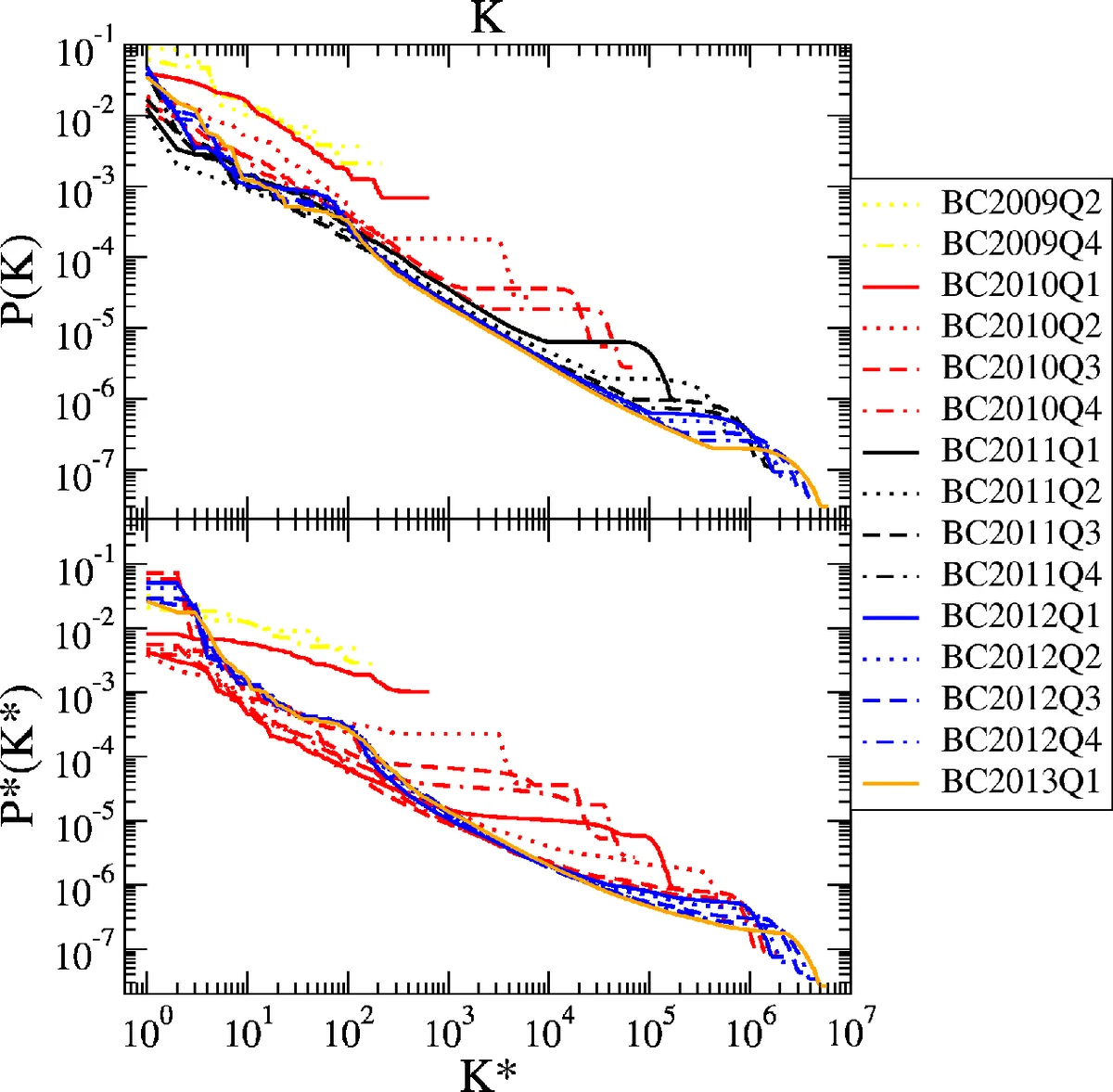
PageRank and CheiRank vectors are computed for each quarterly network. Their probability distributions follow a power‑law decay P(K) ∝ K⁻ⁿᵘ and P*(K*) ∝ K*⁻ⁿᵘ* with exponents ν ≈ 0.86 ± 0.06 and ν* ≈ 0.73 ± 0.04 for the largest quarter (BC2013Q1). These exponents are comparable to those observed in the World Wide Web and Wikipedia, indicating that even a decentralized cryptocurrency network exhibits scale‑free ranking properties. The distributions stabilize as the network size increases, confirming that a relatively small set of addresses dominate the probability mass.
A major contribution of the work is the detailed spectral analysis of the Google matrix. The eigenvalues λ of G lie close to the unit circle and arrange themselves in concentric “rings” in the complex plane. This circular structure is interpreted as evidence of hidden communities where transactions circulate among a tightly knit group of users. However, the low link‑to‑node ratio (≈ 1.5) and the presence of large Jordan blocks make the spectrum numerically delicate. To overcome this, the authors decompose the matrix into invariant subsets (small diagonal blocks that can be diagonalized exactly) and a core space. The core space eigenvalues are obtained with the Arnoldi method (Arnoldi dimension up to 16 000). For the largest networks, eigenvalues with |λ| < 0.95 become unreliable when using standard double‑precision arithmetic; only high‑precision GMP calculations can recover them with an accuracy of 10⁻¹⁵. The authors illustrate this issue with the BC2010Q2 and BC2010Q2* networks, where multiple rings appear but only the outer two are trustworthy.
The authors also examine wealth distribution by defining each user’s balance Bᵤ as the net inflow minus outflow of bitcoins. The Gini coefficient computed over the entire period is 0.99, indicating extreme concentration of wealth: a tiny fraction of “whale” addresses hold the vast majority of bitcoins, while most addresses have balances near zero. This finding challenges the perception of Bitcoin as a uniformly distributed monetary system and highlights the emergence of inequality even in a pseudonymous, decentralized ledger.
In conclusion, the paper successfully applies complex‑network theory and Google matrix techniques to a real‑world financial blockchain, revealing (i) power‑law ranking behavior, (ii) a distinctive circular eigenvalue spectrum linked to community structure, (iii) significant numerical challenges due to sparsity and Jordan blocks, and (iv) a near‑maximal Gini coefficient reflecting wealth concentration. The methodological advances—particularly the combination of invariant‑subset decomposition with high‑precision Arnoldi diagonalization—provide a valuable blueprint for future analyses of large‑scale directed financial networks.
Comments & Academic Discussion
Loading comments...
Leave a Comment