Optimal Radix-2 FFT Compatible Filters for GFDM
For a linear waveform, a finite condition number of the corresponding modulation matrix is necessary for the waveform to convey the message without ambiguity. Based on the Zak transform, this letter presents an analytical approach to compute the cond…
Authors: Ahmad Nimr, Maximilian Matthe, Dan Zhang
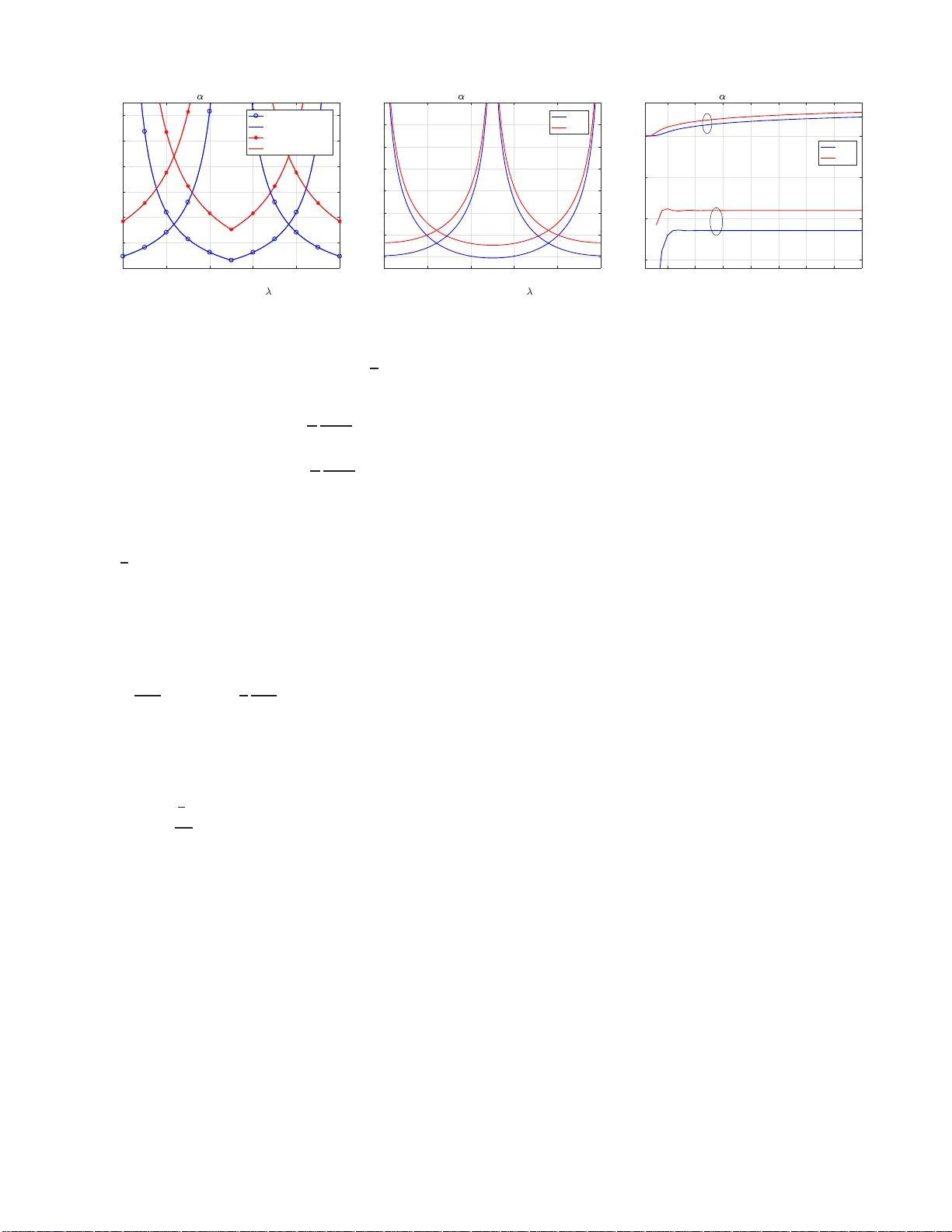
1 Optimal Radix-2 FFT Compatible Fil ters for GFDM Ahmad Nimr , Maximilian Matth ´ e, Dan Zhang, Gerhard Fettweis V odafone Chair Mobile Communication Systems, T echnische Univ ersit ¨ at Dresden , Ge rmany { first name.last name } @ifn.et.tu-dres den.de Abstract —Fo r a linear wa vef orm, a fin ite condition n umber of the corr esponding modulation matrix is necessary f or the wa vef orm to con vey the message with out ambiguity . Based on the Zak transform, thi s letter presents an analytical approach to compu t e th e condition number of the modulation matrix fo r th e mu lti-carrier wav efo rm g eneralized f requency division multiplexing (GFDM). On to p, we further propose a filter design that yields non-singu l ar m odulation matrices for an ev en number of subcarriers and subsymbols, which is not achievable fo r any previous work. Su ch new design h as significant impact on implementation complexity , as th e radi x-2 FF T operations for con ventional multicarrier wav eforms can readily be em ployed fo r GFDM. Additionally , we analytically derive the optimal filter that minimizes the condition number . W e further numerically e valuate the signal-to-interference ratio (SIR) and noise-enhancement factor (NEF) for matched filter (MF) and zero-f orcing (ZF) GFDM r eceivers f or such design, respectiv ely . Index T erms —GFDM, Z ak transform , pul se shape, conditional number , ev en number of subsymbols. I . I N T RO D U C T I O N Among se veral wa vefo rm altern ati ves to orthog onal fre- quency di visio n multiplexing (OFDM) [1], considerable research on detection algorithms, perfo r mance and low- complexity implemen tations has been cond u cted for GFDM [2]. GFDM, as a n on-or thogon al filtered multicarrier system with K subcarrier s employs circular filtering of M subsym bols within each bloc k to keep the signal con fin ed within the blo c k duration of K M samples. Naturally , the c hoice of the pulse shaping filter strongly influences the system per f ormanc e , as it controls system orthogo nality and inter ference structure. In [3], it is p roved b y means o f th e discrete Zak tr ansform (DZT) [4] of the tran smit filter that the tr ansmit signal beco mes ambiguo us and the GFDM modulatio n matrix A is singular when a re a l-valued symmetric filter with ev en M an d K is employed. The authors of [5] extended this result by showing that A has exactly o ne zer o eigen value, sugg esting that one GFDM bloc k can mostly conve y ( K M − 1) d ata symb ols. Hence, odd M is co mmonly adopted for d ata transmission in the literature. Even th ough several works on comp lexity reduction for GFDM modulation and demodu lation h ave been published [6], [7], od d M forbid s the N - p oint FFT to be im- plemented solely b y energy-efficient radix -2 based pro cessing. This also n a r rows the desig n space of GFDM as a flexible wa vefo rm gen erator [8]. In th is paper w e prop ose a filter d esign for GFDM to supports even values fo r bo th M a nd K , particular ly when they are power-of-two. T o this end, we introd uce a fraction al shift in the sampling of the contin uous frequency response of conv entional basis filters, such as raised- cosine (RC) filter , to allow bo th e ven-valued and odd- valued M , K to be der iv ed from the same filter response. As a function of this shift, a closed-fo rm expression f or the con dition nu mber o f A is provided and the optimal shif t fo r both ev en and od d M , K in ter ms o f the minimal co ndition nu mber is derived. T o verify the desig n we evaluate th e SIR for the MF rec e i ver and th e NEF of th e ZF receiver . sectionGFDM Modulation Matr ix Deco mposition One GFDM block conve ys the data sym bols { d k,m } via K sub- carriers an d M subsy m bols, yieldin g N = K M samples. The n th o ne a s the en try n o f x ∈ C N × 1 equals [2] [ x ] n = K − 1 X k =0 M − 1 X m =0 d k,m g [ h n − mK i N ] e j 2 π k K n , (1) where g [ n ] denotes the pulse shaping filter and correspo nds to the entr y n of g ∈ C N × 1 . With the N × N modula tio n matrix A constructed as [ A ] ( n,k + mK ) = g [ h n − mK i N ] e j 2 π k K n , Eq. (1) can b e fo rmed as x = Ad , where [ d ] k + mK = d k,m . A. Decomposition of A For a L × Q matr ix X , let x = vec L,Q ( X ) and u n vec L,Q ( x ) denote the vectorization oper ation an d its inverse. Let F N be the N -p oint d iscrete Fourier tr ansform (DFT) matrix with elements [ F N ] ( i,j ) = e − j 2 π ij N . Let th e unitar y m atrix U L,Q be U L,Q = 1 √ Q I L ⊗ F Q , (2) where ⊗ is the Kronec ker produ ct. Le t Π L,Q ∈ ℜ LQ × LQ be the p ermutation matrix that fu lfills fo r any L × Q matrix X vec ( X T ) = Π L,Q vec ( X ) . (3) The ( Q, L ) DZT [4] Z x = ( F Q ⊗ I L ) x , x ∈ C QL × 1 can be written as a matr ix Z ( x ) Q,L ∈ C Q × L with Z ( x ) Q,L = F Q V ( x ) Q,L = ˜ V ( x ) Q,L , (4) where V ( x ) Q,L = ( unv ec L × Q { x } ) T . (5) Resorting to the DZT of g and ˜ g = F N g , we can factorize A into two for ms A = Π T K,M U H K,M | {z } U ( g ) Λ ( g ) U K,M Π K,M U H M ,K | {z } V ( g ) H , (6) = F H N √ N Π T M ,K U H M ,K | {z } U ( ˜ g ) Λ (˜ g ) U M ,K Π M ,K U K,M Π M ,K | {z } V ( ˜ g ) H , (7) 2 where U (˜ g ) and V (˜ g ) are unitary matrices an d Λ ( g ) = diag n vec M ,K n √ K Z ( g ) M ,K oo , (8) Λ (˜ g ) = diag vec M ,K 1 √ K Z ( ˜ g ) K,M , (9) where Λ ( g ) and Λ (˜ g ) contain the DZT of g and ˜ g , respe c ti vely . As a result, p roperties of A are dictated by Λ (˜ g ) or Λ ( g ) . In this paper we focu s on p ulse sha p es that are sparse in frequen cy , h e n ce we emp loy Λ (˜ g ) for the subsequent analysis. B. P erformance ind icators Define the short- h and n otation z k,m = h Z (˜ g ) K,M i ( k,m ) . Then σ 2 k,m = | z k,m | 2 correspo n d to the squared singular values of A scaled by K . The condition al num ber o f A is given by [9] cond ( A ) = max k,m { σ k,m } min k,m { σ k,m } = σ max σ min . (10) Considering the r e ceiv ed signal in A WGN ch annel [10] the NEF of ZF and the SI R of the MF receiver can be wr itten as NEF = 1 N 2 k A k 2 F A − 1 2 F = 1 N 2 Λ (˜ g ) 2 F Λ (˜ g ) − 1 2 F = 1 N 2 X k,m σ 2 k,m X k,m 1 σ 2 k,m , (11) SIR = 1 N A H A k g k 2 − I N 2 F = 1 N Λ (˜ g ) Λ (˜ g ) H k g k 2 − I N 2 F = 1 N X k,m σ 2 k,m 1 N P k,m σ 2 k,m − 1 2 . (12) I I . G F D M P U L S E S H A P I N G FI LT E R D E S I G N The con ventional pulse shaping filter design f or the GFDM is to let g = F H N ˜ g with [ ˜ g ] n = H ( n N ) , where H ( ν ) stands fo r the discrete-time Fourier transform ( DTFT) of a pre- selected basis filter h [ n ] that is o f practical in te r ests, e.g ., RC or Root- Raised Cosine (RRC). Here, ν is the n ormalized freq uency and th u s the p eriod of H ( ν ) is eq ual to 1 . With su ch design of g , it has been shown in [3] that A becomes sing ular fo r ev en M , K and a real symm etric filter h [ n ] . This is caused by h Z ( ˜ g ) K,M i ( k,m ) = ( Z H ( ν ))( k K , m M ) , where ( Z H ( ν ))( f , t ) denotes the d iscrete-time Zak transfo rm of H ( ν ) an d f or any real symmetric filter we k now ( Z H ( ν ))( 1 2 , 1 2 ) = 0 . The re- quiremen t of o dd M or K impedes an efficient imp lementation in te r ms o f low-comp lexity r adix- 2 FFT o peration s. I n th e sequel, we propose a n ovel design appro ach that overcomes this restriction for any basis filter h [ n ] fulfilling the following condition s 1) h [ n ] is r eal-valued, i.e. H ( ν ) = H ∗ (1 − ν ) = H ∗ ( − ν ) . 2) H ( ν ) spans two sub carriers with in each pe riod, i.e. H ( ν ) = 0 , ∀ ν ∈ [ 1 K , 1 2 ] . 3) | H ( ν ) | is decreasing from 1 to 0 fo r ν ∈ [0 , 1 K ] . W e start f r om noting | ( Z H ( ν − η ))( f , t ) | = | ( Z H ( ν ))( f − η , t ) | , (13) namely , shifting the fr equency response of a filter also shifts the f r equency coor dinate of its Zak transfor m [4]. Hence, shifting H ( ν ) can h e lp us av oid to sample th e zero in ( Z H ( ν )) for ev en M , K . Acc ording ly , the samples of ˜ g are defined as [ ˜ g ] n ( λ )= H n + λ N , 0 ≤ n < M − λ H ∗ N − n − λ N , N − M − λ < n ≤ N − 1 0 , otherwise , (14) for λ ∈ [0 , 1[ . ˜ g can be reshaped as in ( 5) to h V ( ˜ g ) K,M ( λ ) i ( k,m ) = H m + λ N , k = 0 H ∗ M − m − λ N , k = K − 1 0 , else where . (15) Applying DFT acco rding to (4), we get z k,m ( λ ) = H m + λ N + H ∗ M − m − λ N e j 2 π k K . (16) Due to th e sym m etry of H ( ν ) , we h av e z k,m (1 − λ ) = z ∗ k,M − 1 − m ( λ ) e j 2 π k K , σ 2 k,m (1 − λ ) = σ 2 k,M − 1 − m ( λ ) . (17) Hence, all re su lts regarding co nditional numb er , NEF an d SIR are symm etric aro und λ = 0 . 5 . Mo reover , Eq. (16) shows that z k,m (1 + λ ) = z k,m +1 ( λ ) . Hence, it suffices to stud y the c a se 0 ≤ λ ≤ 0 . 5 . Add itionally , we focus on K = 2 x for x > 1 . T o obtain clo sed-form s of the condition nu mber o f A , we subsequen tly focus on two particular families o f H ( ν ) , namely well-localized filters that fulfill the inter-symbol-in terference (ISI)-free cr iterion without or with matche d filterin g. A. ISI fr ee without matched filter In this case H ( ν ) additionally satisfies K − 1 X k =0 H ν − k K = 1 . (18) From the sym m etry and limited ban d of H ( ν ) it follows H ( ν ) + H ∗ 1 K − ν = 1 , ∀ ν ∈ [0 , 1 K ] (19) and H m + λ N + H ∗ M − m − λ N = 1 . A lso , ther e exists a function f ( ν ) = r ( ν ) e j φ ( ν ) with f ( ν ) = − f ∗ 1 K − ν and H ( ν ) = 1 2 (1 + f ( ν )) , ∀ ν ∈ [0 , 1 K ] . (20) Let u s assume a re a l-valued f ( ν ) , i.e. φ ( ν ) = 0 and f ( ν ) = r ( ν ) 1 . Due to the constraint o f decreasing amplitud e H ( ν ) , r ( ν ) must be decre asing fro m 1 to − 1 for ν ∈ [0 , 1 K ] . Based on (19) an d (2 0) we get σ 2 A k,m ( λ ) = (1 + f 2 m ( λ ) 2 + (1 − f 2 m ( λ )) 2 cos 2 π k K , ( 21) 1 Comple x f ( ν ) as in X ia-filters [11] is treated in the follo wing section. 3 where f m ( λ ) = f ( m + λ N ) = 2 H m + λ N − 1 . The singu lar values are sy mmetric with respect to k , an d decreasing with k = 0 , · · · , K 2 . Th erefore, σ 2 A 0 ,m ( λ ) = 1 and σ 2 A K 2 ,m ( λ ) = f 2 m ( λ ) are the max imum and minimum singular value w ith respect to k , respectively . Therefo re, σ 2 A max ( λ ) = 1 , b e c ause f 2 m ( λ ) ≤ 1 , an d σ 2 A min ( λ ) is obtained f rom min m { f m ( λ ) 2 } . Since f ( ν ) is d ecreasing and antisymm etric aroun d 1 2 K , f ( ν ) 2 is decreasing ∀ ν ∈ [0 , 1 2 K ] and increasing ∀ ν ∈ [ 1 2 K , 1 K ] . As a result, when M is even, 0 ≤ λ ≤ 0 . 5 , σ 2 A min is obtained at m = M / 2 , and when M is od d, it is ob tained at m = ( M − 1) / 2 . Th erefore, σ 2 A min ( λ ) = f 2 1 2 K + S ( λ ) 2 N . (22) where S ( λ ) = 2 λ, M is e ven 1 − 2 λ, M is odd . (2 3) From the increasing/decr easing intervals of f 2 ( ν ) , σ 2 A min ( λ ) increases with 0 ≤ λ ≤ 0 . 5 for even M and decr eases when M is odd . Hence, the condition number can b e expre ssed as cond( A A )( λ ) = 1 f 1 2 K + S ( λ ) 2 N . (24) Similarly , co nd( A A )( λ ) is decr easing fo r even M an d incre a s- ing for odd M . Henc e, the b est c o ndition of A is attained at λ = 0 . 5 f or even M a nd λ = 0 f or odd M . B. ISI fr ee after matched filtering A filter H ( ν ) is ISI-free after ma tched filtering if K − 1 X k =0 H ν − k K 2 = 1 . (25) By exploiting the symmetry and band limit, we get | H ( ν ) | 2 + H ∗ 1 K − ν 2 = 1 , ∀ ν ∈ [0 , 1 K ] , (26) and henc e H m + λ N 2 + H ∗ M − m − λ N 2 = 1 . Furtherm ore, there exists a real-valued function f ( ν ) = − f 1 K − ν , which is d ecreasing from 1 to − 1 in the interval ν ∈ [0 , 1 K ] with | H ( ν ) | 2 = 1 2 (1 + f ( ν )) , ∀ ν ∈ [0 , 1 K ] . (27) Adding an (arb itrary) phase φ ( ν ) yield s the original H ( ν ) by H ( ν ) = e j φ ( ν ) r 1 2 (1 + f ( ν )) , ∀ ν ∈ [0 , 1 K ] . (28) Using ( 26) and (28), H m + λ N = e j φ a,m ( λ ) r 1 2 (1 + f m ( λ )) , H ∗ M − m − λ N = e j φ b,m ( λ ) r 1 2 (1 − f m ( λ )) . (29) where φ a m ( λ ) = φ m + λ N , φ b m ( λ ) = − φ M − m − λ N , an d f m ( λ ) = f m + λ N . As special cases, we stud y the p hase in the form φ ( ν ) = − φ 1 K − ν + β π 2 , β = 0 , 1 , 2 , 3 . Th en e j φ a,m ( λ ) = j β e j φ b,m ( λ ) . No ISI with and with out MF, as the Xia filters [11] p rovide, is obtained with f ( ν ) = cos (2 φ ( ν )) and β = 2 or , eq ually , φ ( ν ) = 1 2 acos( f ( ν ) . From (16), we get σ 2 B k,m ( λ ) = 1 + p 1 − f 2 m ( λ ) cos 2 π k − β K 4 K ! . (30) The m aximum singular value with r espect to k is located at k max = β K 4 and the m inimum one at k min = ( β + 2 mo d 4) K 4 . This re quires that K is a mu ltiple of 4 for β = 1 , 3 . σ 2 B k max ,m ( λ ) = 1 + p 1 − f 2 m ( λ ) , σ 2 B k min ,m ( λ ) = 1 − p 1 − f 2 m ( λ ) . (31) Follo wing the same argu ment as previously , based on the proper ties of f ( ν ) , both σ 2 B min ( λ ) and σ 2 B max ( λ ) are ob tained at m = M / 2 for even M and m = M − 1 2 and f or o dd M . Thus, σ 2 B max ( λ ) = 1 + s 1 − f 2 1 2 K + S ( λ ) 2 N , σ 2 B min ( λ ) = 1 − s 1 − f 2 1 2 K + S ( λ ) 2 N , (32) and the co nditional n umber can th e n b e written as cond( A B )( λ ) = f 1 2 K + S ( λ ) 2 N 1 − r 1 − f 2 1 2 K + S ( λ ) 2 N . (33) cond( A B )( λ ) is decreasing for even M and increasing for odd M with λ ∈ [0 , 0 . 5] . When using the same fu nction f ( ν ) in cases A and B, we notice that σ 2 B max ( λ ) ≥ 1 = σ 2 A max and σ 2 B min ≤ f 2 m max ( λ ) = σ 2 A min , and hence cond( A A )( λ ) ≤ cond( A B )( λ ) , (34) proving that th e con d ition num ber is smaller when u sing an ISI-free filter, com pared to using its square ro ot, which has been numerically shown in [12]. I I I . N U M E R I C A L E X A M P L E In this section, we stud y the family o f pro totype filters with roll-off factor α , b eing ob tained with the gener ator fu n ction f ( ν ) = 1 , 0 ≤ ν ≤ 1 − α 2 K f a 2 K α [ ν − 1 2 K ] , 1 − α 2 K < ν ≤ 1+ α 2 K − 1 , 1+ α 2 K < ν ≤ 1 K . (35) f a is rea l-valued anti-sy m metric ( f a ( x ) = f a ( − x ) ), and decreasing from 1 to − 1 f or x ∈ [ − 1 , 1] . T herefor e, f ( ν ) = − f ( 1 K − ν ) . Hence , f ( ν ) can con struct pulse shap es acco rding to (20 ) or (28). From ( 33), (24) and u sing (35), we find that for M α ≤ S ( λ ) , cond( A A ) = cond( A B ) = 1 . For S ( λ ) ≤ M α , cond( A A )( λ ) = 1 f a S ( λ ) αM , cond( A B )( λ ) = f a S ( λ ) αM 1 − q 1 − f a 2 ( S ( λ ) αM ) . (36) The condition n umber is inde penden t of K and, based on the proper ties of f a , increa ses with αM . As a particular example, 4 0 0.2 0.4 0.6 0.8 1 Sampling offset 2 4 6 8 10 12 14 Conditional number = 0.5, K = 64 M=8 M=8 M=9 M=9 M=9 M=9 RC-Sim RC-Closed-form RRC-Sim RRC-Closed-form Fig. 1: Conditiona l number . 0 0.2 0.4 0.6 0.8 1 Sampling offset 1 2 3 4 5 6 7 8 Noise enhancment [dB] = 0.5, K = 64 M=8 M=8 M=9 M=9 M=9 M=9 RC RRC Fig. 2: Noise en hancmen t Factor . 5 10 15 20 25 30 35 40 M -15 -10 -5 0 NEF/SIR [dB] = 0.5, K = 64 RC RRC NEF SIR Fig. 3: NEF an d SIR for o ptimal λ . RC and RRC use the fun ction f a ( x ) = − sin( π 2 x ) . Replacing in (36) we g et, cond( A RC )( λ ) = sin π 2 S ( λ ) αM − 1 , cond( A RRC )( λ ) = tan π 4 S ( λ ) αM − 1 . (37) Fig. 1 shows the co n dition number of A f or different sam- pling shift λ , and validates the closed-f o rm expressions ( 37) numerically . As sho wn, λ = 0 is o ptimal fo r o dd M and λ = 1 2 for even M when K is also e ven. In addition, as pr oved in ( 37), using RC yields a better cond itioned A than RRC. Further more, num e r ically o btained values for NEF as shown in Fig. 2 behave similarly as th e cond ition number . This can be explained by the influence of the smaller singular value on the noise en h ancemen t. In both cases, th e condition number as well as the smallest singular value depen d on f a S ( λ ) αM = sin π 2 S ( λ ) αM . Considerin g th e op timum λ , Fig. 3 illu strates N E F and SIR with different M . The proper choice of λ with respect to M preserves the trend of NEF which increases with M . On the other ha n d, SIR is indepen dent of M when M is big enou gh. In fact, SIR approa c h es the interferen ce value that can be directly obtain e d from SIR = 2 R 1 2 1 2 K | H ( ν ) | 2 dν , which is in d epende n t of λ and K but depe n ds on α . I V . C O N C L U S I O N For the wa vefo rm GFDM, the con dition number of its modulatio n matrix is fully characte r ized by the ado pted pulse shaping filter . In this letter , we obser ved th at a frequency- domain shift o f the f requency response of the pulse sha ping filter can y ield a ch ange in th e condition number . By de riving a closed-form expression of the conditio n number, we can find the o p timal shift that min im izes th e cond ition n umber for GFDM modulatio n. This yields a filter desig n that per- mits GFDM to h av e an arb itrary n umbers o f subcarriers an d subsymbo ls per subcarrier, in pa rticular power-of-two values become possible. W e num e rically verified the obtained closed- form expression an d computed the NEF and SIR with respect to ZF and MF receivers in an additive white Gaussian noise (A WGN) chan nel, in dicating that an optimal con dition num b er yields a lso o ptimal N E F v alues. A C K N OW L E D G M E N T The work pr e sen ted in th is paper has bee n perfor med in the framework of the SA TURN projec t with contr act no. 10023 5995 f unded by the Euro paischer Fonds f ¨ ur regionale Entwicklun g (EFRE) and by the Federal Ministry of Educatio n and Research within the p rogram me ”T wenty20 - Partnership for Innovation” u nder co ntract 03ZZ05 05B - ”fast wireless”. R E F E R E N C E S [1] P . Banelli et al. , “Modulation Formats and W ave forms for 5G Network s: Who W ill Be the Heir of OFDM?: An overvie w of alternat i ve modula- tion schemes for improve d spectr al ef ficienc y , ” IEEE Signal Proc essing Mag . , vol. 31, no. 6, pp. 80–93, Nov . 2014. [2] N. Michailo w et al. , “Gener alize d frequency di vision multiple xing for 5th generatio n cellular networks, ” IEEE Tr ans. Commun. , vol. 62, no. 9, pp. 3045–3061 , Sep. 2014. [3] M. Matth ´ e et al. , “General ized frequency divi sion multipl exi ng in a gabor transform setting, ” IEEE Commun. Lett. , vol. 18, no. 8, pp. 1379– 1382, 2014. [4] H. B ¨ olcsk ei and F . Hlawatsc h, “Discrete Zak transforms, polyphase transforms, and applic ations, ” IE EE T rans. Signal P rocess. , vol. 45, no. 4, pp. 851–866, apr 1997. [5] D. W . Lin and P .-S. W ang, “On the configura tion-dep endent singul arity of GFDM pulse-shaping filter banks, ” IEE E Commun. Lett. , vol. 20, no. 10, pp. 1975–1978, 2016. [6] A. Farhang et al. , “Low complexity GFDM recei ver design: A ne w approac h, ” in 2015 IEEE Internationa l Conf er ence on Communic ations (ICC) , London, UK, June 2015, pp. 4775–4780. [7] D. Zhang et al. , “Expect ation Propagation for Near -Optimum Detecti on of MIMO-GFDM Signals, ” IE EE T rans. W ir eless Commun. , vol. 15, no. 2, pp. 1045 – 1062, 2015. [8] V . W . S. W ong et al. , Ke y T echnolo gies for 5G W irel ess Systems . Cambridge Uni versity Press, 2017. [9] V . Klema and A . Laub, “The singular val ue decomposition: Its com- putati on and some applica tions, ” IEEE T rans. Autom. Contr ol. , vol . 25, no. 2, pp. 164–176, 1980. [10] N. Michailo w et al. , “Genera lized frequenc y div ision multipl exi ng: A flexi ble m ulti-c arrier modulati on scheme for 5th generation cellul ar netw orks, ” in Proce edings of the German micr owave confere nce (GeMiC 12) , Ilmenau, Germany , 2012 , pp. 1–4. [11] X. -G. Xia, “ A family of pulse-shaping filters with isi-free matched and unmatche d filter properties, ” IEEE T rans. Commun. , vol. 45, no. 10, pp. 1157–1158, 1997. [12] M. Matth´ e et al. , “Influence of Pulse Shaping on Bit Error Rate Performance and Out of Band Radiation of Generalized F requency Di vision Multiple xing, ” in ICC’14 - W orkshop on 5G T echnolo gies (ICC’14 WS - 5G) , Sydney , Australia, 2014, pp. 43—-48. [13] R. M. Gray et al. , “T oeplitz and circula nt matrices: A re view , ” F ounda- tions and T r ends R in Communicatio ns and Information Theory , vol. 2, no. 3, pp. 155–239, 2006. 5 A P P E N D I X Let S ∈ C QL × QL be a block circu lant ma trix g enerated from d iagonal m atrices, such that S = S 0 S Q − 1 · · · S 1 . . . . . . . . . S Q − 1 · · · S 0 , (38) where S q = diag { v q } ∈ C L × L , and v q is the q - th co lumn of a matrix V ∈ C L × Q , i.e. v q = [ V ] (: ,q ) , then [13] S = Π T L,Q U H L,Q Λ U L,Q Π L,Q . (39) where, Λ = dia g vec F Q V T . (40 ) Using the notations x ( i ) = x [ < n − i > N ] an d definin g the rep letion matrix R L,Q ∈ ℜ LQ × L , R L,Q = 1 L ⊗ I Q , the transmitted GFDM block in ( 1) ca n b e expr essed in the following vector fo r m, x = K − 1 X k =0 M − 1 X m =0 d k,m diag n g ( mK ) o R M ,K F H K (: ,k ) , = M − 1 X m =0 √ K diag n g ( mK ) o R M ,K 1 √ K F H K d m = S ( M ) U H M ,K vec { D } = A · vec { D } . (41) Here, A = S ( M ) U H M ,K and S ( M ) √ K = h diag n g (0 K ) o R M ,K , · · · , diag n g (( M − 1) K ) o R M ,K i (42) is block circular matrix as in (38), with S ( M ) m = diag √ K h V ( g ) K,M i (: ,m ) . From (39), we g e t S ( M ) = Π T K,M U H K,M Λ ( g ) U K,M Π K,M , (43) Λ ( g ) = √ K diag vec F M V ( g ) K,M T . (44) As a r esult we get A defined in (6). The N -FFT of (1) results in ˜ x [ n ] = K − 1 X k =0 M − 1 X m =0 d k,m ˜ g [ < n − k M > N ] e − j 2 π m M n . (45) Follo wing similar steps we get ˜ x = F N A · vec { D } . (46) Here F N A = S ( K ) U K,M Π M ,K and S ( K ) √ M = diag ˜ g (0 M ) R K,M , · · · , diag ˜ g (( K − 1) M ) R K,M . (47) By replacing S ( K ) as in (44), th e n 1 √ N F N A = Π T M ,K U H M ,K Λ (˜ g ) U M ,K Π M ,K U K,M Π M ,K . (48) Λ (˜ g ) = 1 √ K diag vec F K V ( ˜ g ) M ,K T . (49) And finally b y m u ltiplying whit 1 √ N F N , we get (7 ).
Original Paper
Loading high-quality paper...
Comments & Academic Discussion
Loading comments...
Leave a Comment