Inter-Satellite Communication System based on Visible Light
Future space missions will be driven by factors such as the need for reduced cost of spacecraft without diminished performance, new services and capabilities including reconfigurability, autonomous operations, target observation with improved resolut…
Authors: David Amanor, William Edmonson, Fatemeh Afghah
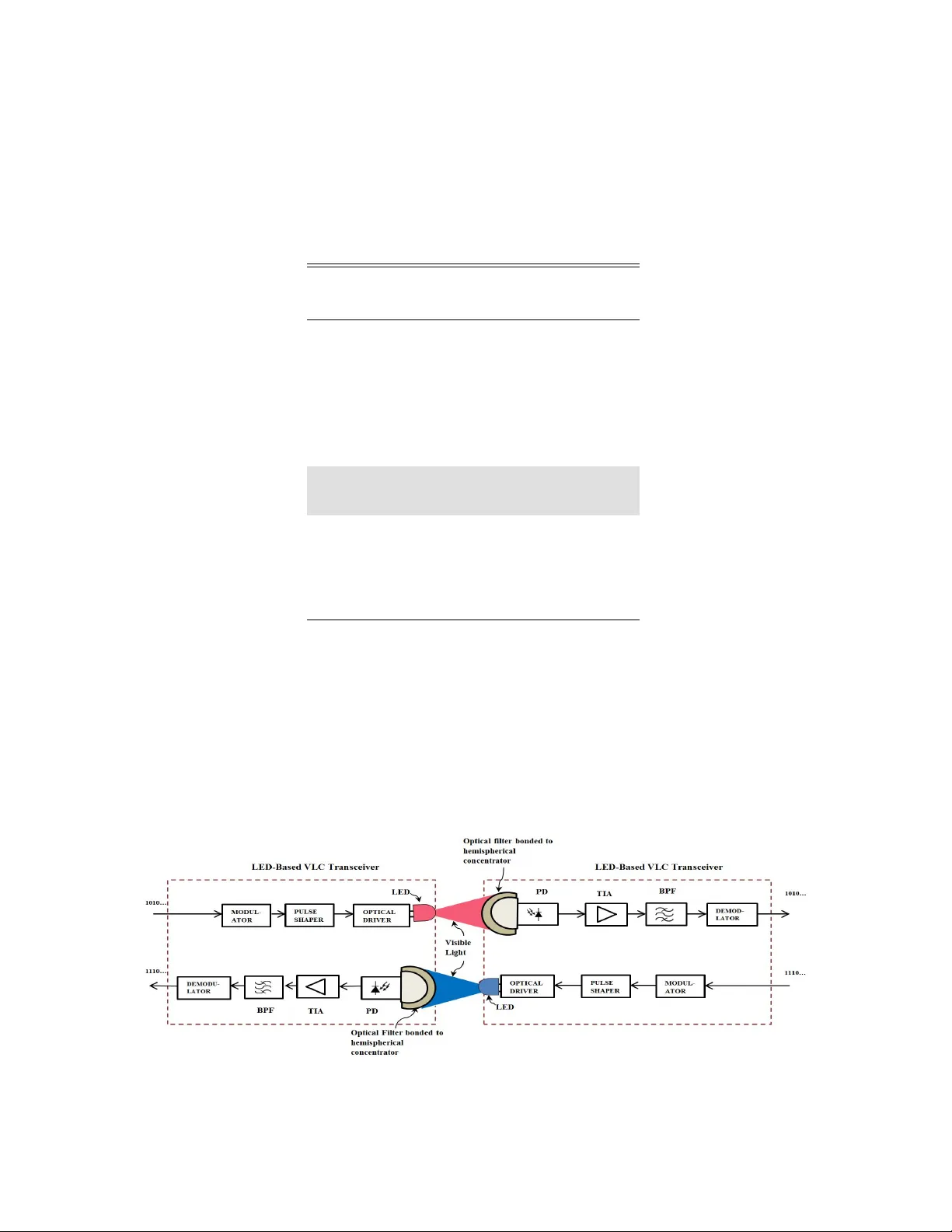
IEEE TRANSA CTIONS ON AER OSP A CE AND ELECTR ONIC SYSTEMS, V OL. X, NO. X, XXXXX 2018 1 Inter -Satellite Communication System based on V isible Light Da vid N. Amanor , Member , IEEE, W illiam W . Edmonson, Senior Member , IEEE, and Fatemeh Afghah, Member , IEEE Abstract Future space missions will be dri ven by factors such as the need for reduced cost of spacecraft without diminished performance, ne w services and capabilities including reconfigurability , autonomous operations, target observation with improved resolution and servicing (or proximity) operations. Small satellites, deployed as a sensor network in space, can through inter-satellite communication (ISC) enable the realization of these future goals. Developing the communication subsystem that can f acilitate ISC within this distributed network of small satellites require a complex range of design trade-offs. For small satellites, the general design parameters that are to be optimized for ISC are size, mass, and po wer , as well as cost (SMaP-C). Novel and efficient design techniques for implementing the communication subsystem are crucial for b uilding multiple small satellite networks with capability for achie ving significant data-rates along the inter-satellite links (ISLs). In this paper, we propose an alternativ e approach to RF and laser ISLs for ISC among small satellites deplo yed as a sensor netw ork in lo w Earth orbit (LEO). For short to medium range ISLs, we present an LED-based visible light communication (VLC) system that addresses the SMaP constraints, including capability for achieving significant data rates. Our research is focused on the dev elopment of the physical layer for pico-/nano class of satellites with prime consideration for the impact of solar background illumination on link performance. W e develop an analytical model of the inter-satellite link (ISL) in MA TLAB and e valuate its feasibility and performance for different intensity modulation and direct detection (IM/DD) schemes. Using a transmitted optical power of 4W and digital pulse interval modulation (DPIM), a receiv er D. N. Amanor was with the Department of Electrical and Computer Engineering, North Carolina A&T State Uni versity , Greensboro, NC 27411, USA. He is now with Intel Corporation, Hillsboro, OR 97124, USA. e-mail: narh.amanor@gmail.com W . W . Edmonson is a National Institute of Aerospace (NIA) Langley Professor, and is with the Department of Electrical and Computer Engineering, North Carolina A&T State Univ ersity , Greensboro, NC 27411, USA. e-mail: wwedmons@ncat.edu F . Afghah is with the School of Informatics, Computing & Cyber Systems, Northern Arizona Univ ersity , Flagstaff, Arizona 86011, USA. e-mail: fatemeh.afghah@nau.edu Manuscript receiv ed August 21, 2017; revised February 12, 2018. IEEE TRANSA CTIONS ON AER OSP A CE AND ELECTR ONIC SYSTEMS, V OL. X, NO. X, XXXXX 2018 2 bandwidth requirement of 3.5 MHz is needed to achiev e a data rate of 2.0 Mbits/s over a moderate link distance of 0.5 km at a BER of 10 -6 . Index T erms Inter-satellite communication, small satellites, solar background illumination, visible light commu- nication. I . I N T RO D U C T I O N The de velopment of small-size, light-weight, low-po wer and lo w-cost satellites has witnessed significant growth in the last fe w years. An important class of small satellites, which is being used by academia, industry and government as a platform for space exploration and research, is CubeSats. These satellites are special category of nanosatellites defined in terms of 10 cm × 10 cm × 10 cm sized units (approx. 1.3 kg each) called “U's”. Although a 1U CubeSat can be extended to higher configuration (i.e., 1.5, 2, 3, 6, and 12U) if more capability is required, it is crucial to resist the creep toward larger and more expensi ve CubeSat missions, as this defeats the primary goal of maintaining lo w-cost approaches as the cornerstone of CubeSat dev elopment [1]. Small satellites, deployed as a sensor network in space, hav e an adv antage over con ventional satellites in space exploration because of their potential to perform coordinated observations, high-resolution measurements, and identification of Earth's asset that is inclusi ve of its space en vironment. Lo w-latency communications between these satellites result in improved av ailabil- ity for observation, telecommunications and reconnaissance applications [2]. One fundamental reason for the shift from using large and expensi ve satellites to multiple low-cost small satellites is the resulting inherent intelligence of the distrib uted multi-satellite nodes which has potential for autonomous operations. Another dri ving motiv ation for the development of lar ge constellations of small satellites is the desire for rapid revisit rates or persistence from lo w-earth-orbit (LEO) satellites. Such satellites hav e the potential to provide inter-satellite data relay , providing a highly survi v able mesh of nodes capable of relaying data before downlink to ground stations [2]. T o enable cooperation among these distrib uted multi-satellite nodes requires a need for inter- satellite communication. Presently , the dominant research and development for implementing inter-satellite communication links (ISLs) consists of using either radio frequency (RF) or highly directed lasers. The latter will require a highly accurate pointing satellite control system, while IEEE TRANSA CTIONS ON AER OSP A CE AND ELECTR ONIC SYSTEMS, V OL. X, NO. X, XXXXX 2018 3 Fig. 1: Network of Small Satellites: Adapted from [6] the former is not suitable for systems with sensitiv e electronics onboard or in applications where high data rates are required due to the limited av ailable spectrum. It is also mechanically challenging to deploy large parabolic antennas on small satellites equipped with RF radios in order to support high data rates. The required pointing accuracy needed for laser communication presents a challenge to the form factor of pico-/nano class of satellites due to the stringent SMaP restrictions imposed by the platform. Lasers produce a narro w and focused beam of light that could fall out of the field-of-view (FO V) of a small satellite receiv er due to slight mov ements. Furthermore, for formation flying systems in LEO, the ISLs are much shorter than links between satellites in geostationary orbit; thus, the use of lasers and the highly accurate pointing they provide can be considered superfluous [3], [4]. T o minimize the SMaP constraints imposed by the platform, along with the need for reduced pointing accuracy and to achie ve high data transmission rates, we propose a visible light communication (VLC) subsystem for pico-/nano class of satellites for ISC. These multiple small satellite missions will benefit from VLC's ability to transmit higher data rates with smaller , light-weight nodes, while avoiding the usual interference problems associated with RF , as well as the apparent radio spectrum scarcity belo w the 6 GHz band [5]. Furthermore, the electronics required for achieving precision pointing accuracy for laser communication systems will be avoided. W ith approximately 300 THz of free bandwidth av ailable for VLC, high capacity data transmission rates could be provided ov er short distances using arrays of LEDs. This paper is an extensi ve treatment of the preliminary study presented in [4] and [7]. In these conference papers, we proposed a high-lev el description of a VLC system for ISC among small satellites. In this paper , we de veloped the physical layer requirements and design concepts for a VLC-based communication subsystem for ISC in small satellite networks. The proposed system addresses the SMaP constraints of small satellites and challenges associated with RF and Laser ISLs in small satellites networks. IEEE TRANSA CTIONS ON AER OSP A CE AND ELECTR ONIC SYSTEMS, V OL. X, NO. X, XXXXX 2018 4 The remainder of the paper is structured as follows. Section II cov ered background information of related w orks on ISC. The design considerations and proposed system description are presented in Sections III and IV , respectiv ely . Section V examined the VLC link physical model, while Section VI treated the solar background noise model. The characteristics of the VLC modulated signal is discussed in Section VII, follo wed by an example power budget design in Section VIII. The performance ev aluation of an analytical model of the proposed system is treated in Section IX, and the concluding remarks are presented in Section X. I I . BA C K G RO U N D Most of the launched and projected missions of multiple small satellite systems employed RF or laser ISLs [8]. Among these missions, the most ambitious one is QB-50, which uses RF ISLs and consists of a network of CubeSats that will study the Earth's upper thermosphere, measuring oxygen le vels, and electron behavior among others. All 50 CubeSats were supposed to be launched together in February 2016, but due to the unav ailability of the launch vehicle, the plan was re vised and 28 CubeSats were deployed from the International Space Station (ISS) in May 2017, follo wed by the launch of another 8 CubeSats from an Indian Polar Satellite Launch V ehicle (PSL V) in late May 2017. Notwithstanding the dominance of RF and laser ISLs in most multiple small satellite missions, recent adv ancements in LED technology hav e triggered rene wed interest in VLC as a viable alternati ve to RF and laser for LOS communication links of moderate scope. V isible light communication systems exploit the optical bandwidth a vailable within the visible light band (i.e., 380 nm to 750 nm) for data communications. LED-based transmitter sources hav e a relativ e adv antage over RF and laser transmission sources due to their low po wer requirements, light- weight, and small footprint. In [3], the feasibility of LEDs for short-range ISLs was examined for a hypothetical lo w-end ISL. The work discussed methods for minimizing background illumi- nation, but did not quantitativ ely ev aluate solar background illumination and its impact on ISL performance. The fundamental analysis for VLC system using LED lights for indoor applications was discussed in [9]. In [10], a VLC system using LEDs was successfully demonstrated between satellite and ground. The ShindaiSat, Shinshu Uni versity Satellite, is a VLC experimental satellite for on-orbit technology demonstration using LED light as a communication link. T o achieve this feat, the ShindaiSat used a relati vely large micro-satellite measuring 400 mm × 400 mm × 450 mm and weighing 35 kg. This contrasts sharply with the form-factor of CubeSats. In [11], LEDs IEEE TRANSA CTIONS ON AER OSP A CE AND ELECTR ONIC SYSTEMS, V OL. X, NO. X, XXXXX 2018 5 Fig. 2: Fraunhofer Lines within V isible Light Spectrum [12]: wa velength (nm) were ev aluated and flown in orbit for intra-satellite communication between internal assemblies onboard satellites. These lamps combine very low-po wer consumption with an extremely long operational life, maintaining during all their operation the same chromaticity without significant changes. The abov e studies and on-orbit demonstrations on LED-based VLC underscores the potential feasibility of this technology for ISC. Ho we ver , in vestigating the feasibility of LEDs for ISC without a quantitati ve ev aluation of solar background radiation that reaches the receiv er field-of- vie w (FO V) and its impact on the SNR leav es a research gap that needs to be addressed. This is because the radiativ e energy that the Sun emits within the visible light spectrum (i.e., 380 nm - 750 nm) to the Earth system, including LEO, is about 595 W/ m 2 . This high background illumination is large enough to “drown” the receiv ed information signal from an LED source. By modeling the solar background power and numerically e valuating its impact on the ISL, this paper seeks to fill the research gap in previous studies, and demonstrate the feasibility of using LED-based visible light links for ISC in future multiple small satellite space missions. I I I . K E Y D E S I G N C O N S I D E R A T I O N S In general, a satellite whether small or large, is composed of sev eral functional subsystems including communications, attitude determination and control, tracking, telemetry and command (TTC), as well as electrical power supply . For small satellites, it is crucial for the subsystem's designer to take into account the o verall system's SMaP constraints in order to av oid an y violation of the stringent size and v olume restrictions. The characteristics of the operational en vironment must also be considered. In this section, we summarized the critical design issues of LED-based VLC system for ISC among small satellites. IEEE TRANSA CTIONS ON AER OSP A CE AND ELECTR ONIC SYSTEMS, V OL. X, NO. X, XXXXX 2018 6 A. APPR O ACH TO MITIGA TE B A CKGR OUND RADIA TION The radiativ e energy per cross-sectional unit area that the Sun emits to the Earth system across all wa v elengths of the electromagnetic spectrum based on Planck's radiation formula is 1360 W/ m 2 . The equi valent radiative energy within the visible light band is approximately 595 W/ m 2 . The se verity of this background power is enough to degrade the SNR at the receiv er and thus poses a threat to reliable visible light communications. Ho wev er , at certain frequencies within the visible band, the Sun's output spectrum has been absorbed by chemical elements present in the Sun, and in the process they leave a characteristic fingerprint on the solar spectrum in the form of black lines (i.e., Fraunhofer lines). The po wer and resulting noise from the Sun at these frequencies is reduced. By placing photodetectors behind optical filters selected to match Fraunhofer lines can enable clear signal detection ev en when the detector is directly facing the Sun [3]. At the most intense Fraunhofer lines, the solar background falls belo w 10 percent of its continuum v alues [13]. This work is inspired by the background radiation mitigation concept espoused in [3] and the recei ver design approach proposed in [14] to dev elop a noise-resistant inter-satellite commu- nication system for small satellites using LED(s) at the transmitter and a photodetector at the recei ver . The LED is chosen such that its peak transmission energy (or peak wa velength) lies at the center of a Fraunhofer line, while the optical front-end of the receiv er consists of a filter whose passband matches the Fraunhofer line spectral width. Some prominent Fraunhofer lines are illustrated in Fig. 2. B. DOPPLER EFFECTS A fundamental problem that needs to be addressed for ISC is Doppler effect and its impact on the ISLs. A Doppler shift causes the receiv ed signal frequency of a source to differ from the sent frequency due to motion that is increasing or decreasing the distance between the source and recei ver . For our proposed application, the background signal from the Sun and the information carrying signal from the transmitting satellite will both experience some form of Doppler shifts at the recei ver due to the continuous motion of the recei ver that either increases or decreases the distance between the recei ver and the two sources. The impact of Doppler ef fects on the performance of inter-satellite links in LEO has been studied in [15] and [16]. The normalized wa velength shift between a transmitting and receiving satellite is giv en by [15]: IEEE TRANSA CTIONS ON AER OSP A CE AND ELECTR ONIC SYSTEMS, V OL. X, NO. X, XXXXX 2018 7 ∆ λ = λ s c d dt | r ( t, τ ) | (1) where ∆ λ = λ d − λ s (2) and ∆ λ stands for normalized Doppler wav elength shift; λ d and λ s are the wav elengths of the receiv ed signal and emitted signal, respecti vely . The term, r ( t, τ ) , represents the actual propagation range of the signal from the source satellite to destination. It follows from (1) that a normalized Doppler shift of 0.015 nm corresponds to spacecraft moving at a relati ve velocity of 9 km/s for a 500 nm emitted light signal, while a shift of 0.05 nm corresponds to a relativ e velocity of 30 km/s. Shifts smaller than 0.001 nm are assumed to be insignificant [17]. In this work, we focus on intra-orbit ISLs, where the distance between satellites is fixed and Doppler ef fects is negligible. C. PR OPOSED LED PEAK W A VELENGTHS FOR TRANSMISSION A limited number of Fraunhofer lines offer a natural lo w background noise channel for VLC. The wav elengths and bandwidths of the most intense Fraunhofer lines are shown in T able I. W e selected Fraunhofer lines with bandwidths greater than 250 GHz in order to ensure that Doppler shifts are accommodated within the Fraunhofer linewidth. The LED signal transmissions will be centered on these Fraunhofer lines and the bandwidths are broad enough to accommodate any Doppler shifts that may cause marginal shifts of the targeted Fraunhofer line without the need for additional on-board electronics to provide retuning. The Fraunhofer lines in T able I possess significant bandwidth that can be exploited for high data rate ISLs. In particular , the Fraunhofer lines at 393.3682 nm and 396.8492 nm wav elengths are broad enough to guarantee stable transmissions e ven in the presence of sizable Doppler shifts. W e did not consider Fraunhofer lines in the range 490 nm to 590 nm in the selection of potential frequencies (sho wn in T able I) for the proposed system due to their proximity to the Sun's peak, which is close to the 500 nm wa v elength mark. F or Si PIN Photodiodes, transmissions along Fraunhofer lines below 390 nm wav elength may suffer from poor detector responsivity , and therefore would not be appropriate for applications where very weak signals reaches the IEEE TRANSA CTIONS ON AER OSP A CE AND ELECTR ONIC SYSTEMS, V OL. X, NO. X, XXXXX 2018 8 detector . The proximity of these lines to the ultrav oilet region also poses a hazard to terrestrial applications, but this may not be an issue for space applications. T ABLE I: The Most Intense Solar Fraunhofer Lines with Bandwidth greater than 250 GHz [18], [19] W av elength Spectral W idth Bandwidth Element nm nm GHz 381.5851 0.1272 262.1 Fe 382.0436 0.1712 351.9 Fe 382.5891 0.1519 311.3 Fe 383.2310 0.1685 344.2 Mg 383.8302 0.1920 391.0 Mg 385.9922 0.1554 312.9 Fe 393.3682 2.0253 3926.6 Ca 396.8492 1.5467 2946.3 Ca 410.1748 0.3133 558.7 H 434.0475 0.2855 454.6 H 486.1342 0.3680 467.2 H 656.2808 0.4020 280.0 H D. LED SPECIFICATION For our proposed system, LEDs with peak wav elengths centered in the blue and/ or red wa velengths can be utilized in the transmitter . T able II is an approximation of the spectral colors Fig. 3: Conceptual Architecture of Full Duplex VLC System for ISC for Small Satellites IEEE TRANSA CTIONS ON AER OSP A CE AND ELECTR ONIC SYSTEMS, V OL. X, NO. X, XXXXX 2018 9 T ABLE II: Spectral Colors Emitted By Specific W av elengths W av elength Spectral W idth Bandwidth Color nm nm GHz 381.5851 0.1272 262.1 V iolet 382.0436 0.1712 351.9 V iolet 382.5891 0.1519 311.3 V iolet 383.2310 0.1685 344.2 V iolet 383.8302 0.1920 391.0 V iolet 385.9922 0.1554 312.9 V iolet 393.3682 2.0253 3926.6 Blue 396.8492 1.5467 2946.3 Blue 410.1748 0.3133 558.7 Blue 434.0475 0.2855 454.6 Blue 486.1342 0.3680 467.2 Blue 656.2808 0.4020 280.0 Red emitted by the wav elengths in T able I. Note that the boundaries depicted in the T able II are not precise. The color of an LED is determined by the wav elength of the light emitted, which also depends on the semiconductor materials used in the manufacture of the LED. Thus, technically it is possible to manufacture LEDs for most wav elengths in the visible light band [20]. The technology for creating Red and Green LEDs is generally vie wed as mature. Aluminium gallium arsenide (AlGaAs) and g allium phosphide (GaP) can be used to manufacture red and green LEDs, respecti vely . W ith the dev elopment of aluminum indium gallium phosphide (AlInGaP), gallium nitride (GaN), and indium gallium nitride (InGaN), LEDs can be produced for a broad range of colors in the visible light spectrum. These ne w materials are now replacing GaP and AlGaAs as the semiconducting materials of choice for most commercial LEDs. These materials are durable and can withstand high temperatures which makes them ideal for space applications. E. PHO TODETECT ORS Se veral factors influence the choice of a detector for a gi ven application. K ey among these include the light po wer lev el, wav elength range of the incident light, electrical bandwidth of the detector amplifier and the mechanical requirements of the application, such as size or temperature range of operation. Also important are cost, and the space en vironment. Most often, these criteria will limit the options for a gi ven application. IEEE TRANSA CTIONS ON AER OSP A CE AND ELECTR ONIC SYSTEMS, V OL. X, NO. X, XXXXX 2018 10 A valanche photodiodes (APD) and PIN photodiodes ha ve been used in many experimental studies on free space optical communication including VLC [3], [14], [21], [22]. APDs are adv antageous ov er PIN photodiodes in applications where the dominant noise is the electrical noise in the pre-amplifier , rather than shot noise [14]. They hav e superior adv antages in fiber optic systems, where the only source of shot noise is the photodetector dark current and the signal itself is weak. Howe v er , in free space optical communication systems, the background light is generally large enough that the resulting shot noise overshado ws the thermal noise produced within the amplifiers and load resistors internal to the detection system (primarily in the front end), ev en with a PIN diode, thus limiting the usefulness of APDs for free-space optical wireless communication systems. I V . P R O P O S E D S Y S T E M D E S C R I P T I O N Fig. 3 depicts a block diagram representation of the proposed LED-based VLC system for ISC. The main sub-systems in the transmitter block are the modulator , optical driv er and LED emitter; while the optical front-end, Si PIN photodetector (PD), transimpedance amplifier (TIA) and demodulator constitute the main elements in the recei ver . The primary concept of the design is the utilization of Fraunhofer lines as natural low background noise channels for signal transmission. The design of the receiver optical front-end follows the approach proposed in [14] in order to take advantage of a high gain, wide FO V front-end. W e provide further elaboration on the proposed transmitter and recei ver front-end architectures. A. TRANSMITTER FR ONT -END CONCEPT A single high-power LED or a bank of LEDs in series can be employed in VLC transmitter systems using On-Off Ke ying (OOK), which relies mainly on switching the light source on and of f. Howe ver , OOK is a binary modulation scheme with low spectral ef ficiency . Thus, OOK can only provide limited data rates. Generally , optical transmitter front-ends using single high- po wer LEDs (or bank of LEDs) are not optimized for higher-order modulation and multi-carrier schemes. In [23], the authors proposed an LED(s) transmitter front-end that is optimized for high data rates and can be used for higher-order modulation and multi-carrier schemes. They employed discrete power le vel stepping technique, which allows utilization of the full dynamic range of LEDs by av oiding non-linearity issues. IEEE TRANSA CTIONS ON AER OSP A CE AND ELECTR ONIC SYSTEMS, V OL. X, NO. X, XXXXX 2018 11 In this paper and for our simulations, we assume the transmitter front-end consist of a single LED or bank of lo w-po wer LEDs with an equi valent amount of ouput optical power . B. RECEIVER FR ONT -END OPTICS The recei ver front-end is designed as sho wn in Fig. 4. A narrow-band optical filter is bonded to the outer surface of a hemispherical concentrator in order to achiev e a high gain, wide FO V optical front-end. It w as sho wn in [14] that, under certain conditions, the gain of the hemispherical front-end is nearly omni-directional which makes it a more useful configuration to deploy in a wide FO V application. It is also more rob ust to receiver movements and FO V misalignments compared to a planar optical front-end. W e used PIN photodiode because the background light is generally large enough that the resulting shot noise dominates the thermal noise produced within the electrical front-end. Fig. 4: Recei ver Front-End Architecture V . V L C L I N K P H Y S I C A L M O D E L W e can model the line-of-sight (LOS) link between any two adjacent satellites in a trailing formation or within a cluster according to the generic LOS VLC scenario shown in Fig. 5. The distance between the LED emitter and detector is denoted by d , while the detector aperture radius and physical area are represented by r and A pd , respectively . The angle of incidence with respect to the receiv er axis is ψ , and the angle of irradiance with respect to the transmitter perpendicular axis is ϕ . Angle ϕ is referred to as vie wing angle as it indicates how focused the beam is when emitted from the LED. In line-of-sight (LOS) optical links, the relationship between the receiv ed optical po wer P r and the transmitted optical po wer P t can be represented by [4], [9] IEEE TRANSA CTIONS ON AER OSP A CE AND ELECTR ONIC SYSTEMS, V OL. X, NO. X, XXXXX 2018 12 Fig. 5: LOS VLC Link Model: Adapted from [24] P r = H (0) P t (3) The quantity H (0) represents the channel DC gain and it is the single most important quantity for characterizing LOS optical links. As shown in [25], the channel gain in LOS optical links can be estimated fairly accurately by considering only the LOS propagation path and can be expressed as H (0) = ( m +1) 2 π d 2 A pd cos m ( ϕ ) T s g ( ψ ) cos( ψ ) , : 0 ≤ ψ ≤ ψ c 0 , : ψ > ψ c (4) where m is the order of Lambertian emission (i.e., a number which describes the shape of the radiation characteristics). The filter transmission coefficient (or gain) and concentrator gain are represented by the parameters T s and g ( ψ ) , respectiv ely , while the concentrator FO V semi-angle is denoted by ψ c . The Lambertian order m is related to the semi-angle at half illuminance of an LED, φ 1 2 and is gi ven by [24], [25] m = − ln 2 ln(cos( φ 1 2 )) (5) By using a hemispherical lens (i.e., non-imaging concentrator) with internal refractiv e index n , we can achie ve a gain of [14] g ( ψ ) = n 2 sin 2 ψ c : 0 ≤ ψ ≤ ψ c 0 , : ψ > ψ c (6) IEEE TRANSA CTIONS ON AER OSP A CE AND ELECTR ONIC SYSTEMS, V OL. X, NO. X, XXXXX 2018 13 A hemisphere can achiev e ψ c ≈ π 2 and g ( ψ ) ≈ n 2 ov er its entire FO V provided the hemisphere is sufficiently lar ge in relation to the detector , i.e., R > n 2 r , where r and R represents the detector and hemisphere radii, respecti vely [25]. For a given recei ver FO V , the effecti v e signal-collection area A eff ( ψ ) of the detector is gi ven by A eff ( ψ ) = A pd cos ψ where | ψ | < F O V . For non-Lambertian emission sources, (4) does not hold. For such sources, where the LEDs hav e particular beam shaping components, kno wledge of the reshaped beam spatial distribution function g s ( θ ) is needed in order to calculate the path loss [24]. Follo wing from (3), the average receiv ed optical po wer P r can be expressed as the sum of the transmitted power and path-loss on a dB scale, i.e., P r = P t + H (0) , where the channel has an optical path loss of − 10 log 10 H (0) [measured in Optical decibels]. The electrical signal component at the recei ver side is giv en by [21] S = ( γ P r ) 2 (7) Depending on the desired transmitter power , an array of standard LEDs can be used as the transmitter . When such multiple LEDs are used, spatially connecting distributed LEDs to a single recei ver , we can obtain the total optical power by summing (or superimposing) the recei ved power of all single LOS links within the recei ver field of view (FO V) [24]. For the situation where two signals from different satellites are within the receiv er’ s FO V , we can distinguish between these signals in the medium access control (MA C) layer . The MAC layer provides functionality for coordinating access to the shared wireless channel and utilizing protocols that facilitates the quality of communications ov er the medium. Interested readers are referred to [8], where v arious multiple access techniques applicable to ISC for small satellites systems are discussed. V I . T H E N O I S E M O D E L In this work, we consider the Sun as the main source of background illumination from the en vironment. W e modeled the Sun as a blackbody using Planck’ s blackbody radiation model, in which spectral irradiance of the source is a function of wa velength and temperature [21], i.e., W ( λ, T ) = 2 π h p c 2 λ 5 1 ( e h p c λkT − 1) (8) where λ is the wa velength, c is the speed of light, h p is Planck's constant, k is Boltzmanns constant and T is average temperature of the Sun's surface. IEEE TRANSA CTIONS ON AER OSP A CE AND ELECTR ONIC SYSTEMS, V OL. X, NO. X, XXXXX 2018 14 T ABLE III: Comparison of Dif ferent Models for Solar Flux Estimation No. W av elength Interval Observ ed Solar Flux Solar Flux for a BB Sun Proposed Model for Solar - (nm) @ 1 A U (W/ m 2 ) @ 5780K (W/ m 2 ) Flux @ 1 A U (W/ m 2 ) 1 240 - 400 118 158 157.18 2 400 - 800 643 630 627.98 3 800 - 1310 348 349 347.68 4 1310 - 1860 148 123 122.92 5 1860 - 2480 52 51 50.61 6 2480 -3240 29 24 24.13 7 3240 - 4500 17 14 13.95 8 4500 - 8000 neglected 7.7 7.70 9 8000 - 12000 dust band 1.3 1.30 10 12000 - 24000 15 µm C O 2 band 0.9 0.50 11 24000 - 60000 neglected 0 0.07 12 60000 - 1000000 neglected 0 0.00 Follo wing the approach of Spencer [26], we dev eloped a simple yet fairly accurate analytical model that describes the irradiance that falls within the spectral range of the recei ver optical filter E det ≈ 2 . 15039 × 10 − 5 d f t f Z λ b λ a W ( λ, T ) dλ (9) where d f and t f are coefficients that represents the day of the year and time of day , respectiv ely . For this work, we assume the maximum v alue for t f , which is 1.0. W e validated our model by ev aluating (9) for different wav elength intervals and compared the results with observed solar fluxes (W/ m 2 ) taken from the 1985 W ehrli Standard Extraterrestrial Solar Irradiance Spectrum and a Blackbody (BB) Sun model from NASA [27], [28]. The BB Sun produces an integrated flux ov er these intervals of 1359 W/ m 2 at 1 astronomical unit (A U) compared to 1355 W/ m 2 for the observed sun. Our model produces an integrated flux of 1354 W/ m 2 ov er the same wa v elength intervals as shown in T able III. The background noise po wer detected by the optical receiv er physical area can be computed as [14]: P bg = E det T s A pd n 2 (10) IEEE TRANSA CTIONS ON AER OSP A CE AND ELECTR ONIC SYSTEMS, V OL. X, NO. X, XXXXX 2018 15 where T s is the filter transmission coefficient and n is the internal refractiv e index of the concentrator at the recei ver's optical front-end. The total input noise variance N is the sum of the variances of the shot noise and thermal noise [14]: N = σ 2 shot + σ 2 thermal (11) W e ne glect the ef fects of intersymbol interference (ISI) based on the assumption that the inter-satellite link between any two adjacent satellites in a leader-follo wer or cluster formation is not susceptible to multipath propagation. The shot noise v ariance is gi ven by [21] σ 2 shot = 2 q γ ( P r + I 2 P bg ) B (12) where q is the electronic charge, B is the equiv alent noise bandwidth, γ represents the photodetector responsivity , and I 2 is the noise bandwidth factor for a rectangular transmitter pulse. Follo wing the analysis in [14], the thermal noise variance can be expressed by: σ 2 thermal = 8 π k T A G η A pd I 2 B 2 + 16 π 2 k T A Γ g m η 2 A 2 pd I 3 B 3 (13) where k is Boltzmanns constant, T A is the absolute temperature, G is the open-loop voltage gain, η is the fixed capacitance of photodetector per unit area, Γ is the FET channel noise factor , g m is the FET transconductance and I 3 is the noise bandwidth factor for a full raised-cosine pulse shape [14]. Finally , the electrical SNR at the recei ver , which is a ke y metric for measuring the quality of the communication link, can be determined by SNR = S N = ( γ P r ) 2 σ 2 shot + σ 2 thermal (14) V I I . C H A R AC T E R I S T I C S O F T H E V L C M O D U L A T E D S I G N A L A key difference between VLC and RF communications is in the way data is encoded or con v eyed. While data can be encoded in the amplitude or phase of an RF signal, signal intensity is the primary parameter used for con v eying information in VLC systems [29], [30]. The implication is that phase and amplitude modulation techniques cannot be applied in VLC; rather the data has to be encoded in the varying intensity of the emitting light pulses [30]. At the receiv er side, direct IEEE TRANSA CTIONS ON AER OSP A CE AND ELECTR ONIC SYSTEMS, V OL. X, NO. X, XXXXX 2018 16 detection is the dominant approach for signal recovery due to changes in the instantaneous po wer of the transmitted signal [31]. Thus, IM/DD schemes are the main modulation/demodulation methods used in VLC systems. A further attribute of an IM/DD system is that the modulating signal must be both r eal valued and unipolar [30]. This distinctiv e feature of VLC, as an IM/DD system, has profound consequence on the type of modulation scheme to use. In other words, many full-fledged modulation schemes used in RF communications are inapplicable in VLC systems. Additionally , unlike RF communication systems, the modulation scheme for a VLC system is generally required to support dimming and flicker mitigation [29]. Dimming is particularly important for applications where illumination is not a primary requirement as it can be used as a technique for conserving energy and increasing battery life. Ne vertheless, dimming should not result in degradation of the communication performance. Besides dimming, an additional requirement for VLC modulation schemes is resistance to flickering. Flickering is the human- percei v able fluctuations in the brightness of light and it is usually caused by long runs of 0s or 1s in the data sequence which can reduce the rate at which light intensity changes and cause the flickering ef fect [29]. Flickering was shown in [32] as a likely cause of adverse physiological changes in humans. Ho we ver , for a space-based application, flickering may not be an issue. V I I I . L I N K B U D G E T D E S I G N Unlike RF communication links, not much work has been done in the formulation and analysis of link budgets for visible light links between CubeSats. The closest work in the literature is the seminal work done by [33], where they examined the power budgets for inter-satellite links between CubeSat radios. Howe v er , the link budget parameters for an RF link differ from a VLC link. While the propagation path loss of an RF link is dependent on the radio signal frequency , path loss for LOS optical links is assumed to be independent of wa velength. Follo wing from (3), (7), (11) and (14), the SNR per bit can be expressed as [34], [35]: SNR = E b N o = [ γ H (0) P t ] 2 N B R (15) where B is the bandwidth in Hz ov er which noise is measured, R represents the desired bit-rate to be supported by the link in bits per second (bps), and E b N o is the bit-energy per noise-spectral- density . Note also that N = N o B [35], where N o , is the maximum single-sided noise power spectral density in W/ Hz , and it is generally assumed to be uniformed. IEEE TRANSA CTIONS ON AER OSP A CE AND ELECTR ONIC SYSTEMS, V OL. X, NO. X, XXXXX 2018 17 Equation (15) can be expressed on a logarithmic dB scale, which is a more appropriate form for the analysis of the link po wer budget SNR(dB) = 10 log 10 [ γ H (0) P t ] 2 N B R (16) SNR(dB) = 10 log 10 γ 2 + 10 log 10 H (0) 2 + 10 log 10 ( P t ) 2 + (17) 10 log 10 B − 10 log 10 N − 10 log 10 R From (17), it is possible to estimate the minimum transmitter po wer required to achiev e a targeted SNR. T o ensure a resilient link, the link budget usually include other terms to account for additional losses as well as a link margin. I X . P E R F O R M A N C E E V A L UA T I O N A N D R E S U L T S For our system model, we consider two, 1U CubeSats in direct LOS and in a leader-follo wer configuration. W e assume that the satellites are deployed in nearly circular lower Earth orbits and that the distance between the CubeSats is fixed. W e used the numerical v alues in T able IV for the simulation of our analytical model. The optical filter at the receiv er's front-end is tuned to the deep Fraunhofer line at 656.2808 nm wav elength with a line width of 0.4020 nm. W e assumed a concentrator radius of 2.0 cm and PIN photodiode with acti ve physical area of 7.84 cm 2 (Hamamatsu Si Photodiode S3584). In this section, we inv estigated the impact of solar background illumination on the SNR at the receiv er , and then conducted a comparativ e e v aluation of the ISC link performance for fi ve dif ferent IM/DD schemes, namely , on-off ke ying non-return-to-zero (OOK-NRZ), pulse position modulation (PPM), digital pulse interval modulation (DPIM), DC biased optical OFDM (DCO-OFDM) and asymmetrically clipped optical OFDM (A CO-OFDM). These schemes were considered based on the individual merits they bring to small satellites. These include bandwidth and po wer efficienc y , reduced implementation complexity , as well as robustness to ISI. W e also assessed the performance of the VLC link with and without the use of forward error correction (FEC). T able V is a summary of methods for determining the BER and bandwidth requirements for the abov e modulation schemes. The BER has been expressed as a function of SNR to simplify the analysis and allo w a quantitati ve comparison of the different schemes. IEEE TRANSA CTIONS ON AER OSP A CE AND ELECTR ONIC SYSTEMS, V OL. X, NO. X, XXXXX 2018 18 T ABLE IV: Simulation Model Parameter Assumptions Parameter V alue Semi-angle at Half Power , Φ 1 2 30 o LED Peak W avelength, λ peak 656.2808 nm Concentrator FoV Semi-angle, ψ c 35 o Filter Transmission Coefficient, T o 1.0 Incidence Angle, ϕ 30 o Irradiance Angle, ψ 15 o Detector Responsivity , γ 0 . 51 Refractiv e Index of Lens, n 1.5 Radius of Concentrator, R 2.0 cm Detector Activ e Area, A pd 7.84 cm 2 Desired Electrical Bandwidth, B 0.5 MHz Optical Filter Bandwidth, ∆ λ 0.4020 nm Optical Filter Lower Limit, λ 1 656.0798 nm Optical Filter Upper Limit, λ 2 656.4818 nm Open Loop V oltage Gain, G 10 FET Transconductance, g m 30 ms FET Channel Noise Factor , Γ 0.82 or 1.5 Capacitance of Photodetector, η 38 pF / cm 2 Link Distance, d 0.5 km Noise Bandwidth Factor for White Noise, I 2 0.562 Noise Bandwidth Factor for f 2 noise, I 3 0.0868 Boltzmann Constant, k 1 . 3806 × 10 − 23 J / K Absolute T emperature, T A 300 K A. Impact of Solar Backgr ound on SNR For a transmitted optical power of 2W , Fig. 6 represents a plot of the SNR for different v alues of concentrator FoV . Clearly , the impact of the concentrator FoV on the SNR is apparent. A 10 o reduction in the FoV semi-angle translates into an improv ement of the SNR by about 3.5 dB. It is important, following the analysis in [14], that the concentrator FoV semi-angle, ψ c is greater than the incidence angle, ϕ in order to achiev e a concentrator gain g ( ψ ) of n 2 or greater . Fig. 7 shows that doubling the link distance results in a drastic degradation of SNR. It is also evident from (3), (4) and (14), that doubling the transmitted optical power or halfing the activ e detector area has a profound impact on SNR. Ho wev er , for a gi ven small satellite configuration, the SMaP constraints limit the extent to which power and detector ar ea can be extended. Using the IEEE TRANSA CTIONS ON AER OSP A CE AND ELECTR ONIC SYSTEMS, V OL. X, NO. X, XXXXX 2018 19 T ABLE V: Methods for BER and Bandwidth Requirements [36]–[40] Modulation BER Bandwidth Scheme Requirement OOK-NRZ 1 2 erfc( 1 2 √ 2 √ SNR) R b L-PPM 1 2 erfc( 1 2 √ 2 q SNR L 2 log 2 L ) R b L log 2 L DPIM 1 2 erfc( 1 2 √ 2 q SNR L avg 2 log 2 L ) R b L avg log 2 L DCO-OFDM √ M − 1 √ M log 2 √ M erfc( q 3 SNR 2( M − 1) ) R b ( N + N g ) ( N 2 − 1) log 2 M A CO-OFDM √ M − 1 √ M log 2 √ M erfc( q 3 SNR 2( M − 1) ) R b ( N + N g ) ( N 4 − 1) log 2 M Fig. 6: Impact of Solar Background on SNR for Link Distance of 0.5 km, T ransmitted Optical Po wer Output of 2W and Electrical Bandwidth of 0.5 MHz minimum desired bandwidth for a giv en application will also yield an improv ed SNR. Ultimately , the task of the communication system designer is to trade-off these critical parameters in order to achie ve the desired performance. B. Analysis of Differ ent IM/DD Schemes For a targeted BER of 10 -6 , T able VI depicts the required transmitted optical po wer for the dif ferent IM/DD modulation schemes. The results show that for higher le vels of L (i.e., L IEEE TRANSA CTIONS ON AER OSP A CE AND ELECTR ONIC SYSTEMS, V OL. X, NO. X, XXXXX 2018 20 Fig. 7: SNR Plot for Link Distance of 1.0 km, T ransmitted Optical Power Output of 2W , and Electrical Bandwidth of 0.5 MHz for Dif ferent Concentrator FoVs ≥ 4 ), PPM requires less optical power than OOK-NRZ to achiev e the same error performance. Similarly , for L=8, DPIM requires 65 percent less optical power than OOK. Moreover , unlike PPM, DPIM requires no symbol synchronization, thus yielding a less complicated recei ver structure. Compared to multi-carrier modulation schemes such as DCO-OFDM and A CO-OFDM, DPIM (L=8) requires about 67 percent less power than ACO-OFDM (M=16) for the same BER. As illustrated in Fig. 8, at lo w to moderate data-rates, PPM and DPIM exhibit better error properties than DCO-OFDM and A CO-OFDM. Ho we ver , at v ery high data-rates, the multi-carrier schemes (i.e., DCO-OFDM and ACO-OFDM) are more resilient to noise and offer superior capabilities in terms of throughput. The disadvantage of these schemes is the cost of the associated high transmitted optical po wer . Clearly , for low to moderate data-rates, the higher power requirement of DCO-OFDM, puts it at a relativ e disadvantage to power -efficient modulation schemes required for small satellites, where mass and v olume of onboard electronics are restricted. The simplified receiv er structure of DPIM coupled with its relativ ely good po wer-ef ficiency and bandwidth requirements makes it an attractiv e choice for ISC for small satellites at moderate data-rates. For very high data-rates, the multi-carrier schemes can be considered at the expense of high transmitted optical power . C. Uncoded versus Coded P erformance Evaluation In this sub-section, we examined the impact of forward error -correction (FEC) on the per- formance of the VLC link. W e used the uncoded transmission characteristic of a 16-QAM IEEE TRANSA CTIONS ON AER OSP A CE AND ELECTR ONIC SYSTEMS, V OL. X, NO. X, XXXXX 2018 21 Fig. 8: BER Plot for Link Distance of 0.5 km, T ransmitted Optical Power Output of 4W , and Electrical Bandwidth of 2.5 MHz T ABLE VI: Required T ransmitted Optical Po wer for Link Distance of 0.5 km, Assumed Bandwidth of 0.5 MHz and T argerted BER of 10 -6 Modulation SNR TX Optical Power Scheme (dB) @ 5 Percent Background OOK-NRZ 19.56 2.2 W L-PPM L=2 19.56 2.2 W L=4 13.54 1.1 W L=8 8.77 0.6 W DPIM L=2 18.59 1.97 W L=4 14.12 1.18 W L=8 10.40 0.77 W DCO-OFDM M=4 13.54 1.1 W + DC Bias M=16 20.42 2.4 W + DC Bias M=64 26.56 5.0 W + DC Bias A CO-OFDM M=4 13.54 1.1 W M=16 20.42 2.4 W M=64 26.56 5.0 W constellation, which can be applied in A CO-OFDM and DCO-OFDM schemes. The simulation was carried out in MA TLAB for a range of bit-ener gy per noise-spectral-density Eb/No (i.e., SNR per bit) v alues from 7dB to 12 dB. For the coded case, we used a Reed-Solomon encoder and decoder pair consisting of a RS(15,11) code. The code has two-symbol error correction capability and a generator polynomial IEEE TRANSA CTIONS ON AER OSP A CE AND ELECTR ONIC SYSTEMS, V OL. X, NO. X, XXXXX 2018 22 gi ven by: g ( X ) = X 4 + ( α 3 + α 2 + 1) X 3 + ( α 3 + α 2 ) X 2 +( α 3 ) X + ( α 3 ) X + ( α 2 + α + 1) , (18) where α is root of the primitiv e polynomial p ( X ) in GF(16): p ( X ) = X 4 + X + 1 (19) Thus, the generator polynomial g ( X ) can be expressed as: g ( X ) = X 4 + 13 X 3 + 12 X 2 + 8 X + 7 (20) W e further examined the impact of redundancy on the BER by comparing the performance of a RS(15,13) encoder/decoder pair against the abov e encoder/decoder pair and the uncoded modulation case. The generator polynomial of the RS(15,13) code is gi ven by g 2 ( X ) = X 2 + ( α 2 + α ) X + α 3 (21) where α is root of primitiv e polynomial (24) in GF(16), i.e., g 2 ( X ) = X 2 + 6 X + 8 (22) Fig. 9: Bit Error Rate versus Eb/No (i.e., SNR per bit) Fig. 9 depicts the simulation results of the uncoded and coded cases. For a Eb/No of 12 dB, the error probability of RS (15, 11) has improved by a factor of more than 100 compared to the IEEE TRANSA CTIONS ON AER OSP A CE AND ELECTR ONIC SYSTEMS, V OL. X, NO. X, XXXXX 2018 23 uncoded case. Clearly , the added redundancy resulted in faster signaling, less energy per channel symbol, and more errors detected out of the demodulator . It is evident from the profile of the RS (15, 13) that the higher the redundancy (i.e., the lower the code rate), the better the bit-error performance. Howe v er , the implementation complexity of a RS encoder rises with increases in redundancy . Additionally , there must be corresponding expansion in bandwidth to accommodate the redundant bits for any real-time communications application. X . C O N C L U S I O N S A major limitation of small satellites is their restricted form factor which regulates the size, mass, and power of the electronics that can be carried onboard. For a giv en small satellite configuration, these restrictions limit the range and throughput that can actually be achiev ed across the ISL. In this paper , we proposed an LED-based VLC system for ISC that addresses the SMaP constraints of small satellites and discussed essential physical layer requirements and design concepts for the realization of high performance visible light ISLs. The proposed system can be deployed within a constellation of small satellites and it is capable of establishing reliable communication links in the presence of steady background solar radiation through the use of natural lo w-background noise channels. The major contributions of this work include the following: 1) This work is the first to provide a quantitativ e assessment of solar background illumination on ISLs between small satellites. 2) W e in vestigated the use of natural lo w background noise channels (i.e., Fraunhofer lines) for VLC systems of medium scope using hypothetical LEDs whose peak wav elength coincides with the chosen Fraunhofer lines. 3) W e dev eloped an analytical model of the ISL and ev aluated the impact of solar background illumination on its performance for both uncoded and coded IM/DD schemes. 4) The work discussed the design and formulation of power link budget for VLC ISLs. 5) W e discussed physical layer design issues and attempt to provide recommendations on ke y issues to be considered in the de velopment of VLC-based communication subsystem for multiple small satellite systems. Using a transmitted optical power of 4W and DPIM modulation, a recei ver bandwidth re- quirement of 3.5 MHz is needed to achie ve a data rate of 2.0 Mbits/s for a moderate link IEEE TRANSA CTIONS ON AER OSP A CE AND ELECTR ONIC SYSTEMS, V OL. X, NO. X, XXXXX 2018 24 distance of 0.5 km at an uncoded BER of 10 -6 , which is the performance requirement for stable communication link. This data rate is sufficient to support navig ation, command and health data as well as science data. R E F E R E N C E S [1] Space Studies Board, “ Achieving science with cubesats - thinking inside the box, ” National Academy of Sciences, Engineering and Medicine, T ech. Rep., 2016. [Online]. A vailable: https://www .nap.edu/catalog/23503/ achieving- science- with- cubesats- thinking- inside- the- box [2] Conney , M., “D ARP A seeks high-speed inter-satellite communication technology , ” Net- work W orld , 2015. [Online]. A v ailable: http://www .networkworld.com/article/2934437/wireless/ darpa- seeks- high- speed- inter- satellite- communication- technology .html [3] W ood, L., Ivancic, W ., and Dorpelkus, K., “Using Light-Emitting Diodes for Intersatellite Links, ” in 2010 IEEE Aerospace Confer ence , Big Sky , MT , 2010, pp. 1–6. [4] Amanor, D., Edmonson, W ., and Afghah, F ., “Utility of Light Emitting Diodes for Inter-Satellite Communication in Multi- Satellite Networks, ” in 2016 IEEE International Conference on W ir eless for Space and Extreme En vir onments (W iSEE) , Aachen, 2016, pp. 117–122. [5] Rajagopal, S., Roberts, R., and Lim, S., “IEEE 802.15.7 Visible Light Communication: Modulation Schemes and Dimming Support, ” IEEE Communication Magazine , vol. 50, no. 3, pp. 72–82, Mar . 2012. [6] Amanor, D., Edmonson, W ., and Afghah, F ., “Presentation Slides: Utility of Light Emitting Diodes for Inter-Satellite Communication in Multi-Satellite Networks, ” in 2016 IEEE International Confer ence on W ir eless for Space and Extr eme En vir onments , Aachen, 2016. [Online]. A v ailable: https://ti.rwth- aachen.de/W iSEE2016/proceedings/ [7] Amanor, D., Edmonson, W ., and Anyanhun, A., “V isible light communication system for inter-satellite communication of small satellites, ” in Small Satellites Systems and Services (4S) Symposium , V alletta, Malta, 2016. [Online]. A vailable: http://esaconferencebureau.com/4S2016/programme/proceedings [8] Radakrishnan, R., Edmonson, W . W ., Afghah, F ., Rodriguez-Osorio, R. M., Pinto, F ., and Burleigh, S., “Survey of Inter- satellite Communication for Small Satellites Systems: Physical layer to network layer vie w , ” IEEE Communications Surve ys and T utorials , vol. 18, no. 4, pp. 2442–2473, 2016, fourth Quarter . [9] Komine, T ., “Fundamental Analysis for Visible-Light Communication System using LED Lights, ” IEEE Tr ansactions on Consumer Electr onics , vol. 50, pp. 100–107, 2004. [10] Nakajima, A., Sako, N., Kamemura, M., W akayama, Y ., Fukuzawa, A., Sugiyama, H., and Okada, N., “ShindaiSat: A Visible Light Communication Experimental Micro-Satellite, ” in International Confer ence on Space Optical Systems and Applications (ICSOS) , no. 12-1, Ajaccio, Corsica, France, Oct. 2012. [11] Arruego, I. et al. , “OWLS: A Ten-Year History in Optical Wireless Links for intra-Satellite Communications, ” IEEE Journal on Selected Ar eas in Communications , vol. 27, pp. 1599 – 1611, 2010. [12] Encyclopedia Britannica . Encyclopedia Britannica, Inc, 2007. [13] Gelwachs, J. and T abat, M., “Solar Background Rejection by Pressure Broadened Atomic Resonance Filter Operating at a Fraunhofer Wavelength, ” Optics Letters , vol. 14, pp. 211–213, 1989. [14] Barry , J., Wireless Infrar ed Communications . Kluwer , 1994. [15] Liu, Y ., T an, L. et al. , “Doppler Effects Performance for Multi-hop Optical Connections in Leo Satellite Constellations, ” Optik Elsvier GmbH , 2012. IEEE TRANSA CTIONS ON AER OSP A CE AND ELECTR ONIC SYSTEMS, V OL. X, NO. X, XXXXX 2018 25 [16] Y ang, Q. et al. , “Doppler Characterization of Laser inter-Satellite Links for Optical LEO Satellite Constellations, ” Optics Communications , vol. 282, pp. 3547–3552, 2009. [17] Kerr , E., “Fraunhofer Filters To Reduce Solar Background for Optical Communications, ” The T elecommunications and Data Acquisition Report - NASA , pp. 48–55, 1986. [18] Lang, R., “The Most Intense Solar Fraunhofer Lines, ” Astrophysical F ormulae Springer V erlag , p. 175, 1978. [19] The Columbus Optical Observatory . Online. SPIE OSETI Conference. [Online]. A vailable: http://www .coseti.org/solatype. htm [20] Barrington, J., Hildner , M., and Navabi, A., “LEDs: Everything you wanted to kno w , ” White P aper: L.J. ST AR INCORPORA TED , 2015. [21] Lee, I. et al. , “Performance Enhancement of Outdoor Visible-Light Communication System using Selectiv e Combining Receiv er , ” IET Optoelectronics , vol. 3, pp. 30–39, 2009. [22] Kharraz, O. and Forsyth, D., “Performance Comparison between PIN and APD Photodetectors for use in Optical Communication Systems, ” Optik - International Journal for Light and Electron Optics , vol. 124, no. 13, pp. 1493–1498, Jul. 2013. [23] Fath, T ., heller , C. et al. , “Optical Wireless Transmitter Employing Discrete Power Level Stepping, ” Journal of Lightwave T echnolo gy , vol. 31, pp. 1734 – 1743, 2013. [24] Cui, K. et al. , “Line-of-sight Visible Light Communication System Design and Demonstration, ” in Communication Systems Networks and Digital Signal Pr ocessing , 2010. [25] Barry , J. and Khan, J., “Link Design for Non-Directed Wireless Infrared Communications, ” Applied Optics , vol. 34, pp. 3764–3776, 1995. [26] Spencer, W ., “Fourier Series Representation of the Sun, ” Sear ch , vol. 2, p. 172, 1971. [27] NASA-AMES, “Mars Climate Modeling Center , ” http://spacescience.arc.nasa.gov/mars- climate- modeling- group/brief.html, accessed online on 29 March 2016. [Online]. A vailable: http://spacescience.arc.nasa.gov/mars- climate- modeling- group/ brief.html [28] NASA, “Brief description of 1-d radiation code in general circulation model, ” NASA AMES, Mars Climate Modeling Center , T ech. Rep., 2011. [29] Pathak, P ., Feng, X., Hu, P ., and Mohapatra, P ., “Visible Light Communication, Networking and Sensing: A Survey , Potential and Challenges, ” IEEE Communications Surveys and T utorials , vol. 17, no. 4, pp. 2047–2077, 2015, fourthquarter . [30] Tsonev , D., V ide v , S., and Haas, H., “Light fidelity (Li-Fi): Tow ards All-Optical Networking, ” in Pr oceedings of SPIE - The International Society for Optical Engineering . Proc SPIE 9007, Dec. 2013. [31] Medina, C. et al. , “LED Based Visible Light Communication: Technology , Applications and Challenges - A Survey , ” International Journal of Advances in Engineering and T echnology , vol. 8, pp. 482–495, 2015. [32] Berman, S., Greehouse, D. et al. , “Human electroretinogram responses to video displays, fluorescent lighting, and other high frequency sources, ” Optometry and V ision Science , vol. 68, pp. 645–662, 1991. [33] Popescu, O., “Power budgets for cubesat radios to support ground communicationsand inter-satellite links, ” IEEE Access , vol. 5, pp. 12 618–12 625, Jun. 2017. [34] Ghassemlooy , Z., Optical Wireless Communications: System and Channel Modelling with MATLAB . CRC Press, 2012. [35] Sklar, B., Digital Communications: Fundamentals and Applications . Prentice Hall PTR, 2001. [36] Trisno, S., “Design and Analysis of Advanced Free Space Optical Communication Systems, ” Ph.D. dissertation, Univ ersity of Maryland, 2006. [37] Mesleh, R. et al. , “On the Performance of Different OFDM Based Optical Wireless Communication Systems, ” Journal of Optical Communications and Networking , vol. 3, pp. 620–628, 2011. IEEE TRANSA CTIONS ON AER OSP A CE AND ELECTR ONIC SYSTEMS, V OL. X, NO. X, XXXXX 2018 26 [38] Elganimi, T ., “Preformance Comparison between OOK, PPM and P AM Modulation Schemes for Free Space Optical (FSO) Communication Systems: Analytical Study , ” International Journal of Computer Applications , vol. 79, no. 11, pp. 22–27, Oct. 2013. [39] Hayes, A., Ghassemlooy , Z. et al. , “Optical W ireless Communication using Digital Pulse Interval Modulation, ” in Pr oceedings of SPIE , 1998. [40] Amanor, D., “V isible Light Communication Physical Layer Dev elopment for Inter-Satellite Communication, ” Ph.D. dissertation, North Carolina A&T State University , Dec. 2017.
Original Paper
Loading high-quality paper...
Comments & Academic Discussion
Loading comments...
Leave a Comment