Transient temperature calculation method for complex fluid-solid heat transfer problems with scattering boundary conditions
A calculation method for engine temperatures is presented. Special focus is placed on the transient and scattering boundary conditions within the combustion chamber, including fired and coasting conditions, as well as the dynamic heat transfer of the…
Authors: Peter Hoelz, Thomas Boehlke, Thomas Kraemer
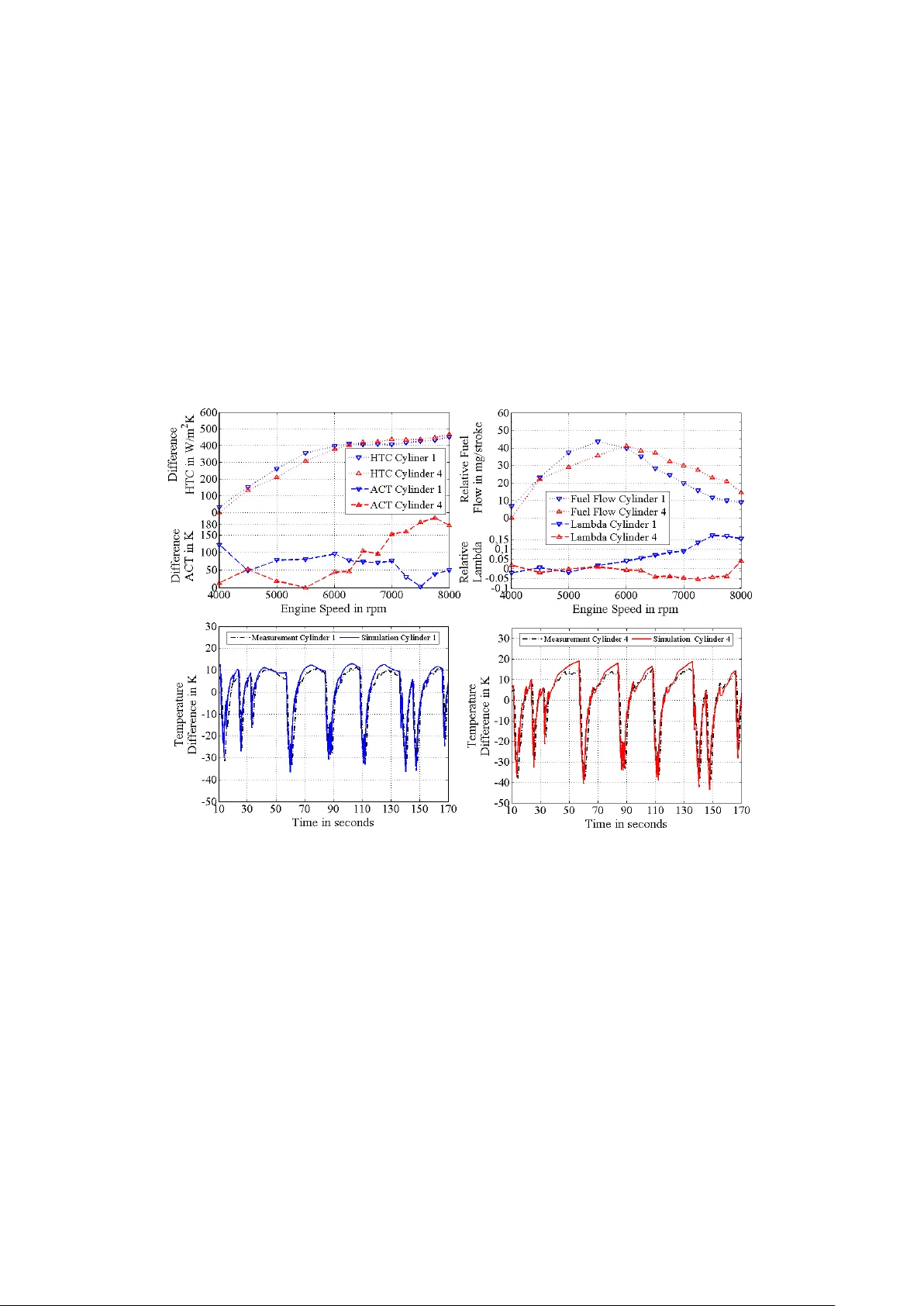
T ransien t temp erature calculation metho d for complex fluid-solid heat transfer problems with scattering b oundary conditions P eter H¨ olz a, ∗ , Thomas B¨ ohlk e b , Thomas Kr¨ amer a a Porsche AG, Porsche Motorsp ort, Porschestr. 911, 71287 Weissach, Germany b Chair for Continuum Me chanics, Institute of Engineering Me chanics, Karlsruhe Institute of T e chnology (KIT), Kaiserstr. 10, 76131 Karlsruhe, Germany Abstract A calculation metho d for engine temp eratures i s presen ted. Sp ecial fo cus is placed on the transien t and scattering b oundary conditions within the combustion cham b er, including fired and coasting conditions, as well as the dynamic heat transfer of the w ater jac ket. Mo del reduction is achiev ed with dimensional analysis and the application of probabilit y densit y functions, whic h allows for a timescale separation. Stationary in-cylinder pressure measuremen ts are used as input v alues and, according to the transien t behavior, modified with an own part-load mo del. A turbo charged SI race engine is equipped with 70 thermocouples at v arious positions in pro ximity to the combustion c ham b er. Differentiating from already published works, the metho d deals with the transient engine b ehavior during a race lap, which undergo es a frequency range of 0.1-1 Hz. This includes engine speed build-ups under gear changes, torque v ariations, or the transition from fired to coasting conditions. Differen t thermal b eha viors of v arious measuring p ositions can b e sim ulated successfully . Additionally , cylinder individual temp erature effects resulting from an unsymmetrical ignition sequence and different volumetric efficiencies with unequal residual gas can b e predicted. Up to a few percent, the energy balance of the water jac ket is fulfilled and v ariations of water inlet temp eratures can b e sim ulated accurately enough. Keywor ds: Similarit y mec hanics, Buc kingham Pi-Theorem, Conjugate heat transfer, Engine heat transfer, T ransien t simulation. Copyrigh t, including manuscript, tables, illustrations or other material submitted as part of the manuscript, is assigned to the authors. Con ten ts 1 In tro duction 2 1.1 State of the art . . . . . . . . . . . . . . . . . . . . . . . . . . . . . . . . . 2 ∗ Corresponding author. T el.: +49 711 911 88680 Email addr ess: peter.hoelz@porsche.de (Peter H¨ olz) Pr eprint submitted to arXiv June 21, 2021 1.2 Outline of the pap er . . . . . . . . . . . . . . . . . . . . . . . . . . . . . . 3 1.3 Metho d used in this pap er . . . . . . . . . . . . . . . . . . . . . . . . . . . 4 2 Programming details 7 3 Determination of b oundary conditions b y means of similarit y mec han- ics 10 3.1 Heat transfer mo deling in the inlet and outlet system . . . . . . . . . . . . 10 3.2 Heat transfer mo deling in the combustion cham b er - F ull load condition - . . . . . . . . . . . . . . . . . . . . . . . . . . . . . 11 3.3 Heat transfer mo deling in the combustion cham b er - Coasting condition - . . . . . . . . . . . . . . . . . . . . . . . . . . . . . 12 3.4 Heat transfer mo deling in the combustion cham b er - P art load condition - . . . . . . . . . . . . . . . . . . . . . . . . . . . . . 12 3.5 T ransien t heat transfer due to v ariations of w ater mass flo w and temperature 14 3.5.1 Mo del reduction based on similarity mechanics . . . . . . . . . . . 14 3.5.2 Increased heat transfer due to turbulence . . . . . . . . . . . . . . 15 4 Results and discussion 16 4.1 Single cylinder calibration . . . . . . . . . . . . . . . . . . . . . . . . . . . 17 4.2 Cylinder individual effects . . . . . . . . . . . . . . . . . . . . . . . . . . . 20 4.3 V ariation of w ater quan tities - Simplified calculation metho d . . . . . . . 22 4.3.1 V ariation of w ater mass flow rate . . . . . . . . . . . . . . . . . . . 22 4.3.2 V ariation of w ater inlet temp erature . . . . . . . . . . . . . . . . . 25 5 Conclusions 26 6 Nomenclature 27 7 References 31 1. Introduction 1.1. State of the art A precise engine thermal managemen t should b e targeted at as little as p ossible heat transfer to solid comp onen ts. The underlying thermomechanical fatigue mechanisms are v ery sensitive to temp erature c hanges. As an example, aluminium alloys lik e wrought allo y 2618A show a great temp erature dep endence of its high cycle fatigue resistance [ 1 ]. Differen t fatigue mechanisms lik e low cycle fatigue (LCF) or high cycle fatigue (HCF) react differen tly to temp erature c hanges. F urthermore, other fatigue mechanisms like creeping b ecome more imp ortant with increasing solid temp eratures. The w ell-known deformation and fracture mechanism maps [ 2 ] can giv e a goo d ov erview in eac h case. In order to describe quan titatively crack initiation and propagation caused b y the com bi- nation of all p ossible fatigue mechanisms, calculation metho ds are required to determine solid temperatures. T ransien t engine b ehaviour and the resulting temperatures also influence other asp ects lik e fuel consumption or emissions. A new method for estimating transient engine-out 2 temp eratures and emissions is presen ted in [ 3 ]. As an example, an increase of fuel con- sumption ab out 25 percent is reported at a cold start with a gasoline-pow ered engine. Another example are HC emissions in SI engines: ab out 60-80 percent of the emissions result in the cold initial phase when the engine, esp ecially the catalyst, is cold [ 4 ]. One part of the problem arises from flame extinction at cold walls. Ho wev er, due to re- diffusion into the extinguishing flame, some unburn t hydrocarb ons can b e consumed [ 5 ]. One possibility to deal with cold initial phases are h ydro carb on trap strategies [ 4 ]: cold HCs are adsorb ed un til the TWC catalyst reaches the ligh toff temperature. Early works addressed the problem of engine heat transfer with dimensional analysis and exp erimen tal studies: [ 6 ], [ 7 ], [ 8 ]. In addition to these more phenomenological re- sults, simple lump ed turbulence mo deling tec hniques can show the physical backgroun d of heat transfer in more detail: using a global k - ε model, [ 9 ] prop osed a heat transfer mo del with a Reynolds-Colburn analogy . In c hapter 3.2 , a more detailed description of quasi-dimensional turbulence modeling is giv en. There also exist man y w orks which uses three-dimensional CFD in-cylinder flow sim ulations, including com bustion and heat transfer pro cesses: [ 10 ], [ 11 ], [ 12 ]. [ 13 ] proposed a metho d which couples detailed CFD tec hniques with a simplified engine working pro cess analysis in order to ensure the ov er- all heat transfer rate. Additionally , sp ecific mo dels w ere dev elop ed for different kind of engines or flow structures: Relating to heat transfer, HCCI (Homogeneous Charge Com- pression Ignition) engines are inv estigeated in [ 14 ], [ 15 ] and [ 16 ]. Similarly , h ydrogen engines are studied in [ 17 ], [ 18 ] or [ 19 ]. In this context, a design of exp erimen ts metho d is applied in [ 20 ]: V arious engine settings like, e.g., ignition timing, air-fuel ratio, fuel or compression ratio, are in vestigated. In a more fundamen tal manner, the P olhausen equation in seven different op erating regimes is v erified. In literature, one can find v arious stationary temperature analysis of combustion engines b y using CFD-CHT metho ds: [ 21 ], [ 22 ], [ 23 ]. Unfortunately , steady-state engine tem- p eratures are significan tly differen t from transient conditions. Within the framework of thermo-mec hanical fatigue analysis, many transien t FEM sim ulations can b e found: [ 24 ], [ 25 ], [ 26 ], [ 27 ]. How ever, suc h typical time sections of these self-contained temper- ature cycles are in the range of one minute, e.g., 0.02 Hz: run-stop conditions should b e simulated. There also exist combustion-cycle resolved thermal analysis with detailed in-cylinder heat transfer treatement: [ 28 ], [ 29 ], [ 30 ]. Ho w ever, these simulations describ e a high-frequency timescale in the range of the com bustion perio d, e.g, 8-80 Hz, depending on the engine sp eed. Crank angle resolved calculations corresp ondingly deal with fre- quencies of up to sev eral tens of Kilohertz. In this con text, big c hallenges are transien t b oundary conditions under transien t drives with frequencies betw een the aforementioned ones, e.g., in the range of 0.1-1 Hz. Two- and three-dimensional transient finite-element mo dels are presen ted in [ 31 ]. It b ecomes clear that the correct determination of thermal b oundary conditions is mandatory . The essen tial role of engine operational transients, e.g., sudden c hanges in sp eed and/or load, is presented in detail. Ho w ever, con tinuously c hanging engine states like transitions b et ween fired and motored condition, including sp eed build-ups with gear changes and part load sections, are not presen ted. That is exactly the fo cus of the presented pap er. 1.2. Outline of the p ap er Regarding daily developmen t w ork and the current av ailable computing p ow er, it is not p ossible to in vestigate every p ossible thermo dynamic state of an engine during a transien t 3 driv e with detailed 3D-CFD simulations, con taining heat transfer treatmen ts. Therefore, the researc h question can b e form ulated as follows: With regard to the dynamic response of engine comp onen t temp eratures and the heat flux of the water jac ket, is it p ossible to dev elop a transien t calculation metho d which is a work able solution tec hnique in the in- dustrial practice? In particular, with resp ect to the different thermal b eha vior of v arious comp onen ts and to v ariations in the engine setting like air-fuel ratios or w ater temper- atures, ho w should the metho d b e established in order to resolve the aforemen tioned frequency range of 0.1-1 Hz? Using dimensional analysis and a statistical description of all relev ant quan tities, a MA TLAB c - StarCCM+ c in terface w as dev elop ed and implemen ted, which provides transien t thermal b oundary conditions for a subsequent three-dimensional finite volume sim ulation. By using in-cylinder pressure measuremen ts under stationary conditions as an input, the method can account for different engine mappings or cylinder individual effects. Small deviations from these stationary states under a transien t drive, resulting from div erse v ariations in ignition time or air-fuel ratio, are mo delled with an own de- v elop ed p art lo ad mo del , which is described in c hapter 3.4 . Due to restricted calculation time, a detailed CFD sim ulation of the water jac ket, includ- ing turbulence mo deling, can not b e p erformed under transient conditions. T o calculate w ater heat transfer, a new metho d for determining heat transfer co efficients is, therefore, presen ted. The metho d w as v alidated with a turb o c harged SI engine. Cylinder individual heat transfer phenomena, resulting from different volumetric efficiencies and unequal residual gas, are shown. Moreo ver, differen t transient b eha viours of v arious measuring p oin ts around the combustion cham b er are presented. Finally , a v ariation of the w ater inlet temp erature and the resulting effect on solid temp eratures is shown. 1.3. Metho d use d in this p ap er The presented metho d distinguishes b etw een inner and outer b oundary conditions for an engine. The outer b oundary conditions can b e defined as a time-dependent, five- dimensional engine state matrix: M ( t ) = ( n engine ( t ) , m air ( t ) , t int ( t ) , T i ( t ) , m fuel ( t )) . (1) The entries are engine sp eed, air mass flo w rate, inlet air temp erature, induced torque and fuel mass flow rate, resp ectively . Either, these quantities can b e measured, or they can b e mo delled within the electronic con trol unit (ECU). In the context of a threed- imensional, transient finite-volume simulation, one has to determine the inner b ound- ary conditions; more sp ecifically , the thermal b oundary conditions. In the follo wing, a metho d is suggested how one can translate outer, c onc entr ate d b oundary conditions in to inner, distribute d b oundary conditions. 4 Figure 1: Metho d ov erview to generate b oundary conditions for a 3D FVM simulation. T rac k data M ( t ) and pressure indication measuremen ts p ( α cr ), as function of crank angle α cr , are required. Usually , the reference temp erature T ref , which is related to the heat transfer coefficient α , is the in-cylinder gas temp erture. An ov erview of the metho d is sho wn in Fig. 1 . With the help of an self-programmed co de in MA TLAB c , b oundary conditions are determined for a subsequen t 3D-FVM sim ulation of the full engine. Therefore, the engine state M ( t ) is imp orted by track telemetry with a high enough sampling frequency . All measured states are discretised in a 5D engine state matrix for whic h a histogram is computed. This histogram is normed in order to use it as an appro ximation for the probability density function p n for the random v ariable n which describ es the 5D engine state. Th us, in this case, the engine state is in terpreted as a random v ariable. F or stationary simulations, this densit y function can be used to get a kind of exp ectation field of the solid temp erature h T i ( x ). The exp ectation v alue with resp ect to time is denoted by h·i . This field can b e used for comparison purp oses b etw een different engine mappings or race tracks. It also serves as an initial solution for subsequen t transient simulations. Additionally , one needs a high pressure indication measurement p ( α cr ) of the in-cylinder gas pressure as a function of the crank angle α cr . In this pap er, these stationary measurements w ere resolv ed with 0.1 ◦ CA. The full-load curve consisted of 14 engine sp eed p oin ts for which 60 complete engine cycles were recorded in order to take account of the scattering nature of combustion pro cesses. Therefore, a piezo-quartz pressure transducer was moun ted on the cylinder head. According to forced conv ection, thermal b oundary conditions are assumed to b e of the Newton-form: q = − α ( T ref − T s ) n . (2) In this case, the heat flux vector q , which p oin ts in the direction of the surface normal v ector n , is calculated from the temp erature difference b etw een a w ell-defined reference temp erature T ref and the solid temp erature T s . The prop ortionalit y constant is the heat transfer co efficien t α (HTC). Different mo dels can b e used to calculate this coefficient with the help of the measured pressure data p ( α cr ). Again, b oth quantities are inter- preted as random v ariables. How ever, in this case one has to use conditional probability densit y functions. In the case of heat transfer co efficien ts, this is p α | n with n as the random v ariable of the engine state. One can easily show that following relation holds for conditional probability density functions [ 32 ]: p α | n ( A | N ) = p αn ( A, N ) /p n ( N ) . (3) The realisations of the b oth random v ariables α and n are describ ed with A and N . The 5 join t probability densit y function is given b y p αn ( A, N ). It must b e noted that the tw o random v ariables are strongly statistically dep endent: p αn ( A, N ) 6 = p α ( A ) p n ( N ) . (4) Ph ysically sp eaking, a heat transfer co efficien t α strongly dep ends on the engine state M ( t ). The description as a random v ariable is quite useful b ecause one can pa y atten tion to the cyclic fluctuations in the pressure curves as well as the intermitten t op eration of an engine, without simulating each stroke in detail. Therefore, this method implies a lo w-pass filter function which only resolves the lo wer frequencies in the range of the c haracteristic frequencies of the engine state M ( t ). High frequencies of the individual engine cycles are filtered out. Therefore, in the case of a four-stroke engine, a time discretization in the order of 2 (1 /n engine ) 60 ≥ 0 . 015 seconds is used. In this pap er a race engine is inv estigated. As can b e seen in Fig. 4 , most of the time, suc h a race engine is in the full-load or in a coasting state. That is the reason wh y only the full-load curv e was measured. How ever, in chapter 3.4 , a part load mo del is suggested whic h can b e used for mo deling probability density functions for engine states whic h significantly differ from the full-load or coasting state. In summary , one gets for an y arbitrary random v ariable ˜ f ( α, n ) follo wing expressions for its expectation v alues. In case of a quasistationary simulation in order to calculate a kind of exp ectation v alues h T i ( x ): h ˜ f ( α, n ) i = Z · · · Z R 5 ≥ 0 Z R ≥ 0 ˜ f ( A, N ) p αn ( A, N ) dA dN = Z · · · Z R 5 ≥ 0 Z R ≥ 0 ˜ f ( A, N ) p α | n ( A | N ) dA | {z } h ˜ f ( α,n ) | n = N i p n ( N ) dN . (5) In case of a transien t simulation in order to calculate time-dep enden t exp ectation v alues h T i ( x , t ): h ˜ f ( α ) i ( t ) = Z R ≥ 0 ˜ f ( A ) p α | M ( t ) ( A ) dA. (6) Equation ( 5 ) and ( 6 ) apply to b oth, the w etted surfaces with gas, like v alves, channels or the combustion cham b er, as w ell as the w ater c hannel. How ever, as will b e explained later in chapter 3.5.1 , the HTC for the water channel is assumed to be clearly deter- mined for a given engine sp eed n engine . In this case, the probability density function is the Dirac Delta-Distribution. It must b e noted that p α | n ( A | N ) also con tains coasting conditions, that means T i = 0. The inner integral of equation ( 5 ) gives the conditional mean h ˜ f ( α, n ) | n = N i of the random v ariable ˜ f ( α, n ). Note that, due to the nonlinearity in equation ( 2 ), a statistically mo dified reference temp erature h αT ref i / h α i is necessary: 6 h q i = −h α i h αT ref i h α i − h T s i n . (7) Whenev er it will b e sp ok en of a reference temp erature, this mo dified version is mean t. In the follo wing, the acronym ACT, for a verage cylinder temp erature, is used. Remem- b er that equation ( 5 ) and ( 6 ) also applies to the mo dified reference temp erature. F or stationary conditions, details to the prop osed statistical metho d can b e found in [ 33 ]. 2. Programming details In Fig. 2 , an ov erview of the co de structure is shown. Beginning with the calculation of the probability densit y functions for the HTC and A CT with the help of pressures measuremen ts, the analysis of the transient engine states follows. The stationary matrix M stat corresp onds to the engine state matrix M ( t ) from equation ( 1 ) for the stationary measuring p oin ts. It serves as a reference state to which the transient states M ( t ) are related. Esp ecially , using the part load mo del from c hapter 3.4 , ratios of the matrix en- tries are of in terest. Afterwards, for each discretized engine state, the coasting condition is mo delled and the corresp onding probability density functions are calculated. In the end, the PDF’s are in tegrated in order to get quasistationary , h ˜ f ( α, n ) i , or transien t, h ˜ f ( α ) i ( t ), boundary conditions for the subsequent FVM sim ulation. Figure 2: Programming o v erview. The probability densit y functions are implemented as normed histograms. Therefore, a discretization for each state v ariable, e.g., the inner and outer b oundary conditions, is needed. Just like the mo delled HTC and ACT from chapter 3 , the engine state matrix 7 M ( t ) is represented as a real matrix which is called e dges . It consists of fiv e dimen- sions: eac h of them consists of a vector with different num b er of elements, dep ending on the discretization level of the corresp onding v ariable. It is imp ortan t to note that the histograms hav e to b e normed regarding the corresp onding integration field. Multidi- mensional in tegration uses F ubini’s theorem resulting in a piecewise in tegration o ver all dimensions of M ( t ). In case of equation ( 5 ), it follo ws: h ˜ f ( α, n ) i ≈ X N f master ( N ) z }| { X A ˜ f ( A, N ) ˆ p α | n ( A | N ) ∆ A ! | {z } f slav e ( N ) ˆ p n ( N ) ∆ N . (8) The corresponding normed histograms, with resp ect to b oth summations, are described b y ˆ p α | n ( A | N ) and ˆ p n ( N ). Note that the part load mo del (See c hapter 3.4 for details) only c hanges the function f slav e ( N ) which has the same structure as the matrix e dges . It’s clear that lots of entries of ˆ p n ( N ) are zero b ecause some com binations are not ph ysical: As an example, one can not get a p ositive v alue for the induced torque T i > 0 if no fuel is injected m fuel = 0. One has to mention that the discretization of the engine state matrix M ( t ) can be theoretically infinitely small, dep ending on calculation pow er. Ho wev er, the measured full load line on the test b enc h has an finite num b er of engine sp eed grid p oints. That is the reason why the function f slav e ( N ) | n engine , ev aluated for a sp ecific engine sp eed n engine , is received by linearization b et ween corresp onding test b enc h engine sp eed grid p oin ts n left engine and n right engine : f slav e ( N ) | n engine = (1 − a ) f slav e ( N ) | n left engine + af slav e ( N ) | n right engine , (9) with n left engine ≤ n engine ≤ n right engine , (10) and a = n engine − n left engine n right engine − n left engine . (11) In order to p erform transient simulations, one does not need exp ected v alues in the form ( 8 ): in this case, one needs the conditional mean h ˜ f ( α, n ) | n = N i . Of course, this v alue is a function of time b ecause the engine state matrix M ( t ) is a function of time. F or this kind of sim ulation, a p oin ter matrix P was implemented which is a matrix with the same num b er of ro ws as p oints in time, which dep ends on the sampling rate of M ( t ) and the temp oral discretization of the 3D FVM simulation, and fiv e columns, corresp onding to the five-dimensional engine s tate. These columns contain the p osition within the matrix f slav e ( N ). The pro cedure is given in Fig. 3 : F or a given simulation time t Sim , the corresp onding matrix row n Sim con tains the p oin ter vector P ( n Sim , :). It pro vides the necessary indices for the matrix f slav e . As an example, in Fig. 4 a) a pro jection of the fiv e-dimensional engine state M ( t ) for a typical race lap is shown. The state matrix is pro jected onto the T i - n engine subspace. The coasting state is described by the condition T i = 0. Statistical analysis shows that ab out t wo third of the complete time the engine 8 is in full load state, while ab out a quarter of the p erio d the coasting condition is fulfilled. In Fig. 4 b) and c), the corresp onding discretized sample space is shown. Figure 3: T ransient sim ulation method. Boundary conditions are determined and sav ed in a MA TLAB c en vironment. The subsequent finite volume simulation is done with the aid of the softw are StarCCM+. 9 a) b) c) Figure 4: a) Exemplary scatter plot in the T i - n engine sample space for a t ypical race lap. b) Corresp onding even t counting in a discretized sample space with v ariable mesh size. c) Corresponding relative density of the even ts. 3. Determination of b oundary conditions by means of similarity mec hanics F or all fluid-w etted surfaces, e.g., the combustion cham b er walls, the inlet and outlet c hannels as well as the w ater channels, b oundary conditions lik e equation ( 5 ) or ( 6 ) are required. In the follo wing, a brief summary about the most imp ortant mo dels is given. 3.1. He at tr ansfer mo deling in the inlet and outlet system The correlation according to [ 34 ] N u v = 1 , 84 Re 0 . 58 v ( D v /l v ) 0 . 2 (12) is used for the outlet v alv e stem. The Reynolds num b er and Nusselt num b er, whic h are based on the v alve lift l v and the exhaust jet gas v elo cit y , are describ ed by Re v and N u v , resp ectively . The diameter of the v alv e is D v . F or the inlet v alve stem, a similar expression can b e assumed [ 35 ]. In this case, the co efficient in equation ( 12 ) has to b e reduced b y 40 p ercen t. F or the in take p ort, a simple form of N u = cRe m , (13) with a co efficien t c and exponent m is used. According to a fully developed flow, in this pap er, a v alue of one was used for the exp onen t m . The co efficien t c is used as a calibration parameter. F or the exhaust p ort, follo wing model is proposed [ 34 ]: 10 N u = q (8 Re j P r /π ) . (14) In this case, N u and Re j are based on the duct diameter and the exhaust jet gas velocity . The Prandtl num b er P r = ν /a describ es the ratio b etw een the kinematic viscosity ν and the temperature conductivity a . 3.2. He at tr ansfer mo deling in the c ombustion chamb er - F ul l lo ad c ondition - In this paper, the mo del according to Bargende is chosen for the heat transfer co efficien t α [ 36 ]. F or the reference temperature in equation ( 2 ), the cylinder-a verage gas temp erature T g = pV N R (15) is used. N is the amount of substance, R the universal gas constant and V the total v olume. In the following, only the most imp ortan t equations for the heat transfer mo del are given. In complemen tarity with the original formulation, the c haracteristic v elo cit y v additionally consists of a scaled combustion con vection v c [ 37 ]: v = q (8 / 3) k + v 2 p + v 2 c , (16) v c = 6 √ y B 4 d y d t − T ub T g d x d t . (17) In equation ( 17 ), the engine b ore diameter is given by B . Using the turbulent kinetic energy k and the curren t piston sp eed v p , the other tw o summands describ e v elo cit y fluctuations due to turbulence and the in-cylinder flow structure. According to a t wo- zone combustion mo del, the ratio b etw een burnt and complete in-cylinder volume is giv en by y . Similarly , the mass fraction is given by x . Beginning with the ignition time, the unburn t gas temp erature T ub is calculated with the assumption of a p olytropic compression and a homogeneous in-cylinder pressure. According to [ 38 ], the burnt gas temp erature is mo delled by using the volume balance of the tw o zones and the ideal gas law. T ogether with the pressure indication measurements p ( α cr ) from Fig. 1 , the necessary burn function is gained with a pressure trace and com bustion analysis. T o calculate the turbulent kinetic energy k in equation ( 16 ), a lump ed turbulence mo del is necessary . In this paper, the mo del according to [ 39 ] is used. Assuming isotropic, homogenous turbulence for equilibrium conditions, the turbulen t dissipation rate ε is giv en by ε ∼ k 3 / 2 /l with a characteristic eddy length scale l , which is given b y the com bustion cham b er volume V according to l = (6 /π V ) 1 / 3 . On the basis of the rapid distortion theory , e.g., serving the angular momen tum, the turbulen t kinetic energy k is related to the eddy length scale l according to k 1 / 2 ∼ l . The conserv ation of mass finally gives the turbulent pro duction rate d k ∼ 2 k / (3 ρ ) d ρ , resulting in the following differen tial equation: d k d t = − 2 3 k V d V d t − ε c k 3 / 2 l . (18) 11 T ogether with the initial condition at the inlet v alve closed state, the mo del constant ε c is aligned with a three-dimensional in-cylinder CFD sim ulation for a representativ e engine sp eed of 7000 rpm. The sensitivity of the initial v alue to the engine speed is then mo delled according to [ 40 ]. In [ 41 ], within the framew ork of a quasi-dimensional combustion mo del, equation ( 18 ) is supplemented with a sp ecial squish term, and the initial condition is used for engine sp ecified adjustments. F urther effects on the temp oral evolution of the turbulent kinetic energy , like fuel injection, tum ble or swirl flo w, are presented in [ 42 ]. The alternative, quasi-dimensional turbulence mo del in [ 43 ] contains tw o differential equations for k and ε . Additionally , the t w o proportional constan ts for ε ∼ k 3 / 2 /l and d k ∼ 2 k / (3 ρ ) d ρ are ev aluated in more detail. Similarly , [ 44 ] mo dels a zero-dimensional energy cascade through a coupled, ordinary differential equation system for the mean kinetic energy and the turbulent kinetic energy . Completing this approach, [ 45 ] also considers pro duction terms whic h are related to the flow through the intak e and exhaust v alves. F or the necessary energy transfer rate, different approaches can b e found in literature: [ 46 ] or [ 47 ]. The last one systematically transforms the three-dimensional conserv ation equations of the RANS k - ε mo del in to a quasi-dimensional turbulence mo del. 3.3. He at tr ansfer mo deling in the c ombustion chamb er - Co asting c ondition - Using the first three entries of the five-dimensional engine state matrix M ( t ) and an isen tropic assumption for the motored pressure during compression and expansion, pV κ = p ini V κ max , (19) the heat transfer co efficient under coasting conditions can b e easily mo delled. In this case, κ is the isentropic exp onen t. The subscripts denotes the initial pressure and the maxim um v olume. In literature, on can find v arious approac hes for conv ective heat trans- fer equations under motored conditions. The influence of engine speed is inv estigated in [ 48 ]. In [ 49 ] an alternative model for motored conditions is suggested and compared with con ven tional engine models. A review about this topic is giv en in [ 50 ]. The effect of gas prop erties is explicitly in v estigated in [ 51 ]. 3.4. He at tr ansfer mo deling in the c ombustion chamb er - Part lo ad c ondition - Most of the time, a race engine op erates in full load or coasting conditions. Nevertheless, a full load state under race conditions differs from stationary measuremen ts on a test b enc h. According to Fig. 4 a), it do es not exist a line, but rather a small subspace of full load p oin ts. The ECU has to adjust p ermanen tly the op erating conditions: Ignition angle, fuel and air mass flow - to name just a few asp ects. Moreo ver, inertia effects of sev eral subsystems like turb o c hargers cause transient b oundary conditions: generating the required b o ost pressure after coasting needs time resulting afterw ards in some ov er- sho ots. In the following, an attempt is shown how to model heat transfer co efficien ts and corresp onding reference temp eratures with the help of stationary full load data. An o verview is given in Fig. 5 . The probability density functions derived with measured pressure data from the stationary test b enc h serv e as input. In dependence of the tran- sien t engine state M ( t ), new probability density functions are mo delled. In this pap er, all v ariances from the stationary conditions are called p art lo ad conditions. 12 Figure 5: Metho d ov erview for generating probability density functions for HTC and A CT at part load conditions. Given are the probability density functions at full load condition and the engine state matrix M ( t ). In the follo wing, a v ery simple model for the heat transfer coefficient in the combustion c hamber is presented. All other heat transfer coefficients can be modelled in an analogous manner. This summary briefly outlines the main tec hniques: details to the suggested part load mo del as w ell as its v alidation under stationary b oundary conditions can b e found in [ 52 ]. The matrix entries of M ( t ), describing the transient engine condition according to equation ( 1 ), and M stat , the corresp onding full load state at stationary conditions, are related. Let α stat and α ( t ) b e tw o realisations for the heat transfer co efficient in the state M stat and M ( t ), resp ectively . Using following approach for the transformation of realisations α ( t ) = β ( M stat , M ( t ) , α stat ) α stat , (20) the new probability density functions according to equation ( 5 ) and ( 6 ) can b e easily calculated. F or the mathematical background, see [ 32 ]. Starting from the simplified correlation according to W oschni [ 7 ] α ∝ p m v m T 0 . 75 − 1 . 62 m g , (21) the transformation co efficien t β can b e describ ed b y β ( M stat , M ( t ) , α stat ) = p | M ( t ) p | M stat m v | M ( t ) v | M stat m T g | M ( t ) T g | M stat ! 0 . 75 − 1 . 62 m . (22) Approac hes for the sp ecific ratios in equation ( 22 ), as a function of the matrix entries of M ( t ) and M stat , can b e found in [ 52 ]. In Fig. 6 , an example for using the part load mo del is shown. The inlet temp erature t int w as kept constant, resulting in a four-dimensional engine state matrix M ( t ) from equation ( 1 ). In order to visualize the different impacts, the m air - m fuel sample space is meshed with a m uch coarser mesh size than the T i - n engine sample space. The red separate sub divisions of the heat transfer coefficients result from the coarse mesh. The v ariation within one subdivision is the result of the T i - n engine sample space, whic h has a finer mesh. F or comparison purp oses, the full load line, resulting from stationary measurements on the engine test b enc h, is plotted as a blue reference line. The step function results from the engine sp eed discretization. 13 Figure 6: Example for using the part load mo del for a represen tativ e race lap. The T i - n engine and m air - m fuel sample spaces are shown and discretized with different mesh sizes. V alues are normed to corresponding maxim um v alues. The resulting HTC sample space is shown on the righ t side: V alues give the difference to the maximum, stationary HTC. 3.5. T r ansient he at tr ansfer due to variations of water mass flow and temp er atur e 3.5.1. Mo del r e duction b ase d on similarity me chanics According to similarity mechanics, one can assume a correlation of the form N u = f ( Re, P r ) for the water c hannel. Because of the large heat capacity of water, the tem- p erature in the water jack et v aries quite slowly . Its difference during one lap is in the range of 5 K. Therefore, the dep endence on the Prandtl num b er P r can b e negle cted. With the same argument, the viscosity in the Reynolds n umber can b e ignored, resulting in a pure dep endence of the water velocity . Actually , it is very expansive to simulate nearly every o ccurring water mass flow rate during one lap within a detailed CFD simu- lation. Additionally , if one w ants to inv estigate solid temp erature curv es with transient sim ulations one ough t to map the heat transfer co efficients at every time step on the solid mesh, resulting in an extremely high effort. Alternativ ely , one could simulate the fluid region with the transient Na vier-Stokes equations simultaneously . How ever, due to turbulen t flo w with thin b oundary la yers, m uc h more cells w ould b e necessary in compar- ison with a pure solid simulation. Therefore, a new metho d is presented by simulating heat transfer by means of CFD for only one reference water mass flow rate. The result of this stationary reference simulation is a heat flux vector for each solid cell, e.g., a field function q ref ( x ). Assuming a correlation N u = f ( Re, P r ) with a Reynolds exponent m , follo wing separation approac h for the HTC in transient simulations can b e formulated: α ( x , t ) ≈ ˜ c ref ( x ) v m water ( t ) ∼ c ref ( x ) n m engine ( t ) . (23) The prop ortionality factors ˜ c ref and c ref con tain implicitly the field function q ref ( x ) from the stationary r eference sim ulation. v water is a c haracteristic v elo city of the w ater c hannel 14 flo w. Due to the water pump and the fixed transmission ratio with resp ect to the engine, this velocity is prop ortional to the engine sp eed. Consequently , the transien t HTC can b e approximated with α ( x , t ) ≈ α ref ( x ) n engine ( t ) n engine | ref m . (24) n engine | ref is the engine sp eed in the stationary reference sim ulation. This reference engine sp eed should b e chosen carefully according to the weigh ted av erage n engine | ref = ( h n m i ) 1 /m . (25) Due to the isothermal assumption in equation ( 24 ), temperature dep endencies of the form ∝ λ/ν m P r n are neglected. In this case, the Prandtl exp onen t is describ ed with n , and the thermal conductivity is denoted with λ . The kinematic viscosity is ν . The mapp ed reference heat transfer co efficient α ref is determined by α ref ( x ) = q cond ( x ) · n ( x ) ( T ref − T s ( x )) . (26) In this case, q cond is the heat flux vector due to heat conduction in the solid part, and n is the b oundary normal v ector. Moreov er, T ref is the sp ecified reference temperature, e.g., the water inlet temp erature, and T s is the solid temp erature of the w all next cell. 3.5.2. Incr e ase d he at tr ansfer due to turbulenc e The determination of the reference HTC α ref ( x ) is based on a CFD-CHT calculation metho d. Therefore, the SST k - ω turbulence mo del by Menter [ 53 ] is used. According to the approac h by Boussinesq, the Reynolds stress tensor R is mo delled with the turbulen t viscosit y ν t ( x ) = k ˜ T with the time scale ˜ T = max ( ω , S F 1 /a 1 ) − 1 . F 1 is a smo othing function which is one at the wall and go es to zero with increasing wall distance. Balance equations are solv ed for the tw o additional field v ariables k = 1 / 2 h u · u i , with the v elo cit y v ector u , and ω = /k . According to = 2 ν h s · · s i , the turbulent dissipation is giv en b y , with s = sym(grad ( u 0 )). The dynamic viscosity is describ ed by µ = ν ρ , and the densit y is given by ρ . The transp ort equations for a fixed control volume are then given b y d d t Z V ρk dV + Z A ρk h u i · d a = Z A µ + µ t σ k grad ( k ) · d a + Z V G k − ρβ ∗ ( ω k ) dV , (27) d d t Z V ρω dV + Z A ρω h u i · d a = Z A µ + µ t σ ω grad ( ω ) · d a + Z V G ω − β ρω 2 + D ω dV . (28) σ k and σ ω describ e turbulen t Prandtl num b ers. β , β ∗ and a 1 are mo del parameters, and G k is the pro duction term according to G k = µ t S 2 , with S = √ 2 S · · S and S = sym(grad ( h u i )). G ω = ργ S 2 and D ω ∼ ρ/ω grad ( k ) · grad ( ω ) describ e additional 15 pro duction terms, whereas γ is an additional mo del parameter. Increased heat transfer due to turbulence is calculated with the follo wing expression − div ( h u 0 T 0 i ) = div ( ρc p a t grad ( h T i )) . (29) The turbulen t Prandtl n umber P r t , whic h describ es the ratio b etw een the turbulent viscosit y ν t and the turbulen t temp erature conductivit y a t , was set to 0.9. The heat capacit y for constan t pressure is describ ed b y c p . Fluctuation v alues with respect to time are denoted by ( · ) 0 . Boundary la yer velocity and temp erature is mo delled with the help of the well kno wn w all la ws for the viscous and logarithmic lay er [ 54 ]. 4. Results and discussion According to the heat transfer mo del according to Bargende, the necessary model calibra- tion was done with a single cylinder engine. Afterw ards, no mo difications of the mo del parameters were carried out. F or mo del v alidation, transien t measurements on a full engine are used. Both engines are geometrically equal with resp ect to relev ant sections lik e the w ater c hannel, the combustion c hamber or the gas c hannels. 70 measuring points w ere moun ted on a turb ocharged engine, which is based on a Porsc he racing application. T yp e K thermocouples with an uncertain ty of 1 K w ere used for the measuremen t of solid temp eratures. A heat-conducting paste with a thermal conductivity of 2.5 W/(mK) w as put b et ween the solid surface and the thermocouples. Fluid temperatures were measured with Pt100 sensors, which ha ve an uncertain ty of 0.053 K. W ater temperatures w ere mea- sured at the inlet and outlet. According to equation ( 26 ), these quantities are used as reference temp erature for each time step during the transient simulation. Additionally , a measuring turbine for the volume flow rate was installed. In Fig. 7 , some measuring p oin ts for one cylinder are shown. The holes for all measuring p oints ended ab out one millimeter below the surface. 16 Figure 7: Exemplary measuring points for one cylinder in red. F or a clear presentation, some comp onen t edges are plotted. Upp er row: Overview of all measuring points. Lo wer ro w left: Inlet and outlet channels as well as rings. Low er row centred: Liner shoulder with axial v ariation. Lo wer ro w righ t: Combustion cham b er wall of cylinder head with spark plug and intermediate measuring point in b et w een t wo cylinders. 4.1. Single cylinder c alibr ation As already mentioned, the HTC mo dels were calibrated with a single cylinder engine. Therefore, one represen tativ e, stationary measuring p oin t on the full load line w as used: the engine sp eed w as n engine = 6000 rpm. P arameter V alue P arameter V alue λ cmb 1.095 max. m fuel 80.6 kg/h t int 293.15 K t waterin 373.65 K T able 1: T est parameters for in v estigation of water heat flow and cylinder individual effects. As an example, a transient drive with the test parameters presented in table 1 is in vesti- 17 gated. Firstly , the w ater heat transfer is shown in Fig. 8 . As one can see, the maximum sim ulated heat flow is within the range of measurement inaccuracy . The heat flow is calculated with the volume flow rate, the heat capacity and the temp erature difference b et w een inlet and outlet. In the detail section b elow, one can see a sligh tly phase shift within the gear changes. The differences b et ween simulation and exp eriment is ab out 10 p ercen t at the b eginning. On the left side, ra w data are plotted. Because of the thermal inertia effect of sensors, measurement quality can b e impro v ed b y correcting water tem- p eratures according to T cor = T + τ c d T / d t . The time constant τ c can b e determined b y measuring the step response time. How ever, heat flo w measuremen ts ha ve some p oten tial sources of errors: Besides the measurement uncertaint y of volume flow rates, the high sensitivit y to temp erature changes is challenging. Because of the large heat capacit y of w ater, a small temp erature change results in a high difference in heat flow. Additionally , the measuring p ositions of the sensors make some differences. In transien t experiments, there is another asp ect: strictly sp eaking, simultaneous measurement of inlet and outlet temp eratures is not right. That is the reason for the slightly phase shift in Fig. 8 : the w ater takes some time to flo w through the complete engine. Moreo ver, pulsating flow can increase or decrease heat transfer in turbulen t pip e flo ws. An analytical study ab out this problem can b e found in [ 55 ] for laminar flows. In addition to the Reynolds num- b er, there are m uch more system parameters which influence heat flow: Prandtl n umber, oscillating frequency and amplitude as well as the entry length of pip es. Exp erimental results with comparable parameters prev ailing in engine water channels can b e found in [ 56 ] or [ 57 ]. Cho osing P r ≈ 1, Re ≈ 10 4 − 10 5 and the oscillating frequency in the range of 1 − 5 Hz, the Nusselt n umber increase, respectively decrease, is ab out 10 p ercen t. This can explain some discrepancies during gear changes. 18 Figure 8: Abov e: Complete transient w ater heat transfer for one racing lap. The settling time of ab out 10 seconds is not presented. The measuremen t tolerance tak es the un- certain ty of PT100 sensors into account. V alues are referred to the maximum measured heat flow. Below left: Detail section of the third acceleration phase including some gear c hanges. Ra w data are sho wn. Below right: Same detail section. Measured temp eratures are modified according to T cor = T + τ c d T / d t . Secondly , some solid temp erature curves are presented in Fig. 9 . Interestingly , one can observ e a different thermal b eha viour for each engine section. The temp erature at the inlet channel is quite constant and the differences b et ween sim ulation and measurement are negligible small. In the initial phase within the first 30 seconds, the simulation sho ws a settling pro cess. F or the outlet channel, one can observe a strong degressive character for the temp erature curve within acceleration phases. The temp erature amplitudes are in the order of 20 K. The simulation shows weak ov er- and undersho ots of ab out 3 K. Ho wev er, the mean v alue is exact enough. The inlet rings show a step-wise linear system resp onse for differen t time p erio ds. Again, mean v alues are similar for measuremen t and simulation. T emp erature measurements at the outlet rings are v ery challenging: Normally , the thermal conductivity is very low resulting in high temp erature gradients within a ring. Typical v alues are ab out 50 K/mm. Small position deviations of the thermo couple result in high temp erature discrepancies. In this case, it is a strong in- 19 trusiv e measuremen t metho d. The high thermal conductivity of thermo couples disturbs the temp erature field and increases the heat flow from the outlet rings. Nevertheless, sim ulated mean v alues are comparable with measurements. Ho wev er, the different tran- sien t b eha viour is noticeable: The sim ulation shows a contin ually gro wing temp erature, whereas the measured line is piecewise constant. Figure 9: Simulated and measured temp erature curves for v arious measuremen t p ositions. As reference temp erature, the measured mean v alues were chosen. Ab ov e left: Inlet c hannel. Ab ov e right: Outlet channel. Below left: Inlet ring. Below right: Outlet ring. 4.2. Cylinder individual effe cts Because of an unsymmetrical ignition sequence for the in vestigated engine, there are dif- feren t volumetric efficiencies with unequal residual gas. As an example, in Fig. 10 tw o cylinder liner shoulders with differen t thermal b ehaviours are presented. F or b oth cylin- ders, mean v alues as w ell as amplitudes of the simulated curves are in go o d agreement with experimental results. Ov er- or undershoots are temp orarily in the range of 5 K. It is more interesting that the presented metho d is able to predict the characteristic curves for each cylinder. Observing an increasing temp erature with a subsequent temperature drop at high-sp eed sections for the first cylinder, one can recognise a contin ual growth at cylinder four. As can b e seen in Fig. 10 , the main reason is the con trary progression of av erage cylinder gas temp eratures with increasing engine sp eed. Cylinder four has a 20 more stoichiometric combustion, whereas cylinder one gets higher air-fuel ratios result- ing in low er gas temperatures. This is physically meaningful b ecause it is well known that the laminar flame sp eed and the adiabatic flame temp erature ha v e their maxim um v alues when λ cmb is a little bit low er than one [ 5 ]. Remem b er that Fig. 10 only shows a verage gas temp eratures. According to equation ( 7 ), the statistically mo dified temp er- ature h αT ref i / h α i is needed. F or quantitativ ely accurate simulations, the progression of the HTC is at least as imp ortan t as gas temp eratures. In this case, the qualitative progression is the same for b oth cylinders. Cylinder one has some slightly smaller v alues for high engine sp eed sections. Figure 10: Differen t thermal loads for cylinder liner shoulders due to individual air- fuel ratios resulting from unequal residual gas. Ab ov e righ t: Injected fuel quantit y and lam b da v alue under stationary full load conditions. Lo w est fuel flow for cylinder four as w ell as the mean lambda for b oth cylinders at 4000 rpm are used as reference. Abov e left: Calculated HTC and ACT for b oth cylinders under full load state. In each case, the minim um v alues serv e as a reference. Below: Sim ulated and measured transient thermal b ehaviour for b oth cylinders. T emp erature differences according to measured mean v alues are plotted. In addition, Fig. 11 shows some spatial differences at the cylinder liner shoulder. Mea- suring p ositions near the exhaust side hav e ab out 20K higher temp eratures at the end of straight. Main reason is the less heat dissipation b ecause of the hot exhaust c hannel of the cylinder head. 21 Figure 11: T emp erature curves for different measuring p ositions at the cylinder liner shoulder of cylinder four. The mean temp erature of the measured inlet temp erature, fron t of the engine, is used as a reference. 4.3. V ariation of water quantities - Simplifie d c alculation metho d 4.3.1. V ariation of water mass flow r ate In order to v alidate the prop osed calculation metho d for transien t water mass flow from c hapter 3.5 , stationary measurements with different water mass flo w rates are compared with simulation results. Therefore, the engine sp eed was kept constan t. A summary of engine parameters is given in table 2 . As a reference water mass flow rate, a v alue of 2.32 kg/s was chosen. Engine parameter V alue Engine parameter V alue n engine 7000 rpm t oilin 364.15 K t int 310.15 K t waterout 361.65 K t amb 301.15 K m fuel 100 mg/strok e λ cmb 1.14 α ign 29 ◦ CA T able 2: Engine parameters during v ariation of w ater mass flow rate In Fig. 12 , relativ e differences in the heat flux and the exhaust ring temperature are sho wn for tw o different mo del parameters m in equation ( 24 ). In literature, differen t v alues can be found: [ 58 ] inv estigated different forms for the Nusselt correlation in simple turbulen t tub e flows. They show ed that the exp onent strongly dep ends on the Prandtl n umber. Increasing Prandtl num b er results in higher exp onen ts. W ater temp eratures 22 ab out 373 K are typical in engine applications. Using the proposed mo del in [ 58 ] v alues sligh tly larger than 0.8 should be expedient. In comparison with this mo del, experimental data b y [ 59 ] sho w only a little bit lo wer v alues for the Nusselt n um b er gradien t. Ho wev er, b oth results are based on a tub e length of 1250 mm. [ 60 ] sho wed that the Reynolds exp onen t m gets smaller with shorter tub e length. This is in accordance with the results presen ted in this pap er. Muc h b etter results can b e achiev ed by using Reynolds n um b er exp onen ts in the range of 0.7 instead of 0.8. Because of the complex geometry of engine w ater c hannels, mo dels based on shorter tub es seems to b e more exp edien t. a) b) Figure 12: a) Relative heat flux to water concerning reference w ater mass flow rate at one cylinder. Two different Reynolds num b er exp onents for equation ( 24 ) are shown. b) Resulting relative temperatures concerning reference water mass flo w rate at the exhaust v alve ring. Higher v alues for the Reynolds n umber exp onent result in a higher sensitivit y to the relativ e heat flux concerning the reference water mass flow rate. In Fig. 12 a), the difference of heat flux to the w ater channel is shown for t wo sim ulations with v alues m = 0 . 7 and m = 0 . 87. The resulting solid temperatures are sho wn in Fig. 12 b). As already mentioned, v alues higher than 0.8 ov erpredict the sensitivity of the Nusselt n umber. Using the prop osed metho d from chapter 3.5 , a v alue in the range of 0.7 seems to be exp edient. The corresp onding sim ulated solid temp eratures are in go o d agreement with the exp erimen tal results. In Fig. 13 , a comparison of the field function α ( x ), according to equation ( 24 ), is shown. 23 Figure 13: W ater channel around the exhaust v alve seats: Comparison of the field func- tion α ( x ) for a water mass flo w rate of 1.61 kg/s. Ab o ve: Reference HTC for a w ater mass flo w rate of 2.32 kg/s. Lo wer left: HTC field resulting from a detailed CFD-CHT method with k − ω turbulence mo del and wall laws for velocity and temp erature. Low er right: HTC field resulting from simplified metho d according to equation ( 24 ). The Reynolds exp onen t m was set to 0 . 7. V alues giv e the relation to the maxim um v alue of the reference sim ulation. Figure 14: Same plot as Fig. 13 . F or a b etter comparison, v alues give the relation to the maximum v alue of the detailed CFD-CHT metho d for a w ater mass flo w rate of 1.61 kg/s. Quan titatively , the simplified metho d ov erpredicts the HTC v alues in the intermediate area of the v alve seats ab out 20 p ercent. Ho wev er, in some regions, e.g., several small 24 areas on the side w alls, the v alues are a bit lo w er than the detailed simulation. 4.3.2. V ariation of water inlet temp er atur e Beside the HTC, the reference temp erature in equation ( 2 ) should b e noted. Therefore, transien t measuremen ts with four differen t w ater inlet temp eratures t waterin are compared with corresp onding transient simulations. T est parameters are given in table 3 . As an example, temp erature curv es for t w o differen t w ater inlet temperatures are sho wn in Fig. 15 a). As one can see, a change in water inlet temp erature results in a kind of temp erature offset. In case of Fig. 15 a), this offset is a little bit low er than the change of the water inlet temp erature. P arameter V alue P arameter V alue λ cmb 1.095 max. m fuel 80.6 kg/h t int 296.15 K t waterin v arious T able 3: T est parameters during v ariation of water inlet temp erature. Except of the first tw o acceleration phases, the sim ulated curves are b elow the measured lines. In Fig. 15 b), the change of temp oral mean v alues for v arious measurement p oin ts of the cylinder head are shown. a) b) Figure 15: a) Simulated and measured temp erature curves for the in termediate mea- suring p oint in b etw een cylinder one and tw o. The mean v alue of the measured curve ( t waterin =383 K) serves as a reference for all four curves. b) Change of mean v alues for v arious measuring points at the com bustion c hamber w all: Inlet water temp erature w as progressiv ely reduced by 10 K. The reference p oin t is t waterin =383 K. The dashed blue lines serv e as an orientation and correspond to perfect simulations. The distinct three collections of dots correspond to a reduction of w ater inlet temperature from t waterin =383 K to t waterin =353 K. Measurement points at the combustion cham b er w all of cylinder one, tw o and four are shown. A general high sensitivity to water inlet temp erature can b e observed. Ho wev er, most of the p oin ts are sligh tly ab o ve the dashed blue orientation line. F or these p oin ts, the sim ulation underestimates the sensitivity . 25 The in termediate p ositions of engine bank one and tw o corresp ond to points b etw een t wo cylinders. The in b oard points were radially p ositioned at t wo thirds of the cylinder diameter. The corresp onding sideward p oin ts w ere around the circumference. 5. Conclusions In this pap er, a transien t calculation method for complex fluid-solid heat transfer prob- lems is presen ted. Concerning the initial researc h question, how should a transien t calcu- lation metho d be established in order to simulate engine temp eratures in the industrial practice, the result is as follows: Using dimensional analysis and a stationary single cylinder engine calibration, the pro- p osed metho d can predict solid temp eratures accurate enough in the range of 0.1-1 Hz within a reasonable calculation time: Using 80 CPUs, a complete full engine, which w as meshed with 13 . 5 million cells for the solid parts, could b e simulated within three hours. The corresp onding simulation time w as one race lap with 180 seconds. T emp erature mean v alues and amplitudes are in go od agreemen t with exp erimental data. Different thermal b eha viours of v arious engine comp onen ts, cylinder-individual temp erature effects, as w ell as the transient heat transfer within the water jack et can b e simulated. Consequently , this w ork complemen ts curren t simulation techniques in the field of transient thermal analysis of combustion engines in such a wa y that frequency ranges of 0.1-1 Hz can b e successfully sim ulated. Concerning the water jac k et, at the end of straigh t, the difference b etw een sim ulation and measuremen t for the heat flow was within the measurement tolerance. Under transient conditions during gear shifts, the error was less than 10 p ercen t. Differences b etw een the detailed and the simplified metho d in the lo cal heat transfer co efficien t near the v alves w ere found to b e in a maxim um range of 20 p ercent. Overestimations, or underestima- tions resp ectiv ely , of div erse temp erature amplitudes are t ypically in the range of 2-4 K. T emp orally , some v alues can b e up to 7 K. F urther inv estigations, with a wider range of the engine load, should b e made. Typical applications are series-pro duction engines with a wide range of part load states. 26 6. Nomenclature Sym b ol Description Unit a t T urbulent temp erature conductivity m 2 /s A Realisation of random v ariable α W/(m 2 K) a 1 Mo del parameter turbulence modelling dimensionless B Engine b ore m c p Sp ecific heat at constan t pressure J/(kgK) edg es Matrix whic h represen ts M v arious ˜ f Arbitrary random v ariable v arious f slav e Appro ximated inner integral according to equation ( 8 ) v arious f master Argumen t of outer integral according to equation ( 8 ) v arious k T urbulent kinetic energy (m/s) 2 l Characteristic eddy length scale m m Re exponent dimensionless m air Mass flo w of air mg/strok e m fuel Mass flo w of fuel mg/strok e m water Mass flo w of water kg/s M Fiv e-dimensional engine state matrix of outer b ound- ary conditions v arious M stat Stationary engine state matrix of outer b oundary conditions for reference purp oses v arious n Pr exponent dimensionless n Sim Matrix ro w of pointer matrix P for a giv en sim ulation time t Sim dimensionless n engine Engine speed rounds per minute [rpm] 27 Sym b ol Description Unit n 5D random v ariable describing the engine state v arious N Amoun t of substance mol N Realisation of random v ariable n v arious n Boundary normal vector dimensionless N u Nusslet n um b er dimensionless p Static pressure P a p αn Join t probabilit y densit y function on α and n dimensionless p n Probabilit y densit y function on n dimensionless ˆ p n Normed histogram; Approximated probability den- sit y function on n dimensionless p α | n Conditional probabilit y density function on α with regard to n dimensionless P P ointer matrix dimensionless P r Prandtl n um b er ν /a dimensionless P r t T urbulent Prandtl n umber ν t /a t dimensionless q Heat flux v ector W/m 2 q cond Heat flux vector due to heat conduction in the solid W/m 2 R Univ ersal gas constant J/(molK) Re Reynolds n umber lv /ν dimensionless Re j Exhaust jet Reynolds num b er lv j /ν dimensionless t int Inlet temperature of air K t amb Am bient temp erature of air K t waterin Inlet w ater temperature K t waterout Outlet w ater temperature K 28 Sym b ol Description Unit t oilin Inlet oil temp erature K t Ph ysical time s t Sim Sim ulation time s T T emp erature K T ref Reference temperature of fluid K T g Cylinder-a verage gas temp erature K T ub Un burnt gas temp erature K T s Solid temperature K T i Indicated torque by combustion Nm u V elo cit y v ector m/s v Characteristic v elo cit y m/s v j Exhaust jet velocity through v alve op ening m/s v p Curren t piston speed m/s v c Scaled com bustion con v ection m/s V V olume m 3 x Ratio b et ween burnt mass and complete in-cylinder mass dimensionless x Position vector m y Ratio betw een burn t v olume and complete in-cylinder v olume dimensionless Greek symbols Sym b ol Description Unit α Heat transfer co efficient W/(m 2 K) 29 Sym b ol Description Unit α stat Heat transfer co efficien t for stationary engine state M stat W/(m 2 K) α ref Reference heat transfer co efficien t W/(m 2 K) α cr Crank angle ◦ CA α ign Ignition crank angle ◦ CA β Mo del parameter turbulence modelling dimensionless β ∗ Mo del parameter turbulence modelling dimensionless γ Mo del parameter turbulence modelling dimensionless ε T urbulent dissipation m 2 /s 3 ε c Mo del constant for turbulen t dissipation dimensionless κ Isentropic exp onent dimensionless λ Thermal conductivity W/(mK) λ cmb Ratio b etw een actual air mass and stoic hiometric air mass dimensionless µ Dynamic viscosity kg/(ms) µ t T urbulent dynamic viscosit y kg/(ms) ν Kinematic viscosity µ/ρ m 2 /s ν t T urbulent kinematic viscosit y µ t /ρ m 2 /s ρ Mass densit y kg/m 3 σ k T urbulent Prandtl n umber for k dimensionless σ ω T urbulent Prandtl n umber for ω dimensionless ω T urbulen t frequency ω = ε/k 1/s Mathematical Notation 30 Sym b ol Description grad ( · ) Gradien t: ∂ ( · ) ∂ u k g k with contra v arian t comp onent u k and corresponding recipro cal basis g k . div ( · ) Divergence: grad ( · ) [ I ] I Second order identit y tensor, which maps each v ector a on to itself: I a = a , ∀ a . a · b Scalar pro duct according to a i b i with cov ariant com- p onen t a i and con tra v ariant comp onent b i . A · · B Scalar pro duct according to A ij B ij with co v ariant comp onen t A ij and con tra v ariant comp onent B ij . sym( A ) Symmetric part of a tensor A according to sym( A ) = 1 / 2 A + A T . A T T ransp osed tensor of tensor A defined b y: a · A T b = b · ( Aa ) with arbitrary vectors a and b . h·i Exp ectation v alue with resp ect to time ( · ) 0 Fluctuation v alue with resp ect to time Abbreviations Abbreviation Description AC T A v erage C ylinder T emperature E C U E lectronic C con trol U nit F V M F inite V olume M ethod F E M F inite E lemen t M etho d H T C H eat T ransfer C oefficient I V C I nlet V alve C losing P D F P robabilit y D ensity F unction 7. References References [1] J. S. Robinson, R. L. Cudd, J. T. Ev ans, Creep resistant aluminium alloys and their applications, Mater. Sci. T echnol. 19 (2) (2003) 143–155. doi:https://doi.org/10.1179/026708303225009373 . [2] H. J. F rost, M. F. Ashb y , Deformation-Mechanism Maps - The Plasticity and Creep of Metals and Ceramics . URL http://engineering.dartmouth.edu/defmech/ 31 [3] Z. Gao, J. C. Conklin, C. S. Daw, V. K. Chakrav arthy , A prop osed methodology for estimating transient engine-out temp erature and emissions from steady- state maps, Int. J. Engine Res. 11 (2010) 137–151. doi:10.1243/14680874JER05609 . [4] R. M. Hec k, R. J. F arrauto, Automobile exhaust catalysts, Appl. Catal. A Gen. 221 (2001) 443–457. doi:https://doi.org/10.1016/S0926- 860X(01)00818- 3 . [5] J. W arnatz, U. Maas, R. W. Dibble, Combustion, 4th Edition, Springer Berlin Heidelb erg New Y ork, 2006. [6] G. Eichelberg, Some inv estigations on old combustion-engine problems. P arts I and I I., Engineering 148 (1939) 463–466, 547–550. [7] G. W oschni, A Universally Applicable Equation for the Instantaneous Heat T ransfer Co efficient in the Internal Combustion Engine, in: SAE T ech. Pap. 670931, 1967. doi:https://doi.org/10. 4271/670931 . [8] G. F. Hohen b erg, Adv ance approaches for heat transfer calculation, in: SAE T ech. Pap. 790825, 1979. doi:https://doi.org/10.4271/790825 . [9] C. Sc hubert, A. Wimmer, F. Chmela, Adv anced Heat T ransfer Mo del for CI Engines, in: SAE T ech. Pap. 2005-01-0695, SAE international, 2005. doi:10.4271/2005- 01- 0695 . [10] F. Pa yri, X. Margot, A. Gil, J. Martin, Computational Study of Heat T ransfer to the W alls of a DI Diesel Engine, in: SAE T ech. Pap. 2005-01-0210, SAE International, 2005. doi:10.4271/ 2005- 01- 0210 . [11] A. Mohammadi, M. Y aghoubi, M. Rashidi, Analysis of lo cal conv ective heat transfer in a spark ignition engine, Int. Commun. Heat Mass T ransf. 35 (2) (2008) 215–224. doi:https://doi.org/ 10.1016/j.icheatmasstransfer.2007.06.008 . [12] A. Mohammadi, M. Y aghoubi, Estimation of instantaneous lo cal heat transfer co efficien t in spark- ignition engines, Int. J. Therm. Sci. 49 (7) (2010) 1309–1317. doi:10.1016/j.ijthermalsci.2009. 12.010 . [13] M. Chiodi, M. Bargende, Improv ement of Engine Heat-T ransfer Calculation in the Three- Dimensional Simulation Using a Phenomenological Heat-T ransfer Mo del, in: SAE T ech. Pap. 2001- 01-3601, SAE international, 2001. doi:https://doi.org/10.4271/2001- 01- 3601 . [14] S. Bro ek aert, T. D. Cuyp er, M. D. Paepe, S. V erhelst, Ev aluation of empirical heat transfer mo dels for HCCI combustion in a CFR engine, Appl. Energy 205 (2017) 1141–1150. doi:http://dx.doi. org/10.1016/j.apenergy.2017.08.100 . [15] H. S. Soyhan, H. Y asar, H. W almsley , B. Head, G. T. Kalghatgi, C. Sorusbay , Ev aluation of heat transfer correlations for HCCI engine mo deling, Appl. Therm. Eng. 29 (2-3) (2009) 541–549. doi: https://doi.org/10.1016/j.applthermaleng.2008.03.014 . [16] J. Chang, O. G¨ uralp, Z. Filipi, D. N. Assanis, T.-W. Kuo, P . Na jt, R. Rask, New Heat T ransfer Correlation for an HCCI Engine Derived from Measuremen ts of Instantaneous Surface Heat Flux, in: SAE T ech. Pap. 2004-01-2996, SAE international, 2004. doi:10.4271/2004- 01- 2996 . [17] J. Michl, J. Neumann, H. Rottengrub er, M. W ensing, Deriv ation and v alidation of a heat transfer model in a hydrogen combustion engine, Appl. Therm. Eng. 98 (2016) 502–512. doi:http://dx. doi.org/10.1016/j.applthermaleng.2015.12.062 . [18] J. Demuync k, M. D. Paepe, H. Huisseune, R. Sierens, J. V ancoillie, S. V erhelst, Investigation of the in fluence of engine settings on the heat flux in a h ydrogen- and methane-fueled spark ignition engine, Appl. Therm. Eng. 31 (2011) 1220–1228. doi:http://dx.doi.org/10.1016/j.applthermaleng. 2010.12.023 . [19] T. Shudo, Y. Nak a jima, T. F utakuchi, Thermal efficiency analysis in a hydrogen premixed com- bustion engine, JSAE Rev. 21 (2) (2000) 177–182. doi:https://doi.org/10.1016/S0389- 4304(99) 00091- 0 . [20] T. D. Cuyp er, J. Demuync k, S. Bro ek aert, M. D. Paepe, S. V erhelst, Heat transfer in premixed spark ignition engines part I I : Systematic analysis of the heat transfer phenomena, Energy 116 (2016) 851–860. doi:http://dx.doi.org/10.1016/j.energy.2016.10.032 . [21] S. F ontanesi, G. Cicalese, A. Tiberi, Combined In-cylinder / CHT Analyses for the Accurate Es- timation of the Thermal Flow Field of a High Performance Engine for Sp ort Car Applications, in: SAE 2013 W orld Congr. Exhib., SAE International, 2013. doi:10.4271/2013- 01- 1088 . [22] S. F ontanesi, M. Giacopini, Multiphase CFD-CHT optimization of the co oling jacket and FEM analysis of the engine head of a V6 diesel engine, Appl. Therm. Eng. 52 (2) (2013) 293–303. doi: https://doi.org/10.1016/j.applthermaleng.2012.12.005 . [23] S. F ontanesi, G. Cicalese, A. D’Adamo, G. Piv etti, V alidation of a CFD Metho dology for the Analysis of Conjugate Heat T ransfer in a High Performance SI Engine, in: 10th Int. Conf. Engines V eh., SAE International, 2011. doi:10.4271/2011- 24- 0132 . 32 [24] X. Su, M. Zub ec k, J. Lasec ki, C. C. E.-p. Jr, C. T ang, J. Allison, Thermal F atigue Analysis of Cast Aluminum Cylinder Heads, in: SAE T ech. Pap. 2002-01-0657, SAE International, 2002. doi:https://doi.org/10.4271/2002- 01- 0657. [25] M. Metzger, M. Leidenfrost, E. W erner, H. Riedel, T. Seifert, Lifetime Prediction of EN-GJV 450 Cast Iron Cylinder Heads under Combined Thermo-Mechanical and High Cycle F atigue Loading, SAE Int. J. Engines 7 (2) (2014) 2014–01–9047. doi:10.4271/2014- 01- 9047 . [26] T. Seifert, H. Riedel, F atigue Life Prediction of High T emp erature Comp onents in Combustion Engines and Exhaust Systems, in: Pro c. 4Th EASC, 2009. [27] E. Nicouleau, F. F eyel, S. Quilici, G. Cailletaud, Structural calculation and lifetime-prediction in thermomechanical fatigue of engine components, in: T emp. In teract., V ol. 29 of Europ ean Structural Integrit y Society , 2002, pp. 331–340. doi:https://doi.org/10.1016/S1566- 1369(02)80089- 9 . [28] A. Mohammadi, M. Y aghoubi, M. Rashidi, Analysis of lo cal conv ective heat transfer in a spark ignition engine, Int. Commun. Heat Mass T ransf. 35 (2) (2008) 215–224. doi:10.1016/ j.icheatmasstransfer.2007.06.008 . [29] V. Esfahanian, A. Jav aheri, M. Ghaffarp our, Thermal analysis of an SI engine piston using differen t combustion b oundary condition treatments, Appl. Therm. Eng. 26 (2-3) (2006) 277–287. doi: 10.1016/j.applthermaleng.2005.05.002 . [30] S. Kenningley , R. Morgenstern, Thermal and M ec hanical Loading in the Combustion Bowl Region of Light V ehicle Diesel AlSiCuNiMg Pistons; Reviewed with Emphasis on Adv anced Finite Element Analysis and Instrumented Engine T esting T echniques, in: SAE T ech. Pap. 2012-01-1330, SAE International, 2012. doi:https://doi.org/10.4271/2012- 01- 1330 . [31] C. Rakopoulos, G. Mavropoulos, Study of the steady and transient temp erature field and heat flow in the com bustion cham b er comp onen ts of a medium sp eed diesel engine using finite element anal- yses, Int. J. Energy Res. 20 (1996) 437–464. doi:10.1002/(SICI)1099- 114X(199605)20:5< 437:: AID- ER169> 3.0.CO;2- J . [32] S. B. Pope, T urbulent Flows, 7th Edition, Cambridge Universit y Press, 2010. [33] P . H¨ olz, T. B¨ ohlk e, T. Kr¨ amer, CFD-CHT calculation method using Buckingham Pi-Theorem for complex fuid-solid heat transfer problems with scattering b oundary conditions, Int. J. Automot. Engine T echnol. (2018) 1–16 doi:https://doi.org/10.1007/s41104- 018- 0026- z . [34] J. A. Caton, J. B. Heywoo d, An exp erimen tal and analytical study of heat transfer in an engine exhaust p ort, Int. J. Heat Mass T ransf. 24 (4) (1981) 581–595. doi:https://doi.org/10.1016/ 0017- 9310(81)90003- X . [35] L. C. Y ang, A. Hamada, K. Ohtsubo, Engine V alve T emp erature Sim ulation System, in: SAE T ech. Pap. 2000-01-0564, SAE International, 2000. doi:https://doi.org/10.4271/2000- 01- 0564 . [36] M. Bargende, Ein Gleich ungssatz zur Berec hnung der instation¨ aren W andw¨ armeverluste im Hochdruckteil von Ottomotoren, Ph.D. thesis, T echnisc he Ho chsc hule Darmstadt (1991). [37] M. Bargende, M. Heinle, H.-J. Berner, Einige Erg¨ anzungen zur Berec hnung der W andw¨ armeverluste in der Prozessrec hnung, in: 13th Symp. W ork. Process In tern. Combust. Engine, Graz, 2011, pp. 45–63. [38] D. Lejsek, A. Kulzer, J. Hammer, A no vel transient w all heat transfer approach for the start-up of SI engines with gasoline direct injection, Heat Mass T ransf. 46 (10) (2010) 1053–1067. doi: 10.1007/s00231- 010- 0712- 5 . [39] C. Borgnakke, V. S. Arpaci, R. J. T abaczynski, A Mo del for the Instantaneous Heat T ransfer and T urbulence in a Spark Ignition Engine, in: Automot. Eng. Congr. Exp o., SAE International, 1980. doi:https://doi.org/10.4271/800287 . [40] P . Kozuch, Ein ph¨ anomenologisc hes Mo dell zur kom binierten Stick oxid- und Rußb erec hnung bei direkteinspritzenden Dieselmotoren Peter Koˇ zuc h, Ph.D. thesis (2004). [41] M. Grill, T. Billinger, M. Bargende, Quasi-Dimensional Mo deling of Spark Ignition Engine Com- bustion with V ariable V alve T rain, in: SAE 2006 W orld Congr. Exhib., SAE International, 2006. doi:https://doi.org/10.4271/2006- 01- 1107 . [42] M. Grill, Ob jektorientierte Prozessrechn ung v on V erbrennungsmotoren, Ph.D. thesis, F akult¨ at Maschinen bau der Universit¨ at Stuttgart (2006). [43] C. LIU, D. JIANG, T. OBOKA T A, A Simplified T urbulence Mo del for In-cylinder Gas Flow in Quasi-dimensional T urbulence Com bustion Mo del for Spark-ignition Engines, in: In t. F uels Lubr. Meet. Exp o., SAE International, 2000. doi:https://doi.org/10.4271/2000- 01- 2803 . [44] T. K. Lee, Z. S. Filipi, Improving the predictiveness of the quasi-d combustion mo del for spark ignition engines with flexible intak e systems, Int. J. Automot. T echnol. 12 (1) (2011) 1–9. doi: 10.1007/s12239- 011- 0001- 4 . [45] V. D. Bellis, E. Severi, S. F ontanesi, F. Bozza, Hierarchical 1D / 3D approach for the developmen t 33 of a turbulen t combustion model applied to a VV A turb ocharged engine . P art I : turbulence mo del, Energy Pro cedia 45 (2014) 829–838. doi:10.1016/j.egypro.2014.01.088 . [46] V. De Bellis, F. Bozza, S. F ontanesi, E. Severi, F. Berni, Developmen t of a Phenomenological T urbulence Model through a Hierarc hical 1D/3D Approach Applied to a VV A T urb ocharged Engine, SAE Int. J. Engines 9 (1) (2016) 506–519. doi:https://doi.org/10.4271/2016- 01- 0545 . [47] F. Bozza, L. T eo dosio, V. De Bellis, S. F ontanesi, A. Iorio, Refinement of a 0D T urbulence Mo del to Predict T umble and T urbulent Intensit y in SI Engines. Part I I: Mo del Concept, V alidation and Discussion, in: SAE T ech. Pap. 2018-01-0856, 2018. doi:10.4271/2018- 01- 0856 . [48] A. Sanli, A. N. Ozsezen, I. Kilicaslan, M. Canakci, The influence of engine speed and load on the heat transfer b et ween gases and in-cylinder w alls at fired and motored conditions of an IDI diesel engine, Appl. Therm. Eng. 28 (11-12) (2008) 1395–1404. doi:10.1016/j.applthermaleng.2007.10.005 . [49] A. Irimesc u, Convectiv e heat transfer equation for turbulent flow in tub es applied to internal com- bustion engines op erated under motored conditions, Appl. Therm. Eng. 50 (1) (2013) 536–545. doi:http://dx.doi.org/10.1016/j.applthermaleng.2012.06.051 . [50] S. Bro ek aert, J. Demuync k, T. D. Cuyp er, M. D. Paepe, S. V erhelst, Heat transfer in premixed spark ignition engines part I : Identification of the factors influencing heat transfer, Energy 116 (2016) 380–391. doi:http://dx.doi.org/10.1016/j.energy.2016.08.065 . [51] J. Demuync k, M. De Paepe, L. Sileghem, J. V ancoillie, S. V erhelst, K. Chana, Applying Design of Experiments to Determine the Effect of Gas Properties on In-Cylinder Heat Flux in a Motored SI Engine, SAE In t. J. Engines 5 (3) (2012) 1286–1299. doi:https://doi.org/10.4271/2012- 01- 1209 . [52] P . H¨ olz, T. B¨ ohlke, T. Kr¨ amer, F ast algorithms for generating thermal b oundary conditions in combustion cham b ers, Appl. Therm. Eng. 141 (2018) 101–113. doi:https://doi.org/10.1016/j. applthermaleng.2018.05.099 . [53] F. R. Men ter, Tw o-Equation Eddy-Viscosit y T urbulence Models for Engineering Applications, AIAA J. 32 (8) (1994) 1598–1605. doi:https://doi.org/10.2514/3.12149 . [54] J. H. F erziger, M. Peric, Computational Metho ds for Fluid Dynamics, Springer Berlin Heidelb erg, 2002. [55] T. Mosc handreou, M. Zamir, Heat transfer in a tube with pulsating flo w and constan t heat flux, In t. J. Heat Mass T ransf. 40 (10) (1997) 2461–2466. doi:https://doi.org/10.1016/S0017- 9310(96) 00266- 9 . [56] J. T. P atel, M. H. A ttal, An Exp erimen tal Investigation of Heat T ransfer Characteristics of Pulsating Flow in Pipe, Int. J. Curr. Eng. T echnol. 6 (5) (2016) 1515–1521. [57] M. A. Habib, A. M. Att ya, S. A. M. Said, A. I. Eid, A. Z. Aly , Heat transfer c haracteristics and Nusselt n umber correlation of turbulent pulsating pip e air flows, Heat Mass T ransf. 40 (2004) 307–318. doi:10.1007/s00231- 003- 0456- 6 . [58] D. T aler, J. T aler, Simple heat transfer correlations for turbulent tub e flo w, in: E3S W eb Conf., V ol. 13, 2017. doi:https://doi.org/10.1051/e3sconf/20171302008 . [59] S. Eiamsa-Ard, P . Promvonge, Thermal c haracteristics in round tube fitted with serrated twisted tape, Appl. Therm. Eng. 30 (13) (2010) 1673–1682. doi:10.1016/j.applthermaleng.2010.03.026 . [60] K. Uchida, T. Suzuki, Y. Oguri, M. Y oshida, Precise Measurement of Heat T ransfer to the Inlet Air using Intake Port Mo del, in: SAE T ech. Pap. 2005-01-0999, SAE International, 2005. doi:https: //doi.org/10.4271/2005- 01- 0999 . 34
Original Paper
Loading high-quality paper...
Comments & Academic Discussion
Loading comments...
Leave a Comment