Localization of multilayer networks by the optimized single-layer rewiring
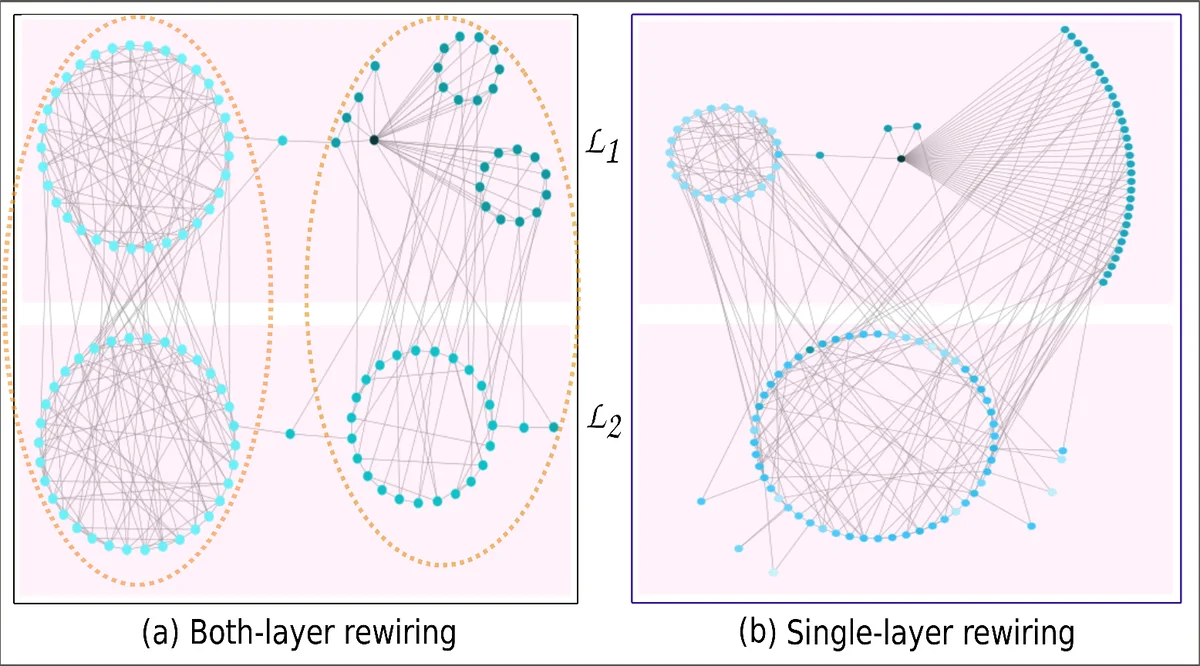
We study localization properties of principal eigenvector (PEV) of multilayer networks. Starting with a multilayer network corresponding to a delocalized PEV, we rewire the network edges using an optimization technique such that the PEV of the rewired multilayer network becomes more localized. The framework allows us to scrutinize structural and spectral properties of the networks at various localization points during the rewiring process. We show that rewiring only one-layer is enough to attain a multilayer network having a highly localized PEV. Our investigation reveals that a single edge rewiring of the optimized multilayer network can lead to the complete delocalization of a highly localized PEV. This sensitivity in the localization behavior of PEV is accompanied by a pair of almost degenerate eigenvalues. This observation opens an avenue to gain a deeper insight into the origin of PEV localization of networks. Furthermore, analysis of multilayer networks constructed using real-world social and biological data show that the localization properties of these real-world multilayer networks are in good agreement with the simulation results for the model multilayer network. The study is relevant to applications that require understanding propagation of perturbation in multilayer networks.
💡 Research Summary
This paper investigates how the principal eigenvector (PEV) of a multilayer network (MN) can be made highly localized by rewiring edges in only a single layer. The authors start from a multilayer system whose PEV is completely delocalized (i.e., its components are roughly equal) and then apply an optimization procedure that seeks to increase the inverse participation ratio (IPR), a standard measure of eigenvector localization. The IPR is defined as (Y = \sum_{i=1}^{N} (x_i)^4), where (x) is the normalized PEV of the supra‑adjacency matrix of the MN; a value of (1/N) corresponds to a perfectly delocalized vector, while a value of 1 corresponds to a vector concentrated on a single node.
Model and Notation
The multilayer network consists of (l) layers, each containing the same number of vertices (n) and the same average degree. Intra‑layer connections are described by adjacency matrices (A^{(\alpha)}) ((\alpha = 1,\dots,l)), while inter‑layer connections are represented by identity matrices that link each node to its replica in the other layers. The supra‑adjacency matrix therefore has a block structure, e.g., for two layers (A = \begin{pmatrix} A^{(1)} & I \ I & A^{(2)} \end{pmatrix}). Because each layer is connected and the matrix is non‑negative, the Perron‑Frobenius theorem guarantees a unique, strictly positive PEV.
Optimization Procedure
The authors use a simulated‑annealing scheme to maximize the IPR. Two rewiring protocols are examined:
-
Both‑layer rewiring – at each step a layer is chosen uniformly at random, an existing intra‑layer edge is removed, and a non‑existent edge is added, keeping the total number of edges constant.
-
Single‑layer rewiring – only a pre‑selected layer (e.g., layer 1) is altered in the same manner, while the other layers remain untouched.
All rewiring moves are accepted only if they increase the IPR and preserve connectivity of the altered layer (checked via depth‑first search). The total number of vertices and edges in the whole MN stays fixed throughout the process.
Structural Findings
During optimization, the network evolves a pronounced hub in the rewired layer. This hub gathers a large fraction of the PEV weight, leading to a dramatic rise in IPR. Accompanying structural changes include:
- Higher clustering around the hub, because many new triangles are formed when the hub connects to many low‑degree nodes.
- Reduced degree‑degree correlation, as the hub (high degree) connects preferentially to low‑degree nodes, breaking assortativity.
These features are identified as the main drivers of eigenvector localization in multilayer systems.
Spectral Sensitivity
A striking observation is that, after the network has been optimized to a highly localized state, a single edge modification can cause the PEV to become completely delocalized again. This “sensitivity” is linked to the emergence of an almost degenerate pair of top eigenvalues (λ₁ ≈ λ₂). When the gap between them is tiny, the PEV can switch between the two corresponding eigenvectors with a minimal perturbation, causing the IPR to drop sharply. The authors find that this sensitivity persists under the both‑layer protocol but is markedly reduced when only a single layer is rewired, because the optimization tends to keep a larger eigenvalue gap in that case.
Layer‑Combination Experiments
The paper systematically explores several combinations of layer types: Erdős‑Rényi (ER), scale‑free (SF), star (STAR), and one‑dimensional regular lattice (1D). Key results include:
- STAR‑ER and STAR‑1D produce the highest IPR values because the star layer contributes a dominant hub while the other layer remains delocalized, concentrating the PEV on the hub.
- STAR‑STAR yields a lower IPR, as two competing hubs split the PEV weight.
- SF‑SF behaves similarly to STAR‑STAR due to multiple high‑degree nodes.
- ER‑ER and 1D‑1D remain largely delocalized, reflecting the uniform degree distribution of each layer.
These observations confirm the earlier analytical bound ( \frac{1}{2N} \le Y_{\text{MN}} < \max{Y_{L_1}, Y_{L_2}}).
Real‑World Data Validation
To test the relevance of the model, the authors apply the same optimization to two empirical multilayer systems:
- A social multiplex consisting of Facebook and Twitter interactions, where each layer represents a different platform.
- A brain multiplex with a physical (structural) layer and a functional layer derived from neuroimaging data.
In both cases, the IPR increases during single‑layer rewiring, and the resulting structural signatures (a prominent hub, higher clustering) match those observed in the synthetic experiments. This demonstrates that the mechanisms uncovered in the model are present in real multilayer networks.
Implications and Applications
Since the PEV often determines the steady‑state distribution of dynamical processes such as epidemic spreading (SIS model), opinion dynamics, or signal propagation in neural tissue, the ability to localize the PEV by manipulating only one layer offers a powerful control lever. For instance, reinforcing or protecting the hub node in the rewired layer could either amplify or suppress the spread of a contagion across the whole multiplex. Conversely, the identified sensitivity suggests that small perturbations (e.g., removal of a single edge) could dramatically alter the system’s dynamical response, a fact that may be exploited for targeted interventions or, alternatively, must be guarded against in critical infrastructures.
Conclusion
The study shows that a multilayer network’s principal eigenvector can be driven from a delocalized to a highly localized state by rewiring edges in just one layer, using an IPR‑maximizing simulated‑annealing algorithm. The resulting networks exhibit a dominant hub, increased clustering, and low degree‑degree correlation, while the spectral signature of an almost degenerate top‑eigenvalue pair explains the observed extreme sensitivity to single‑edge changes. The findings are robust across synthetic layer combinations and are validated on real‑world social and brain multiplexes, highlighting both theoretical insight and practical relevance for controlling dynamical processes on multilayer structures.
Comments & Academic Discussion
Loading comments...
Leave a Comment