Dynamic Signal Measurements Based on Quantized Data
The estimation of the parameters of a dynamic signal, such as a sine wave, based on quantized data is customarily performed using the least-square estimator (LSE), such as the sine fit. However, the characteristics of the experiments and the measurem…
Authors: Paolo Carbone, Johan Schuokens, Antonio Moschitta
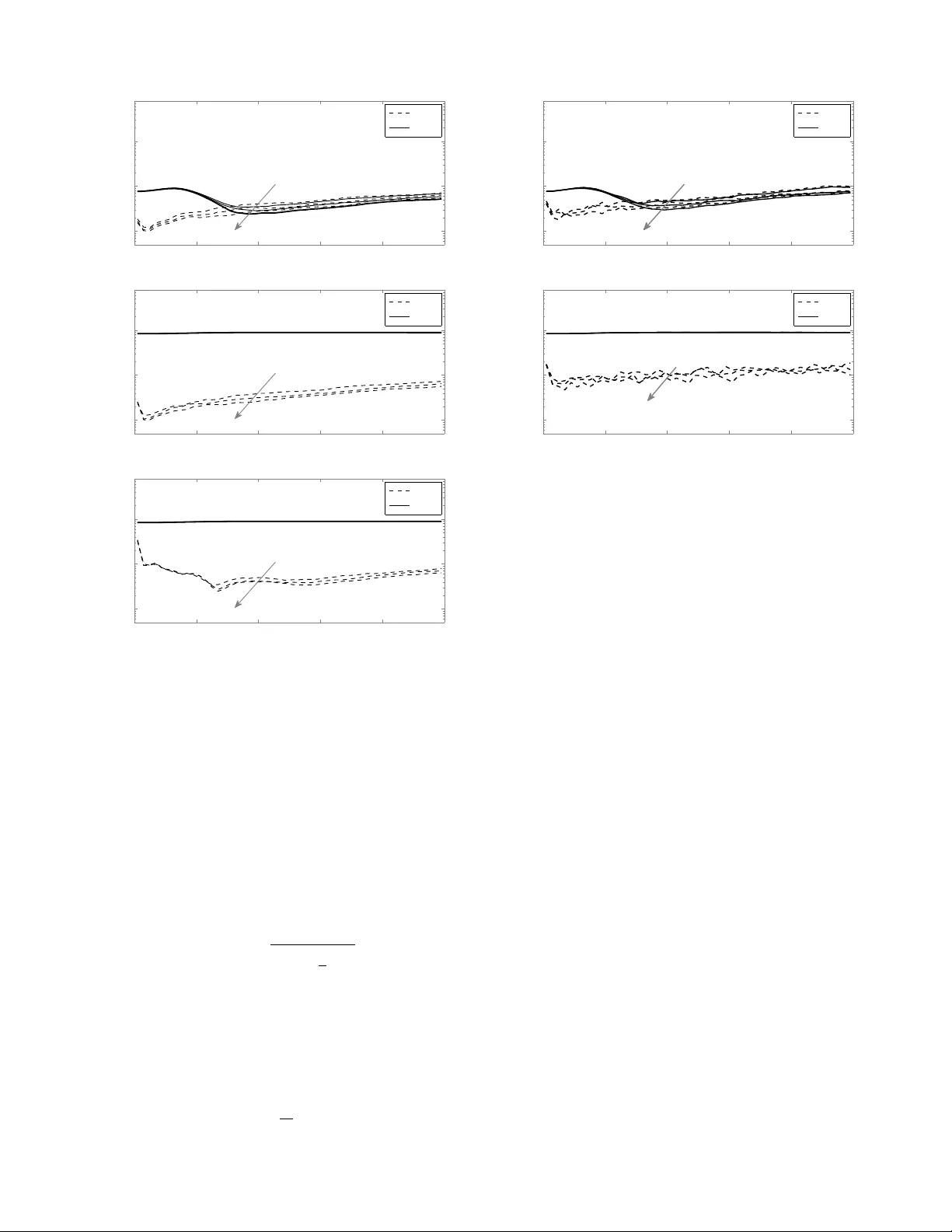
1 Dynamic Signal Measurements based on Quantized Data P . Carbone, F ellow Member , IEEE and J. Schoukens, F ellow Member , IEEE and A. Moschitta Member , IEEE c 2017 IEEE. Personal use of this material is permitted. Permission from IEEE must be obtained for all other uses, in any current or future media, including reprinting/republishing this material for advertising or promotional purposes, creating new collective works, for resale or redistribution to servers or lists, or reuse of any copyrighted component of this work in other works. DOI: 10.1109/TIM.2016.2627298 Abstract —The estimation of the parameters of a dynamic sig- nal, such as a sine wa ve, based on quantized data, is customarily performed using the least-square estimator (LSE), such as the sine fit. Howev er , the characteristic of the experiments and of the measurement setup hardly satisfy the requir ements ensuring the LSE to be optimal in the minimum mean-squar e-error sense. This occurs if the input signal is characterized by a large signal- to-noise ratio resulting in the deterministic component of the quantization error dominating the random error component, and when the ADC transition lev els are not unif ormly distributed ov er the quantizer input range. In this paper , it is first shown that the LSE applied to quantized data does not perform as expected when the quantizer is not uniform. Then, an estimator is introduced that over comes these limitations. It uses the values of the transition lev els so that a prior quantizer calibration phase is necessary . The estimator properties are analyzed and both numerical and experimental results are described to illustrate its performance. It is shown that the described estimator outperforms the LSE and it also pro vides an estimate of the probability distribution function of the noise before quantization. Index T erms —Quantization, estimation, nonlinear estimation problems, identification, nonlinear quantizers. I . I N T RO D U C T I O N When measuring the parameters of a noisy signal using quantized data, often the least-square estimator (LSE) is used. Accordingly , the parameters of the input signal are estimated by choosing those values minimizing the squared error be- tween the input and quantizer output signals. This is the case, for instance, when an analog-to-digital con verter (ADC) or a wa veform digitizer is tested using the procedures described in [1], [2]. The LSE is known to be optimal under Gaussian experimental conditions. Ho wev er, this is rarely the case when data are quantized by a memoryless ADC, unless the input signal is characterized by a low signal-to-noise ratio (SNR). Moreov er, e ven if the transition lev els in the used quantizer are uniformly distributed o ver the ADC input range, the LSE is known to be biased [3], [4], [5] and sensitive to influence factors such as harmonic distortion and noise [6]. Modifications of the original algorithm that o vercome some of these limitations were proposed in [7]. In practice, howe ver , transition lev els are not uniformly distributed in an ADC and the LSE or its modified versions produce suboptimal results. If the values of the ADC transition levels are known, the input signal parameters can be estimated with better accuracy than the LSE. This knowledge is used for instance by maximum-likelihood estimators applied to quantized data P . Carbone and Antonio Moschitta are with the University of Perugia - Engineering Department, via G. Duranti, 93 - 06125 Perugia Italy , J. Schoukens is with the Vrije Universiteit Brussel, Department ELEC, Pleinlaan 2, B1050 Brussels, Belgium. [8], whose main limitation is the ‘curse of dimensionality’ [9]. Moreover , they rely on numerical calculations that may result in suboptimal estimates due to local minima in the cost function. Alternativ e estimators based on sine wav e test signals were recently published in [10] to measure specifically the SNR in an ADC, sho wing the ongoing interest of the instrumentation and measurement community to this topic. Sev eral results are published about estimators using cate- gorical data as those output by ADCs. A general discussion within a statistical framework can be found in [11], where the usage of link functions applied to ordinal data is described. References [12], [13] contain an extensi ve description of estimators applied to quantized data and of their asymptotic properties, mainly in the context of system identification and control. In [14], a maximum-likelihood estimator is proposed for static testing of ADCs using link functions. By extending the results presented in [15] this paper intro- duces an estimator of the parameters of a signal quantized by a noisy ADC denominated Quantile-Based-Estimator (QBE). The main idea is that an ADC can first be calibrated by measuring its transition levels and then used to measure the input signal and noise parameters. When compared to the LSE that is customarily used for the estimation of sine wa ve parameters based on quantized data, it offers sev eral advantages: a reduced bias when the signal-to- noise ratio is large and a reduced mean-square-error (MSE) when the ADC is not uniform. Moreover , it also pro vides an estimate of the input noise standard deviation and of its cumulativ e (CDF) and probability density functions (PDF). Estimates are obtained by matrix operations so that the curse of dimensionality issue is av oided. The QBE operates both when the input signal frequency is known or unknown and with or without synchronization between signal and sampling frequencies. Thus, it advances results presented in [15], where a similar estimator was applied only in the case of known synchronized signal and sampling frequencies. While results can be used in the context of ADC testing the estimator is applicable whenev er parametric signal identification based on quantized data is needed. At first, a motiv ating example is illustrated. Then, the estimator is described and its properties analyzed through both simulation and experimental results. I I . R E S E A R C H M OT I V A T I O N Processing of samples con verted using non-uniform quan- tizers requires usage of suitable procedures to extract the max- imum possible information from quantized data, as illustrated in the following subsections. 2 Gaussian noise signal Non-uniform Uniform quantizer quantizer LS estimator LS estimator absolute error Relative calculation absolute error Relative calculation e U e N Fig. 1. The signal chain assumed for showing the ef fects of INL in the estimation of the amplitude of a cosinusoidal sequence when a noisy quantization is performed. 2 4 6 8 10 12 14 10 −5 10 0 nu mb e r o f b it r e la t i ve a bs o l u te e r r o r e U e N 2 4 6 8 10 12 14 0 10 20 30 Fig. 2. Magnitude of the relative error in the estimation of the amplitude of a cosinusoidal sequence, based on a LSE following the signal chain described in Fig. 1, when the quantizer is both uniform (filled circles) and non-uniform (squares). The inset shows the ratio between the magnitudes of the mean estimation errors. A. An example T o sho w the effect of a non-uniform distribution of transition lev els in an ADC when estimating the amplitude A of a cosine signal by means of the LSE, consider the sequence x n = A cos (2 π λ n ) λ n = 10 n N , n = 0 , . . . , N − 1 (1) where 0 < A ≤ 1 and N is the number of collected samples. Further, assume that the sequence is affected by zero–mean additiv e Gaussian noise with standard deviation σ = 0 . 3∆ , where ∆ = 2 / 2 b and b is the number of quantizer bits. By processing the noisy data sequence after the application of a rounding b -bit quantizer , A is estimated through an LSE when the quantizer is both uniform and non-uniform. In this latter case, transition levels are assumed displaced by their nominal position, each by a random variable uniformly distributed in [ − 0 . 45∆ , 0 . 45∆] to introduce integral nonlinearity (INL) while maintaining monotonicity of the input/output character- istic. Both signal chains are shown in Fig. 1. The relative absolute errors e U and e N in the uniform and non-uniform cases, respectiv ely , are considered as estimation quality criteria. Results obtained by simulating the signal chains shown in Fig. 1 with A = 2 b − 2 ∆ + ∆ / 2 and by collecting 100 records of N = 10 4 samples each, are shown in Fig. 2 using a semilogarithmic scale. The inset sho ws the ratio between the magnitudes of the estimation errors in the non- uniform and uniform case, respectiv ely. Observe that the INL always results in worse performance and in a ratio between the magnitudes of the mean errors as large as 29 . This is not surprising, as INL destroys the otherwise periodic behavior of the quantization error input-output characteristic and because its effects are only marginally attenuated by the addition of noise. B. An impr oved appr oach The loss in estimation performance highlighted in Fig. 2 arises because the LSE processes the quantizer output codes corresponding to a specific quantization bin. Howe ver , while the bin width is constant in a uniform quantizer, it changes from bin to bin in a non-uniform quantizer , resulting in the so- called differential nonlinearity (DNL). Processing data in the code domain does not acknowledge this difference, as codes already embed the associated errors. Consequently, informa- tion loss is expected. As an alternati ve, data can be processed in the amplitude domain so to avoid usage of quantizer codes. This approach is feasible if the values of the transition lev els in the used quantizer are kno wn or , equi valently , are measured before ADC usage. Observe that kno wledge of transition le vels allows usage of maximum-likelihood estimators as in [8]. Howe ver , this may result in a high computational load and in the need to neglect suboptimal solutions, when numerically maximizing the likelihood function. Instead, the described technique is based on matrix computation and does not require iterated numerical ev aluations, when the input signal frequenc y is known. By using results published in [16] it will be shown that this procedure also provides an estimate of the input noise standard deviation and of its CDF . I I I . Q UA N T I L E - B A S ED E S T I M A T I O N The main idea of quantile-based estimation was described in [15] and it is here ex emplified to ease interpretation of mathematical deriv ations. A. The estimator working principle Assume that the measurement problem consists in the estimation of an unknown constant value µ , affected by zero- mean additiv e Gaussian noise with known standard deviation σ . Consider also the case in which the noisy input is quantized repeatedly by a comparator with known threshold T 0 that outputs 0 and 1 , if the input is below or above T 0 , respectiv ely . By repeating the experiment sev eral times, the probability of collecting samples with amplitude lower than the threshold can be estimated by the percentage count ˆ p 0 of the number of times 0 is observed. This probability can be written as: p 0 = Φ T 0 − µ σ (2) where Φ( · ) is the CDF of a standard Gaussian random variable. Thus, by in verting (2) and substituting ˆ p 0 for p 0 , we obtain the estimate ˆ µ of µ as ˆ µ = T 0 − σ Φ − 1 ( ˆ p 0 ) , (3) where all the rightmost terms are known. Similar arguments can be inv oked to solve estimation problems when the quan- tizer is multi-bit, when the input sequence is time-v arying, it is synchronously or asynchronously sampled and when re- moving the hypotheses about knowledge of the noise standard deviation. T o illustrate the estimation of the amplitude of a time- varying signal based on noisy quantized samples, consider the periodic signal shown in Fig. 3. Synchronous sampling of 3 0 1 2 3 4 5 6 7 8 9 10 11 12 13 14 15 16 17 18 19 20 21 22 23 Fig. 3. A periodic signal x P ( t ) sampled synchronously at 8 samples per period that is also the period of the resulting sampled sequence x [ n ] . Dashed lines connect corresponding samples. When time indices belong to an y such subset of corresponding samples the probability p k [ m ] can be estimated for ev ery possible v alue of the transition level as shown in Fig. 4. Here, for ev ery k and ev ery threshold T k , 7 such probabilities can, in principle, be estimated. this signal provides the periodic sequence graphed in Fig. 3 using dots. By suitably selecting samples within this sequence, data can be thought as if they were obtained through the sampling of 7 constant values, graphed in Fig. 3 using dashed lines. The amplitude of the original signal affects the relativ e distance among these constant values. Then, a mathematical model, similar to (2), is used to relate the unknown signal amplitude to the v alues taken by the sampled data. Once code occurrence probabilities are estimated using the quantizer output sequence, kno wledge of this model and its inv ersion, result in the estimation of the amplitudes of the constant sequences shown in Fig. 3 and of the overall signal, as in (3). In the following subsections this procedure will be explained in more depth. Accordingly , the next section introduces the signal and system models used in the estimation procedure. B. Signals and Systems For n = 0 , . . . , N − 1 we assume: Θ = [ θ 0 θ 1 · · · θ M − 1 ] T S [ n ] = [ s 0 [ n ] s 1 [ n ] · · · s M − 1 [ n ]] T x [ n ] = S [ n ] T Θ x q [ n ] = Q ( x [ n ] + η [ n ]) (4) where x [ n ] is a discrete-time sequence obtained by sampling a periodic continuous-time signal, S [ n ] represents a vector of known discrete-time values s 0 [ n ] , . . . , s M − 1 [ n ] , and η [ · ] is a sequence of independent and identically distributed zero-mean Gaussian random v ariables, having standard deviation σ . In (4), Θ represents the vector of unknown parameters, Q ( · ) represents the quantization operation and e [ · ] the associated quantization error sequence. Quantization results in x q [ n ] taking one of the K possible ordered quantization codes Q k − 1 , k ∈ K = { 1 , . . . , K } , if the quantizer input belongs to the interval [ T k − 1 , T k ) , where T k represents the k -th quantizer transition lev el. In practice, x [ n ] is measured in volt, while x q [ n ] is coded by the ADC, according to the choice made by the producer (e.g. binary , decimal). T o ex emplify the use of the signal model (4), consider the case described in subsection A. Accordingly , M = 1 , s 0 [ n ] ≡ 1 , the output of the comparator Q ( · ) can be either 0 or 1 , based on the value of the unique threshold lev el T 0 and N still represents the number of observed and processed samples. Similarly , (4) models (1) by assuming M = 1 , θ 0 = A and S [ n ] = s 0 [ n ] = cos 2 π · 10 n N , obtained by sampling synchronously the signal cos (2 πf t ) , where f is the signal frequency . Finally , the case shown in Fig. 3 is modeled by assuming M = 2 and the sampled sequence x [ n ] = θ 0 s 0 [ n ] + θ 1 s 1 [ n ] , n = 0 , . . . , 23 , where θ 0 , θ 1 represent the two unknown amplitudes to be estimated and s 0 [ n ] = arccos (cos (2 π h 0 . 125 · n i )) s 1 [ n ] = sin (4 π h 0 . 125 · n i ) , (5) two kno wn sequences, with h x i representing the fractional part of x . Observe that, in general, x [ n ] is itself a periodic sequence if sampling is done synchronously , that is the ratio between the signal frequency and sampling rate is a rational number , and aperiodic otherwise. C. Extension to multi-bit quantizers The approach described in subsection A, based on a single threshold T 0 , can be extended to comprehend both the multi- threshold case that applies when using multi-bit quantizers and the case when the input signal is time-v arying. The first example in subsection III-A was related to a constant input signal resulting in a constant probability to be estimated, as shown by (2). When the input signal is time-dependent the probabilities to be estimated are no longer constant, but time- dependent as well. This is indicated in the following by using the symbol p k [ n ] = P ( x q [ n ] ≤ Q k − 1 ) . Then, for k ∈ K and n = 0 , . . . , N − 1 one can write P ( x q [ n ] ≤ Q k − 1 ) = P ( x [ n ] + η [ n ] ≤ T k ) = P ( η [ n ] ≤ T k − x [ n ]) = Φ T k − x [ n ] σ = Φ T k − S [ n ] T Θ σ (6) If an estimate ˆ p k [ n ] of p k [ n ] is av ailable, such that 0 < ˆ p k [ n ] < 1 , (6) can be in verted according to whether σ is known or unknown. If σ is known, from (6) we hav e: Φ − 1 ( ˆ p k [ n ]) = T k − S [ n ] T Θ σ . (7) that is, for k ∈ K and n = 0 , . . . , N − 1 S [ n ] T Θ = T k − σ Φ − 1 ( ˆ p k [ n ]) , (8) If σ is unknown, it must be estimated using the quantized data, so that from (7) we have: S [ n ] T Θ σ − T k σ = − Φ − 1 ( ˆ p k [ n ]) , (9) that, for k ∈ K and n = 0 , . . . , N − 1 results in S [ n ] T T k Θ U = − Φ − 1 ( ˆ p k [ n ]) , (10) 4 T k T k +1 T k 1 x [ n ] x [ n 1] t Q k Q k +1 Q k 1 Fig. 4. Estimation of the probabilities p k [ m ] : for a given subset of indices { n − 1 , n } , x [ n ] takes the same v alue x n − 1 = x n and the shaded probability can be estimated by counting the number of times the code is less than or equal to Q k and di viding by 2 . Observ e that in this very simple case the only possibility for p k [ m ] not to be equal to 0 or 1 , is when the number of counts is equal to 1 . The other two cases would be discarded by the algorithm as the link function Φ − 1 ( p k [ m ]) would not be in vertible. in which, by setting θ M = σ , Θ U is defined as Θ U = θ 0 θ M θ 1 θ M · · · θ M − 1 θ M − 1 θ M T . (11) Notice that if an estimate ˆ Θ U of Θ U is av ailable, the scalar parameters θ 0 , . . . , θ M can be recovered by means of simple transformations of the elements in ˆ Θ U . The noise standard deviation σ = θ M can be estimated by in verting the right- most element in ˆ Θ U and by changing its sign. Estimates of θ 0 , . . . , θ M − 1 are obtained by multiplying the M leftmost elements in ˆ Θ U by the obtained value of θ M . D. The derivation of the pr oposed estimator Expressions (8) and (10) show a linear relationship between the vector of unkno wn parameters and the estimated probabil- ity ˆ p k [ n ] , suitably transformed by the so–called link function Φ − 1 ( · ) [11], [12]. Observe that, in principle, K · N such relationships are av ailable. In practice, howe ver , the number is much lower for two reasons: 1) the application of the link function requires the inv ersion of Φ( p k [ n ]) that is unfeasible if the estimated probability is equal to 0 or 1 . When this occurs, data are discarded; 2) for a gi ven T k , the estimation of a probability requires a percentage count of the codes that result in the noisy input signal being below or equal to T k . This would require the input signal x [ n ] to remain constant over n , while se veral such codes are collected. Since this is unfeasible when the signal is time-varying unless the input sequence is largely oversampled, there is the need to identify subsets of time indices n approximately providing the same value of x [ n ] . Accordingly , the N time indices are partitioned into subsets associated with values of x [ n ] having close magnitude. Consequently , the estimation of a single probability requires usage of sev eral input samples resulting in a number of estimates that for a gi ven k ∈ K is lo wer than N . The partitioning mechanism will be presented in the next subsection. E. Estimation of pr obabilities p k [ n ] The determination and in version of the measurement model as in (3) and in (10) require kno wledge of probabilities p k [ n ] , as defined in (3). In general, if x [ n ] is obtained by sampling a periodic signal x P ( t ) with period T , one obtains x [ n ] = x P ( nT s ) = x P nT S T T . Synchr onous sampling applies if T S / T is a rational number resulting in a periodic sequence x [ n ] . When T S / T is irrational, sampling is asynchr onous and x [ n ] is no longer a periodic sequence. The two cases are treated separately in the following. 1) Synchronous sampling (rational T s / T ): If T s T = L N where L is an integer number , x [ n ] = x P nL mod N N T , results, where mo d is the remainder operator . It is of interest to analyze the image of the map I L = ( nL mo d N ) when n = 0 , . . . , N − 1 . By the theorem 2.5 in [17], this image consists of the N / d integers n · d, n = 0 , . . . , N d − 1 (12) where d is the greatest common divider of L and N . By this argument, x [ n ] can only take the values x [ n ] = x P nd N T , n = 0 , . . . , N d − 1 (13) which may not be all unique, and x [ n ] becomes a periodic sequence with period gi ven by N d . As an example, if N = 10 and L = 1 , d = 1 results, the map I L provides the unique values n = 0 , . . . , 9 , and the samples represent a single period of x P ( t ) . Con versely , if N = 10 and L = 2 , d = 2 and the image of the map I contains the v alues 2 n , n = 0 , . . . , 4 . These values are provided twice when n = 0 , . . . , 9 so that the sequence x [ n ] has period 10 / 2 = 5 . Each one of the N d different values in the image of the map is repeated d times. Each time, this value results in the same value of the signal x [ n ] provided to the ADC. The synchronous case is ex emplified in Fig. 3, where 3 periods of a synchronously sampled periodic signal x P ( t ) are shown, when N = 24 , L = 3 , so that d = 3 results. Samples corresponding to the same input value are connected through dashed lines. Thus a partition P = {{ 0 , 8 , 16 } , { 1 , 9 , 17 } , { 2 , 10 , 18 } , { 3 , 11 , 19 } , { 4 , 12 , 20 } , { 5 , 13 , 21 } , { 6 , 14 , 22 } , { 7 , 15 , 23 }} of the indices 0 , . . . , 23 is obtained. Then, for any giv en k identifying the selected threshold and for ev ery m = 0 , . . . , |P | − 1 , where |P | represents the cardinality of the partition, the samples belonging to each subset P m in the partition P describe the same e vent and a counter can be updated with 1 or 0 according to whether or not the quantizer output is less than or equal to Q k , as defined in (6). Thus, for a given and known threshold T k , p k [ m ] , m = 0 , . . . , |P | − 1 can be estimated by the percentage count accumulated over those indices in P m providing the same quantizer input x [ n ] . Even though the exact value of x [ n ] is not known by the user , as it depends on the unknown parameter values, if the same argument t of x P ( t ) repeats over time, so does its sampled version x [ n ] . Thus, by matching the time instants corresponding to the same value of x P ( t ) , an estimate p k [ m ] can be obtained for ev ery k . This is ex emplified in Fig. 4, where a sinusoidal 5 0 1 2 3 4 5 6 7 8 9 10 11 12 13 14 15 16 17 18 19 20 21 22 23 Fig. 5. A periodic signal x P ( t ) sampled asynchronously at about 8 samples per period resulting in an aperiodic sampled sequence x [ n ] . Dashed lines connect corresponding samples. Samples can be grouped according to their closeness so that an estimate of the probability for the signal to be above or below a given threshold can then be estimated (see text). The enlar ged detail shows the ef fect of asynchronous sampling to the relativ e position of samples, in re gions of the signal exhibiting different time derivati ves. signal x P ( t ) is assumed and the probability to be estimated is shaded. In this figure, the values of 3 transition lev els are shown using dashed lines and the corresponding quantizer codes are indicated as Q k − 1 , Q k and Q k +1 . Results on the application of synchronous sampling to the estimation of the parameters of a sinusoidal function are published in [15]. 2) Asynchronous sampling (irr ational T s / T ): In practice, synchronization requires the careful setup of the experiments since disturbing mechanisms may occur . For instance, basic bench top equipment used to generate signals is affected by frequency drifts over time that can not easily be compensated for . Similarly , the used ADC may sample inputs with a sampling period that may vary over time and that may not be controlled directly by the user or disciplined by e xternal stable sources such as cesium or rubidium frequency standards. As a consequence, the ratio between sampling and signal periods is more properly assumed as T s T = λ, where λ is an irrational number and x [ n ] = x P ( h nλ i T ) , n = 0 , . . . , N − 1 (14) becomes an aperiodic sequence. This case is graphed in Fig. 5, where 3 periods of an asynchronously sampled periodic signal x P ( t ) are shown, when N = 24 and λ = 0 . 1245 · · · . Reference dashed lines show the progressiv e deviations from synchronicity when the time index increases. Contrary to the rational case, since the map I λ = h nλ i has no periodic orbits, when n = 0 , . . . , N − 1 , no two equal values of the argument of x P ( t ) in (14) can be found. Remind that probabilities p k [ m ] can be estimated only when the same value of x [ n ] is input to the ADC. Ho wever , when λ is irrational, x [ n ] provides only approximately equal values for selected indices n . Accordingly , by choosing a small value > 0 , the image of I λ can be explored to find those indices n for which I λ returns values that differ at most by . If the sequences in S [ n ] have bounded deriv ativ es, small deviations in their arguments will result in bounded variations of their amplitudes and the estimation will occur as if synchronous sampling was adopted. The main idea is that by selecting arguments for x P ( t ) in (14) that are close to each other , x P ( t ) will result in samples with similar values, at the same time. Thus, the estimation procedure can be described by the following steps: 1) the interval [0 , 1) is partitioned into adjacent subinter- vals, each of length > 0 ; 2) each subinterval is associated with that particular set of indices n for which I λ returns values belonging to that interval. The collection of these sets represents a partition P of the whole set of integers n = 0 , . . . , N − 1 ; 3) for e very subset P m in this partition, a ne w vector S [ m ] = [ s 0 [ m ] s 1 [ m ] · · · s M − 1 [ m ]] T is defined, where each sequence s i [ m ] is obtained by av eraging s i [ m ] ov er the indices in P m . This vector takes the role of S [ m ] in (8) and (10). Corresponding estimates of p k [ m ] are obtained by accumulating counts when these indices occur . The asynchronous case is ex emplified in Fig. 5. Assuming N = 24 and λ = 0 . 1245 · · · , the sampled sequence can be modeled as: x [ n ] = θ 0 arccos (cos (2 π h nλ i )) + θ 1 sin (4 π h nλ i ) , n = 0 , . . . , 23 (15) Using the notation defined in (4), M = 2 and we can initially write: Θ = [ θ 0 θ 1 ] T S [ n ] = [arccos (cos (2 π h nλ i )) sin (4 π h nλ i )] T x [ n ] = S [ n ] T Θ (16) By assuming = 0 . 1 , the procedure returns the partition of the set of indices P = {{ 0 } , { 1 , 9 , 17 } , { 2 , 10 , 18 } , { 3 , 11 , 19 } , { 4 , 12 , 20 } , { 5 , 13 , 21 } , { 6 , 14 , 22 } , { 7 , 15 , 23 } , { 8 , 16 }} , where |P | = 9 represents a bound on the number of probabilities that can be estimated for every k . The actual number might be lower because of the additional constraint 0 < ˆ p k [ m ] < 1 . Subsets P m ∈ P identify samples of x [ n ] having approximately the same magnitude. This is shown in Fig. 5 where θ 0 = θ 1 = 1 is assumed and each sample is identified by the corresponding v alue of n . Asynchronous sampling results in dif ferent displacements among corresponding samples because of the different deriv ati ve of the signal in different temporal regions. An enlarged detail in Fig. 5 shows this phenomenon. Observe that estimates of p k [ m ] that differ from 0 and 1 require subsets with at least 2 indices, as at least 2 counts are needed. Thus, for every P m ∈ P and for ev ery possible transition lev el T k , a corresponding probability p k [ m ] can be estimated. In this example out of the av ailable 24 samples, only 8 sets are av ailable for estimating corresponding sets of probabilities p k [ m ] , when k = 1 , . . . , K . Accordingly , for ev ery P m ∈ P and for ev ery k = 1 , . . . , K the corresponding 6 value of the known sequence can finally be written as in the model: Θ = [1 1] T S [ m ] = [ s 0 [ m ] s 1 [ m ]] T = " 1 N m X n ∈ P m arccos (cos (2 π h nλ i )) 1 N m X n ∈ P m sin (4 π h nλ i ) # T x [ m ] = S [ m ] T Θ , m = 0 , . . . , |P | − 1 (17) where N m represents the cardinality of P m and the bar reminds that the kno wn signals s 0 [ m ] and s 1 [ m ] are obtained after averaging all approximately equal amplitude values as- sociated with indices in P m . F . Model in version and parameter estimation Define S as the set containing only couples of indices ( k , m ) , allo wing estimation of p k [ m ] , that is implying 0 < ˆ p k [ m ] < 1 . Then, (8) can be put in matrix form as follows. When σ is known, for each couple of indices ( k , m ) ∈ S • a ro w is added to a matrix H containing the vector S [ m ] or S [ m ] , in the case of synchronous or asynchronous sampling respectively; • a ro w is added to a column vector Y containing the scalar T k − σ Φ − 1 ( ˆ p k [ m ]) , where T k and σ are kno wn and ˆ p k [ m ] is estimated using the data, as shown above. Once all indices ( k , m ) in S are considered, the linear system H Θ = Y , (18) results. Observe that, by construction, the number of rows in H and Y is a random variable as S contains a random number of entries. Then, if the number of rows in H is not lower than the number of unknown parameters, an estimate of Θ can be obtained by applying a least-square estimator as follows: ˆ Θ = ( H T H ) − 1 H T Y . (19) Similarly when σ is unkno wn, for each couple of indices ( k , m ) in S • a matrix H U can be constructed by adding entries con- taining the vector S [ m ] − T k or S [ m ] − T k , in the case of synchronous or asynchronous sampling respectively; • a column vector Y U is created, whose entries are the corresponding values − Φ − 1 ( ˆ p k [ m ]) . The linear system H U Θ U = Y U , (20) results, where H U and Y U hav e again a random number of rows. Finally , Θ U can be recov ered by a least-square approach as follows: ˆ Θ U = ( H T U H U ) − 1 H T U Y U . (21) Observe that se veral techniques can be applied to find an esti- mator of Θ and Θ U , starting from (18) and (20), respectively . As an e xample, by estimating the co variance matrix associated with av ailable data, a weighted least-square estimator can be applied, as done in [15]. In this paper, the simplest possible approach based on the application of the least-square solution is taken. Finally , observe that the procedure described in this subsection can be applied irrespecti ve of the rationality or irrationality of the ratio T s / T . In the former case and for sufficiently small values of , it will provide the same set of indices that the user would select by following the indications in section III-E1. I V . A N E W Sine F it P RO C E D U R E Fitting the parameters of a sine wav e to a sequence of quantized data is a common problem when testing systems, e.g. ADCs or other nonlinear and linear systems. The LSE is the technique adopted in this case. Howe ver , this estimator is known: • to be a biased, not necessarily asymptotically unbiased, estimator [3]; • to perform poorly when the resolution of the quantizer is low , e.g. 4-5 bits, and the added noise has a small standard deviation so that the ADC can hardly be considered as a linear system adding white Gaussian noise. It will be sho wn in this section how to use the QBE to obtain an alternati ve estimator that outperforms the LSE with respect to both bias and MSE and both when the sine wa ve frequency is known and unkno wn. The general case of an irrational value of λ = T s T is treated in the following since it also includes the case when T s T is rational. The further general assumption of σ unkno wn is considered. T wo further cases apply: when λ is kno wn or unkno wn to the user , so that an equi valent formulation of the 3 - or 4 -parameter sine fit is obtained, respectively [1]. A. Known F r equency Ratio λ This is the case when the input signal can be modeled as: x [ n ] = θ 0 sin 2 π n T s T + θ 1 cos 2 π n T s T + θ 2 (22) By follo wing the procedure described in section III in the case of unknown σ , a small value is chosen for that results in the corresponding partition P of the set of indices n = 0 , . . . , N − 1 . For ev ery couple of ( k , m ) , k = 0 , . . . , K − 1 , m = 0 , . . . , |P | − 1 , a probability p k [ m ] is estimated. If this estimate ˆ p k [ m ] differs from 0 and 1 , the following 1 × 4 row vector is added to the observation matrix H U S [ m ] = = " 1 N m X n ∈ P m sin (2 π h nλ i ) 1 N m X n ∈ P m cos (2 π h nλ i ) 1 T k # (23) and the scalar − Φ ( ˆ p k [ m ]) is added to the column vector Y U . In (23), N m represents the cardinality of P m . Once all couples in ( k , m ) are considered, an estimate of Θ U is found through (21), from which estimates of θ i , i = 0 , . . . , 3 can straightforwardly be deriv ed. 7 B. Unknown F r equency Ratio λ Often, the user is unaware of the exact value of the ratio between signal frequenc y and sampling rate. When this occurs, an iterative approach applies [1]: • λ is initially guessed, e.g. using the procedure described in [ 18 ] , [ 19 ] ; • using this value of λ , Θ U is estimated following the pro- cedure described in section III and the MSE is ev aluated; • the frequency estimate is updated, e.g. by following the golden section search algorithm, with the MSE as the goodness-of-fit criterion [20]; • the magnitude of the deviation in the frequency values from one update to the following is chosen as the stopping rule: if it is belo w a user given value γ , the procedure is stopped. As it happens when the LSE is applied iteratively , this pro- cedure con ver ges if the initial frequency guess is within a giv en frequency capture range. The initial guess provided by the discrete-Fourier -transform of quantized data, as suggested in [18], [19], prov ed to be sufficiently accurate in the cases illustrated in the following sections. V . P R AC T I C A L I M P L E M E N TA T I O N I S S U E S The practical implementation of the QBE algorithm shows that setting parameters and interpreting results require some caution. In fact: • for a given N and when λ is irrational, if decreases the number of subsets in the partition P increases, leading to a lar ge number of different estimates of p k [ m ] . Howe ver , at the same time the average number of indices in each subset of the partition decreases, resulting in a less accurate estimation of each probability p k [ m ] . Thus, the choice of is a result of a compromise: either few accurate or many rough estimates are processed by the algorithm. Repeated simulations sho wed that approximately results in similar MSEs for a wide range of values, since the two effects tend to compensate each other . An approximated reasoning can explain this beha vior . Consider the estimator asymptotic accuracy for small values of . Both the number of counts used to estimate p k [ m ] and var ( ˆ p k [ m ]) are O 1 , while the variance in estimating Θ is O 1 number of counts × var ( ˆ p k [ m ]) = O ( ) O 1 = O ( 0 ) , that is independent of ; • the estimation of Φ − 1 ( p k [ m ]) implies the application of a nonlinear function to the random variable ˆ p k [ m ] obtained through a percentage count. While ˆ p k [ m ] based on a percentage of the total number of samples satisfying a giv en rule, is an unbiased estimator of the underlying unknown probability [22], the application of the nonlinear function results in a biased but asymptotically unbiased estimator . Three approaches are possible: – a lower bound is set to discard estimates based on small size samples; – the bias can be estimated and partially corrected for , e.g., by expanding the nonlinear function using a T aylor series about the expected value p k [ m ] of ˆ p k [ m ] ; – the bias magnitude can be bounded. In this latter case, the bias can be expected to be more sev ere when p k [ m ] is close to 0 and 1 , that is where Φ − 1 ( · ) has two vertical asymptotes and exhibits a strong nonlinear beha vior . Thus, to reduce the bias in estimating Φ − 1 ( p k [ m ]) , guard intervals can be set, so that data are processed by the algorithm only if, e.g. 0 . 05 < ˆ p k [ m ] < 0 . 95 . V I . V A L I D A T I N G T H E A S S U M P T I O N O N T H E N O I S E P D F The QBE is based on the assumption that the noise CDF is known, as the in verse of this function represents the link function needed to apply the main estimator equation (7). This assumption can be tested by estimating the input noise CDF and PDF by following the procedure described in [16]. Accordingly , if the transition levels in the ADC, are known, as well as the input sequence x [ n ] , a pointwise estimate of the noise CDF for any av ailable estimate ˆ p k [ m ] , is provided by: ˆ F η ( T k − x [ m ]) = ˆ p k [ m ] , ( k , m ) ∈ S (24) where x [ m ] represents the input signal amplitude associated with the estimated probability ˆ p k [ m ] . In practice, x [ m ] is not known. Ho wev er once the signal parameters are estimated, an estimate ˆ x [ m ] = S [ m ] T ˆ Θ of x [ m ] is av ailable and can be substituted in (24), as follows: ˆ F η ( T k − ˆ x [ m ]) = ˆ p k [ m ] . (25) In addition, normalization by the estimated standard de viation ˆ σ , pro vides an estimate of the CDF of the normalized random variable η = η / σ . ˆ F η ( T k − ˆ x [ m ]) = ˆ F η T k − ˆ x [ m ] ˆ σ = ˆ p k [ m ] . (26) T o validate the initial assumption about the noise CDF , es- timates provided by (25) or (26) can be interpolated and compared to the assumed noise CDF , e.g. Φ( · ) . Then, the corresponding PDF can be estimated by differentiation. Ob- serve that the LSE provides an error sequence obtained as the difference between the estimated signal at the ADC input and the measured signal at the ADC output. Howe ver , the histogram of such error samples would not estimate the PDF of the noise at the quantizer input, since the error sequence also contains the error contributions due to quantization. This is not the case with the estimator (25) that is only marginally affected by signal quantization. V I I . S I M U L A T I O N R E S U LT S The QBE estimator was coded in C and simulated on a personal computer using the Monte Carlo approach. The practical case of estimating the parameters of a sine wa ve was considered after modeling the signal as in (22). Results obtained using the QBE under the assumption of known and unknown signal frequencies and known uniformly and non- uniformly distributed transition le vels are compared in the following with results obtained using the sine fit estimation 8 0 0.2 0.4 0.6 0.8 1 10 −3 10 −2 10 −1 10 0 R M S E / ∆ σ / ∆ (a) i n c r e a s i n g N = 7 · 1 0 4 , 1 0 5 , 1 . 3 · 1 0 5 QBE LSE 0 0.2 0.4 0.6 0.8 1 10 −3 10 −2 10 −1 10 0 R M S E / ∆ σ / ∆ (b) i n c r e a s i n g N = 7 · 1 0 4 , 1 0 5 , 1 . 3 · 1 0 5 QBE LSE 0 0.2 0.4 0.6 0.8 1 10 −3 10 −2 10 −1 10 0 R M S E / ∆ σ / ∆ (c) i n c r e a s i n g N = 7 · 1 0 4 , 1 0 5 , 1 . 3 · 1 0 5 QBE LSE Fig. 6. Simulation results, known frequency ratio, λ = 0 . 1155545 · · · : Root mean-square-error as a function of the noise standard deviation (both normalized to ∆ = 20 / 2 8 ) when N = 7 · 10 4 , 10 5 , 1 . 3 · 10 5 , in the case of the QBE (dashed lines) and LSE (continuous line): (a) 8 -bit ADC with threshold lev els uniformly distributed in the [ − 10 V , 10 V ] input range; (b) 8 -bit non-uniform ADC simulated using a resistor ladder with Gaussian distributed resistance and maximum absolute INL = 0 . 215∆ ; (c) same as (b) but with additional uncertainty on the v alues of the transition le vels: each transition le vel is assumed to be known up to a random de viation uniformly distributed in the interv al [ − 0 . 2∆ , 0 . 2∆] . method based on the LSE [1]. In all cases the noise standard deviation was assumed unknown, λ was set to 0 . 1155545 · · · and = 0 . 0011 was assumed. As a performance criterion, the root-mean-square error (RMSE) based on R records of N samples was considered. This was defined as: RM S E = r e 2 DC + 1 2 e 2 AC , (27) where e DC and e AC represent the errors in estimating the DC and AC signal components with respect to the known simulated values. A. Known F r equency Ratio λ If both the sine wav e frequenc y and the ADC sampling rate are known, so is the ratio T s T and both QBE and the 3 - parameter sine fit, can be applied as described. Accordingly , simulations were done assuming an 8 -bit ADC, R = 100 0 0.2 0.4 0.6 0.8 1 10 −3 10 −2 10 −1 10 0 R M S E / ∆ σ / ∆ (a) i n c r e a s i n g N = 7 · 1 0 4 , 1 0 5 , 1 . 3 · 1 0 5 QBE LSE 0 0.2 0.4 0.6 0.8 1 10 −3 10 −2 10 −1 10 0 R M S E / ∆ σ / ∆ (b) i n c r e a s i n g N = 7 · 1 0 4 , 1 0 5 , 1 . 3 · 1 0 5 QBE LSE Fig. 7. Simulation results, unknown frequency ratio, λ = 0 . 1155545 · · · : Root-mean-square error as a function of the noise standard deviation (both normalized to ∆ = 20 / 2 8 ), and parametrized by N = 7 · 10 4 , 10 5 , 1 . 3 · 10 5 , in the case of the QBE (dashed lines) and LSE (continuous line): (a) 8 -bit ADC with threshold lev els uniformly distributed in the [ − 10 V , 10 V ] input range; (b) 8 -bit non-uniform ADC simulated using a resistor ladder with Gaussian distributed resistance and maximum absolute INL = 0 . 215∆ . records, and N = 7 · 10 4 , 10 5 , 1 . 3 · 10 5 samples. The RMSE is graphed in Fig. 6 in the case of the QBE (dashed line) and the LSE (solid line), as a function of the noise standard de viation and for various values of N . Both axes are normalized to the quantization step ∆ = 20 / 2 8 . While data in Fig. 6(a) refer to the case of a uniform ADC, graphs in Fig. 6(b) are associated with a non-uniform ADC, based on a resistor ladder [21]. Distribution of resistance values following a Gaussian distribution resulted in a maximum absolute INL of 0 . 215∆ . It can be observed that: • for a giv en v alue of σ , when N increases, the RMSE shows an overall decrease, as expected; • when σ / ∆ is small, the RMSE associated with the LSE is dominated by the estimator bias, rather than by its variance: in fact, by increasing N , the corresponding RMSE does not change in the left part of the graph (solid lines). This means that the contribution of the estimation variance to the RMSE, that depends on N , is negligible with respect to the bias and that the bias does not v anish when N increases, as expected [3]; • the RMSE associated with QBE is largely independent of the ADC being uniform or non-uniform since it only uses information about threshold levels, irrespectiv e of their distribution over the input range. Con versely , since the LSE processes code values, departure from uniformity in the distribution of the transition lev els results in an ov erall worse performance, as shown by comparing data in Fig. 6(a) to data in Fig. 6(b). This latter figure shows that the RMSE in the case of the LSE (solid lines), 9 is dominated by estimation bias rather than estimation variance, since all curves collapse, irrespecti ve of the number of processed samples. The QBE relies on the knowledge of the ADC transition lev els that are known, in practice, only through measurement results affected by uncertainty . T o show the robustness of the QBE with respect to this aspect, a simulation was done by assuming the transition levels known up to a random deviation uniformly distributed in the interval [ − 0 . 2∆ , 0 . 2∆] . The same data used to produce graphs in Fig. 6(b) was used under the same simulated conditions. Results are shown in Fig. 6(c), which displays an increase of the RMSE e vident for small values of σ , but also that the QBE still outperforms the LSE when INL affects the quantizer . B. Unknown F r equency Ratio λ If either or both signal frequency and sampling rate are unknown, so is the ratio T s T . In this case, the procedure described in subsection IV -B applies. After a rough estimation of λ based on the discrete Fourier transform of the simulated data, the estimation procedure is applied iterati vely to find the minimum of the experimental mean-square-error , defined as: MSE exp = 1 N N − 1 X n =0 S [ n ] T ˆ Θ − x q [ n ] 2 , (28) where S [ n ] T ˆ Θ is the estimated input signal at time n and x q [ n ] the known quantized value. Observe that (28) and (27) consider different errors: while in (28) the error is defined with respect to the measured values x q [ n ] , in (27) the error is defined with respect to the known simulated values. An estimate of (28) is found by minimizing MSE exp ov er the set of possible values of Θ = h θ 0 θ 3 θ 1 θ 3 θ 2 θ 3 − 1 θ 3 i through the golden section search algorithm [20]. Here θ 0 , θ 1 , and θ 2 represent the sine , cosine and dc components, respecti vely , as defined in (22) , while θ 3 represents the unkno wn noise standard deviation. The resulting RMSE is shown in Fig. 7(a) and (b) in the case of a uniform and non-uniform ADC, respectiv ely . Same simulated conditions as in subsection VII-A were applied in this case, but with R = 30 . Although the frequency was not assumed as being known in advance, results shown in Fig. 7 are comparable to those graphed in Fig. 6. V I I I . E X P E R I M E N T A L R E S U LT S The measurement setup shown in Fig. 8 was used to first measure the ADC transition le vels and then to perform measurements to estimate the sine wav e parameters, the noise standard deviation and its CDF . It included a rubidium fre- quency standard used to control a waveform synthesizer . The generated signal was acquired both by a USB connected 16-bit D A Q (U2351) by Ke ysight T echnologies and by a 6 1 / 2 digit DMM, whose results were taken as reference v alues. The volt- age divider was used to reduce the range of values generated by the wa veform synthesizer by a factor approximately equal to 30 . The exact attenuation factor was not needed because all voltages were also measured by the reference instrument. The D A Q transition levels were first measured in the code interval [ − 100 , 100] , using a software implementation of the servo-loop technique [1]. Measured values were fitted using linear interpolation to remove gain and offset errors and to obtain the integral nonlinearity shown in Fig. 9, after normalization to the D A Q quantization step ∆ = 20 / 2 16 V . The synthesizer was programmed to generate a sine wav e with nominal frequency 500 Hz, sampled by the D A Q at 500 kSam- ple/s in the [ − 10 , 10] V input range. The procedure processed 10 sine wa ve amplitudes in the range [1 . 042∆ , 64 . 803∆] . For each amplitude, N = 1 . 5 · 10 5 samples were collected and processed by QBE and LSE iterativ ely . The DMM was programmed to measure each time the A C and DC signal components in av erage mode. These values were taken as the true values of the sine wa ve parameters and (27) was then applied to e valuate the RMSE. This figure is graphed in Fig. 10 for both estimator, as a function of the A C signal component. Data show that QBE outperforms the LSE. In fact, contrary to QBE, the solution provided by LSE ignores the effect of INL on measured data. QBE also provided an estimate of the noise standard devia- tion and of the noise CDF . Estimates of the noise standard deviation were obtained for each one of the 10 datasets collected by varying the sine wa ve amplitude. The estimated mean value and standard deviation of these 10 estimates were 0 . 800∆ and about 0 . 004∆ , respectively . Thus, stable and repeatable results were obtained. The estimated CDF associated with the noise sequence normalized to the standard de viation is plotted in Fig. 11 along with a fitted CDF of the standard Gaussian CDF . The good match between the points and the fitted curve validates both the assumption of the noise distribution and the correctness of the adopted approach. Notice that the choice of the guard intervals [0 , 0 . 05] and [0 . 95 , 1] used for discarding selected data, resulted in an estimate of the noise CDF that is truncated in the bottom and upper parts of the graph. I X . C O N C L U S I O N Signal quantization is customarily performed in numeri- cal instrumentation. Even if research activities continuously 33220A U2351 DMM Rubidium Source V oltage divider Fig. 8. Measurement setup used for the experiments. The Rubidium frequenc y standard Stanford Research System PRS10 is used to provide a stable clock to the waveform synthesizer Agilent 33220A. This is used to generate the test signals that are input to the 16 -bit D AQ Keysight U2351. A resistor- based voltage divider is used to reduce the range of the generated signals. A 6 - 1 / 2 digit multimeter (DMM, Keithley 8845A) is used as the reference instrument, measuring both DC and A C signals. A personal computer controls the measurement chain. 10 −100 −50 0 50 100 −0.4 −0.2 0 0.2 0.4 0.6 I N L / ∆ c o d e Fig. 9. INL normalized to the quantization step ∆ = 20 / 2 16 and measured through the measurement setup shown in Fig. 8, after removal of gain and offset errors. 0 10 20 30 40 50 60 10 −4 10 −2 10 0 10 2 s i n e wa v e R M S a m pl i t u d e / ∆ R M S e r r o r / ∆ QBE LSE Fig. 10. Experimental data: performance comparison between the QBE and the LSE; RMSE in the estimation of the DC and AC values of a sine wa ve generated and quantized using the setup shown in Fig. 8. Both axes are normalized to the quantization step ∆ = 20 / 2 16 and both the QBE and LSE estimates are based on N = 1 . 5 · 10 5 samples. The ratio between sine wave frequency and sampling rate was estimated by finding the minimum of the square error cost function, using the iterativ e golden section search algorithm. −2 −1 0 1 2 0 0.2 0.4 0.6 0.8 1 x E s t i m at e d C D F estimated CDF fitted normal CDF Fig. 11. Experimental results obtained using the measurement setup shown in Fig. 8. Pointwise estimation of the normalized input noise CDF obtained by (26) (dots) and plot of the CDF of a standard Gaussian random variable (solid line). The input sine wav e had a measured RMS amplitude of 3 . 93 · 10 − 3 V and a measured DC component of 7 . 9 · 10 − 5 V . provide ne w ADC architectures exhibiting increasing perfor- mance, de vices are not characterized by uniformly distributed transition lev els. If not compensated, this non-ideal behavior results in biases and distortions in the estimated quantities. In this paper , we proposed a new estimator that uses information about the values of the ADC transition lev els to improv e the performance of con ventional estimators. The esti- mator is based on the kno wledge of the ADC transition le vels, so that an initial calibration phase is necessary before actual parameter estimation. Theoretical, simulated and experimental results show that the proposed technique outperforms typically used estimators such as the sine fit, both when the input signal frequency is known and unknown. As an additional benefit, also the ADC input noise standard de viation and the noise cumulativ e distribution function are estimated. Finally , while results are presented mainly in the context of the estimation of the parameters of a sine wa ve, this procedure can be applied whenev er a bounded periodic signal is acquired and processed. A C K N O W L E D G E M E N T This work was supported in part by the Fund for Scientific Research (FWO-Vlaanderen), by the Flemish Government (Methusalem), the Belgian Government through the Inter univ ersity Poles of Attraction (IAP VII) Program, and by the ERC advanced grant SNLSID, under contract 320378. R E F E R E N C E S [1] IEEE, Standar d for T erminology and T est Methods for Analog– to–Digital Con verters , IEEE Std. 1241-2010, 2011, DOI: 10.1109/IEEESTD.2011.5692956. [2] IEEE, Standar d for Digitizing W aveform Recor ders , IEEE Std. 1057, Apr . 2008. [3] P . Carbone, J. Schoukens, “ A Rigorous Analysis of Least Squares Sine Fitting using Quantized Data: the Random Phase Case, ” IEEE T rans. Instr . Meas. v ol. 63, no. 3, pp. 512-530, 2014, DOI: 10.1109/TIM.2013.2282220. [4] F . Correa Ale gria, “Bias of amplitude estimation using three-parameter sine fitting in the presence of additive noise, ” Measur ement , 2 (2009), pp. 748–756. [5] P . H ¨ andel, “ Amplitude estimation using IEEE-STD-1057 three- parameter sine wav e fit: Statistical distribution, bias and variance, ” Measur ement , 43 (2010), pp. 766–770. [6] J. P . Deyst, T . M. Sounders, O. M. Solomon, Jr ., “Bounds on least- squares four-parameter sine-fit errors due to harmonic distortion and noise, ” IEEE T rans. Instrum. Meas. , vol. 44, no. 3, pp. 637-642, June 1995. [7] I. Koll ´ ar , J. Blair, “Improved Determination of the Best Fitting Sine W ave in ADC T esting, ” IEEE T rans. Instrum. Meas. , v ol. 54, no. 5, pp. 1978-1983, Oct. 2005. [8] L. Balogh, I. Koll ´ ar , A. S ´ arhegyi, J. Lipt ´ ak, “Full information from measured ADC test data using maximum likelihood estimation, ” Mea- sur ement , vol. 45, no. 2, pp. 164-169, Feb . 2012. [9] B. Chandrasekaran, A. K. Jain, “Quantization Complexity and Indepen- dent Measurements, ” IEEE T rans. on Computer s, vol. C-23, no. 1, pp. 102-106, Jan. 1974. [10] S. Negusse, P . H ¨ andel, P . Zetterberg, “IEEE-STD-1057 Three Parameter Sine W av e Fit for SNR Estimation: Performance Analysis and Alterna- tiv e Estimators, ” IEEE T rans. Instrum. Meas., vol. 63, no. 6, pp. 1514- 1523, June 2014. [11] A. Agresti, Cate gorical Data Analysis, second ed. , Wiley Inter -Science, New Jersey , 2002. [12] L. Y . W ang, G. G. Y in, J. Zhang, Y . Zhao, System Identification with Quantized Observations, Springer Science, 2010. [13] L. Y . W ang, G. Y in, “ Asymptotically efficient parameter estimation using quantized output observations, ” Automatica , V ol. 43, 2007, pp. 1178– 1191. [14] A. Di Nisio, L. Fabbiano, N. Giaquinto, M. Savino “Statistical Properties of an ML Estimator for Static ADC T esting, ” Proc. of 12th IMEKO W orkshop on ADC Modelling and T esting, Iasi, Romania, Sept. 19–21, 2007. [15] P . Carbone, J. Schoukens, A. Moschitta, “Parametric System Identifica- tion Using Quantized Data, ” IEEE Tr ans. Instr . Meas. vol. 64, no. 8, pp. 2312-2322, Aug. 2015. [16] P . Carbone, J. Schoukens, A. Moschitta, “Measuring the Noise Cu- mulativ e Distribution Function Using Quantized Data, ” IEEE T rans. Instrum. and Meas. , vol. 65, no. 7, July 2016, pp. 1540-1546. DOI: 10.1109/TIM.2016.2540865. 11 [17] V . Shoup, A Computational Intr oduction to Number Theory and Algebr a, second ed. , Cambridge Univ ersity Press, 2008. [18] J. Schouk ens, R. Pintelon, H. V an hamme, “The Interpolated Fast Fourier T ransform: A Comparative Study , ” IEEE T rans. on Instrumentation and Measur ement , IM-41, No. 2, April 1992, pp. 226-32. [19] D. Petri, D. Belega, D. Dallet, Dynamic T esting of Analog-to-Digital Con verters by Means of the Sine–F itting Algorithms, in Design, Model- ing and T esting of Data Converter s P . Carbone, S. Kiaei, F . Xu, (eds) Berlin: Springer , 2014, pp. 341–377. [20] W . H. T eukolsky , S. A. V etterling, W . T . Flannery , Numerical Recipes: The Art of Scientific Computing (3r d ed.) , New Y ork: Cambridge Univ ersity Press, ISBN 978-0-521-88068-8, 2007. [21] F . Maloberti, Data Converter s , Springer , 2007. [22] J. L. De vore, Pr obability and Statistics for Engineering and the Sciences , 8th Ed., 3rd edition, Duxb ury Press, 2011. [23] P . Carbone, A. Moschitta, “Cramer–Rao lower bound for parametric estimation of quantized sinewa ves, ” IEEE T rans. Instr . Meas. , vol. 56, no. 3, pp. 975–982, June 2007.
Original Paper
Loading high-quality paper...
Comments & Academic Discussion
Loading comments...
Leave a Comment