BER Performance Analysis of Coarse Quantized Uplink Massive MIMO
Having lower quantization resolution, has been introduced in the literature, as a solution to reduce the power consumption of massive MIMO and millimeter wave MIMO systems. In this paper, we analyze bit error rate (BER) performance of quantized uplin…
Authors: Azad Azizzadeh, Reza Mohammadkhani, Seyed Vahab Al-Din Makki
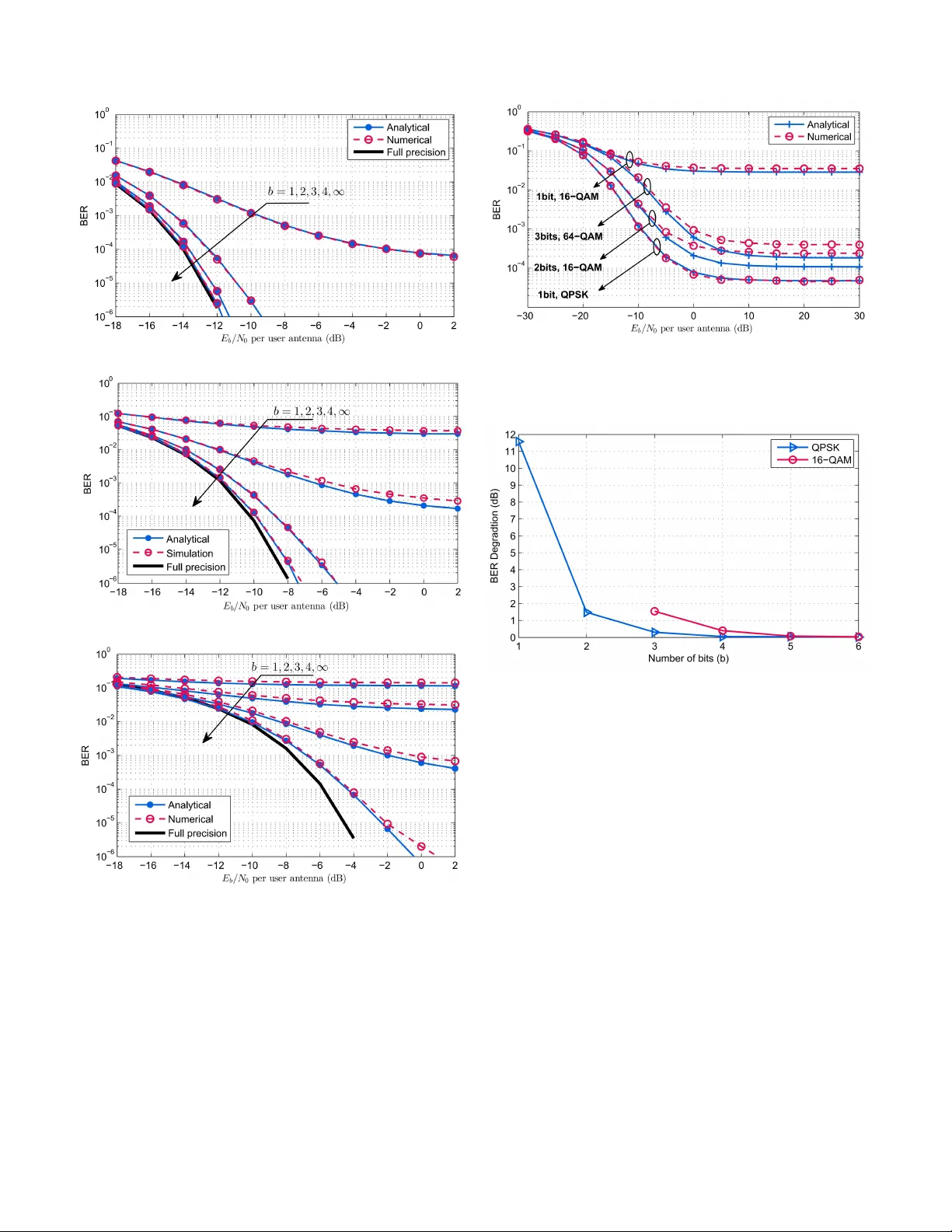
This work has been submitted to the IEEE Journals for possible publication. Copyright may be transferred without notice, after which this version may no longer be accessible. BER Performance Analysis of Coarse Quantized Uplink Massi v e MIMO Azad Azizzadeh, Reza Mohammadkhani, Seyed V ahab Al-Din Makki, and Emil Bj ¨ ornson Abstract —Having lower quantization resolution, has been in- troduced in the literature, as a solution to reduce the power consumption of massive MIMO and millimeter wave MIMO systems. In this paper , we analyze bit error rate (BER) perfor - mance of quantized uplink massiv e MIMO employing a few-bit resolution ADCs. Considering Zero-For cing (ZF) detection, we derive a closed-form quantized signal-to-interference-plus-noise ratio (SINR) to achieve an analytical BER approximation f or coarse quantized M-QAM massive MIMO systems, by using a linear quantization model. The proposed expression is a func- tion of quantization resolution in bits. W e further numerically in vestigate the effects of different quantization lev els, from 1-bit to 4-bits, on the BER of three modulation types of QPSK, 16- QAM, and 64-QAM. Uniform and non-uniform quantizers ar e employed in our simulation. Monte Carlo simulation results reveal that our appr oximate formula gives a tight upper bound for the BER perf ormance of b -bit resolution quantized systems using non-unif orm quantizers, whereas the use of uniform quantizers cause a lower performance for the same systems. W e also found a small BER performance degradation in coarse quantized systems, for example 2-3 bits QPSK and 3-4 bits 16-QAM, compared to the full-precision (unquantized) case. Howe ver , this performance degradation can be compensated by increasing the number of antennas at the BS. Index T erms —Bit Error Rate (BER), low resolution ADC, coarse quantization, massive MIMO. I . I N T RO D U C T I O N M ASSIVE MIMO technology as a result of rethinking the concept of MIMO wireless communications, en- ables each base station (BS) to communicate with tens of users at the same time and frequency , by increasing the number of antennas at the BS [1]. Furthermore, this technology reduces the effect of additiv e thermal noise for the uplink by averaging ov er a large array at the BS, and allo ws the use of simple linear processing techniques [2]. Howe ver , massiv e MIMO systems, ha ving hundreds of antennas and the same number of radio frequency (RF) chains at the BS, are facing high power consumption and hardware complexities. Among hardware components of each RF chain, analog-to-digital-con verter (ADC) has attracted the most interest. It stands to reason that power consumption of an ADC is gro wing exponentially by increasing the quantization resolution, and linearly by an increase in sampling rate or Corresponding author: R. Mohammadkhani . A. Azizzadeh and S. V . Makki are with the Department of Elec- trical Engineering, Razi Univ ersity , Kermanshah, Iran (e-mail: aziz- zadeh.azad@razi.ac.ir , v .makki@razi.ac.ir). R. Mohammadkhani is with the Department of Electrical Engineering, Uni- versity of Kurdistan, Sanandaj, Iran (e-mail: r .mohammadkhani@uok.ac.ir). E. Bj ¨ ornson is with the Department of Electrical Engineering (ISY), Linkoping Uni versity , Sweden (email: emil.bjornson@liu.se). bandwidth [3], [4]. Moreover , there is a limit of ( sampling rate × bit-resolution ) for ADCs [3]. Therefore, sev eral studies hav e inv estigated the use of lo w resolution quantization (in bits) for massiv e MIMO [5]–[11] and millimeter wav e MIMO systems [12]–[14]. Reducing the bit-resolution of ADCs, results in the re- duction of power consumption not only for the ADCs, but also for the baseband circuits connected to ADC/D AC [14]. Howe ver , by the use of few-bit resolution and especially the ultimate coarse quantization level of 1-bit ADCs, we face sev eral challenges. Channel estimation algorithms [15], [16], the way we use channel-state-information (CSI) for precoding [17]–[19], detection techniques [6], [10], [20], [21] and other signal processing algorithms are different. Sev eral studies ha ve inv estigated the effects of quantization bit-resolution on achiev able rates [5], [12], [22] and energy efficienc y (ratio of data rate to the power consumption) [23] recently , and some closed-form expressions are proposed for the achiev able rate of quantized massi ve MIMO systems [5], [24]. Howe ver , up to our knowledge, there is no theoretical closed-form expression in the literature for the BER perfor- mance of low-resolution (in bit) quantized massiv e MIMO systems. There are some simulation results that inv estigate the ef fects of lo w-resolution (in bits) quantization on the BER performance for downlink [11], and uplink [25] mas- siv e MIMO systems. Howe ver , a vailable analytical studies are limited to some special cases. For example, [9], [17] ev aluate the Symbol-Error -Rate (SER) for 1-bit QPSK, at uplink and do wnlink, respectiv ely . In addition, [18] studies the BER of quantized massi ve MIMO systems with different bit-resolutions, but only for QPSK modulation at downlink in order to rather design a precoder at the BS. In this paper, we study the BER performance of uplink mas- siv e MIMO systems with different coarse quantization lev els of b -bit resolution ADCs. W e present an approximate BER expression for M-QAM modulations, assuming ZF detection at the BS, using the liner quantization model. W e extend our preliminary simulation results in [25] that uses uniform quantizers, to the case of ha ving both uniform and non-uniform quantizers. Our contributions are listed as follows: • Obtaining the ZF detection matrix for the b -bit resolution quantized system, using the liner quantization model, • Deriving a quantized signal-to-interference-plus-noise ra- tio (SINR) that leads to a closed-form BER expression for M-QAM quantized massiv e MIMO systems, • Evaluating asymptotic BER performance of quantized systems 2 Fig. 1: An uplink quantized massiv e MIMO system • Simulating the BER of quantized massiv e MIMO systems with dif ferent b -bit resolutions from b = 1 to 4 for three modulation types of QPSK, 16-QAM, and 64-QAM, using both uniform and non-uniform quantizers. • Simulating the BER degradation to find the optimum b -bit quantization resolution for each one of the above modulations. The rest of this paper is organized as follows. Section II presents the system model, and revie ws a linear quantizer model based on Bussgang decomposition theory for Gaussian distributed signals, that would be simplified to a simple model called additive quantization noise model (A QNM), when we hav e equal b -bit quantizers for all antennas. Then, considering ZF detection for massi ve MIMO systems in Section III, we deriv e a ZF detection matrix for b -bit resolution quantized systems, using the linear quantizer model. Next, in Section IV, a BER expression of M-QAM MIMO using ZF detectors is used and extended to apply in quantized massive MIMO systems, follo wed by asymptotic BER behavior analysis of such systems. Section V provides the numerical BER results employing ( b = 1 to 4)-bit resolution ADCs for three mod- ulation types of QPSK, 16-QAM, and 64-QAM, using both uniform and non-uniform quantizers. At the end, we conclude the paper in Section VI. I I . S Y S T E M M O D E L An uplink massiv e MIMO system with one base station (BS) having N antennas, and serving K single-antenna user equipments is considered. W e assume users transmit a symbol vector x ∈ C K × 1 where each symbol x k has a constellation size M . The receiv ed symbol vector y ∈ C N × 1 at the BS, is giv en by y = Hx + n = K X k =1 h k x k + n (1) where h k ∈ C N × 1 is the channel vector between the BS and the k th user , H ∆ = [ h 1 , h 2 , ..., h K ] ∈ C N × K denotes the channel matrix, and n ∼ C N (0 , σ 2 n I N ) is the additive white Gaussian noise vector . The channel state information (CSI) is unknown to the users (transmit side), therefore we assume the same symbol energy per user , and R x = E { xx H } = σ 2 x I K . W e further assume that entries of H and n are independent. As illustrated in Fig.1, the real and imaginary parts of the complex received signal at each antenna, are quantized T ABLE I: values of α and ρ for b -bit resolution ADCs b 1 2 3 4 5 ρ 0.3634 0.1175 0.03454 0.009497 0.002499 α 0.6366 0.8825 0.96546 0.990503 0.997501 separately by b -bit resolution ADCs. The resulting quantized signal vector is defined as y q = Q ( y ) = Q ( y R ) + j Q ( y I ) = y + e (2) where Q ( · ) represents the quantization function, e is the vector of quantization error , and y R and y I are the real and imaginary parts of y , respectively . A. Linear Quantizer Model Assuming a Gaussian input vector x in (1), for each realization of the channel matrix H , the output y would also be Gaussian distributed. Therefore, according to the Bussgang theorem [21], [26], the output of the non-linear quantizer y q = Q ( y ) can be decomposed into a desired signal part and an uncorrelated distortion, as follows y q = By + n q , (3) where the quantization noise vector n q is uncorrelated with y , and B is a linear matrix operator chosen to minimize the power of the quantization noise n q , and is gi ven by [21], [27] B = E y q y H E yy H − 1 = R y q y R − 1 yy . (4) Let assume y i as the receiv ed signal of the i th antenna, quantized by two separate b -bit quantizers for the real and imaginary parts, y i,R and y i,I , respecti vely . Therefore, we hav e y i,R q = Q ( y i,R ) and y i,I q = Q ( y i,I ) , and distortion factor for each quantizer can be expressed as [21] ρ i,c = V ar[ e i,c ] V ar[ y i,c ] (5) for i = 1 , 2 , . . . , N and c ∈ { R, I } , where V ar[ y i,c ] is the variance of the input y i,c , and V ar[ e i,c ] is the v ariance of the quantizer error e i,c = y i,c q − y i,c . It is worth noting that the distortion factor ρ of each quantizer is equal to the in verse of the signal-to-quantization-noise ratio (SQNR). Assuming the same b -bit resolution ADCs for all recei ved signals (and for both real and imaginary parts of each one), in a MIMO system illustrated in Fig. 1, and considering Gaussian distributed x and y , the distribution factor of all quantizers would be equal, i.e. ρ i,c = ρ for all i and c ∈ { R, I } . Therefore, for each realization of the channel matrix H , the correlation matrix of n q can be expressed as [21], [28] R n q n q = E ( y q − By )( y q − By ) H = R y q y q − R y q y R − 1 yy R yy q = ρ (1 − ρ ) diag ( R yy ) (6) 3 where ρ is a scalar depending on the number of quantization bit-resolution 1 . For such assumptions, the linear matrix B can also be simplified as B = (1 − ρ ) I N = α I N . (7) T able I sho ws the values of ρ and α for b -bit quantization resolution ( b ≤ 5 ). For higher bit-resolution of b > 5 , an approximate of ρ = π √ 3 2 2 − 2 b can be applied [29]. Substituting (7) into (3), we hav e y q = (1 − ρ ) y + n q = α y + n q . (8) The abov e form of the quantizer model is called Additive Quantization Noise Model (A QNM) in the current studies [5], [12], [30]. As we see, the linear quantizer model resulted from Bussgang decomposition theory , considering equal b -bit quantizers for all antennas, will be equal to the A QNM model. I I I . Z F D E T E C T I O N O F Q UA N T I Z E D M A S S I V E M I M O In this section, we begin with ZF detection for unquantized massiv e MIMO systems, and then, we extend it to the b - bit resolution quantized systems by using the linear quantizer model. A. ZF Detection It has been known that linear detectors (such as zero forcing (ZF) and minimum mean squared error (MMSE) detectors) hav e lower computational complexity compared to optimal detectors, at the expense of achieving suboptimal performance [31], [32]. Howe ver , for a massiv e MIMO system where N K 1 , linear detectors perform very close to optimal detectors [33], [34]. In this article, we employ ZF detector for an uplink massive MIMO scenario. Having the channel state information at the BS (recei ve side), we multiply a K × N detection matrix A H by the recei ved vector y , to hav e an estimate of the transmit symbol vector x as follows ˆ x = A H y = A H Hx + A H n . (9) Follo wing the fact that noise is ignored in ZF detection, the detection matrix is found by solving A H Hx = x . (10) Since H is a non-square matrix in general, we may express the solution as [34] A = H ( H H H ) − 1 . (11) Substituting (11) into (9), an estimate of the transmit symbol vector is given by ˆ x = x + ( H H H ) − 1 H H n (12) and by doing some maths, we can express the signal-to- interference-noise-ratio (SINR) of the k th user as γ k = σ 2 x σ 2 n [( H H H ) − 1 ] kk = γ 0 1 [( H H H ) − 1 ] kk (13) 1 Howe ver, it should be replaced by a diagonal matrix ρ ∈ R N × N if we use different bit-resolution for the available quantizers [28]. where γ 0 = σ 2 x /σ 2 n is the SNR for A WGN channel model (in other words, when H is an identity matrix), and [ · ] kk denotes the k th diagonal element. For an independent and identically distributed (i.i.d) Rayleigh flat-fading channel matrix H , the article [35] shows that χ 2 d = 1 / [( H H H ) − 1 ] kk is a chi-squared random variable with d = 2( N − K + 1) degrees of freedom. Since the SINR distribution of symbol streams for all users are assumed to be equal, i.e. uniform power allocation for the case of no CSI at the transmit side, we simply neglect the subscript k and consider the SINR of each symbol stream as γ = γ 0 χ 2 d . B. ZF Detection of Quantized Massive MIMO In order to inv estigate the effects of lo w resolution quantiza- tion on the BER performance of massiv e MIMO systems, we substitute the linear quantizer model of (8) into (9) as follows ˆ x = A H y q ≈ A H ( α y + n q ) = α A H Hx + A H ( α n + n q ) | {z } noise . (14) Therefore, we hav e to solve α A H Hx = x , (15) to find the ZF detection matrix for a quantized system, using linear quantization model. It is giv en by A q = 1 α H ( H H H ) − 1 . (16) Substituting (16) into (14), we may write the transmit vector estimate as ˆ x = A H q y q ≈ A H q ( α y + n q ) = 1 α ( H H H ) − 1 H H ( α Hx + α n + n q ) = x + ( H H H ) − 1 H H ( n + 1 α n q ) = x + n e (17) we define n e = ( H H H ) − 1 H H ( n + 1 α n q ) as the effective noise , consisting of an additiv e white Gaussian noise (A WGN) and the quantization noise. In order to determine the SINR of user k , we need to calculate the cov ariance matrix of the effecti ve noise E { n e n H e } = E { [( H H H ) − 1 H H ( n + 1 α n q )][( H H H ) − 1 H H ( n + 1 α n q )] H } = ( H H H ) − 1 H H E { ( n + 1 α n q )( n + 1 α n q ) H | {z } nn H + 1 α nn H q + 1 α n q n H + 1 α 2 n q n H q } H ( H H H ) − 1 . (18) W e assume that unquantized noise vector n and the quanti- zation noise vector n q are uncorrelated. Therefore, E { nn H q } and E { n q n H } are equal to zero, and (18) can be simplified as E { n e n H e } =( H H H ) − 1 H H [ E { nn H } + 1 α 2 E { n q n H q } ] H ( H H H ) − 1 , (19) 4 where E { nn H } = σ 2 n I N , (20) E { n q n H q } = α (1 − α ) diag ( σ 2 x HH H + σ 2 n I N ) . (21) In order to calculate the term diag( · ) in the above, we examine the i th diagonal element as [diag( σ 2 x HH H + σ 2 n I N )] ii = σ 2 x K X k =1 | h ik | 2 + σ 2 n (22) The channel is assumed to be i.i.d Rayleigh fading, in other words, h ik are i.i.d complex Gaussian random v ariables with zero-mean and unit-variance. In [36], it is shown that for such channel coefficients, | h ik | 2 is a Gamma distributed random variable with unit-shape and unit-scale parameters. Equiv a- lently , | h ik | 2 are i.i.d exponential random v ariables with unit- parameter ( λ = 1 ). Furthermore, according to the weak law of lar ge numbers [37], for a fixed and large enough v alue of K , sample mean of K i.i.d samples g k = | h ik | 2 approaches their mean value, i.e. λ = 1 for our channel model. Therefore, 1 K K X k =1 g k = 1 K K X k =1 | h ik | 2 ≈ 1 (23) and σ 2 x K X k =1 | h ik | 2 + σ 2 n ≈ K σ 2 x + σ 2 n . (24) Consequently , (19) can be re written as E { n e n H e } ≈ σ 2 n + (1 − α ) α ( K σ 2 x + σ 2 n ) ( H H H ) − 1 (25) Assuming an equal transmit power of σ 2 x for all users, the receiv ed SINR of k th user is giv en by γ q ,k ≈ σ 2 x σ 2 n + 1 − α α ( K σ 2 x + σ 2 n ) 1 [( H H H ) − 1 ] kk = γ q 0 1 [( H H H ) − 1 ] kk (26) As explained in the previous section, χ 2 d = 1 / [( H H H ) − 1 ] kk is a chi-square distributed random v ariable with d = 2( N − K + 1) degrees of freedom. Furthermore, we assume the SINR per streams for all users are identically distributed. Therefore, the SINR of each symbol stream is represented by γ q = γ q 0 χ 2 d , where γ q 0 = σ 2 x σ 2 n + 1 − α α ( K σ 2 x + σ 2 n ) . (27) I V . B E R O F Q UA N T I Z E D M - Q A M M A S S I V E M I M O A. BER of M-QAM MIMO An analytical BER expression of an i.i.d. Rayleigh fading MIMO, for square M-QAM modulations (with Gray code mapping and ZF detection) is obtained in [38] by a veraging ov er the bit error probability with respect to the chi-squared random variable χ 2 d that is addressed in the pre vious subsec- tion. Readily , the BER of an M-QAM MIMO base station is giv en by [38] B E R M QAM ∼ = 2 √ M log 2 √ M log 2 √ M X k =1 (1 − 2 − k ) √ M − 1 X i =0 ( ( − 1) b i. 2 k − 1 √ M c 2 k − 1 − b i. 2 k − 1 √ M + 1 2 c B ( i ) ) (28) where b x c is the floor function giving the greatest integer , less than or equal to the input x , and B ( i ) = [ 1 2 (1 − µ i )] D +1 D X j =0 D + j j [ 1 2 (1 + µ i )] j (29) where µ i = s 3(2 i + 1) 2 γ 0 2( M − 1) + 3(2 i + 1) 2 γ 0 , D = N − K . (30) The BER estimate of M-QAM in (28), can be more sim- plified by keeping only two dominant terms at i = 0 , 1 and neglecting the rest. Therefore we have [38] B E R M QAM ∼ = 2( √ M − 1) √ M log 2 √ M B (0) + 2( √ M − 2) √ M log 2 √ M B (1) (31) The abov e analytical BER formula is validated in [38] for M- QAM MIMO, and here we use it for the case of unquantized massiv e MIMO. B. BER of Quantized M-QAM Massive MIMO A closed-form BER e xpression of a massi ve MIMO base station using low-resolution ADCs, for M-QAM modulations and ZF detection, can be obtained from (31) if we replace γ 0 by γ q 0 from (27). W e further inv estigate the ef fects of quantization on the BER performance of uplink massive MIMO, by considering the following cases. C. Incr easing the bit r esolution of ADCs As b goes to infinity , α approaches 1. Then, γ q 0 = σ 2 x σ 2 n + 1 − α α ( K σ 2 x + σ 2 n ) − − − − − − − → b →∞ γ 0 = σ 2 x σ 2 n . (32) Accordingly , γ q ,k in (26) approaches γ k in (13), and we will have the same received SINR for both quantized and unquantized massiv e MIMO. D. Incr easing the transmit power As we increase the transmit power to infinity , for an unquantized massive MIMO system, γ 0 approaches ∞ and therefore the BER performance goes to zero. Howe ver , for the quantized massiv e MIMO, we have γ q 0 − − − − − − − − − − − − → ( σ 2 x /σ 2 n ) →∞ α (1 − α ) K , (33) and BER goes to a non-zero constant value. W e readily see that this BER floor can be reduced if we increase γ q 0 either by increasing the quantization resolution that result in α → 1 , or reducing the number of users K. 5 E. Incr easing the number of users, K Referring to (26), as we increase the number of users, the denominator of γ q ,k (representing the sum of quantization noise and interferences) is increased. Therefore, the BER gets worse by increasing K for quantized massive MIMO. V . N U M E R I C A L R E S U LT S In this section, some numerical simulations are performed to inv estigate the accuracy of the proposed analytical BER expression for coarse quantized massi ve MIMO systems. W e consider an uplink massi ve MIMO with N = 100 antennas at the BS and K = 10 users, employing two types of uniform and non-uniform quantizers, with different quantization bit resolutions of b = 1 , 2 , 3 , 4 and full precision (i.e., b = ∞ ). A. Uniform Quantization W e numerically analyze the BER performance of quan- tized QPSK and 16-QAM modulations, employing uniform quantizers, in Fig. 2. Numerical results are compared to the corresponding BER values obtained from the analytical formula of (31) that uses the linear quantization model . Looking at the BER curves, we observe that analytical curves giv e an upper bound for the BER performance of the corresponding numerical curves, with noticeable gaps between numerical and analytical curv es for both QPSK and 16-QAM modulations at very low-resolution quantization ( b = 1 , 2 , 3 ). W ith an exception of 1-bit QPSK that both curves are matched, discrepancies are arising by increasing E b / N 0 (SNR per bit) per user . This may happen due to the inaccuracy of the linear quantization model for uniform quantizers at low- bit resolutions [30]. Therefore, we examine the use of non- uniform quantizers at the following subsection. B. Non-uniform Quantization Since the linear quantization model parameters in T able I is provided for a non-uniform quantizer [39], we re generate our numerical BER curves by using a non-linear quantizer described in [39] that is optimal for a Gaussian distributed input signal. From no w on, we use the abov e non-uniform quantizer for the rest of numerical results. The numerical BER performance of three modulation types of QPSK, 16-QAM and 64-QAM are illustrated in Fig. 3. As we see, the numerical and analytical BER curv es for QPSK are similar , e ven for very low quantization resolutions of b = 1 , and 2-bits. Furthermore, we observe a very small dif ference between numerical and analytical v alues of BER at b = 1 , 2 for 16-QAM, and b = 1 , 2 , 3 for 64-QAM. Howe ver , the gap between these curves is slowly growing by increasing the SNR per bit ( E b / N 0 ). Therefore, we see that analytical BER expression provides a very tight upper bound for the BER performance of coarse quantized systems having non-uniform quantizers. Another lessen learned from Fig. 3 is that a very poor BER performance is achie ved for the coarse quantized cases of (i) 1- bit 16-QAM, (ii) 1-bit and 2-bits 64-QAM. Therefore, we need (a) QPSK (b) 16-QAM Fig. 2: BER of quantized massi ve MIMO for (a) QPSK, and (b) 16-QAM modulations with N = 100 , and K = 10 , using uniform quantizer . to increase the bit-resolution of quantization. Howe ver , the effects of coarse quantization might be somehow compensated by employing coding techniques. C. BER Floor at Low-Resolution Quantization As we discussed earlier in Section IV, the BER of unquan- tized system approaches zero by increasing the SNR. Ho wev er, the BER of a lo w-resolution quantized system goes to a non- zero v alue and we can not further decrease it by increasing the transmit power . As we observed in Fig. 3, we can improve the BER performance and achie ve very low BER v alues by having a very small increase in bit-resolution of quantizers, from 1-bit to 3-bits ev en in 64-QAM. Therefore, Fig. 4 demonstrates the following coarse quantized modulations: (i) QPSK at b = 1 , (ii) 16-QAM at b = 1 , 2 , and (iii) 64-QAM at b = 3 -bits quantization resolution. W e see that, in the case of 1-bit 16- QAM, we can not reach a BER of 10 − 2 or lo wer . In addition, a similar trend is observed for both numerical and analytical BER curves of 1-bit QPSK, 2-bits 16-QAM, and 3-bits 64- QAM with a BER floor of 10 − 4 , with QPSK and 64-QAM attaining the lowest and the worst BER, respectiv ely . It means 6 T ABLE II: BER values for SNR → ∞ in an uncoded M-QAM massiv e MIMO system with K = 10 users and N = 100 antennas at the BS, having b -bit resolution ADCs. b = 1 b = 2 b = 3 b = 4 Analytical Numerical Analytical Numerical Analytical Numerical Analytical Numerical QPSK 4 . 76 × 10 − 5 4 . 8 × 10 − 5 1 . 4 × 10 − 14 0 1 . 1 × 10 − 36 0 2 . 47 × 10 − 74 0 16-QAM 2 . 84 × 10 − 2 3 . 52 × 10 − 2 1 . 8 × 10 − 4 2 . 31 × 10 − 4 8 . 5 × 10 − 12 0 1 . 91 × 10 − 30 0 64-QAM 1 . 14 × 10 − 1 1 . 41 × 10 − 1 2 . 13 × 10 − 2 2 . 85 × 10 − 2 1 . 83 × 10 − 4 3 . 69 × 10 − 4 6 . 59 × 10 − 11 2 . 33 × 10 − 9 that, higher bit-resolution is needed to achiev e the same BER performance by using higher order modulations. Moreover , the gap between the numerical (using non-uniform quantizer) and the analytical curves of the BER performance, for the two coarse quantized modulations of 16-QAM and 64-QAM, is growing by increasing the SNR. This issue is also reported in [12] for the capacity of low-resolution quantized massiv e MIMO. This might happen due to the inaccuracy of the linear quantizer model for high SNR values. T able II provides BER values of b -bit quantized systems employing uncoded modulations of QPSK, 16-QAM, and 64- QAM when the SNR per user goes to infinity . Analytical results are obtained by using asymptotic formulas in Section IV, and numerical results are coming from Monte Carlo simulations having a very high SNR of 100 dB. As we see from the table, analytical BER v alues show an upper bound (best possible value) of the BER performance for any M-QAM modulation, using b -bit resolution quantizers. This will help to decide easily what number of bit-resolution would be required. D. BER De gradation Considering a reference SNR for the unquantized (full- precision) system to achiev e a BER of 10 − 4 , we calculate the extra SNR (in dB) required to attain the same BER for b -bit resolution quantized system, and we call it BER de gradation . W e note that this process is performed separately for each types of modulations. Fig. 5 sho ws the BER degradation of QPSK and 16-QAM modulations in quantized massiv e MIMO systems with b -bit ADCs’ resolution. W e see that 2-bits QPSK and 3-bits 16- QAM ha ve the same BER degradation value of roughly 1.5 dB, whereas this v alue is reported in [25] to be 3 to 4 dB larger for uniform quantization. Furthermore, 3-bits QPSK and 4-bits 16-QAM hav e a very little BER degradation of 0.3 dB. Comparing these results to the corresponding v alues for un i form quantization in [25], we see that optimal non- uniform quantizers achiev e much higher BER performance at coarse quantized systems, although we will hav e similar performance for both non-uniform and uniform quantizations at higher resolutions. W e further inv estigate the effects of quantization bit- resolution and the number of BS antennas, on the BER degradation in Fig. 6 for QPSK and 16-QAM modulations. It can be seen that, the BER degradation caused by lower quantization resolution, can be compensated by increasing the number of antennas at the BS for both QPSK and 16-QAM modulations. E. V arying the Number of Users, and BS Antennas Authors in [17] claim that the downlink SER performance of the BS with 1-bit QPSK is the same for any number of BS antennas ( N ) and users ( K ) that result in the same ratio of N /K . W e in vestigated this issue in Figures 7a and 7b for 1-bit QPSK and (1 to 3)-bits 16-QAM modulations. Howe ver , while holding a fixed ratio of N/K , we see that results are different and having higher N causes better BER performance for both types of modulations. It may happen due to a different definition of SNR in [17]. If we consider ¯ P as the total transmit power of the users, and replace σ 2 x with ¯ P /K in our equations, we achieve similar results by plotting the SER versus ¯ P . In other words, we observe equal SER performance while having a fixed ratio of N /K . Howe ver , this kind of defining the SNR, might be more useful for the downlink scenario. It is worth noting that both numerical and analytical curves hav e very close BER results. Therefore, we can find reasons of the BER performance behavior by looking at the analytical expression. Referring to (27), the number of users, K , appears in the denominator of γ q 0 . W e further recall that the quantized BER performance is obtained by replacing γ 0 with γ q 0 in (29)-(31). Moreov er , the expression of the unquantized BER depends on the term D = N − K , and it would justify our results in Figures 7a and 7b. A similar behavior for uplink ZF MIMO is reported in [38]. Furthermore, we hav e performed another simulation in Fig. 7c in vestigating other ways that K and N can be varied. W e observe that any equal increase in K and N result a lower BER performance, although a system with higher N has shown higher performance in previous figures. Ha ving a term K in the denominator of γ q 0 , might explain such results. Then, we conclude that if the number of users are increased in the system, we can compensate the performance loss by increasing the number of BS antennas, albeit with more increment for N compared with K . V I . C O N C L U S I O N W e in vestigated the ef fect of coarse quantization on the BER of uplink massive MIMO systems. Assuming ZF detection at the BS, we deri ved a quantized SINR and obtained an analytical BER expression for M-QAM modulations employ- ing low resolution quantizers. The proposed expression is a function of quantization resolution in bits. The use of uniform and non-uniform quantizers are also inv estigated numerically , and we found that the analytical expression gives us an upper bound for the BER performance of quantized massiv e MIMO systems. For the case of non-uniform quantizers, analytical and numerical BER values are very close, e ven at very low 7 (a) QPSK (b) 16-QAM (c) 64-QAM Fig. 3: BER of quantized massi ve MIMO for (a) QPSK, (b) 16-QAM, and (c) 64-QAM modulations with N = 100 , and K = 10 , using non-uniform quantizer . b -bit resolution quantizations of b = 1 to 3 bits for QPSK, 16-QAM, and 64-QAM modulations. W e found that a small BER performance degradation happens for coarse quantized systems of 2-3 bits QPSK and 3-4 bits 16-QAM, compared to the full-precision (unquantized) case. Howe ver , increasing the number of BS antennas can compensate the performance degradation of quantized systems. W e further found that any BER performance loss due to the increase of number of users, K , can also be compensated by increasing the number of BS Fig. 4: BER of coarse quantized massiv e MIMO with N = 100 , K = 10 and modulation types of QPSK, 16-QAM, and 64-QAM. Fig. 5: BER degradation as a function of b -bit quantization resolution for a massiv e MIMO system with N = 100 , and K = 10 , using QPSK and 16-QAM modulations. antennas, albeit with more increment for N compared with K . W e generalize our results to include the challenge of channel estimation error at coarse quantized systems, in our future work. R E F E R E N C E S [1] E. G. Larsson, O. Edfors, F . T ufvesson, and T . L. Marzetta, “Massi ve MIMO for next generation wireless systems, ” IEEE Communications Magazine , vol. 52, no. 2, pp. 186–195, 2014. [2] F . Rusek, D. Persson, B. K. Lau, E. G. Larsson, T . L. Marzetta, O. Edfors, and F . Tufv esson, “Scaling up MIMO: Opportunities and challenges with very large arrays, ” IEEE Signal Pr ocessing Magazine , vol. 30, no. 1, pp. 40–60, 2013. [3] R. H. W alden, “ Analog-to-digital con verter survey and analysis, ” IEEE Journal on Selected Areas in Communications , vol. 17, no. 4, pp. 539– 550, 1999. [4] J. Singh, S. Ponnuru, and U. Madhow , “Multi-gigabit communication: the ADC bottleneck, ” in Ultra-W ideband, 2009. ICUWB 2009. IEEE International Confer ence on . IEEE, 2009, pp. 22–27. [5] L. Fan, S. Jin, C.-K. W en, and H. Zhang, “Uplink achiev able rate for massiv e MIMO systems with low-resolution ADC, ” IEEE Communica- tions Letters , vol. 19, no. 12, pp. 2186–2189, 2015. [6] S. W ang, Y . Li, and J. W ang, “Multiuser detection for uplink large- scale MIMO under one-bit quantization, ” in Communications (ICC), 2014 IEEE International Confer ence on . IEEE, 2014, pp. 4460–4465. 8 (a) QPSK (b) 16-QAM Fig. 6: BER degradation of QPSK and 16-QAM modulations with K = 10 , and dif ferent number of BS antennas ( N ). [7] J. Zhang, L. Dai, S. Sun, and Z. W ang, “On the spectral efficiency of massiv e MIMO systems with low-resolution ADCs, ” IEEE Communi- cations Letters , vol. 20, no. 5, pp. 842–845, 2016. [8] S. W ang, Y . Li, and J. W ang, “Con vex optimization based multiuser detection for uplink large-scale MIMO under low-resolution quantiza- tion, ” in Communications (ICC), 2014 IEEE International Conference on . IEEE, 2014, pp. 4789–4794. [9] C. Risi, D. Persson, and E. G. Larsson, “Massiv e MIMO with 1-bit ADC, ” arXiv preprint , 2014. [10] Y . Zhang, L. Huang, and J. Song, “MPDQ-based high-order QAM detection scheme for massiv e MIMO with low-precision quantization, ” in Signal and Information Pr ocessing (GlobalSIP), 2015 IEEE Global Confer ence on . IEEE, 2015, pp. 28–32. [11] C. Desset and L. V an der Perre, “V alidation of low-accurac y quantization in massive MIMO and constellation EVM analysis, ” in Networks and Communications (EuCNC), 2015 European Confer ence on . IEEE, 2015, pp. 21–25. [12] O. Orhan, E. Erkip, and S. Rangan, “Low power analog-to-digital con- version in millimeter wave systems: Impact of resolution and bandwidth on performance, ” in Information Theory and Applications W orkshop (IT A), 2015 . IEEE, 2015, pp. 191–198. [13] J. Mo and R. W . Heath, “High SNR capacity of millimeter wav e MIMO systems with one-bit quantization, ” in Information Theory and Applications W orkshop (ITA), 2014 . IEEE, 2014, pp. 1–5. [14] R. W . Heath, N. Gonzalez-Prelcic, S. Rangan, W . Roh, and A. M. Sayeed, “ An overvie w of signal processing techniques for millimeter wav e MIMO systems, ” IEEE Journal of Selected T opics in Signal Pr ocessing , vol. 10, no. 3, pp. 436–453, 2016. [15] C.-K. W en, C.-J. W ang, S. Jin, K.-K. W ong, and P . T ing, “Bayes-optimal joint channel-and-data estimation for massive MIMO with low-precision ADCs, ” IEEE T ransactions on Signal Pr ocessing , vol. 64, no. 10, pp. 2541–2556, 2016. (a) QPSK (b) 16-QAM (c) 16-QAM Fig. 7: BER performance of (a) 1-bit QPSK (b) b -bits 16-QAM for b = 1 to 3, and (c) 2-bits 16-QAM, with varying number of users ( K ), and antennas at the BS ( N ). [16] J. Choi, J. Mo, and R. W . Heath, “Near maximum-likelihood detector and channel estimator for uplink multiuser massiv e MIMO systems with one-bit ADCs, ” IEEE T ransactions on Communications , vol. 64, no. 5, pp. 2005–2018, 2016. [17] A. K. Saxena, I. Fijalkow , and A. L. Swindlehurst, “ Analysis of one-bit quantized precoding for the multiuser massiv e MIMO downlink, ” IEEE T ransactions on Signal Pr ocessing , vol. 65, no. 17, pp. 4624–4634, Sept 2017. [18] S. Jacobsson, G. Durisi, M. Coldrey , T . Goldstein, and C. Studer, “Quantized precoding for massive MU-MIMO, ” IEEE T ransactions on 9 Communications , 2017. [19] H. Jedda, J. A. Nossek, and A. Mezghani, “Minimum BER precoding in 1-bit massi ve MIMO systems, ” in Sensor Array and Multichannel Signal Pr ocessing W orkshop (SAM), 2016 IEEE . IEEE, 2016, pp. 1–5. [20] A. Mezghani, M.-S. Khoufi, and J. A. Nossek, “ A modified MMSE receiv er for quantized MIMO systems, ” Proc. ITG/IEEE WSA, V ienna, Austria , pp. 1–5, 2007. [21] A. Mezghani, M. Rouatbi, and J. A. Nossek, “ An iterative receiver for quantized MIMO systems, ” in Electrotec hnical Confer ence (MELE- CON), 2012 16th IEEE Mediterranean . IEEE, 2012, pp. 1049–1052. [22] C. Moll ´ en, J. Choi, E. G. Larsson, and R. W . Heath, “ Achiev able uplink rates for massi ve MIMO with coarse quantization, ” in Acoustics, Speech and Signal Pr ocessing (ICASSP), 2017 IEEE International Confer ence on . IEEE, 2017, pp. 6488–6492. [23] M. Sarajli ´ c, L. Liu, and O. Edfors, “When are low resolution ADCs energy efficient in massiv e MIMO?” IEEE Access , vol. 5, pp. 14 837– 14 853, 2017. [24] C. Moll ´ en, J. Choi, E. G. Larsson, and R. W . Heath, “Uplink per- formance of wideband massiv e MIMO with one-bit ADCs, ” IEEE T ransactions on Wir eless Communications , vol. 16, no. 1, pp. 87–100, 2017. [25] A. Azizzadeh, R. Mohammadkhani, and S. V . A.-D. Makki, “BER performance of uplink massive MIMO with lo w-resolution ADCs, ” in 2017 7th International Conference on Computer and Knowledge Engineering (ICCKE) . IEEE, 2017, pp. 298–302. [26] J. J. Bussgang, “Crosscorrelation functions of amplitude-distorted gaus- sian signals, ” 1952. [27] Y . Li, C. T ao, G. Seco-Granados, A. Mezghani, A. L. Swindlehurst, and L. Liu, “Channel estimation and performance analysis of one-bit massi ve mimo systems, ” IEEE Tr ansactions on Signal Pr ocessing , v ol. 65, no. 15, pp. 4075–4089, 2017. [28] Q. Bai, A. Mezghani, and J. A. Nossek, “On the optimization of ADC resolution in multi-antenna systems, ” in W ireless Communication Sys- tems (ISWCS 2013), Proceedings of the T enth International Symposium on . VDE, 2013, pp. 1–5. [29] Q. Bai and J. A. Nossek, “Energy efficienc y maximization for 5g multi-antenna recei vers, ” T ransactions on Emerging T elecommunications T ec hnologies , vol. 26, no. 1, pp. 3–14, 2015. [30] A. K. Fletcher, S. Rangan, V . K. Goyal, and K. Ramchandran, “Robust predictiv e quantization: Analysis and design via con vex optimization, ” IEEE Journal of Selected T opics in Signal Pr ocessing , vol. 1, no. 4, pp. 618–632, 2007. [31] T . Brown, P . Kyritsi, and E. De Carvalho, Practical guide to MIMO radio channel: W ith MA TLAB examples . John W iley & Sons, 2012. [32] L. Bai and J. Choi, Low complexity MIMO detection . Springer Science & Business Media, 2012. [33] H. Q. Ngo, E. G. Larsson, and T . L. Marzetta, “Energy and spectral efficienc y of very large multiuser MIMO systems, ” IEEE T ransactions on Communications , vol. 61, no. 4, pp. 1436–1449, 2013. [34] X. Ma and Q. Zhou, Massive MIMO and its detection . Boca Raton, FL, USA: CRC Press/T aylor & Francis, 2014. [35] J. H. Winters, J. Salz, and R. D. Gitlin, “The impact of antenna div ersity on the capacity of wireless communication systems, ” IEEE T ransactions on Communications , vol. 42, no. 234, pp. 1740–1751, 1994. [36] Y .-G. Lim, C.-B. Chae, and G. Caire, “Performance analysis of massive mimo for cell-boundary users, ” IEEE T ransactions on W ireless Commu- nications , vol. 14, no. 12, pp. 6827–6842, 2015. [37] A. L. Garcia, Pr obability , statistics, and random processes for electrical engineering . Prentice Hall Upper Saddle River , NJ, 2008. [38] C. W ang, E. K. Au, R. D. Murch, W . H. Mow , R. S. Cheng, and V . Lau, “On the performance of the MIMO zero-forcing receiver in the presence of channel estimation error , ” IEEE T ransactions on W ir eless Communications , vol. 6, no. 3, 2007. [39] J. Max, “Quantizing for minimum distortion, ” IRE T ransactions on Information Theory , vol. 6, no. 1, pp. 7–12, 1960.
Original Paper
Loading high-quality paper...
Comments & Academic Discussion
Loading comments...
Leave a Comment