Collective Attention towards Scientists and Research Topics
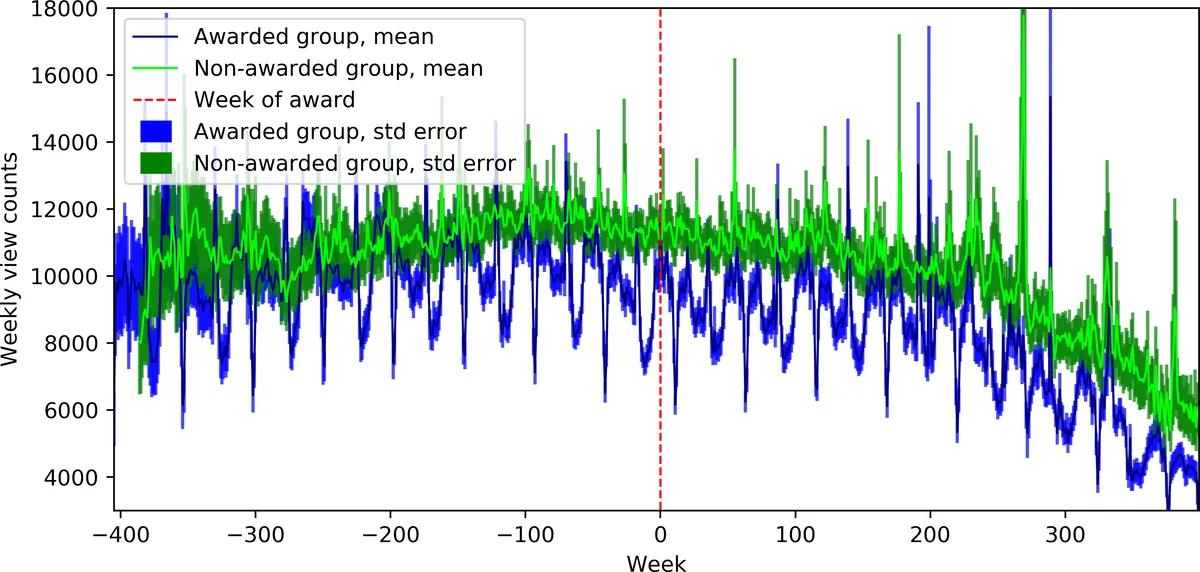
Emergent patterns of collective attention towards scientists and their research may function as a proxy for scientific impact which traditionally is assessed via committees that award prizes to scientists. Therefore it is crucial to understand the relationships between scientific impact and online demand and supply for information about scientists and their work. In this paper, we compare the temporal pattern of information supply (article creations) and information demand (article views) on Wikipedia for two groups of scientists: scientists who received one of the most prestigious awards in their field and influential scientists from the same field who did not receive an award. Our research highlights that awards function as external shocks which increase supply and demand for information about scientists, but hardly affect information supply and demand for their research topics. Further, we find interesting differences in the temporal ordering of information supply between the two groups: (i) award-winners have a higher probability that interest in them precedes interest in their work; (ii) for award winners interest in articles about them and their work is temporally more clustered than for non-awarded scientists.
💡 Research Summary
This paper, titled “Collective Attention towards Scientists and Research Topics,” presents a comparative analysis of the temporal dynamics of online collective attention towards scientists who have received major academic awards and those who have not, using Wikipedia as a primary data source. The study aims to understand how external recognition, such as prestigious awards, influences the supply (article creation/editing) and demand (page views) of information about scientists and their associated research topics.
The researchers constructed two meticulously matched datasets. The “awarded” group comprised 262 scientists who received top honors like the Nobel Prize, Turing Award, or Fields Medal between 2008 and 2015. The “non-awarded” control group consisted of 262 highly-cited researchers from the same fields and era who did not receive such awards. For each scientist, data was collected on their Wikipedia article’s creation date, edit history, and daily page views. Furthermore, outgoing links from these articles were extracted and filtered to generate lists of related scientific research topics, resulting in 1,911 topics for awarded and 1,070 for non-awarded scientists.
The analysis yielded several key findings. Firstly, regarding information supply, the act of receiving an award functions as a significant external shock. While most Wikipedia articles about both awarded and non-awarded scientists were created before they won their award, the growth trajectory of articles about awardees diverges sharply post-award. Their articles accumulate hyperlinks and words at a significantly faster rate compared to articles about non-awarded scientists, indicating that awards trigger additional information production.
Secondly, the study uncovered nuanced differences in the temporal ordering of information supply. For both groups, articles about research topics were typically created before the article about the scientist themselves, aligning with the cumulative nature of normal science. However, awarded scientists were more than twice as likely (27% vs. 10%) to have their personal Wikipedia article created before articles about their key research topics. This suggests that award-winning scientists may be more frequently associated with pioneering or relatively novel research areas that gain Wikipedia coverage only after the scientist becomes notable.
Thirdly, the temporal clustering of attention differs. The time lag between the creation of a scientist’s article and articles about their research topics is less dispersed for award winners, meaning interest in them and their work is more tightly coupled in time.
Finally, on the demand side, awards have a starkly differential impact. Page views for articles about awarded scientists show a clear and sustained increase following the award event, remaining elevated even years later. In stark contrast, page views for articles about the research topics associated with these award-winning scientists show no statistically significant response to the award. This indicates that the surge in public attention driven by an award is primarily directed towards the scientist as an individual or symbol, rather than translating into increased exploration of the substance of their work.
In conclusion, this research highlights that while scientific awards powerfully amplify online attention towards individual scientists, this attention often remains superficial, failing to extend deeply to their research topics. It provides valuable insights for the altmetrics community, cautioning that online popularity metrics may reflect celebrity-like status more than substantive scholarly impact, and underscores the complex relationship between formal recognition, public interest, and the dissemination of scientific knowledge.
Comments & Academic Discussion
Loading comments...
Leave a Comment