Performance Enhancement of Downlink NOMA by Combination with GSSK
In non-orthogonal multiple access (NOMA), cell-edge users experience significantly low spectral density because only some part of the total transmit power is allocated. This leads to low spectral efficiency for the paired users in NOMA. To overcome t…
Authors: Jin Woo Kim, Soo Young Shin, Victor C.M.Leung
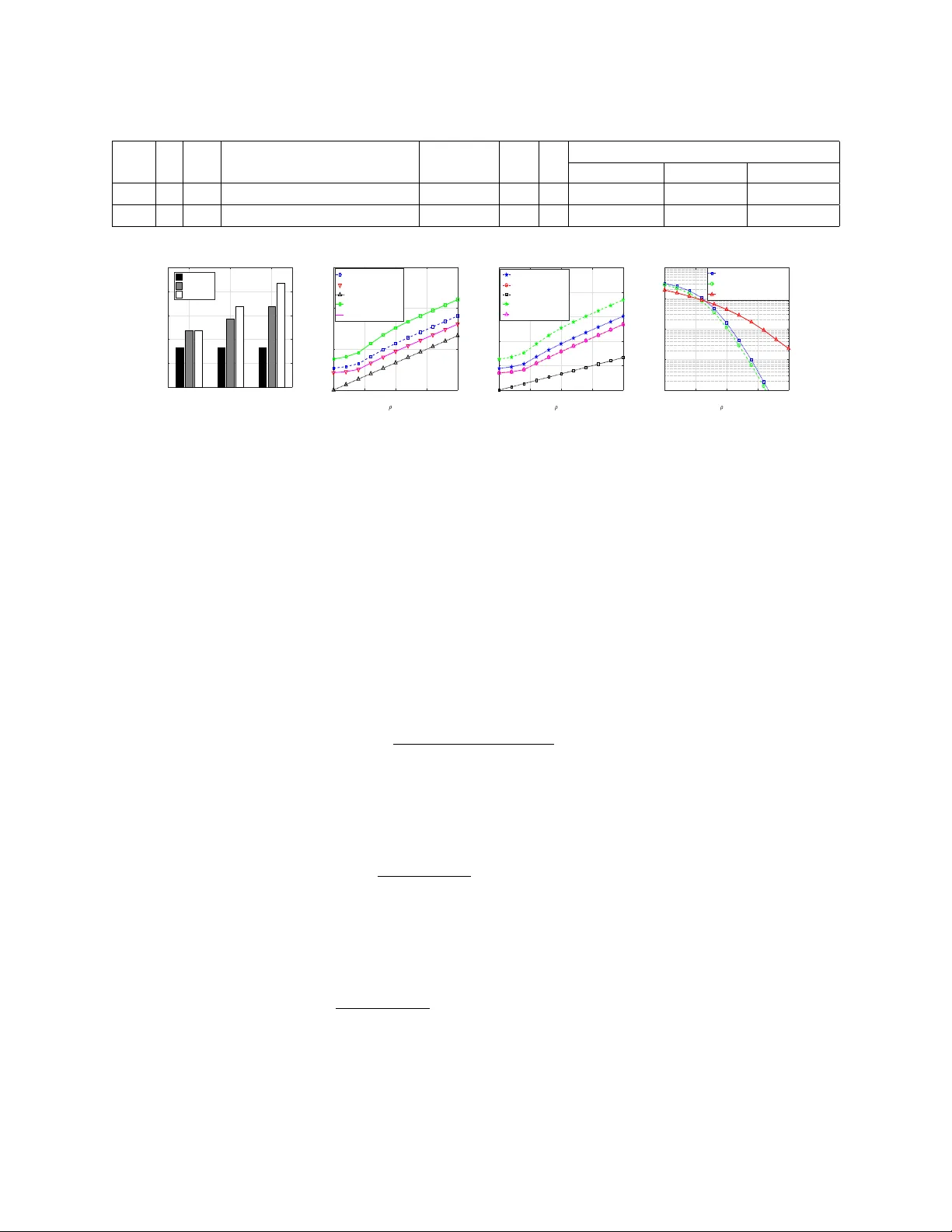
1 Performance Enhancement of Do wnlink NOMA by Combination with GSSK Jin W oo Kim, and Soo Y oung Shin, Senior Member , IEEE, V ictor C.M.Leung F ellow , IEEE Abstract In non-orthogonal multiple access (NOMA), cell-edge users experience significantly lo w spectral density because only some part of the total transmit power is allocated. This leads to lo w spectral efficienc y for the paired users in NOMA. T o overcome this problem, we propose an integration of NOMA and generalized space shift keying (GSSK), called NOMA-GSSK, to improve the spectral efficienc y by exploiting the spatial domain. Spectral and ener gy efficienc y , bit error rate (BER), and computational complexity of the proposed system were analyzed and compared to those of multiple-input multiple-output NOMA (MIMO-NOMA). It is shown that NOMA-GSSK outperforms MIMO-NOMA. Index T erms Non-orthogonal multiple access (NOMA), generalized space shift keying (GSSK), spectral ef ficiency , energy efficienc y , computational complexity . I . I N T RO D U C T I O N In recent years, the amount of network traf fic has increased significantly because of the large number of users connecting to the network. Moreover , the boom in the Internet of Things is expected to increase network traf fic dramatically . T o address this soaring traffic demand, next-generation wireless technologies such as 5G are required to provide advantages, such as better spectral ef ficiency , massive connectivity , and faster response time [1]. Non-orthogonal multiple access (NOMA) is a promising candidate for 5G to achiev e better capacity gains because of its high spectral efficienc y [2]–[4]. In [2], the author classified NOMA as code domain and power domain. In this letter , we aimed for power domain NOMA (hereinafter referred to as NOMA). In NOMA, multiple users are served in each orthogonal resource block, e.g., a time slot, frequency channel, or spreading code, by exploiting the power domain. The signals of multiplex ed users are allocated different power lev els by the base Manuscript received XXX, XX, 2016; revised XXX, XX, 2017. This research was supported by Basic Science Research Program through the National Research Foundation of Korea (NRF) funded by the Ministry of Education (2015R1D1A1A01061075). Jin W oo Kim and Soo Y oung Shin are with the WENS Lab ., Dept. of IT Conv ergence Engineering, Kumoh National Institute of T echnology , 39177, Gumi, Republic of K orea. (email:rerua@kumoh.ac.kr, wdragon@kumoh.ac.kr). V . Leung is with the Department of Electrical and Computer Engineering, Uni versity of British Columbia, Canada (e-mail: vleung@ece.ubc.ca). 2 station (BS), superimposed with each other, and transmitted. T o recover their signals, cell center users perform successiv e interference cancellation (SIC) [5]. Howe ver , cell-edge users do not perform SIC, and experience a decrease in spectral efficienc y due to degraded signals. Recently , to enhance the spectral efficiency , NOMA with spatial modulation (SM) was in vestigated in [6], [7]. In those studies, the authors aimed to analyze the spectral efficienc y of SM-NOMA from the point of vie w of mutual information. T o solv e the problem of cell-edge users, NOMA-SSK has been suggested, in which the cell-edge user is multiplex ed in the spatial domain to improve the spectral efficienc y of the system by using NOMA and space shift keying (SSK) [8]. SSK is a multiple-input multiple-output (MIMO) technique, which transmits information using an antenna index, contrary of the con ventional modulation schemes [9]. Moreover , the application of SSK can efficiently reduce transmitter ov erhead and receiver complexity by using the antenna index instead of any modulation scheme. Howe ver , because of the characteristics of SSK, the number of transmit antennas must be a power of two. In this letter , to further improve the spectral efficienc y of cell-edge users and to ov ercome the limitation on the number of transmit antennas of NOMA-SSK, we propose a nov el transmission scheme by combining NOMA and generalized space shift ke ying (GSSK), called NOMA-GSSK. GSSK is a generalized form of SSK and uses multiple transmit antennas, unlike SSK [10]. The proposed scheme achieves higher spectral and energy efficienc y , and lo wer bit error rate (BER), compared to MIMO-NOMA and NOMA-SSK, because the users are multiplex ed in both the power and spatial domains, by using a set of transmit antennas, whereas in MIMO-NOMA, all antennas are used to transmit the NOMA signal. In addition, because cell-edge users are multiplexed in the spatial domain, the complexity of the system is also decreased, because the SIC steps are reduced. I I . S Y S T E M M O D E L Assume N + K users to be uniformly distributed in a cell, N users are multiplexed using NOMA, and K users exploit the spatial domain. The channel gains of users are in the order | h 1 | ≥ · · · ≥ | h N | ≥ | h N + 1 | ≥ · · · ≥ | h N + K | . The users with low channel gain are regarded as cell-edge users, and are multiplexed by GSSK. Fig.1 shows the downlink transmitter model for K users. Fractional transmit power allocation (FTP A) is used to allocate o wer to the N NOMA users. The transmitted signal is X = N Õ i = 1 p α i P x i , (1) Fig. 1: NOMA-GSSK T ransmitter model. 3 (a) NOMA (b) NOMA-GSSK Fig. 2: Frequency Distribution of NOMA and NOMA-GSSK in 4 users case. where α i is the i t h user’ s po wer allocation factor , such that α 1 < α 2 < · · · < α i < · · · < α N and Í N i = 1 α i = 1 , P is the total transmit po wer, and x i is the symbol of the i -th user . As shown in Fig.1, N users are transmitted using specific antennas from the entire set of transmit antennas, M t . The data symbols of cell-edge users, U E K , are transmitted by using the selected specific antenna set on the basis of the antenna index information. Symbols for the cell-edge users are transmitted by the antenna allocation on the basis of the GSSK mapping rule. For the example of M a = 2 activ e transmit antennas, transmitted signal X i is expressed as X i , [ X √ M a · · · 0 X √ M a · · · 0 ] T , (2) where M a is number of acti ve transmit antennas. The receiv ed signal of the i -th user can be e xpressed as y i = h i , j X i + n i , j , (3) where h i , j is the channel gain of the i -th user using the j -th antenna set, and n i , j is additiv e white Gaussian noise (A WGN). In the GSSK case, each acti ve transmit antenna sends only a constant signal 1 / √ M a , because it transmits only antenna index information based on the set of transmit antennas. Ho wever , NOMA-GSSK transmits X / √ M a symbols , similar to generalized spatial modulation (GSM) [11]. By transmitting the superposed signal X i and antenna index information together , spectral efficiency is impro ved. N NOMA users detect transmitted signals in the same way as NOMA. Howe ver , because of the characteristics of NOMA-GSSK, the detection method of the receiv ed data is different from that of NOMA. NOMA users are detected by SIC, and K users multiplexed in the spatial domain are detected by a maximum likelihood (ML) detector . Moreover , because only N users are multiplex ed in the po wer domain, the complexity of the system can be decreased by reducing the use of SIC, which requires high comple xity . For e xample, in the case of 4 users ( N + K = 4 ,), Fig. 2 shows the comparison of frequency distrib ution between NOMA and NOMA-GSSK. In the example, we assume that N=2 users can be multiplexed by NOMA. Unlike 4 NOMA, in NOMA-GSSK, U E 3 and U E 4 are multiplex ed in the spatial domain, and the remaining users in the power domain, i.e., NOMA. Assuming that one channel bandwidth is 15 kHz (L TE’ s sub-band channel bandwidth), NOMA requires 30 kHz for 4 users, considering two users per channel. NOMA-GSSK can support all 4 users with only 15 kHz ( 1 sub-channel). This shows that NOMA-GSSK has naturally better spectral ef ficiency than NOMA. There are N H possible index sets j representing the activ e antennas, i.e., b H = l o g 2 ( N H ) bits can be con veyed by the particular choice of index set j. If K > 1 cell-edge users are supposed to be supported, the y have to share these b H bits, i.e., each user will recei ve b H / K bits-per-channel-use (bpcu). A. Cell-edge user detector In the proposed NOMA-GSSK, GSSK is used for the symbol transmission of cell-edge users, and symbol detection is performed by determining which set of transmit antennas is activ ely transmitting. Cell-edge users receiv e NOMA symbols, and ev aluate the transmit antenna index used at the BS. Received signals are demodulated by using an ML detector . For each i t h cell-edge user , ML detection can be e xpressed as ˆ l = arg min j k y i − p ρ 0 h j , e f f k 2 , (4) where ˆ l is the detected transmit antenna set, ρ 0 is signal-to-noise ratio (SNR), h j , e f f is the ef fectiv e channel gain of the j t h antenna set ( h j , e f f = h j ( 1 ) + h j ( 2 ) + · · · + h j ( M a ) , j ( · ) = j ∈ { 1 , 2 , . . . , M t } ). It is to be noted that, as the cell-edge users information is modulated using antenna set, they are only concerned about the transmit antenna set detection. Error performance of the ML detector can be deri ved as P e ≤ 1 N H l o g 2 ( N H ) N H Õ j N H Õ k , k , j N b j , k Q ( A ) , (5) A = v u t γ M a | M a Õ l = 1 [ h j ( l ) − h k ( l ) ] | 2 , (6) where N b j , k is the number of error bits between the j -th and k -th constellation points that follow the GSSK mapping rule, N H the possible constellation with size of a po wer of 2 ( j = 1 , 2 , . . . , N H ), Q (·) = 1 / √ 2 π ∫ ∞ 0 e x p (− u 2 / 2 ) d u , γ is the SNR (a verage SNR), and h x ( l ) is the x -th constellation point [10]. The sum-rate of all cell-edge users ( U E N + 1 , · · · , U E N + K ) is expressed as R K = ( 1 − P e ) b log 2 ( M t C M a )c , (7) where M t C M a is the binomial coef ficient of ( M t , M a ). I I I . P E R F O R M A N C E A N A L Y S I S A. Capacity Analysis For a total of N + K users in a MIMO-NOMA system [4], the capacity is gi ven by R M I M O − N O M A = log 2 ( ρ log 2 ( log 2 ( N + K ))) . (8) 5 The capacity of NOMA-SSK and NOMA-GSSK can be calculated as the sum of the capacity of N NOMA users and the capacity of cell-edge users using the spatial domain. NOMA-SSK has an av erage capacity given as R N O M A − S S K = log 2 ( ρ log 2 ( log 2 ( N ))) + ( 1 − P e ) b log 2 ( M t )c . (9) The capacity of NOMA-GSSK is gi ven by R N O M A − GS S K = log 2 ( ρ log 2 ( log 2 ( N ))) + R K . (10) Fig. 3a shows the capacity comparison with respect to the number of transmit antennas. When the number of transmit antennas is less than 4 , the capacity of NOMA-SSK is equal to that of NOMA-GSSK. Ho we ver , when the number of transmit antennas is more than 4 , NOMA-GSSK has a higher capacity , because GSSK can hav e a plurality of active transmit antenna sets rather than one active transmit antenna. B. Ener gy Ef ficiency Analysis Generally , the energy efficiency is e xpressed as η = R P T , (11) where R denotes the capacity , and P T is the total transmit power . The cell-edge user is multiplexed in the spatial domain and the information is transmitted using the antenna index set. Because the cell-edge user of NOMA-GSSK does not use po wer allocation, NOMA-GSSK has superior energy efficienc y compared to MIMO-NOMA. In MIMO-NOMA, where the total power is allocated to the entire number of users N + K , the total power of MIMO-NOMA can be e xpressed as P T ( M I M O − N O M A ) = Í N + K i = 1 α i P . NOMA-GSSK assigns the total po wer to users other than the cell-edge users like NOMA-SSK does. Therefore, P T ( N O M A − S S K ) = P T ( N O M A − GS S K ) = Í N i = 1 α i P and the energy efficienc y of MIMO-NOMA, NOMA-SSK, and NOMA-GSSK are giv en by η M I M O − N O M A = R M I M O − N O M A Í N + K i = 1 α i P , (12) η N O M A − S S K = R N O M A − S S K Í N i = 1 α i P , (13) η N O M A − GS S K = R N O M A − GS S K Í N i = 1 α i P . (14) Eqs. (12)-(14) clearly show that NOMA-GSSK has impro ved ener gy efficienc y compared to con ventional schemes. C. Comple xity Analysis The complexity of SIC can be di vided into two parts: decoding and subtraction. In this system, because an ML detector is used, the complexity of MIMO-NOMA in UE j can be obtained as O M I M O − N O M A = ( 4 M r M t M + 2 M r M M t )( N + K − j + 1 ) , (15) 6 T ABLE I: Comparison of the complexity of MIMO-NOMA, NOMA-SSK and NOMA-GSSK. N+K K M r M t (MIMO-NOMA, NOMA-SSK) M t (GSSK) M a M Complexity MIMO-NOMA NOMA-SSK NOMA-GSSK 5 2 4 4 4 1 2 3,840 1,024 1,024 5 2 4 8 5 2 3 793,080 317,256 5,072 M t =4 M t =8 M t =16 Number of Transmit Antennas 0 2 4 6 8 10 Data Rate, bps MIMO-NOMA NOMA-SSK NOMA-GSSK (a) Data Rate (NOMA- GSSK, M a = 2). 0 5 10 15 20 , dB 0 5 10 15 Spectral Efficiency, bps/Hz NOMA-SSK; M t =8 NOMA-SSK; M t =4 MIMO-NOMA NOMA-GSSK; M t =8, M a =4 NOMA-GSSK; M t =4, M a =2 (b) Spectral Efficienc y 0 5 10 15 20 , dB 0 5 10 15 20 25 Energy efficiency; bps/joule NOMA-SSK;M t = 8 NOMA-SSK;M t = 4 MIMO-NOMA NOMA-GSSK;M t =8, M a =3 NOMA-GSSK;M t =4, M a =2 (c) Energy Ef ficiency 0 5 10 15 20 , dB 10 -4 10 -3 10 -2 10 -1 10 0 Bit Error Rate SSK(M t =8); 3bpcu GSSK(M t =5,M a =2); 3bpcu MIMO-NOMA(M t =3,BPSK); 3bpcu (d) BER of cell-edge user Fig. 3: Performance comparison of MIMO-NOMA, NOMA-SSK, and NOMA-GSSK. where M r is the number of receiv e antennas, M is the modulation order , and j is the ordering for UE from the nearest UE ( 1 ≤ j ≤ N + K ) . In (15), 4 M r M t M + 2 M r M M t is the decoding part based on the ML detector [12], ( N + K − j + 1 ) is the subtraction part, and the unit of comple xity is the number of add-compare operations. Indeed, the subtraction step of UE j is N + K − 1 , because the last user of NOMA does not perform SIC. Howe ver , NOMA users should decode their o wn signals after subtraction. From (15), the comple xity for all users can be obtained as O M I M O − N O M A , t o t a l = ( N + K )( 2 + ( N + K − 1 )) 2 ( 4 M r M t M + 2 M r M M t ) . (16) The complexity of NOMA-SSK and NOMA-GSSK can be calculated using the same approach. Ho wever , SSK and GSSK decoding complexity is different from that of the MIMO-ML detector . For this reason, we applied the decoding complexity equation from [9]: O N O M A − S S K , t ot a l = N ( 2 + ( N − 1 )) 2 ( 4 M r M t M + 2 M r M M t ) N + ( K N r M ) . (17) In the NOMA-GSSK case, the number of transmit antennas is less than in the MIMO-NOMA and NOMA-SSK cases for the same number of accommodated users, ( N + K ). Therefore, it can achieve lo wer comple xity than the other schemes. O N O M A − GS S K , t ot al = N ( 2 + ( N − 1 )) 2 ( 4 M r M t M + 2 M r M M t ) N + ( K M a M r l o g 2 ( M t C M a )) . (18) In T able I, with some numerical examples, we sho w that the complexity of NOMA-GSSK is lower than that of MIMO-NOMA and NOMA-SSK. The lo w complexity of NOMA-GSSK is one of the advantages that makes it easier to implement than other schemes (e.g., MIMO-NOMA, NOMA-SSK). 7 I V . N U M E R I C A L R E S U L T S This section discusses the e valuation of the performance of the proposed scheme by simulation. W e assumed that the receiv er perfectly kno ws the channel state information (CSI) of the flat Rayleigh fading channel with A WGN. W e let M r = 4 , N = 2 , K = 1 in all simulations (MIMO-NOMA, N = 3 , K = 0 ). In Fig. 3a and 3b, M t = 2 for MIMO-NOMA. User channel gains are in the range 0 ≤ | h i | ≤ 1 . For cell-center users, | h i | ≥ 0 . 6 , whereas for cell-edge users, | h i | ≤ 0 . 4 . Fig. 3b compares the spectral efficiency of MIMO-NOMA, NOMA-SSK, and NOMA-GSSK. NOMA-SSK and NOMA-GSSK show better spectral efficienc y than MIMO-NOMA because of the gain of exploiting the spatial domain. In addition, NOMA-GSSK has better spectral ef ficiency than NOMA-SSK, if the same number of transmit antennas is used, depending on the characteristics of GSSK. This clearly sho ws the comparison between NOMA- SSK, with M t = 8 , and NOMA-GSSK, with M t = 8 , M a = 4 . Fig. 3c shows the energy ef ficiency comparison of MIMO-NOMA, NOMA-SSK, and NOMA-GSSK. In Fig. 3c, we can see that the energy efficiency of NOMA-SSK with M t = 4 and NOMA-GSSK with M t = 4 , M a = 2 is the same, because the same energy is assigned, and the data rate is equal to 2 bps. Ho wever , when the number of transmit antennas is 8, the efficiency of NOMA-GSSK is better than that of NOMA-SSK, because the achie vable data rate of NOMA-GSSK with M t = 8 , M a = 3 is 4 bps. The achiev able data rate of NOMA-SSK with M t = 8 is 3 bps. In this case, NOMA-GSSK can transmit one more bit at the one-channel bandwidth using the same amount of transmit energy . Fig. 3d shows the BER comparison of cell-edge users in MIMO-NOMA, NOMA-SSK, and NOMA-GSSK for the same number of bpcu case. The total number of users was 3. Therefore, three users were multiplexed in the power domain in MIMO-NOMA, and two users were multiplexed in the power domain in NOMA-SSK and NOMA-GSSK. Because NOMA-SSK and NOMA-GSSK utilize the spatial domain, interference caused by power allocation does not occur . As a result, their BER performance is better than that of MIMO-NOMA. V . C O N C L U S I O N In this letter, we propose NOMA-GSSK using multiple acti ve transmit antennas for performance enhancement. In NOMA-GSSK, the spatial domain w as assigned to cell-edge users for transmitting symbol information using only the antenna index without SIC. In addition, computational complexity was reduced. Both analytical and simulation results show that the proposed scheme achiev es significant spectral and energy efficienc y gain, and BER and complexity reduction, compared to MIMO-NOMA. R E F E R E N C E S [1] D. Jiang and G. Liu, “ An ov erview of 5G requirements, ” in 5G Mobile Communications . Springer , 2017, pp. 3–26. [2] L. Dai, B. W ang, Y . Y uan, S. Han, C. l. I, and Z. W ang, “Non-orthogonal multiple access for 5G: Solutions, challenges, opportunities, and future research trends, ” IEEE Communications Magazine , vol. 53, no. 9, pp. 74–81, sep 2015. [3] M. B. Shahab, M. F . Kader , and S. Y . Shin, “ A virtual user pairing scheme to optimally utilize the spectrum of unpaired users in non-orthogonal multiple access, ” IEEE Signal Pr ocessing Letters , vol. 23, no. 12, pp. 1766–1770, 2016. [4] Z. Ding, Z. Y ang, P . Fan, and H. V . Poor , “On the performance of non-orthogonal multiple access in 5G systems with randomly deployed users, ” IEEE Signal Pr ocessing Letters , v ol. 21, no. 12, pp. 1501–1505, 2014. 8 [5] K. Saito, A. Benjebbour, Y . Kishiyama, Y . Okumura, and T . Nakamura, “Performance and design of SIC receiver for downlink NOMA with open-loop SU-MIMO, ” in Communication W orkshop (ICCW), 2015 IEEE International Confer ence on . IEEE, 2015, pp. 1161–1165. [6] X. W ang, J. W ang, L. He, Z. T ang, and J. Song, “On the achiev able spectral efficiency of spatial modulation aided do wnlink non-orthogonal multiple access, ” IEEE Communications Letters , vol. 21, no. 9, pp. 1937–1940, sep 2017. [7] X. W ang, J. W ang, L. He, and J. Song, “Spectral efficiency analysis for downlink noma aided spatial modulation with finite alphabet inputs, ” IEEE Tr ansactions on V ehicular T echnology , vol. 66, no. 11, pp. 10 562–10 566, nov 2017. [8] M. Irfan, J. W . Kim, and S. Y . Shin, “Spectral and energy efficient spatially modulated non-orthogonal multiple access (NOMA) for 5G, ” The Journal of Kor ean Institute of Communications and Information Sciences , v ol. 40, no. 8, pp. 1507–1514, 2015. [9] J. Jeganathan, A. Ghrayeb, L. Szczecinski, and A. Ceron, “Space shift keying modulation for MIMO channels, ” IEEE T ransactions on W ireless Communications , vol. 8, no. 7, pp. 3692–3703, 2009. [10] K. Ntontin, M. D. Renzo, A. Perez-Neira, and C. V erikoukis, “ Adaptiv e generalized space shift keying, ” EURASIP Journal on Wir eless Communications and Networking , v ol. 2013, no. 1, p. 43, feb 2013. [11] A. Y ounis, N. Serafimovski, R. Mesleh, and H. Haas, “Generalised spatial modulation, ” in 2010 Conference Record of the F orty F ourth Asilomar Conference on Signals, Systems and Computers . IEEE, nov 2010, pp. 1498–1502. [12] J. S. Kim, S. H. Moon, and I. Lee, “ A new reduced complexity ML detection scheme for MIMO systems, ” IEEE Tr ansactions on Communications , vol. 58, no. 4, pp. 1302–1310, apr 2010.
Original Paper
Loading high-quality paper...
Comments & Academic Discussion
Loading comments...
Leave a Comment