A Survey on Neural Network-Based Summarization Methods
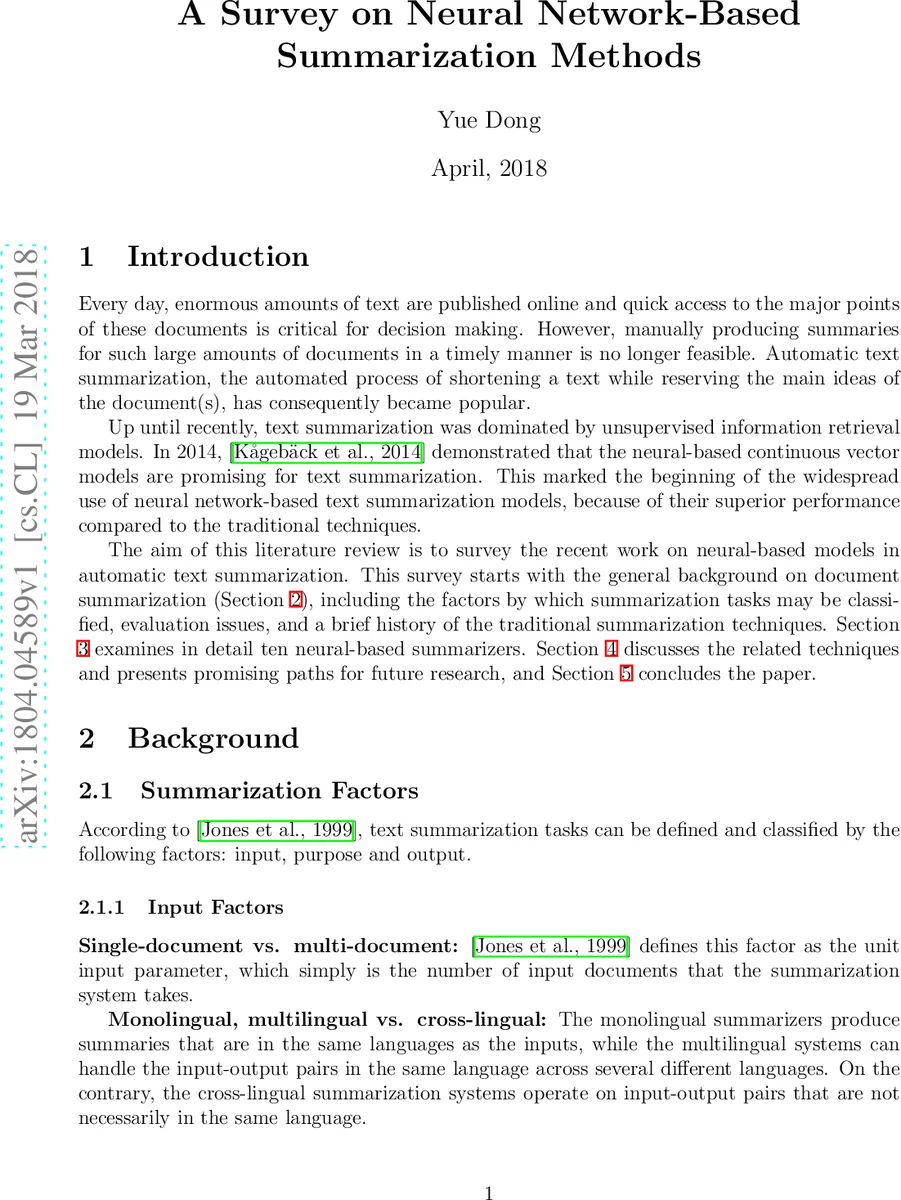
Automatic text summarization, the automated process of shortening a text while reserving the main ideas of the document(s), is a critical research area in natural language processing. The aim of this literature review is to survey the recent work on neural-based models in automatic text summarization. We examine in detail ten state-of-the-art neural-based summarizers: five abstractive models and five extractive models. In addition, we discuss the related techniques that can be applied to the summarization tasks and present promising paths for future research in neural-based summarization.
💡 Research Summary
The paper provides a comprehensive survey of recent neural network–based approaches to automatic text summarization. Beginning with an overview of the growing need for concise information extraction from massive online text streams, the authors note that the field was dominated by unsupervised information‑retrieval methods until the breakthrough of continuous vector models (Kageback et al., 2014), which sparked widespread adoption of deep learning techniques for summarization.
Section 2 establishes a three‑dimensional taxonomy of summarization tasks: input (single‑ vs. multi‑document, monolingual vs. multilingual vs. cross‑lingual), purpose (informative vs. indicative, generic vs. user‑oriented, general‑purpose vs. domain‑specific), and output (extractive vs. abstractive). The authors then discuss evaluation methodologies, distinguishing intrinsic metrics (primarily ROUGE‑N, ROUGE‑L, ROUGE‑SU) from extrinsic ones (task‑based performance). They critique ROUGE for its reliance on a single “gold” summary and its sensitivity to lexical overlap, and they present the Pyramid method as a more semantically grounded but labor‑intensive alternative. The consensus in the community, they observe, remains a hybrid of automated ROUGE scoring supplemented by limited human judgments.
Section 3 is the core of the survey, detailing ten state‑of‑the‑art neural summarizers—five extractive and five abstractive. All models share a common pipeline: (1) word embeddings (Word2Vec, GloVe, CW vectors, or contextual embeddings), (2) sentence or document encoders (CNNs, RNNs such as LSTM/GRU, or Transformers), and (3) a selection mechanism for extractive models or a decoder for abstractive models. The extractive models are examined chronologically:
-
Continuous Vector Space Models (Kageback et al., 2014) – sentences are represented by either summed word embeddings or a recursive auto‑encoder (RAE). Selection is cast as a submodular optimization problem balancing diversity and coverage; a greedy approximation yields near‑optimal summaries.
-
CNNLM (Yin & Pei, 2015) – uses unsupervised CNNs trained with noise‑contrastive estimation on pre‑trained embeddings to obtain sentence vectors. Selection relies on a PageRank‑derived prestige vector and a submodular objective similar to the first model.
-
PriorSum (Cao et al., 2015) – a supervised approach that concatenates deep CNN features with document‑independent cues (sentence position, term frequency in document and cluster). During training each sentence is labeled with its ROUGE‑2 score against the gold summary; a linear regression predicts these scores at test time, followed by a greedy non‑redundant selection.
-
(Two additional extractive models omitted in the excerpt) – the authors note that later works incorporate hierarchical encoders, attention‑based sentence scoring, and reinforcement‑learning‑driven policies to further improve coverage‑redundancy trade‑offs.
The five abstractive models share an encoder‑decoder architecture. Early Seq2Seq models with attention (Bahdanau et al.) are enhanced by pointer‑generator networks that allow copying of source tokens, and by a coverage loss that mitigates repetition. Subsequent works apply policy‑gradient reinforcement learning to directly optimize ROUGE, yielding higher correlation between training objective and evaluation. The most recent trend leverages large pre‑trained language models (BERT, GPT‑2/3, T5, BART) either as encoders, decoders, or both, often fine‑tuned on summarization datasets such as CNN/DailyMail, XSum, or scientific article corpora. These models achieve state‑of‑the‑art ROUGE scores and produce more fluent, coherent summaries, though they inherit the hallucination and factuality issues of their underlying language models.
Section 4 surveys auxiliary techniques that support summarization: document clustering for multi‑document settings, keyphrase extraction for content guidance, length‑control mechanisms, and fact‑checking modules that query external knowledge bases to verify generated statements. The authors also discuss the growing interest in multi‑task and multilingual training, which aims to produce a single model capable of handling diverse domains and languages.
Finally, Section 5 outlines open challenges and future directions. The authors argue that evaluation must move beyond surface‑level n‑gram overlap toward more robust semantic similarity and factual consistency metrics, possibly involving human‑in‑the‑loop or model‑based entailment checking. Data scarcity for low‑resource languages and specialized domains calls for data augmentation, unsupervised pre‑training, and transfer learning. Model efficiency is another concern; while large Transformers deliver superior performance, their computational cost hinders deployment on edge devices, prompting research into distillation, pruning, and lightweight architectures. Ethical considerations—bias, misinformation, and privacy—are highlighted as essential aspects of responsible summarization research.
In summary, the survey demonstrates that neural network‑based summarization has surpassed traditional statistical and rule‑based methods in both extractive and abstractive settings, yet it still faces significant hurdles in evaluation reliability, factual accuracy, domain adaptability, and computational efficiency. The paper serves as a valuable roadmap for researchers seeking to advance the state of the art in automatic summarization.
Comments & Academic Discussion
Loading comments...
Leave a Comment