On the Performance of Non-Orthogonal Multiple Access Systems with Imperfect Successive Interference Cancellation
Non-orthogonal multiple access (NOMA) technique has sparked a growing research interest due to its ability to enhance the overall spectral efficiency of wireless systems. In this paper, we investigate the pairwise error probability (PEP) performance …
Authors: Lina Bariah, Arafat Al-Dweik, Sami Muhaidat
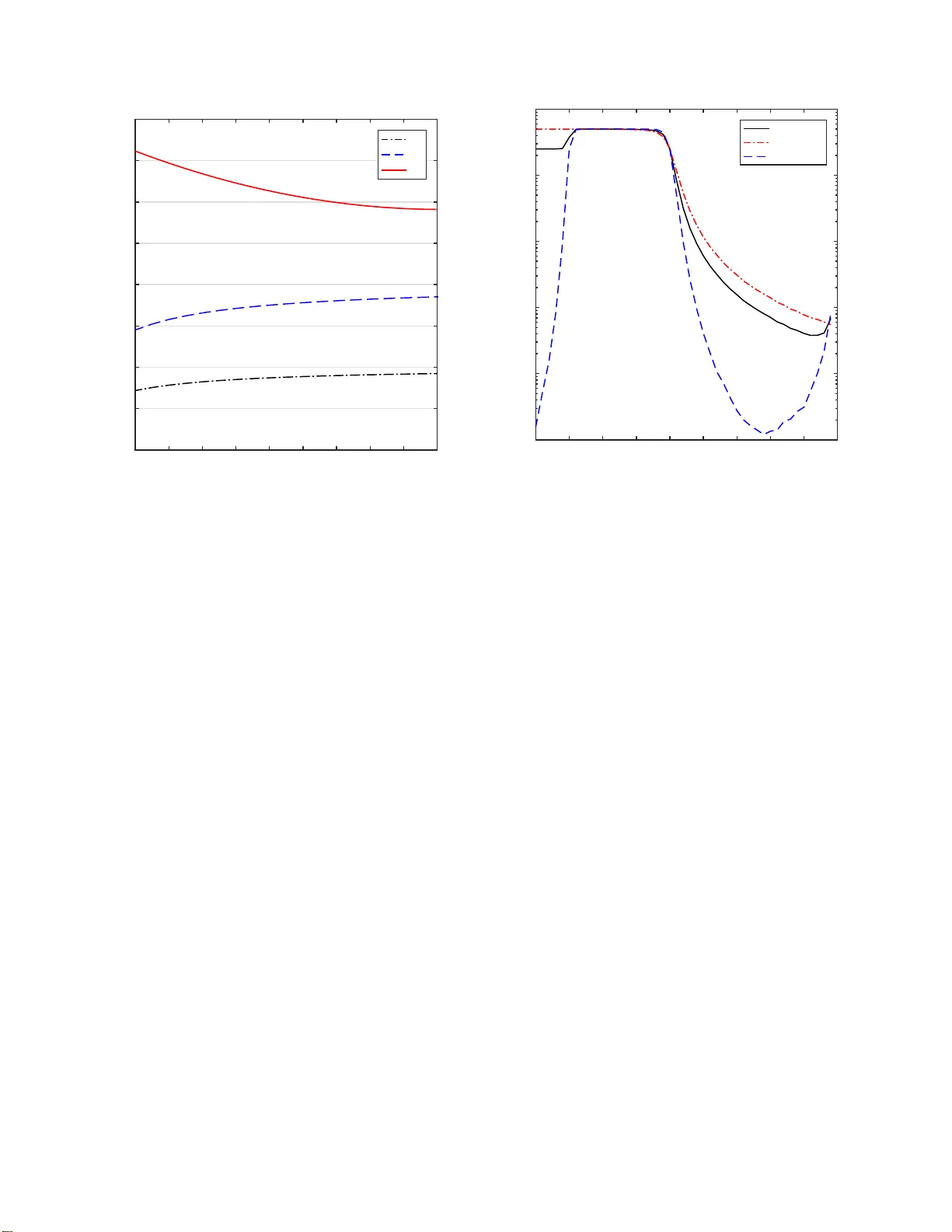
On the Performa nce of Non-Orthogonal Multipl e Access Systems wit h Imperfec t Successi v e Interfer ence Cancellation Lina Bariah * , Arafat Al-Dweik * † and Sami Mu h aidat * ‡ * Department of Electrical and Computer Engineering, Khalifa University , Abu Dhab i, UAE. Emails: { lina.bariah, dweik } @kustar .ac.ae * † W estern University , London, Canada. Email: dweik@fulbrightmail.or g * ‡ University of Surr ey , Guildfor d, U .K. Email: muhaidat@ieee .or g Abstract —Non-orthogonal multiple access (NOMA) tech nique has sparked a gr owing resear ch i nterest due to its ability to enhance the ov erall spectral efficiency of wireless systems. In this paper , we in vestigate the pairwise error probability (PEP) perfo rmance of con ventional NOMA systems, where an exact closed form expression f or th e PEP is deri ved for different users, to giv e some insi ght about the r eliability of the far and near users. Through the derivation of PEP express ions, we demonstrate that the maximum achievable diversity order is proportional to t h e user’ s order . T he obtained erro r probability expressions ar e used to formulate an opti mization problem that min imizes the overall bit error rate (BE R ) under power and error rate threshold constrains. The derived analytical results, cor roborated by Monte Carlo simulations, are presented to sh ow the diversity order and error rate perf ormance of each individual user . Index terms— NOMA, pairwise error pro bability , reliab il- ity , di versity gain, op tim ization. I . I N T RO D U C T I O N Non-or thogon al multiple access (NOMA) is a pro m ising technique for the upcoming fifth g eneration (5G) wireless commun ications, and it has attracted a n increased research interests in rec ent years. En hanced laten cy , spectral efficiency and con nectivity are th e main factors that stimulated the emer- gence of NOMA sy stems, in wh ich m ultiple u sers are allowed to share the same time and f requen cy resources [1]. The key point of NOMA systems is to perm it a constrained level of interferen ce fro m other users that allows the receiver to per- form succe ssive in terference cance llation (SIC) for the oth er users’ sign als before detecting its own signal. NOMA systems rely on exploiting the power doma in mu ltiplexing to contro l interferen ce and main tain user fairn ess, in a way tha t grants the far users higher power co efficients an d assign low power coefficients to n ear users [2]. Althou gh NOMA technique enhances users’ fairness, in co mparison with the conventional systems such as ortho gonal multiple access (OMA) systems, quality of serv ice (Qo S) of far users is relatively lo w , which is considered as a p e r forman ce limitin g factor in many scenar ios due to error propag ation. Extensive research efforts have been cond ucted to stud y the perfor mance of NOMA sy stem s from different perspe cti ves and und er different scen a r ios. In [3], the authors investi gated the ou tage pro bability and the ergodic sum r ates perf ormanc e in downlink NOMA systems with ran domly deployed users. The derived a nalytical results in [3] show that the outage probab ility of NOMA systems h ig hly dep ends on the targeted data rates and th e allocated power f o r each user . D in g et al. [4] studied the e ffect o f user pairing on the outag e proba b ility perfor mance and the sum rate for two scen arios, fixed power allocation an d cogn itiv e-radio inspired NOMA. As rep orted in [4], selecting user s with distinctive chann el gain s ca n enhan ce the achiev ed sum rate. Dynamic p ower allocation f or uplin k and d ownlink NOMA systems is presented in [5] with gu aranteed QoS for dif- ferent users. Unlike conventional techniques, suc h as fixed power allo cation and co gnitive-radio inspired NOM A , dy- namic power allocation provides m o re flexibility by allo wing tradeoffs between user fairness and overall system thro ughpu t. Performan ce analysis o f NOMA systems is ev alua te d in [6] from users’ fairness standpoin t. In par ticular, the a u thors in vestigate th e ou tage pro bability and the sum rate o f d ifferent power allocation scenarios, wher e instantaneou s and average channel gains are co nsidered. Although perfo r mance analysis of NOMA systems is well in vestigated in the literatur e [7]– [ 12], m ost of the repor ted work concen tr ates o n ev alu ating the system’ s perform a nce in terms of outage prob ability , in dividual sum rate and av erage sum rate. T o the best of the autho rs k nowledge, no ne of the reported work addressed the err or r a te p erform ance analysis of NOMA systems. Emp hasizing on this, studyin g the error rate perf o rmance of different users while consider in g impe rfect SIC is cru c ial, to have some in sightful results abo ut the QoS of each in dividual user . Ac c urate bit err or rate (BER) a n alysis of NOMA systems is intractable due to the SIC process, howe ver, p airwise err or pro bability (PEP) can be analyzed . It is worth n oting that PEP gives a valuable indicato r for the BER perfor mance, since it is considered as an upper bou nd for the BER. Based on the afo remention ed discussion, the m ain contri- butions of this pap e r are sum marized as follows: • I n this work, th e PEP per forman ce analysis of co n ven- tional NOMA systems with imperfe c t SIC is considered , where an exact closed fo rm PEP expression is derived for each u ser individually . The der iv ed PEP expression s are verified by Mon te Car lo simulations. • Build ing on the obta in ed PEP form ulae, asymptotic PEP is derived to analyze the achieved effectiv e diversity gain, which represents the perform ance of the system at high SNR regime. • Using the d erived asymptotic expression o f the PEP , an optimization problem is f o rmulated and so lved to ob tain the optimum power a llo cation coefficients that m in imize the BER, u n der power an d users’ ind ividual erro r rate constrains. The r est of th e pap er is organized as follows. Adopted system and channe l mod els are p resented in Sec. II fo llowed by exact and asymp totic PEP analysis fo r each individual user in Sec. III. Power allocation coefficients op timization is a d dressed in Sec. IV. Numerical and simulation results are presente d in Sec. V and the paper is concluded in Sec. VI. Notation: ( · ) ∗ and | . | denote the comp lex conjug ate opera- tion an d the absolute value, respec ti vely . Re { . } r epresents the real p art o f a comp lex n umber . ˆ x r e presents a detected symbo l and ∆ denotes ( x − ˆ x ) . I I . S Y S T E M A N D C H A N N E L M O D E L S Recalling that the b a sic id ea behind NOMA systems is to utilize the bro a dcast nature of the wire less chan nels to allow multiple users to share the same tim e, fr equency and co de domains while assigning d ifferent p ower levels for different users, to p ermit a sp e c ific level of interference f rom the other users. In th is work, downlink tra nsmission NOMA system with L u sers is co nsidered, where ea c h user is equ ipped with single antenna, as depicted in Fig. 1. Users ar e classified b ased on their d istance f rom the base station (BS), where th e first user is the farthest u ser fr om th e BS, consequ e ntly , it h as the weakest channel. On the other han d, the L th user is the n earest with the stro ngest chan nel. The c hannels be twe en the BS a nd the L users are mode led as in depend ent an d iden tically distributed (i.i.d) Rayleigh flat fading chann els. It is worth mention ing that near users a r e assigned lower power coefficients than far users. Giv en the total transm itted signal power is P , the transmitted signal from the BS is gi ven b y , Fig. 1: T y pical NOMA system with L users. s = L X l =1 p α l P x l (1) where x l is th e transm itted signal of the l th u ser and α l is th e power allocatio n co efficient, where P L l =1 α l = 1 . Th e received signal at the l th user is, r l = h l s + n l (2) where h l ∼ C N (0 , 2 σ 2 h ) is th e channel frequen cy respon se and n l is th e add iti ve white Gau ssian no ise ( A WGN) with zero mean and variance σ 2 n . Power allo cation coefficients are sorted in descending or der, α 1 > α 2 > ... > α L , given tha t | h 1 | 2 < | h 2 | 2 < ... < | h L | 2 . The fir st user decodes only its signal x 1 , while treating the signa ls of a ll oth er user s as interferen ce. The rest of the u sers sho uld e mploy SIC to be able to detect their signa ls. For the l th user, it should p erform SIC f or the high er power users, i.e., U 1 , · · · U l − 1 , and treat the rest of users signals as interferen c e , i.e., U l +1 , · · · U L . I I I . P A I RW I S E E R RO R P RO B A B I L I T Y A N A LY S I S F O R N O M A S Y S T E M S A. PEP Ana lysis for F irst User W itho ut loss of gener ality , we consider the first user as the farthest user , therefo re, | h 1 | 2 < | h 2 | 2 < · · · < | h L | 2 . Th e received sig n al at the first user can b e represented as follows, r 1 = h 1 p α 1 P x 1 + L X l =2 p α l P x l ! + n 1 (3) where P L l =2 √ α l P x l represents the interf erence term from the oth er users. PEP is defined as the probability of detecting the symbo l ˆ x wh ile symbol x was transmitted [13], wh ich c a n be e valuated for the first user as follows, PEP ( x 1 , ˆ x 1 ) = Pr r 1 − p α 1 P h 1 ˆ x 1 2 ≤ r 1 − p α 1 P h 1 x 1 2 , ˆ x 1 6 = x 1 . (4) Using the cumulative distribution functio n (CDF) of a no rmal distribution, the cond itional PEP for the first user can be represented as giv en in ( 5). In ( 5), Q ( x ) = 1 √ 2 π Z ∞ x exp − u 2 2 du (6) is the Gaussian Q-f unction [1 4] and ∆ 1 = ( x 1 − ˆ x 1 ) . It is worth noting that the derived PEP expressions are c o nditione d on particular interference values, which depen d on th e tran smitted and detected symbols for each user . T o get the unco nditional PEP , we average over the prob- ability den sity function (PDF) of | h | . By no ting that user 1 has alw ays the weakest channel, and channel g ains for the rest o f users are ordered in a scen ding order, i.e. | h 1 | = min ( | h 1 | , · · · , | h L | ) an d | h L | = max ( | h 1 | , · · · , | h L | ) , ord ered statistics should be considered when e valuating the PDF of | h 1 | . Therefo re, the PDF of the l th user is given b y [15], f ( l ) ( x ) = L ! ( l − 1)!( L − l )! f X ( x ) F X ( x ) l − 1 (1 − F X ( x )) L − l . (7) PEP ( x 1 , ˆ x 1 | | h 1 | ) = Q √ α 1 P | h 1 | | ∆ 1 | 2 + 2 | h 1 | Re n ∆ 1 P L l =2 √ α l P x ∗ l o √ 2 | ∆ 1 | σ n . (5) Considering that | h | is Rayleigh d istributed, its PDF and CDF are f X ( x ) = x σ 2 exp − x 2 2 σ 2 and F X ( x ) = 1 − exp − x 2 2 σ 2 , respectively [ 16]. Theref ore, using (7), the PDF of | h 1 | , ω 1 is gi ven by , f Ω ( ω 1 ) = 2 ω 1 σ 2 h exp − ω 2 1 2 σ 2 h (8) where σ 2 h = E h | h l | 2 i , l = 1 , 2 , · · · , L . Hence, the PEP a veraged over the PDF of ω 1 is PEP ( x 1 , ˆ x 1 ) = Z ∞ 0 ω 1 σ 2 h exp − ω 2 1 2 σ 2 h erfc Γ ω 1 √ 2 ζ dω 1 (9) where Γ = p α 1 P | ∆ 1 | 2 + 2 Re ( ∆ 1 L X l =2 p α l P x ∗ l ) (10) and ζ = √ 2 | ∆ 1 | σ n . (11) In ( 9 ), we use the identity , Q ( x ) = 1 2 erfc ( x √ 2 ) , wh ere er fc ( x ) is the complementary error functio n. Solv ing the in tegral in (9) gives [ 17], PEP ( x 1 , ˆ x 1 ) = 1 2 1 − Γ σ h p 2 ζ 2 + Γ 2 σ 2 h ! . (12) which can be averaged over all the possible values of x l , l = 2 , · · · , L , to consider all interferenc e scenarios. B. PEP Ana lysis for the l th User For th e l th user, it first dec o des the signals with high er power , i.e., U 1 , · · · , U l − 1 , to perform SIC before detec tin g its own sign al. Th e ou tp ut o f the l th SIC receiver can be represented as, ˜ r l = p α l P h l x l + L X n = l +1 p α n P h l x n + l − 1 X k =1 p α k P h l ∆ k + n l (13) where ∆ k = ( x k − ˆ x k ) . The PEP o f the l th user ca n be ev alua ted as sh own in (4), which after simplification can b e represented as sho wn in (14). W e would like to h ighlight that for the L th user , the term Re n ∆ l P L n = l +1 √ α n P x ∗ n o equals to z ero. Hen ce, the PEP of the L th user is gi ven in (15). Theref ore, using the CDF o f a n ormal Gaussian ran dom variable, th e conditional PEP of th e l th user can be e valuated as the following, PEP ( x l , ˆ x l | | h l | ) = Q | h l | β l υ (16) where β l = p α l P | ∆ l | 2 + 2 " Re ( ∆ l L X n = l +1 p α n P x ∗ n ) + Re ( ∆ l l − 1 X q =1 p α q P ∆ ∗ q ) # (17) and υ = √ 2 σ n | ∆ l | . (18) T o ev alu ate the u nconditio nal PEP , we a verage over the PDF of | h l | , ω l . Using the PDF o f the ordered statistics provided in (7) and con sidering th at | h | is Rayleig h distributed, the PDF of | h l | is, f Ω ( ω l ) = L ! ( l − 1)!( L − l )! ω l σ 2 h exp − ω 2 l 2 σ 2 h 1 − exp − ω 2 l 2 σ 2 h l − 1 exp − ω 2 l 2 σ 2 h L − l . (19) T o ca lculate the u n conditio n al PEP , we use bin omial expansion ( a + x ) n = P n k =0 n k x k a n − k [18, Eq . 1 . 111] to represent the term 1 − exp − ω 2 l 2 σ 2 h l − 1 . Accordin gly , the PEP can b e ev alua ted using the following integral, PEP ( x l , ˆ x l ) = L ! σ 2 h ( l − 1)!( L − l )! l − 1 X j =0 l − 1 j ( − 1) 2( l − 1) − j × Z ∞ 0 ω l exp − [ L − l + j − 1] ω 2 l 2 σ 2 h Q β l ω l υ dω l . (20) Solving the integral in (2 0) gives the closed form expression for the PEP for the l th user, as shown in (21). C. Asymptotic Analysis PEP repr esents an uppe r boun d for the BER, an d it gives a useful in sight on the error rate perf ormance when th e closed form expression of the BER ca n not be fou n d. PEP is u sed also to study the achieved div ersity , where the diversity gain is de fined as the magnitud e of the slop e of th e PEP wh en th e signal-to-n oise ratio (SNR) value goe s to in finity [13], d s = lim ¯ γ →∞ − log PEP ( x l , ˆ x l ) log ¯ γ (22) where ¯ γ = E { γ } is th e av erage transmit SNR. Cap italizin g on the PEP presented in (21), in this section we deriv e the asymptotic expression for the PEP of the l th user , which will be used to ev alu ate the asymptotic diversity order . In this work PEP ( x l , ˆ x l | | h l | ) = P r 2 √ α l P Re { h l ∆ l n ∗ l } ≤ − h 2 l α l P | ∆ l | 2 + 2 √ α l P " Re ( ∆ l L X n = l +1 √ α n P x ∗ n ) + Re ( ∆ l l − 1 X k =1 √ α k P ∆ ∗ k )#!! . (14) PEP ( x L , ˆ x L | | h L | ) = P r 2 √ α L P Re { h L ∆ L n ∗ L } ≤ − h 2 L α L P | ∆ L | 2 + 2 √ α L P Re ( ∆ L L − 1 X k =1 √ α k P ∆ ∗ k )!! . (15) PEP ( x l , ˆ x l ) = L ! σ 2 h ( l − 1)!( L − l )! l − 1 X j =0 l − 1 j ( − 1) 2( l − 1) − j [ L − l + j + 1] 1 − β l σ h p β 2 l σ 2 h + [ L − l + j + 1] υ 2 ! . (21) we will concentrate on the ef fective diversity g a in , d e = − log PEP ( x l , ˆ x l ) log ¯ γ . (23) As it is no ticed, when ¯ γ → ∞ , th e effecti ve diversity order conv erges to th e asymp totic diversity gain. The cond itional PEP presen ted in E qn. (16) can be b ound ed by the following, PEP ( x l , ˆ x l | | h l | ) ≤ exp − γ β 2 l 4 | ∆ l | 2 ! (24) where β l is given in (1 7) and γ = | h l | 2 /σ 2 n is the instanta- neous SNR, which is mod eled a s exponen tial random variable with PDF , f ( γ ) = 1 ¯ γ exp − γ ¯ γ . (25) Using (25) and the o rdered statistics PDF pr ovided in (7) an d after some m anipulation s, th e order e d PDF o f the instanta- neous SNR at the l th user is given by , f l ( γ ) = A l l − 1 X j =0 l − 1 j ( − 1) j 1 ¯ γ exp − γ ¯ γ j + L − l +1 (26) where A l = L ! ( l − 1)!( L − l )! . Therefo re, th e a symptotic unconditio n al PEP can be e valu- ated as, PEP ( x l , ˆ x l ) ≤ A l l − 1 X j =0 l − 1 j ( − 1) j 1 ¯ γ × Z ∞ 0 exp − γ ¯ γ j + L − l +1 exp − γ β 2 l 4 | ∆ l | 2 ! dγ . (27) Giv en that th e diversity orde r is ev alua ted a t high SNR values, th e first exponential in (27) can b e ap proxim ated as exp − γ ¯ γ ≈ (1 − γ ¯ γ ) . Hence, PEP ( x l , ˆ x l ) ≤ A l l − 1 X j =0 l − 1 j ( − 1) j 1 ¯ γ × Z ∞ 0 1 − γ ¯ γ j + L − l +1 exp − γ β 2 l 4 | ∆ l | 2 ! dγ . (28) Solving th e integral in (28) a nd after some simplification s, the bound ed PEP can be expressed as f ollows, PEP ( x l , ˆ x l ) ≤ A l ¯ γ l − 1 X j =0 z X k =0 l − 1 j z k ( − 1) j + z + k ( ¯ γ ) − z + k Γ( z − k + 1) 4 | ∆ l | 2 β 2 l ! (29) where z = j + L − l + 1 . At high SNR values and considerin g the dominant compon ents from the su mmations in (29), it is observed that th e boun ded PEP is pro portion al to th e effecti ve div ersity o rder, PEP ( x l , ˆ x l ) ∝ ¯ γ − z + k − 1 . (30) The effecti ve di versity ord er is ev aluated from (29) u sin g numerical methods and results are p rovided in Sec. V. I V . P O W E R A L L O C A T I O N C O E FFI C I E N T S O P T I M I Z A T I O N It has been demonstrated in literature an d using numer ical and analy tical r esults, that power alloc a tio n coefficients p lay an essential rule in deter mining the overall performan ce o f the NOMA system s. Proper power allocation among different users can enhance the overall perfo r mance re markably . In this section, we will form an optimization p roblem that aims to find the optimu m power allocatio n coefficients th at min im izes the average BER. It is worth me n tioning that PEP is used to calculate a union bound on the BER, as follows [14], P e ≤ M X m =1 P m M X ˜ m =1 x 6 = ˆ x q ( x ( m ) → ˆ x ( ˆ m ) ) PEP ( x ( m ) , ˆ x ( ˆ m ) ) (31) where P m is the probab ility that x ( m ) is transmitted and q ( x ( m ) → ˆ x ( ˆ m ) ) is the numb er of bit error s betwe e n x ( m ) and ˆ x ( ˆ m ) . Ther e fore, ou r aim is to find th e optimu m p ower allocation coefficients th at minimize the following o bjective function , Ψ = M X m =1 P m M X ˜ m =1 x 6 = ˆ x q ( x ( m ) → ˆ x ( ˆ m ) ) PEP ( x ( m ) , ˆ x ( ˆ m ) ) (32) while satisfying a specific er ror rate perfor mance thr eshold for all users to main tain user fairne ss. Additionally , fo r norm alized av erage power , the some of the p ower allocation coefficients should equals to 1 . Hen c e, the op timization pr oblem can be represented as, Minimize Ψ s.t. P L j =1 α j = 1 , PEP ( x l , ˆ x l ) ≤ P th . (33) The above o ptimization prob lem is solved using num erical methods since closed fo rm expressions for the op timum coef- ficients are hard to derive. V . N U M E R I C A L A N D S I M U L A T I O N R E S U LT S In this section , n umerical and simu lation results are con- ducted to ev aluate the perfo r mance of the propo sed schem e and to v alidate the deriv ed an alytical results. A co n ventional NOMA system is adop ted wh ere a single BS and three users are co n sidered with power allocation coefficients α 1 , α 2 and α 3 , for the first, second and third user , respectively . Without loss o f gene r ality , we con sider the first u ser as the farthest user, α 1 > α 2 > α 3 . All users are equipped with single an tenna and the link b etween each u ser and the BS is considered as Rayleigh flat fading ch a nnel. Transmitted sign als ar e cho sen random ly from qu adratur e ph ase shift keying (QPSK) constel- lation with average power P = 1 . It is worth mentioning that in the presented results, the tran sm itted signals of d ifferent users are fixed an d imperfect SIC is considered. Fig. 2 presents the PEP for the three u sers while c onsidering imperfect SIC scenarios. Power alloc ation coefficients ar e α 1 = 0 . 7 , α 2 = 0 . 2 and α 3 = 0 . 1 . This power alloca- tions coefficients values are chosen based on the ev alu ated perfor mance of the system, where it is noted tha t these values give goo d per forman ce in comparison with othe r values. The derived analy sis are co rrobo rated with simu la tio n results, where it is shown th at the d erived analysis and simulation results match pe r fectly fo r the three users over the entire SNR range. As expected , the PEP gives an indicatio n abou t th e perfor mance of the thr ee users in NOM A systems in low an d high SNR values, whe r e at high SNR value, th e n ear users show stron g perfo rmance wh ile the far u ser has relati vely weak perfor mance. The effective diversity o r der of d ifferent users is shown in Fig. 3. From th e figu r e, it is observed that at h igh SNR values, the div ersity ord er of the l th user co n verges to l . Which is expected since the a sy mptotic diversity g ain is achieved when the PEP o f NOMA sy stems behaves as PEP ( x, ˆ x ) ∝ ¯ γ − d e [13]. It is noted here that diversity gain in NOMA systems is realized du e to the o rdered chan nel gains, which in reality represents how far each user from the BS. Fig. 4 shows the av erage and individual err o r rate p erfor- mance of NOMA system with two users scenario over different combinatio ns of p ower allocatio n coefficients, wh ere SNR = 30 d B. Fr o m the figur e, it is noticed th at the second user can achieve th e threshold error rate at very low an d very high values of α 1 . Howev er , at very low values of α 1 , the fir st user h a s a very poor per forman ce, and this is ju stified b y the increased in terferenc e fro m the second user . Although the second user achieves the best perfor mance wh en α 1 = 0 . 7781 , at this value o f α 1 the first u ser exceeds the threshold value, where P th = 10 − 3 , hen ce, user fairness is vio lated in this scenario. T o ach iev e u sers’ fairness, where both user s have error rate performan ce less th a n the th reshold value wh ile the av erage BER is kept to the minimum, α 1 should take values from 0.85 2 to 0 .99. Choosing the op timum power allo c ation coefficients is a tra d eoff p roblem that is determin ed based on the targeted average BER and the individual BER of each u ser . 0 5 10 15 20 25 30 35 40 E b / N o (dB) 10 -8 10 -6 10 -4 10 -2 PEP U 1 U 2 U 3 Simulatio n Fig. 2: Analytical and simulated PEP for the 3 users with imperfect SIC. V I . C O N C L U S I O N In this pap er , we investigated the perfo rmance o f NOMA systems from error rate standpoint. An exact clo sed fo r m ex- pression fo r the PEP is derived, which repre sents a tigh t up p er bound for the BER, therefo re, it can give usef u l indication about the BER perfor mance of each u ser in NOMA systems. Using th e ob tained PEP , asym ptotic expression is derived, which is then used to ev a luate the achieved effecti ve diversity order . Capitalizing on th e importan ce of th e allocated power 30 40 50 60 70 80 90 100 110 120 E b / N o (dB) 0 0.5 1 1.5 2 2.5 3 3.5 4 Effective Diversity Order U 1 U 2 U 3 Fig. 3: Effecti ve d iv ersity order for the three u ser s, α 1 = 0 . 7 , α 2 = 0 . 2 and α 3 = 0 . 1 . coefficients, co nstrained optim ization problem is intr oduced to ev alua te the optimu m co efficients that reduce the overall err or rate. Derived expressions, verified b y Monte Carlo simu lation results, gave an insigh tful r esults abou t the u sers’ reliability and error rate perform ance. V I I . A C K N O W L E D G M E N T This work was supported by ICT fund gr a nt No. 11/15/TRA- I CTFund/KU. R E F E R E N C E S [1] Z. Ding, Y . Liu, J. Choi, Q. Sun, M. Elkashlan, C. L . I, and H. V . Poor , “ Applicati on of non-orthogon al multiple access in L TE and 5G netw orks, ” IEEE Commun. Mag . , vol. 55, no. 2, pp. 185–191, Feb . 2017. [2] W . Shin, M. V aezi, B. Lee, D. J . Love, J. Lee, and H. V . Poor , “Non- orthogona l multipl e access in multi-c ell networks: Theory , performance, and practical challe nges, ” IEE E Commun. Mag . , vol . 55, no. 10, pp. 176–183, Oct. 2017. [3] Z. Ding, Z. Y ang, P . Fan, and H. V . Poor , “On the performance of non-orthog onal multiple access in 5G systems with randomly deplo yed users, ” IEEE Signal Pr ocess. Lett. , vol. 21, no. 12, pp. 1501–1505 , Dec. 2014. [4] Z. Ding, P . Fan, and H. V . Poor , “Impact of user pairing on 5G nonorthogo nal multiple -access do wnlink transmissions, ” IEEE T rans. V eh. T ech nol. , vol. 65, no. 8, pp. 6010–6023, Aug. 2016. [5] Z. Y ang, Z. Ding, P . Fan, and N. Al-Dhahir , “ A general power allocat ion scheme to guarantee quality of service in do wnlink and uplink NOMA systems, ” IEEE T rans. W irele ss Commun. , vol. 15, no. 11, pp. 7244– 7257, Nov . 2016. [6] S. Timothe ou and I. K rikidis, “Fairness for non-orthogona l multipl e access in 5G systems, ” IEEE Signal Proce ss. Lett. , vol. 22, no. 10, pp. 1647–1651, Oct. 2015. [7] L. Zhang, J. Liu, M. Xiao, G. Wu , Y . C. Liang, and S. Li, “Performance analysi s and optimizati on in downli nk NOMA systems with cooperati ve full-dupl ex relaying, ” IEEE J. Sel. Areas Commun. , vol. 35, no. 10, pp. 2398–2412, Oct. 2017. 0.1 0.2 0.3 0.4 0.5 0.6 0.7 0.8 0.9 α 1 10 -5 10 -4 10 -3 10 -2 10 -1 10 0 BER Avg. BER U 1 U 2 Fig. 4: A verage BER over different power alloc a tio ns, SNR = 30 dB, α 2 = 1 − α 1 , P th = 1 0 − 3 . [8] X. Liang, Y . Wu, D. W . K. Ng, Y . Zuo, S. Jin, and H. Zhu, “Outage performanc e for coope rati ve NOMA transmissi on with an AF relay , ” IEEE Commun. Lett. , vol. 21, no. 11, pp. 2428–2431, Nov . 2017. [9] T . Qi, W . Feng, Y . Chen, and Y . W ang, “When NOMA m eets sparse sig- nal processing: Asymptotic performance analysis and optimal sequence design, ” IEE E Access , vol. 5, pp. 18 516–18 525, 2017. [10] R. Jiao, L . Dai, J. Zhang, R. MacKe nzie, and M. Hao, “On the performanc e of NOMA-based cooperati ve relaying systems ove r Rician fadi ng channe ls, ” IE EE T rans. V eh. T ech nol. , vol. 66, no. 12, pp. 11 409– 11 413, Dec. 2017. [11] D. Zhang, Y . Liu, Z. Ding, Z. Z hou, A. Nalla nathan, and T . Sato, “Performanc e analysis of non-reg enerati ve massi ve-mimo-noma relay systems for 5G, ” IEEE T rans. Commun. , vol. 65, no. 11, pp. 4777–4790, Nov . 2017. [12] X. Y ue, Y . Liu, S. Kang, and A. Nallana than, “Performanc e analysis of NOMA with fixed gain relaying ove r Nakag ami- m fading cha nnels, ” IEEE Access , vol. 5, pp. 5445–5454, 2017. [13] M. Uysal, “Div ersity analysis of space-ti me coding in cascaded Rayleig h fadi ng channe ls, ” IEEE Commun. Lett. , vol. 10, no. 3, pp. 165–167, Mar . 2006. [14] J. Proakis and M. Salehi, Digital Communi cations , 5th ed. UK: Ashford Colour Press, 2014. [15] P . Dhakal, R. Garello, S. K. Sharma, S. Chatzinotas, and B. Ottersten, “On the error performance bound of ordered s tatistics decoding of linea r block codes, ” in IEE E Internatio nal Conferen ce on Communicat ions (ICC) , 2016, pp. 1–6. [16] M. Simon, Prob ability Distribut ions In volving Gaussian Random V ari- ables . Springer US, 2002. [17] A. P . Prudniko v , Inte grals and Series, V olume 2: Specia l Functions . CRC Press, 1986. [18] I. Gradshte yn and I. Ryzhik, T able of Inte grals, Series, and Pr oducts , A. Jeffre y and D. Zw illinger , Eds. Academic Press, 2007.
Original Paper
Loading high-quality paper...
Comments & Academic Discussion
Loading comments...
Leave a Comment