Predicting Gross Movie Revenue
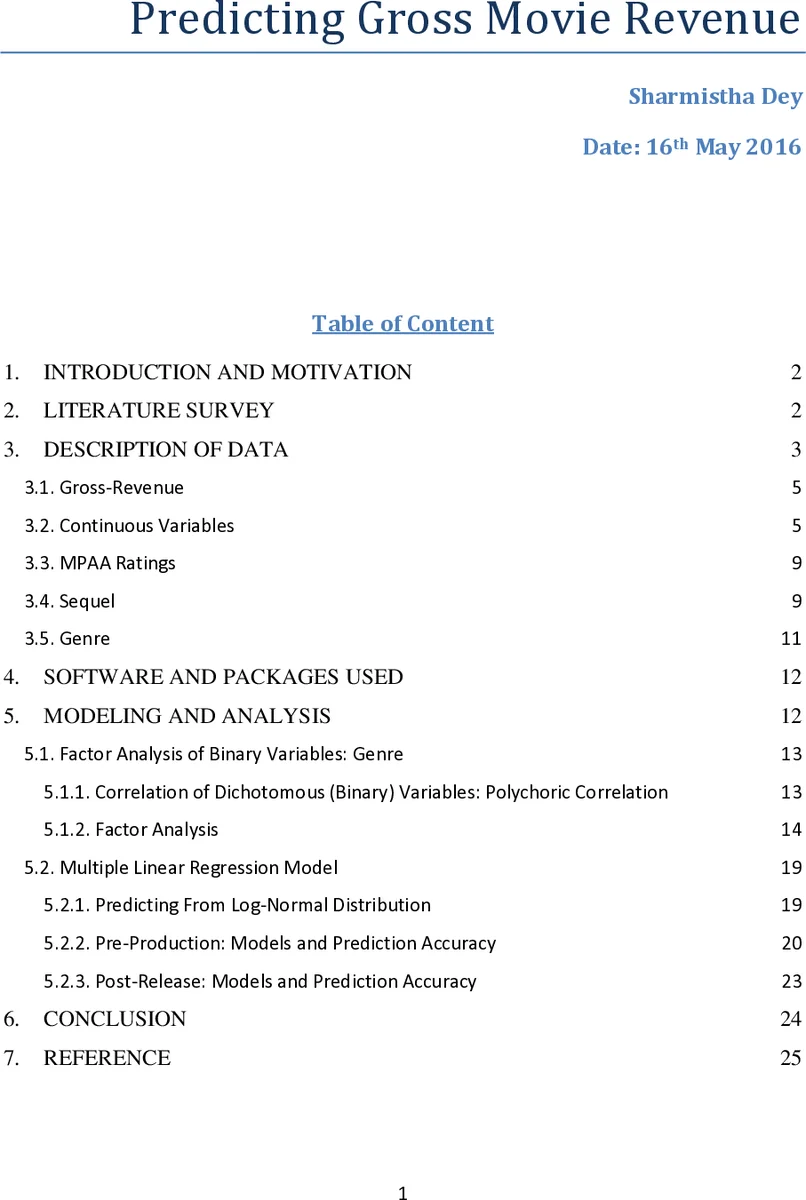
‘There is no terror in the bang, only is the anticipation of it’ - Alfred Hitchcock. Yet there is everything in correctly anticipating the bang a movie would make in the box-office. Movies make a high profile, billion dollar industry and prediction of movie revenue can be very lucrative. Predicted revenues can be used for planning both the production and distribution stages. For example, projected gross revenue can be used to plan the remuneration of the actors and crew members as well as other parts of the budget [1]. Success or failure of a movie can depend on many factors: star-power, release date, budget, MPAA (Motion Picture Association of America) rating, plot and the highly unpredictable human reactions. The enormity of the number of exogenous variables makes manual revenue prediction process extremely difficult. However, in the era of computer and data sciences, volumes of data can be efficiently processed and modelled. Hence the tough job of predicting gross revenue of a movie can be simplified with the help of modern computing power and the historical data available as movie databases [2].
💡 Research Summary
The paper “Predicting Gross Movie Revenue” investigates how to forecast a film’s box‑office earnings using a combination of statistical techniques on a dataset of 771 English‑language movies released in the United States between 2010 and 2015. The authors begin by motivating the problem: accurate revenue forecasts can guide budgeting, talent contracts, and distribution strategies in a multibillion‑dollar industry. They review prior work, notably Jeffrey et al., who used linear regression on a 1998 sample and found opening‑week revenue to be the strongest predictor.
Data were harvested from the IMDb FTP site, cleaned with a custom Python script, and filtered to exclude movies with missing fields, non‑English releases, or gross revenue below $1 million. The final sample contains 771 titles. Variables include continuous measures (budget, opening‑week revenue, number of screens, IMDb votes, IMDb rating) and categorical or binary attributes (year, month, sequel flag, MPAA rating, and 20 genre indicators). Because gross revenue exhibits a heavy right‑skew, the natural logarithm of revenue, budget, and opening‑week revenue is used as the dependent variable and as two key predictors.
Exploratory correlation analysis shows that opening‑week revenue (r≈0.8) and number of screens (r≈0.7) are the most strongly correlated with total gross, while IMDb rating (r≈0.2) and runtime (r≈0.3) are weak. The authors also note that sequel status and MPAA rating (PG/PG‑13) are associated with higher grosses.
A distinctive contribution of the study is the treatment of the 20 binary genre variables. Since standard Pearson correlations are inappropriate for dichotomous data, the authors compute a polychoric correlation matrix using the R ‘polycor’ package. They then perform factor analysis on this matrix with an ordinary least‑squares (OLS) extraction method, which does not require the correlation matrix to be positive‑definite. Eigenvalues greater than one suggest eight latent factors, which together explain 87.2 % of the variance in the genre space. Varimax rotation yields interpretable factors such as “Family/Animation”, “Action/Thriller”, “Documentary/Biography/History”, etc. These factor scores are used as composite genre predictors in subsequent regression models.
Two regression models are built: a pre‑production model and a post‑release model. The pre‑production model includes budget, runtime, sequel flag, MPAA rating, release year/month, and the eight genre factor scores. The post‑release model adds the real‑time variables opening‑week revenue, number of screens, IMDb votes, and IMDb rating. Both models are fitted using ordinary least squares in R, with data split into a 70 % training set and a 30 % test set; the ‘caTools’ package is used for random partitioning and cross‑validation. Model performance is evaluated with R² and root‑mean‑square error (RMSE).
Results indicate that the post‑release model substantially outperforms the pre‑production model, confirming that early box‑office data (especially opening‑week revenue) dominate the predictive power. The genre factors contribute meaningfully in the pre‑production stage, while sequel status and MPAA rating retain modest but significant effects. The authors conclude that integrating log‑transformed financial variables with a statistically sound treatment of binary genre data improves revenue forecasts.
However, the paper omits detailed regression coefficients, p‑values, and diagnostic plots, limiting assessment of model robustness. It also does not address potential bias introduced by log‑to‑original‑scale back‑transformation, nor does it explore regularization techniques (e.g., LASSO, Ridge) that could mitigate multicollinearity among predictors. The dataset is confined to a five‑year US window, excluding recent streaming‑driven revenue streams and international markets, which may affect the generalizability of the findings.
Future work suggested includes: (1) applying machine‑learning algorithms such as random forests or neural networks to capture nonlinear interactions; (2) incorporating textual sentiment analysis of reviews and social‑media buzz; (3) extending the temporal scope to include post‑2015 releases and global box‑office data; and (4) employing penalized regression to refine variable selection and improve out‑of‑sample performance. Overall, the study demonstrates a methodical approach to movie‑revenue prediction, highlighting the importance of early box‑office indicators and a rigorous handling of categorical genre information.
Comments & Academic Discussion
Loading comments...
Leave a Comment