Performance Comparison of Constant Envelope and Zero-forcing Precoders in Multiuser Massive MIMO
In this article, the adoption and performance of a constant envelope (CE) type spatial precoder is addressed in large-scale multiuser MIMO based cellular network. We first formulate an efficient computing solution to obtain the antenna samples of suc…
Authors: Alberto Brihuega, Lauri Anttila, Mikko Valkama
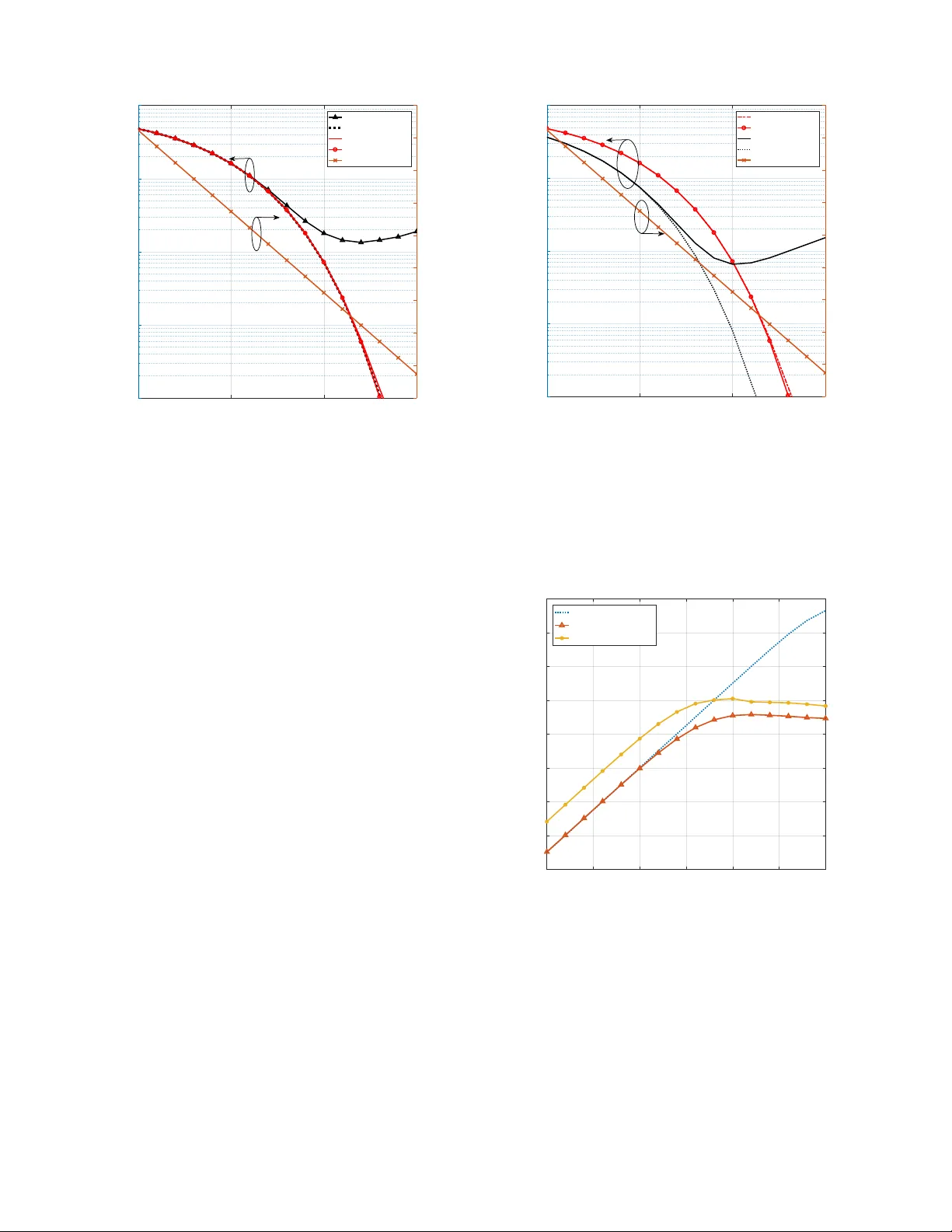
Performance Comparison of Constant En v elope and Zero-F orcing Precoders in Multiuser Massi v e MIMO Alberto Brihuega, Lauri Anttila, and Mikk o V alkama T ampere Uni versity of T echnology , Department of Electronics and Communications Engineering, T ampere, Finland Email: alberto.brihuegagarcia@tut.fi, lauri.anttila@tut.fi, mikko.e.valkama@tut.fi Abstract —In this article, the adoption and performance of a constant en velope (CE) type spatial pr ecoder is addressed in large-scale multiuser MIMO based cellular network. W e first formulate an efficient computing solution to obtain the antenna samples of such CE precoder . W e then evaluate the achiev able CE precoder based multiuser downlink (DL) system performance and compare it with the corresponding perf ormance of more ordinary zero-f orcing (ZF) spatial precoder . W e specifically also analyze how realistic highly nonlinear power amplifiers (P As) affect the achievable DL performance, as the individual P A units in large- array or massive MIMO systems are expected to be small, cheap and operating close to saturation for increased energy-efficiency purposes. It is shown that the largely reduced peak-to-average power ratio (P APR) of the P A input signals in the CE precoder based system allows for pushing the P A units harsher towards saturation, while allowing to reach higher signal-to-interference- plus-noise ratio (SINRs) at the intended r eceivers compar ed to the classical ZF precoder based system. The obtained results indicate that the CE precoder can outperform the ZF precoder by up to 5-6 dBs, in terms of the achievable SINRs, when the P A units are pushed towards their saturating region. Such large gains are a substantial benefit when seeking to improv e the spectral and energy-efficiencies of the mobile cellular networks. Index T erms —massive MIMO, multiuser MIMO, large-array systems, spatial precoding, nonlinear power amplifiers, peak-to- av erage power ratio, optimization I . I N T RO D U C T I O N Power consumption of the cellular network is commonly recognized as a major concern [1]. The power -efficiency of radio transmitters, and particularly the in volved power am- plifiers (P As), is one ke y aspect in the total network po wer consumption [2]. Due to the en velope characteristics of the currently used radio access wav eforms, power amplifiers need to operate in a relatively linear regime in order not to distort the transmit signals, resulting commonly into low power - efficienc y [3]. Furthermore, the demands of data hungry users and new services lead to adopting large antenna arrays at the base stations (BS). Such large antenna arrays enable the impro vement of the system spectral efficiency linearly proportional to the number of antennas [4]. In addition to beamforming and multiplexing gains, it has recently been established that large antenna arrays also allo w for transmit wa veform shaping in such a way that robustness against P A nonlinearities can be achieved [5]. Constant en velope type of precoders allow for reducing the peak-to-average power ratio (P APR) of the corresponding continuous-time P A input signals, while simultaneously providing beamforming and spatial multiplexing benefits, similar to more ordinary linear precoders. This allows to simultaneously address the two main targets of new mobile communications systems, namely improved spectral and energy efficiencies. In the recent literature [5]–[10], the optimization and characterization of such CE precoders have been addressed, howe ver , none of the existing w orks provide a comprehensi ve performance ev aluation under realistic measurement-based nonlinear P A units nor comparison with traditional spatial precoders such as zero forcing (ZF). In this paper, the ZF based spatial precoder serves as the reference precoding technique, due to its simplicity , well known performance and wide-scale utilization in massi ve MIMO research and dev elopment work. Furthermore, the proposed CE based spatial precoder inv olves setting a constraint on maximum allowed multiuser interfer- ence (MUI), as it will be detailed further below . The fact that ZF type of precoder is capable of fully suppressing the MUI makes ZF a better reference than, for example, maximum ratio transmission (MR T) precoder that does not explicitly control MUI. Thus, this ensures that the performance limitations of the reference precoder is due to the nonlinear distortion introduced by the P As, and not due to any other sources. Thereby , ZF precoder serves well as the reference solution in ev aluating and comparing the performance of the CE-based spatial precoder . In this article, based on above reasoning, we analyze and ev aluate the performance of a large-array multiuser (MU) MIMO downlink system, with CE and ZF based spatial precoders. In order to be able to perceiv e the ef fects of the P APR reduction on the realistic system performance, we adopt measurement based nonlinear P A models in ev ery antenna branch of the base-station. For a given transmit power , it is shown that the resulting continuous-time wav eforms obtained through the CE precoding exhibit substantially milder inband distortion due to the higher tolerance to the P A nonlinearities, an ef fect that is more rigorously analyzed and characterized through the experienced signal-to-noise-and-interference ratio (SINR) and bit error rate (BER) at the intended receivers. In case of ordinary ZF precoder , it is also shown that as the transmit power is increased, the inband distortion produced by the nonlinear behaviour of the P As becomes more and more significant, and ev entually will become the main source of interference or distortion experienced in the receivers, and thus becomes the limiting factor to the achiev able system performance. The CE precoder does not ha ve such limit as long as the P A units are not fully saturated. Furthermore, in the paper , we describe and implement a computationally efficient optimization approach to obtain the CE precoded antenna samples. Overall, the obtained results reported in the paper show that compared to ordinary ZF precoder , the CE precoder allows for pushing the P A units of a large-array base- station substantially harsher tow ards saturation, while allowing to reach higher SINRs at the intended receivers. Depending on the transmit sum-po wer or effecti ve radiated po wer constraints, the results sho w that the gain of the CE precoder over ZF can be ev en up to 5-6 dBs, in terms of the achie vable SINRs. Such large gains are a substantial benefit when seeking to improv e the spectral and energy-ef ficiencies of the existing and emerging mobile cellular networks. The rest of this paper is organized as follows: In Section II, the basic system model of multi-user massi ve MIMO do wnlink transmission is provided, incorporating the construction of the in volved CE precoder . Also the P A nonlinearities and other different distortion and interference aspects are addressed. Then, in Section III, the performance ev aluation results and their analysis are provided. Finally , Section IV will conclude the work and summarize the main findings. I I . S Y S T E M M O D E L A N D C E P R E C O D E R W e assume a large-scale MU-MIMO downlink system where K and N t denote the number of single-antenna si- multaneously scheduled users and the number of transmit antennas at the base station, respecti vely , where N t >> K . It is assumed that there is a total symbol-rate transmit sum- power constraint P t . Let S denote the information alphabet and s = [ s 1 , s 2 , · · · , s K ] T denote the vector of information symbols, where s k ∈ S denotes the information symbol intended for the k -th user . Furthermore, in case of linear precoding, let W T X ∈ C N t × K denote the precoding matrix which will be obtained through the ZF principle, and used as the reference method in this paper . The linear precoded symbols x = [ x 1 , x 2 , · · · , x N t ] T are obtained as x = W T X s . (1) The CE precoder , in turn, is a nonlinear mapping from the information symbols s to the precoded samples x , which we will address explicitly later in this section. For mathematical tractability , we assume a single-carrier system, as in [5]–[10], and thus root raised-cosine (RRC) filters are utilized for filtering the precoded and upsampled symbols, generating thus the continuous-time signals x ( t ) = [ x 1 ( t ) , x 2 ( t ) , · · · , x N t ( t )] T . Notice that since the CE precoder operates at symbol level, the continuous-time signals are not exactly CE wa veforms since the RRC filtering introduces some inherent P APR increase - e ven if the precoded symbols x n hav e constant en velope. This P APR increase and the associated sensitivity to P A nonlinearities will be addressed in Section III. The continuous-time signals then pass through highly non- linear P As. In this work, 9 -th order memoryless polynomial models of the form z n ( t ) = b 1 ,n x n ( t ) + b 3 ,n x n ( t ) | x n ( t ) | 2 + b 5 ,n x n ( t ) | x n ( t ) | 4 + b 7 ,n x n ( t ) | x n ( t ) | 6 + b 9 ,n x n ( t ) | x n ( t ) | 8 (2) obtained from RF measurements of a set of actual P As, are utilized, where n refers to the antenna/P A index. The polynomial coefficients of the different P A units, obtained from the measurements, are all slightly different reflecting the true characteristics and nature of the measured P As. In general, since the polynomials behav e expansi vely , at large amplitude lev els, they are properly clipped to reflect the true saturation lev els of the individual P As. For simplicity , we assume narrowband fading, and thus, the channel between the k -th recei ving antenna and the n - th transmit antenna can be modeled as a single complex coefficient. The corresponding zero-mean-unit-variance flat- fading Rayleigh multiuser channel matrix is denoted by H ∈ C K × N t . Furthermore, perfect channel state information (CSI) knowledge is assumed at the transmitter . The well-kno wn ZF precoder coefficients [11], utilized in this paper as the reference technique, are obtained by means of the right pseudoin verse of the multiuser channel matrix as W Z F T X = H H HH H − 1 (3) On the other hand, the CE precoded samples are commonly obtained by means of more elaborate optimization frame- works, as discussed in [5]–[10]. In this work, we formulate next a computationally efficient iterative least-mean square (LMS) type of an approach to obtain such CE precoded samples. First, the CE precoded samples are constrained to hav e constant en velope such that | x n | = p P t /N t , therefore, the precoder outputs x n are of the form x n = r P t N t e j θ n , n = 1 , · · · , N t (4) Thus, the precoder generates a symbol rate constant en velope signal in every antenna branch, each of them with a certain phase. The expression in (4) also automatically guarantees that the symbol-rate transmit sum-power constraint of P t is met Then, by neglecting the P A induced distortion in the algorithm dev elopment phase, the CE precoded signal received by the k - th user can be consequently expressed as y k = r P t N t N t X n =1 h k,n e j θ n + n k , k = 1 , · · · , K (5) where n k refers to additive noise while h k,n denotes the channel between the k -th user and the n -th transmit antenna. The MUI experienced by the k -th receiv er can be measured as the difference between the actual noise-free received signal and the intended symbol, and can be expressed, in terms of the instantaneous squared value, as γ k = r P t N t N t X n =1 h k,n e j θ n − αs k ! 2 (6) where α denotes the obtained beamforming gain tow ards the intended user . Then, the phases of the precoded samples are selected such that the instantaneous power of the MUI ov er all intended receivers is minimized. Such phase optimization problem reads thus [5] Θ = [ θ 1 , θ 2 , · · · , θ N t ] = arg min θ n ∈ [ − π ,π ) ,n =1 ,...,N t f (Θ , s ) f (Θ , s ) = K X k =1 r P t N t N t X n =1 h k,n e j θ n − αs k ! 2 s.t. || x || 2 = P t | x n | = r P t N t (7) where θ n denotes the phase of the precoded sample for the n -th antenna. Algorithm 1 LMS-based optimization framework for CE precoder 1: Θ 1 = [0 , 0 , · · · , 0] T 2: thr eshold = +inf. 3: for n = 1 to N t do 4: for m = 1 to M do 5: e m = P K k =1 q P t N t P N t n =1 h k,n e j θ n ,m − αs k 2 6: θ n,m +1 = θ n,m + θ LM S,m ( e m ) 7: if e m < thr eshold then 8: thr eshold = e m 9: θ n,opt = θ n,m 10: end if 11: end for 12: θ n = θ n,opt 13: end f or 14: retur n x opt = h q P t N t e j θ 1 ,opt , · · · , q P t N t e j θ N t ,opt i T T o solve the optimization problem, we adopt an iterativ e approach described in Algorithm 1. This computing friendly algorithm consists of N t × M iterations, where M is a certain prefixed integer value. Intuiti vely , in ev ery n -th iteration, the phase of the symbol at the n -th antenna branch is adapted following M sub-iterations of the gradient descent algorithm based on the error signal e m , while the phases of the rest of the antenna branches remain fixed. Then, the phase of the m - th sub-iteration which resulted in the lowest MUI (denoted by θ n,opt ) is assigned to the n -th antenna. Then, the algorithm proceeds to the ( n + 1) -th iteration. In general, if one wants to provide a certain beamforming gain α , a constraint on the maximum allowed MUI is required. Then, Θ is selected such that α is maximized, while keeping the MUI belo w the maximum allo wed limit. For further details, please, refer to [5]. In order to later compare the system performance with different precoders in a fair manner , specific care is needed in constraining the transmit po wer . In general, one approach is to assume that the transmit sum-powers under both precoders are constrained identical. It is to be noted, howe ver , that due to the fact that the two precoders may present somewhat different beamforming gains, the equiv alent isotropic radiated powers (EIRP) may also be different. Thus, in the following performance ev aluations and comparisons, we consider two scenarios, one in which the transmit power is scaled in such a way that both precoders present the same EIRP , and a second scenario assuming that both precoders hav e the same transmit power , and thus, their EIRPs are different. In order to constrain the output sum-power of the ZF precoder , one can first consider a general linear precoded signal of the form x = W T X s . In order to constrain the sum-power to P t , we first express the cov ariance matrix of the precoded samples as cov ( x ) = E xx H = σ 2 W T X W H T X (8) where it has been assumed that the data streams are indepen- dent from one another and hav e a cov ariance E ss H = σ 2 I . Assuming further that the indi vidual data stream powers are normalized to one, that is σ 2 = 1 , the total output sum-power constraint can be expressed as E || x || 2 = tr ace { cov ( x ) } = tr ace W T X W H T X = P t (9) Thus, the transmit sum-power constraint is met if any gi ven precoding coefficients W T X are normalized by β = s P t tr ace W T X W H T X (10) The normalized precoder output thus reads x = β W T X s (11) Notice that the CE precoded samples obtained through Algo- rithm 1 are, by design, automatically fulfilling the transmit sum-power constraint of P t . Notice also that in case of ZF precoder in (3), the above normalization factor represents directly the beamforming gain α , while for CE precoder the beamforming gain has to be calculated numerically . Finally , since the beamforming gains of the CE and ZF precoders are generally different, the EIRPs are also different under the giv en transmit sum-po wer constraint. Therefore, if perfor- mance comparison under fixed EIRP is pursued, an additional sum-power scaling needs to be adopted. In general, the precoder coefficients obtained by means of the ZF principle need to follow the time variations of the MIMO channel, and therefore, its updating rate is dictated by the coherence time of the propagation channel. On the other hand, CE based precoder optimization to obtain the precoded samples must be executed at ev ery symbol instant. The coher- ence time of the channel can easily be hundreds or thousands of times longer than the symbol duration, thereby , the CE precoder inv olves substantially larger computing complexity than the linear precoders. Furthermore, the complexity of the ZF based precoder gro ws linearly with the number of antennas, while that of the proposed CE increases quadratically with the number of antennas. Dev eloping CE precoders with reduced complexity is thus an important future work item for us. I I I . P E R F O R M A N C E R E S U L T S A N D A N A L Y S I S In this section, detailed performance ev aluation results and their analysis are presented. As a concrete example, we focus on a 24 × 4 MU-MIMO scenario with four single-antenna users. Four data streams, all of 16-QAM symbols, serve as precoder inputs, while the precoder can be either CE or ZF . The CE precoded samples are optimized such that a 20 dB MUI suppression is guaranteed. For the considered MUI suppression, it can be shown that the CE precoder provides 1.9 dB lower beamforming gain than the ZF precoder . In general, the precoders map the data streams into 24 antenna branches, and the resulting signals then pass through upsampling and RRC filtering stage of order 33 and with 0.4 roll-off f actor . Lastly , 24 different clipped 9 -th order memoryless polyno- mial models, obtained from extensiv e RF measurements, are adopted in order to model the beha vior of the P A units in true array transmitter 1 . Since normalized polynomial models are used, one needs to properly scale and unscale the input and output signals of the P As, respecti vely , such that the signals fit in the polynomial range. At the recei ver side, we e valuate the BER and SINR in order to quantify the quality of the received signals. Noise level at the receiver side is fixed such that in the absence of in-band distortion, it constitutes the main source of received signal degradation. In the e valuations, we vary the transmit sum- power P t (under fixed noise level), which has an impact on the resulting BER, back-off and SINR, which are presented in the following subsections. The higher the transmission power , the lower the applied back-off is, and therefore, the P As introduce higher in-band distortion which degrades the BER in case of ZF precoder . In the figures belo w , we also plot the mean back- off, relativ e to the 1dB compression point, as a function of the transmission po wer . The reason to illustrate the mean back-off is because every P A has a slightly different characteristic. A. P APR Distributions with CE and ZF pr ecoders W e begin by shortly e valuating and illustrating the com- plementary cumulative distribution functions of the precoded antenna signals, using both the ZF and CE precoders. The results are shown in Fig. 1, and illustrate how efficiently the symbol-rate CE precoder is able to reduce the P APR of the antenna signals despite the RRC filtering stage. While the P APR of the ZF precoded signals can easily reach a lev el of 12 dB, the P APR of the CE coded signals is commonly in the order of 3 dB only . Next we address how this translates to multiuser radio link performance under nonlinear P A units. B. Multiuser Radio Link BER with Fixed EIRP Here we ev aluate and analyze the case in which both precoders are scaled such that the EIRP is fixed independent of which precoder scheme is utilized. Note that this corre- sponds to dif ferent transmit sum-po wers due to the dif ferent beamforming gains that the two precoders are able to provide. 1 Lund Uni versity Massi ve MIMO testbed, http://www .eit.lth.se/mamitheme Fig. 1. CE and ZF precoder P APR distributions. The set of curves on the left side corresponds to the CE precoded signals, while the set of curves on the right corresponds to the ZF precoded signals. Only the P APR CCDFs of the antenna signals 1-8 are shown, while those of 9-24 behav e very similarly . The results under fixed EIRP shown in Fig. 2 clearly illustrate how the actual reduction of the P APR of the CE precoded P A input wav eforms allows to push the P As closer to their nonlinear operation zone for a given in-band distortion. W ith the ZF precoder, as the transmit power increases, the nonlinear distortion starts to become lar ger and lar ger until it constitutes the main source of interference, thus saturating the performance of the ZF precoded system. CE precoder, in turn, exhibits almost ideal performance even when nonlinear P As are considered. Only at the very highest transmit po wer lev els, the CE precoded system exhibits a very minor BER degradation compared to the fully linear P A case. C. Multiuser Radio Link BER with Fixed T ransmission P ower Next, we consider the scenario in which both precoding schemes yield the same transmission power , and thus some- what different EIRPs. The results are shown in Fig. 3 where it can be observed that for low transmit powers, ZF precoder outperforms CE by 1.9 dB due to the larger beamforming gain. Ho wev er , when the effect of in-band distortion due to the nonlinear P As start to become larger , the actual benefit of CE precoder becomes again evident, exhibiting a big gain at higher transmit powers, of around 5 dB, compared to the traditional ZF precoder . D. SINR Characteristics In Fig. 4, we sho w ho w the relati ve transmit po wers map into SINR at the receiv er side. Since we assume perfect CSI knowledge, ZF precoder is capable of fully suppressing the MUI, while the CE precoder is designed and optimized to guarantee a minimum of 20 dB suppression (20 dB signal- to-MUI ratio). Such level of 20 dB MUI suppression can be safely assumed to be sufficient in most practical recei ver scenarios, as the thermal noise SNR in cellular systems is 0 5 10 15 Relative Transmit Power (dB) 10 -4 10 -3 10 -2 10 -1 10 0 BER 0 2 4 6 8 10 12 14 16 18 Mean PA back-off (dB) CE and ZF BER performance with fixed EIRP ZF Real PA Units ZF Ideal PA Units CE Real PA Units CE Ideal PA Units Back-off Fig. 2. BERs of CE and ZF precoders with (i) Ideal P A Units referring to a case with fully linear P As and with (ii) Real P A Units referring to the case with actual measured nonlinear P As. Precoders are scaled such that both yield the same EIRP . Back-off ranging between 1.5 and 16.5 dB. Relativ e transmit power of 0 dB corresponds to receiv er thermal noise SNR of -1 dB. commonly less than 20 dB and thus the MUI is belo w the thermal noise floor . From Fig. 4 we can conclude that the P As exhibit very linear performance when fed by the CE precoded wa veforms. The SINR increases linearly relative to the linear increase in the transmit po wer . It can also be seen that the transmit power maps into useful signal plus negligible in-band distortion, although for 15 dB of relativ e transmit po wer it exhibits a small reduction in the slope. On the other hand, in the case of ZF precoded signal, the performance is much worse. The SINR clearly exhibits a saturation behaviour due to the substantial in-band distortion suffered by the ZF precoded wa veforms when passing through the P As. W e can also observ e that the CE precoder performance is, at best, 5 dB above that of ZF , which is a considerable gain. In order to obtain further insight of the obtained results, one can dif ferentiate between two scenarios. First, a scenario where the TX po wer is relativ ely low , and thus, the result- ing in-band distortion exhibited by the ZF precoder is not sufficiently large to allow CE precoder to outperform ZF precoder . Second, a high transmit po wer scenario in which CE precoder outperforms ZF precoder due to the increasing effect of the nonlinearities of the P As. Such observation leads us to consider employing dif ferent precoders depending on the adopted transmit power in order to provide a better ov erall system performance. Since CE precoder provides somewhat lower beamforming gain, it is not adequate for transmit po wers that do not allo w to take advantage of the P APR reduction. Howe ver for the second scenario, a CE precoder would allo w to increase the performance significantly . 0 5 10 15 Relative Transmit Power (dB) 10 -4 10 -3 10 -2 10 -1 10 0 BER 0 2 4 6 8 10 12 14 16 18 Mean PA back-off (dB) CE and ZF BER performance with fixed Tx power CE Real PA Units CE Ideal PA Units ZF Real PA Units ZF Ideal PA Units Back-off Fig. 3. BERs of CE and ZF precoders with (i) Ideal P A Units referring to a case with fully linear P As and with (ii) Real P A Units referring to the case with actual measured nonlinear P As. Precoders are scaled such that both yield the same Tx power . Back-off ranging between 1.5 and 16.5 dB. Relativ e transmit power of 0 dB corresponds to recei ver thermal noise SNR of -1 dB in case of CE precoder , and 0.9 in case of ZF precoder due to the larger beamforming gain. 0 2.5 5 7.5 10 12.5 15 Relative Transmit Power (dB) -2 0 2 4 6 8 10 12 14 Estimated SINR (dB) CE ZF Fixed EIRP ZF Fixed Tx Power Fig. 4. SINRs of CE and ZF precoders with (i) ZF Fixed Tx P ower referring to the case in which the transmit sum-power of ZF is the same as that of CE precoder, and with (ii) ZF F ixed EIRP referring to the case in which ZF precoder has the same EIRP as that of CE precoder . I V . C O N C L U S I O N In this article, we studied constant en velope (CE) like precoding in multiuser large-array or massive MIMO systems. First, a computationally efficient optimization approach to ob- tain such CE precoded antenna samples was formulated. Then, the achiev able multiuser radio link performance was addressed and analyzed under the ef fects of practical measurement-based nonlinear P A units in the transmitting array , using the CE precoder as well as the well-known ZF precoder for reference. The analysis and ev aluations sho wed that despite providing around 2 dB lower beamforming gain than the ZF precoder , the P APR reduction of the CE precoder is suf ficiently large to allow it to outperform ZF in multiuser radio link performance at high transmit powers, i.e., when the P As are pushed towards their saturating region. The actual SINR gain exhibited by CE precoder was shown to be up to 5-6 dB under realistic assumptions. Furthermore, the two highlighted transmit po wer scenarios, low and high, lead us to consider the adoption of a transmit power aware precoding approach, such that the CE precoder is deployed when the used transmit power allows to take advantage of the P APR reduction, while ZF precoder can be then adopted at lo wer power lev els. A C K N O W L E D G M E N T This work was financially sponsored by the Academy of Finland (under projects 288670 and 301820) as well as by the Finnish Funding Agency for Innovation (T ekes), Nokia Bell Labs, Huawei Finland, Qualcomm, Pulse Finland and Sasken Finland under the project 5G TRX. The work was also supported by TUT President Graduate School, and by T ekes under the T AKE-5 project. R E F E R E N C E S [1] M. Olsson, C. Cavdar , P . Frenger, S. T ombaz, D. Sabella and R. Jantti, ”5GrEEn: T owards Green 5G mobile networks, ” 2013 IEEE 9th Interna- tional Conference on W ireless and Mobile Computing, Networking and Communications (WiMob) , L yon, 2013, pp. 212-216. [2] V . Mancuso and S. Alouf, ”Reducing costs and pollution in cellular networks, ” IEEE Communications Magazine , vol. 49, no. 8, pp. 63-71, August 2011. [3] Seung Hee Han and Jae Hong Lee, ”An overview of peak-to-av erage power ratio reduction techniques for multicarrier transmission, ” IEEE W ireless Communications , vol. 12, no. 2, pp. 56-65, April 2005. [4] F . Rusek et al., ”Scaling Up MIMO: Opportunities and Challenges with V ery Large Arrays, ” IEEE Signal Pr ocessing Magazine , vol. 30, no. 1, pp. 40-60, Jan. 2013. [5] S. K. Mohammed and E. G. Larsson, ”Per-Antenna Constant En velope Precoding for Large Multi-User MIMO Systems, ” IEEE T ransactions on Communications , vol. 61, no. 3, pp. 1059-1071, March 2013. [6] S. K. Mohammed and E. G. Larsson, ”Constant-En velope Multi-User Precoding for Frequency-Selectiv e Massive MIMO Systems, ” IEEE W ireless Communications Letters , vol. 2, no. 5, pp. 547-550, October 2013. [7] J. Pan and W . K. Ma, ”Constant Env elope Precoding for Single-User Large-Scale MISO Channels: Efficient Precoding and Optimal Designs, ” IEEE J ournal of Selected T opics in Signal Pr ocessing , vol. 8, no. 5, pp. 982-995, Oct. 2014. [8] A. Liu and V . K. N. Lau, ”T wo-Stage Constant-Envelope Precoding for Low-Cost Massive MIMO Systems, ” IEEE Tr ansactions on Signal Pr ocessing , vol. 64, no. 2, pp. 485-494, Jan.15, 2016. [9] J. C. Chen, C. K. W en and K. K. W ong, ”Improved Constant Env elope Multiuser Precoding for Massiv e MIMO Systems, ” IEEE Communica- tions Letters , vol. 18, no. 8, pp. 1311-1314, Aug. 2014. [10] S. Mukherjee and S. K. Mohammed, ”Constant-Env elope Precoding W ith Time-V ariation Constraint on the T ransmitted Phase Angles, ” IEEE W ireless Communications Letters , vol. 4, no. 2, pp. 221-224, April 2015. [11] C. B. Peel, B. M. Hochwald and A. L. Swindlehurst, ”A vector -perturbation technique for near-capacity multiantenna multiuser communication-part I: channel in version and regularization, ” IEEE T ransactions on Communications , vol. 53, no. 1, pp. 195-202, Jan. 2005.
Original Paper
Loading high-quality paper...
Comments & Academic Discussion
Loading comments...
Leave a Comment