AdaM: Adapting Multi-User Interfaces for Collaborative Environments in Real-Time
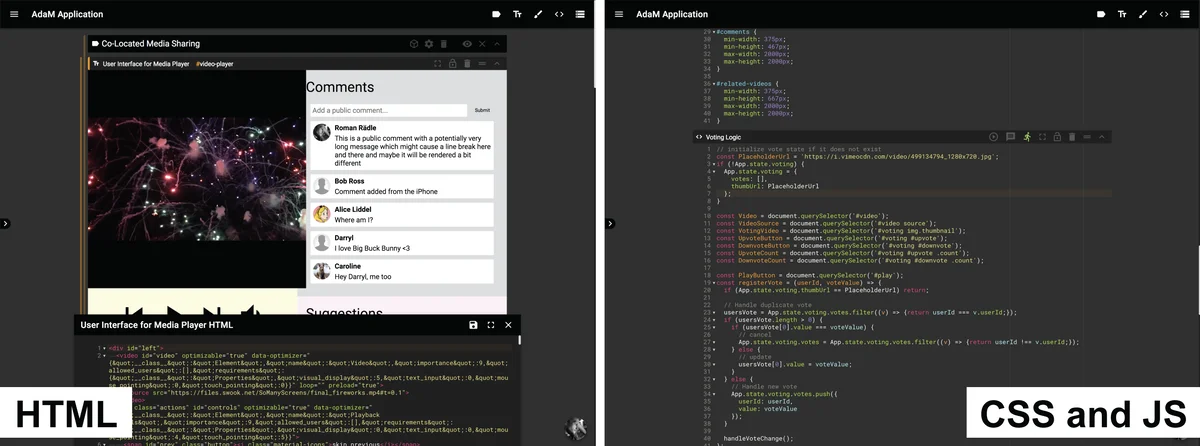
Developing cross-device multi-user interfaces (UIs) is a challenging problem. There are numerous ways in which content and interactivity can be distributed. However, good solutions must consider multiple users, their roles, their preferences and access rights, as well as device capabilities. Manual and rule-based solutions are tedious to create and do not scale to larger problems nor do they adapt to dynamic changes, such as users leaving or joining an activity. In this paper, we cast the problem of UI distribution as an assignment problem and propose to solve it using combinatorial optimization. We present a mixed integer programming formulation which allows real-time applications in dynamically changing collaborative settings. It optimizes the allocation of UI elements based on device capabilities, user roles, preferences, and access rights. We present a proof-of-concept designer-in-the-loop tool, allowing for quick solution exploration. Finally, we compare our approach to traditional paper prototyping in a lab study.
💡 Research Summary
The paper introduces AdaM, a system that automatically distributes user‑interface (UI) elements across multiple devices in collaborative, co‑located settings where users may join or leave at any time. The authors frame UI distribution as a many‑to‑many assignment problem and solve it with a mixed‑integer linear programming (MILP) model that can be solved in real time using modern solvers such as Gurobi.
Key inputs to the model are: (1) Element importance for each user (iₑᵤ), (2) Device characteristics (visual quality, text input, touch, mouse) encoded as a four‑dimensional vector u_d, (3) Element requirements (vₑ) expressed in the same space, (4) Access rights aᵤd (whether user u can use device d) and permission flags pₑᵤ (whether user u may interact with element e), and (5) physical constraints such as screen size and minimum/maximum pixel area for each element.
Decision variables are binary xₑd (element e assigned to device d) and oₑᵤ (element e made available to user u). Constraints enforce that an element can only be placed on a device the user can access, that privacy or role‑based permissions are respected, that the total area of assigned elements does not exceed a device’s screen, and that each element respects its size bounds.
The objective function maximizes a weighted sum of two normalized sub‑objectives: Quality (Q), which measures how well the chosen device matches the element’s functional requirements (the dot product u_d·vₑ) and penalizes excessive screen usage, and Completeness (C), which ensures that every user receives all elements they consider essential. Empirically the authors set the weight for quality to 0.8 and for completeness to 0.2, reflecting a preference for high‑quality placements while still guaranteeing a minimal level of functional completeness.
Because the MILP formulation is compact, the solver finds optimal (or near‑optimal) assignments within a few hundred milliseconds even for scenarios involving up to a thousand users and dozens of devices. The authors also built a designer‑in‑the‑loop tool that lets UI designers adjust importance scores and weight parameters and instantly visualise the resulting distribution, dramatically reducing the time needed for iterative design.
The evaluation consists of two parts. In a simulation study the authors generate random user‑device configurations to test scalability; solution time grows linearly with problem size, confirming real‑time feasibility. In a controlled user study (24 participants) they compare AdaM‑generated distributions with traditional paper prototyping. Participants using AdaM complete the distribution task faster (average 8 s vs. 35 s) and make far fewer errors (5 % vs. 22 %). Moreover, when users dynamically added or removed devices during the task, AdaM automatically recomputed a valid distribution, preserving interaction continuity.
Overall, the contributions are: (1) a formal problem definition that integrates role‑based access, privacy, and device heterogeneity; (2) a real‑time MILP model that jointly optimises quality and completeness; (3) a practical design tool that supports goal‑driven exploration rather than rule‑based scripting; and (4) empirical evidence that the approach outperforms manual methods in speed, accuracy, and adaptability. The authors suggest future extensions such as incorporating predictive user behavior, richer layout optimisation, and distributed solving in cloud environments, indicating that AdaM could become a foundational component for next‑generation cross‑device collaborative applications.
Comments & Academic Discussion
Loading comments...
Leave a Comment