Cooperation in NOMA Networks Under Limited User-to-User Communications: Solution and Analysis
This paper proposes a new communication protocol for a cooperative non-orthogonal multiple access (NOMA) system. In this system, based on users' channel conditions, each two NOMA users are paired to reduce system complexity. In this concern, the user…
Authors: Duc-Dung Tran, Ha-Vu Tran, Dac-Binh Ha
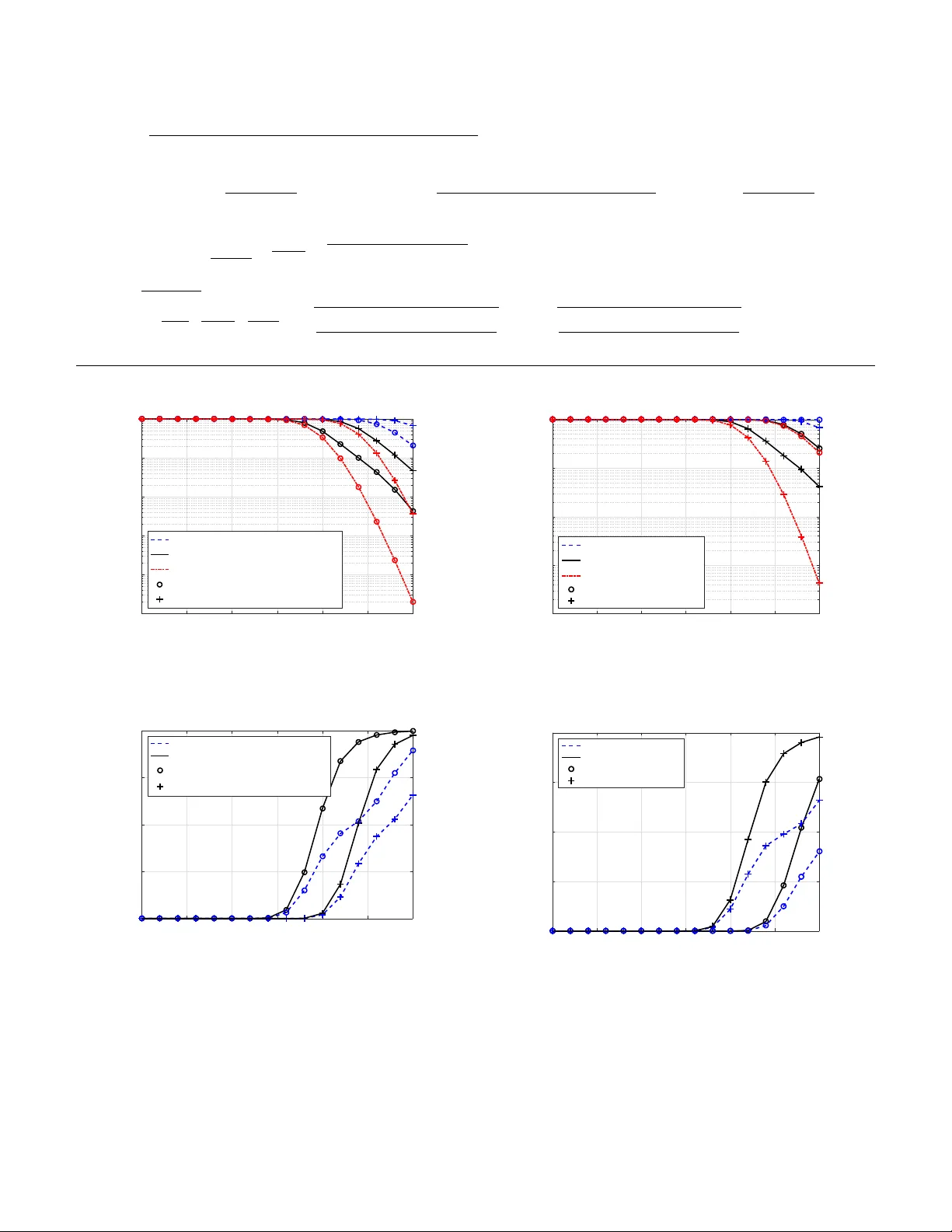
This is the authors’ version of the paper that has been accepted for publication in IEEE W ireless Communications and Networking Conference, 15-18 April 2018, Barcelona, Spain Cooperation in NOMA Networks Under Limited User -to-User Communications: Solution and Analysis Duc-Dung T ran ∗ , Ha-V u T ran † , Dac-Binh Ha ∗ , and Georges Kaddoum † ∗ Faculty of Electrical and Electronics Engineering, Duy T an Uni versity Danang, V ietnam Email: dung.td.1227@gmail.com, hadacbinh@duytan.edu.vn † ETS Engineering School, University of Quebec, Montreal, Canada Email: ha-vu.tran.1@ens.etsmtl.ca, georges.kaddoum@etsmtl.ca Abstract —This paper proposes a new communication proto- col for a cooperative non-orthogonal multiple access (NOMA) system. In this system, based on users’ channel conditions, each two NOMA users are paired to reduce system complexity . In this concern, the user with a better channel condition decodes and then forwards messages received from the source to the user with a worse channel condition. In particular , the direct link between the paired users is assumed to be unavailable due to the weak transmission conditions. T o overcome this issue, we propose a new cooperative NOMA protocol in which an amplify-and-forward (AF) relay is employed to help the user- to-user communications. T o evaluate the pr oposed pr otocol, the exact closed-form expressions of outage probability (OP) at the two paired users are derived. Based on the analysis of the OP , we further examine the system thr oughput in a delay-sensitive transmission mode. Finally, our analytical results verified by Monte-Carlo simulation show that the proposed pr otocol is efficient in enhancing the perf ormance of NOMA system when the user-to-user communications is limited. Index T erms —Amplify-and-f orward, cooperative network, decode-and-forward, non-orthogonal multiple access, outage probability . I . I N T R O D U C T I O N The fifth generation (5G) networks are expected to sup- port multimedia applications to achiev e a 1000-fold higher throughput, a 1000-fold higher mobile data per unit area, and a 10-fold longer lifetime of devices ov er the fourth generation (4G) netw orks [1]–[3]. T o reach these goals, in the quest for new technologies, non-orthogonal multiple access (NOMA) has emerged as one of the promising candidates [4]–[6]. In fact, this method can be considered as a key solution to improv e spectral efficiency . Specifically , its principle relies on exploring the power domain and users’ channel conditions to serve multiple users at the same time/frequency/code [5]. Furthermore, compared with conv entional multiple access, NOMA can offer a better user fairness since the users with a weak transmission condition can be served at a timely manner [5], [6]. On the other hand, cooperative communication is an out- standing solution to improve system performance and ex- tend coverage areas [7] for wireless networks. Particularly , a combination between cooperativ e transmission and NOMA has gained significant attention from the research community [8]–[13]. In this research line, the paper [8] has in vestigated NOMA in cooperative networks in which the system consists of one base station (BS) and two users. In this concern, the BS communicates directly with the first user while the second one exchanges information with the BS through the help of a decode-and-forward (DF) relay . The authors hav e shown that the performance of outage probability and ergodic sum capacity is significantly improved by using the proposed NOMA. As an exte nsion of [8], the work [9] has considered a do wnlink cooperative NOMA system with the aid of an amplify-and-forward (AF) relay . This study has compared the ov erall outage probability of the cooperati ve NOMA with the con ventional cooperativ e OMA to clarify the benefits of cooperative NOMA scheme. Moreover , the deri vation of outage probability , diversity order and coding gain have been presented. Furthermore, in [10], a NOMA-based downlink cooperativ e cellular system has been examined, in a scenario where the BS communicates with two paired mobile users via the help of a half-duple x amplify-and-forward (AF) relay . In addition, the work [11] has analyzed the outage performance of NOMA networks with cooperative relaying transmission, in which the energy-limited near users are po wered by the source applying simultaneous wireless information and power transfer (SWIPT). The authors hav e identified that NOMA can provide an improved spectral efficiency and user fairness in cooperativ e networks. In particular , the works in [12] and [13] have exploited this advantage to improve the ov erall performance of cooperativ e communication. Specifically , they hav e proposed cooperativ e NOMA transmission schemes to improv e the outage performance of the users with poor channel conditions by considering the users with good channel gains as relays to help the others. In cooperativ e NOMA networks, the user with a better channel condition is responsible for decoding and then for- warding the messages to the user with a poorer condition [14]. In other words, it can be seen as a decode-and-forw ard (DF) relay . On this basis, one can be observed that the user- to-user communication plays a critical role in the operation of the networks. In fact, most of the previous works [8]– [13] consider their proposed systems under the assumption that the direct links between the users with good channel conditions. Nevertheless, in practice, these connections may be unav ailable due to the weak transmission conditions or obstacles between the users. T o our best’ s kno wledge, there has been little work on such an issue. Motiv ated by the above discussions, in this paper, we focus on designing a cooperativ e NOMA protocol to deal with limited user-to-user communications and enhance the reliability for the considered system. Thus, this scheme will be suitable to the networks with high reliability , such as V ehicle-to-anything (V2X) system [15]. More specifically , in the proposed protocol, multiple users are divided into multiple pairs to perform cooperative NOMA network. Indeed, this manner helps to reduce an amount of system overhead, as well as used time slots, in comparison with combining all users to perform cooperativ e NOMA [14]. Considering the two paired users, con ventionally , the user with a better channel gain w orks as a DF relay to enhance the quality of the receiv ed signal at the remaining user . Howe ver , since the direct communication between the two paired users is unav ailable due to a poor transmission condition or obstacles, the use of an AF relay is proposed to help the user with a better channel condition forward the signals to the user with a severe channel quality . The main contributions of our paper are presented as follows • Proposing a cooperativ e NOMA protocol addressing the issue of limited user-to-user communications. • Deriving closed-form expressions of outage probability (OP) and system throughput for the considered system. • Exploring the impact of the distances between the com- munication nodes and users-paired selection, on the sys- tem performance. Particularly , by comparing the performance of cooperativ e communication with that of non-relaying communication, nu- merical results clarify the adv antage of the proposed cooper- ativ e communication in NOMA networks. I I . S Y S T E M M O D E L As depicted in Fig. 1, we consider a do wnlink cooperative NOMA system. The considered network consists of one BS denoted by S , M users denoted by { D i } (1 ≤ i ≤ M ) , and one AF relay node denoted by R . Moreover , it is also assumed that each user has a single antenna and operates in a half-duplex mode. The channels are supposed to undergo frequency non-selective Rayleigh block fading. In addition, the channel gains between BS S and users { D i } are assumed to follow the order of | h S D 1 | 2 ≤ | h S D 2 | 2 ≤ . . . ≤ | h S D M | 2 . In the model, BS S intends to con vey information to users { D i } . Prior to transmission, two users, e.g. D m and D n (1 ≤ m < n ≤ M ) , are selected to perform NOMA. It is assumed that the direct link between D n and D m is unav ailable due to S (so ur ce ) R (r ela y) Fig. 1. Model of cooperativ e NOMA system the poor transmission conditions. On this basis, the proposed scenario can be described as follows • In the first phase, source S starts with transmitting the superimposed message to users D m and D n by applying NOMA. • In the second phase, given the two paired users, the user with the better channel condition, i.e. user D n , first decodes the message of the remaining user , i.e user D m , from the received signal, then performs successi ve inter- ference cancellation (SIC) to remo ve this component from its observation and finally recov ers its own information. • In the third phase, after decoding the message of user D m , user D n forwards the result to user D m via the help of relay R . Thus, user D m receiv es two messages transmitted from both the source and relay . Specifically , selection combining (SC) scheme is employed at user D m to process these signals. Giv en the proposed scenario, mathematical formulation can be provided as follows. In the first phase, S transmits the message x s = √ a m P 0 s m + √ a n P 0 s n ( a m > a n ) to two selected users D m and D n following NOMA. Specifically , s m and s n are the messages of users D m and D n , respectively . Also, a m and a n are the po wer allocation coefficients satisfied the condition a m + a n = 1 , and P 0 is the transmit power . Accordingly , the receiv ed signals at users D m and D n are respectiv ely giv en by y Dm = h S Dm q d θ S Dm p a m P 0 s m + p a n P 0 s n + n Dm , (1) y Dn = h S Dn q d θ S Dn p a m P 0 s m + p a n P 0 s n + n Dn , (2) where d S Dm and d S Dn are the distances from BS S to users D m and D n , respectiv ely . Additionally , θ is the path loss exponent, and n Dm and n Dn ∼ CN (0 , N 0 ) denote the additiv e white Gaussian noise (A WGN) at users D m and D n , respectiv ely . Thus, the instantaneous signal-to-interference- and-noise ratio (SINR) at user D m to detect s m is written as γ S Dm = a m | h S Dm | 2 a n | h S Dm | 2 + d θ S Dm /γ 0 , (3) where γ 0 = P 0 N 0 denotes the av erage transmit signal-to-noise ratio (SNR) at BS S . In the second phase, user D n decodes the message of user D m (i.e. s m ), and then employs SIC to subtracts the signal s m from the recei ved signal before decoding its own message (i.e. s n ). Right after , it forwards s m to relay R . It is assumed that the information processing times at user D n and relay R are negligible and ignorable, respectiv ely . The receiv ed signal at relay R can be e xpressed as y R = h DnR q d θ DnR p P Dn s m + n R , (4) where, h DnR is the channel coefficient of D n − R link, P Dn is the transmit power at user D n , d DnR is the D n − R distance, n R ∼ CN (0 , N 0 ) is the A WGN at relay R . The instantaneous SINR at user D n to detect s m of user D m can be given by γ S Dn → m = a m | h S Dn | 2 a n | h S Dn | 2 + d θ S Dn /γ 0 . (5) The instantaneous signal-to-noise ratio (SNR) at user D n to detect s n of user D n is written as γ S Dn = γ 0 a n | h S Dn | 2 d θ S Dn , (6) In the third phase, relay R amplifies the received signal, and then re-transmits the result to user D m . Hence, the receiv ed signal at user D m has the following form y RD m = v u u t P R P Dn P Dn d θ DnR | h DnR | 2 + N 0 d θ RD m d θ DnR h RD m h DnR s m + v u u t P R P Dn d θ DnR | h DnR | 2 + N 0 d θ RD m h RD m n R + n RD m , (7) where h RD m is the channel coefficient of R − D m link, P R is the transmit power at relay R , d RD m is the R − D m distance, n RD m ∼ CN (0 , N 0 ) is the A WGN at user D m . Here, for simplicity but without loss of generality , we assume that P Dn = P R = P 0 . The instantaneous SINR of user D m related to R − D m link is given by γ RD m = γ 2 0 | h RD m | 2 | h DnR | 2 γ 0 d θ DnR | h RD m | 2 + γ 0 d θ RD m | h DnR | 2 + d θ RD m d θ DnR . (8) In order statistics, the probability density function (PDF) of | h S Di | 2 (1 ≤ i ≤ M ) is expressed as [10] f | h S Di | 2 ( x ) = M ! ( M − i )! ( i − 1)! 1 λ S D i − 1 X k =0 i − 1 k × ( − 1) k e − x ( M − i + k +1) /λ S D , (9) and its cumulative distribution function (CDF) can be written as F | h S Di | 2 ( x ) = x Z 0 f | h S Di | 2 ( t ) dt = i − 1 X k =0 Φ k,i 1 − e − x ( M − i + k +1) /λ S D , (10) where Φ k,i = i − 1 k (1) k M ! ( M − i )!( i − 1)!( M − i + k +1) and λ S D = E h | h S Di | 2 i , E [ · ] is the expectation operator . I I I . P E R F O R M A N C E A N A L Y S I S In this section, the performance analysis in terms of outage probability and system throughput is presented. A. Outage pr obability The outage probability of users D n and D m is analyzed through Theorem 1 and 2 as follo ws. Theor em 1: Under Rayleigh fading channel, the outage pr obability of user D n can be expr essed as P ( n ) Out = n − 1 X k =0 Φ k,n h 1 − e − β ( M − n + k +1) /λ S D i . (11) where Φ k,n = n − 1 k ( − 1) k M ! ( M − n )!( n − 1)!( M − n + k +1) , β = max n αd θ S Dn , γ thn d θ S Dn a n γ 0 o , α = γ thm ( a m − a n γ thm ) γ 0 . Pr oof: Since user D n needs to decode the signal of user D m first, the probability to characterize such an ev ent can be formulated as P ( n ) Out = 1 − Pr ( γ S Dn → m ≥ γ thm ) Pr ( γ S Dn ≥ γ thn ) . (12) Substituting (5) and (6) into (12), the outage probability of user D n can be rewritten as P ( n ) Out = 1 − Pr | h S Dn | 2 ≥ β = Pr | h S Dn | 2 < β . (13) It is important to note that the condition γ thm < a m a n is used to obtain (13). The achiev ed result in (11) is attained by substituting (10) into (13). Theor em 2: The outage pr obability of user D m can be given by P ( m ) Out = n − 1 X k =0 Φ k,n h 1 − e − α ( M − n + k +1) d θ S Dn /λ S D i + ( 1 − n − 1 X k =0 Φ k,n h 1 − e − α ( M − n + k +1) d θ S Dn /λ S D i ) × m − 1 X k =0 Φ k,m h 1 − e − α ( M − m + k +1) d θ S Dm /λ S D i × " 1 − e − γ thm γ 0 d θ RDm λ RDm + d θ DnR λ DnR t K 1 ( t ) # , (14) where Φ k,m = m − 1 k ( − 1) k M ! ( M − m )!( m − 1)!( M − m + k +1) , t = 2 r d θ DnR d θ RDm γ thm ( γ thm +1) γ 2 0 λ DnR λ RDm and K 1 ( · ) denotes the 1 st - order modified Bessel function of the second kind. Pr oof: Considering user D m with SC, an outage ev ent occurs if and only if both the direct communication and the relaying communication are interrupted. Therefore, the outage probability of user D m can be shown as P ( m ) Out = Pr ( γ S Dn → m < γ thm ) + [1 − Pr ( γ S Dn → m < γ thm )] × Pr ( γ S Dm < γ thm ) Pr ( γ RD m < γ thm ) , (15) where Pr ( γ S Dn → m < γ thm ) = n − 1 X k =0 Φ k,n h 1 − e − α ( M − n + k +1) d θ S Dn /λ S D i , (16) Pr ( γ S Dm < γ thm ) = n − 1 X k =0 Φ k,m h 1 − e − α ( M − m + k +1) d θ S Dm /λ S D i , (17) and Pr ( γ RD m < γ thm ) can be calculated as sho wn in (18) at the top of the next page. Note that the final result in (18) is obtained after changing v ariable u = γ 0 x − d θ RD m γ thm and applying [[16], 3.324.1]. By substituting (16), (17) and (18) into (15), the final expression of P ( m ) Out is deriv ed as (14). B. System thr oughput In this subsection, we consider the throughput ( τ ) in delay- sensitiv e transmission mode. Giv en the analytical results re- garding the outage probability of users D n and D m , the system throughput can be expressed relying on [13] as belo w τ = 1 − P ( n ) Out R n + 1 − P ( m ) Out R m , (19) where P ( n ) Out and P ( m ) Out are obtained from (11) and (14), respectiv ely . I V . N U M E R I C A L R E S U L T S In this section, numerical results are provided to analyze the performance of the proposed scenario. Giv en this concern, our simulation focuses on the outage probability (OP) and the sys- tem throughput ( τ ) metrics in the delay-sensitiv e transmission mode. Specifically , in the considered system, it is assumed that there exist six user nodes ( M = 6) . In addition, the power allocation coefficients are set to be a m = 0 . 7 and a n = 0 . 3 . Also, the data rates at nodes D m and D n are defined as R m = R n = 1 (bit/s/Hz). In particular , considering the relati ve distances between the nodes ( S , D m , D n and R ), the values of d RD m and d DnD m can be calculated by a simple way as fol- lows: d RD m = p d 2 DnD m + d 2 DnR − 2 d DnD m d DnR cos α 1 , where α 1 = 40 o denotes the angle ∠ D m D n R , and d DnD m = p d 2 S Dm + d 2 S Dn − 2 d S Dm d S Dn cos α 2 with α 2 = 60 o repre- sents the angle ∠ D m S D n . T o this end, we set the path loss exponent to be θ = 2 . In Fig. 2 and 3, the variation of the OP and the throughput with respect to average transmit SNR γ 0 is in vestigated in cases of dif ferent distance values, i.e. d S Dn , d S Dm , d DnR , d RD m , and d DnD m . As observed in Fig. 2, it is visible that the increase in communication ranges results in the scale up of the OP . This implies a significant performance loss caused by the path loss. Also, the same phenomenon can be ev aluated from Fig. 3 in which a lo wer throughput is observ ed in the case that the longer distances are applied. Furthermore, considering node D m , one can observe from these two figures that the help of relay R plays an important role in desirably improving the performance of the OP and the throughput. According to the principle of NOMA, dif ferently selecting a pair of user nodes, i.e. { D m , D n } , leads to various changes in system performance. T o address this issue, Fig. 4 and Fig. 5 are plotted to identify how the selection affects the performance of the OP and the throughput, respectiv ely . Giv en this concern, it is observed that the OP scales down whereas the througput scales up in the case that m and n are assigned with higher values. On this basis, it is suggested that m and n should be selected as large as possible to obtain the better performances. Particularly , the provided discussion is confirmed by the fact that the analytical results are in a good agreement with the simulation results, as observed from all four figures. V . C O N C L U S I O N In this work, we have raised the problem of limited user- to-user communications in NOMA systems, and then hav e proposed a ne w cooperative NOMA protocol to overcome such a problem. T o ev aluate the performance of the protocol, the closed-form expressions of the outage probability and the system throughput in delay-sensitiv e transmission mode hav e been derived. On this basis, the impact of some system parameters on the system performance has been in vestigated. Specifically , the analysis confirmed by simulation results sho w that the proposed scenario improves the system performance significantly . Finally , properly selecting a pair of users to perform NOMA is also suggested. Pr ( γ RD m < γ thm ) = Pr γ 2 0 | h RD m | 2 | h DnR | 2 γ 0 d θ DnR | h RD m | 2 + γ 0 d θ RD m | h DnR | 2 + d θ RD m d θ DnR < γ thm ! = Pr | h RD m | 2 < d θ RD m γ thm γ 0 + Pr | h DnR | 2 < γ thm d θ DnR γ 0 | h RD m | 2 + d θ RD m γ 0 γ 0 | h RD m | 2 − d θ RD m γ thm , | h RD m | 2 ≥ d θ RD m γ thm γ 0 = 1 − ∞ Z d θ RDm γ thm γ 0 1 λ RD m e − x λ RDm e − γ thm d θ DnR ( γ 0 x + d θ RDm ) γ 0 ( γ 0 x − d θ RDm γ thm ) λ DnR dx = 1 − e − γ thm γ 0 d θ RDm λ RDm + d θ DnR λ DnR 2 s d θ DnR d θ RD m γ thm ( γ thm + 1) γ 2 0 λ DnR λ RD m K 1 2 s d θ DnR d θ RD m γ thm ( γ thm + 1) γ 2 0 λ DnR λ RD m ! , (18) 0 5 10 15 20 25 30 γ 0 (dB) 10 -5 10 -4 10 -3 10 -2 10 -1 10 0 Outage Probability Analysis - D m (without relaying) Analysis - D m (with relaying) Analysis - D n Simulation: {d SDn , d SDm , d DnR } = {3; 4; 2} (m) Simulation: {d SDn , d SDm , d DnR } = {5; 6; 4} (m) Fig. 2. Outage probability v .s. γ 0 with different values of the distances, where m = 3 , n = 6 . 0 5 10 15 20 25 30 γ 0 (dB) 0 0.5 1 1.5 2 System Throughput Ana. - without relaying Ana. - with relaying Sim. {d SDn , d SDm , d DnR } = {3; 4; 2} (m) Sim. {d SDn , d SDm , d DnR } = {5; 6; 4} (m) Fig. 3. System throughput v .s. γ 0 with different values of the distances, where m = 3 , n = 6 . R E F E R E N C E S [1] A. Gupta and R. K. Jha, “ A survey of 5G network: Architecture and emerging technologies, ” IEEE Access , v ol. 3, pp. 1206 – 1232, July 2015. [2] E. Hossain and M. Hasan, “5G cellular: Ke y enabling technologies and 0 5 10 15 20 25 30 γ 0 (dB) 10 -4 10 -3 10 -2 10 -1 10 0 Outage Probability Analysis - D m (without relaying) Analysis - D m (with relaying) Analysis - D n Simulation: m=1, n=3 Simulation: m=3, n=6 Fig. 4. Outage probability v .s. γ 0 with different values of m and n , where d S Dn = 4 (m), d S Dm = 6 (m) and d DnR = 4 (m). 0 5 10 15 20 25 30 γ 0 (dB) 0 0.5 1 1.5 2 System Throughput Analysis - without relaying Analysis - with relaying Simulation: m=1, n=3 Simulation: m=3, n=6 Fig. 5. System throughput v .s. γ 0 with different values of m and n , where d S Dn = 4 (m), d S Dm = 6 (m) and d DnR = 4 (m). research challenges, ” IEEE Instrum. Meas. Mag. , v ol. 18, no. 3, pp. 11–21, June 2015. [3] H.-V . Tran and G. Kaddoum, “RF wireless power transfer: Regreening future networks, ” IEEE P otentials , vol. 37, no. 2, pp. 35 – 41, March- April 2018. [4] Y . Saito, Y . Kishiyama, A. Benjebbour , T . Nakamura, and K. H. A. Li, “Non-orthogonal multiple access (NOMA) for cellular future radio access, ” in V ehi. T ech. Conf. (VTC Spring) , June 2013, pp. 1–5. [5] L. Dai, B. W ang, Y . Y uan, S. Han, C.-L. I, and Z. W ang, “Nonorthogonal multiple access for 5G: Solutions, challenges, opportunities, and future research trends, ” IEEE Commun. Mag. , vol. 53, no. 9, pp. 74–81, September 2015. [6] T . Nakamura, A. Benjebbour , Y . Kishiyama, S. Suyama, and T . Imai, “5G radio access: Requirements, concept, experemental trials, ” IEICE T rans. Commun. , vol. E98–B(8), pp. 1397–1406, August 2015. [7] H. A. Suraweera, G. K. Karagiannidis, and P . J. Smith, “Performance analysis of the dual-hop asymmetric fading channel, ” IEEE T rans. W ire . Commun. , vol. 8, no. 6, pp. 2783–2788, Jun. 2009. [8] J.-B. Kim and I.-H. Lee, “Non-orthogonal multiple access in coordinated direct and relay transmission, ” IEEE Commun. Lett. , vol. 19, no. 11, pp. 2037–2040, Nov ember 2015. [9] X. Liang, Y ongpeng, D. W . K. Ng, Y . Zuo, S. Jin, and H. Zhu, “Outage performance for cooperative NOMA transmission with an AF relay , ” IEEE Commun. Lett. , vol. 21, no. 11, pp. 2428–2431, Nov . 2017. [10] J. Men and J. Ge, “Performance analysis of non-orthogonal multiple access in downlink cooperativ e network, ” IET Commun. , vol. 9, no. 18, pp. 2267–2273, December 2015. [11] N. T . Do, D. B. D. Costa, T . Q. Duong, and B. An, “ A BNBF user selection scheme for NOMA-based cooperative relaying systems with SWIPT, ” IEEE Commun. Lett. , vol. 21, no. 3, pp. 664–667, Mar . 2017. [12] Z. Ding, M. Peng, and H. V . Poor, “Cooperati ve non-orthogonal multiple access in 5G systems, ” IEEE Commun. Lett. , vol. 19, no. 8, pp. 1462– 1465, August 2015. [13] Y . Liu, Z. Ding, M. Elkashlan, and H. V . Poor , “Cooperativ e nonorthog- onal multiple access with simultaneous wireless information and power transfer , ” IEEE Journal on Selected Areas in Commun. , vol. 34, no. 4, pp. 938–953, April 2016. [14] Z. Ding, Y . Liu, J. Choi, Q. Sun, M. Elkashlan, C.-L. I, and H. V . Poor , “ Application of non-orthogonal multiple access in L TE and 5G networks, ” IEEE Commun. Mag. , vol. 55, no. 2, pp. 185–191, February 2017. [Online]. A vailable: http://arxiv .org/abs/1601.03613 [15] K. Manolakis and W . Xu, “Time synchronization for multi-link D2D/V2X communication, ” in V ehi. T ech. Conf. (VTC F all) , Sept. 2016. [16] I. Gradshteyn and I. Ryzhik, T able of Integrals, Series, and Products , 7th ed. Academic Press, March 2007.
Original Paper
Loading high-quality paper...
Comments & Academic Discussion
Loading comments...
Leave a Comment