Dual Polarized Modulation and Reception for Next Generation Mobile Satellite Communications
This paper presents the novel application of Polarized Modulation (PMod) for increasing the throughput in mobile satellite transmissions. One of the major drawbacks in mobile satellite communications is the fact that the power budget is often restric…
Authors: Pol Henarejos, Ana I. Perez-Neira
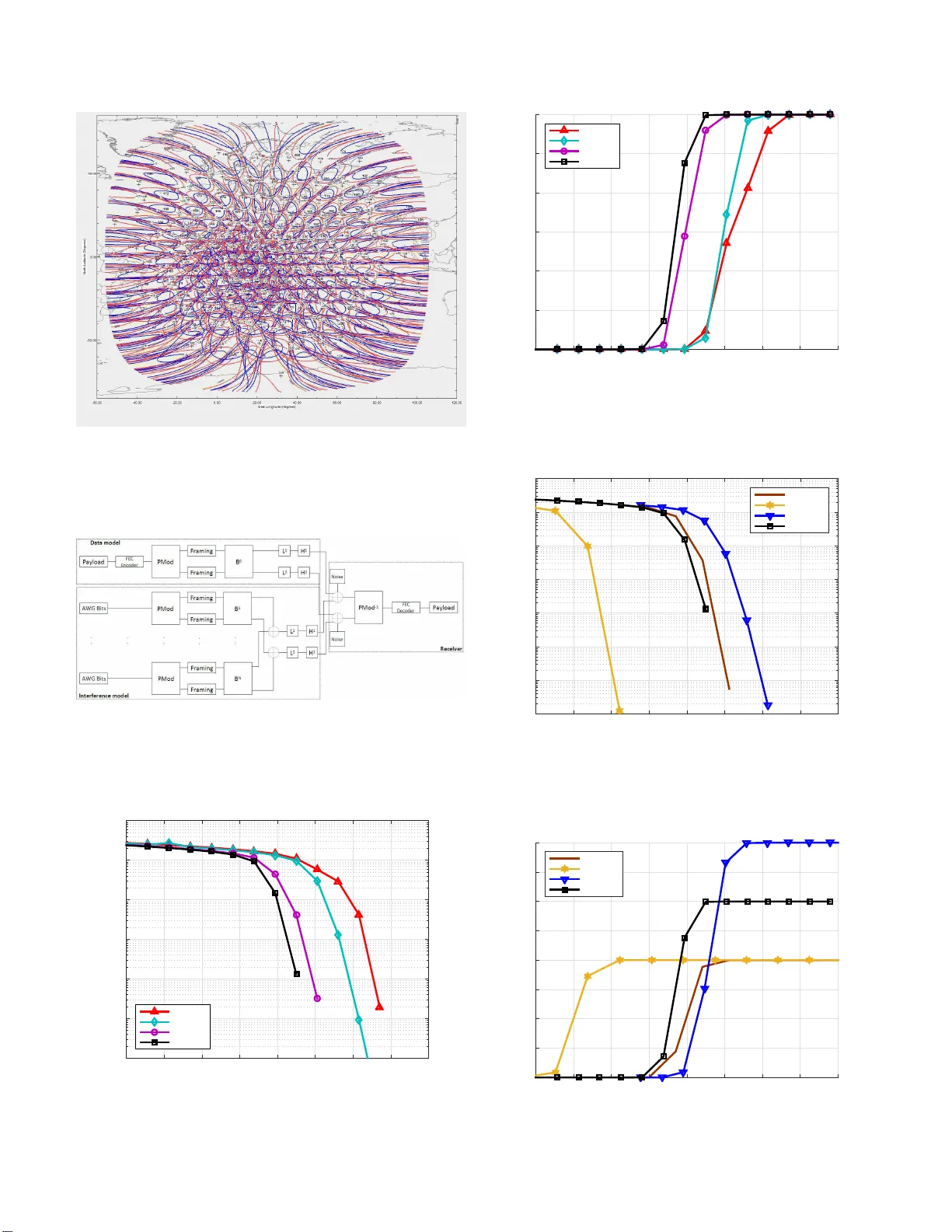
SUBMITTED TO IEEE TRANSA CTIONS ON COMMUNICA TIONS ON OCTOBER 15TH 2014 1 Dual Polarized Modulation and Reception for Ne xt Generation Mobile Satell ite Communications Pol Henarejos, Studen t, IEEE, , Ana Pe rez-Neira, Senior , IEEE Abstract —This paper presents the nov el application of Polar - ized Modulation (P Mod) f or increasing the throughput in mobile satellite transmissions. One of th e major drawbacks in mobile satellite communications is the fact that the po wer budget is often restrictiv e, making unaffo rdable to improv e the spectral efficiency with out an increment of transmitted power . By using dual polarized antennas in the transmitter and recei ver , th e P Mod technique achiev es an impro vement in throughput of up to 100 % with respect t o existing deployments, with an increase of less th an 1 dB at low E b /N 0 regime. Ad ditionally , the proposed scheme implies minimum hardware modifications with respect to th e existing du al polarized systems and d oes not require additional channel state inform ation at the transmitter; thus it can be used in current depl oyments. Demodulation (i.e. detection and decoding) alternativ es, with di fferent processing complexity and perfo rmance, are stud ied. Th e results are validated in a typical mobile i nteractiv e scenario, the newest version of TS 102 744 standard (Broadband Global Area Network (BGAN)), whi ch aims to provide in t eractive mobile satellite communications. Index T erms —S atellite Com munications, Polarized M od u la- tion, Dual Polarized Antenn as, Interactive Services I . I N T RO D U C T I O N M UL TIPL E -input multiple-ou tput (MIMO) schemes were introduc e d as a prom ising way to notably in- crease the spectral efficiency (SE) using m ultiples antenn as at transmission and/or reception [1]– [ 3]. I n contrast to terr estrial commun ications, wher e the transmitter c an obtain Ch annel State In f ormation at the T ransmitter ( CSIT ) , in satellite links it is impossible to maintain CSIT u pdated due to th e lo ng round trip time. By the time the satellite receiv es th e feedb ack parameters, the channe l varies and the CSIT b ecomes ou td ated. Among the different ap proach es that do not use CSIT , V ertical Bell Laboratorie s Layer ed Space-Time (VBLAST) scheme and suc c essi ve improvements present a simple way to in crease th e ach iev able r ate with a relative in c rease o f th e processing complexity [4]– [7] in th e absence of CSIT . How- ev er , VBLAST introd uces inter ference b etween th e stre a ms since all signals ar e tran smitted through all ante n nas withou t any in terferenc e pre-ca ncellation. In co nsequen c e, the signals must be tra n smitted with high er amplitude to ob tain the same error rates comp ared with the single stream case. In contrast to VBLAST , Spatial Modulation ( SM) appear e d recently to increase the SE [ 8 ]–[10]. In SM , the bits o f P . Henare jos is wit h the Communications Systems Divisi on of Cat- alonia n T e chnologic al T ele communicati ons Center , Barcelona , e-mail: pol.henare jos@cttc .es. A. Perez-Neira is with the Signal and Communica tion Theory Department of Uni versit at Politcnica de Catalunya and with the Cataloni an T echno logical T e lecommunica tions Center , e-mail: ana.isabe l.perez@upc .edu Manuscript submitted on October 15th 2014 informa tio n are split in bloc k s; some are code d as anten na indices and th e rest ar e transmitted throu gh the antennas that are selected by the indices. By estimating the antenn a indices, the receiver can recover the bits used fo r this p urpose. Nev ertheless, this ap proach is very sensiti ve to the chann el variations and requires an accurate channel estimation as well as spatially uncor r elated chann els [ 11]–[13]. In satellite scenar ios, du e to the Line of Sig ht (LOS), the spatial components beco me corr elated at the recei ver side although the transmitting anten nas may be separated at half wa velength. Hence, in the ab sence o f scatterers, th e receiver only d iscovers a single tra n smission path an d the sensitivity o f the ter minal is n ot en ough to distingu ish the different spatial signatures and detect the antenna ind ices. Because of this, SM does no t seem suitable as it does not provide sufficient div ersity in satellite scenarios. On the c ontrary , the polarization channel p rovides m o re div ersity and may be used f or this kind of schemes [14]. Although d ual polarized antennas wer e u sed for broadcasting, where subscribers only tuned a sin g le po larization, recent stud - ies unveil th at d ual-polar ized M IMO chan nel is richer in terms of diversity [15]. Ad ditionally , th e use of dual polar ized anten- nas is increasingly mo tiv ated by the new possibilities arising, together with the newest standards including dual polar ized MIMO, such as Digital V ideo Broadcasting -Next Generatio n broadc a stin g system to Hand-held (DVB -NGH [1 6]). Finally , research pr o jects such as [17], [18] r eported that the throug h- put c a n be incr eased as in a conventional MIMO system if mor e antennas, and the conseque nt radio frequ ency (RF) chains [19]–[2 1], are added in o rder to multip lex polar izations. The price to be paid is that the comp lexity of the satellite pay- load in c reases since in terferenc e amon g polarizatio ns appears. For instance, extending the VBLAST strategy to dual polarized schemes req uires h igher transmit power to main tain the same Quality of Service (QoS) in p oint-to- point clients [17]. The primar y motiv ation behind the p resent work is to apply the SM concept to dual polarized communications in th e challengin g mobile satellite channels. Hereafter, th is scheme is referred to as polarized modulation (PMod). In deed, it is not po larization mu ltiplexing since only o ne p olarization is activ ated at a time an d therefore p recludes the p resence of in terferenc e. Although this work has b een trigg ered as an attempt to apply a simp le di versity techniqu e as SM to the satellite scenario, the pape r cou ld also be viewed as th e extension to satellite communicatio ns o f the PMod idea th at has been repor te d previously in optical commu nications [22]. Howe ver , f r om the author s’ knowledge there is no literature describing in de ta il PMod demodulation schem e ( detection SUBMITTED TO IEE E T RANSACTIONS ON COM MUNICA TIONS ON OCTOBER 15TH 2014 2 and d ecoding ) for optical commun ica tions, be in g po larization multiplexing far mo re co mmon. The sche me to be proposed contain s the f ollowing contri- butions: • T he proposed PMod techn ique explo its the p olarization div ersity in satellite scenarios, whe re the spatial div ersity is highly pen alized. • PM o d d oes n ot re q uire CSIT and increases the th r ough p ut maintaining the robustness ba sed on the polar ization div ersity . • U su ally , satellite systems opera te with dual polarized antennas and th us th e proposed scheme does n o t r equire additional an tennas. T he min imum req uirement is to use a dual polar ized fee der . • T he success of this scheme lies n ot only on the simp licity of the tr ansmission techn iq ue, but also on the receiver design, which is also o ne main contribution of the present work, to gether with the perf orman c e evaluation. Note tha t the information is co n veyed no t o nly in the transmitted bit stream, but also in the polarizatio n. • Fin ally , as we demo nstrate in a maritime mob ile satellite L-band scen ario, the result is an increase o f the overall perfor mance in terms of thro u ghpu t, whereas gu arantee- ing a m in imum QoS and req uiring a minimu m in crease in p ower usage. Th e b est per forman ce is obtain ed for low order mod ulations, where the propo sed meth o d achieves a gain o f 2 when it is compare d with a basic system without PMod. I I . S Y S T E M M O D E L Let us co nsider a MI MO system where transmitter and receiver are equipp ed with a single antenna with dual p o- larization, an d a Rician fr e q uency flat channel. Each sy m bol contains b + 1 bits o f information , where b bits are modu lated within the con stellation S and the rem aining bit is used f o r polarization selection. This r emaining bit is denoted as c an d the mo d ulated b its as s ∈ C . W e would like to remark that th e informa tio n is co nveyed th roug h the sym bol s as well as bit c . The channels across the polarization s 1 and 2 are den oted h 11 ∈ C and h 22 ∈ C , respe ctiv ely , and th eir respectiv e cross- channels a s h 21 ∈ C a n d h 12 ∈ C . All ch annel co efficients h ij follow a Rice statistical distribution with ( K , σ h ) parameter s with a pair-wise correlation ρ ij = [0 , 1] . Th e received signals for po larizations 1 and 2 are d enoted as y 1 ∈ C and y 2 ∈ C , respectively , and ω i ∈ C fo llows Additiv e White Gaussian Noise (A WGN), ω ∼ C N ( 0 , N 0 I 2 ) . Dependin g on the value of c ∈ { 0 , 1 } , the s symb ols are conv eyed using one polarization or the other . Hence, we can formu late the system mod el as follows: y 1 y 2 = h 11 h 21 h 12 h 22 1 − c c s + ω 1 ω 2 (1) or in a mo re com pact way as: y = [ h 1 h 2 ] c s + ω (2) = Hc s + ω , (3) where h i is the ch annel correspo nding to th e i th p o larization. Since this sch eme adds an addition a l bit to the tr ansmission by keeping th e same power budget, th e throug hput gain of PMod with respect to Single-inp u t Single-ou tput (SISO) case is G = b + 1 b = 1 + 1 b . (4) For hig her order modulation s, (4) is asympto tically 1 an d thus the p roposed PMod scheme increases the g ain fo r lo w order mod ulations. For instance, the g ain is 2 for Binary Pha se- Shift Keying (BPSK) modulatio n or 1 . 5 f or Quadratur e Pha se- Shift Ke ying (QPSK) mod ulation. As low order mod ulations are used in low signal to no ise ratio (SNR) regime, it is clea r that PMod increases sign ificantly th e thro ughp u t gain G in low SNR systems. This is exactly the scena rio fo r mobile satellite co m municatio ns wh ere shadowing, fading an d power limitations cause low SNR. I I I . D E M O D U L AT I O N S C H E M E S The implementation o f the receiver derives into se veral approa c h es depen d ing on the scenario constra in ts. Since PMod transmits a sing le stream, we aim to extract th is stream to be processed into a SISO decoder . This scheme offers two m a in advantages: • Red uces th e co mplexity drastically since th e signal pro- cessing is one dim ensional. • Can b e c o mbined with existing SISO dec o ders, m aintain- ing the compatib ility with the cur rent standards. The reception scheme is illustrated in Fig . 1. W ith this scheme, PM o d − 1 implements one of the four demodu lation schem es that are introduced in this section, estimates the bit c and manipu lates th e received signal y to produ ce the signal r , which is cap able to be used by a SISO decoder . The o ptimal d emodulatio n schem e is based on the Max- imum a Posteriori (MAP) criteria, which is equiv alent to the Max imum-Likeliho od ( ML) cr iteria fo r the case where the transmitted symbo ls are equipro bable. Th us, the optimal receiver can b e derived from the expression ˆ x = arg max x ∈M p ( y | x , H ) (5) where x = c s a n d M is the symbol alphabet of x . Herea fter , we assume th at the n oise co ntribution is Gaussian. Note that there is no restriction with the characteristics o f the chann el matrix. Thu s, we do no t take any a ssum ption on the statistical indepen d ence of H . Hence, (5) can be simplified as ˆ x = arg min x ∈M k y − Hx k 2 . (6) Based on the expression pro posed in ( 6) four dif ferent demodu lators are prop osed: • Fir st approac h: zero force r . • Sec ond approach : per-symbol d etection. • T hird approach : per-hard- bit detection. • Four th app roach: pe r-soft-bit detection. SUBMITTED TO IEE E T RANSACTIONS ON COM MUNICA TIONS ON OCTOBER 15TH 2014 3 A. F irst Appr oach: Zer o F or cer In this approach a zero for cing pre- filter is ap p lied befo r e detecting the informatio n in x . W e no te th at the zero f orcer is the so lu tion of d f d x H = 0 , where f ( x ) = k y − H x k 2 . This is equiv alent to app ly the filter W = H H H − 1 H H . (7) Therefo re we o btain the sign al after th e pr ocessing as follows: z = Wy = c s + H H H − 1 H H ω . (8) In th e case wh ere the signal is being tran smitted throu gh polarization 1 , i.e . c = 0 , z 1 contains the sign a l p lus n oise and z 2 only receiv es the no ise; and the recipr ocal case fo r c = 1 , z 1 contains only the noise and z 2 conv eys the signal plus the no ise. Therefo r e, to de cide on c we prop o se a p ower detector . It is d enoted as: ˆ c = arg max i | z i | 2 − 1 . (9) Once the rec e iv er kn ows the used polar ization path, it is a ble to decod e the symb ol s based on the sign al r = z ˆ c +1 . This so lution p resents a simple imp lementation but it is not a sufficient statistic to decode the who le pro blem (symb ol s and b it c ). Since it computes the en velope o f the vector, th e informa tio n conveyed throu gh th e phases is lost and th e refore it is no t sufficient. Nev ertheless, th is solution p resents a major d isadvantage. H H H could be badly condition ed and thus it may p roduce an excessi ve noise e n hancem e nt, d oing imp ossible the demo du- lation. B. Sec o nd Appr oach: P er-Symbol Detec tio n As we stated in the previous sectio n, apply ing the W filter may in troduce im portant distortions. Since the solution ha ve to lie in the sub set M , the so lution o f the first a p proach may not be the op timal. Thus, the optim a l approach to solve (6) is perfor ming an exhaustive search over the subset M . In the particu lar ca se of PMod, the tran sm itted vector x can be restricted to th e sub set x ∈ M , where the first vector [ s 0 ] of the set d e fines the transmission using the fir st polarization and the second vector [ 0 s ] of the set, using the second po la r ization. Hence, th e decision rule for demod u lating the bit c is based on ˆ c = 0 if ˆ x = [ s 0 ] and ˆ c = 1 if ˆ x = [ 0 s ] . In the same way , the signal r can be written as r = x ˆ c +1 . This scheme, howe ver , p resents a n otable increase of com- putational complexity . T he exh a u stiv e search requir es to find the solution among several possibilities. The complexity of th e initial search is O 2 b 2 but due to the restriction o f the set aforemen tioned, the comp lexity is re d uced to O 2 b +1 , which is equiv alent to the complexity of the SISO case where b + 1 bits are conve yed. Furthermo re, th e previous demodulatio n schem e s introd u ce hard decisio n s that ind u ce non-linear ities, such as sign() or abs() fu nctions. In the presence o f coded infor mation, as it c an be seen in [23], sof t d ecoding ou tperfor m s the previous ML implementatio n. In the following sectio ns we descr ib e schemes that introd uce soft inf ormation . C. Thir d App r oach: Likelihood Ratio with Har d Decision Usually , to d eal with chann el impairm ents, the transmitted bits ar e coded. The c hannel de c oder com putes th e m etrics based on the likelihood of the received signal and is able to estimate the unco d ed bits. The th ir d appro ach is based on this philoso p hy a n d b it c is estimated based on the likeliho od ratio. If the likelihood ratio is defined as Λ ( y ) = P 2 P 1 = P ( c = 1 | y ) P ( c = 0 | y ) = P ˜ s ∈S exp − k y − h 2 ˜ s k 2 σ 2 w P ˜ s ∈S exp − k y − h 1 ˜ s k 2 σ 2 w , (10 ) the decision ru le for estimating c d epend s on ly o n the sign of log (Λ ( y )) . In the case where likelihood ratio is greate r than 1 , it means that it is mo re proba b le that c = 1 and v ice- versa. Assuming that only b bits ar e cod e d, an estimator of the uncode d c can be stated as: ˆ c = 1 + sig n (log (Λ ( y ))) 2 . (11) Once the r eceiver obta in s the estimation o f c , it k nows which polarization is being u sed an d thus it can recover the sy mbol s using the signal r = y ˆ c +1 . Although this scheme uses soft infor m ation in the decoding of sym b ol s , the decision o f bit c is still hard . Thu s, if this bit is also cod e d, the result is sub optimal. In the n ext section we describe how to ob tain a soft version o f bit c . D. F ou rth Appr oach: Likelihood Ratio with Soft Decision The three approach es d escribed ab ove perf orm hard decision for th e estima tio n of bit c . Ho wever , they c a n introdu ce errors if the system conve ys code d inform ation as it was m e ntioned. The soft versio n of bit c correspond s to the log -likelihood, exactly as the b its b . Tha t is ˆ c = log (Λ ( y )) . After that, the bit c is soft an d can b e passed to the soft decoder . Howe ver , there is th e problem o f which p olarization to c hoose for d ecoding . In the previous schemes, since the b it c is har d, it is p ossible to proc e ss the re c eiv ed signal on th e polarization ind ic a ted by c . In the present scheme it is n o t possible to decid e which polar ization c o n veys in formatio n. T o solve this issue w e comp ute the av erage received signal: r = P 1 y 1 + P 2 y 2 . (12) Using the likelihood ratio Λ ( y ) computed as in (1 0), and using P 2 = P ( c = 1 | y ) = 1 − P ( c = 0 | y ) = 1 − P 1 , (13) we can rewrite P 2 = P ( c = 1 | y ) = Λ ( y ) 1 + Λ ( y ) . (14) Therefo re, the receiver can recover the signal by weighting the r eceiv ed sign als from bo th polarizations by P 1 = 1 − P 2 and P 2 , r espectively . If we assume that th e bit c is transmitted with equal probab ility , the averaged received signal takes the following for m : r = (1 − P 2 ) y 1 + P 2 y 2 = 1 1 + Λ ( y ) ( y 1 + y 2 Λ ( y )) . (15) SUBMITTED TO IEE E T RANSACTIONS ON COM MUNICA TIONS ON OCTOBER 15TH 2014 4 Finally , the comb ined sign a l r is p assed to the deco der in order to obtain the b bits. I V . N U M E R I C A L R E S U LT S F O R U N C O D E D B E R In th is section we an alyse th e results of the p roposed schemes. T o com pare them, we dep loy a system conv eying QPSK symbols in a d dition to the switch ing bit c . For this purpo se, we only examine the u ncoded bit err o r rate ( BER). The ch annel mod el used co rrespon ds to the Rician maritime mobile ch annel m o del described in the experiment V in [24] with a correla tio n factor of ρ ij . All parameter s are summ a rized in T able I. In all results the f ollowing labels are used : 1) R efer ence denotes the refer ence scen ario, i.e. the sce- nario where single po larization is used. 2) V BLAST is th e p olarization multiplexing VBLAST cod- ing scheme. 3) P Mod ZF is the first ap proach descr ib ed in Sectio n III - A. 4) P Mod ML is the second ap proach de scr ibed Sec- tion III-B. 5) P Mod HD is the third approa c h described in Sec- tion III-C. 6) P Mod SD is the fo urth appr o ach described in Sec- tion III-D. 7) OS TBC corresponds to the Ortho gonal Spa ce T ime Block Codes applied to po larization instead of spatial div ersity [ 25]. In Fig. 2, we compare the BER o f the four PMo d schemes. The four cu rves are labelled in the same order that th ey have been introd uced (fr om th e first to the fou r th app roach) . As we stated in Section III -B, the ML solution provides the lowest erro r rate, immediately followed by the fourth so lution. As expected, in the absenc e of ch annel coding , the ML receiver be c omes the o ptimal solution . Althoug h we remark that ML uses a reduce d sear ch space of or der O 2 b +1 , the computatio nal comp lexity is sensibly high er with r e sp ect to the other solutions. Next to th e cu rve of ML is th e pure soft scheme (the four th). If we exam in e the mag n ified area, we observe the gap be twe e n the ML solu tion with the pu r e soft is tight. Hen ce, we conclu de that the four th de m odulatio n scheme stays very close to th e optimal solution. Finally , the third appro ach, wh ic h does not u se the con di- tional m ean of the signal, p erform s close to PMod SD, whereas the first app roach PMod ZF obtains the high est BER. Hereinafter, we choose the fourth app roach, PMod SD, to compare it with other schemes different to PMod . The reason is twofold: • Fir st, it performs a near -optima l ML solutio n, with a small gap of 0 . 05 dB of E b /N 0 for a fixed BER of 1 0 − 6 . • Sec ond, the c o mputation al com plexity is less expensive than in ML. Fig. 3 co mpares the PMod SD solution with the conv en- tional O ST BC, VBLAST and r eference scenar io u sin g a QPSK constellation for all schemes. Note that even thou gh we use the sam e constellation for a ll schemes, th e to tal SE is different for each scheme. Thu s, alth ough we ar e com paring different schemes with different SE, the mo st rem arkable poin t is the fact that the PMod is bo unded by OSTBC (lower SE) and VBLAST ( higher SE) and therefore PMod achieves a trade- off between OSTBC an d VBLAST in ter ms of BER an d SE. In all these sche mes, 2 b its/channel use are co n veyed. As expected, OSTBC o b tains lowest BER, followed by PMod and VBLAST . Howe ver , OSTBC do es not allow to increase the granular ity of th e adap tiv e bit rate. In other words, ther e is no choice to transmit 3 bits/channel u se. The n ext step is to transmit a 16QAM with OSTBC, which is 4 b its/channel use. Newest standard s, such a s D VB-S2X [26], aim to include new modulatio n schemes to refine the rate adaptation curve. A. Eq u al SE An alysis In co n trast to the pr evious section, where the comparison is perfor med m aintaining the same constellation, in this section we analyse the p e rforma n ce o f PMo d compared with th e other schemes but constraint to the same SE. T o do this, we u se the following transmission schemes: • PM o d SD with BPSK constellation . • V BLAST with BPSK constellation. • O ST BC with QPSK constellation. • Ref erence with QPSK constellation . In all sch emes, 2 bits per channel use are conveyed. Fig. 4 describes the curves of the different throughp uts an d it is clear that all curves tend to the same thr ough p ut for high SNR. Fig. 5 depicts the BER fo r the different tech niques. In this case, O S TBC o btains the lowest BER, followed by PMod SD , Refer ence and VBLAST , respectively . As expected, OSTBC exploits the f ull d iversity o f the chann el and is closely f ollowed by PMod . Howe ver , one o f the advantages of PMod in f ront o f OSTBC is the ability to increase the g ranular ity of the throu gh- put adap tation. Whereas OSTBC increases the th rough put by a p owers of two, PMod can increa se the thro ughp u t b y small fractions, as it is seen in ( 4). V . R E S U LT S I N A R E A L I S T I C S Y S T E M C O N T E X T In this section we describe the implementatio n o f the PMod solution inside the Broa d band Global Are a Network (BGAN) standard. In m ore detail, we deploy the downlink of the Next Generation Satellite Com m unication s standa rd, currently being reda cted at the Eu ropean T elecom m unication s Standar ds Institute (ETSI) comm ittee (more detail at [27]). This part of the standar d d efines the scr ambling, turbo co ding and mapp ing stages, a m ong other procedu res. In o rder to offer flexibility in terms of data rate, se veral bear ers and sub bearers are detailed. They a re different profiles with many combin ations of coding rate and constellation s. Focusing in the do wnlink part, the symbol rate is 33 . 6 ksps and the frame length is 8 0 ms, where the blocks of cod ed sym bols are not interleaved. In order to simplify the m odel, QPSK bearers will be used in all simulations. A. Next Generation Satellite Commu nications Simulatio n F ramework W e simulate a L-band geostationar y satellite with 7 be ams (one desired beam and six interfering beams) an d dual po - larization. Since th e beams are not perfectly orth o gonal, we SUBMITTED TO IEE E T RANSACTIONS ON COM MUNICA TIONS ON OCTOBER 15TH 2014 5 consider six adjacent b eams at the same frequen cy subban d as interfer ences, as well as the cross polar ization coupling s. All these values are sum marized in T a b le II and are obtained via realistic multibeam antenna pattern during the project Next Generation W aveforms fo r Improved Spectral Efficiency (NGW), whose results are summ a rized in [17]. In mor e detail, Fig. 6 illustrates the beam patter n, where the working b eam is marked with a re d circumf e rence and th e interfering beams as yellow circumfer e nces. I t is impor ta n t to remark that not all beams in d uce the same levels of inter ference. Depen d ing on the position of th e satellite an d the geometry o f th e reflectors, the po wer o f interferences varies between beams. In more detail, Fig. 7 and Fig . 8 illustrate the c o-polar and cross- polar coverage for the for ward link with conto urs at 3 d B (red lines) and 4 . 5 dB (blue line s). One of the relev ant aspect is the asym metry o f the co - polar and cross-polar gains in each beam. From these figu res, it is clear that gains a r e different for each beam spo t. Finally , Fig. 9 sh ows the block diagr am used for the simu la tio ns described hereafter . In Fig. 9 the id entified blocks are: • Forward Err or Correction ( FEC) Enco d er: en codes the bit stream using the specificatio ns o f [27]. • P M od : group s the bits in blocks of size b + 1 , modu la te s the symb ols s and u ses the c bits to select the po larization for each symbo l. • Fr aming: encapsulates the symbols of each polarizatio n in a frame defined in [27]. I t inserts pilots fo r channel estimation, a preamble for syn chroniz a tio n and a header for modu lation-co d e iden tificatio n. • I nterfere n ce matrix B i : m odels the cr oss polarization by a factor define d in T ab le II. B 0 correspo n ds to the cross-polar iz e d matrix of intended data an d B 1 , . . . , B 6 correspo n d to the cross-polar ized matrices of interf e ring beams. • P : th e signal is amplified by a f actor of √ P . It is importan t to remark that this is possible due to the fact that, for each symbol, only a single polarizatio n is active and th us all power budget P is available, wh ereas in the case o f VBLAST and OSTBC th is factor is divided by 2 . • L i , i = 0 , 1 : equiv alent p ath-loss for each polar ization. • H i , i = 0 , 1 : conv olves the signal using the Rician fast fading ch annel m odel. • N o ise: adds the A WGN. • P M od − 1 : implemen ts on e of the schemes. • FE C Decoder: perfo r ms the in verse operation o f FEC Encoder . It implements a T urbo Coder with Systema tic Recursiv e Con volutional Codes (SRCC). W e co nsider the Rician maritime mobile channel m odel described in the experimen t V in [24] and the parameter s described in T able I. The aim is to ev aluate the basic tran smission and reception concepts and schemes; thu s, in th is work it is assumed p erfect synchro n ization at the receiv er side as well as perfect channel estimation. Prior to detection of symbol s , one o f the four approa c h es is pe r formed in order to estimate the b it c and filter the received signal. W e remark tha t th is scenario in c lu des nongaussian in ter- ference. Thus, as we described the PMo d solution und e r th is assumption, we need to cop e with the interferen ce to minimize it. T o achieve that, the rec e iv er implements a MMSE linear filter . This configu ration mitigates the interferen ces from the other b eams as w e ll as the other polariz a tio n for the detection of symbol s . One impor tant aspect is the Faraday Rotation (FR), which appears at L-band . This effect is ca u sed by the free electron s in the ion osphere and causes a rotation of the polarization . Since it ch a nges the polariza tio n, FR m ay be critical in ord er to estimate the bit c . Fortunately , this effect can be reduced using a cir cular po larization or per formin g an estimation and assuming that the FR remains in variant du r ing the time slot. An estimation o f FR is described in [ 28] an d it can be applied u sing the pilot sym bols used by the ch annel estimation. Nev ertheless, f or the simulations, we assume th at th is effect is corrected . Finally , in th e n ext stage , the d emodu la te d soft bits are passed to the turbo decoder and scrambled to obtain the informa tio n bits. In contr a st to the previous section, since we consider interference s in this scenario, we use the signal to interferen ce plus noise ratio (SINR) in the x -axis rather than SNR. B. Compa ring PMo d Solution s W e compare the fou r proposed demodu lation schemes. I n contrast to Fig . 10, a lth ough the M L solution is the o ptimal in absence of channel cod in g, this is not the case in the presence of co ded information. Certainly , the PMod SD scheme pro- duces the lowest BER, followed by PMod HD. Both schemes use soft bits and , thus, their perfo rmance is better than the hard solutions (PMod ZF an d PMo d ML). In order to compare the propo sed schemes with the existing ones, we comp are the performan ce in terms of thr ough put, which cor respond s to the average rate o f successful informa- tion delivery and is defined as T = R (1 − B L E R ) G. (16) This is equiv alent to the bitrate ( R ) of the pa r ticular beare r weighted by th e probab ility of n o error in the whole block ( 1 − B L E R ) and th e thro ughp ut gain ( G ), d efined in (4). During all simulations, a fixed modulation -code is simulated with coding rate of 0 . 625 ( R = 40 kb ps without fra m e overhead). B LE R is o btained by simulation s and correspo nds to th e n u mber of erroneo us blocks divided by th e total numb er of blo cks. Fig. 11 describes the through put ach iev ed using th e fo u r schemes. W e o b serve th at the fou r curves are gro uped in the soft and har d receiv ers. In contrast to the previous section where the gap betwe e n the solutions is tight, in th is case the gap increases no tably , making cleare r the perfo rmance of the PMod SD/HD. C. Comparing P Mo d SD with Other Solu tions In this section we compar e the perfo rmance o f the PMo d SD with OSTBC and VBLAST in the same interfer ence sce- nario. W ith the following com parisons we examine d ifferent strategies to in crease the throug hput. SUBMITTED TO IEE E T RANSACTIONS ON COM MUNICA TIONS ON OCTOBER 15TH 2014 6 Fig. 12 illustrates the c oded BER for the different schemes. As with the uncoded BER (see Fig. 3 )), in this case, PMod SD lies between O ST BC and VBLAST . On e im portant aspec t is that im p roves th e BER of the Reference scenario. This is positive since PMo d increases the SE but also the err or ra te. Finally , Fig. 1 3 illustrates th e th rough put achieved by each scheme. The interesting p art of th is figure is th e a d aptation of the rate. For very low E b /N 0 the mo st effective sch eme is OSTBC. From 3 . 5 dB, th e PMod SD increases the th rough put by a factor of 1 . 5 , f ollowed by VBLAST f r om 5 . 5 d B. This motivates the use of PMo d in Ad aptive Modulatio n and Coding Schemes (AMC). D. XPD Analysis In ad dition to pr ior comp arisons, we also in clude a cross- polarization d iscrimination ( XPD) analy sis for the PMod . The results are extremely encou r aging and reveal tha t the PMod scheme is robust in f ront of cr oss-polarizatio n impairments. The reason is twofold: • For h ig h XPD values, only one p o larization carries the data sym b ol whereas the other only contains no ise. In this case, the system will decode th e sym bols s and the switching bits c cor rectly . • For low XPD values, both p olarization s carry the same symbol but only one polarization is d e coded. In th is case, the probability o f erro r of deco ding bit c increases as the XPD d ecreases b ut the pr o bability of erro r of decodin g the symbol s remains the same. T h is is motivated by the fact that, even in the case where the c bit is erro n eous and the dec o ded polarizatio n is th e wron g one, it also contains the sym b ol s and thus, is able to deco d e th e s symbols as if it was decoded f r om the other polarization. T o analyse the XPD of the PMod techniqu e, the XPD is defined as follows: X P D = 2 0 log | y c | | y 1 − c | , ( 17) where y c is the sign al received at the po larization where the symbol is transmitted an d y 1 − c is the other o n e. Fig. 14 co m pares the throu ghpu t of th e fo ur pro posed schemes ( PMod ZF , PMod ML , PMod HD an d PMo d SD ) f or different values to the XPD with the r e ference ( Refer ence ). Note that PMod HD and PMod SD a re ov erlapped in the fig., althou g h the P Mod SD has slightly higher robustness. Particularly , on ly f or these simulation a fixed SNR o f 2 0 d B was set, whilst the other para meters remain the same as in previous fig ures. As afo rementio n ed, the PMod technique is robust in fron t of XPD as it can exploit th e fact tha t the 2 / 3 of the bits are tran smitted throug h the bo th po larizations. E. Imp erfect Cha nnel Estimation In th is section we an alyse th e impa c t o f an imp e rfect channel estimatio n . T o stud y this behaviour we intr oduced an error ξ in to the cha n nel estimation which is no rmalized by the channel norm. I ndeed, the power of the err o r ξ is de fined as follows: | ξ | 2 = E n h − ¯ h 2 o E n | h | 2 o (18) where E { x } is the expectation value of the variable x and ¯ h is the estimated co e fficient. T h e results can b e examined in Fig. 15. The PMod scheme becom e s mo re robust in front o f the referenc e sch eme ( R efer ence ). Particularly , three of the four schemes ( PMod ZF , PMod HD and PMod SD ) offer the same tolerance, but with the dif ference that PMod ZF in addition is able to d ecode the bit c co rrectly . This means tha t although the scheme m a y be inaccurate, it is always capable to decode the b it c . This m otiv ates hier archical m odulatio n s. For example, usin g the PMod ZF we co uld establish a hie r archical BPSK+QPSK and al ways succeed on decodin g the BPSK scheme at least. Finally , it is worth mentioning that the PMod techniq ue presents a good trade-o ff between ro bust tech niques but with less through put, such as OSTBC, and more throu g hput avail- able techn iques but more power consuming such as VBLAST , as Fig. 15 dep icted. V I . C O N C L U S I O N S This paper introdu ces a novel application to mobile satellite commun ications of the entitled Polarized M o dulation , which is based on dual p olarized antennas. The work shows that with dual-po larized mod ulation the throughpu t can be increased by a factor of 1 + b − 1 in the absence of CSIT in low E b /N 0 regime and that the transmission results robust to cross-polar iz a tio n and imperf ect chan nel estimation. Perfor- mance dep ends on the im plemented receiver , that is why in this paper different alternatives are pro p osed th at trade-o ff computatio nal comp lexity vs. per forman ce. One of the de m od- ulation schemes is based o n prob abilities, w h ich inv olves soft detections and to the auth o rs knowledge it is novel in the context of either sp a tial or polarized modu lation. Fin ally , the propo sed techniques have been th oroug hly tested and validated using a maritime mobile satellite scenario and the newest implementatio n o f th e n ovel ETSI ’ s stand a rd TS 102 744 [2 7], known as BGAN, which is used for in teractive mobile satellite commun ications. I t validates th e PMod scheme and demon- strates the enhancement of throu ghpu t an d the ro bustness. Further work is to extend th e results and receiv er architectures to mo r e than two po larizations and invest igate the PMod in aeronau tical an d urb an chan nels. PMod exploits the div ersity of the ch annel and th erefore, where a s the polarization chan n el has diversity , th e PMod will work as expected. Addition ally , although the union bo und for Rayleigh ch annel is provided , an interesting actio n is to study the impact of the averaged probab ility of error in Rician channe ls as well as the mutual informa tio n and capacity an alysis. A C K N O W L E D G E M E N T The simulator tool w as developed in the context of the Europ e a n Space Agency (E SA) co ntract for the project Next SUBMITTED TO IEE E T RANSACTIONS ON COM MUNICA TIONS ON OCTOBER 15TH 2014 7 Generation W aveform for Im proved Spectral Ef ficiency and for the Satellite Network of Experts (SatNEx IV) . The r eal measuremen ts u sed as the interf erence gains as well as the coverage patterns were provided by ESA. This work has received fun d ing fro m the Spanish Ministry of Econ o my a nd Competitiveness (Ministerio de Econ omia y Competitividad) u n der project TEC20 14-5 9 255- C3-1-R and from the Catalan Governme n t ( 2014SGR1 5 67). W e would also like to especially thank P . D. Arapog lou for his valuable c o mments and appreciation s. W e also k indly thank Prof . Mig uel Angel Lag u nas for his fru itful discussions. R E F E R E N C E S [1] Schwarz, A. Knopp, B. L ankl, D. Ogermann, and C. A. Hofmann, “Optimum-ca pacity MIMO satellite broadcast system: Conceptual de- sign for los channels, ” in Advanced Satell ite Mobile Systems, 2008. ASMS 2008. 4th , 2008, pp. 66–71. [2] R. T . Schwarz, A. Knopp, D. Ogermann, C. A. Hofmann, and B. Lankl, “Optimum-ca pacity MIMO satellite link for fixed and mobile services, ” in Smart Antennas, 2008. WSA 2008. International ITG W orkshop on , 2008, pp. 209–216. [3] P . Arapogl ou, P . Burzigo tti, M. Bertinelli , A. Bolea Alamanac, and R. De Gauden zi, “T o MIMO or not to MIMO in mobile satellite broadca sting systems, ” IEEE T r ans. W ireless Commun. , vol. 10, no. 9, pp. 2807–2811 , 2011. [4] P . W . W oln iansky , G. J. Foschi ni, G. D. Golden, and R. V alenzue la, “V -BLAST : an archit ecture for realizin g very high data rates over the rich-sca ttering wireless channel, ” in Signals, Systems, and Electr onic s, 1998. ISSSE 98. 1998 URSI Internat ional Symposium on , 1998, pp. 295– 300. [5] G. D. Golden, C. J. Foschi ni, R. V alenzue la, and P . W . W olniansky , “Detec tion algo rithm and initial laboratory results using V -BLAST space-t ime communicati on archite cture, ” Electr on. Lett , vol. 35, no. 1, pp. 14–16, 1999. [6] C. Shen, H . Zhuang, L. Dai, and S. Zhou, “Det ection algorith m improvi ng V -BLAST performa nce ov er error propaga tion, ” Electr on. Lett , vol . 39, no. 13, pp. 1007–1008, 2003. [7] Y . Xue and T . Kaiser , “ Adapt iv e detection of V -BLAS T in slo wly time-v aryin g channels, ” in Signal Pr oce ssing Advances in W ire less Communicat ions, 2003. SP A WC 2003. 4th IE EE W orkshop on , 2003, pp. 477–481. [8] R. Y . Mesleh, H. Haas, S. Sinano vic, C. W . Ahn, and S. Y un, “Spatial modulati on, ” IEEE T rans. V eh. T echnol. , vol . 57, no. 4, pp. 2228–2241, 2008. [9] Y . A. Chau and S.-H. Y u, “Space modulation on wirele ss f ading channe ls, ” in V ehicular T e chnolo gy Confere nce, 2001. VT C 2001 F al l. IEEE VTS 54th , vol . 3, 2001, pp. 1668–1671. [10] R. Mesleh, H. Haas, C. W . Ahn, and S. Y un, “Spati al modulat ion - a ne w lo w complexity spectra l effici ency enhanc ing techniq ue, ” in Communicat ions and Networking in China, 2006. ChinaCom ’06. Fir st Internati onal Confer ence on , 2006, pp. 1–5. [11] M. Di Renzo and H. Haas, “Bit error probabili ty of sm-MIMO over general ized fadin g channels, ” IEEE T rans. V eh. T echno l. , vol. 61, no. 3, pp. 1124–1144 , 2012. [12] M. Di Renzo, H. Haas, and P . M. Grant, “Spat ial modulati on for multiple -antenna wireless systems: a s urve y , ” IEEE Commun. Ma g. , vol. 49, no. 12, pp. 182–191, 2011. [13] R. Mesleh, S. Ganesan , and H. Haas, “Impact of channel imperfec tions on spatial modulati on OFDM, ” in P er sonal, Indoor and Mobile Radio Communicat ions, 2007. P IMRC 2007. IEE E 18th International Sympo- sium on , 2007, pp. 1–5. [14] P . Horva th and I. Frigyes, “In ve stigati on of the polari zation properti es of satell ite channe ls with multipl e antennas, ” in Antennas and Pr opagat ion, 2006. EuCAP 2006. F irst E ur opean Confe ren ce on , 2006, pp. 1–4. [15] K. P . Liolis, J. Gom ez-V ilarde bo, E. Casini, C. Peel, and A. I. P erez- Neira, “Statist ical modeling of dual-pol arized MIMO land mobile satel - lite channels, ” IEEE T r ans. Commun. , vol. 58, no. 11, pp. 3077–3083, 2010. [16] Digital V ideo Br oadcasti ng (DVB); Nex t Generati on br oadcastin g system to Handheld, physical layer specifi cation (D VB-NGH) , D VB Std. [17] P . Henarej os, M. A. V azquez, G. Cocc o, and A. P ´ erez-Ne ira, “Forward link interferenc e mitigation in mobile interact iv e satell ite systems, ” in in Proce edings of AIAA Internati onal Communications Satellit e Systems Confer ence (ICSSC), 14-17 Octobe r 2013 . [18] G. Galli naro, E. Tirr ` o, F . D. Cecca, M. Migli orelli, N. Gatti, and S. Cioni, “Next generation interacti v e s-band mobile systems: challen ges and solutions, ” Internationa l Journal of Satellite Communications and Network ing , vol. 32, no. 4, pp. 247–262, 2014. [19] H. V asseur , “Degrada tion of av ailabi lity performance in dual-pola rized satell ite communicat ions systems, ” IEEE T rans. Commun. , vol. 48, no. 3, pp. 465–472, 2000. [20] Arapoglou, P . Burzigotti, A. B. Alamanac, and R. de Gaudenzi, “Ca- pacit y potential of mobile satellite broadcasti ng systems emplo ying dual polariz ation per beam, ” in Advanced s atell ite multime dia systems confer - ence (asma) and the 11th signal pr ocessing for space communic ations workshop (spsc), 2010 5th , 2010, pp. 213–220. [21] Zorba, M. Realp, M. Lagunas, and A. I. Perez-Neira, “Dual polarizati on for MIMO processing in multibeam s atellite systems, ” in Signal P r ocess- ing for Space Communication s, 2008. SPSC 2008. 10th International W orkshop on , 2008, pp. 1–7. [22] M. Karlsson and E. Agrell , “Which is the most powe r- ef ficient modulation format in optical links?” Opt. Expre ss , vol. 17, no. 13, pp. 10 814–10 819, J un 2009. [Online] . A v ailabl e: http:/ /www .optic sexpre ss.org/abstract.cfm?URI=oe- 17- 13- 10 814 [23] P . Fertl, J. Jalden, and G. Matz, “Performance assessment of MIMO- bicm demodulat ors based on mutual information, ” IEEE T rans. Signal Pr ocessing , vol. 60, no. 3, pp. 1366–1382, 2012. [Online]. A v aila ble: http:/ /ieee xplore.ieee.or g/stamp/stamp.jsp?arnumber=6093979 [24] M. Sellat hurai, P . Guinand, and J. L odge, “Space-time coding in mobile satell ite communications using dual-pola rized channe ls, ” IEEE Tr ans. V eh. T echno l. , vol. 55, no. 1, pp. 188–199, 2006. [25] A. Perez-Neira, C. Ibars, J. Serra, A. del Coso, J. Gomez, and M. Caus, “MIMO applicabi lity to satell ite netw orks, ” in Signal Pr ocessing for Space Communications, 2008. SPSC 2008. 10th International W orkshop on , 2008, pp. 1–9. [26] Digital V ideo Broadc asting (DVB); Second generat ion framing structur e, chan nel coding and modulation systems for Broadca sting, Inter active Service s, Ne ws Gathering and other broad band satellite applica tions; P art 2: D VB-S2 Extensions (D VB-S2X) , D VB Std. [27] TS 102 744-2-1: Satell ite Component of UMTS (S-UMTS); F amil y SL satelli te radio inte rface; P art 2: Physical Layer Specific ations; Sub-part 1: Physical Layer Interfac e , E TSI Std. [28] F . J . Meyer and J. B. Nicoll, “Predict ion, detection, and correcti on of fara day rotation in full-pola rimetric l-band sar data, ” Geoscience and Remote Sensing, IEEE T ransact ions on , vol. 46, no. 10, pp. 3076–3086, 2008. SUBMITTED TO IEE E T RANSACTIONS ON COM MUNICA TIONS ON OCTOBER 15TH 2014 8 T ABLE I S C E NA R I O M A I N P A R A M E T E R S Profile Maritime Channel model Ricia n flat fadi ng Ricia n K fac tor 10 Doppler shift 2 Hz Doppler spectrum Jakes Stream correlat ion ρ ij = 0 . 5 Path distan ce 35786 km Path loss 187 . 05 dB Bandwidt h 200 kHz T e rminal G/T − 12 . 5 dB/K Carrier band L ( 1 . 59 GHz) Code rate 0 . 625 Bitrat e 40 kbps T ABLE II D ATA C O U P L I N G P O L A R I Z ATI O N M ATR I X + I N T E R F E R E N C E M ATR I C E S Index Interfer ence matrix (dB) Data 0 40 . 8 − 11 . 6 − 11 . 6 40 . 8 1 3 . 7 − 12 . 3 − 12 . 3 3 . 7 2 8 . 7 − 13 − 13 8 . 7 3 3 . 6 − 6 . 7 − 6 . 7 3 . 6 4 13 . 4 − 8 . 9 − 8 . 9 13 . 4 5 8 . 9 − 4 . 7 − 4 . 7 8 . 9 Interfer ence 6 11 . 6 − 3 . 7 − 3 . 7 11 . 6 Fig. 1. Recep tion scheme. PMod − 1 applie s one of the followi ng demodula- tion schemes to estima te the bit c and prepare the signal r to be processe d by a common SISO decod er . Pol Henar ejos was worn in Barcelona, Catalonia. He recei ved the M.Sc. degr ee in telecommuni ca- tion engineer ing from UPC in May 2009 and the European Master of Resea rch on Informatio n and Communicat ion T echnologies (ME RIT) in 2012. He joined CTTC in January 2010 as a research en- gineer . In 2010, he parti cipate d in European projec ts implement ing real rece iv ers using the filterbank mul- ticarr ier approa ch. After that, he was in v olved in industria l projects based on implementat ions of the physical layer aspects of L TE in prototypes. That research permitted the deployment of the new standard for interacti v e s ervices in satell ite communicat ions and testing inno va ti ve tec hniques. His interests comprise the implementat ions of the physical layer of radio communicat ions in real devic es to theore tical studies in resource manageme nt in multiuser scenari os. SNR [dB] -2 0 2 4 6 8 10 12 14 BER 10 -8 10 -7 10 -6 10 -5 10 -4 10 -3 10 -2 10 -1 10 0 PMod ZF PMod ML PMod HD PMod SD Fig. 2. Comparison of the uncode d BER of the four proposed PMod techni ques con v eyi ng a QPSK constel lation. SNR [dB] 0 2 4 6 8 10 12 14 16 BER 10 -7 10 -6 10 -5 10 -4 10 -3 10 -2 10 -1 10 0 Reference OSTBC VBLAST PMod SD Fig. 3. Comparison of the uncoded BER of the PMod SD with other existing techni ques con v eyi ng a QPSK constel lation. Ana I. P ´ ere z-Neira is full professor at UPC (T ec h- nical Univ ersity of Catalonia) in the Signal Theory and Communicat ion depa rtment. She has been the leade r of 20 projects and has partic ipated in over 50 (10 for ESA). She is author of 50 journal papers (20 related with Satcom) and more than 200 confere nce papers (20 in vite d). She is co-author of 4 books and 5 patents (1 on sat- com). Since 2008 she is member of EURASIP BoD (European Signal Processing Association) and since 2010 of IEEE SPTM (Signal Processing T heory and Methods). She has been guest editor in 5 special issues and currently she is editor of IEEE Tran sactions on Signal Processing and of Eurasip Signal Processing and Adv ance s in Signal Processing. She has been the general chairman of IWCLD09, E US IPCO11, EW14 and IWS CS14. She has partic ipated in the organiza tion of ESA conference 1996, SAM04 and she is the general chair of ASMS16. She has been in the board of directors of ETSETB (T ele com Barcelon a) from 2000-03 and V ice president for Resear ch at UPC (2010-13). She created UPC Doctoral School (2011). Current ly , she is Scienti fic Coordinator at CTTC (Centre T ecnolgic de T ele comunicac ions de Catal unya). She is the coordi nator of the Network of Excell ence on satellit e communicat ions, financed by the European Space Agenc y: SatnexIV . Her resea rch topics are in: multi-antenn a signal processing for satelli te communicat ions and wirele ss and in physical layer scheduling for multicarri er SUBMITTED TO IEE E T RANSACTIONS ON COM MUNICA TIONS ON OCTOBER 15TH 2014 9 SNR [dB] 0 2 4 6 8 10 12 14 16 18 20 Throughput [kbps] 52 54 56 58 60 62 64 66 68 PMod SD VBLAST OSTBC Reference Fig. 4. Comparison of the throughput of the PMod SD with other existing techni ques constra int to the same SE. SNR [dB] 0 2 4 6 8 10 12 14 16 18 20 BER 10 -4 10 -3 10 -2 10 -1 10 0 PMod SD VBLAST OSTBC Reference Fig. 5. Comparison of the Uncoded BER of the PMod SD with other existi ng techni ques constra int to the same SE. systems. Fig. 6. Considere d beam pattern to perform realisti c simulati ons. W orki ng beam is m arke d with a red circumference and interfer ing beams as yello w circumfer ences. Fig. 7. Co-polar cov erage for the forward link with contours at 3 dB (red lines) and 4 . 5 dB (blue lines). SUBMITTED TO IEE E T RANSACTIONS ON COM MUNICA TIONS ON OCTOBER 15TH 2014 10 Fig. 8. Cross-polar co verage for the forward link w ith contours at 3 dB (red lines) and 4 . 5 dB (blue lines). Fig. 9. Blo ck diagram of the simulation frame work. SINR [dB] 0 1 2 3 4 5 6 7 8 BER 10 -6 10 -5 10 -4 10 -3 10 -2 10 -1 10 0 PMod ZF PMod ML PMod HD PMod SD Fig. 10. Comparison of the coded BER of the four proposed PMod technique s con v eying a QPSK constell ation. SINR [dB] 0 1 2 3 4 5 6 7 8 Throughput [kbps] 0 10 20 30 40 50 60 PMod ZF PMod ML PMod HD PMod SD Fig. 11. Comparison of the throughput of the four proposed PMod techniques con v eying a QPSK constell ation. SINR [dB] 0 1 2 3 4 5 6 7 8 BER 10 -7 10 -6 10 -5 10 -4 10 -3 10 -2 10 -1 10 0 Reference OSTBC VBLAST PMod SD Fig. 12. Comparison of the coded BER of the PMod SD with other existi ng techni ques con v eyi ng a QPSK constel lation. SINR [dB] 0 1 2 3 4 5 6 7 8 Throughput [kbps] 0 10 20 30 40 50 60 70 80 Reference OSTBC VBLAST PMod SD Fig. 13. Compa rison of the throughput of the PMod SD with other existing techni ques con v eyi ng a QPSK constel lation. SUBMITTED TO IEE E T RANSACTIONS ON COM MUNICA TIONS ON OCTOBER 15TH 2014 11 XPD [dB] 0 1 2 3 4 5 6 7 8 Throughput [kbps] 0 10 20 30 40 50 60 PMod ZF PMod HD PMod SD Reference PMod ML Fig. 14. Comparison of the throughput with respect of XPD of the diffe rent techni ques con v eyi ng a QPSK constel lation. | ξ | 2 0 0.1 0.2 0.3 0.4 0.5 0.6 0.7 0.8 0.9 1 Throughput [kbps] 0 10 20 30 40 50 60 70 80 Reference VBLAST PMod ZF PMod HD PMod SD OSTBC PMod ML Fig. 15. Impact of the imperfect channel estimation in the dif ferent techniq ues con v eying a QPSK constell ation.
Original Paper
Loading high-quality paper...
Comments & Academic Discussion
Loading comments...
Leave a Comment