A Low Complexity Space-Frequency Multiuser Scheduling Algorithm
This work presents a resource allocation algorithm in K-user, M-subcarrier and NT-antenna systems for on-line scheduling. To exploit temporal diversity and to reduce complexity, the ergodic sum rate is maximized instead of the instantaneous one. Dual…
Authors: Ana I. Perez-Neira, Pol Henarejos, Velio Tralli
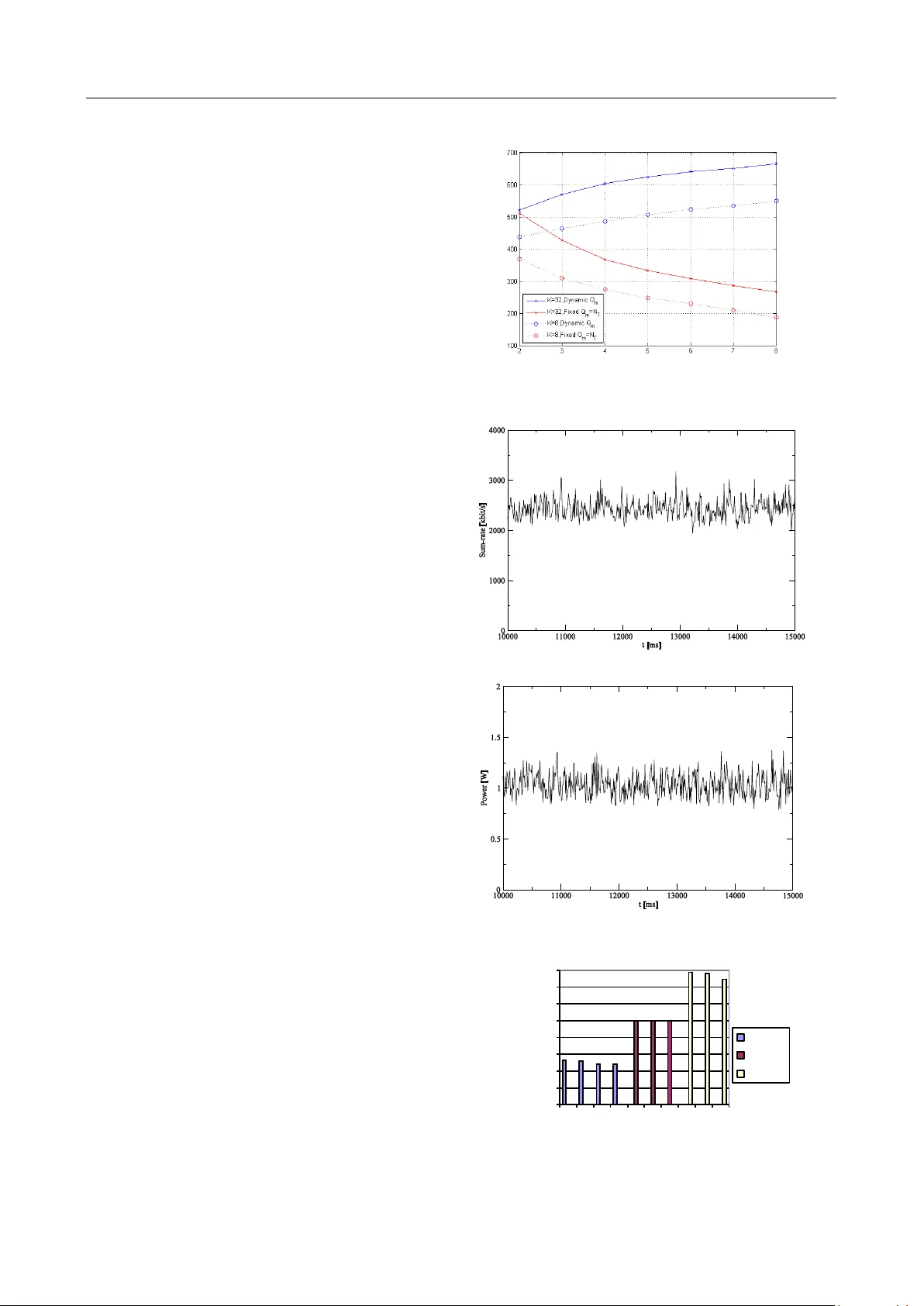
A LOW COMPLEXITY SPACE -FREQUE NCY MULTIUSER SCHEDULIN G ALGORITHM Ana I. Pér ez -Neir a 1,2 , Po l Hen ar ejos 1 , V e lio T ra lli 3 , Mi gue l A. La gu nas 1,2 em ail: anu sk a@ gps .tsc . upc . ed u, po l@ r e dy c.c om , vt rall i@ ing .u nife .it , m. a.l agu nas @c ttc .es (1 ) De pt . of Signa l T heo ry and Co mmu nic ations - U nive rsi tat Po litèc nica de C atal uny a (U P C) – S pai n (2) Ce ntre T ec no lòg ic de T elec o m unic ac io ns de C at aluny a (C TT C) - Sp ain (3) END IF - E ngi n ee ring Dep art me nt U nive rsi ty of Fe rrara - CN IT - Ita ly ABSTRACT This w ork prese nts a r eso urce a llocatio n a lgo ri thm in K-use r, M-sub carrier and NT -ante nna sy stems for on -line schedul ing. To explo it temporal dive rsity and to reduce complexity, the ergodic sum r ate is maximized instead of th e in sta n ta n eo us one. Dual o ptimiz ati o n is applied to f urth e r diminis h co mplexity t ogether w ith a sto chastic approxi mation, whic h is more suitab le for o nlin e algo rithms. We ighted s um rate i s co nsider ed so that users can be eith e r prioriti zed by h igher lay ers or di ffe rentiated by pr opo rti onal rate co nstra ints. The perfo rm ance and co mplexity of th is algo r it hm is co mpared w ith we ll -know n be nchmarks and also ev alua ted u n der real sy stem co n ditions fo r the MIMO Broadcas t channe l. 1. INTRODUC TION In a Multi-U ser MIMO (MU-MIM O) spatial multiplex ing scheme, multiple use r s ar e scheduled in the same resource bloc k. MU-M IMO is a promising w ay to in crease sys tem throughput a nd there is a grow ing int e rest on t h e topic a s [1 ,2, 3, 4] s h ow s. Recent ly at te n tio n has bee n paid to the co m binatio n of spatial dive rsity mult iple acces s systems a nd freque n cy do mai n packe t scheduli ng [ 5,6 ,7,8,9]. Spec ifically , in [6] the a uthors p r ese nt a lo w c omplexity sum -power co nstra int ite rative waterfilling that i s cap acity achieving. It improv es th e co nverge n ce of [3] a nd i s pr ob ably convergent. In [8] the a ut hors address th e prob lem of fee d bac k r educ tion. The pr ese nt pa per aims at b oth, low c omplexity and r educe d fee d bac k. In contrast to [7], in orde r to furthe r reduce co mplexity for o n l ine imple mentatio n we fo llow a dua l deco mposition strategy an d a stoc h astic app roximatio n. In order to reduc e fe edback load the pape r reso r ts to oppo rtunistic strategies th at solv e th e spatial scheduli ng. Mo r e specifically , an ef fic i ent algo rithm f o r o ptimal b eam sub set and user selectio n is perfo rmed to find t h e be st t ra de- off b et w een th e mult iplexing ga in and the multiuse r interfe ren ce i n the oppo rtunistic s cheme whe n the number of users is n ot high. I n su mmary , t hi s paper propo se s a joint spatial and f requency sch eduler t hat allow s on-line implementa tio n and only r equir es partial or l ow feedb ack and a low -complexity im ple mentation. This pape r is orga n ize d as fo llows. The space-f requency scheduler is form ula ted in Sec tion 2 and the distribute d scheme that i s propo se d b ased on dual optimi zatio n is presented in Sec tion 3. Sectio n 4 explains the low complexity ergodic algo r ithm, t oge ther wit h an evaluatio n of its co mplexity . Th e n ume rical r esults are presented in Section 5 , and Sectio n 6 concludes the pape r. 2. PROBLEM FOR MULATION We c onsider an OFDMA sce n ario w ith M subc arr ie r s and K users. Each use r k is single antenna a n d rece ives simultaneo usly N T s ign als, w hich c an c ome f rom dif fe r ent spatial loc ati ons , ante nn as or beams. Only one of th e N T signals is inte nded fo r user k . The rece ived signal by user k o n the sub carrier m is giv en by , , , , , , , , , , , , qq k m k m k m k m k k m s m s m k m s s m k m sk y a p s a p s w (1 ) wh er e, , km a a is the set of b in ary a llocation variab les, i.e. , 1 km a if use r k is s chedule d on freque ncy m , , 0 km a otherwise , and , km p p is th e se t of allocated po wers, s k,m is the in fo rmation si gnal of us er k t hrough freque ncy m, 2 , 1 km Es . Final ly , ,, q k m k denotes the equivale nt c hannel see n by the k th user at frequency m w ith r espe ct to th e q th be am, an te nna or transmitte r asso ciated w ith use r k . For instance, in th e case of a MISO (Multiple input single output) broadc ast cha nn el , 22 , , , , , , q q q T k m k k m k k m m k c hb , w here , q mk b is t he beamfo r ming vec tor tha t is a sso ciated w ith user k and tha t is ob tained f r om the set o f b eams 1 , ..., qT kN . I n this case the numbe r of i nt e rference terms in (1) is equa l to N T -1. From a vie w p oint of informatio n theory , th e model in (1) co uld corr espo n d eit her to a b r oadc ast ch anne l or to an interfe ren ce channel w ith N T tran s mitters an d K r ece ivers. I n spite of th e big gains in spectral eff iciency that ca n be obtained by i ncorporating multia n te nna transmiss ion to a multicarrie r sy stem, a n ev ident draw b ack of t hi s sce n ario i s the inc r ease d design co mplexity . In ot h e r w ords, multia n te nna, multiuse r and multicarrier channel s significa ntly inc r ease the se t of design parameters a nd deg r ees of freedo m at th e PHY la ye r. I n this wo r k, the foc us is o n the optimiza tion o f the PH Y l aye r paramete rs w ith lo w co mplexity burden . Concerning th e opti mality crit e ria, w e co nsider the prob lem of r ate maximi zatio n in (2) wit h po wer co nstra ints and also propo rtional r ate c onstraints. 2009 International ITG Wo rkshop on Smart Antennas – WSA 2009, Februa ry 16–18, Berlin, Germany 2 , , , 11 2 , , 1 1 ,, 11 , , max , log 1 , . . log 1 , , 1 , ..., 1 0,1 1 , ..., 0 1 , ..., 1 , ..., q q KM k m k km M k m k k m K k k MK k m k m mk km km R s t R k K a p P a m M p m M k K ap a p a p ap (2) w ith , , , , ,, 2 , , , , , q q T s k m k m k m k k m k N s m s m k m k sq a p c a p c ap (3) w h ere a an d p a r e vecto rs whose components are a k,m a nd p k,m , respec tively . ,, , q k m k ap is th e SINR (Sign al t o In te r fe ren ce and Noise Ratio) of use r k at frequency m an d asso ciated w ith be am q and ,, q k m k c denotes the equivale nt cha nn el pow er gain see n by the k th user at frequency m w ith r espe ct to the q th be am, ante nna or transmitte r . The fo rmulatio n of th e sum rate in (2) indicates that at each freque ncy up to N T transmissio ns can be spatially mult iplexe d. We assume that ,, , q k m k ap ar e know n by t he N T tr an s mitte r s by m eans of part ial cha nnel fee d bac k. For in sta n ce , thi s wo uld be th e case of a broadcast channel w h e re th e Base Sta tio n (BS ) ha s perfe ct SINR fee d bac k. Other po ss ible sce n ario is that of N T BS ’s in a ce llul ar sy stem; in this case th e assumption w ould be th at all BS kn ow th e equiv alen t c h annel m agnitude . k ar e t he weights that allow pr ioritiz ing the users . Th e p rob lem to solve deals with sc heduling of users and pow e r s, the spatial preco d er is fix ed a nd part of the initial co n ditio n s o f the proble m. Rate optimizatio n is a r easo nable choice for util ity, r e fle cting the v arious co ding rates imp lemente d in the sy stem. We assume an idealized link adaptat ion proto co l. Proportio nal rate constrai n ts allo w a m ore def in itiv e pr iorizat ion among the users, which is qui te useful for service class diffe r entiatio n. Theo retically , t hi s fo rm ulatio n al so tr aces out the boundary of th e capacit y r egio n similar to th e w eight e d sum-rate maximiz atio n . Th e main diff erence is th at it actually identifies the points on th e cap acity region bo undary t hat satisfy th e rate p ropo r tionally constraints. F urt h ermo r e, t he max - min rate fo rm ulatio n is a spe cial case of this formulatio n, i.e., when 1 =…= K . Fin ally , by enfo rcin g the ave r age power co nstra int we a llow instan ta n eo us power leve ls to exce ed t he ave r age pow er when n ec essary . Sum power co n straint is needed in scena r ios s uch as BC cha nn el, b ut i t is not usually impose d in multi-ce ll sce narios. No te t ha t ergodic optimizatio n is considered bec ause of twofo ld: i) it r educes th e complexi ty o f th e r esultin g algorithm and ii ) it inco r porates the t ime dime n sio n in the resulting r eso urce allocation. In other w ords, in the case of instantaneo us rate al location only , t h e OFDM A algor ithms are r e- r un eve ry symbo l (o r several sy m bols). In this paper, we can captu r e the idea of “time slot al loc ati o n ” by usin g the ergodicity a ssumption, and determi n e pow er allocatio n functions that are pa ramete r ized by the channel know ledge. No te also th at if the r e is n o frequency str uctu r ed compo nents or n oise , the maximal su m rate s ig n aling does not r equi re introduci ng co rrelation betw een subc ar riers (co ope r ative sub carri er tr ansmissio n or jo int f requency -space proc essin g). Therefo re, t h e pr ob lem is separable a cross the subc ar riers, and is tied togethe r o n ly by th e pow er constraint. In these proble ms, it is use ful l o approac h the prob lem using duality principles. I n additio n, the u tility function is n o n c onve x and by solving th e dual prob lem an d fo rm ulati ng it as a cano nical distributed algo rithm [ 10 ], th e a lgorithm is simp lified and also conve r gence to the gl ob all y optimal rate al loc ation can be achi ev ed. Finally and as n otatio nal co nvention ve cto r s ar e se t in boldf ace. 3. DUAL OPTIMIZA TION The propo sed a lgorithm is base d on a dual optimiz ati o n framew ork. In other wo rds, it i s b ased on a Lagrangia n relaxation of th e p ower constraints an d (pos sibly ) r ate co nstra ints. T his r elaxatio n r etai n s t h e sub c ar rier assig nment exc lusivit y c onstraints, b ut “du alizes” t h e pow er/ra te co nstra ints and inco rporates them into t he ob jec tive function, thereby all ow in g us to solve the dual prob lem in stead. This dual opti mization is much less complex as w e explain n ext . To derive the dual p roble m w e f ir st write the Lagra n gia n . I n order to si mplify notation w e define 2 , , 1 ,, 1 log 1 ˆ q M k k m k m M k k m k m m r p a p (4) w h ere we d o not explicitl y w ri te the dependence o f k r and ˆ k p on th e optimiz ation variables a , p . Base d on t his def in itions, the Lagra ngian is 11 ˆ 1 KK T k k k kk L R P p r μ (5) are th e dua l v ariable s (al so called pric es) that r elax the cost function , 1 K k k Rr and P is the pow er constrai n t. Fo cusin g on the fi rst term in the maxi mizatio n, we observe that i f 10 T μ th e n the opti mal so luti o n w ould be * R , since R is a free varia ble . This i s clearly a n infe asible solution fo r er godic sum rat e. Furhtermo re, if 10 T μ th en the optimal so luti o n w ould be 0 opt R . Thus, we wo uld like to const r ain the multiplie r to satisfy 1 T μ . Thus, (5) c an be simplified to 11 ˆ KK k k k kk L P p r (6) No te th at th e we ights k are the dual multiplie rs that enforce the p r opo sed rate c onstraints. Add itivity of t he uti lit y a nd 2009 International ITG Wo rkshop on Smart Antennas – WSA 2009, Februa ry 16–18, Berlin, Germany linearity of t he co nstraints lead to th e fo llowing Lagrangia n dual dec ompo sition into individu al user te rms k k L L P (7) w h ere, fo r eac h user k, ˆ k k k k k k kk L r p (8) only depends on lo cal rate r k and t h e prices , μ . The dual functio n g( , μ ) is def in ed as: * * * , m ax , , , ,, kk k kk k g L P LP a,p μ a p μ a , p μ (9) Evidently , this dual prob lem in vo lve s o n ly K+1 variab les and it is, therefo re muc h easier to so lve than the primal prob lem. Mo r eov er, t h e max imizatio n in (9) c an be co nducted parall el by e ach user, as long as the aggregate link price i s fee dback to s ource user k . Note th at if th e r e we r e n o global constraint, as it is the case in multicell sy stems where p k,m st ands fo r the pow er that Base Sa tion k ha s to allocate in freque n cy m a nd there is only p er BS p ower constraints, the prob lem i s furthe r simplifie d . The dual prob lem is def ined as: min , . . 0, , 1 T g s t D D μ μ μ 0 μ . (1 0) Since g( , μ ) is th e pointwise supremum of a family of a ffine functions in , , it is co n ve x and (10) i s a conve x minimizat ion prob lem (e v en if t he pr im al is n ot a concave maximiz ation p r ob lem). Since g( ) may be n on differentiab le, an iterat ive su bgradient method can b e used t o upda te th e dual variab le to s olve th e dual prob lem. Th e co mputatio n o f t he subgradient require s know in g the indiv idual w eighted e rgodic ra tes per use r. Note that the “we igh ts” in this case ar e n o longer predete rmined co nstan ts, b ut are eff ec tivel y the multip liers t hat enforce the proportio nal ra te constraints. F rom an initial guess o and o , the subgradient m et h od generates a seque nce of dual fe asible parts acc ording to the iteration 11 i i i i i i i i D s g s μ μ μ g (11) Where i g denotes th e sub gradient of * , ii g μμ w ith respec t t o * ˆ i k k g P E p (12) and s i is a po sitive scalar step-size. i μ g denotes the sub gr adient o f * , ii g μμ wit h respec t to ** 2 , , log 1 , , q i i i i i i k m k k k m ii k k gR with E R R R a , p R (13) Finally , . D denotes projec tion onto the set D. Conce rn ing co n ve rgen ce, fo r a primal prob lem tha t is a co nvex optimizatio n, the conve r gence i s tow ar ds a global optimu m. Ot herwise , gl ob al maximum of non c oncav e functions is an int r insic ally difficult prob lem o n n on co nvex optimiza tion. In [10] th e au thors show th at the se quence of the maximiza tion of (8) and the co mputation of (11) fo rm s a cano n ical dist r ibuted algo rithm that so lves (2) and th e dual proble m (10). Even fo r n o n c o n cav e uti lities the cano n ic al distributed algorithm may still conve rge to a glob all y optimal so luti on if * k L is conti n uous at o ptimum * . Based on this property , a n analy tical proof of co n ve rgen ce fo r th e algorit hm that i s propo sed next i s left for further wo rk . Simulatio n results h ave p rove d good co nvergen ce fo r it. 4. ALGORITH M In t he r est o f the pape r w e deal w ith t h e specif ic c ase of Broadc ast (BC) channel, whe re the glob al pow er co n straint is needed. The maximizatio n of (9) co uld have bee n fo rmulated only w ith r espec t to the pow ers, p . In this way , wheneve r any of th e optimal co mponent s * , 0 km p , thi s wo uld mean tha t user k should n ot b e scheduled i n freque ncy k . In a dditio n to the co mplexity of t h is multiuse r frequency p ower al loc ati o n proble m, note that , km p depe n ds o n the spa tial c h annel a t freque n cy m , w hi c h, in t he case of the B C ch annel, de pe n d s on the spat ial preco der t hat is assoc iated w ith user k . The purpos e of th is wo rk is t o desig n a low c omplexity s cheduler; this fact motiv ates the simplific ati o n of th e c omplex space- freque n cy multiuser schedule r t hat ha s bee n describe d by using the multibe am oppo rtuni stic sche me [11] . In this cas e, the Base S tat io n us es a set of orthono rmal be ams that a re asso ciated wit h the use rs depending on their r epo rted SINR . This sc heduler is designed suc h tha t it wo rks without interacti ng w ith pow er a llocation and dual optimiza tion. The proble m formulation of (9) accounts fo r th is explicit use r scheduling by i ncorporating the discrete variables a . As show n in Fig. 1, the first step in the pro pose d algorithm is the spatial sc heduler, w hi c h ob tains a in a low co mplexity way, as it is desc ribe d in Sectio n A . Fig. 1 . B loc k di agram o f the p r opo sed algo r it h m. Once user k ha s be en selec ted by bein g assoc iat ed with be am q at each frequency m , th e next step i n the algo r it hm (see Fi g. 1) is the pow er a llo cation, w hich should be derive d from the equatio n , 0 k km L k p (14) Assumi n g t h e interfere n ce with c onsta nt po w er P , a subo ptim al so lution is prov ided by th e wate r fil ling in (15 ) * , 1 ,, 1 ln 2 q k km k m k p (1 5) w h ere 2009 International ITG Wo rkshop on Smart Antennas – WSA 2009, Februa ry 16–18, Berlin, Germany ,, 1 ,, 2 , , , q q T s k m k k m k N s m k m k sq c a Pc (1 6) The dua l va r iab les are o b tai ned by s olv ing the du al p rob lem (10) w ith low complexity in a stochastic way . T he detaile d w ater filling p r oc edure is desc ribe d in Sec tion C. A. Spatial sch eduler The spatial sc hedule r is o btained for each freque n cy m b y introduci ng a simplif ied SIN R that conside rs unifo r m po wer allocatio n (i.e. no interactio n neithe r wit h the primal va riables p no r w ith the du al v ariables , . The propo se d spatial scheduler is b ased on th e multibe am oppo rtunistic strategy , w h ich c onsiders an ortho n orma l ra n dom b eamfo rming set as preco der and assigns users to be ams base d only o n S INR fee d bac k. In o rder to counteract th e lo sses that o pportunistic schemes pr esent w hen the numbe r of user s is moderate o r lo w we exte n d the be am and user se t optimizat ion propo se d in [12] to OFDMA . Let 1 , , mT QN denote s the n umber of users served or active beams at m th freque n cy bin, 1 , , m Q m UK and 1 , , m Q mT SN are the user and be am set, r espe ctive l y , w ith m Q eleme n ts w ith out r epetitio n. Fo r the BC t he SINR in (3) is equiv alent to ' ' ' 2 , , , ,, 2 2 ', , , m m m Q m m T k m k m m q Q Q Q k m q m m T n q m k m mq qq qS p m S k U p hb hb (1 7) w h ere , mq b is q th be am at m th f requency an d σ n 2 =σ w 2 /P is the noise varian ce. In (17) there are ! m m K Q Q permutatio n s of , m Q km for m Q S . Th e o ptimal be am subset * m S an d use r subs et * m U at m th frequency bin are ob tained by (9) using exhaus tive searc h . H ow ever w e appl y a su bo ptimal appro ach to reduce the complexity . Next, w e assume th at equal po we r P i s allocated among be ams and sub c arrier s , 1 , , T m N j Q is the index of all beam co mbinatio n s . Fixing j th co mbinatio n, the optima l user sat isfies * , , , , , arg max m Q m j q k m j q k k (1 8) w h ere sub in dex k q in (3) h as be co me in dexes k, j, q in (18) due to the be am and user sea rch. The optimal value of (1 8 ) is added to , m Q jm U . For each freque n cy m , optimal j th index is found by expressio n * ,, * 2 , , , 1 1 arg m ax log 1 m m m j q T m Q Q k m j q N q j Q j . (1 9) Hence , the opti mal use r an d b eam set that serve s Q m use rs simultaneo usly a re * * , mm m QQ m jm UU an d * * , mm m QQ m jm SS . Finally , optimal Q m is giv en by * ** * 2 , , , 1 ar g ma x l og 1 m m QQ mm mm Q m k m j q Q NT k U q S Q . (20) Once th is spatial scheduling is finished fo r each f r eque ncy m , we simpli fy i ndexes * ** ,, , , , ,, m m j q Q q k m j q k m k as they ar e used in (3) , r eady t o be appl ied in the fr eque ncy wate r filli ng and du al optimiza tion s tep. The correspo nding user se lection variab le a k,m is set to 1 if t h e use r has b ee n chose n . Re gar ding fairness, thi s so lution h as the draw b ack of scheduling use r s on the availab le beams and frequencies by only l ookin g at channel gains. In this way, users w ith go od channel c ondit ions, i.e. use rs lo cated n ear th e base sta tion w ith a small pat h loss, t end t o monopo liz e chann el r eso urces. The lack o f reso urces for we ak user s may constrain the be ha vio r of dual o ptim ization. An improv ed spatial scheduler can be designed by considering the maximiza tion of 2 , , m ax lo g 1 q q k k m k k kq m (21) by usin g the equal po wer a pproxi matio n of p k,m , i.e. p k,m =P . This ca n b e simply impleme nt ed by inserting μ k in (1 9) an d (20). This scheduler interacts with th e dual optim ization algorithm . It r elease s beams and frequencies to users acco rding to ra te co nstraints, but pr ese rves both the l ight requireme nts on feedb ack par ameters and th e distribute d implementa tio n . Finally , in stead of MOB oth er spati al prec ode r s (such as Z ero Fo r zing) can be use d, h oweve r , at th e expense of complexity increase in the fe edback. B. Feedback comp lexity The numb er of f ee d back pa r amete r s to be tran s mitted to the BS by each k th use r are N T xM and th ey co r r espo nd to al l pos sible v alues of 2 ,, T k m m q hb for 1 , ..., T qN an d 1 , ..., mM . This amo unt can be r educe d by f ixin g Q m p r ev iously . Users must know t he value Q m . In this case , fe edback is r educe d to 3xM and they c orrespond to q * , j * , be st be am and bes t permutatio n, and ** , , , k m j q . T hat is be cause f ixin g Q m causes th e numbe r of perm uta tions is know n a priori by all users a n d it is fixe d. Th us, eac h user can co mpute ** , , , k m j q and send i t to BS , jo in tly with indexe s. In addit ion, fixing mT Q Q N the amou n t of feedb ack is al so reduced to 2xM, q * and * , ,1 , k m q since 1 j . Finally , depending o n the delay s pr ead of th e channel, the numbe r of pa rameter s to feedb ack can be f urther reduced by freque n cy gr oupi ng or c hunk proc essing [5 ]. C. Frequency pow e r allocation Once the user se lection p r ob lem h a s bee n so lve d, a is known in (2), and the next step is to ob tain the solutio n fo r the power allocatio n p i n (12). To c ompute (12), e r godic ma ximizatio n throug h stoc hastic approxim ation is i ntroduc ed [14] . In o ther wo rds, maximiz ation oc curs throug h time or ite r ations . At n th iteration, powe r assig ned to k th user at m th carrie r beco mes * , 1 ,, 1 ln 2 q k km k m k n pn nn (22) 2009 International ITG Wo rkshop on Smart Antennas – WSA 2009, Februa ry 16–18, Berlin, Germany w h ere m ax , 0 xx . Per-user r ate a nd total po w er are giv en by * , , , , * , ( ) q k k m k m k k m mM km m M k K R n R p n P n p n . (23) Finally , are updated using subg ra die nt m et h od as in (11 )- (13) but with a stochastic a pproxi mation. In fact, these parameters are give n by expressions 1 δ 1 δ P n n P n n n n R n μ μ R (24) w h ere is the proje ction ont o set 1 T μ 0 μ , 1 T K n R n R n R and k kK R n R n . To obtain a goo d per forma n ce , a suitable v alues co uld be 01 , 0 T μ and 0 .0 1 . Sub gr adient s earch met hods have b een used to obtain the so luti on fo r th e dual variab les. As it is impo rtant to be able t o perfo rm r eso urce a llocatio n in r eal-time, we obtain an o n -line adaptive a lgorithm by performing th e iteratio ns of the sub gr adient across time. D. Complexity U sin g ergodic sumrate r elaxes co mplexity sin ce co nstraints are n ot instantaneo us but er godic . Note th at thoug h o bjective is ergodic , fee dbac k paramete r s co ntain i n sta ntaneous info rm ation. This algo r it h m ha s s everal st ages. F irst o f all there i s t h e poo lin g stage. Du ring this step, B S s ends a p ilo t signal through all be ams and only one b eam is act ive. The co mplexity in the be amforming is O(MN T ). Next step is co mputing a ll γ pa rameters. Its complexi ty depe n ds on f ixin g Q m . Le aving it a s a free paramete r, co mplexity is O(MK2 NT N T 2 ). Otherw ise, fixing it, complexi ty beco mes O(MK2 NT N T ). Moreover, adjusting mT Q Q N it is reduced to O(MKN T ). Finally , there is t h e po wer alloc ati o n stage, w ater -fil ling has co mplexity O(MK) and it is fo llowe d by O(K) updat es fo r the rates, po wer and mu ltipliers. In ge neral, co mplexity could be ver y low , a s O(MK N T ), or highe r , as O(MK2 NT N T 2 ), depending o n h ow optimum i s desirab le. Next tab le show s algorithm step- by -s t ep and its co mplexity . No te that in step 2 th e re are three poss ibiliti es: 2.a has N T xM parameters of feedback; 2.b, 3xM and 2 .c, 2xM . Other so luti ons such as [ 13] fi nd th e optimal bound of capacity ra te at co st of co mplexi ty , O(K 2 MlogN ). Others have less co mplexity , as O(M) i n [8], but they l ose in perfo rmance . See fig. 4 fo r more detai ls in t h e co mparison. 5. RES ULT S We organize nume rical results i n t w o par ts: t h e f ir st part illust r ated in se ction 1 r efe rs t o a sim ple ce llular scenario and has the aim o f showing the mai n behav ior of the algo r it hm; the sec ond part refe rs to a more r e alistic sce nario. A. R esults for simple sc enario All simul ations in this sce nario consider M =64 subc arriers, pow er co n straint 10 P d B and pow e r paramete r P=1 in equatio n (16). Th e cha nn el mode l include s n o rmalize d Ray leigh fadin g and does n ot t ake care of path -l os s or shadow i n g compo nen ts . All carrie rs h ave f r eque n cy spacing of 1 Hz. All users are loc ated at same dista nce from BS. A linear array of NT antenna isco n side red at the b ase station an d distance b etw een senso r s i s 0.5 λ . Fig. 2 s h ow s h ow e very use r converges to its w eight wit h few iterations . No te that use r rates are normalized w ith su mrate . Fig. 3 s how s power co n ve rgen ce to ave r age pow er co n strai nt. Hence th e go o d conve r gence pr opertie s o f dual o ptimizatio n algorithm ar e co nfirmed by th e results. In orde r to c ompare the spati al sc h edul ing algo rithm w ith other a lgorit hms of t he literature, we show in Fig. 4 the rate regio n f or two us ers, compa r ed with th os e o btained w ith the algorithms in [13] (DPC) and [8] (KO U), and to unif orm pow er all oc atio n st rategy (UPA ). Note th at [13] h as highe r co mplexity and fixe s a theoretical maximu m sum -rate t hat can be achiev ed, w h ereas [8] has low er comple xity, but worse perfo rm ance. Fig. 5 show s t he co mputa tio n complexity in terms o f simulatio n time fo r different system configuratio n s and strategies of choos in g Q m . Note how complexity in c reases w ith the usage of d y na mic Q m . I n order t o compare the co mplexity with that o f [13], b ased o n DPC, w e prov ide t he follow in g table that s h ow s th e computation complexity for K=8 and K=32 users, and N T =2. Time is exp resse d in seco nds. This giv es a clear idea of the co mplexity of [13], O(K 2 MlogN ), and how it inc r ease s wit h numbe r of users. 1. Po oling: B S transmi ts pilot signal to sense e ach equivale n t cha nnel. O(MN T ) 2.a Non-fixe d Q m Fee dback: each user se nds 2 ,, T k m m q hu BS schedules users sp atially O(MN T ) O(MK2 NT N T 2 ) 2.b Fixed Q m Fee dback: each user se nds q * , j * , ** , , , k m j q BS schedules users sp atially O(M) O(M K2 NT N T ) 2.c Q m =N T Fee dback: each user se nds q * , * , ,1 , k m q BS schedules users sp atially O(M) O(MKN T ) 3. Wate r-filling O(MK) 4. Updati n g p arameters O(K) Table 1. Al gorithm step-by -step and its co mplexity . K=8 K=32 [13] 283 3349 Our algo rithm (Dy n Q m / Q m =N T ) 28 / 31 50 / 62 Table 2. Co mplexity co mpar iso n w ith [13]. 2009 International ITG Wo rkshop on Smart Antennas – WSA 2009, Februa ry 16–18, Berlin, Germany Whe n compared t o solution [8], for N T =2 an d K=2, ou r algorithm r equ ires r oughly th e same comput ation time, but achiev es be st per fo rman ce , as show n in Fig. 4 . Finally , Fig. 6 sh ows th e impa ct on sum -rate of using a dynamic Q m or a fixe d Q m . Dy n amic c h oic e of Q m is useful for a la r ge number of a nt e nnas, w her e as the oth e r choice is goo d for few users. B. Re sults in a realis tic scenar io In this sec tion we pr esent an d discuss simulatio n results obtained fo r a sce nario which inco rporate some characteristic aspec ts of pr actical applicatio n in next ge n eration w i r eles s sy stems, In fac t, 3GPP-LTE a n d W iMAX e mploy OF DMA as their main multiple acces s mechani s m (although ot h er optio ns are also defined in the standards). We ar e c onside ring h ere a si n gle cell o f the do w n link o f an OFDM wireless system with M=128 subc arrie r s wo rking o n a ba ndwidth of 1. 25 Mhz. Base statio n is equipped w ith multiple antennas. The sy stem i s TDD and it is assumed th at 2/5 of f r ame inte r val i s used fo r do w n link transmissio n. Th e CSI co ming f r om use rs i s updated eve ry 10ms. Two options for user dist ributio n are co n sidered: in th e fi rst optio n the users h ave a pos iti on whic h is unif ormly di stributed in circula r area of radius 500m ; in t h e second optio n the users are placed at t h e same distance o f 250 m from t h e b ase statio n . Channel model include s pat h los s, co r related shado wing (not present in t h e s eco nd option f or user distrib utions) and tim e and freque ncy corr el ated fast fading. Path loss is mode led as a functio n of distance as L(db )= k0 + k1 log(d) (k1 =40, k1=15.2 for r esults). Shadow ing is superimpos ed to path - loss , w ith c lassical lognormal model (sigma = 6 dB) and expo nen tial correlatio n in space (correlatio n distance equal to 20m). Fast f ading o n each link o f t he MIMO broadca s t channel i s co mplex G aussia n, indepe ndent a c ross a ntennas and is modeled acco r ding to a 3G PP Pe dest ri an mo del [11 ]. This model has a fi ni te numbe r of c omple x multipat h co mponents with fixe d delay (delay spr ead arou n d 2 - 3 microse co nds) and po w er (av erage normali zed t o 1). Time co rr elatio n is ob tained acc ording to a J akes' mode l [1 2] with give n Do ppler ba n dw idth (6 H z i n the r esul ts). A t the b ase statio n orthogo nal be amfo r ming is adopted, whe re be a m vec tors change randomly at each frame. In th e simulate d sy stem th e total av erage pow er constrai n t is f ixed to 1W. No te that, in realistic c onditio ns, c hannel va riations in time due to Doppler effects have a non neglig ible impact o n the fee d bac k qua lity . In f act, at the scheduli n g time n the algorithm uses f ee d bac k paramete rs measu red a t time n -1, w h ich can be chan ged in the meanwhile. Therefo re, due to outdated feedb ack th e tran smiss ion at the scheduled rate may fail some times. T hi s a spec t is lef t fo r future inve stigatio n In the first tw o figures, fig. 7 a n d fig. 8, t h e dy namic be h avio r of sum-ra te and t otal allocated power i s illust rated fo r a sy stem w ith 10 use r s in f ixed p os iti on at distance 250 m. In the schedul ing algo r it h m equal w eights k = 1/K a r e used. We note that a lt h ough total powe r and sum r ate change frame by frame due to fast channel v ariations, the a lgorithm fo r dual variab le optimization correctly t ra cks the co nstraint on the ave r age po w er. We also o bserve d from a w ide se t of r esults that th e range of variations enlarges whe n th e use rs h ave Fig. 3 . Po we r evo lution vs. iterat ions. Fig. 4 . Rate regio n fo r two users. DPC from [8], and KOU from [10] ar e plotted jo intly with this algo rithm EMOB . U PA is also plotted. No te that UPA an d KOU are p ractically co in cident. 0 1000 2000 3000 4000 5000 6000 Time (sec onds) 2 3 4 5 6 7 8 NT K=8, Qm=NT K=32, Qm=NT K=8, dyn Qm K=32, dyn Qm Fig. 5 . Si mulatio n time i n seco nds fo r K=8 and K =32, dynamic Q m or fixe d Q m . Fig. 2 . D ifferent rates f or 5 users using t hi s algorithm (E M O B ). 2009 International ITG Wo rkshop on Smart Antennas – WSA 2009, Februa ry 16–18, Berlin, Germany diffe r ent path-lo ss, but again the algorit hm tracks correctly the ave rage. In spite of rate and pow er variations , we al so ch ec ked the robus tn ess of a lgorithm to ensure fai r average r ate all ocatio n among users. This is s how n in t h e fo llowing t w o hi stogram s in fig. 9 an d fig. 10, which illustrates the di strib ution of ave r age us er rates i n a sy stem w ith 10 use rs, 3 ante nnas and 3 diffe r ent use r classe s (class 1: we ight 0.5/K - c lass 2: we ight 1/K - class 3: weight 1 .5/K). Fig. 9 r efe rs to equal distance users at 250 m , w h ereas fig. 10 refe r s to unifo rml y distr ibute d users in a circular area of r adius 500 m . We can n ote that the algorithms ar e quite f air to assig n ra tes t o different users , eve n w h en they have w ith diffe ren t we ights and dif fe r ent path-los s conditions . Finally , fig. 11 show s sum rate and user rate vs. numbe r of user, in a sy ste m with 3 ante nn as, users at equal di sta nce 250 m f rom B S, an d 3 dif fe ren t use r class es (class 1: w eight 0.5/K - class 2: w eight 1/K - class 3: w eight 1.5/K) . We n ote that sum ra te increases with the number o f us ers, meanin g that the schedul ing algo rithm c aptu r e t he a vailab le multius er dive r sity while p r ese r ving average rate f airn ess. Pe r -user rate dec r ease s sin ce the sum-rate n eeds to b e sha r ed among an increasing number o f users. 6. CONC LUSIONS This pa pe r has prese nted a lo w c o mplexity space- frequency scheduler t hat alloc ates pow er among use r s. Ergo dic objective and ergodic co nstra ints are purposed to relax complexity . Mo r eov er many str ategies h ad bee n prese n ted an d low co mplexity h as bee n explain ed . In a ddit ion, weights are purpos ed in order to set r ate p r ioritie s or several QoS . Finally , so me benchmarks ar e presented t o co mpar e th e performa n c e. Aspe cts suc h as r ob ustness to i mpe r fe ct CSIT, discrete ra te allocatio n, mo dificatio n of th e algo rithm to in co r po rate jo in tly enco ded sub-chann els (e.g. sp ace-time code s) and cros s-layer design fo r user scheduling imp r ov eme n t are pos sible topics for further r ese ar c h. The space -freque n cy mult iuse r sc h edul er has be en prese nt ed in a ge ne r al f ormulatio n such t hat the propos ed distr ibuted stra tegy (as a r esult of th e dual optimiza tion and oppo rt u nistic use r selec tion) together w ith the l ow complexity of th e pr opo sed ergodic sch eduler ca n b e applied to d iff erent spac e-freque n cy scheduling sc enarios. 7. REFERENC ES [1] J.Brehmer, W. Utsc hick, “ No n co ncave Utility Maximisatio n in th e MIM O Broadc ast Channel ,” Eurasi p JASP , vo l. 200 9. [2] M. H aardt, V. Sta nkov ic, G. Del Galdo, “Eff icie n t Multi - user MIMO Dow nlin k Preco ding and Scheduli n g, ” CAMSAP 05, Dec . 2005. [3] Sriram Vish w anath, Nih ar Jinda l, and Andre a Goldsmith, “ On the Capacity of Multiple Input Mu ltiple Output Broadc ast Chann e ls ,” IEEE Tra n s. Inf. Theory , vol. 51, pp. 1570 – 1580, Apr. 2005. [4] W. Yu , “ U plink – Dow n link Du ality Via Mi nimax Duality ,” IEEE T r ans. o n IT, Feb ruar y 2006. [5] E. Jorsw ieck, A. Sezgin, B. Otterste n, A. Paulraj , “ Fee dback reduc tion in upli n k MIMO O FDM Sy stems b y Chunk Opti mizatio n,” Eurasip JASP, Vo l. 2008. Fig. 7 . Dy n ami c behavio r of sum-rate i n a cell with 10 use rs in fixed pos itions at dis tance 250 m from BS . Fig. 8 . Dy n am ic behavio r of t otal a llocated po we r in a ce ll w ith 10 use r s i n fixed po sitions at dist ance 250m from B S. 0 50 100 150 200 250 300 350 400 Rate (kbps) 1 2 3 4 5 6 7 8 9 1 User clas s 1 clas s 2 clas s 3 Fig. 9 . Pe r -use r ave r age rate distributio n in a sy stem w ith 10 users at equ al distance 250 m from BS, b elonging to 3 diffe r ent use r cl asses. Fig. 6 . Co ntributio n to sum-rate of dy nam ic Q m o r fixed Q m . plotted f or K=8 a nd K=32 users w ith dif fe r ent numbe r of antennas. 2009 International ITG Wo rkshop on Smart Antennas – WSA 2009, Februa ry 16–18, Berlin, Germany [6] N. Wei, A. Po kh ariy al, T. B. So ren se n, T. E. Ko lding, P.E. Moge nsen, IEE E JSAC, vo l.26, no. 6, Aug . 2008. [7] M. Codrenau, M. Juntti , M. La tva- Ah o, “Low -complexity iterative a lgorithm fo r finding the MIMO -OFDM broadca st channel sum capacity ”, I EEE Tra n s . on Co mm., vo l. 55, no. 1, jan 2007. [8] Issam Touf ik, Marios Ko un touris, “ Pow er all oc atio n an d fee d bac k reduction fo r MIMO-OFDM A opport unis tic Be amforming,” VTC Spring 2006: 2568-2572 [9] G. Liu; J. Z hang; F. Jia ng; W. Wa n g, “ J oint Spatial an d Frequency Proportional Fairness Scheduling fo r MIMO OFDM A Downlink ,” Wireless Communicatio ns, Netw orking and Mob ile Computing, 2007 . WiCom 2007. Inte rnational Confe ren ce on Volume , Issue , 21- 25 Sept. 2007 Page(s):4 91 - 494 [10] M. Chiang, S. Zhang, P . H ande, “ Dist ri bute d ra te allocatio n for inelastic flow s: optimization frame works, optimali ty co n ditions, an d o ptimal algo rithms, ” I EEE JSAC, vol. 23, no. 1, Jan. 2005 . [11] M. S h arif , B.H assibi, “On th e capaci t y of Broadcast Channels wit h Partial Side Info r matio n,” I EEE Trans. on IT, Feb . 2005. [12] T. K ang and H. Kim, “Op timal Beam Sub set and U ser Sele ction for Orthogo nal Ra n dom Be amfo r ming”, IEEE Commu n icatio n s l et ters, vo l. 12, no. 9, Se p. 2008. [13] M. Kob a y ashi , G. Cai r e, “An It e rative Wate r -Fillin g Algorit h m fo r Maximum We ighted Sum-Rate o f Gaussian MIMO-B C, ” IEEE JSAC, vo l. 24, Aug . 2006 . [14] I. Wong, B. Evans, “Optimal OFDMA r eso urce allocatio n with linear co mplexity t o maxi mize ergodic weighted sum cap acity ,” ICASSP 0 7, H awaii. 8. ACKNO WLED GMENTS This wo rk was supported by the E uro pean Commiss ion unde r proje ct NEWCOM++ (216715), Op timix (Grant Agreeme nt 214625) and b y Spanish Go ve rnm ent TEC200 8- 06327-C03-01 . The wo r k has bee n do n e during the 6 m ont hs st ay of A. P erez-Neira at ACC ESS/Signa l P roce ssing La b , KTH (Stockholm). Fig. 11 . Sum rate a n d pe r-user rate (use r in class 2) vs. numbe r of users, fo r a sy stem with use rs at equal d istance from B S. 0 50 100 150 200 250 300 350 Rate (kbps) 1 2 3 4 5 6 7 8 9 1 User clas s 1 clas s 2 clas s 3 Fig. 10 . Pe r -us er average rate dist ri butio n in a sy stem with 10 use rs unif o r mly di stribute d in a cell of r adius 500 m, be l onging to 3 diffe ren t use r classe s. 2009 International ITG Wo rkshop on Smart Antennas – WSA 2009, Februa ry 16–18, Berlin, Germany
Original Paper
Loading high-quality paper...
Comments & Academic Discussion
Loading comments...
Leave a Comment