Cellular and WiFi Co-design for 5G User Equipment
Motivated by providing solutions to design challenges of coexisting cellular and WiFi for future 5G application scenarios, this paper, first, conducts an in-depth investigation of current technological trends of 5G from user equipment (UE) design per…
Authors: Yiming Huo, Xiaodai Dong, Wei Xu
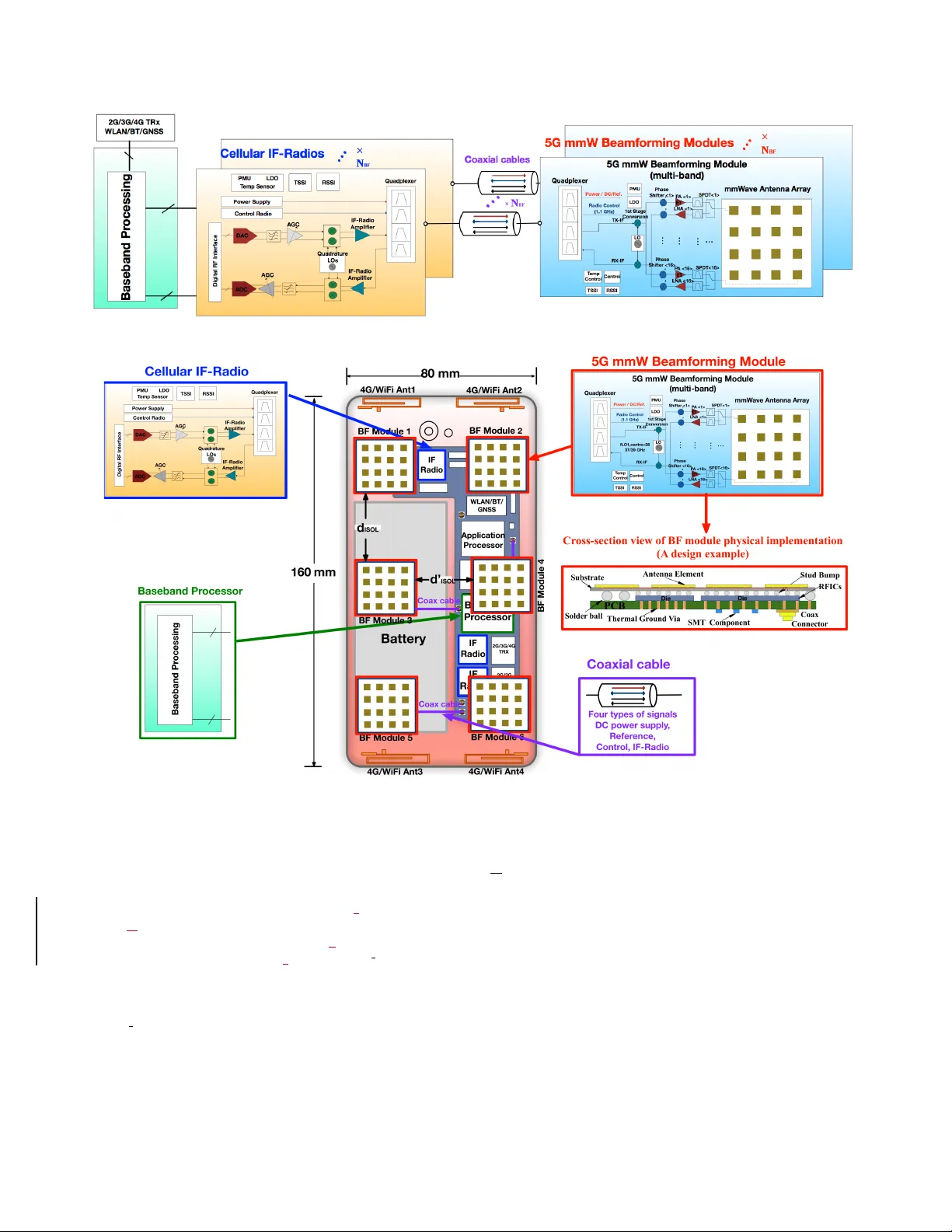
Cellular and WiFi Co-design for 5G User Equipment Yiming Huo, Xi aodai Dong D epartment of Electrical and Computer Engineer ing Univer sity of Vi ctori a Victor ia, Canada ymhuo@uvic.ca, xdong@ece.uvic.ca Wei Xu Nation al Mobi le Co mmunicat ions Research Labo ratory Southeast Uni versity Nanjin g, China wxu@seu. edu.cn Marvi n Yu en Viter bi Sch ool o f Engi neeri ng Univer sity of Sou th ern Califo rnia Los Angeles , U.S.A marvin y u@ usc . edu Abstract — Moti vated by providing solutions to design challenges of coexist ing cellular and WiFi f or future 5G application scenarios, this paper , fir st, conduc ts an in - depth investigation of current technological tren ds of 5G from user equipment (UE) design perspective , and then presents a cost - effective cellular - WiFi desig n meth odology based on t he new distributed phased array M IMO (DPA - MIMO) architecture for practical 5G UE device s as an example . Furthermo re, additional 5G cellular - WiFi app lica tion scena rios and co - operation details within 5G het erogeneous networks ar e unveiled on top of the said cellular - WiFi co - enabled 5G UE design. Keywords — The fifth ge neration (5G) , user equipment (UE) , c ellular, WiFi, WiGig 5G unlicensed , 5G licensed assisted access (5G - LAA), hardware , smartphone. I. I NTRODUCTION 5G has seen exceedingl y rapid growth and promising commercial deploymen t in recent years . Bot h academia and industry are accelerating the progre ss of 5 G ev oluti on wit h enormous efforts . On the aspect of standardization, as early as 2015, three key principle usage scenarios, nam ely, Enhanced Mobil e Broa dban d (eMBB) , Ultra Reliab le Low Latenc y Communicat ions (uRLLC), and Massiv e Machine Type Communicat ions (mMTC), have been defined by the International Telec ommunica tion Union ( ITU ) and follow ed by many organiza tions and groups [1] . In July 201 6, the Federal Communicat ion Committee (FCC) adop ted a new Up per Micr owave Flex ibl e Use Serv ice [2] . Mo st recen tly in December 2017, the first 5G new radio ( NR ) specification s have been finally approved by the 3GPP [ 3] , w hich marks a miles tone for future larg e - scale trial exp eriments and wide commercial deployment. On top o f the standardization prog ress, as 5G heterogeneous networks become an immediate reality [4 ], [ 5] , th e applica tion and usage scen arios will be largely enriched and thus become more diverse and com plicated th an ever . In p articular, there have been and will be more spectrum enhan cement techniq ue s such as , carrier aggregation (CA ) and spectrum sharing paradigm s represented b y LTE license d assisted access (LTE - LAA) [6] . I mpleme nting as many wirel ess standards and technolog ies a s possible on one sing le base station (BS) or user equipment (UE) is ultimately desired , but tech nically challenging and commercially exp ensive, considering that both 5G cellular licen sed high band s (HBs) such as 28, 37, 39 GH z and WiFi mmWave bands (57 - 71 GHz) pose very imm inent challenges . Furthermo re, realizing m ulti - function , multi - standard user eq uipment is eve n m ore difficult as it is largely constrained by limited hardware resource s , slow - gro wing battery perfor mance, and strict form factor requirement s . In this paper, we initiate a n inve stigation a nd an alysis of contemporary and future wirel ess user equipment desig n . Additi onall y, we unveil detailed circuit and system designs for critical , c ost - effective cellular - WiFi re use wit h multipl exing techniques and arc hitecture . The remain der of this paper is arranged as follows: S ection II tho roughly re views a nd analyzes 5 G wireless UE design, from both cellular and WiFi aspects ; Section III pre sents brand - new cost - effective cellular/WiFi physical layer design with specific circuits and systems implem entation details in a 5G UE; Section IV further presents more details considering th e 5G UE ce llular - WiFi co - operation within 5G heterogeneous networks , with conclud ing remark s in Section V. II. 5G W IRE LESS U SER E QUIPMENT D ESIGN 5G UE design will be significantly more complicated than current 4G ones in terms of the classic wireless hardware design classfications such as antenna design, radios frequency (RF) design, baseban d (m odem) design , an d PHY - MAC co - design. This evolut ion is not only a consequence of new 5G technolgo gies s uch as m assive MIMO (M aMi) [7 ], millimet er wave ( mmWave ) beamforming ( BF ) , and 5G new waveforms , but also the ulti mate require ment o f e ver - growing high - end applications such as wireless virtual reality (VR ) , ul tra - high resolution (UHD ) video s treaming, vehicl e communications, machin e lea rning, etc . On the aspec t of UE cel lular design, employing mmWave as 5G high bands brings up seveal m ajor tech nical challenge s including , high propagation loss [8 ] , serious human blockage and human shadowing issues [9 ], high penetration loss, and weak er dif fr action capability due to the stronge r p article nature when f requen cy inc reases . Co nsequently, several techniques 2 (a) (b) (c) Fig. 1. 5G smartphone with (a) conventional be amforming hardware design, and (b) B F modules on both top and bottom, and (c) DPA - MIMO a rchi tect ure . mmW ave BF (direct conversion) Cellular Baseband mmW ave Antenna Array (a) mmW ave BF Module Cellular IF-Radio Baseband Coax Cable mmW ave BF Module Cellular IF-Radio Coax Cable × N (b) Fig. 2. Wireless har dware b lock diagr am of (a) conventional beamforming design, and (b) DPA - MIMO ar chit ect ure. such a s beam forming and MaMi are utilized to deal with these challenges ; however these technique s further ge nerate a se ries of problems for practical hardware designs. Take human blockage for instance, as illustrat ed in Fig. 1 (a) , a conventional design method may place the mmWave beamforming module in o ne specific loca tion, e.g. the central part of the rear housing of 5G smartphone. However, such a design in Fig. 1(a) could lead to a se r ious human ( hand ) blockage issue which causes attenuation as large as 30 - 40 dB [10 ] , [11] . Simply i ncreasing the phased array dim ension or effective isotropic radiated power ( EIRP ) will gener ate more heat and cause a heat distribution issue . An alter native design as shown in Fig. 1(b) accommodates two BF module s on the top and b ottom of the smartphone, which helps partially solve the hu man hand blockage issue , however the alternative des ign will be ineffective when the smartphone is horizontally held by two hands. Fig. 1(c) proposes a structure named as a distributed phased array MIMO (DPA - MIMO) [12 ] where multi ple (= 8 in Fig. 1(c)) BF modules are arranged in the rear housing . Such design mitigate s the human blockage issue, and enhances heat sinking ca pabilities , while s ustaining a faster data rate through enabling higher spatial multiplexing gain . C onventional beamforming design usually em ploys a direct conversion structure , wh ereas the DPA - MIMO ar chi tect ure is comp osed of multi ple mmWave BF modules th at realize conversion between 5G high bands and intermed iate frequen cies (IF). As depic ted in Fig. 3, th e c ellular IF - radio module furth er process signal s between radio fre quencies (RF) and a baseband frequency . C oax cab les are used to con nect BF mod ules w ith IF - radio and baseband functional module s , which are accommodated on the mai n logic board ( MLB ) , and handle transmissio n precoding [ 13 ] and reception combination . Such split - IF architecting , as sh own in Fig. 4, can facilitate a highly reconfigurable 5G UE design. As illustrated in Fig. 3, the quantity and placement of BF modules are flexible as long as a necessary edge - to - edge spacing (>1.5 time s free - space wavele ngth [14 ]) is maintained to guarantee 3 Fig. 3. Circuit and s ystem i mplementat ion of DPA - MIMO f or 5 G UE [ 12 ]. Fig. 4. A 5G UE design exampl e based on DPA - MI MO ar chit ect ure. enough spatial isolation and channel capacity. Separating BF and IF modules could also facilitate the reuse of BF and IF modules for other wire less stand ards. On the ot her hand, WiFi technology has been evolving significantly and is not only limited to sub -6 GHz bands such as 2.4/5 GHz. With this being said, IEEE 802.11a d/ay standards , know n as W iGig, employ 60 GHz bands that are constantly being expanded (57 - 71 GHz in U .S.) , and will play a critical role in future 5G heter ogeneous networks . It is also important to point out that, as predicted based on the current LTE - Licensed Assisted Access (LTE - LAA) techniques and standards ., 5G - LA A will become an immediat e reality (no t yet standardized ). When 5G cellular mmW ave meets W iFi W iGig , they will combine to form more powerful aggreg ated bands which will realize , at least , a 10 times performance boost compared to the current, most advanced LTE - LAA in terms of the data rate an d latency . Therefore, it would be wise to co - exist mmW ave cellular, m mWave WiFi, and 5G - LAA al together, to han dle various application and usage scenarios. III. 5G C ELLULAR W I F I C O - DESIGN Integrating aforementioned 5G wi reles s tec hnologies and func tion s on 5G UE devices is a commercial necessity , but costly and technical ly challenging, particularly consideri ng the limited hardware spac e at the UE end . H ardware res ource competition between 3G PP cellular standards, and IEEE WiFi standards on a smartphone may addi tionally become a severe problem. For example, when both standards require multiple BF modules, 5G UE designers need to arrange them w ith in a limited hardware area. To further exacerbate the tec hnical challenges , th e mmWa ve BF modu les are technica lly demanding , expensive , and power - hungry. 4 mmW ave BF Modules Cellular IF-Radios Cellular Baseband Coax Cables WiGiG IF-Radios WiGiG Baseband Cellular/WiGiG Switches Cellular Sub-6GHz Front ends Switches Cellular Sub-6GHz Antennas Fig. 5. 5G c ellular and WiFi (WiGig) reuse/multiplex ing function . Fig. 6. 5G cellular and WiFi (WiGig) reuse/mult iplexing fu nction based on DPA - MIMO . As illustr ated in Fig. 5, a cellul ar/WiGi g mode switch is insert e d between coax cables and cellula r IF - radios , as well as WiGig IF - radio s. As a result, the mmWave BF module c an be multi pexed for either WiFi WiGi g or 5G cel lul ar fun cti on ality . Furthermore, cellular IF - radio s can be also reused for cellular sub - 6GHz fron t ends and antenn as through enabling the switches connected to them. Conse quently, 5G mmW ave cellular, W iGig, and 5G su b- 6GHz cellular can be re configured . In particul ar, WiGig and sub - 6GHz cellular function s could be simultaneously activated on request . A detailed circuit and system design example based on DPA - MIMO archi tec ture is given in Fig. 6 . There are a total of N BF groups of 5G mmWave BF mo dules, cell ular IF - radio s, and N WiGig WiGig IF - radio s. A s noted , N WiGig should be no bigger than N BF . WiGig and 2.4/5GHz WiFi have different modems and low - layer MA C design s. The cellular m odem will be c omplex as it needs to provide backw ard com patibilty to 3G PP legacy s tandards , as well as also support 5G NR that may employ several canidate waveforms [15], suc h as orthogonal frequency divi sion multiplexing ( OFDM ) based multi carrier wavefor m s. Examples of OFDM ba sed multi carri er wavefor ms include cyclic prefix OFDM ( CP - OFDM ) , D iscrete Fourier T ransform - sp read - OFDM (DFT -s- . OFDM) , u niversal filtered m ulti c arrier ( UFMC ) , filter bank multi carri er ( FBMC ) , generalized frequency divisi on multi plexi ng (GFDM ) , and single carrier (SC) wavefor m su ch as sing le ca rrier frequ ency division multiple access ( SC - FDMA ) . On the other hand, it is worthy to mention that, wideband m ulti - band phased antenna array design [16], [17] and m ulti - 5 band power amplifier (PA) design [18 ] are also the critical enabling factors for cell ular - WiFi mult ipe xed art hic tect ure s . IV. 5G C ELLULAR W I F I C O - OPERATION Spectrum Sensing Determine Networks Availability T ransmit or Receive Wireless Data on Request End Examine Application Requirement Configure System for WiFi Operation Configure System for Cellular Operation re Start User Decision on Networks Selection Configure System for Cellular +WiFi Operation Fig. 7. Flow chart of multiplex ed DPA - MIMO wirele ss communication in a user equipment device. As conc luded from above, a mult iplexe d DPA - MIMO architecture accomod ates a plural ity of BF modules, 5G sub - 6GHz front ends and antennas, cellular IF - radio s, WiFi/ WiGig IF - radio s, etc. T herefo re it can facilitate very rich an d diver se application scenarios. A higher MAC layer design and physical - layer - MAC - layer ( PHY - MAC ) cross - layer design should be carefully considered to en able mo re cost - efficient co - operation of cellular and WiFi or other wi reless technolog ies. As shown in Fig. 6, a cellular M AC block needs to w ork with a WLA N MAC block to enab le standa lone (cellular/WiFi) function s or functions requiring co - operation between cellular and WiFi such a s 5G - LAA . Addition ally, 5G super carrier a ggregation (5G - Super CA) , that inv olve s an e ven wider range of bands, such as from sub - 6G Hz licensed/un licensed to above - 6GHz lic ensed/un licensed , m ay also be enabled . Fig . 7 illustr ates a flow chart illustrating an exemplary process for m ultiplexed D PA - MIMO wirel ess com munication w hich comprises of several steps, namely, spectrum sensing step, determin ing netw ork av ailability s tep , examining application requirement step, network sele ction step, configuring cellular operation step , configuring cellu lar and WiFi (5G - LAA, or 5G - Super CA) operation step , and configuring WiFi opera tion step . More comple x and spec ifi c algorithms could be built and expanded on thi s flow chart to Fig. 8. Wireless communication for a multiplexed DPA - MIMO based 5G UE devic e w ithin 5 G hetero geneous networks. enable more cost - effective PHY - MAC cros s - layer architectures. Furthermore, Fig. 8 depicts one of the situations when wirel ess communicat ion is establi shed between a multipl exed DPA - MIMO based 5G UE de vice , a WiF i route r , an d a cellular b ase station. In one specific operation mod e, multiple BF modules on the UE are enabl ed to communica te with the cellular base station using different car rier frequencies (particularly for neighboring modules) to mitigate potential interferen ce. Moreover, a 5G - Super CA mode can be operational when unlicens ed 71 GHz band and WiFi 60 GHz band are aggregated. V. C ONCLUSION This paper introduce s a series of cellular - WiFi co - design and co - enabling techniques , on top of the cellular - WiFi fu nction al reuse with multipl exing hardware architecture and PHY - MAC cros s - layer designs. Furthermore, deta iled circuit s, system designs, and implementation s are specified with detailed cellular - WiF i coop erat ion deta ils withi n 5G heterogeneous networks. Wit h the sa id techniques and architectures , very rich an d div erse 5 G a pplication and usage scenarios can be facilitated, which address future 5G design and application challenges. R EFERENCES [1] Rec. ITU - R M.2083 - 0, “IM T Vision - Framework and overall objective s of the future development of IMT for 2020 and beyond,” Sep, 2015. [2] “ REPORT AND ORDER AND FURTHER NOTICE OF PROPOSED RULEMAKING ,” [Online]. Available : h ttps://apps.fcc.gov/ed ocs_public /attachmatch/FCC - 16 - 89A1.pdf 6 [3] “First 5G NR Specs Approved , ” [Online]. Available: http://www.3gpp.org/news - events/3gpp - news/1929 - nsa_nr_5g [4] C. - X. Wang, F. Haider, X. Gao, X. - H. You, Y. Yang, D. Yuan, H. M. Aggoune, H. Haas, S. Fletcher, and E. Hepsaydir, “Cellular architectur e and key technologies for 5G wireless co mmunicatio n networks,” IEEE Commun. Mag. , vol. 52, no. 2, pp. 122 - 130, Feb. 2014. [5] F. Boccardi et al. , “ Five Disrupti ve Technology Directions for 5G ,” IEEE Commun. Mag. , vol. 52, no. 2, pp. 74 - 80, Feb. 2014. [6] S. Han, Y. - C. Liang, Q. Chen, B. - H. Soong, “Licensed - assisted access for LTE in unlicensed s pectrum: A MAC protocol design,” IEEE J. Sel. Areas Commun ., vol. 34, no. 10, pp. 2550 - 2561, Oct. 2016. [7] S. Malkowsky et al. , ‘‘The World’s first real - time testbed for massive MIMO: Design, implementa tion, and validation ,’’ IEEE Access , vol. 5, pp. 9073 - 9088, 2017. [8] T. S. Rappaport, Y. Xing, G. R. MacCartney, Jr., A. F. Molisch, E. Mellios , and J. Zhang, “Overvie w of mil limeter wave com municati ons for fifth - generation (5G) wireless networks - with a focus on propagation models,” IEEE Trans. Anten nas Propag ., vol. 65, no. 12, pt. I, pp. 6213 – 6230, Dec. 2017. [9] G. R. MacCart ney Jr., T. S. Rappaport, and S. Rangan, “Rapid Fading Due to Human Blockage in Pedestrian Crowds at 5G Millimeter - Wave Frequencies,” in Proc. IEE E Global C ommuni cations Co nference (GLOBECOM) , Dec. 2017, pp. 1 -6. [10] M. N. Kulkarni, A. O. Kaya, D. Calin , and J. G. Andrews “Impact of Humans on the Design and Performance of Millimeter Wave Cellular Networks in St adiums,” in Proc. IEEE Wireless Communications a nd Networki ng Conference (WCNC), Dec . 2017, pp. 1 - 6. [11] G. R. MacCa rtney Jr. , S. Deng, S. Sun , and T. S. Ra ppaport, ‘‘Millim eter - wave human blockage at 73 GHz with a simple double knife - edge diffraction model and extension for directional antennas,’’ in Proc. IEEE 84th Veh. Technol. Conf. (VTC - Fall) , Sep. 2016, pp. 1 – 6. [12] Y. Huo, X . Dong, and W . Xu, “5G Cellular User Eq uipment: From Theory to Practical Hardware Design,” IEEE Access , v ol. 5, pp. 13992 - 14010, 2017. [13] L. Liang, W. Xu, and X. Dong, “Low - complexity hybrid precodi ng in massive multiuser MIMO systems,” IEEE Wireless Commun. Lett., vol. 3, no. 6, pp. 653 - 656, Dec. 2014. [14] F. Rusek et al., ‘‘Scaling up MIM O: Oppo rtunities and challenges with very large arrays,’’ IEEE Signal Process. Mag. , vol. 30, no . 1, pp . 40 - 60, Jan. 2013. [15] R. Gerzaguet et al ., “The 5G candidate wavefo rm race: A comparison of complexity and performance,” EURASIP J. Wireless Commun. Netw. , vol. 1, pp. 13, Jan. 2017. [16] C. - X. Mao, S. Gao, and Y. Wang, Q. Luo, and Q. - X. Chu, “Broadband High - Gain Beam - Scannin g Antenna Array for Millimeter - Wave Applicatio ns,” IEEE Trans. Antennas Propag ., vol. 65, no. 9, pp. 4864 - 4868, Sep. 2017. [17] W. Hong, “ Solving the 5G Mobile Antenna Puzzle: Assessing Future Directions for the 5G Mobile Antenna Paradigm Shift ,” IEEE Microwave Mag ., vol. 18 , no. 7 , pp. 86 - 102, 2017. [18] S. Hu, F. Wang, and H. Wang, “A 28GHz/37GHz/ 39GHz multiband linear Dohe rty power amplifier for 5G ma ssive MIM O applic ations,” IEEE Int. Solid - State Circuits Conf. (ISSCC) D ig. Tech. Paper , pp. 32 - 33, Feb. 2017.
Original Paper
Loading high-quality paper...
Comments & Academic Discussion
Loading comments...
Leave a Comment