A Review of Empirical Applications on Food Waste Prevention & Management
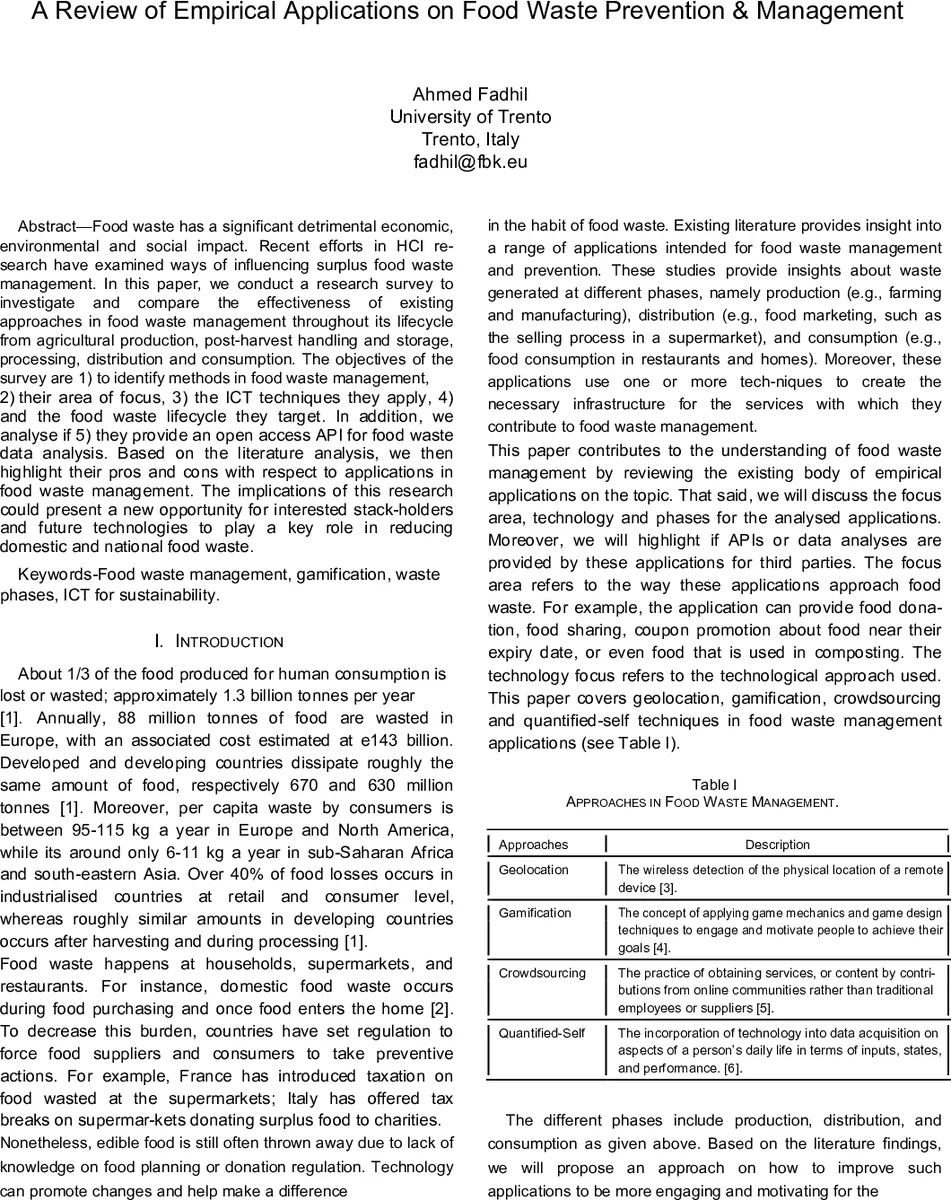
Food waste has a significant detrimental economic, environmental and social impact. Recent efforts in HCI re-search have examined ways of influencing surplus food waste management. In this paper, we conduct a research survey to investigate and compare the effectiveness of existing approaches in food waste management throughout its lifecycle from agricultural production, post-harvest handling and storage, processing, distribution and consumption. The objectives of the survey are 1) to identify methods in food waste management, 2) their area of focus, 3) the ICT techniques they apply, 4) and the food waste lifecycle they target. In addition, we analyse if 5) they provide an open access API for food waste data analysis. Based on the literature analysis, we then highlight their pros and cons with respect to applications in food waste management. The implications of this research could present a new opportunity for interested stack-holders and future technologies to play a key role in reducing domestic and national food waste.
💡 Research Summary
This paper presents a comprehensive survey of empirical applications that aim to prevent and manage food waste across the entire food‑supply chain – from agricultural production, through post‑harvest handling and storage, processing and distribution, to final consumption. The authors identified 32 distinct applications and classified each according to four dimensions: (1) the ICT technique employed (geolocation, gamification, crowdsourcing, or quantified‑self), (2) the primary focus area (donation, sharing, promotional coupons, composting, etc.), (3) the lifecycle phase targeted (production, distribution, or consumption), and (4) whether an open‑access API is offered for third‑party data analysis.
The introduction contextualises the magnitude of the problem: roughly one‑third of all food produced for human consumption is lost or wasted, amounting to about 1.3 billion tonnes per year worldwide. In Europe alone, 88 million tonnes are wasted annually, with an estimated cost of €143 billion. The authors note that waste patterns differ between developed and developing regions – the former concentrate waste at retail and consumer levels, the latter during harvesting and processing.
In the “Reasons for Food Waste” section the paper quantifies waste distribution (e.g., 20 % production, 1 % processing, 19 % distribution, 60 % consumer) and highlights key drivers such as mechanical damage, poor storage, oversized packaging, lack of cooking experience, and demographic factors (e.g., older adults tend to waste less). The authors also discuss existing mitigation strategies, especially food donation programmes, and provide statistics on the European Food Aid Programme (FEAD).
The core of the article reviews each application, describing its functional scope, the ICT techniques used, and the phase(s) it addresses. Representative examples include:
- Leloca – a geolocation‑based coupon system that helps restaurants offload surplus meals, targeting the consumption phase.
- Cheetah – a West‑African platform that exchanges traffic and routing data among growers, transporters, and traders to reduce spoilage during distribution.
- Breading – a bakery‑focused donation app that geolocates leftover bread for nearby collectors.
- Ratatouille – a consumer‑level fridge‑sharing app that displays nearby food donations with expiry dates.
- MintScraps – a waste‑tracking tool for professional kitchens that incorporates gamification (points, leaderboards) to encourage regular data entry.
- Hello Compost – a low‑income‑household programme that rewards food‑waste collection with credits for fresh produce, combining crowdsourcing, gamification, and quantified‑self metrics.
The authors compile the data into three tables: (I) focus area per application, (II) ICT technique per application, and (III) targeted lifecycle phases. From this taxonomy they draw several key observations:
- Dominance of the consumption phase – 24 of the 32 apps focus primarily on consumer‑level waste, while only a handful address production or distribution.
- Limited use of gamification – only four applications (MintScraps, PolarBear, Hello Compost, FitterCritters) employ game mechanics, suggesting an under‑exploited avenue for sustained engagement.
- Sparse open data provision – merely two or three apps expose an API, limiting external research, integration, and policy‑making opportunities.
- Prevalence of geolocation and crowdsourcing – most apps rely on location services to match donors with recipients and on user‑generated content (photos, expiry data) to keep inventories current.
In the “Findings” section the paper evaluates each application against five user‑centric criteria: adoption, awareness/knowledge, expressed needs, engagement/attitude, and behaviour change. While many apps succeed in raising awareness and providing immediate convenience (e.g., coupon discounts, easy donation workflows), they often fall short on long‑term habit formation. The authors cite behavioural‑science literature (e.g., Blevis 2007) to argue that without continuous motivational loops and feedback, initial enthusiasm wanes.
The discussion culminates in a set of recommendations for future research and development:
- Standardised open APIs – to enable cross‑platform data analytics, benchmarking, and policy‑level monitoring.
- Lifecycle‑integrated solutions – tools that bridge production, distribution, and consumption, reducing siloed interventions.
- Enhanced gamification design – incorporating educational content, progressive challenges, and social comparison to sustain user interest.
- Data‑driven personalization – leveraging quantified‑self data to tailor recommendations (e.g., shopping lists, portion sizes) to individual waste patterns.
- Multi‑stakeholder ecosystems – encouraging collaboration among academia, industry, NGOs, and governments to scale successful pilots.
Overall, the paper provides a valuable taxonomy of current food‑waste management applications, highlights gaps in technology adoption, data openness, and behavioural design, and outlines a roadmap for more holistic, data‑rich, and user‑engaging solutions that could meaningfully curb food waste at national and global scales.
Comments & Academic Discussion
Loading comments...
Leave a Comment