Optimization of a Two-Hop Network with Energy Conferencing Relays
This paper considers a two-hop network consisting of a source, two parallel half-duplex relay nodes, and two destinations. While the destinations have an adequate power supply, the source and relay nodes rely on harvested energy for data transmission…
Authors: Sharief Abdel-Razeq, Ming Zhao, Shengli Zhou
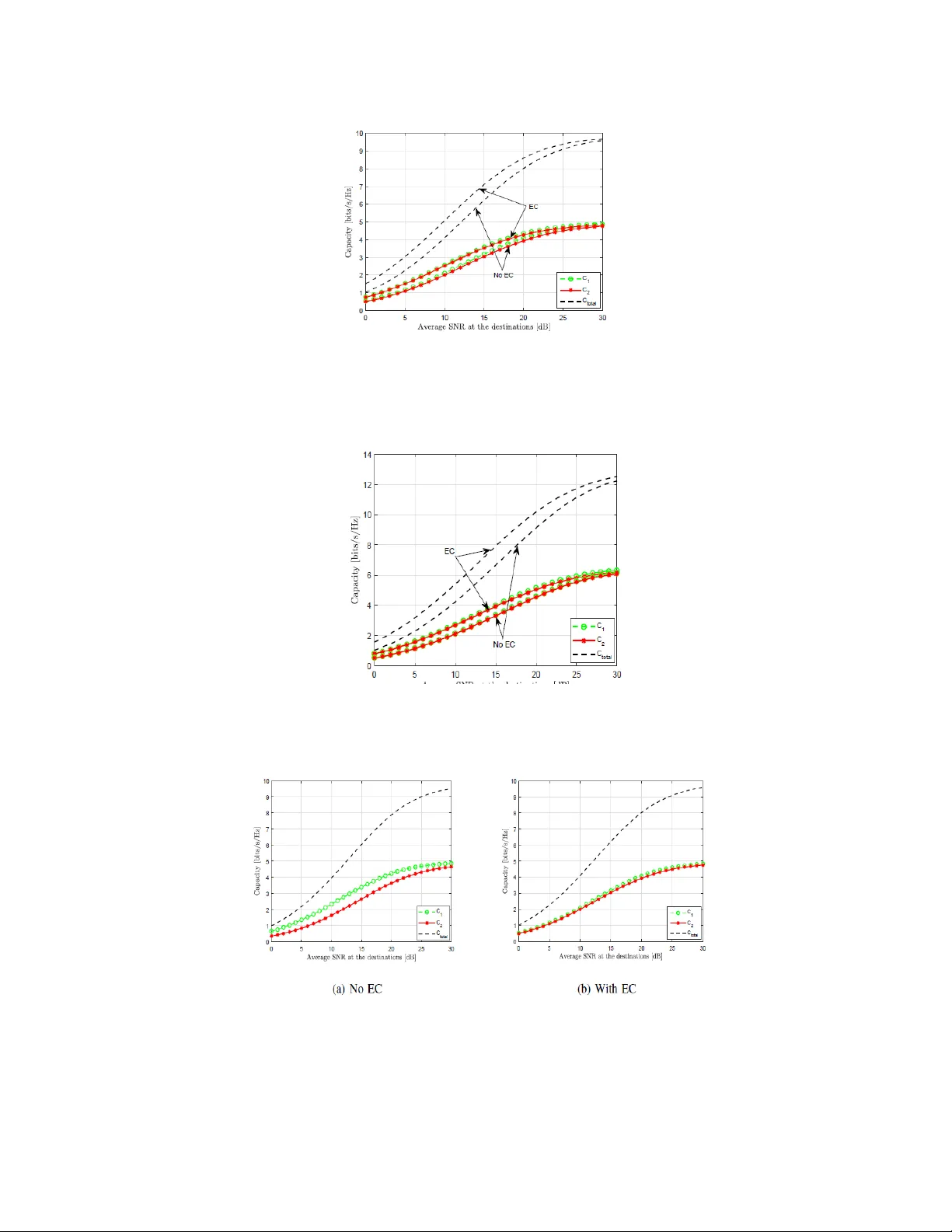
International J ournal of Wirel ess & Mobile Netw orks (IJWMN) V ol. 10, No. 1, Feb ruar y 2018 DOI: 10. 5121/ijwmn.201 8 .1010 4 35 O PTIMIZ ATION O F A T WO -H OP N ETWO RK W ITH E NE RGY C ONFERE NCING R ELA YS Sharief Abdel-Raze q 1 , Min g Zhao 2 , Shengli Zhou 1 , Zhengdao W ang 3 1 Dept. of Electrical and Computer Engineering, Univ ersity of Con necticu t, Storrs, CT , US A 2 Dept. of Electronic Engineering a nd Inf. Sci., Un i v . of Sci. and T ech. of C hina, Hefei, China 3 Dept. of E lectrical and C omputer Eng ineering, Io wa State Univ ersit y , Ames, IA, USA A BSTR ACT This paper considers a tw o-hop network consisting of a source , two parallel half-duplex r elay node s, and two destinati ons. While the destin ations have an adequat e power supply , the sour ce and r e lay n odes r ely on harve sted ener gy f or data transmissi on. Diff erent fr om al l ex istin g works, t he two r elay nodes can a lso transfer their h arvested energy to e ach other . F or such a system, a n optimization pr o blem is formulate d with the objective of maximizing the total data rate and conservi ng the sour ce a nd r ela ys transmission e ner gy , wher e any e xtra energy sa ved in the current transmission cycle can be used in the n ex t cycle. It turns out th at t he optimal sol utions f or t his pro blem can be either f ound in a clo sed- form or through one-di mensional sea r ches, dependin g o n the scenario. Sim ulation results based on both the average d ata r ate and t he outage pr obability sh ow t hat ene r gy c ooperat ion b etwe en the two r ela ys consistently impr oves the system p erform ance. K EYWO RD S Capacity optimiz ation, conferencing r elays, ener gy cooperation, ene r gy harvesti ng, ener gy savin g strate gy , outag e p r obabi lity , t wo-hop r elay network. 1. I NTRODUC TION In the past few y ears, there h a s been a significant researc h progress on energy harv e sting (EH) communications as it’ s a promising approac h to realize green communications, which allow s to powe r the communication de vices and networks wit h renew able energy sour c es; s ee recent rev iew p apers [1]–[4] and references therein. V arious types of en ergy sources can be utilized to supplement energy supplies such as solar , wind, vibration, motion, and electromag netic ( EM ) wa ve [5]. Further , th roug h power transfer b y radio wa ves , energ y cooperati on allow s wireless nodes to in tentionally transfer some ener gy to ot hers to assist comm unications [6]. In EH, the main focus is on t he de ve lopment of energy ha r v esting models, protocols, a nd transmission schemes. F or instance, in poi n t-to-point communications, both the tr ans mitter and the receive r could be equipped with energy-harv esting devices , and energy transfer can happen between the transceiv ers [7]–[10]. Recently , cons iderable research ef forts have been e xtended towa rd e nergy harvesting networking like coopera tive networks, cognitiv e radio networks, multiuse r i nterferenc e networks, and cellular networks [11]–[19]. For instance, i n [1 2] a two- hop relay channel with ener gy-harve sting source and relay nod es, and one- w ay ene rgy transfer from the source node to the rel a y node was studied. Multiple a ccess and two-way channels are considere d in [13] wi th energy h arve sting International J ournal of Wirel ess & Mobile Netw orks (IJWMN) V ol. 10, No. 1, Feb ruar y 2018 36 transmitters that transfe r energy to each other . An energy-ha rvesting diamond r elay ch a nnel i s analyzed in [14], where the source c a n tra nsfer some of its harvested ene rgy to the relays . In [18], a multi-relay ne twork is in ves tigated where t he relay s that are randomly located within the cooperating area and a single b est re lay is selected to the decoded source message to the destination. Recently , EH in the doma in of the fi fth generation (5G) has been studied in [19]. There are sev eral other works in the aforeme ntioned research areas related to e nergy cooperation (EC) but not on energy-harv esting sensor networks [20]–[25]. The transmitter design for wireless info rma tion and EC in a multiple-input single-output interference channel was in ve stigated in [20]. In the contex t of cognitive radio networks, the primary transmitter can transmit po wer to seconda ry t ra nsmitters such that the latt e r can obtain t he extra powe r to help the former besides serving t he ir own secondary u se rs [21 ]. In a wi rele ss p o wered cellul ar communication network, do wnlink wir eles s energy t ransfe r can be used to assist the uplink information transmissions [22], and EC among base s tations has been studied in [24]. Several objectives have bee n considered when designing energy harvesting communica tions systems, including data rate, outage pr obability, harveste d energy, and total power c onsumption [26]. For example, the minimization of the outage probability is considered in [27]–[29] while the data rate i s m a ximized in [30], [3 1]. The work in [ 30] att em pts to max imize the data rate under heavy channel fluctuations a nd energy variati ons. In [31], t he optimal water leve l fo r the data rate maximization was proposed base d on a recursive water-filling approach. On the oth e r hand, reg arding t he EH mod e ls and b a sed on the ava ilability of non-ca u sa l knowle dge about ener gy arriv als at the transm itters, th e researc hers p rimarily div ide those models in to two s treams: deterministic models [32], [33] and stochas tic models [ 34], [35]. I n t he former one , a full kno wledge of en e rgy arriv al instants and amo unts a vailable at the transmitters beforehand. In the stochastic models, the en e rgy rene wal processes are r e garded as r a ndom processes. For energy scheduling designs, ther e are two approac hes: offline and online , depending on whether the knowledg e of cha nnel sta te information (CSI) and energ y st ate information (ESI) are av ailable at th e beginning of a trans mission. In offline approaches, the full (causal and non- causal) knowledge of CSI and ESI during t he ene rgy sche duli ng pe riod is av ai lable at t he transmitter side a priori and the o ptimiza tion problems are formul ate d to maximize certain short- term objectiv es and solved by con vex optimization t ec hniques [31], [ 36]. Online approaches, on the other side, only account for the causa l know ledge of the CSI and ESI [37], [38]. In t his paper , we consider a t wo- hop network consisting o f a source, two parallel half-duplex relay nodes, and t w o destinations, where the two ener gy-harvesting relays can exc hange their harves ted energies t o e a ch other . T o the b es t of our know ledge, a system with ener gy- conferencing relays has n ot been studied i n al l existing works, and hence the study he rein offers a fresh perspectiv e. F or such a system, we formulate an optimization problem to maximize the total data rate of t he network wh ile conserving the system resources via judicious choices of the source and rel ays transmission energy on the source-to-relay l inks a nd relay-to-destination links, respectiv ely , and the ener gy transfe r betw een the two relay nodes. Th e optimal sys tem soluti on is fo und either in a closed-form or throu gh one- dimensional searches. Moreov er , w e stu dy the outage probability at the two des tinations and sho w ho w EC between the two relays can reduce the system ou tage. The remainder of thi s paper is organ ized as fo llo ws. Se ction 2 descr ibe s the system model and assumptions and Section 3 pr ov ides the problem formulation. The solutions to the optimization proble m u nde r different scenarios are detailed i n Section 4, and a numerical International J ournal of Wirel ess & Mobile Netw orks (IJWMN) V ol. 10, No. 1, Feb ruar y 2018 37 exam ple is presented in Section 5. Sec tion 6 exte nds the analysis to the outage probability whi le Section 7 concludes this paper . 2. S YSTEM D ESCRIPTION A ND A SSUMPTIONS Fig. 1 shows the con sidere d system, which consis ts of a source S, two p ara llel relays R 1 and R 2 , and two de s tination s D 1 and D 2 . Each node is equipped with a sing le antenna. S, R 1 , and R 2 rely on harvested energy while D 1 and D 2 are po wered with ad equate power supply . There is no direct link betwee n S and D 1 and D 2 , and t ha t R 1 and R 2 are half-duplex working in either a receiv e mode or in a tran sm it mode. R 1 and R 2 will apply decode-and-forward (DF) relaying scheme to forward the data just receiv ed from th e pre vious ti me s lot. Fig. 1. A tw o -hop netwo r k with energy c onferencing re lay s. One t ransmiss ion cycle c onsists of two stages; the information collection stage , i n which, S, R 1 , and R 2 collect the information about channels states and ener gy harvested at each node then decide the o ptimum solutions to be used. Once this stage is over , data transmission stage starts which will be done i n two consecutiv e t ime sl ots as f ollo ws: In th e fi rst ti me slot, S will transmit two different data streams to R 1 and R 2 simultaneously . In the second time slot, R 1 and R 2 will decode and then f orw ard their data separately to t heir destinations. Mor e ov er , data transmission through t he upper hop links, i.e., S − R 1 and R 1 – D 1 will b e orthogonal on data transmission thro ug h the lower hop links, S − R 2 and R 2 − D 2 . After finishing a whole transmission cycle, t here is a sleeping p eriod, during which, S, R 1 , and R 2 will ha ve t he time to harv est more en er gy to be used in next transmission cyc le while D 1 and D 2 will be idle as show n in Fig. 2. Throughout the paper , the following set of assumptions are considered. 1) EC between R 1 and R 2 is done via two conferencing l inks that could be wir ed or wireless. These li nks assumed to be ortho g onal to each other and also ort hog onal to the source-to- relays and relays-to-destinations links. Moreove r , data transmission a nd energy t ransfer channels are orthogonal, i.e., energy transfer does not create i nterference to data communication [39]. International J ournal of Wirel ess & Mobile Netw orks (IJWMN) V ol. 10, No. 1, Feb ruar y 2018 38 Fig. 2. A timeline sh o wing two consecutive transmissi on cy cles, separate d by a sleeping period. 2) S, R 1 , and R 2 ha v e separate batteries and harvested energ ies are stored in the batteries. The energy loss durin g the energy transfer pr oc edure will be modelled by a multiplicativ e effic iency factor , a lthough other mode ls would be ap plicable. 3) The proce ssing energy requir e d by circuits at any rela y i s ne gligible comp ared to the ener gy used for signal transmission especially when transmission distances are l arg e which is applicable in our work [40], [41]. 4) In our work, the C SI and the energy harvested at S, R 1 , and R 2 nodes are assumed to be collected and known before the start of the transmission cycle and this knowledge assumed to be correct. Hence s yste m optimization can be performed. 3. P ROBLEM F ORMULATION The d e liv ery of the d ata t o D 1 and D 2 from S will be done in two ti m e slots; during the f irst time sl ot, S wi ll transmit data to R 1 and R 2 concurrently on two separate channels. In the second time slot, R 1 and R 2 will forward t he recei ved the data to their designated destinations on two separate channels. Note that the S − R 1 and R 1 − D 1 could be on t he same channel, and so does S − R 2 and R 2 − D 2 . On the first hop, S broadca sts independe nt data s treams to R 1 and R 2 . The baseband discrete-time cha nnel with tw o relays is where x k [ m ] is t he signal int e nded for relay k at time slot m , h k denote the channel gain from the source to rela y k , y k [ m ] is the recei ved signal at relay k during ti me slot m , and w k [ m ] is the noi se at r e lay k durin g time sl ot m which is assumed i ndepen dent and identically distributed (i.i.d.) complex Gauss ian with w k . On the second hop, R 1 and R 2 are responsible to decode the data recei ve d from the first hop and then forward it during the nex t time slot. Hence where x l [ n ] is the signal intended from rela y k to destination D l at time n , g l denote the channel gain from the relay k to destination D l , z D l [ n ] is the recei ve d signa l at destina tion D l during time slot n , and is the noise at destination D l assume d i.i.d. com plex Gaussia n with k . International J ournal of Wirel ess & Mobile Netw orks (IJWMN) V ol. 10, No. 1, Feb ruar y 2018 39 Let E S , E R 1 , and E R 2 denote the energy av ailable per symbol during the data transmis sion slot at t he be ginning of each transmi ssion cycle at S, R 1 , and R 2 , respecti v ely . Note that S , R 1 and R 2 are random v aria bles, but th e va lues o f their realizat ions are assumed know n before t he cycle starts. When R 1 transfers δ 12 amount of ener gy to R 2 , t he energy at the receiv er is γ 12 δ 12 , where γ 12 is the transfer ef f icienc y from R 1 to R 2 . W hen R 2 transfers δ 21 amount of energy to R 1 , the receive d energy is γ 21 δ 21 , where γ 21 is the transfer efficienc y from R 2 to R 1 . T he transfer efficie ncies are less than one, which accounts for the potential loss due to va rious reas ons in the ener gy trans fer procedure . Fur thermore, γ 12 and γ 21 are no t necessarily the same. On the first h op, define C S, R 1 and C S, R 2 as t he maximum data rates fr om S to R 1 and fr om S t o R 2 , respectiv ely . He nce where s 1 and s 2 is the av erage energy per transm it symbo l fr om S to R 1 and R 2 , respecti vely , with s 1 s 2 S . On the se cond hop, d efine C R 1 ,D 1 and C R 2 ,D 2 as the ma x imum data rate from R 1 to D 1 and fr om R 2 to D 2 , respectiv ely . Henc e, where R 1 and R 2 is the av erage e nergy per t ransm it symbol from R 1 and R 2 , respectiv ely . If C 1 and C 2 are t he max imum data rates of the upp er a nd lower hops’ links, respectiv ely . Then, the tot a l data rate of a two-hop DF network is C total = C 1 + C 2 = min{ C S,R 1 , C R 1 ,D 1 } + mi n{ C S,R 2 , C R 2 ,D 2 }. (7) For each direction of energy transfer , one op timization problem needs to be for mula ted as follows [42]. International J ournal of Wirel ess & Mobile Netw orks (IJWMN) V ol. 10, No. 1, Feb ruar y 2018 40 1) F rom R 1 to R 2 : 2) F rom R 2 to R 1 : Note t hat the equality constraints in (8b) and (8c), and also (9b) and (9 c ), are imposed since when the maximum total d a ta rate is achie ved, any extra energy due to the i m balance of data rates on the fi rst and se cond hops c a n be s a ved for next cycle of transmis sion and will be a dded to the ne wly harveste d energy by that nod e . W e will call this st rate gy a s energy saving strategy (ESS). Hence, at t he end of any transmission c y cle , the saved ene rgy at R 1 , R 2 , and S for the ne xt transm ission cycle is defi ne d as follows where indicates the optimal v alue to be found later . For each realization of the channel gains and the harvested e nergy le ve ls, the s y stem aims to maximize C total while conserving the transmission energy at S, R 1 , and R 2 . The optimi z ation problems in (8a) an d ( 9a ) will be carried out separately . The final solution will be selected fr om the two t en tativ e s olutions ba sed on the data rate comparison. International J ournal of Wirel ess & Mobile Netw orks (IJWMN) V ol. 10, No. 1, Feb ruar y 2018 41 4. S OLUTI ONS The optimization pr ob lems (8a) and (9a) have multiple in equa lity constraints. They could be solved through the Karush-Kuhn-Tucker (K.K.T.) conditions, howeve r, the procedure i s cumbersome. Through heuristic reasoning, most cons traints can be removed in different scenarios and optimal solutions can be found through one-dimensional searc hes. A. First hop is the bottlene ck Assuming t hat the f irst hop is the bottlenec k and the second hop can fully support the f irst hop. The sum rate of the first-hop links C 1 sum = C S,R1 + C S,R2 and the problem is to fi nd the energy allotment that ma ximizes this sum rate subject to the constraint that s 1 s 2 S . T his is a standard water-filling p rob lem on power allocation over parallel Gaussian channels [43]. The solution is: where v is chosen so that where ( x ) + denotes the positive part of x . Once we optimized the first hop, we can proceed to check whether the second hop can suppor t the optimal solution from the first hop. W e have the following case s of interest: Case A1): w s w R and w s w R . Under this condition, there is n o need for EC between R 1 and R 2 as both ha ve enough energy. The optimal solution is: Case A2): w s w R but R w s w R R ! w s w " . Under thi s condition, R 1 will transfer ene rgy to R 2 to support the da ta rate as required by the first hop. Case A 3): w s w R but R w s w R R ! w s w " . Under thi s condition, R 2 will transfer ener g y to R 1 , which ca n support the data rate as required by the first hop. International J ournal of Wirel ess & Mobile Netw orks (IJWMN) V ol. 10, No. 1, Feb ruar y 2018 42 B. First hop is not the bottleneck Since the first hop i s not t he bottleneck, the second ho p needs to exhaust all the available energy, i.e., R saved R saved # Moreover, as we have two di rections of energy transfer, l e t us investigate each direction se parately. 1) Energy Transfer from R 1 to R 2 : Under the ass umption that the first hop has enoug h energy to support the second hop, the target then is to maximize C 2 sum = C R1,D1 + C R2,D2 on the secon d hop. Since by taking the derivative relative to $ , we obtain This obje ctive fu nc tion is convex, whi c h can be verified by che cking its second derivative. However, the constraints in (8h) should be imposed to make sure that the solution is in range, we define Now we need to check if condition (8f) has bee n satisfied by using the ene rgy transfer $ % 12 unc . Plugging $ $ % 12 unc into (15) leads to one unique opti m al values for s 1 and s 1 , which are denoted as % s 1 unc and % s 2 unc . If indeed % s 1 unc % s 2 unc S , t hen the condition is satisfied which means t ha t th e first hop can fully support the optimized second h op, and hence s 1 * % s 1 unc a nd s 2 * % s 2 unc . In shor t, if Cases A1-A3 are not applicable, this leads us to wh e re the optimization problem in (8a) is solved as follows. Case B1): If % s 1 unc % s 2 unc s , then the optima l solution to (8a) is and However, if s 1 s 2 & S th e n the condi t ion (8 f) nee ds to be enforced and a on e-dime nsional search o n $ 12 * solves the optimization problem in (8a) wh ich lead s to maximize C total for t his direction. Case B2): The solution is International J ournal of Wirel ess & Mobile Netw orks (IJWMN) V ol. 10, No. 1, Feb ruar y 2018 43 2) Energy T ransfer from R 2 to R 1 : The optimization pr oblem in (9a) is solved following the same steps as in t he opposit e di rec tion, i .e., R 1 to R 2 . Explanations are now skipped, with only key equations provided. The opti m um value of $ for an unconstrained optimiza tion on the second hop is based o n wh ich we d e fine the tru nc ated v ersion $ % 21 unc within t he interval [0, R ]. Plugging $ $ % 21 unc into (16), and denote the solution on s 1 and s 2 as % s 1 unc and % s 2 unc . Plugging s 1 s 2 S into (9f) to make s ure that this condition is satisfied. Case B3): The optimal solu tio n to (9a) is and If s 1 s 2 & S , a one-dimensional search on $ 21 * will be performed to solve the optimization problem in (9a) which max imizes C total for this direction. Case B4): The solution is Based on the r es ults from (22) and (26), the system sh ould be able to determine the d irec tion of energy transfer that ma ximizes the total data rate of the network. 5. N UMERICAL E XAMPLE For n ume rical simulation, both fir st- and second-hop ch annels e x perience Rayle igh fading as: ' ( )* + h , - and . ( )* / g , 0 1 2 3 . For t he f irst hop, we assume h 1 h 2 , w 1 w 2 , and the maxim um average SNR at the relay is h 1 S w 1 4 . The energy levels S R and R at the S, R 1 , and R 2 are randomly generated from a Gauss i a n distribution S ) + 5 S E S - and R , ) / 5 R , E R , 0 1 2 3 , respectively. For the second hop, we also assume g 1 g 2 , and define the av erage SNR at the destinations as follow s The numerical values of the system variables are set as follows: w 1 w 2 = 1mJ, w 1 w 2 = 1mJ, and = 90% under t he assumption that the conferencing links are wires. It is worth to mention h e re t hat if these link s a re assumed to be wireless , then an d s hould be muc h lower due to high energy loss in the free space. International J ournal of Wirel ess & Mobile Netw orks (IJWMN) V ol. 10, No. 1, Feb ruar y 2018 44 Fig. 3. Capac ity versus the av erag e SNR at the destina tions for ener gy coope ration (EC) a nd no energy cooperati on (No EC), where t he rela y e nergy levels an d the channel gains are randoml y gene rated with R R S ) 100mJ, 6 mJ # Fig. 4. Capacit y versus the av erag e SNR at the destinations for EC an d No EC, where the rela y ener gy levels and the c hannel gains ar e randoml y generate d with S ) 300mJ, 6 mJ while R R ) 100mJ , 6 mJ # Fig. 5. Capacit y versus the average SN R at the desti nations, where the re lay energy levels and the channel gains are ra n doml y gener ated with R ) 200mJ , 6 mJ while R S ) 100mJ, 6 mJ # International J ournal of Wirel ess & Mobile Netw orks (IJWMN) V ol. 10, No. 1, Feb ruar y 2018 45 Fig. 6. G ain versus the a v erag e SNR at the destina tions, where the relay energy level s and the channe l gains are ra n doml y generated with R R S ) 100mJ, 6 mJ # Fig. 3, Fig. 4, and Fig. 5 show capacity as a function of the averag e SNR at the destinations with ESS is adopted for different v alues of R R S . Fig. 3 and Fig. 4 show that, for a ny values of R R S , EC is always helpful for the system and better t han no EC. It i s worth to mention here that, the role of ES is to control the ma x imum capac ity t hat system can reach, which is expected. In Fig. 3, t he highest capacity was about 10 b its/s/Hz while this floor got higher to about 12 bits/s/Hz when ES is increas ed as Fig. 4 shows. On the ot her hand, Fig. 5 shows that, when R is less than R , EC wi ll be helpful to increase the data rate at D 2 with n o degradation on D 1 ’s data rate. In other words, the strong relay will not sacrifice its rate by EC but it will help the weak relay whi c h benefits the overa ll system. Fig. 6 shows the gain we get by adopting EC. It c an be easily ob serve d that this gain is much higher a t low average SNR. This is j ustifiable as, a t low average SNR , EC is cr ucial to help the system to overcome the b ad channel stat e s. However, this gain will d e crease as average SNR increases due to fact that the ch annel state is getting b e tter and EC i s not critically needed any more. Fig. 7 shows scenari os when a one-dimensional search is needed whi c h corresponds to C ase B3 . In Fig. 7(a) and F ig. 7(b), op timum $ 12 happens to be outside th e designated range which mea ns that the system should sear ch for a viable solution. The search will start f ro m ‘start searching’ point and goes backward until it finds $ 12 that is in the range and can be supported by the first hop then stops searching. The dashed lines show the searched domain. In Fig. 7(c), even though the peak occurs within the des ignated range, t he sys tem must pe rform the search as opt imum $ 12 c ouldn’t be supported by t he first hop due to low value of S . The search will sta rt from the peak in two directions and stops at the point th at c an be supported by the first hop. Fig. 8 shows the percentage of occurrence of each case we mentioned earlier. This figure confirms that al l possible scenario s have been covered. Moreover, as expected, this percentage depends on the energy level at each node. In Fig. 8(a), as S is l es s than R and R , this m eans that first hop will b e more likely t he bottleneck. This is why in thi s figure Cases A1-A3 app ears more frequently than other cases. On the other hand, in Fig. 8(b), S is larger than R and R which means that the first hop is less li ke ly to be the bottleneck. This justifies why Cas e s B1- B4 show up more frequently than other cases. International J ournal of Wirel ess & Mobile Netw orks (IJWMN) V ol. 10, No. 1, Feb ruar y 2018 46 Fig. 7. C total versus $ 12 for three diffe rent realizations draw n from S ) 50mJ, 3 mJ while R R ) 100mJ , 6 mJ # Fig. 8. Pe rcentage of occurrence o f eac h case when the re lay energy levels a nd the channel gains are randoml y generat ed. 6. E XTENSIO N T O O UTAGE P ROBABILITY In the ideal scenario, S transmits the two data streams to R 1 and R 2 and they decode t he received data perfectly and th e n forward it t o their destinations with no outage . However, this is not the situation in the rea l scenario, in which, the outage h a ppens at R 1 , R 2 , D 1 or D 2 . If 7 an d 7 are the target rates at D 1 and D 2 , respectively , then the optimum system energy will b e as follows Now, we can articulate the pos sible scenarios of interest: International J ournal of Wirel ess & Mobile Netw orks (IJWMN) V ol. 10, No. 1, Feb ruar y 2018 47 a) If S 8 9 9 , : R , a nd : R , t he n n o EC needed. However, if : & R while : R , then $ ; <= R > Joules of energy tr a nsfer will ha ppen from R 2 to R 1 under the condition that R 2 can support this tr ans fer. If : R and : & R , th e n $ ; <= R > of energy transfer will ha ppen from R 1 to R 2 under the condition that R 1 ca n support this transfer. He nce, all nodes are working and no outage will happen. b) If S 8 9 and : R , then no EC nee ded from R 2 . However, if : & R , then energy transfer wi ll happen from R 2 t o R 1 u nder the condi tion that R 2 can support R 1 with $ ; <= R > Joules. Hence, R 2 and D 2 are in outage . c) If S 8 9 and : R , then no EC nee ded from R 1 . However, if : & R , then energy transfer wi ll happen fr om R 1 t o R 2 under the condition that R 1 can support R 2 with $ ; <= R > Joules. Hence, R 1 and D 1 are in outage . d) If there i s no enough energy to support t he first and second hop, a ll n odes will be off during that transmission cycle . Hence, all nodes are in outage. For the outage probability, we set bo th t arge t rates 7 and 7 at 1.5 bits/ s/Hz . Fig. 9 shows outage probability as a functi on of the average SNR at the destinations for different values for EC and No EC scenarios with and without E SS. It ca n be easily obse rved that the ou t age probability will be decreased by adopti ng EC a s the two rel ays exc hanging energy which all ows the two destinations to ove rcome the outag e difficultie s a nd to satisfy th eir requirements. Moreo v er, thi s figure shows th e benefit of exploiting the i de a of saving the extra energy to be used in the next cycle of the transm ission cycle. Fig. 9. Outage probabilit y when R R S ) 100mJ , 6 mJ # 7. C ONCLUSIO NS In this paper, we studied a two-hop network that has two energy harvesting relays which can exchange energy through conferencing links. Via suit a ble choices of t he source and relays transmission energy, and t he amount of energy tran sfer between the two relay nodes, the system data rate is maximized while the system en ergy i s conserved. The actual harveste d ene rgy level at the n ode and the channel state i nformation dec ide the way how the optimal solutions can be International J ournal of Wirel ess & Mobile Netw orks (IJWMN) V ol. 10, No. 1, Feb ruar y 2018 48 obtained. They can vary fro m a closed-form solution to one-dimensional s earches . Moreover, system ou tage p robability was investigated t o show the performance improvement through energy cooperation. R EFERENCES [1] H. H abibu, A. Zun g eru, A. Abi mbol a, and I. Gerald , “Ener gy h arvesting wireless sensor networks: Design a nd m odeling,” International Journal of Wireless & Mobile Netw orks (IJWMN), vol. 6, no. 5, pp. 17–31, 201 4. [2] S. U lukus, A. Yener, E. Er kip, O. Simeone, M. Zo rzi, P. Grov er, and K. Huan g, “Ener gy harvesting wireless c ommunications: A re view of rec ent a dvances,” IEEE Journal on Selected Areas in Communica tions, vol. 33, no. 3, pp. 360–381, 20 1 5. [3] O. Ozel, K. Tu tuncuo g lu, S. Ulukus, an d A. Yener, “Fundamen tal limit s of energy harvesting communicati ons,” IEEE Comm unications Magazi ne, vol. 53, no. 4, p p. 126–132, 201 5. [4] M.-L. K u, W. Li, Y. C hen, a nd K. R. Liu, “Ad v ance s i n e nergy ha rvesting c ommunications: P ast, present, and future challenges,” IEEE C ommunications Surve y s & Tutorials, vol. 18, n o. 2, p p . 1384– 1412, 2016. [5] P. Cuffe, P. Smith, and A. Keane, “Tran smission s y s tem impact of wind ener gy h arvesting networks,” IEEE Transacti ons on Sustai nable Energy, v ol. 3, n o. 4, pp. 643–65 1, 2012. [6] W. C. Brown, “The history of power transmission b y ra dio wa ves,” IEEE Transactions on Microwave Theory an d Tech niques, vol. 32, no. 9, pp. 1230–124 2 , 1984. [7] W. Ni a nd X. D ong, “Energy harvesting wireless commu nications with energy cooperati on bet ween transmitter and receiver,” IEEE Transacti ons on Comm unications, vol. 63, no. 4, pp. 1457–146 9, 2015. [8] W. Li, M.-L. Ku, Y . C hen, and K. R. Liu, “O n outa g e probabilit y for stoc hastic ener gy har vesting communicati ons in f ading ch annels,” IEEE Signal Processin g Letters, vol. 22, no. 1 1, pp. 1893–1897, 2015. [9] M.-L. K u, W. Li, Y. Che n, and K. R. Liu, “On energ y ha r v esting gain and diversit y anal ysis in cooperative c ommunications,” IEEE Journa l on Selected Areas in Comm unications, vol. 33, no. 12, pp. 2641–2657, 2015. [10] Z . Fang, T. Song, and T. Li, “Energ y harvesti ng f or t w o -w ay OFDM c ommunications under hostile jamming,” IEE E Signal Pr o cessi ng Letters, vol. 22, no. 4, pp. 413–416, 20 15. [11] S. Singh, M. Si ngh, and D. S ingh, “E nergy eff icient hom o genou s cluste ring al gorithm for wirele ss sensor networks,” International Journal o f Wireless & Mobile Networks (IJWMN), vol. 2, no. 3, pp. 49–61, 2010. [12] B. Gurakan, O. Ozel, J. Yang, a nd S. U lukus, “E nergy co operation i n energy harvestin g communicati ons,” IEEE Tran sactions on C ommunications, vol. 61, no. 12, pp. 4884– 4898, 2013. [13] K. Tutuncuogl u and A. Yener, “ Multiple access and t wo-way channel s with ener gy har vesting and bi- directional ener gy cooperati on,” in I EEE Workshop on Informati on T heory and Applicati o ns (ITA), 2013, pp. 1–8. [14] B. Gura kan a nd S. Ul ukus, “ Energy harvesting diamond channel with ener gy c ooperation,” in IEEE International S ymposium on Information The o r y (ISIT), 20 14, pp. 986–99 0. International J ournal of Wirel ess & Mobile Netw orks (IJWMN) V ol. 10, No. 1, Feb ruar y 2018 49 [15] G. S ara, R. Kalaiarasi, S. Par i, a nd D. Sridharan, “Energ y eff icient c lustering and routing in mobile wireless sensor ne twork,” International Journal of Wir eless & Mobile Networks (IJWMN ), vol. 2, no. 4, pp. 106–114, 2010. [16] T . Wu a nd H.-C. Yang, “ RF ener gy harvesting with c ooperati v e beam selec tion f o r wireless sensors,” IEEE Wireless C ommunications Letters, vol. 3, n o. 6, pp. 585–588, 201 4. [17] H. S. Dhillon, Y. Li, P. Nuggehalli, Z . Pi, a nd J. G. A ndrews, “Funda mentals of h eterogeneous cellular ne tworks with e nergy har v esting,” IEEE Transactio ns on Wire less Communicat ions, vol. 1 3, no. 5, pp. 2782 –2797, 2014. [18] Q. Li , S. Fen g , A. Pan dha ripa nde, X. G e, Q. Ni, and J. Zhan g , “Wirel ess-powered cooper ative multi- rela y systems with re lay selection,” IEEE Access, vol. 5, p p. 19 058–19 0 71, 2017. [19] H. Li, C. Huang, F. E. Al saadi, A. M. Dobaie , and S. Cui, “Energy har vesting base d green heterogene ous wirele ss access for 5G,” in 5G Mobile Communications. Springer, 2017, p p. 475–502. [20] C. Shen, W.-C. Li, and T.-H. Chan g, “Wire less i nformation an d ener gy tran sfer in multi-a ntenna interference c h anne l,” IEEE Tr ansactions on Signal P rocessing, vol. 62, no. 23, pp. 6 249–6264, 2014. [21] G. Zheng, Z. K. M. Ho, E. A. Jorswie ck, and B. E. Ott ersten, “Information and energy c ooperation in cognitive radio netw o rks.” IEEE Transacti o ns on S ignal P rocessing, vol. 62, no. 9, pp. 2290–230 3, 2014. [22] H. Ju and R. Zhan g , “Thr oughput maximizati on in wireless powered communi cation networks,” I EEE Transactions on Wireless Commun ications, vol. 1 3, n o . 1, pp. 418–428, 2014. [23] K. Huang and V. K . Lau, “ Enabling wireless power tra n sfer in cellular networks: Architect ure, modeling and depl oyment,” IEE E Transacti ons on W ireless Com munications, vol. 13, n o. 2, pp. 902– 912, 2014. [24] Y.-K. Chi a, S. Sun, and R . Zhang, “Energ y c ooperation in cellular networks with renewa ble p owered base stati ons ,” IEEE Transactions on W ireless C ommunicati ons, vol. 13, no. 12, p p. 6996–7010, 2014. [25] R. Feng, Q. Li, Q. Zhan g , and J . Qin, “Robust secure transmissi on in MISO s imultaneous wireless information and p ower t ransfer s y stem,” IEEE Transactions on Vehicular Technolog y , vol. 64, no. 1, pp. 400–405, 2015. [26] G. Yang, C. K. Ho, a nd Y. L. Gua n, “D y namic resource allocation for m ult iple-a ntenna wire less power transfer ,” IEEE Transa ctions on Signal Pr ocessing, vol. 62, no. 1 4, pp. 3565– 3577, 2014. [27] C. Huang, R. Zhan g , and S. Cui, “O ptimal power allocati on for outage pr obability minimization i n fading channels with energy har vesting constraints ,” IEEE Transactions on Wireless Communica tions, vol. 13, no. 2, pp. 1074–1087, 2 014. [28] Y. Mao, G. Y u, and Z. Zhang, “On t he opt imal trans mi ssi on policy i n hybrid ener gy s upply wire less communicati on systems,” IE EE Transactions on Wire less Comm unications, vol. 13, no. 11, pp. 6422–6430, 20 14. [29] S. Wei, W. Guan, and K . R. Liu, “P ower sche duling f or ener gy harvesting w ireless c ommunications with battery ca pacity c onstraint,” IEEE Transactions on W ireless Communications, vol. 14, no. 8, pp. 4640–4653, 20 15. [30] O. Ozel, K. Tutuncuo glu, J. Yang, S. Ulu kus, and A. Yene r, “Transmission w ith ener gy h arvesting nodes in fadi ng wir eless c hannels: Opti mal polic ies,” IEEE J ournal on Selected Areas i n Communica tions, vol. 29, no. 8, pp. 1732–1743, 2 011. International J ournal of Wirel ess & Mobile Netw orks (IJWMN) V ol. 10, No. 1, Feb ruar y 2018 50 [31] P. He, L . Zhao , S. Zh ou, and Z. Niu, “ Recursive waterf illing for wireless lin ks with e nergy har vesting transmitters,” IEEE Transactions on Vehicular Tech nology, vol. 63, no. 3, pp. 1232–1241, 2014. [32] S. Reddy and C. R. Murthy, “Pr o file-based load scheduling in wireless ener gy h arvesti ng sensors for data rate ma ximization,” in IE EE International C onference on C ommunications (ICC), 2010, pp. 1 –5. [33] J. Yang a nd S. Ulukus, “ Optimal pac ket sc heduling in an e nergy harvesti ng communicati on system,” IEEE Transacti ons on Commu nications, vol. 60, no. 1, pp. 220– 230, 2012. [34] A. Aprem, C. R. Murthy, a nd N. B. Mehta, “ Transmit p ower control p olicies for ener gy harvesting sensors wit h retransmissi ons,” IEEE J ournal of Selected Topics in Si gnal Processing, vol. 7, n o. 5, pp. 895–906, 201 3. [35] N. Mi chelusi, L. Badia, and M. Zorzi, “Optimal trans mission policies f o r energ y har v es ting devices with limited state of ch arge knowledge,” IEEE Tra nsactions on Communicat ions, vol. 62 , no. 11, p p. 3969–3982, 20 14. [36] K. Tutuncuoglu and A. Y ener, “Optim um trans mission policies for batter y l imited ener gy harvestin g nodes,” IEEE Transactions on Wireless Communic ations, vol. 11, no. 3, pp. 1180–1 189, 2012. [37] C. K. H o and R. Zhang, “ Optimal e nergy all o cation for wi reless c ommunications with e nergy harvesting c onstraints,” IEEE Tr ansactions on Signa l Processing, vol. 60, no. 9, pp. 4808–4818, 2012. [38] B. T. Bacin oglu and E. U y sa l-Biyikoglu, “ Finite-horizon online tr ansmission sc heduling on an energ y harvesting c ommunicati on l ink with a discrete set o f r ates,” J ournal of Communications a nd Networks, vol. 16, no. 3, p p . 393– 300, 2014. [39] C. H uang and S. Cui, “On the al ternative rela y ing Ga ussian diamond c hannel with c onferencing links,” IEEE Tr ansactions on Wireless Commu nications, vol. 12, no. 2, pp. 758– 768, 2013. [40] A. A. Nasir, X. Z hou, S. Durran i, and R. A. Ken nedy, “Re la y ing protocols for wireless energy harvesting a nd information proc essing,” IEEE T ransac tions on Wireles s Communications, vol. 12, no. 7, pp. 3622–3 636, 2013. [41] X. Zhou, R. Zhang, a nd C. K. Ho, “Wireless information and p ower tra nsfer: Architecture design and rate-ener gy trade off,” IEEE Tr ansactions on Com munications, vol . 61, n o . 11, p p. 4754–4767, 2013. [42] R. J. Vanderbei, Linear programming: Foun dations and e xtensions. Springer, 2001. [43] T . M. C over and J. A. T homas, Elements o f inf o rmati on theory. John W iley & Sons, 2 0 12.
Original Paper
Loading high-quality paper...
Comments & Academic Discussion
Loading comments...
Leave a Comment