When Streams of Optofluidics Meet the Sea of Life
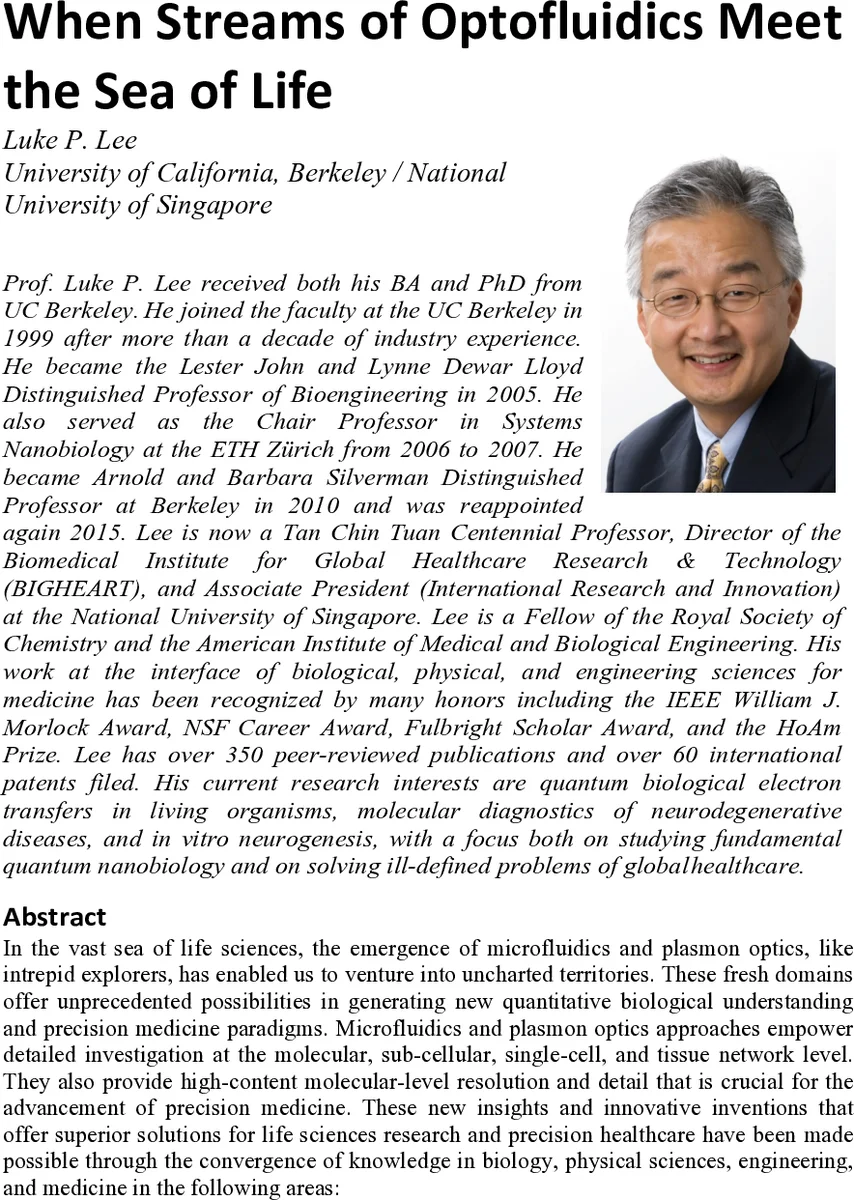
Luke P. Lee is a Tan Chin Tuan Centennial Professor at the National University of Singapore. In this contribution he describes the power of optofluidics as a research tool and reviews new insights within the areas of single cell analysis, microphysiological analysis, and integrated systems.
💡 Research Summary
This paper presents a comprehensive overview of how optofluidics—the convergence of microfluidics and plasmonic optics—has become a powerful research tool across multiple domains of life sciences. Authored by Professor Luke P. Lee, a distinguished scientist at the National University of Singapore, the article highlights his extensive background, awards, and current research interests, which span quantum biological electron transfer, molecular diagnostics of neurodegenerative diseases, and in‑vitro neurogenesis.
The manuscript is organized around three major application areas: (1) Single‑Cell Analysis, (2) Microphysiological Analysis Platforms (MAPs), and (3) Integrated Optofluidic Systems for Molecular Diagnostics (OASIS).
1. Single‑Cell Analysis
Lee’s group developed a two‑stage, high‑throughput RNA cytometry platform that uses microwell arrays containing more than 60,000 reaction chambers. In the first stage, multiplexed single‑cell RNA measurements are performed; in the second stage, a statistical likelihood score derived from the RNA data quantifies cellular heterogeneity. Monte‑Carlo simulations were employed to determine the minimal number of cells required for reliable detection of heterogeneity. The system was applied to purified mouse hematopoietic stem cells, revealing age‑related changes in genes such as Birc6 that were linked to shifts in sub‑population proportions. A micro‑well‑based cytometry method was also created to simultaneously monitor gene and protein expression in thousands of non‑small‑cell lung cancer (NSCLC) cells, enabling the identification of correlated transcript‑protein signatures and drug‑response dynamics at the single‑cell level. This work demonstrates that concurrent transcriptional and translational profiling can uncover regulatory mechanisms invisible to bulk assays.
2. Microphysiological Analysis Platforms (MAPs)
MAPs are 3‑D organ‑on‑chip systems that recapitulate human physiological microenvironments more faithfully than traditional animal models. The paper describes several MAPs, including an artificial liver sinusoid, a cardiac chip derived from human induced pluripotent stem cells (iPSC), and emerging brain‑ and pancreatic‑islet‑on‑chip devices. The cardiac MAP, for example, incorporates human genetic background, aligned tissue architecture, computationally predictable perfusion mimicking vasculature, and multimodal readouts (biological, electrophysiological, physiological). It maintains viable, functional cardiac tissue over extended periods and yields half‑maximal inhibitory concentrations (IC50/EC50) consistent with tissue‑scale reference data, thereby offering a reliable platform for cardiotoxicity screening. By providing high‑content, human‑relevant data, MAPs aim to reduce the high failure rates in drug development that stem from over‑reliance on non‑human animal models.
3. Integrated Optofluidic Systems for Molecular Diagnostics (OASIS)
The OASIS concept integrates sample preparation, nucleic‑acid amplification, and detection into a compact, often self‑powered device. A key innovation is an ultrafast photonic PCR that exploits plasmonic photothermal conversion in a thin gold film. Light‑induced electron‑phonon‑phonon coupling rapidly heats the reaction mixture, enabling 30 PCR cycles (55 °C–95 °C) to be completed within five minutes. This approach overcomes limitations of conventional thermal cyclers such as slow ramp rates and large thermal masses. The authors also describe handheld, point‑of‑care genomic diagnostic systems suitable for resource‑limited settings, as well as label‑free surface‑enhanced Raman spectroscopy (SERS) and nanoplasmonic PCR modalities that achieve single‑molecule sensitivity. By combining these technologies, OASIS platforms can deliver rapid, accurate diagnostics for infectious diseases and other health conditions, supporting precision medicine initiatives worldwide.
Overall, the paper argues that optofluidics uniquely delivers “high resolution, high throughput, and high integration” simultaneously, positioning it as a cornerstone for next‑generation precision medicine, drug discovery, and global health solutions. The author envisions that insights from quantum nanobiology, neurodegenerative disease diagnostics, and in‑vitro neurogenesis will further expand the impact of optofluidic technologies, ultimately translating fundamental knowledge into new therapeutics, diagnostics, and personalized care that improve quality of life on a global scale.
Comments & Academic Discussion
Loading comments...
Leave a Comment