A PTAS for the Time-Invariant Incremental Knapsack problem
The Time-Invariant Incremental Knapsack problem (IIK) is a generalization of Maximum Knapsack to a discrete multi-period setting. At each time, capacity increases and items can be added, but not removed from the knapsack. The goal is to maximize the sum of profits over all times. IIK models various applications including specific financial markets and governmental decision processes. IIK is strongly NP-hard and there has been work on giving approximation algorithms for some special cases. In this paper, we settle the complexity of IIK by designing a PTAS based on rounding a disjuncive formulation, and provide several extensions of the technique.
💡 Research Summary
**
The paper addresses the Time‑Invariant Incremental Knapsack (IIK) problem, a natural multi‑period extension of the classic 0‑1 knapsack. In IIK, a knapsack’s capacity grows over discrete time steps (t=1,\dots,T); items may be added at any step but, once placed, they cannot be removed. The objective is to maximize the total profit accumulated over all periods. Prior work provided PTAS only for very restricted settings (e.g., (T=O(\log n)) or the special case where profit equals weight). The problem is known to be strongly NP‑hard, and no general approximation scheme existed for arbitrary (T).
The authors present a polynomial‑time approximation scheme (PTAS) that works for any number of periods (T). The main ideas are:
-
Normalization and ε‑well‑behaved instances – They first round each item’s profit to a power of ((1+\varepsilon)^{-j}) (or treat very small profits as negligible) and discretize the capacity changes so that capacity only changes at (O(\log_{1+\varepsilon} T)) “significant” times. This preprocessing loses at most a factor ((1‑O(\varepsilon))) of the optimum and can be performed in linear time.
-
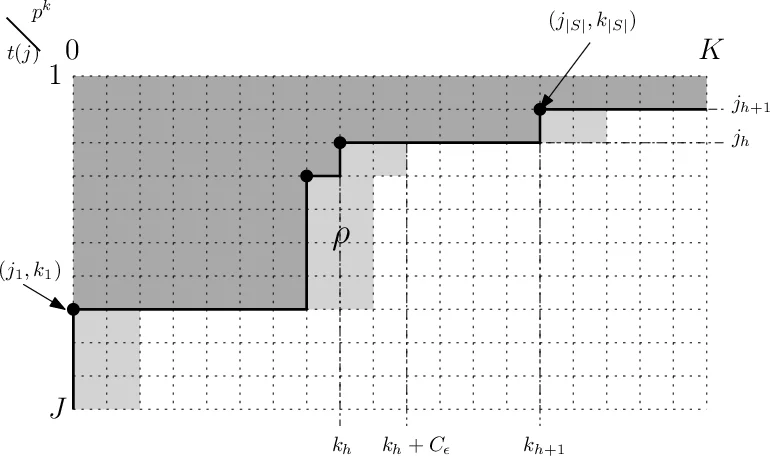
“1‑in” solutions and stairways – They restrict attention to solutions where the highest‑profit item is definitely inserted (called a 1‑in solution). By constructing a grid whose rows correspond to the significant times (size (J = O(\frac{1}{\varepsilon}\log T))) and whose columns correspond to profit classes (size (K = O(\frac{1}{\varepsilon}\log T))), they define a “stairway” as a monotone path that moves down in time and up in profit class. Each stairway encodes a possible pattern of when items of a given profit class first appear in the knapsack. Lemma 5 shows that the number of distinct stairways is bounded by (2K+J+1), i.e., polynomial in (\frac{1}{\varepsilon}\log T).
-
Disjunctive integer programming formulation – For each stairway they build a partial assignment of items to times, and combine all such assignments into a disjunctive IP. The feasible region of this IP is the union of the regions defined by each stairway, and it captures exactly the 1‑in, ε‑well‑behaved solutions.
-
LP relaxation and rounding – Solving the linear relaxation of the disjunctive IP yields a fractional solution (x^*) that is integral on almost all variables; the remaining fractional components are confined to a limited set of “critical” time‑profit cells. The authors devise a greedy‑like rounding procedure that selects items in decreasing profit‑to‑weight ratio within those cells, guaranteeing that the loss in profit is at most an additional (\varepsilon) fraction.
-
Algorithm and complexity – The algorithm enumerates all polynomially many stairways, solves the corresponding LPs, applies the rounding, and keeps the best integral solution found. The total running time is (O\bigl(T\cdot h(\varepsilon)\cdot \text{LP}(n)\bigr)), where (h(\varepsilon)) depends only on (\varepsilon) and (\text{LP}(n)) is the time to solve an LP with (O(n)) variables and constraints. Consequently, for any fixed (\varepsilon>0) the algorithm runs in time polynomial in (n) and (T) and returns a ((1-\varepsilon))-approximate solution.
-
Extensions and related work – The paper discusses how the same framework can be adapted to variants such as multiple profit levels per item, non‑linear capacity growth, or additional constraints. It also positions the result relative to earlier work on IIK, the generalized assignment problem, multiple knapsack, and unsplittable flow, highlighting that the presented PTAS subsumes all previously known approximation results for IIK.
In summary, the authors settle the approximability of the Time‑Invariant Incremental Knapsack problem by providing a PTAS that works for arbitrary numbers of periods, using a novel combination of instance discretization, stairway‑based disjunctive modeling, and careful LP rounding. This advances the theoretical understanding of knapsack‑type problems in dynamic settings and opens the door for practical algorithms in finance, public‑sector planning, and other domains where resources grow over time.
Comments & Academic Discussion
Loading comments...
Leave a Comment