UAV Offloading: Spectrum Trading Contract Design for UAV Assisted 5G Networks
Unmanned Aerial Vehicle (UAV) has been recognized as a promising way to assist future wireless communications due to its high flexibility of deployment and scheduling. In this paper, we focus on temporarily deployed UAVs that provide downlink data of…
Authors: Zhiwen Hu, Zijie Zheng, Lingyang Song
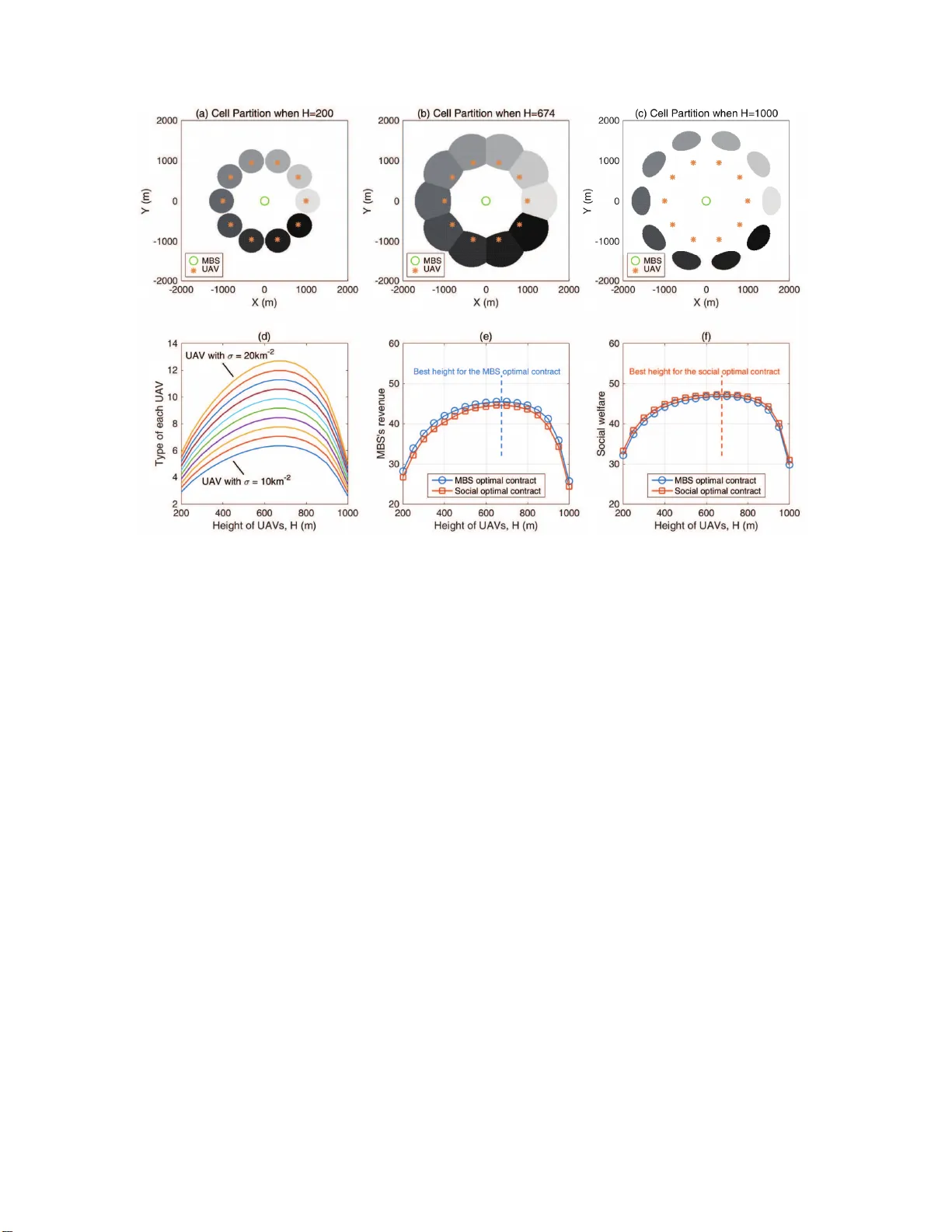
1 U A V Of floading: Spectrum T rading Contract Design for U A V Assisted 5G Netw orks Zhiwen Hu, Zijie Zheng, Lingyang Song, T ao W ang, and Xiaoming Li School of Electronics Engineering and Computer Science, Peking University , Beijing, China Email: { zhiwen.hu, zijie.zheng, lingyang.son g , w angtao, lxm } @pku.edu . cn Abstract Unmanne d Aerial V ehicle (U A V) has been recogn ized as a pro mising way to assist future wireless commun ications due to its high flexibility of deployment and schedulin g. In this pap er , we focus on temporar ily deployed U A Vs that provide downlink data offloading in some region s un der a macr o b ase station (MBS). Since the manager of the MBS and the operato rs of the U A Vs co uld b e of different interest group s, we for mulate the corresponding spectrum tr a ding pro blem by means of contract theo r y , where the m anager of the MBS h as to de sign an optimal c o ntract to maximiz e its own re venue. Such contract comprises a set o f bandwid th options and correspon ding prices, and each UA V o p erator only cho oses the most profitable one fr o m all the options in the wh o le contract. W e an alytically derive the optimal pricin g strategy based o n fixed bandwid th assignm ent, and then p ropo se a d y namic pro g ramming algorithm to calc u late the o p timal ban d width assignment in p olyno mial time. By simu lations, we comp are th e outcome of the MBS optimal contract with that o f a social optim al on e, a n d find that a selfish M BS manager sells less bandwid th to th e U A V op e r ators. Index T erms Unmanne d a e rial vehicles, cellula r networks, con tract theor y , dyna m ic p rogram ming. 2 I . I N T R O D U C T I O N The rapid development of wireless com munication enabled small-scale unmanned aerial ve- hicles (U A Vs) has created a variate of civil applications [1], from car go delivery [2] and remote sensing [3] t o data relaying [4] and connecti vity m aintenance [5], [6]. From the asp ect of wireless communication s , on e major adv antage of utilizing U A Vs i s t h eir high probabilit y o f keeping lin e- of-sight (LoS) si gnals wit h other communi cati on nodes, alleviating the problem brought by sev ere shadowing in urban or m ountainous terrain [7], [8]. Different from high-alti t ude pl atforms which are desi gned for l ong-term assign ment above tens of kil ometers height [9], small-scale U A Vs within only hu n dreds of meters off the ground can be deployed more quickl y . In addi t ion, the properties like low-cost, high fle xibilit y and ease of scheduli n g also make s mall-scale U A Vs a fa vorable choice i n civil u sages, in sp ite of their disadvantages su ch as low battery capacity [10]. One of the major problems in the U A V ass isted wireless comm unications is to opt i mally deploy U A V s , in which wa y m obile users can be better served [10]. Many s t udies have been done to deal wit h th is problem from distinctive viewpoints w i th respect to different objectives and constraints [11]–[23]. Amon g them, the works in [11 ]–[14 ] considered the scenario con s isting only one UA V to provide with coverage, the works in [15]–[18] took int o account mul tiple U A Vs to providing better services by joint coverage, and the works in [19]–[23] studied the coexistence of base stations (BSs) and mu l ti-U A Vs, where data offloading becomes a major problem. T o be specific, in [11], the optimal height of a single U A V was deduced to maximize the cove rage radius. The authors of [12] minim i zed t he transm i ssion powe r of t he U A V with fixed cove rage radius. The problem o f maximizing the number of users that covered by one U A V is studied in [13]. And the authors of [14] further took i nto account t h e int erference from de vice-to- device (D2D) users. For mult i ple U A Vs, the cov erage probabi l ity o f a g round user was deriv ed in [15] . The work in [16] proposed a solutio n to minimize the nu mber of U A Vs to cover all the users. The authors of [17] studied t he deployment of multi ple U A Vs to achieve largest total cove rage area. And in [18], the total t ransmission power of U A Vs was mi nimized while the data rate for each user was guaranteed. W i t h the consideration of BSs in the scenario, the gain of deploying additional U A Vs for offloading was discussed i n [19]–[21]. Th e authors of [22] focused on the optimal cell partition strategy to min imize a verage delay of the users in a cellular 3 network wi th multi ple U A Vs. In [23], the optimal resource allocati o n was presented, where one MBS, multipl e small-cell base station s (SBSs) and m ultiple U A Vs are i n volved. Although U A V coverage and offloading problem s have been widely discus s ed, fe w existi n g studies consider the situ ation w h ere U A V operators could be selfish in dividuals w i th differ ent objective s [24]. For inst ance, the venue owners and scenic area managers may want t o temporarily deploy their own U A Vs t o better serve their vi sitors, due to th e t emporarily increased number of mobile users or t h e incon venience of install ing SBSs in remote areas [25]. In such cases, the deployment of mul tiple UA Vs d epend s on each U A V operator , and th e solution is not likely to be optimal as calculated by centralized algorithms . In addi tion, the wireless channel allocation becomes a more criti cal p roblem since the bandwi dth that the U A Vs used to serve mobil e users has to be explicitl y authorized by th e MBS manager . Therefore, further st udies n eed to be done with respect to selfish U A V operators in U A V assis t ed of floading cellular networks. In this paper , w e focus on the s cenario with one MBS that managed by the MBS manager , and multi p le SBS-e nabled U A Vs that owned by diffe rent U A V operators. T o enabl e do wnlink transmissio n s of t he U A V s , each U A V op erator h as to buy a certain amount of bandwidth that authorized b y th e MBS manager . Ho we ver , the total usable bandwidt h of the M BS i s limi ted, and selling part of the total b andwidth to the U A Vs may harm the capacity of the MBS. Therefore, payments to the M BS manager should be made by U A V operators. Here, contract theory [26] can be appli ed as a tool to analyze the o ptimal contract that the MBS m anager wil l design to maximize its revenue. Specifically , such contract compris es a set of bandwi dth o ptions and corresponding prices. Since each U A V operator on l y chooses t h e mos t profitabl e opti o n from the whole contract, the MBS manager has to guarantee that the contract i s feasible, i.e., t he o ption that a U A V operator chooses from the contract is exactly the one that designed for it. The main contributions of our work are list ed as below: 1) W e formulate the opti m al contract design problem where th e selfish MBS manager has to decide t he number of channels and th e amount of price that designed for each type of selfish U A V operator in order to realize data offloading. 2) W e analyt ically deduce the optim al pricing s trategy and propose our d y namic p rog ramming algorithm to achiev e the optimal bandwidth allocation ef ficiently . 4 3) W e re veal som e signi ficant insights based on the simulatio n results, e.g., the selfish MBS manager s ells less bandw i dth t o the U A V operators compared wit h a social optimal result. The rest of our paper is organized as fol l ows. Section II presents our sys tem model and formulates the optimal contract design problem. Section III th eoretically d edu ces the optim al solution and provides our dynamic programming al g orithm. Section IV focuses on the height of the U A Vs and discuss its impact o n the re venue of the MBS manager . Section V s h ows the simulatio n results of the optim al contract. Finall y , we conclude our paper in Section VI. I I . S Y S T E M M O D E L UAV 1 MBS UAV 2 MBS Downlink Mobile User UAV Downlink MBS Manager UAV Operator Taking Charge 1 2 Fig. 1. The system model of U A V Assisted Offloading in Cellular Networks with 1 MBS manager and multiple UA V operators. W e consider a scenario with one MBS that run by the MBS manager , and N U A Vs that run by N different U A V operators, as shown in Fig. 1. The U A Vs that deployed by the U A V op erators are assum ed to serve mobi le users with l icensed spectrum 1 , and to be deployed at a unified altitude H (designated by the MBS m anager) and at diffe rent fixed horizontal location s. Each U A V operator first has to b uy a certain amo unt of bandwidth from t he MBS manager , where the utilit y and the cost of each individual should be addressed. In the rest part of this section, we first present the wireless downlink model of the MBS and the U A Vs, t hen int roduce the utili ty of the U A V operators as well as the cost of t h e MBS manager , and finally formulate the contract design problem. 1 The wireless backhaul connections between the UA Vs and the MBS, ho we ver , are assumed to follow the standard MBS-SBS communication regulations, and thus is not our major concern in this paper . 5 A. W ir eless Downlink Model The air- to-ground wireless channel between a U A V and a mobil e user mainly consists of two p arts , which are the Line-of-Sight (LoS) component and the None-Lin e-of-Sight (NLoS) component [8]. Based on t h e study in [11], the probabil ity of LoS for a user with eleva tion angle θ (in d egree) to a specific U A V i s given by P LoS ( θ ) = 1 1 + a exp − b [ θ − a ] , where a and b are the parameters that depend on the specific terrain (like urban, rural, etc.). Based on P LoS , the ave rage pathloss from the U A V to the user can be given by (in dB): L U AV ( θ , d ) = P LoS ( θ ) · L LoS ( d ) + 1 − P LoS ( θ ) · L N LoS ( d ) , L LoS ( d ) = 20 log (4 π f d/c ) + η LoS , L N LoS ( d ) = 20 log (4 π f d/c ) + η N LoS , (1) where c i s the s peed of light, d is the distance between the U A V and the user , and f is the frequency of the channel. L LoS ( d ) and L N LoS ( d ) are th e pathloss of the L o S component and t he pathloss of the NLoS com ponent, respectively . η LoS , η N LoS are the av erage additional loss that depends on the en vironment. In cont rast to the U A V -to-user w i reless channel, the MBS-to-user channels are considered as NLoS only , which give s us the a verage p at h loss as: L M B S ( d ) = 20 log (4 π f d/c ) + η N LoS . (2) For sim plicity , we assume that diffe rent channels has similar f and t he dif ference can be ignored. T o see t h e signal qu ali ty that each user could experience, we use γ M B S ( d ) to denote the Signal-to-Noise Ratio (SNR) for MSB users at the distance d from t h e MBS. And we have γ M B S ( d ) = P M B S − L M B S ( d ) / N 0 , where P M B S is t h e t ransmission po wer of t h e M BS and N 0 is t he power of b ackgrou n d noi se. Similarly , we use γ U AV ( d, θ ) to d eno te the SNR for the U A V users with ele vation angle θ and d istance d from a certain U A V , given as γ U AV ( d, θ ) = P U AV − L U AV ( d, θ ) / N 0 , where P U AV is the transmiss i on power of t he U A V . It is also assumed that each user can automatically choose among the MBS and the U A Vs to obtain the best SNR. Therefore, it is necessary t o find out in whi ch region a certain U A V is able to provide b etter SNR t han the others (including the MBS and the other U A Vs). W e denot e the region wh ere U A V n provides better SNR as U A V n ’ s effecti ve offloading region, denoted by Ω n . Let Λ n ( x ) d eno te the b o olean variable that indicates whether the user with the location x (a two-dimension al vector) is in Ω n . Thus the area of Ω n can be calculated by S n = R Λ i ( x ) d x . 6 B. The Ut ility of the U A V operators Each mob ile us er i n an ef fectiv e offl oading region is assum ed to access to the U A V randomly . W e call the d ensity of the users in Ω n that want to connect to UA V n at any inst ant as the “active user density” o f U A V n , denoted by σ n . And the corresponding concept, “activ e user number” ε n , describing the number o f users that want to s et up connects w i th UA V n in any mo m ent, is given by ε n = S n σ n . W e assume that σ n obeys Poisson distribution with mean value of ρ n . Consi d erin g a giv en l o cation o f U A V n (which makes S n a constant), ε n also becomes an Poisson-di stribution var iable, with mean v al u e µ n = S N ρ n . Based on µ n , we can class ify the U A Vs into m ultiple types. Specifically , we refer to U A V n as a λ -type U A V if µ n = λ , whi ch means that t h ere are a veragely λ users connecting to U A V n at any instant. The number of λ -type U A Vs is denoted by N λ , where P λ N λ = N . For writin g simpl i city , we use random variable X λ (instead of ε n ) to denote the activ e u s er number of a λ -type U A V . The probabilit y of X λ = k is giv en by P ( X λ = k ) = ( λ ) k k ! e − λ , k = 0 , 1 , 2 , · · · (3) W itho u t th e l oss of generality , we assu me that each mo bile us er connecting to a U A V (or the MBS) is allocated wit h one channel with fixed bandwidth B , in a frequency division pattern. Due to the variation of the activ e user num ber , there is always a probability that an U A V fails to serve the current active users. Th erefore, the more channels are being obtained, the more u tility the U A V can achieve. The utilit y function of obtainin g w channels for a λ -type U A V is denot ed by U ( λ, w ) . Since the utilit y of obt aining n o channels is 0 , we have U λ, w = 0 , w = 0 . (4) The mar ginal utility of obtaining another channel d epend s on the probability that the current number of channels is not sufficient for random user request s. Thus we have U λ, w = U λ, ( w − 1 ) + P ( X λ ≥ w ) , w ≥ 1 . (5) Based on (4) and (5), we can derive the general term of t h e λ -t y pe U A V ’ s utilit y as U λ, w = k = w X k =1 P ( X λ ≥ k ) , w ≥ 1 . (6) 7 C. Cost o f the MBS manager It is assumed that th e MBS w i ll not reuse the spectrum that i s already s old, which impl ies the MBS manager suf fers a certain degree of loss as it sells the spectrum to U A V operators. The activ e u ser number of the M BS is also assumed to follow the Poisson dis tribution. W e denote this random variable as X B S and the mean value of it as λ B S . Therefore we hav e P ( X B S = k ) = ( λ B S ) k k ! e − λ BS , k = 0 , 1 , 2 , · · · (7) The total num ber of channels of the MBS is denoted by M , M ∈ Z + . Just li ke t he situation of U A Vs , there is also a utili t y of a certain num ber o f chann el s for the MBS manager , U B S ( m ) , representing the av erage number of users that m channels can serve, giv en as U B S m = 0 , m = 0 , (8) U B S m = U B S m − 1 + P ( X B S ≥ m ) , m ≥ 1 . (9) Based on the utility of the MBS manager , we define the cost function C m as the utility loss of reducing the number of channels from M to M − m , giv en as C m = U B S M − U B S M − m = M X k = M − m +1 P ( X B S ≥ k ) . (10) D. Cont ract F ormul ation Since different t ypes of U A Vs hav e different demands, the MBS m anager has to design a contract which contains a set of “quality-price” opti ons for all the U A V operators, denoted by n w ( λ ) , p ( λ ) ∀ λ ∈ Λ o . In this contract, w ( λ ) i s the number of channels that designed to s ell to a λ -type U A V o perator , and p ( λ ) is the corresponding price designed to be charged. Each w ( λ ) , p ( λ ) pair can be seen as a comm odity wit h quality w ( λ ) at price p ( λ ) . Howe ver , each U A V operator is expected t o choose the on e t h at maximize its own profit according to the whole contract. The contract i s feasible i f and onl y if any λ -type U A V operator prefers the commodit y w ( λ ) , p ( λ ) to all the o t hers [27]. An d to achieve this, the first requr- rement is the incentive compatib l e (IC) condit ion, implying th at the commo d i ty designed for a λ -type U A V operator in the contract is indeed the best one for i t, giv en by U λ, w ( λ ) − p ( λ ) ≥ U λ, w ( λ ′ ) − p ( λ ′ ) , ∀ λ ′ 6 = λ. (11) 8 The second requirement is the individual rational (IR) conditi on, meanin g that the λ -ty pe U A V operator will not buy any channels if all of the op tions bring negati ve profits, given by U λ, w ( λ ) − p ( λ ) ≥ U λ, 0 − 0 = 0 , (12) where U λ, 0 − 0 impli es an “empty commod i ty” in the cont ract, wh ich has no utili ty and no price to be char ged. T o put it sim ple, a feasible contract has to satisfy the IC constraint and t h e IR constraint, and any con t ract that satisfies the IC and IR const rain t s is feasible. For the MBS manager , the overall re venue broug ht by the contract { w ( λ ) , p ( λ ) | ∀ λ ∈ Λ } is R = X λ ∈ Λ N λ · p ( λ ) − C X λ ∈ Λ N λ · w ( λ ) , (13) where N λ · p ( λ ) is t he total payment o btained from λ -type U A V operators, and P λ ∈ Λ N λ · w ( λ ) is the total nu m ber of channels that being sold. T h e objective of the MBS manager is to desi g n proper w ( λ ) and p ( λ ) for any given λ ∈ Λ , in whi ch way it can maximize it s own reve nue wi t h the pre-consideration of each U A V operator’ s b ehavior , g iven as ˆ R = max { w ( λ ) } , { p ( λ ) } X λ ∈ Λ N λ · p ( λ ) − C X λ ∈ Λ N λ · w ( λ ) , s.t. U λ, w ( λ ) − p ( λ ) ≥ U λ, w ( λ ′ ) − p ( λ ′ ) ≥ 0 , ∀ λ, λ ′ ∈ Λ and λ ′ 6 = λ, U λ, w ( λ ) − p ( λ ) ≥ 0 , ∀ λ, λ ′ ∈ Λ and λ ′ 6 = λ, p ( λ ) ≥ 0 , w ( λ ) = 0 , 1 , 2 · · · ∀ λ ∈ Λ , X λ ∈ Λ N λ · w ( λ ) ≤ M , (14) where the first t wo cons t raints represent the IC and the IR, and th e last one indi cates the limi ted number o f channels pos sessed by the MBS. In the rest part of our paper , t he quali t y assi gnment w ( λ ) , and the pricing strategy p ( λ ) , are the two most basic concerns. In addition, we call the contract that optimi zes the problem in (14) as th e “MBS optimal contract”. I I I . O P T I M A L C O N T R AC T D E S I G N In this secti o n, we exploit some basic properties of our probl em in Section III-A. By uti lizing these properties, we provide the optimal pricing strategy based on the fixed quality assignm ent in Section III-B. Next, we analyze and transform t he optim al quality assignment problem in 9 Section III-C, in which way it can be s olved by the proposed dynami c p rog ram m ing algorithm giv en in Section III-D. And finally we discuss the social opti m al contract i n Section III-E. T o facilitate the writing o f our fol lowing d i scussions, we put all the types { λ } in the ascending order , give n by { λ 1 , · · · λ t , · · · λ T } where 1 ≤ t ≤ T and λ t 1 < λ t 2 if t 1 < t 2 . Note that, in this case we call λ t 1 as a “lower type” and λ t 2 as a “higher type”. In addition , we also simpl ify N λ t as N t , w ( λ t ) as w t and p ( λ t ) as p t in the discussio n s below . A. B a sic Pr operti es W e first take a look at the u t ility function U ( λ, w ) . As giv en in Fig. 2, we can see that the marginal util ity for a U A V operator d ecreases as the quality w gets larger . In addi tion, a U A V with higher type ( λ = 1 8 ) consider a certain bandwidt h quality w more valuable than a l ower type ( λ = 12 ). T o prove the above observations, we first ha ve t o provide a mo re b asic conclusion with respect to a property of Poiss on distribution, on which the utilit y functio n is defined. 0 10 20 30 w 0 5 10 15 20 U ( λ , w ) (a) UA V’s utility function λ =18 λ =12 0 10 20 30 m 0 5 10 15 20 C ( m ) (b) MBS’s cost function M=120 Fig. 2. An i l lustration of the profiles of the U A V’ s utili ty function and the MBS’ s cost function. Lamma 1. Given th a t X λ and X λ ′ ar e t wo P oiss o n distribution random variables with mean values λ and λ ′ r espectively , if λ > λ ′ > 0 , then P ( X λ ≥ k ) > P ( X λ ′ ≥ k ) fo r any k ∈ Z + . The proof o f Lemma 1 can be found i n Appendix A. This lem m a is particularly singled ou t since it is used in many of the following proposit i ons. Pr oposition 1. The utility functio n U ( λ, w ) monotonously incr eases with the type λ and the quality w , wher e λ > 0 and w ∈ N . In addit i on, the mar gina l in cr ease of U ( λ, w ) with r espect to w gets smaller as w incr eases. 10 The p roof o f Propositio n 1 is provided in Appendix B. This proposition provides a basic property for us to desig n the optimal contract in the rest of our paper . From Fig. 2 (a) we can also notice that U ( λ, w ) con verges t o a fixed value as w → ∞ , given by lim w →∞ U λ, w = ∞ X k =1 P ( X λ ≥ k ) = ∞ X k =1 k · ( λ ) k k ! e − λ = ∞ X k =0 k · ( λ ) k k ! e − λ = λ. (15) Intuitively , the utili t y of a λ -type U A V cannot excee d its active user num ber ev en if excessi ve channels are allocated. Such conclusion provides another way to comprehend the m eaning of U ( λ, w ) , that is, the number of effecti vely served users of the U A V . Based on Lem m a 1 and Proposition 1, we exploit another important property o f U ( λ, w ) , which says that a certain amount of quality improvement is m o re attracti ve t o a hi gher type U A V than a lower t ype U A V . This property can b e referred to as the “increasing preference (IP) property”, and we write it as the fol lowing propo sition: Pr oposition 2. (IP pro perty) : F or any U A V types λ > λ ′ > 0 and channel qualiti es w > w ′ ≥ 0 , the following inequalit y holds: U ( λ, w ) − U ( λ, w ′ ) > U ( λ ′ , w ) − U ( λ ′ , w ′ ) . The proof of IP property is giv en in Appendix C. W i t h the help of this property , we are able to deduce the best pricing strategy in the next sub section. B. Op timal Pricing Strate gy In this subsection , we use fixed quality ass i gnment { w t } to analyti call y deduce the optimal pricing strategy { p t } . Based on the pre v i ous w ork on contract theory (such as in [27]), the IC & IR constrain t s and the IP property of the utili t y functio n in a contract design problem can di rectly lead t o the conclusion as below: Pr oposition 3. F or th e con tract ( w t , p t ) with the IC & IR constraints and the IP pr operty , the following statements ar e s imultaneousl y satis fi ed: • The relation of types a n d qualities: λ i < λ j = ⇒ w i ≤ w j . • The relation of qual ities a nd prices: w i < w j ⇐ ⇒ p i < p j . This conclusi on contains basic properties o f a feasible cont ract. It indicates that a h igher price has to be asso ciated with a hi gher qualit y , and a higher quality m eans higher price sho uld b e char ged. Althoug h dif ferent qualities are not allowed to be associated with the s ame price, it is 11 still possib l e that different types of U A Vs are assig n ed with the same channel qualit y and t hus the same price. Lamma 2. F or the contract ( w t , p t ) with the IC & IR constraint s and the IP pr operty , th e folowing thr ee conditio ns ar e the necessary condition s and sufficient cond i tions to determi n e a feasible pricing: • 0 ≤ w 1 ≤ w 2 ≤ · · · ≤ w T , • 0 ≤ p 1 ≤ U ( λ 1 , w 1 ) , • p k − 1 + A ≤ p k ≤ p k − 1 + B , for k = 2 , 3 , · · · , T , wher e A = U ( λ k − 1 , w k ) − U ( λ k − 1 , w k − 1 ) and B = U ( λ k , w k ) − U ( λ k , w k − 1 ) . The proof of Lemma 2 is given in Appendix A. It provides an important guideline to design the prices for differe nt types of U A Vs. It im plies that with fixed qual i ty ass i gnment { w t } , the proper scope of the price p k depends on the value of p k − 1 . In the following, we provide the optimal pricing strategy of the MBS m anager wit h fixe d quality assignm ent { w t } . Here we call { w t } a feasible qualit y ass i gnment if w 1 ≤ w 2 ≤ · · · ≤ w T , i.e., the first condit ion in Lemma 2 shou l d be satisfied. The maximu m achieva ble revenue of the MBS manager with fixed and feasible quality assignment { w t } is give n by R ∗ { w t } = max { p t } " T X t =1 N t · p t − C T X t =1 N t · w t # . (16) From the above equation we can see that, the key poi nt i s to maximize P T t =1 N t · p t , since the cost functio n is constant with fixed quality assignment { w t } . Accordingly , we provide the following propositi on for t h e opti m al pricing strategy: Pr oposition 4. (Optim al Pricing Strategy) : Given that ( w t , p t ) is a feasible cont ract wit h feasible quality assignment { w t } , the unique optimal pricing strate gy { ˆ p t } is: ˆ p 1 = U ( λ 1 , w 1 ) , ˆ p k = ˆ p k − 1 + U ( λ k , w k ) − U ( λ k , w k − 1 ) , ∀ k = 2 , 3 , · · · , T . (17) Its proo f is given in Appendix E. Accordin g to this propositio n, we writ e the general formul a of the optimal prices { ˆ p t } as ˆ p t = U ( λ 1 , w 1 ) + t X i =1 θ i , ∀ t = 2 , · · · T , (18) 12 where θ 1 = 1 and θ i = U ( λ i , w i ) − U ( λ i , w i − 1 ) for i = 2 , · · · T . Th e optimal pricing strategy is able to m axi mize R and achiev e R ∗ with any giv en feasible quality ass ignment. Howe ver , what { w t } is able to maximi ze R ∗ and achie ve the overall m aximum value ˆ R is stil l unso l ved. C. Opti mal Quality Assignment Pr o blem In thi s subsection, we analyze the optimal quality assi g nment problem based on the results i n Section III-B, and transform this problem into an easier form, as a preparation for the d ynamic programming algorithm in Section III-D. The optimal quality assignment problem is given by ˆ R = max { w t } h R ∗ { w t } i , s.t. T P t =1 N t w t ≤ M , w 1 ≤ w 2 ≤ · · · ≤ w T , and w t = 0 , 1 , 2 · · · (19) where R ∗ ( { w t } ) is th e best rev enue of a g iven quali ty assignment as given in (16 ). Due to the optimal pricing { ˆ p t } in (18), we derive the expression of R ∗ { w t } as follows: R ∗ { w t } = T P t =1 N t · ˆ p t − C T P t =1 N t · w t = T P t =1 N t h U ( λ 1 , w 1 ) + t P i =1 θ i i − C T P t =1 N t · w t = T P i =1 U ( λ i , w i ) · T P t = i N t + T − 1 P i =1 h U ( λ i +1 , w i ) · T P t = i +1 N t i − C T P t =1 N t · w t = T P t =1 C t · U ( λ t , w t ) − D t · U ( λ t +1 , w t ) − C T P t =1 N t · w t , (20) where C t = T P i = t N i , D t = T P i = t +1 N i for t < T , and D T = 0 . Here, we are able to g uarantee that C t > D t ≥ 0 , ∀ t = 1 , 2 , · · · , T , since N t > 0 , ∀ t = 1 , 2 , · · · , T . As we can observed from (20), w i and w j ( i 6 = j ) are separated from each other i n the first term . This is a non- negligible im provement to find th e best { w t } . Definition 1. A set of f u nctions n G t ( w t ) t = 1 , 2 , · · · T o , with the quali t y w t as the in d ependent variable of G t ( · ) , with C t and D t ( C t > D t ≥ 0 ) as the constant s of G t ( · ) , is given by: G t ( w t ) = C t · U ( λ t , w t ) − D t · U ( λ t +1 , w t ) , w t = 0 , 1 , 2 , · · · ∀ t = 1 , 2 , · · · T . (21) Based on (20) and Definition 1, we ha ve R ∗ { w t } = T P t =1 G t ( w t ) − C T P t =1 N t · w t . The meaning of G t ( w t ) is the independent gain of setting w t for the λ t -type U A Vs regardless of the cost. 13 Based on { G t ( w t ) } , we can rewrite the opt imization problem in (19) as: ˆ R = max { w t } " T P t =1 G t ( w t ) − C T P t =1 N t w t # s.t. T P t =1 N t w t ≤ M , w 1 ≤ w 2 ≤ · · · ≤ w T , and w t = 0 , 1 , 2 · · · (22) This problem can be further transformed into an equivalent one, give n by ˆ R = max { W = 0 , 1 , ··· ,M } ( max { w t } T P t =1 G t ( w t ) − C W ) , s.t. T P t =1 N t w t ≤ W, w 1 ≤ w 2 ≤ · · · ≤ w T , and w t = 0 , 1 , 2 · · · (23) From t his formulation, we can see that the opt i mal revenue can be acquired by trying each possible W as the numb er of channels being sold . For each fixed W , we o nly hav e to focus on how to maximize T P t =1 G t ( w t ) , given as max { w t } T P t =1 G t ( w t ) , s.t. T P t =1 N t w t ≤ W, w 1 ≤ w 2 ≤ · · · ≤ w T , and w t = 0 , 1 , 2 · · · (24) By calcul ati ng all the best results of (24) with different po s sible v alues of W , we are able to obtain the optim al solu tion o f (23) by further taking into account C ( W ) . Therefore, we regard (24) as t he ke y problem to be solved. The proposed dynam i c program- ming algorithm for this problem is presented i n the next sub section. D. Al gorithm for the MBS Optimal Contract In what foll ows, we first show the way o f consid ering (24) as a dist inctive form of t he knaps ack problem [28], th en provide our recurrence formu la to calculate its maximum value G max , next present the m ethod to find the p arameters { w t } that achieve G max , and finally provide an overvie w of whole solution including the optim al quali ty assignment { ˆ w t } and the optim al pricing { ˆ p t } . 1) A special knapsa ck pr obl em: First, we have t o take a look at t he constraints abou t the optim ization parameters { w i } . Since w i = 0 , 1 , 2 · · · and P T t =1 N t w t ≤ W , we ha ve w t ≤ W . T o distinguish from the notation of weight in the following di s cussions, we use K ins t ead of W as the comm on upper boun d of w t , ∀ t ∈ [1 , T ] , where K ≤ W . And we rewrite the cons traint as w t ≤ K . Therefore for each t , there 14 are totally K + 1 optional values of w t , giv en by { 0 , 1 · · · K } . And the corresponding results of G t ( w t ) are { G t (0) , G t (1) , G t (2) , · · · , G t ( K ) } , wh ich represent the values of different object that we can choose. In addition, we in t erpret the cons traint P T t =1 N t w t ≤ W as the w ei g h t cons traint in the knapsack probl em, where W is the weigh t capacity of the bag and setting w t = k means taking up the weight of k N t . T ABLE I A L L T H E O P T I O NA L O B J E C T S T O B E S E L E C T E D T ype Optiona l V alues Corresponding W eights 1 T ype λ 1 G 1 (0) G 1 (1) G 1 (2) · · · G 1 ( K ) 0 N 1 2 N 1 · · · K N 1 2 T ype λ 2 G 1 (0) G 2 (1) G 2 (2) · · · G 2 ( K ) 0 N 2 2 N 2 · · · K N 2 · · · · · · · · · · · · T T ype λ T G T (0) G T (1) G T (2) · · · G T ( K ) 0 N T 2 N T · · · K N T For the con venience of understandin g, we l i st t he values and the weight of different options in T abl e I. Each row presents all the options of a type and we should choose an o ption for each type. An d the k th option in the t th row provides us wit h the value of G t ( k ) and the weigh t of k N t . Due to the cons traint of w 1 ≤ w 2 ≤ · · · ≤ w T , we cannot choose t he ( k + 1) th , ( k + 2) th · · · options in the t th row if we have already chosen t h e k th option in the ( t + 1) th row . Therefore, the algorithm introduced below is basically to start from the last row and end at t h e first row . 2) The re curr ence fo rmula to calculate the maximum value G max : The key natu re of designing a dynam i c programmi ng algorithm is to find the sub-problems of the overall problem and write t h e correct recurrence formula. Here we define O P T ( t, k , w ) , ∀ t ∈ [1 , T ] , ∀ k ∈ [0 , K ] and ∀ w ∈ [0 , W ] , as the optimal outcome that includes th e decision s from the T th row to the t th row , wit h the conditions that 1) the k th option in the t th row is chosen and 2) the occupied weight i s no more than w . Since the alg orithm starts from the T th row , we first provide the calculation of O P T ( T , k , w ) , ∀ k ∈ [0 , K ] and ∀ w ∈ [0 , W ] , given as O P T T , k , w = G T ( k ) , if w ≥ k N t , −∞ , if w < k N t , (25) where −∞ implies that O P T ( T , k , w ) is impossible to be achieve d due to the lack of weight capacity . This expression is straight forward s i nce it only includes the T th row in T able I. From 15 O P T T , k , w , we can calculate O P T t, k , w for all t ∈ [1 , T − 1] , k ∈ [0 , K ] and w ∈ [0 , W ] by the following recurrence formula: O P T t, k , w = max l = k , ·· · ,K h G t ( k ) + O P T t + 1 , l , w − k N t i , if w ≥ k N t , −∞ , if w < k N t . (26) The meaning of this formula is: If we want to choose k in th e t th row , then the optio n that made in the ( t + 1) th row must be within [ k , K ] d u e to the constraint of w 1 ≤ · · · ≤ w T . In addition , choosing k in t he t th row with total weight limi t of w in dicates that there is only w − k N t left for t he o ther ro ws from t + 1 to T . And if w − k N t < 0 , the ou t come is −∞ since choosing k in the t th row is impo ssible. Let G max denote max { w t } T P t =1 G t ( w t ) , then we hav e the following expression: G max = max k =0 ··· K h O P T 1 , k , W i . (27) It means that we have to calculate O P T ( 1 , k , W ) for all k ∈ [0 , K ] , whi ch can be obtained by iterativ ely us i ng (26). 3) The metho d to find the parameters { w t } that achiev e G max : Note th at the above calcul ati on o n l y cons i der the value of the opti m al result G max . T o record what exact values of { w t } are chosen for t h is o p timal result by the algori t hm, we have to add another data structure, given as D ( t, k , w ) . W e let D ( t, k , w ) = l if O P T ( t, k , w ) chooses l to maximize its value in the upper l ine of (26), which is giv en by D t, k , w = ar g max l = k , ·· · ,K h G t ( k ) + O P T t + 1 , l , w − k N t i , if w ≥ k N t , 0 , if w < k N t . (28) After acquiring G max in (27), we can use D ( t, k , w ) to in versely find t h e opti mal values of { w t } along the “path” of the optim al solution. Specifically , we have ˆ w 1 = arg max k =0 ··· K h O P T 1 , k , W i , ˆ w t = D t − 1 , ˆ w t − 1 , W − t − 2 P i =1 ˆ w i N i , ∀ t = 2 , · · · , T , (29) where we define P t − 2 i =1 ˆ w i N i as 0 if t − 2 = 0 , just for writi ng si m plicity . 16 4) An overview of whole s olution: By now , we have presented the key part of our soluti on, i.e., th e dy n am ic programming algorithm to solve the optimi zation prob lem i n (24). The probl em in (23), i.e., our final goal, can be directly solved by setting different values of W in (24) and compare the corresponding results with the consideratio n of C ( W ) . An overvie w of our entire solut i on is given in Al gorithm 1. It can be observed th at t h e computational complexity of calculat i ng O P T ( t, k , w ) for all k ∈ [0 , K ] , w ∈ [0 , W ] and t ∈ [1 , T ] is O ( T K 2 W ) . Therefore, the ov erall com plexity is O ( M T K 2 W ) , which can also be written as O ( T M 4 ) since W ≤ M and K ≤ W . Alt hough M 4 seems to be n on-negligible, there are usually no more than hundreds of av ailable channels of a MBS to be allocated in practice. Algorithm 1: The algorit hm of optimal contract for U A V of floading. Input: T ype information { λ 1 , · · · λ T } , { N 1 , · · · N T } , and the number of total channels M . Output: Optimal pricing strategy { ˆ p 1 , · · · ˆ p T } , optimal quality assignment { ˆ w 1 , · · · ˆ w T } . 1 begin 2 Calculate G t ( k ) for all t ∈ [1 , T ] and k ∈ [0 , M ] by (21); 3 Calculate C ( m ) for all m ∈ [0 , M ] by (10); 4 Initialize ˆ R = 0 , w t = 0 for all t ∈ [1 , T ] , and p t = 0 for all t ∈ [1 , T ] ; 5 f or W is fr om 0 to M do 6 Let K = W , to be the upp er bound for each w i ; 7 Calculate O P T ( T , k , w ) for ∀ k ∈ [0 , K ] and ∀ w ∈ [0 , W ] by (25); 8 Calculate O P T ( t, k , w ) for ∀ k ∈ [0 , K ] , ∀ w ∈ [0 , W ] and ∀ t ∈ [1 , T − 1] by (26); 9 Acquire G max from { O P T (1 , w , t ) } according to (27 ); 10 if G max − C ( W ) > ˆ R then 11 Update the overall maximu m rev enue ˆ R = G max − C ( W ) ; 12 Update ˆ w t for all t ∈ [1 , T ] according to (28) and (29); 13 Update ˆ p t for all t ∈ [1 , T ] based on { ˆ w t } according to (17); 14 end 15 end 16 end E. S o cial Optimal Contract T o better discuss the effecti veness of the above MBS op timal contract, in th e fol lowing, we briefly discuss another contract that aims to maxim i ze social welfare. In our context, social 17 welfare indicates the sum of t h e re venue of t he MBS and th e total profits of the U A Vs, w h ich also m eans the i n crease of t he numb er o f users t h at can be served by the overall system . The objective is given by ˆ S = max { w ( λ ) } , { p ( λ ) } X λ ∈ Λ N λ · U λ, w ( λ ) − C X λ ∈ Λ N λ · w ( λ ) , (30) where the first term is the to t al utilit y of the U A Vs, the s econd term is the cost of the M BS, and we omit the constraint s si n ce they are the same with tho s e in (14 ). This opt imization p roblem has a simi lar s t ructure wi th (14) and can be solved by the proposed dynamic programm ing algorithm with only minor changes. T o calculate the optimal { w ( λ ) } and { p ( λ ) } , we need to replace G t ( k ) by N t U ( t, k ) in line 2 of T able I. In addition, we use U max to replace G max to represent the m axi mum overall utility of the U A Vs. At last, the equation i n line 11 of T able I should be replaced by ˆ S = U max − C ( W ) t o represent the m aximum so ci al welfare. For writ i ng con venience, in the rest part of this paper , we call th e solut ions of (14) and (30) as the “MBS optimal contract” and the “social optim al contract”, respectiv ely . In addition, the relation of social welfare and MBS’ s revenue i s il lustrated i n Fig. 3. Cos t o f t he MBS Man ag er R even ue of t he MB S Man ag er To tal Pr ofits of all th e U A Vs To tal Ut ilities of all t he UA Vs Soci al W elfar e To tal Pr ice Be ing C harg ed Fig. 3. The r el at i on of the social welfare, the re venu e of the MBS manager , and t he t otal profit of the U A Vs operators. I V . T H E O R E T I C A L A NA L Y S I S A N D D I S C U S S I O N S In this s ection, we briefly di scuss the i mpact of th e height of the U A Vs, H . Since H influences the optimal re venue of th e MBS ˆ R , through the types of the U A Vs { λ t } , we first discuss the impact of H on { λ t } in Section IV -A and th en discus s the impact of { λ t } on ˆ R in Section IV -B. A. The Impa ct of the Height on the U A V T ypes Pr oposition 5. W i t h fixed transmi ssion power P U AV and P M B S , fixed terrain parameters a , b , η Los and η N LoS , fixed average active user density σ n , fixed hori zontal locatio n s of the U A Vs , 18 and un ified height H ∈ [0 , + ∞ ) of th e UA Vs, ther e exists a height ˆ H n that can maxi m i ze the effec tive offloading a rea of U A V n . The proof of this p rop osition is given in App endix F. From thi s proposition, we know that in the process of H va rying from 0 t o + ∞ , d i ff erent U A Vs are able to achie ve their maxim um effecti ve offl oading areas at differe nt heights. Ho wev er , if all the U A Vs are horizontally symm etrically distributed around the MBS (as shown in Fig. 7 in Section V -B ), their opti mal heights wi ll be the same since the U A Vs have symm etrical positions. Therefore, there is a globally optim al height ˆ H that can m aximize S n , for all n ∈ { 1 , 2 , · · · N } . Due to the fact that the types of the U A Vs is giv en by λ n = σ n S n , we can also achiev e t he largest type for each U A V . B. The Impa ct of the U A V T ypes on the Optimal Revenue For any two random sets of types { λ 1 , · · · λ T 1 } and { λ ′ 1 , · · · λ ′ T 2 } , there is n o obvious relation of the outcomes of the correspondin g two MBS optimal contracts. Howe ver , some properties can be explored wh en we add some constraints , as given in the following propos ition: Pr oposition 6. Given a fixed number of types T , two sets of types { λ t } , { λ ′ t } , an d the constraint λ t ≤ λ ′ t , ∀ t ∈ [1 , T ] , we have ˆ R ≤ ˆ R ′ , wher e ˆ R is t he MBS’ s r evenue of a MBS optimal contract with inputs { λ t } and ˆ R ′ is the MBS’ s r evenue of a MBS optimal contract with inputs { λ ′ t } . The proof of this propos ition is given in Appendi x G. W ith Proposit ion 5 and Propositio n 6, we can directly obtain a conclu s ion th at , there exists a highest va lue of the MBS’ s re venue by manipul ating t he height of the UA Vs , as long as the U A Vs are horizontall y symmetrically distributed around the MBS, as shown in Section V -B. V . S I M U L A T I O N R E S U LT S In t his section, we sim ulate and comp are the outcomes of th e MBS optimal cont ract and the social o p timal contract under different setti ngs. Simulati o n setup s are given in Section V -A, simulatio n results and corresponding discussi o ns are provided in Section V -B . A. S i mulation S et u ps W e set M withi n [100 , 300] , which is suf ficient to generally ev aluate a real system such as L TE [29]. The terrain parameters are set as a = 11 . 95 and b = 0 . 1 36 , in dicating a typ i cal 19 urban en vironment. W e also set the transmiss ion power as P U AV < P M B S , due to t he typical consideration of U A Vs that they hav e lim ited battery capacities. Details of the settings of all the parameters can be found in T able II. T ABLE II S I M U L AT I O N PA R A M E T E R S T errain parameters a and b 11 . 95 and 0 . 136 Additional pathloss parameters η N OLS and η LO S 2 and 20 T ransmission power P M BS and P U AV 10 W and 50 mW Do wnlink transmission frequency f 3 GH z Height of U A Vs H ( m ) between 200 and 1000 A verage acti ve user density σ n ( k m − 2 ) between 10 and 20 Number of U A Vs’ types T between 1 and 20 Number of each type of UA Vs { N t } between 1 and 10 A verage acti ve user number of U A Vs { λ t } between 1 and 20 A verage acti ve user number of MBS λ BS between 10 and 200 Number of total channels of MBS M between 100 and 300 In the following si m ulations, we first study the U A V of floading sys t em b ased on given U A V types (i.e., fixed acti ve user number for each U A V), from which we can acquire basic comprehension of t he MSB optimal contract and the social optim al contract. Then we further study a more practical scenario where the heigh t of the U A Vs determines the t ypes of them. B. S i mulation Res u l ts and Discussions W e first il l ustrate t he typical s t ructure of t he contract that designed according to our algorithm , as given in Fig. 4, where we set T = 10 , { N t } = (1 , 1 , · · · 1) , { λ t } = (1 , 2 , · · · 10) , and M = 2 0 0 . All the fou r subplots show the pat t erns of { w t } , { p t } , and { U ( t, w t ) − p t } wi t h respect to differe nt type λ t . T o be specific, subplot s (a) and (b) show the results of lightly loaded MBS ( λ B S = 120 ) while (c) and (d) show th e resul ts o f hea vi ly loaded MBS ( λ B S = 16 0 ). In addi t ion, subplots (a) and (c) are the outcom es of MBS op t imal contracts wh i le (b) and (d) are t he outcom es of social optim al contracts. In any one of t h es e subplots, we can see that a higher t ype of U A V is allocated with more channels but also a hig her p rice. It can also be observed t h at a higher type gains more p rofit compared with a lower type, i.e., U ( i, w i ) − p i ≤ U ( j, w j ) − p j as long as i < j . In Fig. 4 (a), it is noticeable that for λ 8 , λ 9 and λ 10 -types, th e allocated channels exceed their respective av erage us er numbers. Such phenomenon is quite reasonable si nce a U A V needs more channels w than its a verage active u s er numb er λ to deal with the situati o n of burst access. 20 0 2 4 6 8 10 Index of UAV type, t 0 5 10 15 (a) MBS Optimal, Lightly Loaded MBS P N t w t = 60 Average user number Allocated bandwidth Price being charged Profit 0 2 4 6 8 10 Index of UAV type, t 0 5 10 15 (b) Social Optimal, Lightly Loaded MBS P N t w t = 71 Average user number Allocated bandwidth Price being charged Profit 0 2 4 6 8 10 Index of UAV type, t 0 5 10 15 (c) MBS Optimal, Heavily Loaded MBS P N t w t = 39 Average user number Allocated bandwidth Price being charged Profit 0 2 4 6 8 10 Index of UAV type, t 0 5 10 15 (d) Social Optimal, Heavily Loaded MBS P N t w t = 45 Average user number Allocated bandwidth Price being charged Profit Fig. 4. The structure of the optimal contracts where T = 10 , { N t } = (1 , 1 , · · · 1) , { λ t } = (1 , 2 , · · · 10) , and M = 200 , with λ BS = 120 for (a) and (b), and λ BS = 160 for (c) and (d). In addition, (a) and (c) show MBS optimal contracts while (b) and (d) show social optimal contracts. And due to the IP property , hig her types consider additi onal channels more valuable than lower types. Therefore, o n ly λ 8 , λ 9 and λ 10 -types are allo cated with excessi ve channels. By com paring Fig. 4 (a) wi t h Fig. 4 (b), or Fig. 4 (c) with Fig. 4 (d), we find that a social optimal contract allocates more channels than a M BS optim al contract, where we hav e 60 agains t 71 in (a) and (b), and 39 again s t 45 in (c) and (d). It can be consid ered th at a social optim al contract i s more “generous” than a MBS optimal contract. By comp aring Fig. 4 (a) with Fig. 4 (c), or Fig. 4 (b) with Fig. 4 (d), we can also find the dif ference of the numbers of totall y allocated channels . This is because the cos t of a heavily loaded MBS allocatin g th e same number of channels is greater than that of a light ly lo aded MBS. T o better explain the aforementioned bandw i dth differ ences, we provide Fig. 5 to show how social welfare and the MBS’ s re venue change during the algo rithm with W setting from 0 to M (as described in line 5 in T able I). In Fig. 5 (a), the upmost blue curve shows th e change of social welfare during the s ocial opt i mal al g o rithm. The highest po i nt o f this curve represents the corresponding social optimal cont ract, which makes W = 7 1 just as giv en i n Fig. 4 (b). The lowe rmost orange curve shows the corresponding change of the MBS’ s revenue durin g the 21 50 55 60 65 70 75 80 Allocated bandwidths during the algorithm 20 25 30 35 40 45 50 55 60 65 70 Social welfare or MBS's revenue (a) Lightly Loaded MBS MBS optimal outcome Social optimal outcome Social welfare in social optimal algorithm MBS's revenue in social optimal algorithm Social welfare in MBS optimal algorithm MBS's revenue in MBS optimal algorithm 30 35 40 45 50 55 60 Allocated bandwidths during the algorithm 10 15 20 25 30 35 40 45 50 55 60 Social welfare or MBS's revenue (b) Heavily Loaded MBS MBS optimal outcome Social optimal outcome Social welfare in social optimal algorithm MBS's revenue in social optimal algorithm Social welfare in MBS optimal algorithm MBS's revenue in MBS optimal algorithm Fig. 5. The change of social welfare and MBS’s rev enue during the social optimal al gorithm and MBS optimal algorithm, where T = 10 , { N t } = (1 , 1 , · · · 1) , { λ t } = (1 , 2 , · · · 10) , M = 200 , with λ BS = 120 for (a) and λ BS = 160 for (b). social opt imal algorith m . For the MBS opt i mal algorithm , the resulting curve o f the the M BS’ s re venue l i es above the orange one from the social opti mal algorithm, while the resultin g curve of social welfare l ies below the blu e one from the social optimal algorithm. Since the two groups of curves do not coincide, we can deduce that the structure of the solutions of the two algorit h ms are not identical. For a fixed W , the MBS optim al algorithm somehow changes the allocation of channels among differ ent t ypes to increase th e MBS’ s re venue, which result s in a reduction of social welfare. A n d the bandwidth allocation of the M BS opt imal contract is W = 60 , j ust as give n in Fig. 4 (a). In Fig 5 (b), w e also show the situatio n of heavily l o aded MBS, where the relation of these curves are similar , as w ell as the reason that causes this . Fig. 6 i llustrates the i mpacts of λ B S (i.e., the load of the MBS) on the di f ferent part of the utility of the whole syst em as presented in Fig. 3. From Fig. 6 (a) we can see that, the difference of allocated channels between the MBS opt imal contract and the social opt i mal contract becomes smaller as the load of MBS gets heavier . This is due t o the fact th at the cost of M BS rises fast when it is hea vily loaded and neither the MBS opt imal or the social op t imal contract can allocate enough channels as desired. Fig. 6 (b) s h ows us t hat the M BS optim al contract is abl e to guarantee a high level of total pri ces that being char ged as the MBS is not heavily loaded. In addit ion, the total pri ces being charged according to the social optimal contract is not monot o nous and may rapidly change. For the case λ B S > 150 , although the tot al price being char ged in the M BS 22 0 50 100 150 200 Average user number of MBS, λ BS 0 50 100 150 200 Totol bandwidth being sold (a) MBS optimal Social optimal 0 50 100 150 200 Average user number of MBS, λ BS 10 15 20 25 30 35 40 Totol price being charged (b) MBS optimal Social optimal 0 50 100 150 200 Average user number of MBS, λ BS 0 10 20 30 40 MBS's revenue (c) MBS optimal Social optimal 0 50 100 150 200 Average user number of MBS, λ BS 0 10 20 30 40 50 60 Social welfare (d) MBS optimal Social optimal Fig. 6. The i mpacts of λ BS , where T = 10 , { N t } = (1 , 1 , · · · 1) , { λ t } = (1 , 2 , · · · 10) and M = 200 . optimal contract is lower than t hat in t h e social optimal contract, the final rev enue of t he MBS is still higher in t h e MBS optimal contract as shown in Fig. 6 (c). This is because the MBS optimal contract has less total bandwidth bein g sol d, whi ch reduces the cost of the MBS. The social welfare is giv en in Fig. 6 (d), which implies that for both MBS and soci al opt i mal cont racts, a hea vier loaded MBS could bring a lower overa ll system ef ficiency . Finally , we take a lo ok at the im pact of the height of the UA Vs , as presented in Fig. 7, where M = 20 0 , λ B S = 150 . The considered 10 U A Vs are located 1000 m horizontally from the MBS and symmetrically dis tributed. The average activ e user density of the ef fectiv e offloading region of U A V n (i.e., σ n ) is set from 10 k m − 2 to 20 k m − 2 . From the top three su bplots in Fig. 7 , we can see that the of floading regions of these UA Vs first expand then shrink when t he height of the U A Vs monot onously increases. The maximum offloading areas can be achiev ed at H = 67 4 , where the U A Vs can cover the largest number of active users, as given in Fig. 7 (d). In addition, the MBS’ s rev enue can be m aximized wh en offloading areas become the largest, as discussed in Section IV. It can also be observed in Fig. 7 (f) that the profile of t he social welfare i n th e MBS optimal contract is very close to that of that social welfare in the social optim al contract. In addition, the best heig h t for the social opti mal cont ract ( H = 676 ) is very close to the best 23 Fig. 7. The impact of the height of U A Vs. The subplots (a), (b) and (c) sho w the top views of the cell partition with different height settings. The white areas represent MBS’ s effecti ve service region s, while gray areas represent UA Vs’ effecti ve of floading regions. T he subplot (d) provides the impact on t he type of each UA V with dif ferent activ e user density . The subplots (e) and (f) i l lustrate the impacts of the height of U A Vs on “MBS’ s re venu e” and “social welfare”, respectiv el y . height for the M BS opti m al contract ( H = 674 ). Th erefore, we can infer that, t he height H that designated by the selfish M BS manager will generally keep a high social welfare. In other words, th e performance of the overall system will not be si gnificantly i mpaired. V I . C O N C L U S I O N In this paper , we focused on the scenario w h ere the U A Vs were deployed in a cellar network to better serve local mobile users. Considering the selfish MBS manager and the s elfish U A V operators, we modeled the uti l ities and the costs of spectrum trading among them and formulated the problem of designi ng the optimal contract for the MBS manager . T o deduce the op timal contract, we first d erived the optimal p ri cing strategy based on a fixed quality assi g nment, and then analyze and transform the optimal quality assi gnment problem, in which way it can b e solved by the prop o sed dyn amic prog ram m ing algorit hm in polynomial time. In the si mulations , 24 by comparing with th e social optimal contract, w e found that the MBS optimal contract allocated fe wer channels to the U A Vs to guarantee a lower leve l of costs. M oreover , the best height of the U A Vs for the selfish MBS manager can keep a high performance of the overall system. A P P E N D I X A P R O O F O F L E M M A 1 Pr oof : Consider X α as a Poisson dist ribution random variable with mean value α , we have P ( X α ≥ k ) = 1 − P ( X α < k ) = 1 − e − α k − 1 P i =0 α i i ! . Since α can be a real number in its definition domain, we derive the deri vati ve of P ( X α ≥ k ) wit h respect to α , given as ∂ P ( X α ≥ k ) ∂ α = e − α k − 1 X i =0 α i i ! − e − α ∂ ∂ α k − 1 X i =0 α i i ! . For k = 1 , ∂ ∂ α k − 1 P i =0 α i i ! = 0 . An d for k > 1 , ∂ ∂ α k − 1 P i =0 α i i ! = k − 1 P i =1 α i − 1 ( i − 1)! = k − 2 P i =0 α i i ! . Therefore, we ha ve ∂ P ( X α ≥ k ) ∂ α = e − α α k − 1 ( k − 1)! > 0 , ∀ k ∈ Z + and α > 0 . W ith any g iv en λ > λ ′ > 0 , we can deduce that P ( X λ ≥ k ) − P ( X λ ′ ≥ k ) = R λ λ ′ ∂ P ( X α ≥ k ) ∂ α dα > 0 , ∀ k ∈ Z + . A P P E N D I X B P R O O F O F P RO P O S I T I O N 1 Pr oof : Consider a fixed value w ∈ N and λ > λ ′ > 0 . If w = 0 , we have U ( λ, w ) = U ( λ ′ , w ) = 0 according to the d efinition. If w > 0 , then U ( λ, w ) − U ( λ ′ , w ) = k = w P k =1 P ( X λ ≥ w ) − P ( X λ ′ ≥ w ) > 0 according to Lemm a 1 . Therefore, U ( λ, w ) mon otonously i ncreases with λ . Now consider a fixed λ > 0 and ∀ w > w ′ ≥ 0 , where w , w ′ ∈ N . W e h a ve U ( λ, w ) − U ( λ, w ′ ) = P ( X λ ≥ w ) + · · · + P ( X λ ≥ w ′ + 1) ≥ P ( X λ ≥ w ) > 0 . Therefore, U ( λ, w ) monotonou s ly increases with w . For a fixed λ > 0 and ∀ w ≥ 1 , we hav e U ′ ( w ) = U ( λ , w ) − U ( λ, w − 1) = P ( X λ ≥ w ) . And for w ≥ 2 , we hav e U ′′ ( w ) = U ′ ( w ) − U ′ ( w − 1 ) = − P ( X λ = w − 1) < 0 . Therefore, the marginal increase of U ( λ, w ) with respect to w gets sm aller as w increases. 25 A P P E N D I X C P R O O F O F P RO P O S I T I O N 2 Pr oof : Accordin g to the definitions of the utilit y functio n in (8) and (9), we hav e U ( λ, w ) − U ( λ, w ′ ) = P ( X λ ≥ w ) + · · · + P ( X λ ≥ w ′ + 1) , (31) U ( λ ′ , w ) − U ( λ ′ , w ′ ) = P ( X λ ′ ≥ w ) + · · · + P ( X λ ′ ≥ w ′ + 1) . (32) Based on Lem ma 1, each term in (31) is greater than each corresponding term in (32). Therefore we can obtain U ( λ, w ) − U ( λ, w ′ ) > U ( λ ′ , w ) − U ( λ ′ , w ′ ) . A P P E N D I X D P R O O F O F L E M M A 2 Pr oof : Necessity: These 3 conditi ons can be d educed from the IC & IR constraints and the IP property as follows: 1 ) Since { λ 1 , λ 2 , · · · λ T } is written in the ascendin g order , we hav e 0 ≤ w 1 ≤ w 2 ≤ · · · ≤ w T and 0 ≤ p 1 ≤ p 2 ≤ · · · ≤ p T according to Proposition 3 , where w i = w i +1 if and only if p i = i i +1 . 2 ) Consi dering the IR constraint o f λ 1 -type U A Vs, we can directly obtain 0 ≤ p 1 ≤ U ( λ 1 , w 1 ) . Here, if w x = 0 , then U ( λ t , w t ) = 0 and p t = 0 for any t ≤ x . 3) Considering the IC cons traint for the k -type and the ( k − 1 ) -type where k > 1 , the correspon ding expressions are giv en by U ( λ k , w k ) − p k ≥ U ( λ k , w k − 1 ) − p k − 1 , and U ( λ k − 1 , w k − 1 ) − p k − 1 ≥ U ( λ k − 1 , w k ) − p k . As we focus on the possibl e scope of p k , we can deduce that p k − 1 + U ( λ k − 1 , w k ) − U ( λ k − 1 , w k − 1 ) ≤ p k ≤ p k − 1 + U ( λ k , w k ) − U ( λ k , w k − 1 ) . Sufficienc y: W e have t o prove that the prices { ( p t ) } determi ned by t hese condit ions satisfy the IC and IR constraints. And the basic idea is to use m athematical inducti on, from ( w 1 , p 1 ) to ( w T , p T ) , by adding the q uality-price terms once at a time i nto the who l e contract. For writing simplicit y , the contract that only contain s the first k types o f U A Vs i s denoted as Ψ( k ) , where Ψ( k ) = ( w t , p t ) , 1 ≤ t ≤ k . First, we can verify that w 1 ≥ 0 and 0 < p i < U ( λ 1 , w 1 ) provided by the abov e conditions is feasible in Ψ(1 ) , since the IR constraint U ( λ 1 , w 1 ) − p i > 0 is satisfied and the IC constraint is not useful in a s ingle-type contract. 26 In the rest part of our proo f, we show that if Ψ( k ) is feasible, then Ψ( k + 1) is also feasible, where k + 1 ≤ T . T o this end, we need to prov e that (1) the newly added λ k +1 -type comp lies with its IC and IR constrain t s, given by U ( λ k +1 , w k +1 ) − p k +1 ≥ U ( λ k +1 , w i ) − p i , ∀ i = 1 , 2 , · · · , k , U ( λ k +1 , w k +1 ) − p k +1 ≥ 0 , (33) and (2) t h e existing k typ es still comply with their IC constraints with the addition of λ k +1 -type, giv en by U ( λ i , w i ) − p i ≥ U ( λ i , w k +1 ) − p k +1 , ∀ i = 1 , 2 , · · · , k . (34) F irst, we pr ove (33): Since Ψ( k ) is feasible, the IC constraint of λ k -type should b e satisfied, giv en b y U ( λ k , w i ) − p i ≤ U ( λ k , w k ) − p k , ∀ i = 1 , 2 , · · · , k . Based on t he righ t inequal- ity in the third cond ition, we hav e p k +1 ≤ p k + U ( λ k +1 , w k +1 ) − U ( λ k +1 , w k ) . By adding up these two inequ ali ties, we hav e U ( λ k , w i ) − p i + p k +1 ≤ U ( λ k , w k ) + U ( λ k +1 , w k +1 ) − U ( λ k +1 , w k ) , ∀ i = 1 , 2 , · · · , k . According to the IP property , w e can obtain that U ( λ k , w k ) − U ( λ k , w i ) ≤ U ( λ k +1 , w k ) − U ( λ k +1 , w i ) , ∀ i = 1 , 2 , · · · , k , s ince λ k +1 > λ k and w k ≥ w i . Again, by combini n g these two inequalities together , we can prove the IC constraint of the λ k +1 -type, giv en by U ( λ k +1 , w k +1 ) − p k +1 ≥ U ( λ k +1 , w i ) − p i , ∀ i = 1 , 2 , · · · , k . The IR con s traint of the λ k +1 -type can be easil y deduced from the above IC const rain t since U ( λ k +1 , w i ) − p i ≥ U ( λ i , w i ) − p i ≥ 0 , ∀ i = 1 , 2 , · · · , k . And therefore, we have U ( λ k +1 , w k +1 ) − p k +1 ≥ 0 . Then, we pr ove (34): Since Ψ( k ) is feasible, the IC constraint of λ i -type, i = 1 , 2 , · · · , k , should be satisfied, given by U ( λ i , w k ) − p k ≤ U ( λ i , w i ) − p i , ∀ i = 1 , 2 , · · · , k . Based on t h e left inequality in the third condition , we ha ve p k + U ( λ k , w k +1 ) − U ( λ k , w k ) ≤ p k +1 . By adding up the above t wo inequaliti es, we hav e U ( λ i , w k ) + U ( λ k , w k +1 ) − U ( λ k , w k ) ≤ U ( λ i , w i ) − p i + p k +1 ∀ i = 1 , 2 , · · · , k . According to the IP property , we can obtain that U ( λ i , w k +1 ) − U ( λ i , w k ) ≤ U ( λ k , w k +1 ) − U ( λ k , w k ) , ∀ i = 1 , 2 , · · · , k ,since λ k ≥ λ i and w k +1 ≥ w k . Again, by combining the abov e two inequalities t o gether , we can prove the IC constraint of the existing types, λ i , ∀ i = 1 , 2 , · · · , k , giv en by U ( λ i , w i ) − p i ≥ U ( λ i , w k +1 ) − p k +1 . So far , we have proved that Ψ(1) is feasible, and if Ψ( k ) is feasible then Ψ( k + 1) is also feasible. W e can conclud e that the final cont ract Ψ( T ) whi ch includes all the t y pes is feasible. Therefore, these three necessary conditio n s are also sufficient condi t ions. 27 A P P E N D I X E P R O O F O F P RO P O S I T I O N 4 Pr oof : By comparing (17) wit h Lemma 2 , we can find that { ˆ p t } is a feasible prici n g strategy . In the following, we first prove that { ˆ p t } is optimal, then prove that it is uniq u e. Optimality: In the condition that q u ality assignment { w t } is fixed, { ˆ p t } is optimal if and only if P T t =1 N t · ˆ p t ≥ P T t =1 N t · p t , where { p t } is any pricin g strategy t hat satisfies the conditions in Lemma 2. Let’ s assume that there exists another better s trategy { ˜ p t } for the MBS manager , i.e., P T t =1 N t · ˜ p t ≥ P T t =1 N t · ˆ p t . Since N t > 0 for all t = 1 , 2 , · · · , T , there is at least one k ∈ { 1 , 2 , · · · , T } that satisfies ˜ p k > ˆ p k . T o guarantee t h at { ˜ p t } is still feasib l e, t he following inequalit y mu st b e complied wit h according to Lem m a 2: ˜ p k ≤ ˜ p k − 1 + U ( λ k , w k ) − U ( λ k , w k − 1 ) , if k > 1 . Since ˜ p k > ˆ p k , we have ˆ p k < ˜ p k − 1 + U ( λ k , w k ) − U ( λ k , w k − 1 ) , if k > 1 . By substitut i ng (17 ) i nto t he above in equality , we hav e ˜ p k − 1 > ˆ p k + U ( λ k , w k ) − U ( λ k , w k − 1 ) = ˆ p k − 1 , if k > 1 . Repeat thi s process and we can finally obtain the result that ˜ p 1 > ˆ p 1 = U ( λ 1 , w 1 ) , which contradicts wit h Lemma 2 where p 1 should not exceed U ( λ 1 , w 1 ) . Due to th is contradiction, the above assumption that { ˜ p t } is better than { ˆ p t } is imp o ssible. Therefore, { ˆ p t } is the optim al pricing strategy for t he MBS manager . Uniqueness: Assume that there exists another pricin g s t rategy { ˜ p t } 6 = { ˆ p t } , such that P T t =1 N t · ˜ p t = P T t =1 N t · ˆ p t . Since N t > 0 for all t = 1 , 2 , · · · , T , there is at least one k ∈ { 1 , 2 , · · · , T } that s at i sfies ˜ p k 6 = ˆ p k . If ˜ p k > ˆ p k , then the same contradictio n occurs just like we’ ve discuss ed above. If ˜ p k < ˆ p k , then th ere m ust e xist another ˜ p l > ˆ p l to maintain P T t =1 N t · ˜ p t = P T t =1 N t · ˆ p t . Either way , the contradiction is unav o idable, whi ch i mplies that the optimal pricing strategy { ˆ p t } is unique. A P P E N D I X F P R O O F O F P RO P O S I T I O N 5 Pr oof : W e u se φ (in radian) instead of θ (in degree) t o denote the elev ation angle, where φ = θ · π / 180 ◦ . For a user wit h horizontal distance r to the U A V , the avera ge pathloss is given by L U AV ( φ, r ) = L LoS ( d ) P LoS ( θ ) + L N LoS ( d ) 1 − P LoS ( θ ) . W ith m inor deducti on, we hav e L U AV ( φ, r ) = L N LoS ( d ) − η · P LoS ( θ ) , (35) 28 where η = η N LoS − η LoS < η N LoS , d = r cos φ , θ = 180 ◦ π φ . By denoting η N LoS as L 1 and η · P LoS ( θ ) as L 2 to simp l ify the writing, we can provide the follo wing assertio n s based on (1): As φ increases from 0 to π / 2 , L 1 increases monotono u sly from L N LoS ( r ) to infinity , while L 2 monotonou s ly i n creases wit hin a sub-in terva l of (0 , η ) . T herefore, 0 < L U AV (0 , r ) < L N LoS ( r ) , and L U AV ( φ, r ) → + ∞ as φ → π / 2 . In additio n , L U AV ( φ, r ) has lower bound, L N LoS ( r ) − η N LoS , in t he whol e definition domain [0 , π / 2] . By considering th e partial deriv ativ e of L U AV ( φ, r ) with respect to φ , we have ∂ L U AV ( φ, r ) ∂ φ = ∂ L 1 ∂ φ − ∂ L 2 ∂ φ = 20 ln 10 tan φ − 180 ◦ π − 1 abη exp [ − b ( θ − a )] { 1 + a exp [ − b ( θ − a )] } 2 . (36) where we ha ve ∂ L 1 /∂ φ = 0 as φ = 0 , ∂ L 1 /∂ φ → + ∞ as φ → + ∞ , and ∂ L 2 /∂ φ > 0 as ∀ φ ∈ [0 , π / 2) . Therefore, we can conclude that L U AV ( φ, r ) decreases near φ = 0 and rapidl y increases to + ∞ near φ = π / 2 . By now we hav e confirmed t h at : (a) L U AV ( φ, r ) decreases near π = 0 ; (b) L U AV ( φ, r ) increases to in finity as φ → π / 2 ; and (c) L U AV ( φ, r ) has a lower bo und in [0 , π / 2) . Therefore, there is at least one minim al value as φ ∈ (0 , π / 2) that is smaller t h an L U AV (0 , r ) , which makes t he existence of a minim um value as φ ∈ (0 , π / 2) . Fig. 8 provides a exemplary i llustration of L U AV ( φ, r ) with different r v alues. 0 0.5 1 1.5 Elev ation angle φ 80 100 120 140 Pathloss ˆ L U AV ( φ , r ) (a) Suburban Terrain r=300m r=100m 0 0.5 1 1.5 Elev ation angle φ 80 100 120 140 Pathloss ˆ L U AV ( φ , r ) (b) Dense Urban Terrain r=300m r=100m Fig. 8. (a) shows t he pathloss in a typical suburban terr ai n, where parameters a = 5 , b = 0 . 2 , η LoS = 0 . 1 , and η N LoS = 21 . (b) shows the pathloss i n a typical dense urban terrain, where parameters a = 14 , b = 0 . 12 , η LoS = 1 . 6 , and η N LoS = 23 . The effecti ve offloading region of the U A V , howev er , i s based on the SNR of each possible location. Rigorous mathematical analysis would be highly difficult, thus only a simpl e discussion is p rovided as following. Since we hav e ass umed t hat th e U A Vs h ave the same height and the fixed ho rizontal lo cations, we can first conclude that, if a user is horizontally nearest to U A V n , then the SNR from U A V n is alwa ys the lar gest among all the U A Vs no matter how large H is. 29 Therefore, the user partitio n amo n g U A Vs are i ndependent of H , and we o nly have to care abo u t whether the SNR from UA V n ( γ U AV n ) is greater than the SNR from the MBS ( γ M B S ). For any giv en location, t he scope of H that satisfies γ U AV n > γ M B S can be either an empty interval or one or more disjo i nt i ntervals (called as the effec tive heig h t interval of this u ser), depending on the number and the values of th e minimal points of L U AV ( φ, r ) . At t h e height of H , the effecti ve offloading area of U A V n , (give n b y S n ), depends on whether the va lue o f H resides in the the effecti ve height interval o f each poss i ble l ocation on t he ground. The theoretical deduction of the optimal height that maxim izes S n is i ntractable. Howe ver , the existence of such o ptimal heig ht can be guaranteed, s i nce the effec tive height intervals are ei t her empty or within [0 , + ∞ ) . A P P E N D I X G P R O O F O F P RO P O S I T I O N 6 Pr oof : For the MBS optimal contract based on { λ t } , the bandwidth all ocation is denoted as { w t } and t he corresponding cost of the MBS is denoted as C P w t . If we change the types from { λ t } to { λ ′ t } and assume t h at the bandwidth allocation remai n s to be { w t } , the cost of the MBS will still be C P w t . Since λ t ≤ λ ′ t , we ha ve U ( λ t , w ) < U ( λ ′ t , w ) according to Proposition 1. And based o n (17), we can deduce that p t will be greater , for any t = 1 · · · T . Therefore, the sum of prices will gets larger , and the reve nue of the MBS w i ll increase from ˆ R to ˆ R w . Note that the above discussion is b ased on t h e assump t ion that { w t } remain the same, which is probably no t an opti m al bandwidth allo cation for { λ ′ t } . If we run the alg orithm in Section III-D, the final rev enue ˆ R ′ that based on anot her bandwidth allocation { w ′ t } will be greater than ˆ R w . Therefore, we hav e ˆ R ≤ ˆ R w ≤ ˆ R ′ . R E F E R E N C E S [1] S . Hayat, E. Y anmaz, and R. Muzaf far , “Surve y on Unmanned Aerial V ehicle Networks for C iv il Applications: A Communications Vie wpoint, ” IEEE Communications Surve ys & T utorials , vol. 18, no. 4, pp. 2624-2661, Apr . 2016 . [2] N. R. Kuntz and Y . O. Paul, “Develop ment of autonomous cargo transport for an unmanned aerial vehicle using visual servoing , ” Asme Dynamic Systems & Contr ol Confer ence , vol. 7503, no. 39, pp. 731-73 8, 2008. [3] P . M. Olsson, J. K varnstr ¨ om, P . Doherty , O. Burdakov , and K. Holmberg, “Generating UA V Communication Net works for Monitoring and S urveillance, ” in P r oc. 2010 International Confer ence on Contro l Automation Robotics & V ision , Singapore, Dec. 2010. 30 [4] E. W . F rew and T X. Brown, “ Airborne Communication Networks for Small Unmanned Aircraft Systems, ” Pro ceedings of the IEEE , vo l. 96, no. 12, pp. 2008-20 27, Dec. 2008. [5] ˙ I. Bekmezci, O. K. S ahingoz, and S ¸ . T emel, “Flying Ad-Hoc Networks (F ANETs): A survey , ” Ad Hoc Networks , vol. 11, no. 3, pp. 1254-12 70, May 2013. [6] Y . Zeng, R. Zhang, and T . J. Lim, “Throughpu t Maximization for UA V -Enabled Mobile Relaying Systems”, IEEE T ransactions on Communications , vo l. 64, no. 12, pp. 4983-49 96, Dec. 2016. [7] R. Amorim, H. Nguyen, P . Mogensen, I. K ov ´ acs, J. W igard, and T . B. Sørensen, “Radio Channel Modelling for U A V Communication over Cell ular Networks”, IEEE W ir eless Communication s Letters , accepted. [8] D. W . Matolak and R. Sun, “Unmanned Aircraft Systems: Air-Ground C hannel Characterization for Future Applications, ” IEEE V ehicular T echnolog y Magazine , vol. 10, no. 2, pp. 79-85, June 2015. [9] S . Karapantazis and F . Pav lidou, “Broadband communications via high-altitude platforms: A survey , ” IEEE C ommunications Surve ys & Tu torials , vol. 7, no. 1, pp. 2-31, May 2005. [10] Y . Zeng, R. Zhang, and T . J. Lim, “Wireless Communications with Unmanned Aerial V ehicles: Opportunities and Challenges, ” IE EE Communications Magazin e , vol. 54, no. 5, pp. 36-42, May 2016. [11] A. Al-Hourani, S. Kandeepan, and S. Lardner , “Optimal LAP Altitude for Maximum Coverag e”, IEEE W ir eless Communications L etters , vol. 3, no. 6, pp. 569-572, Dec. 2014. [12] M. Mozaf fari, W . Saad, M. Bennis, and M. Debbah, “Drone Small Cells in the Clouds: Design, Deployment and Performance Analysis, ” in Pr oc. 2015 IEEE Global Communications Confer ence , San Diego, CA, USA, Dec. 2015. [13] M. Alzenad, A. El-Ke yi, F . Lagum, and H. Y anikome roglu, “3D Placement of an U nmanned Aerial V ehicle Base Station (U A V - B S) for Energy -Efficient Maximal Cov erage, ” IEEE W ir eless Communications Letters , accepted. [14] M. Mozaf fari, W . Saad, M. Bennis, and M. Debbah, “Unmann ed Aerial V ehicle W ith Underlaid De vice-to-De vice Communications: Performance and T r adeoffs, ” IEEE T ransa ctions on W ir eless Communications , vol. 15, no. 6, pp. 3949- 3963, June 2016. [15] V . V . C. Ravi and H. S. Dhillon, “Downlink Cov erage Probability in a Fi nit e Network of Unmanned Aerial V ehicle (U A V) Base Stati ons, ” in Proc. 2016 IEEE I nternational W orkshop on Signal Pr ocessing A dvances in W ir eless Communications , Edinbur gh, UK, July 2016. [16] J. Ly u, Y . Zeng, R. Z hang, and T . J. Lim, “Placement Optimization of UA V -Mounted Mobile B ase S tations, ” IEE E Communications L etters , vol. 21, no. 3, pp. 604-607, Mar . 2017. [17] M. Mozaf fari, W . Saad, M. Bennis, and M. Debbah, “Efficient Deploym ent of Multiple Unmanned Aerial V ehicles for Optimal Wireless Covera ge, ” IEEE Communications Letters , vol. 20, no. 8, pp. 1647-1650, Aug. 2016. [18] M. Mozaff ari, W . Saad, M. Bennis, and M. Debbah, “Optimal Tran sport Theory for P ower-Ef ficient Deployment of Unmanned Aerial V ehicles, ” in Proc . 2016 IEE E I nternetional Confer ence on Communication s , Ku ala Lumpur , Malaysia, May 2016. [19] S. Rohde and C. Wietfeld, “Interference A ware Positioning of Aerial Relays for Cell Ove rload and O utage Compensation, ” in Pr oc. 2012 IEEE V ehicular T echnolog y Confer ence , Quebec City , QC, Canada, Sept. 2012. [20] A. Merwaday and ˙ I. G ¨ uvenc ¸ , “UA V Assisted Heterogeneous Networks for Public Safety Communications, ” i n Pr oc. 2015 IEEE W ireless Communications and Net w orking Confer ence W orkshops , New Orleans, LA, USA, Mar . 2015, pp. 329-334. [21] V . S harma, M. B ennis, and R. Kumar , “U A V - Assisted Heteroge neous Networks for Capacity Enhancement, ” IEE E Communications L etters , vol. 20, no. 6, pp. 1207-1210, June 2016. 31 [22] M. Mozaff ari, W . S aad, M. B ennis, and M. Debbah, “Optimal Transp ort Theory for Cell Association in U A V - Enabled Cellular Networks, ” IEEE Communications Letters , accepted. [23] S. Jangsher , V . O. K. Li, “Resource Allocation in Moving Small Cell Network, ” IEEE Tr ansactions on W ireless Communications , vo l. 15, no. 7, pp. 4559-4570, July 2016. [24] C. A. W argo , G. C. Church, J. Glaneueski, and M. Strout, “Unmanned Aircraft Systems (U AS) Research and Future Analysis, ” in Pro c. 2014 IEEE Aerosp ace Confer ence , Big Sky , MT , USA, Mar . 2014 . [25] A. V alcarce, T . Rasheed, K. Gomez, S . Kandeepan, L. Reynaud, R . Hermenier , A. Munari, M. Mohorcic, M. Smolnikar , and I. Bucaille, “ Airborne base stati ons for emergenc y and temporary ev ents, ” Springer International Publishing , vol. 6, no. 2, pp. 49-58, 2013. [26] P . Bolton and M. Dewatripon t, Contract Theory , MIT press, London, England, 2005. [27] L. Gao, X . W ang, Y . Xu, and Q. Zhang, “Spectrum Trading in Cogniti ve Radio Networks: A Contract-Theoretic Modeling Approach”, I EEE Journa l on Selected Areas in Communications , vo l. 29, no. 4, pp. 843-855, Apr . 2011. [28] S. Martello and P . T oth. Knapsac k Pr oblems: Algorithms and Computer Implementations , John & Sons, Inc. New Y ork, USA, 1990 . [29] Evolved Universal T err estrial Radio Access (EUTR A) Physical Layer Proced ur es Release 12 , document 3GPP TS 36.213, Sep. 2014.
Original Paper
Loading high-quality paper...
Comments & Academic Discussion
Loading comments...
Leave a Comment