An Efficient Data-aided Synchronization in L-DACS1 for Aeronautical Communications
L-band Digital Aeronautical Communication System type-1 (L-DACS1) is an emerging standard that aims at enhancing air traffic management (ATM) by transitioning the traditional analog aeronautical communication systems to the superior and highly effici…
Authors: Thinh H. Pham, A. P. Vinod, A. S. Madhukumar
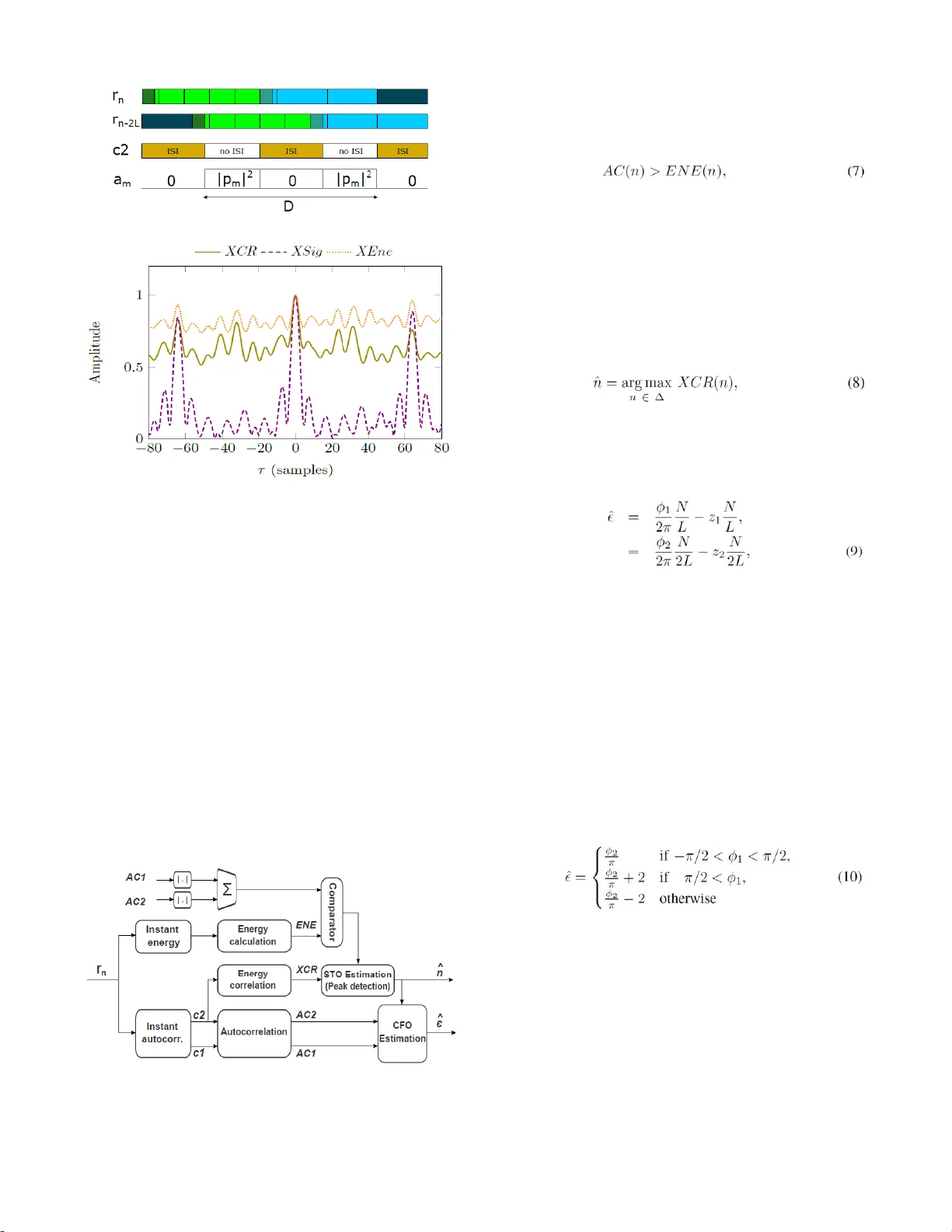
A n Efficient Data-aided Synchronization in L-D A CS1 for A eronautical Communications T. H . Pha m Scho ol of Co mpute r S cie nce an d Eng inee ri ng Nanyang Technologica l Univers ity Singapore 639798 pham _ht @nt u. edu .sg A. P. Vin od Scho ol of Co mpute r S cie nce an d Eng inee ri ng Nanyang Technologica l Universit y Singapore 639798 ASV ino d@nt u. edu .sg A. S. Mad huk um ar Scho ol of Co mpute r S cie nce an d Eng inee ri ng Nanyang Technologica l Uni versity Singapore 639798 asma dhuk u mar @nt u. ed u.s g ABSTRACT L-band Digital Ae ronautical Communication System type -1 (L- DACS1) is an emerging st andard that aims at enhancing air traffic management (ATM) by transitioning the traditional analog aeronautical communication systems to the superior and highly efficient digital domain. L-DACS1 employs modern and eff icient orthogonal frequency division multiplexing (OFDM) modulation technique to achieve m ore efficient and higher data rate in comparison to the existing aeronautical communication systems. However, the performance of OFDM systems is very sensitive to synchronization errors. L-DA CS1 transmission is in the L-band aeronautical channels that suff er from large in terference and large Doppler shifts, which makes the synchronization for L-DACS more challenging. This paper proposes a novel com putationally efficient synchronization method for L-DACS1 systems th at offers robust performa nce. Through simulation, the proposed method is shown to provide accura te symbol timing o ffset (STO) estimation as well a s f ractional ca rrier frequency offset (CFO) estimation in a range of aeronautical channels. In particular, it can yield excellent synchronization performa nce in the face of a large carrier frequency offset. Keywords L-DACS1, OFDM, Synchronization 1. INTRODUCTION Over the past tw o decades, the air transpo rt industry has experienced continuous grow th and the d emand for passenger air traffic is forecast to double th e current level by abou t 2025 [1]. The current air transportation system s will not be able to cope with this growth, e.g., already Very High Frequency communication capacity is expected to saturate in Europe by 2020-2025 [2]. Meeting these growing demands requ ire eff icient air- to -ground communication systems pro viding various d ata of airplanes in real-time. L-DACS is being proposed as a solution that can coexist with legacy L-band systems and aims to explore digital radio techniques to enable eff icient communication for next generation global ATM systems [3]. There are two specifications that are being reviewed for L -DACS, type- 1 (LDACS-1) and type-2 (LDACS- 2) . The type-1 (L-DACS1) specification defined by EUR OCONTROL [4] is the most promising and mature candidate for final selection. It is in tended to be operated in the frequency range th at is mainly utilized b y aeronautical navigation aids (e.g. the distance m easuring equipment (DME), the military Tactical Air Navigation (TACAN)). L-DACS1 em ploys OFDM m odulation that has been widely employed in various h igh bit-rate wireless tran smission systems (e.g. WiM AX, WiFi, etc.). OFDM is a modern and effective multi-carrier modulation technique with its advantages o f combating impulsive noise, ro bustness to multipath effects and spectral efficiency. Ho wever, OFDM performance is sensitive to receiver sy nchron ization. Carrier f requency offse t causes inter- carrier interference (ICI) and errors in timing s ynchronization can lead to inter-symbol interference (ISI) [5 ]. Theref ore, synchronization is critical to th e p erformance o f OFDM systems as well as L-DACS1. Many techniqu es have been proposed for effective OFDM synchronization in the literatu re that include both data -aided schemes [ 6-8], and blind schemes [9] , [10] . The latter schem es use inh erent structure of th e OFDM symbol (i.e. c yclic prefix). However, these methods usually require a large number of OFDM symbols leading to long dela y and large computation cost to achieve satisfactor y perfor mance. In contrast, the form er schemes employ training s ymbols (i.e. preamble) for either the auto - correlation of receiv ed preamble o r the cross -correlation between the copy of transmitted preamble and received symbol at the receiver. Auto-correlation based me thods for timing synchronization [ 8] rely on the repetitions of preamble that o ffer robustness to large CFO and multi-path channel with low computation al cost. These me tho ds are suitable f or coarse STO and CFO estim ation. In the a bsence of CFO, cross -correlation based methods achieve an excellent timing synchronization performance [ 6]. However, th e performance o f these methods degrades significantly du e to the present of large CFO . This limits their u se to fine ti ming estimation in synchronization schemes [7], [1 1 ], which u se auto-correlation for coarse timing and cross- correlation for fine timing esti mation. L-DACS1 transmission is operated in L-band aeronauti cal channels which suffer fro m large interference and larg e Do ppler shifts. S ynchronization of LDACS1 is hardly add ressed in literature. To the best of authors’ knowledge, th ere is on ly one synchronization method th at is presented for an optimized L-DACS1 receiver [ 1 2]. This me thod is based on blind schemes leadin g to requirements of lon g synchronization time and large co mputation cost, and it just tolerates a small CFO which is less than one subcarrier spacing. In this p aper, we propo se a novel data -aided synchronization method for L-DACS1 in which the preamble of OFDM frames in L-DACS1 a re em ployed. Both frequency offset estimation an d timing synchronization are completed within the d uration of this preamble. The proposed method introduces correlation-based timing metrics and an effective sche me that is su itable for computationally efficient hardware implementation. The proposed method is robust against large CFO and achieve accurate STO estimation as w ell as fra ctional CFO estima tion in a range of aeronautical channels. 2. LDACS1 SYNCHRONIZATION OFDM synchronization consists of S TO estimation and CFO estimation. STO estimation is to find th e f irst sam ple of each OFDM symbol to retrieve a co mplete OFDM s ymbol for demodulation. CFO estima tion determines the frequency mismatch between transmitted samples at trans mitter and received samples at r eceiver. Synchronization can be performed at receiver based on the special s ymbols, known as preamble, that are sent at the beginning of each physical fra me. L-DACS1 is specified with two preamble s ymbols. The first s ymbol has a ti me domain waveform con sisting of four identical parts of length L , whereas the second symbol is formed with two identical parts of length 2L . L-DACS1 is specified with L = 16 * N ov where N ov i s th e oversampling factor in the receiver, which is typically four [ 4]. The prea mble of L-DACS1 in time d omain after adding the cyclic prefix ( T cp ) and applying windowing ( T w ) is depicted in Figu re 1. Figure 1. The structure of the LDACS1 Preamb le symbols. A signal is transmitted th rough a frequenc y-selective ch annel and corrupted by a zero mean complex white Gaussian noise η n . At the receiver, th e signal is received and down-converted to baseband for demodulation. The samples of received si gnal can be expressed as follow s: where x n an d r n d enote tran sm itted and received samples, respectively. h l is the baseband equ ivalent discrete-time channel impulse response of len gth C . є denotes the normalised carrier frequency offset between transmitter and receiver. 2.1 Proposed Timing Metrics We propose timing metrics tha t take ad vantage of L -DACS1 preamble structure and energy co rrelation. We define two autocorrelation m etrics base d on the periodic parts o f the f irst preamble sym bol as follo ws: where * deno tes complex conjugation. The first autocorrelation metric searches for q uarter repetition whereas the secon d finds half repetition of the first p ream ble s ymbol. These m etrics are employed n ot only for frame detection but also for accurate CFO estimation which is discussed in following subsection. An energy metric, ENE is p roposed which me asures the rec eived symbol energy in a duration o f le ngth 2L . This metric is used as a reference for detect an incoming pream ble. To keep th e exposition simple, assume an ideal channel with noise. Then, samples of the received prea mble are expressed as follows: where p n denotes th e transmitted sa mples of the preamble symbols. The metrics in (2) is derived as follows: η 1 (n) p resents th e n oise part o n the metric. Φ 1 = 2 πє (L/N) is the phase rotation caused by CFO. Similarly, AC2(n) an d ENE(n) can be derived as follows: where η 2 (n) an d Φ 2 = 2 πє ( 2L /N) are the n oise part and phase rotation part of the second autocorrelation me tric. η e denotes the noise part o f energy metric. If the noise p art an d phase rotation s part are n egligible, the autocorrelation metrics eq ual the energy metric when the first preamble sym bol is received. An energy correlation metric is presented for accurate STO estimation instead of using signal cross-correlation as in conventional appr oach. T he energy correlation is insensitive to phase rotation caused by CFO. Moreover, the metric are co mputed on real numbers leading to reduce computational requirements in comparison to the signal cross-correlation. The periodic waveform o f preamble s ymbols causes the peaks of cross-correlations. Not o nly a pe ak occurs at the correct STO, but also there are secondary p eaks which present at the repetitions of waveform. The secondary p eaks may cause in correct S TO estimations. The pro posed energy correlation metric is expressed as foll ow s: The pro posed metric uses |c2(m, n)| for en ergy correlation in stead of instant energy r * n- m r n-m like in [8]. a m is an en ergy vector o f the transmitted preamble. D is the length o f the vector a m illustrated in Figure 2. It should be noted that when preamble symbols presents at received signal, |c2(m, n)| equals the instant en ergy . Ho wever, |c2(m, n )| eliminates the period ic feature o f the preamble as shown in Figure 2 b ecause ISI o ccurs when received signal multiplies with its delayed version. Therefore, the proposed metric can reduce the secondary peaks leading to improved STO estimation accuracy. Figure 2. The proposed metrics on the L-DACS1 preamble. Figure 3. Cross-correlation metrics for STO estimation at SNR = 10dB. Figure 3 shows the normalised values of p roposed metric ( XCR ) in comparison to signal cross-correlation ( XSig ) and instant energy correlatio n ( XEne ). As can be seen, τ = 0 corresponds to the correct STO w here the larg est peak occurs. T he secondary peaks o f pro posed metric located at -64 , 64 (i.e. -L, L ) is reduced compared to XSig and XEne . 2.2 Proposed Synchronization Flow The proposed synchronization employs the aforementioned timing metrics to jointly estimate STO and CFO in an efficient synchronization flow as follows: First, in coming p reamble symbols are detected by a co mparison operator between the autocorrelation metrics with the signal energy metric. Then, S TO estimation is perfor med using the proposed en ergy correlation metric and CFO is estimated by using the autocorrelation metrics. With the efficient synchronization flow, th e prop osed method can be easily implemented on hardware as illustr ated in Figure 4. Figure 4. Proposed scheme for L-DACS1 synchronization implementation. The preamble detection is b ased on the first preamble sym bol. When th e first symbol presents in receive d signal, the values of autocorrelation metrics are increased and t he condition in (7) will be met. where AC(n) = |AC1(n)| + |AC2(n)| . T o increase stability, the first preamble s ymbol is detected when condition (7) is met for m consecutive samples (with m = 4 *N oc used th roughout this paper) . After th e first preamble symbol is d etected, the synchronization jointly performs STO and CFO estimations. 2.2.1 STO estimation Accor ding to (6), when the pre amble is rece ive d a nd c2(m, n) matches wi th a m , XCR will get the largest peak. The refore , STO can be determined by searc hing the largest peak of XCR metric. The STO est imatio n is perfo rmed as fol lows: where 𝑛 denotes estimated STO and Δ is a searching windo w and empirically chosen to equal 56 *N oc . 2.2.2 CFO estimation Accor ding t o (5), CFO ca n be esti mated a s fol lows: where Φ 1 , Φ 2 are the angle of AC1 , AC2 , respectively . z 1 and z 2 are an in teger. The angle o f AC1 or AC2 can b e used to accurately estimate the CFO if z 1 or z 2 , resp ectively, equals zero. Because of - π < Φ 1 ; Φ 2 < π , the estimation using AC1 is limited in ± 2 subcarrier sp acing, while using AC2 the estimation range is ± 1 subcarrier spacing, respectively. When CFO is larger than the estimation range, z 1 and z 2 are non-zero that re present integer CFO that can be estima ted as in [13] . Integer C FO estimation is beyond th e scope of this paper. CFO estimation using AC1 has larger range th an that using AC2 . However, the estimation usin g AC2 is more accurate co mpared to AC1 . Moreover, by using AC2 , CFO estimation can be performed o n bo th preamble symbol leading to improve estim ation accuracy . The proposed method combines both metrics to achieve the CFO estimation with wide range and h igh accuracy. The proposed CFO estimation is expressed as follows: 3. SIMULATION Monte Carlo simulations are p erformed to evaluate the proposed method for L-DA CS1 sy stems. We investigate the synchronization performance in MATLAB un der both AWGN channels and aeronautical propagation ch annels. 10,000 trials are simulated for each case. The accuracy of synchronization method is measured in terms of fail rate an d mean square error (MSE) for STO and CFO estimations, respectively. Fail rate equ als the fraction o f unsuccessful timing esti mations over the to tal trials (i.e. 10,000 ti mes). MSE is calculated based on the erro r between CFO estimation and actual CFO. 3.1 Performance in AWGN channels The performance o f the proposed method is investigated in comparison to the state of the art ( SoA ) method presented in [13 ] in AWGN channel with th e present of CFO. The comparison is presented in terms o f th e ac curacy of both time s ynchronization and fractional CFO esti mation. The performance o f S TO estimation is measured in terms of failure rate (%), and the accuracy of CFO estimation is evaluated in terms o f mean square error (MSE). Figure 5 sh ows the performance of ti ming synchronization in AWGN channels . Prop an d Prop_1.5 denote the proposed methods in cases of CF O absen ce and large CF O, resp ectively. The large CFO is set to equal 1 .5 subcarrier spacing. The performance of the conventional method in [12] is denoted by SoA and SoA’ . SoA is evaluated with the accuracy of coarse S TO estimation. This means that a timing sy nchronization is successful if STO esti mation is in cyclic p refix duration. But L-DACS1 requires the accuracy of S TO estimation less than 1/11 cy clic prefix length [ 4]. SoA’ , Prop and Prop_1.5 is measured for fine STO esti mation in which a su ccessful estimation requ ires an accuracy less than 1/11 cyclic pref ix length. Figure 5. Performance of time synchronization in AWGN channels with a frequency offset. Figure 6. Performance of frequency offset estima tion in AWGN channels. As can b e seen in Figu re 5, the p roposed method is ro bust against a large CFO. Prop and Prop_1.5 have almost identical fail rate. The proposed m ethod achiev es an exce llent STO estimation with present of large CFO at S NRs above 5 dB. The proposed method outperforms the SoA’ w ith the requ irement of STO estimation accuracy less than 1/11 cyclic prefix length. The pro posed method obtains sim ilar fail rate compared to the SoA. Howev er, th e SoA accuracy is for coars e STO. A fine STO esti mation is required following the SoA op eration to obtain fine STO. This scheme requires further computation and lo ng estimation time which is up to 0.25 s at high SNRs [1 2 ]. The pro posed method can o btain the fine STO within the duration of preamble (i.e. 240 us). As c an be seen in Figure 6, the CFO estimation u sing AC2 metric is better in comparison to AC1 metric. The propo sed method Prop and SoA are p erformed on two preamble s ymbols and h ave almost identical perf ormance that is more a ccurate compared to using AC2 metric. M oreover, when CFO is large than one subcarrier spacing, the SoA_1.1 performance has significant degradation, while th e propo sed method Prop _1.5 still maintains good performance with CFO = 1.5 subcarrier spacing. 3.2 Performance in aeronautical channels In this subsection, the proposed sy nchronization method is further investigated in aeronautical channels. The channels are modelled in practical scenarios such as terminal maneuvering (TMA) area and en-route (ENR) flight with out/with DME interf erence. The simulation p arameters for ch annel model are re ferenced fro m [1 2], [1 4]. The channel models tak e in to account many wireless channel effects including delay spread, Doppler spread, phase no ise, an d channel interference. The ENR channel was modelled with a stron g line- of -sight path and reflected path s with a delay of λ1 = 0.3 µs and λ2 = 15 µs . The maximal velocit y of airplane is assumed 1360 km /h, corresponding to a maximal Dop pler shift o f 1250 Hz. The TMA channel was modelled with maximum path delay of 10 us, Rician factor of 10 dB and ma ximal Dopp ler sh ift of 624 Hz. A realistic model presented in [15] is u sed to simulate DME in terference for the area ar ound P aris as th is is the area with the highest density of DME ground stations in Europe. For this DME interference model, there are three DME interference sources with pu lse rate of 3 600 pulse pairs per second for each. The first DME channel locates at -0.5 MHz offset to L-DACS1 centre frequency with interference power of -67.9 dBm at L- DACS1 Rx input. The oth er two channels are at +0.5 MHz offset with interference power of -74 dBm and -90.3 dBm. Figure 7 and Figure 8 respectively depict the timing synchronization and CFO estimation performance of the pro posed method i n the mentioned scenarios of aeron autical chann els in comparison to its performance in AWGN ch annels. ENR denotes the s ynchronization performance in an ENR chann el without DME interference while ENR-DME implies the case in an ENR channel with DME interference. TMA denotes the synchronization performance in TMA sce nario. Figure 7. Time synchronization performance in aeronautical channels. Figure 8. Frequency offset estimation performance in aeronautical channels. In Figure 7 and Figure 8, i n case of an ENR channel withou t DME interference, the accuracy of STO and CFO estimation has a slight decrease compared to the case in an AWGN channel. The proposed method can achieve excellent accuracy in the ENR channel at SNRs above 8 dB. How ever, when DME interference presents in an ENR chann el, the p erformance o f pro posed method has considera ble degradation. T he a ccuracy of STO estimation and CFO estimation reduce about 10 dB and 4 dB, respectively . The timing synchronization can only achieve goo d p erformance at SNRs abo ve 20 dB. In case o f the TMA chann el, th e synchronization has almost similar performance compared to the case of AWGN and ENR channels at SNRs belo w 8 dB. The CFO accuracy o f TMA saturate s at SNRs above 10 dB while S TO estimation of TMA slightly i mprove at SNRs ab ove 10 d B and achieve an excellent accuracy at SNRs above 22 d B. 4. CONCLUSION L-DACS1 is b eing proposed as a solution that can co -exist with legacy L-band systems and ai ms to explore OFDM -based radio techniques to enab le high d ata rate communication for next- generation glob al A TM systems. T his paper has presented and ev aluated a n ovel synchronization method for L-D AC1. The proposed method is d esigned to achieve synchronization accuracy and to be m uch robust to large CF O tha n the state of the art method. Moreover, the p roposed method can o btain good synchronization in a short time within the duration o f preamble. The accuracy of the propo sed method is also d emonstrated under several aeronautical chan nels. For the future, the s ynchronization can be further studied with interference mitigation techniques to reduce the effect of DME in terferen ce. It is intended to implement the p roposed method on a hardware plat form such as FPGA. Performing synchronization me thod on efficient hardware could lead to reducing the power consumption for LDACS1 systems. 5. REFERENCES [1] EUROCONTROL. 2008. EUROCONTROL’s Chall enges of Growth 2008 study report . Technical Report. [2] Kamali, B. 2 010. An overview o f VHF civil radio network and the resolution o f spectrum depletion . I n Integrated Communications Na vigation and Surveillance Conference (Herndon, Virginia, USA, May 20 10). [3] EUROCONTROL. 2007. Action Pl an 17 - Fu ture Communication Study: Final Conclusions and Recommendations Report ,” Technical Report. EUROCONTROL/ FAA Memorandum of Cooperation. [4] Sajatovic, M., Haindl, B., Epple, U. and T. Grupl, T. 2 011. Updated LDACS1 System Sp ecification . Technical Report. SESAR Joint Undertaking Report EWA04-1- T2 -D1. [5] L. Hanzo, L. and Keller, T. 2006. OFDM and MC-CDMA: A Primer . Wiley-IEEE Press. [6] Pham, T.H., Fah my, S. A. and McLoughlin, I. V. 2013. Low- power correlatio n for IEEE 802.16 OFDM synchronisation on FPGA. IEE E Transactions on Very Large Scale Integration (VLSI) Systems. 21, 8 (Aug. 2013 ), 1549 – 1553. [7] Shamani, F., A iroldi, R., A honen, T. an d Nurmi, J. 2014. FPGA implementation of a flexible synchronizer for cognitive radio applications . I n Proceedings of th e Conference o n Design and Architectures for Signal and Image Processing (Oct. 2014). [8] Pham, T. H., McLoughlin, I. V. and F ahmy, S . A . 2014. Robust and Efficient OFDM Synchronization for FPGA- Based Radios. Circuits, Systems, and Signal Processing . 3 3, 8 (2014), 2475 – 2493. [9] Lashkarian, N. and Kiaei, S. 2 000. Class of cyclic-based estimators for f requency-offset estimation of OFDM systems. IEEE Transactions on Co mmunications . 48, 12 (Dec. 2000), 2139 – 2149. [10] Diaz, I., W ilhelmsson, L . R., Sofotasios, P. C., Miao, Y., Tan, S., Ed fors, O. and O¨ wa ll, V . 2015. A New Appro ach to Sign-Bit-Based Param eter Estimation in OFDM Receivers. Circuits, Systems, and Signal Processing . 34, 11 (2015), 3631 – 3660. [11] Park, J. and Ogunfunmi, T. 2012. Efficient FPGA-Based Implementations of MIMO-OFDM Ph ysical Layer. Circuits, Systems, and Signal Processing . 31 , 4 (2012), 1487 – 1511. [12] Epple, U., Brandes, S., Gligorevic, S. and S chnell, M. 2009. Receiver op timization for L-DACS1. I n IEEE/AIAA 2 8th Digital Avionics Systems Conference (2009) . [13] Pham, T. H., Fahmy , S. A. and Mc Loughlin, I. V. 2016. Efficient Integer F requency Offset Esti mation Architecture for Enhanced OFDM Sy nchronization . IEEE Transactions on Very La rge Scale Integration (VLSI) Systems . 24, 4 (Apr. 2016) , 1412 – 1420. [14] Abdulkarim , H. 2012 . Comparison of Proposals for the Future Aeronautical Communication System LDACS Master’s thesis . Il menau University of Techn ology and Institute of Communications and Navigation, German Aerospace Center (DLR). [15] EU ROCONT ROL. 2005 . VDL Mod e 2 Capa city Analysis through Simulations, WP3.B NAVSIM Overview and Validation Results . Technical Report.
Original Paper
Loading high-quality paper...
Comments & Academic Discussion
Loading comments...
Leave a Comment