Analyzing a stochastic process driven by Ornstein-Uhlenbeck noise
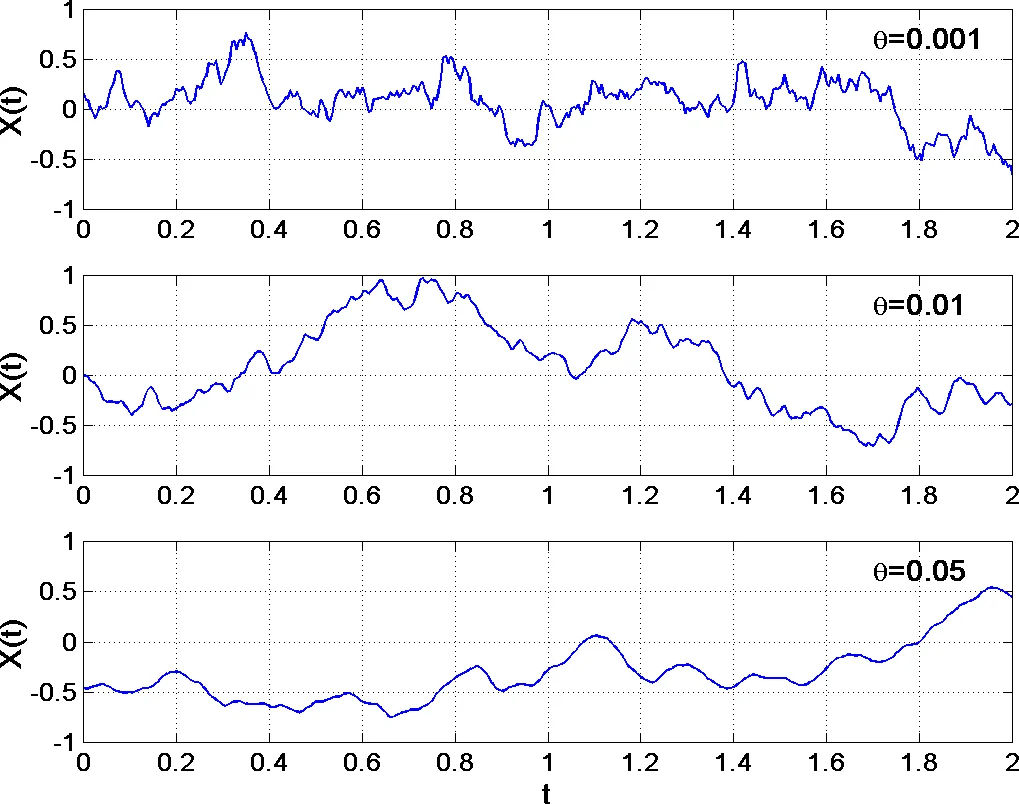
A scalar Langevin-type process $X(t)$ that is driven by Ornstein-Uhlenbeck noise $\eta(t)$ is non-Markovian. However, the joint dynamics of $X$ and $\eta$ is described by a Markov process in two dimensions. But even though there exists a variety of techniques for the analysis of Markov processes, it is still a challenge to estimate the process parameters solely based on a given time series of $X$. Such a partially observed 2D-process could, e.g., be analyzed in a Bayesian framework using Markov chain Monte Carlo methods. Alternatively, an embedding strategy can be applied, where first the joint dynamic of $X$ and its temporal derivative $\dot X$ is analyzed. Subsequently the results can be used to determine the process parameters of $X$ and $\eta$. In this paper, we propose a more direct approach that is purely based on the moments of the increments of $X$, which can be estimated for different time-increments $\tau$ from a given time series. From a stochastic Taylor-expansion of $X$, analytic expressions for these moments can be derived, which can be used to estimate the process parameters by a regression strategy.
💡 Research Summary
The paper addresses the problem of estimating the parameters of a scalar stochastic process X(t) that is driven by exponentially correlated Ornstein‑Uhlenbeck (OU) noise η(t). While the joint dynamics of (X, η) form a two‑dimensional Markov process, in most practical situations only the one‑dimensional time series of X is observable, leading to a partially observed diffusion problem. Existing approaches include Bayesian Markov‑chain Monte Carlo (MCMC) techniques, which are computationally intensive, and embedding strategies that first estimate the velocity ˙X(t) by numerical differentiation, which can introduce spurious correlations.
The authors propose a direct method that relies solely on the conditional moments of the increments ΔX(τ)=X(t+τ)−X(t). The core of the approach is a stochastic Taylor expansion of X(t) in terms of multiple integrals Jα(τ) and coefficient functions cα(x) that depend only on the drift f(x) and diffusion g(x) and their derivatives evaluated at the conditioning point x. The multi‑index α∈{0,1}ⁿ indicates whether a factor in the integrand is a deterministic time integral (αi=0) or an integral with respect to the OU noise (αi=1). This expansion yields an exact representation
X(t+τ)=x+∑αcα(x)Jα(τ),
where the Jα are stochastic functionals of η(t). By expressing η(t) as a sum of its initial value η(0) and a convolution of white noise ξ(t), the authors compute the conditional expectations φα(τ,x)=⟨Jα|X(t)=x⟩ in closed form. Because η is Gaussian, only even‑order correlations survive, and the resulting φα can be written as linear combinations of a finite set of basis functions ri(τ,θ) that depend on the lag τ and the OU correlation time θ.
The conditional first and second moments of the increments are then expressed as
M¹(τ,x)=∑iλi(x,θ) ri(τ,θ), M²(τ,x)=∑i,jλi(x,θ)λj(x,θ)
Comments & Academic Discussion
Loading comments...
Leave a Comment