Sending Information Through Status Updates
We consider an energy harvesting transmitter sending status updates regarding a physical phenomenon it observes to a receiver. Different from the existing literature, we consider a scenario where the status updates carry information about an independ…
Authors: Abdulrahman Baknina, Omur Ozel, Jing Yang
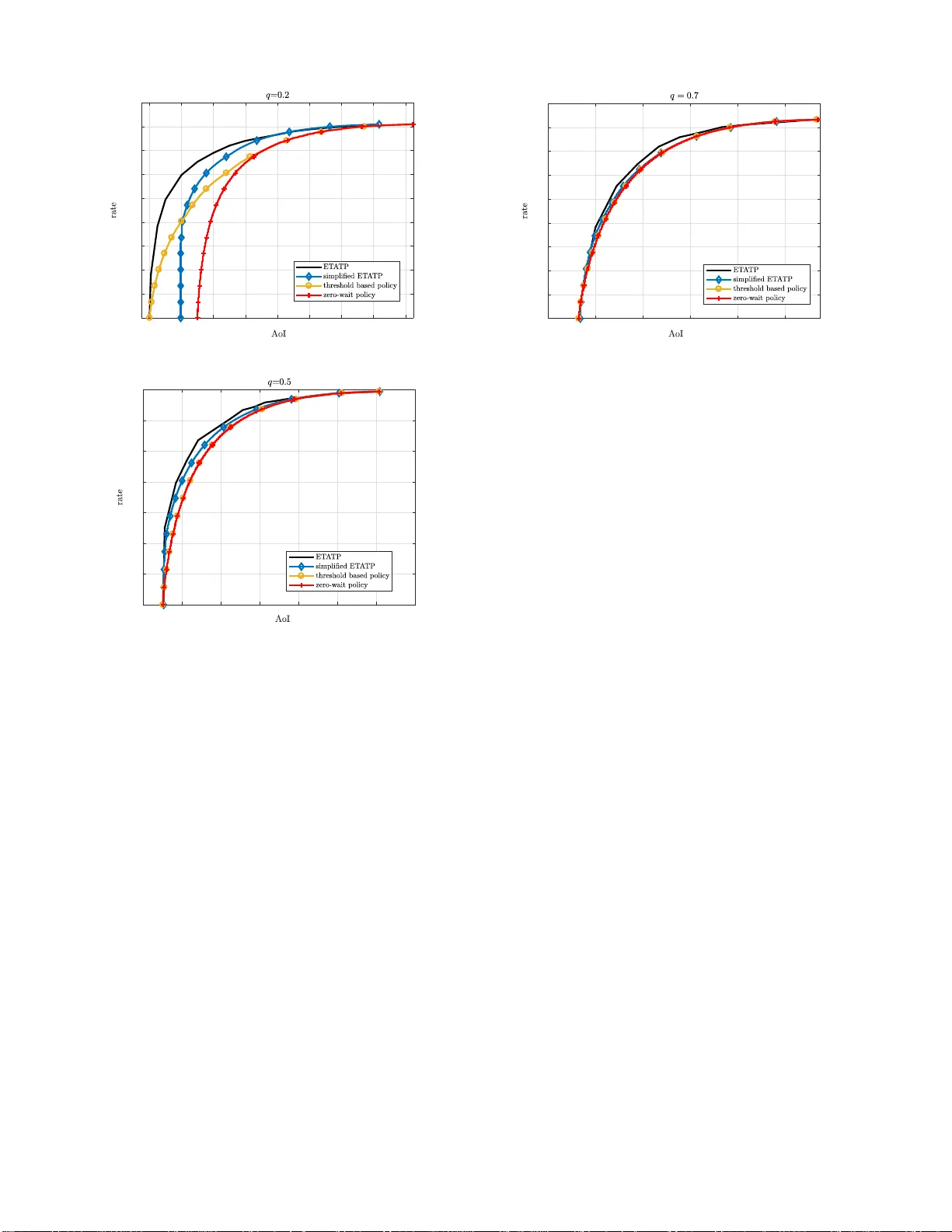
Sending Information Through Status Updates Abdulrahman Baknina 1 , Omur Ozel 2 , Jing Y ang 3 , Sennur Ulukus 1 , and A ylin Y ener 3 1 Departmen t of Electrical and Computer Engineer in g, University of Maryla n d, College Park, MD 20 742 2 Departmen t of Electrical a n d Com puter En gineering , Carnegie Mellon University , Pittsburgh, P A 15 213 3 Departmen t of Electrical Engin eering, The Pennsylvania State University , University Park, P A 16 802 Abstract — W e consider an energy harv esting transmitter send - ing status updates regarding a physical phenomenon it observ es to a receiv er . Different from th e existing literature, we consid er a scenario where the status u pdates carry information about an independ ent message. The transmitter encodes this message into the ti mings of th e status u pdates. The receiv er needs to extract this encoded informa tion, as well as upd ate the st atus of the observ ed phenomenon. The timings of the status updates, theref ore, d etermine both the age of information (AoI) and th e message rate (rate). W e study th e tradeoff between t he achiev able message rate and th e achievable av erage AoI. W e propose several achiev able schemes and compare their rate-AoI perfor mances. I . I N T R O D U C T I O N W e consider an energy harvesting transmitter sending status updates to a rec e iver via status update p a c kets. Each status update packet requires a unit of energy; an d the transmitter harvests energy stochastically o ver time, one unit at a time, at random times. 1 In o rder to minimize the age of information (AoI), the transmitter needs t o send frequen t and r egular (over time) status updates, howe ver , the freque ncy and regularity of the up dates are constrain ed by the stochastic en ergy arriv al process, which is known only causally at the transmitter . In th is paper, dif ferent fr om the existing literature, we consider the scenar io whe re the tim ings of the status updates also carry an in depend e nt message; see Fig. 1. In order to obtain a tractable formulation , we consider an abstraction where the physical channe l is no iseless and the transmitter has a battery of u nit size. Intuitively , as will be clarified shortly , there is a trade o ff between the AoI a nd the rate of th e message. Our goal in this paper is to characteriz e this tradeoff. For this scenario , under cau sal (i.e., on lin e) knowledge of energy arriv als, [1] has determin e d that, in ord er to minimize the long-term a verage AoI, the transmitter needs to apply a thr eshold based policy: There exists a fixed and deterministic threshold τ 0 such that if an energy arrives soon e r tha n τ 0 seconds since the last u pdate, the tr a nsmitter waits until τ 0 and sends the upd ate packet; on the other hand, if it has been more than τ 0 seconds since the last upd ate, the tran sm itter sends an update packet rig ht away wh e n an energy arrives . On the other hand, again for this scenar io , [2] h a s co nsidered the in formatio n -theoretic capacity of this energy harvesting channel. The m ain inf ormation- theoretic challenge arises du e to having a state-depen dent chan nel (where the state is the This wor k was supported by NSF Grants CCF 14-22111 /14-22347, CNS 15-26608/1 5-26165. 1 Energy require ments and ener gy harvests are normal ized. E i B = 1 Tx measuremen ts Rx message ( M ) Fig. 1. An energ y harve sting transmitte r with a finite-sized battery , that s ends status updates and i ndepende nt informatio n to a recei v er . energy a vailability), time-co rrelation introdu ced in the state due to the existence of a battery at the tran smitter whe re energy can be saved and used la te r, and the una vailability of the state informa tio n at the recei ver . Reference [2] con verts the problem from regular chan nel u ses to a timing channel and o btains t he capacity in te r ms of some auxiliar y rand o m variables using a bits throug h queues approa c h as in [ 3]. Sending info r mation necessarily req uires the transmitter to send out a p acket after a rando m amount of time following an energy arri val in [2 ], whereas minimizing AoI requires the transmitter to apply a deterministic thre shold based policy in [1]. Note that in [1], the transmitter send s a packet either at a deterministic time τ 0 after an energy a r riv al, or r ight at th e time of an energy arr i val, thus, it canno t send a ny rate with the packet timings even thoug h it min imizes the Ao I. Th is is the main sour ce of the tension b etween AoI min imization an d informa tio n ra te m a x imization; and is the subject of this paper . In this pape r , we first pr esent a g e neral tr adeoff region be- tween the achievable AoI and the achiev able info rmation r ate. W e then co nsider th e class o f re n ew al po licies in which the system action d epends on ly on the most recen t transmission . W ithin this class of policies, we first pr opose p olicies that determine the n ext tra n smission instan t as a func tion o f the time difference between the most rece nt energy arri val and the most recent status update. W e then consid e r simpler policies which we call sepa rable policies. T h ese policies separate the update decision and info rmation tra n smission in an additive manner: When an en ergy arri ves, the transmitter decides when to up date, neglecting the info rmation transmission; o nce th e transmitter decides to send an up date, it then encodes th e message on top of that up date timin g. For all the po licie s, we deriv e the average achiev able AoI and the achievable rate. W e then com pare the tradeo ff regions of these policies. W e observe nu m erically that the first class of p olicies achiev e better tr a deoff r egions. W e also o bserve that as th e value o f the t ∆( t ) Z 1 ( τ 1 ) Z 2 ( τ 2 ) Z 3 ( τ 3 ) Z 4 ( τ 4 ) V 1 V 2 V 3 V 4 Q 2 Q 3 Q 4 Q 1 T 1 T 2 T 3 T 4 Fig. 2. An example ev olution of instantaneou s AoI. av erage e n ergy arrival increases, policies per form similarly . Related W ork: Minimizing th e AoI has been studied in many different settings, including settings with no energy constraints [4]–[1 3] an d settings with en ergy con straints in offline an d online en ergy har vesting mo d els [1] , [14]– [17]. Energy har- vesting co mmunication systems ha ve b een exten sively studied in schedulin g-theore tic and inf ormation- theoretic settings, for example, offline schedulin g in single- u ser and multi-user set- tings have been conside r ed in [1 8]–[26 ], o nline scheduling has been con sidered in [20], [27 ] –[32], and inf ormation- theoretic limits h av e b een c o nsidered in [2 ], [3 3]–[3 6]. I I . S Y S T E M M O D E L W e consider a noiseless b inary energy ha r vesting channe l where the transmitter s ends status upd ates and an independ ent message simultaneou sly as in Fig. 1. The transmitter has a unit size ba tter y , i.e., B = 1 . Energy arri vals are known causally at the transmitter and are distributed according to an i.i.d. Bernoulli distribution with p arameter q , i.e., P [ E i = 1] = 1 − P [ E i = 0] = q . Hence, the inter-arriv al times between the energy arrivals, denoted as τ i ∈ { 1 , 2 , · · · } , are geometric with parameter q . Each transmission costs unit energy ; thu s, when the transmitter sen d s an update, its ba ttery is depleted. The timings of the transmitted updates d e termine the av erage Ao I and the m essage rate. The instantaneou s AoI is giv en by ∆( t ) = t − u ( t ) (1) where u ( t ) is the time stamp of the latest received status update packet and t is the cu rrent time. An example e volution of the AoI is shown in Fig. 2. The average long-term AoI is ∆ = lim sup n →∞ E " P n j =1 Q j P n j =1 T j # (2) = lim sup n →∞ E " P n j =1 T 2 j 2 P n j =1 T j # (3) where T i is th e du ration betwee n two up dates, Q j = T 2 j / 2 is the total acc umulated age betwee n two upda te s rep r esented by the ar ea (see Fig. 2), an d the expectation is over the en ergy arriv als a nd p o ssible random ness in the transmission de c isions. energy arriv al info. symbol τ 1 V 1 τ 2 V 2 T 1 T 2 Fig. 3. Sending information through a ti ming c hannel. Then, th e minimum AoI is g i ven b y ∆ ∗ = inf π ∈ Π ∆ = inf π ∈ Π lim sup n →∞ E " P n j =1 T 2 j 2 P n j =1 T j # (4) where Π is the set of all feasible policies. Since the transm itter is equippe d with a unit-sized battery and due to energy causal- ity [1 8], we have T i ≥ τ i . Note that due to the mem o ryless proper ty of the geo metric distribution, we assume witho u t loss of gener ality , that τ i is the time from the instant of the previous update an d no t the tim e from the instant of th e p revious en ergy arriv al. T o send inform ation throug h the timing s of the status up- dates, we consider the model studied in [2, Section V .A]. Th us, here, we assume the knowledge of the energy arriv al instants causally at the tr a nsmitter an d the receiver . Th e inform ation in the time du ration T i is carried by the ra ndom variable V i ∈ { 0 , 1 , · · · } wh ere we have here T i = τ i + V i , see Fig. 3. The achiev able rate of this timin g chann el is [2], R = lim inf n sup p ( V n | τ n ) I ( T n ; V n | τ n ) P n i =1 E [ V i ] + E [ τ i ] (5) = lim inf n sup p ( V n | τ n ) H ( V n | τ n ) P n i =1 E [ V i ] + E [ τ i ] (6) where the seco nd equality f o llows since H ( V n | τ n , T n ) = 0 . W e denote the AoI-rate trade o ff re gion by the tuple ( AoI ( r ) , r ) , where r is the achievable rate and Ao I ( r ) is the minimum achiev able AoI given that a message r ate of at least r is ach iev able, AoI ( r ) = inf M lim sup n →∞ E " P n j =1 T 2 j 2 P n j =1 T j # (7) where M is defined as M = ( { T i } ∞ i =1 T i ≥ τ i , lim inf n sup p ( V n | τ n ) H ( V n | τ n ) P n i =1 E [ V i ] + E [ τ i ] ≥ r ) (8) where V n denotes ( V 1 , · · · , V n ) and similarly fo r τ n . An alternate characteriz a tion fo r the trad e o ff r egion can also be done u sing the tuple ( α, R ( α )) whe r e the achievable Ao I is equal to α and R ( α ) is the m aximum a chiev able informatio n rate g i ven that the Ao I is no mo re tha n α . I I I . A C H I E V A B L E T R A D E O FF R E G I O N S In this section, we consider several achie vable schemes. All considered achievable schemes belon g to the class of ren ew al policies. A r enew al policy is a po licy in wh ich the action T i at time i is a function of only th e curr ent energy arriv al instant τ i . The long-ter m a verage AoI under renewal policies is, ∆ = lim sup n →∞ E " P n j =1 T 2 j 2 P n j =1 T j # = E [ T 2 i ] 2 E [ T i ] (9) which r esults from rene wal reward theo ry [37 , Theorem 3.6 . 1]. Since we use renewal policies and τ i is i.i.d., hereafter, we d rop the subscript i in the rand om variables. Then, the maximum achiev able info rmation rate in (6) redu ces to, R = max p ( v | τ ) H ( V | τ ) E [ V ] + E [ τ ] (10) and the Ao I in (9) reduces to ∆ = E [ T 2 ] 2 E [ T ] = E [( V + τ ) 2 ] 2 E [ V + τ ] (11) Next, we present our achiev able schemes. I n the first scheme, info rmation transmission is adap te d to the timing of energy arriv als: If it takes a l ong time for energy to a r riv e, the transmitter ten ds to transmit less information and if energy ar - riv es ea r ly , the transmitter ten ds to transmit more information. This scheme fully adapts to the timings of the en ergy arrivals , but this comes a t th e cost of high computation al com plexity . W e the n relax th e adaptation in to just two regions, di vided by a thresho ld c : If en e rgy arrives in less tha n c slots, we transmit the informatio n using a geometric distrib ution with parame ter p b , and if energy arr i ves in more than c slots, we transmit the in formation using another geom etric rand o m variable with parameter p a . Th e cho ice of a g e o metric ran dom variable for V here and hereafter is motiv ated by the fact that it maximizes the inf ormation rate when the energy ar riv al timings are k nown at the receiver; see [ 2 , Section V .A]. In the pre viou s schemes, the instantan eous information rate depend s on th e timings of e nergy arrivals. W e next relax this assumption and assume that the instantan eous information r ate is fixed an d indep endent of timin g s of energy arriv als. W e call such policies separable po licie s. In these p olicies, the transmitter ha s two separ ate decision block s: T h e first block is f or the status update which takes the decision depend in g on the timing of the energy arriv al, and the secon d block is for encodin g the desired message on to p of the tim ings of these updates. This is similar in spirit to super-position coding. In the first separable policy , the up d ate dec ision is a thr e shold based f unction inspired by [1 ]: if the energy ar riv es before a threshold τ 0 , the u pdate b lock decides to update at τ 0 and if the energy arrives after τ 0 , the update b lock de c id es to update immed iately . Th e inform ation block does not g enerate the u pdate immediately , but adds a geometric ran dom variable to carry th e informa tio n in the timin g on top of th e tim ing decided by the update block. In the second separable policy , which we call zer o-wait p olicy , the update b lock decides to update in th e ch a nnel use immed ia tely after an e n ergy ar riv al. A. Energy T iming Ad aptive T r ansmission P olicy ( E T A TP) In th is policy , the info r mation which is carr ied in V is a (rando m) f unction of the energy ar riv al realization τ . This is the most g eneral case under r enew al policies. The op timal tradeoff can be obtained by solving the following prob lem min p ( v | τ ) E [( V + τ ) 2 ] 2 E [ V + τ ] s.t. H ( V | τ ) E [ V ] + E [ τ ] ≥ r (12) The maximum p ossible value for r is equal to r ∗ = max p ( v | τ ) H ( V | τ ) E [ V ]+ E [ τ ] . The solution of this pro blem c a n be f ound by con sidering the following alternative problem which gives the same tradeoff region max p ( v | τ ) ,m H ( V | τ ) m s.t. E [( V + τ ) 2 ] ≤ 2 α E [ V + τ ] E [ V + τ ] = m (13) For a fixed m , p roblem (13) is con cav e in p ( v | τ ) and can be solved efficiently . Then, to obtain th e entire tradeoff region, we sweep over all possible values of th e parameter α (which are all possible values o f the AoI) . The solution for (13) is found numerically by optimizing over all possible conditional pmfs p ( v | τ ) fo r each v alue of m . Then, we use line search to search f or th e optimal m . All this, has to b e r epeated fo r all possible v alues of the AoI α . Finding the o p timal solution fo r (13) h as a h igh comp lexity , hence, we prop ose the following policy which r educes this com plexity significantly , and at the same time a dapts to the tim in g of the energy arr i vals to the extent possible within this set of policies. B. Simplifi e d ET A TP In this policy , we sim p lify the fo rm of the depen dence of the transmission on the timings of en e rgy arriv als significantly . The transmitter waits un til an energy arrives, if the energy takes mo re than c slo ts since th e last update, we tran smit the informa tio n using a geometric r andom v ariable with p r obabil- ity of success p b , oth erwise the transmitter tran smits the in- formation using a geometric random v ariable with probability of success p a , i.e., the transmitter chooses p ( v | τ ) as follows p ( v | τ ) = ( p b (1 − p b ) v − 1 , τ < c p a (1 − p a ) v − 1 , τ ≥ c , v = 1 , 2 , · · · (14) In th is case, p a , p b and c ar e the variables over which th e optimization is perfor med. Th e a verage achieved info rmation rate as a f unction o f p a , p b and c can be obtain ed as, R = H 2 ( p b ) p b (1 − (1 − q ) c ) + H 2 ( p a ) p a (1 − q ) c E [ τ ] + E [ V ] (15) where E [ V ] is eq u al to E [ V ] = (1 − p b ) p b (1 − (1 − q ) c ) + (1 − p a ) p a (1 − q ) c (16) Now , we ca n calcu late the average AoI with this po licy as, ∆ = E [( τ + V ) 2 ] 2 E [ τ + V ] = 2 − q q 2 + E [ V 2 ] + 2 E [ τ V ] 2 E [ τ ] + 2 E [ V ] (17) where we have E [ V 2 ] as E [ V 2 ] = 2 + p 2 b − 3 p b p 2 b (1 − (1 − q ) c ) + 2 + p 2 a − 3 p a p 2 a (1 − q ) c (18) and E [ τ V ] as E [ τ V ] = (1 − p b ) p b 1 q (1 − (1 − q ) c +1 ) − ( c + 1 )(1 − q ) c + (1 − p a ) p a (1 − q ) c +1 q + c (1 − q ) c − 1 (19) This schemes is simpler than the gen eral class of ET A TP; still, we need to search fo r the op tim al p a , p b and c . W e reduce this complexity furth er in the n ext p olicy . C. Threshold Based T ransmission P olicy W e now present th e first separable po licy . In this policy , we assume that T = Z ( τ ) + V , wher e the information is still car - ried only in V ; see Fig. 2. Z ( τ ) is the duration the transmitter decides to wait in order to minimize the AoI, wh ile V is the duration the transm itter dec id es to wait to add inform ation in the timing of the update. Z ( τ ) and V are indepen dent which implies tha t H ( V | Z ( τ )) = H ( V | τ ) = H ( V ) . T he duratio n Z ( τ ) is determined according to a thre shold policy as follows, Z ( τ ) = τ U ( τ − τ 0 ) + τ 0 U ( τ 0 − τ − 1) (20) The op timal value of τ 0 is yet to be determine d and is an optimization variable. The optimal value of τ 0 is to b e calculated and, thu s, known both at the tr a n smitter and the receiver; hence, this threshold p o licy is a deterministic policy . This ensur e s that we still have H ( V n | τ n , T n ) = 0 , wh ich is consistent with (6) . W e th e n choose V to be a g eometric random variable with param eter p . The tr a d eoff region can then be wr itten as, min T ( τ ) ,p E [( Z ( τ ) + V ) 2 ] 2 E [ Z ( τ ) + V ] s.t. Z ( τ ) ≥ τ r ≤ H 2 ( p ) /p (1 − p ) /p + E [ Z ( τ )] (21) where r is a fixed po siti ve num ber . The feasible v alues of r are in [0 , r ∗ ] where r ∗ is equal to r ∗ = ma x p ∈ [0 , 1] H 2 ( p ) /p (1 − p ) /p + E [ τ ] . This follows because the smallest value that Z ( τ ) can take is equal to τ . Th e optimization pr oblem in th is case beco mes a function of only τ 0 and p . W e now n eed to calculate E [ Z ( τ )] an d E [ Z 2 ( τ )] . W e calculate E [ Z ( τ )] as fo llows, E [ Z ( τ )] = (1 − q ) τ 0 + (1 − q ) τ 0 +1 q + τ 0 (22) and we calculate E [ Z 2 ( τ )] as follows, E [ Z 2 ( τ )] = 2 − 3 q q 2 (1 − q ) τ 0 + 2 ( τ 0 + 1)(1 − q ) τ 0 + 2 ( τ 0 + 1 ) (1 − q ) τ 0 +1 q + τ 2 0 (23) Finally , we no te that in this case E [ V 2 ] is equal to, E [ V 2 ] = 2 + p 2 − 3 p p 2 (24) Substituting these q uantities in the above optim ization pro blem and solving f or p and τ 0 jointly gives the solution . D. Zer o-W ait T r ansmission P olicy This po licy is similar to the thr eshold based policy , with one difference: The up date blo ck does not wait after an en ergy arrives, instead , it decides to update righ t away , i.e., Z ( τ ) = τ . Hence, the tr adeoff region can be o btained by solv ing, min p E [( τ + V ) 2 ] 2 E [ τ + V ] s.t. r ≤ H 2 ( p ) /p (1 − p ) /p + E [ τ ] (25) W e can then calculate E [( τ + V ) 2 ] = E [ τ 2 + V 2 + 2 V τ ] , where V and τ are ind ependen t a s the message is indep endent of the en ergy arr i vals. Sin ce τ is g eometric E [ τ 2 ] = 2 − q q 2 . Th is optimization p r oblem is a fu n ction of only a single variable p . This p r oblem is solved by line search over p ∈ [0 , 1] . I V . N U M E R I C A L R E S U LT S Here, w e com pare the tradeoff r egions resulting fr om the propo sed schemes. W e plo t these regions in Figs. 4- 6 for different v alues of av erage energy arr ivals, na m ely , q = 0 . 2 , q = 0 . 5 and q = 0 . 7 . For low values of q , as for q = 0 . 2 in Fig. 4, there is a significant ga p between the p erforma n ce of ET A TP and the simplified schemes. For this value o f q , in most o f th e region, simplified ET A TP perfo rms better t han the threshold and zero -wait po licies. As the value of q in c reases as shown in Fig. 5 and Fig . 6, the gap betwee n the per forman c e of the different policies d ecreases significantly . In Fig . 5, th e threshold and zero -wait policies overlap. In Fig. 6, simplified ET A TP , thresh old and zero -wait policies overlap. In all cases, zero-wait policy per f orms the worst. This is consistent with early results e.g . , [4] , early results in the con text of energy harvesting e.g ., [14], [1 5], a n d r e cent results [ 1], [ 16], [17] , where updatin g as soon as one can is no t optim um. R E F E R E N C E S [1] X. Wu, J. Y ang, and J. W u. Opti mal status update for age of information minimizat ion with an energy harvest ing source. IE EE T ra ns. on Green Communicat ions and Networkin g , 2017. T o appear . Also av ail able online at arXi v:1706.05773. [2] K. Tutunc uoglu, O. Ozel, A . Y ener , and S. Ulukus. The bin ary e nergy harve sting channel wi th a unit-sized battery . IEE E Tr ans. Info. Theory , 63(7):4240 – 4256, April 201 7. [3] V . Ananthara m and S. V erdu. Bits through que ues. IEEE T ran s. Info. Theory , 42(1):4–18, January 1 996. [4] S. Kaul , R. Y ates, and M. Grute ser . Real-time status: How often should one update? In IEEE INFOCOM , March 2012. 4.2 4.4 4.6 4.8 5 5.2 5.4 5.6 5.8 0 0.05 0.1 0.15 0.2 0.25 0.3 0.35 0.4 0.45 Fig. 4. The rate-AoI t radeof f re gion for q = 0 . 2 . 1.4 1.6 1.8 2 2.2 2.4 2.6 2.8 0 0.1 0.2 0.3 0.4 0.5 0.6 0.7 Fig. 5. The rate-AoI t radeof f re gion for q = 0 . 5 . [5] S. Kaul, R. Y ates, and M. Gruteser . Status updates through queues. In CISS , March 2012. [6] R. Y ates and S. Kaul. Real-time status upda ting: Multipl e sources. In IEEE ISIT , July 2012. [7] C. Kam, S. Kompel la, and A. Ephremides. Age of information under random updates. In IEEE ISIT , July 2013. [8] M. Cost a, M. Codreanu, and A. Ephre mides. Age of information wit h pack et mana gement. In IEEE ISIT , June 2014. [9] Y . Sun, E . Uysal-Bi yikoglu , R. Y ates, C. E . Koksal, and N. B. Shroff. Update or wait : How to keep your data fresh. In IEEE INFOCOM , April 2016. [10] A. Kosta , N. Pappas, A. Ephremides, and V . Angel akis. Age and value of information: Non-linear age case. Av ailable at arXiv:1701.06927 , 2017. [11] A. M. Bede wy , Y . Sun, and N. B. Shrof f. Age-optimal informatio n updates in multihop networks. A vail able at arXiv:17 01.05711 , 20 17. [12] P . Parag, A. T agha vi, and J. Chamberland. On rea l-time sta tus u pdates ov er symbol erasure channel s. In IEEE WCNC , pages 1–6, March 2017. [13] R. Y ates, E. Najm, E. Solj anin, and J. Zhong. Timely updates o ver an erasure channel. In IEEE ISIT , June 20 17. [14] R. Y ates. L azy is timely: Status updates by an energ y harv esting source. In IEEE ISIT , Ju ne 2015. [15] B. T . Bacin oglu, E. T . Ceran, and E. Uysal-Biyik oglu. Age of informa- tion under energy replenishment constrai nts. In UCSD ITA , February 2015. [16] A. Arafa and S. Ulukus. Age minimiza tion in energ y harvesting communicat ions: Energy-control led de lays. In Asilomar , October 2017. [17] A. Arafa and S. Ulukus. Age- minimal transmission in energy harvesting two-ho p net works. In IEEE Globecom , D ecember 201 7. [18] J. Y ang and S. Ulukus. Optimal pack et scheduling in an energy harve sting communication system. IEEE T rans. Comm. , 60(1): 220–230, January 2012. 0.8 1 1.2 1.4 1.6 1.8 0 0.1 0.2 0.3 0.4 0.5 0.6 0.7 0.8 0.9 Fig. 6. The rate-AoI t radeof f region for q = 0 . 7 . [19] K. T utuncuo glu and A. Y ener . Optimum transmission polici es for batte ry limite d energy harve sting nodes. IEEE T rans. W ir eless Comm. , 11(3):1180 –1189, March 2012. [20] O. Ozel, K. T utuncuogl u, J . Y ang, S. Ulukus, and A. Y ener . Transmission with energy harvest ing nodes in fading wireless channe ls: Optimal polici es. IEE E JSA C , 29(8):1732–174 3, September 2011. [21] C. K. Ho and R. Zhang. Optimal ener gy alloca tion for wireless communicat ions with ener gy harv esting constraints. IEEE T rans. Signal Pr oc. , 60(9):4808–481 8, September 2012. [22] J. Y ang, O. Ozel, and S. Ulukus. Broadc asting with an energy harv esting rechar geable tra nsmitter . IE E E T rans. W irele ss Comm. , 11(2):571–583, February 2012. [23] J. Y ang and S. Ulukus. Optimal packet scheduling in a multiple acc ess channe l with energy harv esting transmitte rs. J ournal of Comm. and Network s , 14(2):14 0–150, Apri l 2 012. [24] Z. W an g, V . Aggarwal, and X. W ang. Iterati v e dynamic water -filling for fadi ng multiple -access channels with energy harvesting. IEEE JSA C , 33(3):382– 395, March 2015. [25] K. Tutu ncuoglu and A. Y ener . Sum-rate optimal power policie s for ener gy harv esting transmit ters in an interference channe l. Journa l of Comm. Networks , 14(2):151–161, Apr il 2012. [26] D. Gunduz and B. De villers. A gener al framew ork for the opti mization of energy harvest ing communicati on systems with battery imperfecti ons. J ournal of C omm. Networks , 1 4(2):130–139, April 2 012. [27] Q. W ang and M. Liu. When simplicity meets optimalit y: E f ficient transmission power control wi th st ochastic e nergy harvesting. In IEEE INFOCOM , April 2013. [28] M. B. Khuzani a nd P . Mitran. On online ene rgy harvesting in multiple access communica tion systems. IE E E T rans. Info. Theory , 60(3):1883– 1898, February 2014. [29] D. S havi v and A. Ozgur . Univ ersally near -optimal onli ne po wer cont rol for energy harvest ing nodes. IEEE JSA C , 34(12):3620–3631, Dece mber 2016. [30] A. Ba knina and S. Ulu kus. Optimal a nd ne ar-opti mal online st rateg ies for energy harvesting broadc ast channels. IEEE JSA C , 34(12):3696– 3708, December 2016. [31] H. A. Inan and A. Ozgur . Online power control for the energy harv esting multiple access channel. In W iOpt , May 2016. [32] A. Baknina and S. Ulukus. Online p olicies for multiple access channel with common energy harvesti ng source. In IEE E ISIT , July 2016. [33] O. Ozel and S. Ulukus. Achi ev ing A WG N capacity under stoc hastic en- ergy harv esting. IE EE T rans. Info. Th eory , 58(10):6471– 6483, Octobe r 2012. [34] W . Mao and B.Hassibi. Capacity analysis of discret e e nergy harv esting channe ls. IEEE T rans. Info. Theory , 63(9):5850–5885, Sept ember 2017. [35] D. Shav iv , P . Nguyen, and A. Ozgur . Capacity of the energy-ha rvesti ng channe l with a finite bat tery . IEEE T rans. Info. Theory , 62(11):6436– 6458, Novembe r 2016. [36] V . Jog and V . Anantharam. A geometric anal ysis of the A WGN channel with a ( σ , ρ ) -po wer co nstraint. IE E E Tr ans Info. Theory , 62(8): 4413– 4438, August 2016. [37] S. M. Ross. Stochasti c Pro cesses , volume 2. John W ile y & Son s Ne w Y ork, 1996.
Original Paper
Loading high-quality paper...
Comments & Academic Discussion
Loading comments...
Leave a Comment